Waltey
Kamar az Zaman in draguljarjeva žena
Tisoč in ena noč · arabska pripovedna tradicijaO besedilu
Kamar az Zaman in draguljarjeva žena
- Vir
- Tisoč in ena noč
- Avtor
- arabska pripovedna tradicija
- Jezik branja
- English
- Jezik izvirnika
- Arabic
- Čas branja
- 103 min branja
- Obseg
- 83 strani
- Naslov izvirnika
- حكاية قمر الزمان وزوجة الجوهري - الليالي ٩٦٣ إلى ٩٧٨
O izvirniku
Tisoč in ena noč
Zgodbe v zgodbah, polne trgovcev, dvorov, preoblek in nočnih zapletov. Bralni jezik je English, izvirnik pa prihaja iz vira Tisoč in ena noč v jeziku Arabic.
Besedilo
Kamar az Zaman in draguljarjeva žena
It is also related, O fortunate King, that in olden times there lived a merchant named Abd al-Rahman, whom God had blessed with a daughter and a son. He named the girl Kawkab al-Sabah, Morning Star, for her surpassing beauty, and the boy Qamar al-Zaman, Moon of the Age, for his exceeding loveliness. When he saw the beauty, grace, radiance, and perfect proportions God had bestowed on them, he feared for them from watching eyes, envious tongues, the plots of schemers, and the wiles of the wicked. So he secluded them from the world in a palace for fourteen years, during which no one saw them except their parents and a slave girl who attended to their needs. Their father could recite the Quran as God revealed it, and their mother could recite it too; so the mother taught her daughter and the father his son, until both had learned the Quran by heart. They also learned penmanship, arithmetic, the arts, and polite accomplishments from their parents, and had no need of a teacher. When the boy reached manhood, the merchant’s wife said to him, “How long will you keep your son Qamar al-Zaman hidden from people’s eyes? Is he a girl or a boy?” “A boy,” he replied. “Then since he is a boy,” she said, “why do you not take him to the market with you and let him sit in the shop, so that he may come to know people and they may know him, and it may become common knowledge that he is your son? You can teach him buying and selling. Something may happen to you, and if people already know him as your son, he will be able to claim what you leave behind. But if you die with matters as they stand, and he tells people, ‘I am the son of the merchant Abd al-Rahman,’ they will not believe him. They will say, ‘We have never seen you, nor do we know that he had a son.’ The authorities will seize your property, and your son will be left with nothing. As for the girl, I wish to make her known to people, so that perhaps a suitable man may ask for her hand, and we may marry her to him and rejoice in her.” He answered, “It is because I fear for them from people’s eyes.” And dawn overtook Shahrazad, and she fell silent, leaving her tale untold.
When it was the nine hundred and sixty-fourth night
She said: It has reached me, O fortunate King, that when the merchant’s wife spoke these words to him, he answered, “It is because I fear for them from people’s eyes, for I love them, and lovers are fiercely jealous. Well did the poet say:
I am jealous over you of my own gaze, of myself, of you, of your place and of time. Were I to keep you forever within my eyes, I should never weary of your nearness. And were you to grant me union every day until the Day of Resurrection, it would not suffice me.” His wife said to him, “Put your trust in God. No harm comes to one whom God protects. Take him with you to the shop today.” Then she dressed him in a suit of the finest clothes, and he became a temptation to all who looked upon him and a torment to lovers’ hearts. His father took him to the market, where everyone who saw him was captivated, and came forward to kiss his hand and greet him. His father began cursing the people who followed them to gaze at him. Some said, “The sun has risen in such-and-such a place and is shining in the market!” Others said, “The full moon has risen over there!” Others said, “The crescent of the feast has appeared to God’s servants!” They spoke admiringly of the boy and called down blessings on him. His father was mortified by their words, yet could not stop anyone from speaking, and began cursing the boy’s mother and calling down calamity on her, for she had been the cause of his coming out. Turning, he saw crowds pressing around them, before and behind. He walked on until he reached his shop, which he opened, and sat down with his son seated before him. When he looked at the people, he found that they had blocked the road. Every passerby, coming or going, stopped before the shop to gaze at that beautiful face and could not bring himself to leave it. Men and women alike gathered around him, quoting the poet’s words:
You created beauty as a temptation for us, then said, “My servants, fear Me.” Yet You are beautiful and love beauty: how, then, can Your servants help but love? When the merchant Abd al-Rahman saw the people crowding about him, men and women standing in rows before his shop and staring at his son, he was utterly abashed and bewildered, not knowing what to do. Suddenly a wandering dervish, dressed in the garb of God’s righteous servants, approached him from the end of the market. He came up to the boy and began reciting poetry and shedding copious tears. Seeing Qamar al-Zaman seated there like a slender bough of the ben tree growing from a mound of saffron, he let his tears flow and recited these two verses:
I saw a branch upon a dune, bright as the full moon in its radiance. “What is your name?” I asked. “Lulu,” he replied. “Mine, mine!” I said. “No, no!” said he. Then the dervish began to walk slowly, stroking his white beard with his right hand, and the crowd parted before his imposing presence. When he looked at the boy, both his mind and his sight were dazzled. To him the poet’s words applied:
While that fair one sat in his place, the crescent of the Feast of Breaking the Fast shone from his face. Then an elder of dignity appeared, walking slowly and deliberately. He had tried the days and nights, and plunged into the forbidden and the lawful; had been enamored of women and men, and grown as slender as a toothpick. In this art he was a foreign master, beside whom an old hand seemed a child; in loving women he was an Udhri lover, yet in both pursuits skilled and wayward. He adored fair women and loved all beauty, lamented deserted dwellings and wept over abandoned camps. So great was his yearning that you would have thought him a branch swaying with the east wind, now here, now there. He was versed in the arts of passion, alert and discerning in its affairs; he had traversed its easy ways and hard, and embraced both the gazelle and the tender youth. Then he approached the boy and gave him a sprig of basil. His father put his hand into his pocket, brought out a few dirhams, and said, “Take your portion, dervish, and go your way.” The dervish took the money and sat down on the shop’s raised platform, facing the boy. He gazed at him and wept, heaving sigh after sigh, his tears flowing like gushing springs. People began watching him and finding fault with him. Some said, “All dervishes are debauchees.” Others said, “The dervish’s heart is burning with love for the boy.” When the father saw this, he rose and said, “Get up, my son. Let us close the shop and go home. There will be no more buying or selling for us today. May God Most High repay your mother for what she has done to us, for she is the cause of all this!” Then he said, “Get up, dervish, so that I can close the shop.” The dervish rose, the merchant closed his shop, and he took his son and went away. The dervish and the crowd followed them until they reached their house. The boy went inside, and the merchant turned to the dervish and asked, “What do you want, dervish? And why do I see you weeping?” He replied, “My lord, I wish to be your guest tonight, and the guest is God Most High’s guest.” “Welcome to God’s guest,” said the merchant. “Come in, dervish.” And dawn overtook Shahrazad, and she fell silent, leaving her tale untold.
When it was the nine hundred and sixty-fifth night
She said: It has reached me, O fortunate King, that when the dervish said to the merchant, Qamar al-Zaman’s father, “I am God’s guest,” the merchant answered, “Welcome to God’s guest. Come in, dervish.” But he said to himself, “If this dervish is in love with the boy and asks him to commit an indecency, I shall certainly kill him tonight and hide his grave. If he harbors no evil, then a guest shall eat his allotted portion.” He brought the dervish and Qamar al-Zaman into a hall, and said privately to his son, “Sit beside the dervish, my son, and tease him and play with him after I have left you. If he asks anything wicked of you, I shall be watching from the window overlooking the hall, and I will come down and kill him.” When the boy was alone with the dervish in that hall, he sat beside him. The dervish kept looking at him, sighing and weeping; whenever the boy spoke, he answered gently, trembling, turning toward him, sighing and shedding tears. At last supper was brought, and he ate with his eyes fixed on the boy, never ceasing to weep. When a quarter of the night had passed, conversation was over, and bedtime had come, the boy’s father said, “My son, attend carefully to your uncle the dervish, and do not disobey him.” As he was about to leave, the dervish said, “My lord, take your son with you, or sleep here with us.” “No,” he replied, “my son shall sleep here beside you. Perhaps you may wish for something, and he will see to your needs and attend you.” Then he went out, leaving them together, and sat in another hall with a window overlooking the one they were in.
Such was the merchant’s case. As for the boy, he went up to the dervish and began teasing him and offering himself to him. The dervish grew angry and said, “What is this talk, my son? I seek refuge in God from Satan the accursed! O God, this is an abomination that displeases You. Keep away from me, my son!” He rose from his place and sat at a distance from the boy, but the boy followed him, threw himself upon him, and said, “Why, dervish, do you deny yourself the pleasure of union with me, when my heart loves you?” The dervish’s anger increased. “If you do not leave me alone,” he said, “I shall call your father and tell him what you are doing!” “My father knows that this is my nature,” the boy answered, “and cannot prevent me. So grant me my heart’s desire. Why do you refuse me? Do I not please you?” The dervish replied, “By God, my son, I would not do it even if I were cut to pieces with sharp swords.” And he recited the poet’s words:
My heart loves the fair, both male and female, and I am no laggard in admiring them. I gaze upon them morning and evening, yet I am neither sodomite nor adulterer. Then he wept and said, “Get up and open the door for me, so that I may go my way. I will no longer sleep in this place.” He rose to his feet, but the boy clung to him, saying, “Look at the radiance of my face, the redness of my cheeks, the suppleness of my limbs, and the softness of my lips.” Then he bared a leg that put wine and wine-server to shame, and gazed at him with a glance that baffled sorcery and charms. He was wondrously beautiful and sweetly coquettish, as one poet said of him:
I have not forgotten him since he rose and deliberately bared his leg, gleaming like a pearl. Do not wonder that my Day of Judgment should arise: for Judgment Day is the day the shin is bared. Then the youth showed him his breast, saying, “Look at my breasts: they are lovelier than a girl’s, and my saliva is sweeter than sugar candy. Abandon piety and austerity; let us have no more of devotion and worship. Seize the chance of union with me and feast upon my beauty. Fear nothing at all: you are safe from harm. Give up this dullness, for it is a wretched habit.” He went on uncovering his hidden charms and displaying them, seeking with his swaying movements to turn the reins of the dervish’s reason. But the dervish turned his face away and said, “I seek refuge in God! Have some shame, my son. This is forbidden, and I would not do it even in a dream.” The boy pressed him harder, until the dervish broke free, faced the qibla, and began to pray. Seeing him at prayer, the boy left him alone until he had performed two prayer cycles and spoken the final salutation. When he tried to approach him again, the dervish began another prayer and performed two more cycles. He continued in this fashion a third, fourth, and fifth time, until the boy said, “What is all this praying? Do you mean to fly above the clouds? You have wasted our chance, spending the whole night at your devotions.” Then the youth threw himself upon him and began kissing him between the eyes. “My son,” said the dervish, “put Satan to shame and obey the Merciful.” The boy answered, “If you will not do what I want, I shall call my father and tell him that the dervish wants to commit an indecency with me. He will come in and beat you until he breaks your bones beneath your flesh.” All this while, his father watched with his own eyes and listened with his own ears. Now he was certain that the dervish harbored no wickedness, and said to himself, “If this dervish were corrupt, he would never have endured all this trouble.” Still the boy continued to beset him, interrupting him whenever he tried to pray, until the dervish became furious, spoke harshly to him, and struck him. The boy burst into tears, and his father came in, wiped his tears away, and comforted him. Then he said to the dervish, “My brother, since this is how you are, why did you weep and sigh when you saw my son? Was there some reason?” “Yes,” he replied. The merchant said, “When I saw you weeping at the sight of him, I suspected you of evil, and ordered the boy to behave in this manner to test you. I intended, if I saw you ask him for an indecency, to come in and kill you. But when I saw how you behaved, I knew you to be a man of great righteousness. Yet I beg you, by God, to tell me the reason for your tears.” The dervish sighed and said, “My lord, do not reopen wounds that lie quiet.” “You must tell me,” said the merchant. “Know, then,” he replied, “that I am a dervish who wanders through lands and countries, contemplating the signs of the Creator of night and day. It happened that I entered the city of Basra late one Friday morning…” And dawn overtook Shahrazad, and she fell silent, leaving her tale untold.
When it was the nine hundred and sixty-sixth night
She said: It has reached me, O fortunate King, that the dervish said to the merchant, “Know that I am a wandering dervish. It happened that I entered the city of Basra late one Friday morning, and found the shops open and filled with every kind of merchandise, food, and drink, yet deserted: there was not a man, woman, girl, or boy inside them. Nor were there dogs or cats in the streets and markets, nor the faintest sound, nor a single human being. I marveled and said to myself, ‘Where can the people of this city have gone with their cats and dogs? What has God done to them?’ I was hungry, so I took some hot bread from a baker’s oven, entered an oil seller’s shop, soaked the bread in clarified butter and honey, and ate. Then I went into a sherbet seller’s shop and drank as much as I wished. Seeing a coffeehouse open, I entered it and found the pots full of coffee standing over the fire, but no one there. I drank my fill and said, ‘This is extraordinary! It is as though death came upon the people of this city and they all died in this very hour, or else some terror befell them and they fled without being able to close their shops.’ While I was pondering this, I suddenly heard a band striking up. Frightened, I hid for a while and peered through the cracks. I saw slave girls like moons walking through the market two by two, unveiled, with their faces uncovered. There were forty pairs, eighty girls in all. Then I saw a young woman mounted on a horse that could scarcely move its feet for the gold, silver, and jewels weighing upon both horse and rider. The young woman’s face was uncovered. She was adorned with the most splendid ornaments and dressed in the finest clothes. Around her neck was a necklace of jewels, upon her breast were chains of gold, on her wrists bracelets that shone like stars, and on her ankles golden anklets set with precious stones. The slave girls surrounded her, before and behind, to right and left. Ahead of her walked a girl wearing a great sword, its hilt of emerald and its straps of gold studded with jewels. When the young woman reached the place opposite me, she drew rein and said, ‘Girls, I heard something inside this shop. Search it, lest someone be hiding there to watch us with our faces uncovered.’ They searched the shop opposite the coffeehouse where I was hiding, and I remained in terror. Then I saw them come out with a man, and they said to her, ‘Our lady, we found a man here. He is before you now.’ She said to the girl carrying the sword, ‘Strike off his head.’ The girl stepped forward and beheaded him. Then they left him lying on the ground and went on. I was terrified at what I had seen, yet my heart had fallen in love with the young woman. An hour later, the people reappeared, and every shopkeeper went into his shop. People thronged the markets and gathered around the dead man to look at him. I slipped secretly out of my hiding place, and no one noticed me. But love for that young woman had mastered my heart, and I began making discreet inquiries about her, though no one would tell me anything. At last I left Basra with my heart aching for love of her. When I saw your son, I found him more like her than anyone I had ever seen. He reminded me of her, stirred the fire of my passion, and set my heart ablaze. That is why I weep.” Then he wept more bitterly than words can tell, and said, “My lord, I beg you by God to open the door and let me go my way.” The merchant opened the door for him, and he left.
Such was his case. As for Qamar al-Zaman, when he heard the dervish’s story, his thoughts became absorbed in love for that young woman. Passion took possession of him, and longing and infatuation swept over him. When morning came, he said to his father, “All merchants’ sons travel abroad to seek their fortunes. Not one of them but has a father who provides him with merchandise, with which he travels and makes a profit. Why, Father, have you not furnished me with goods, so that I too may travel and try my luck?” “My son,” he replied, “those merchants are short of money, so they send their sons abroad for profit and gain, to acquire worldly wealth. But I have abundant riches and no greed for more. How could I send you far away when I cannot bear to be parted from you for an hour, especially since you are unequaled in beauty, loveliness, and perfection, and I fear for you?” The boy answered, “Father, you must furnish me with merchandise to travel with, or I shall seize a moment when you are off your guard and run away, even without money or goods. If you wish to please me, provide me with merchandise, so that I may travel and see other people’s lands.” When his father saw how determined he was to travel, he told his wife, saying, “Your son wants me to furnish him with merchandise so that he may travel to foreign lands, though exile is anguish.” His wife replied, “What harm would that do you? Such is the custom among merchants’ sons: they all take pride in their travels and their profits.” He said, “Most merchants are poor and seek to increase their wealth, but I have plenty of money.” “More good fortune does no harm,” she answered. “If you will not grant him this, I shall furnish him with merchandise from my own money.” The merchant said, “I fear for him in foreign lands, for exile is a dreadful affliction.” “There is no harm in traveling abroad when there is profit to be made,” she replied. “Otherwise our son will go away, and we shall search for him without finding him and be disgraced before everyone.” The merchant accepted his wife’s advice and furnished his son with merchandise worth ninety thousand dinars. His mother gave him a purse containing forty precious gems, the least of them worth five hundred dinars, and said, “My son, keep these jewels safe, for they will be useful to you.” Qamar al-Zaman took all this and set out for Basra. And dawn overtook Shahrazad, and she fell silent, leaving her tale untold.
When it was the nine hundred and sixty-seventh night
She said: It has reached me, O fortunate King, that Qamar al-Zaman took all this and set out for Basra, having put the jewels into a money belt and fastened it about his waist. He traveled on until he was only one day’s journey from Basra, when Bedouin raiders fell upon him, stripped him, and killed his men and servants. He lay down between two dead men and smeared himself with blood. The raiders thought him dead, left him alone, and no one came near him. They took his wealth and departed. When they had gone, Qamar al-Zaman rose from among the slain and walked away, possessing nothing but the gems in his belt. He continued until he entered Basra, and it so happened that he arrived on a Friday. The city was deserted, just as the dervish had described. He found the markets empty and the shops open and full of goods. He ate and drank and wandered about looking at everything. While he was doing so, he heard the band strike up, and hid in a shop until the girls arrived. He watched them, and when he saw the young woman riding her horse, love and passion seized him, and longing and infatuation so mastered him that he could scarcely stand. After a while, the people reappeared and filled the markets. He went to the bazaar, approached a jeweler, and brought out one of the forty stones, worth a thousand dinars. He sold it to him and returned to his lodgings, where he spent the night. In the morning he changed his clothes, went to the bathhouse, and emerged like the full moon. Then he sold four gems for four thousand dinars and began strolling through the streets of Basra, dressed in the finest clothes. At last he came to a market where he saw a barber. He went into his shop, had his head shaved, and made friends with him. Then he said, “Father, I am a stranger in this land. Yesterday I entered this city and found it deserted, with not a soul in it, neither human nor jinn. Then I saw some girls, and among them a young woman riding in a procession…” He told him what he had seen. The barber asked, “My son, have you told anyone else about this?” “No,” he replied. “My son,” said the barber, “take care not to mention this to anyone but me. Not everyone can keep a matter secret, and you are young. I fear that the story may pass from person to person until it reaches those concerned, and they will kill you. Know, my son, that no one outside this city has seen or knows of what you witnessed. As for the people of Basra, they are dying of this misery. Every Friday, late in the morning, they shut up the dogs and cats and keep them from roaming the markets. All the townspeople go into the mosques and lock the doors upon themselves. No one dares pass through the market or look out of a window, and no one knows the reason for this affliction. But tonight, my son, I shall ask my wife about it. She is a midwife who enters the houses of the great and knows the news of this city. Come to me tomorrow, God Most High willing, and I will tell you what she says.” Qamar al-Zaman scooped up a handful of gold and said, “Father, take this gold and give it to your wife, for she has become my mother.” Then he scooped up a second handful and said, “Take this for yourself.” The barber replied, “My son, sit where you are while I go to my wife and ask her, and bring you the true account.”
He left him in the shop and went to his wife, told her about the youth, and said, “I want you to tell me the truth about this city’s affair, so that I may tell this young merchant. He is eager to discover why people and animals are kept out of the markets late on Friday mornings. I think he is in love, and he is generous and openhanded. If we tell him, much good may come to us from him.” She replied, “Go and fetch him. Say, ‘Come and speak to your mother, my wife. She sends you greetings and says that your wish is granted.’” He returned to the shop, where he found Qamar al-Zaman sitting and waiting. He gave him the news and said, “My son, come with me to your mother, my wife. She says your wish is granted.” Then he took him to his wife, who welcomed him and gave him a seat. He brought out a hundred dinars and gave them to her, saying, “Mother, tell me who that young woman is.” She replied, “My son, know that the Sultan of Basra received a jewel from the King of India and wished to have it pierced. He summoned all the jewelers and said, ‘I want you to pierce this jewel for me. Whoever does so shall have one wish from me, and whatever he asks I shall grant him. But if he breaks it, I shall strike off his head.’ They were frightened and said, ‘O King of the Age, jewels are easily damaged, and it is rare for anyone to pierce one without mishap, for most often they break. Do not burden us with what is beyond our power. We cannot undertake to pierce this jewel, but our master is more skilled than we are.’ ‘Who is your master?’ asked the king. They answered, ‘Master Ubayd. He is more experienced in this craft than we are, possesses great wealth, and has excellent knowledge. Send for him, have him brought before you, and command him to pierce the jewel.’ The king sent for him and ordered him to pierce it on the terms already mentioned. Ubayd took it and pierced it to the king’s satisfaction. ‘Ask a wish of me, master,’ said the king. ‘O King of the Age,’ he replied, ‘give me until tomorrow.’ He asked this because he wished to consult his wife, who was the young woman you saw in the procession. He loved her dearly, so dearly that he never did anything without consulting her, and for this reason he put off making his wish until he had spoken with her. When he came to her, he said, ‘I pierced a jewel for the king, and he has granted me a wish. I delayed making it until I could consult you. What would you like me to ask?’ She replied, ‘We possess more wealth than fire could consume. But if you love me, ask the king to proclaim throughout the streets of Basra that every Friday, two hours before the prayer, all the townspeople must enter the mosques. Let no one in the city, great or small, remain anywhere but in a mosque or a house, with the doors locked upon them, and let them leave their shops open. Then I shall ride through the city with my slave girls, and no one shall look at me from a casement or a window. Whoever I discover shall be killed.’ He went to the king and made this wish. The king granted it and had the proclamation made among the people of Basra…” And dawn overtook Shahrazad, and she fell silent, leaving her tale untold.
When it was the nine hundred and sixty-eighth night
She said: It has reached me, O fortunate King, that when the king granted the jeweler’s wish and proclaimed it among the people of Basra, they said, “We fear for our goods from cats and dogs.” So the king ordered that these too be shut up that day until the people came out from Friday prayers. Thus every Friday, two hours before the prayer, that young woman goes out riding through the streets of Basra with her slave girls, and no one dares pass through the market or look out of a casement or window. “That is the reason,” the barber’s wife continued, “and now I have told you who the young woman is. But tell me, my son, did you merely wish to know about her, or do you wish to meet her?” “Mother,” he replied, “I wish to meet her.” She said, “Tell me what precious treasures you possess.” He answered, “Mother, I have four kinds of precious stones: one kind worth five hundred dinars apiece, another seven hundred, another eight hundred, and another a thousand.” “Would you be willing to part with four of them?” she asked. “I would willingly part with them all,” he replied. She said, “Rise, my son—not that I am sending you away—and take out a stone worth five hundred dinars. Ask for the shop of Master Ubayd, chief of the jewelers, and go there. You will find him seated in his shop, wearing fine clothes, with craftsmen working under him. Greet him, sit down at the shop, bring out the stone, and say, ‘Master, take this stone and set it in a gold ring for me. Do not make the ring large: let it weigh one mithqal and no more, and make it well.’ Then give him twenty dinars, and give each craftsman a dinar. Stay with him a while and converse with him. If a beggar comes to you, give him a dinar. Display your generosity, so that he may become fond of you. Then leave him, return to your lodgings, and spend the night there. In the morning bring a hundred dinars and give them to your father, for he is poor.” “It shall be done,” he replied. He left her, went to the caravanserai, took a stone worth five hundred dinars, and made his way to the jewel market. He asked for the shop of Master Ubayd, chief of the jewelers, and was directed to it. When he arrived, he found the chief jeweler to be a man of imposing appearance, dressed in fine clothes, with four craftsmen working under him. “Peace be upon you,” he said. The jeweler returned his greeting, welcomed him, and gave him a seat. Once seated, Qamar al-Zaman brought out the stone and said, “Master, I want you to set this stone in a gold ring for me. But let the ring weigh one mithqal and no more, and fashion it beautifully.” Then he brought out twenty dinars and said, “Take this for the engraving; your fee is still to come.” He gave each craftsman a dinar, and both they and Master Ubayd took a liking to him. He sat conversing with the jeweler, and whenever a beggar approached, he gave him a dinar, so that they marveled at his generosity. Now Master Ubayd had a set of tools at home like those in his shop, and whenever he wished to make something unusual, he would work on it at home, so that his craftsmen would not learn his special techniques. His young wife would sit before him, and when she was there and he looked at her, he could create wondrous works of his craft, fit only for kings. So he sat at home making this ring with extraordinary skill. When his wife saw it, she asked, “What do you mean to make with this stone?” “I mean to set it in a gold ring,” he replied. “It is worth five hundred dinars.” “For whom?” she asked. He answered, “For a handsome young merchant, whose eyes wound and whose cheeks kindle fire. His mouth is like Solomon’s seal, his cheeks like anemones, his lips red as coral, and his neck like the neck of a gazelle. His skin is white suffused with rose; he is graceful, charming, and generous. He did such-and-such.” At one moment he described the youth’s beauty and loveliness, at another his generosity and excellence. He continued praising his charms and noble character until he made her fall in love with him. No man is more of a cuckold than one who describes to his wife another man’s beauty, loveliness, and lavish generosity! When passion overflowed within her, she asked, “Does he possess any of my charms?” He answered, “He possesses every one of them and resembles you in appearance. Perhaps he is the same age as you. Were I not afraid of hurting your feelings, I would say he is a thousand times more beautiful than you.” She fell silent, but the fire of love for him blazed in her heart. The goldsmith continued recounting his charms until he had finished making the ring. Then he handed it to her, and she put it on. It fitted her finger exactly. She said, “My lord, my heart has fallen in love with this ring. I long to have it for my own and never take it from my finger.” “Be patient,” he replied. “Its owner is generous, and I shall ask to buy it from him. If he sells it to me, I will bring it to you. If he has another stone, I shall buy it for you and make you one like it.” And dawn overtook Shahrazad, and she fell silent, leaving her tale untold.
When it was the nine hundred and sixty-ninth night
She said: It has reached me, O fortunate King, that the jeweler said to his wife, “Be patient. Its owner is generous, and I shall ask to buy it from him. If he sells it to me, I will bring it to you. If he has another stone, I shall buy it and make you one like it.”
Such was the case with the jeweller and his wife. As for Qamar al-Zaman, he spent the night at his lodgings, and in the morning took a hundred dinars and went to the old woman, the barber’s wife. “Take these hundred dinars,” he said. “Give them to your father,” she replied. He gave them to her husband, and she asked, “Did you do as I told you?” “Yes,” he answered. “Then get up now and go to the master jeweller. When he gives you the ring, slip it onto the tip of your finger, pull it off quickly, and say, ‘Master, you have made a mistake: the ring is too tight.’ He will ask, ‘Merchant, shall I break it up and make it larger?’ Tell him, ‘There is no need to break it up and make it again. Take it and give it to one of your slave girls.’ Then bring out another stone worth seven hundred dinars and say, ‘Take this stone and set it for me; it is finer than the other.’ Give him thirty dinars, and each of his workmen two, and say, ‘These dinars are for the engraving; your fee is still owing.’ Then return to your lodgings and spend the night there. Come to me in the morning with two hundred dinars, and I shall tell you the rest of the scheme.” He went to the jeweller, who welcomed him and seated him in the shop. Once seated, he asked, “Have you finished the work?” “Yes,” replied the jeweller, and brought out the ring. Qamar al-Zaman took it, slipped it onto the tip of his finger, then quickly pulled it off. “You have made a mistake, master!” he said, tossing it back to him. “It is too tight for my finger.” “Merchant,” said the jeweller, “shall I enlarge it?” “No, take it as a gift and put it on one of your slave girls. Its value is trifling—only five hundred dinars—and it is not worth making over again.” Then he brought out another stone worth seven hundred dinars and said, “Work this one.” He gave him thirty dinars, and each workman two. “My lord,” said the jeweller, “we shall take our fee when we have made the ring.” “This is for the engraving,” he answered. “Your fee is still owing.” Then he left and went away, while the jeweller and his workmen marvelled at Qamar al-Zaman’s boundless generosity. The jeweller went to his wife and said, “My dear, never have my eyes seen anyone more generous than this young man! Your luck is good, for he gave me the ring for nothing, saying, ‘Give it to one of your slave girls.’” He told her the whole story, then added, “I think this lad is no merchant’s son, but the son of a king or sultan.” The more he praised him, the more her passion, longing, and love increased. She put on the ring, and the jeweller made the second a little larger than the first. When he had finished it, she slipped it onto her finger behind the first ring and said, “My lord, look how lovely the two rings are on my finger! I wish they were both mine.” “Be patient,” he told her. “Perhaps I shall buy you the second.” He spent the night at home, and in the morning took the ring and went to his shop.
Such was his case. As for Qamar al-Zaman, he went that morning to the old woman, the barber’s wife, and gave her two hundred dinars. She said, “Go to the jeweller. When he gives you the ring, put it on your finger, then pull it off quickly and say, ‘You have made a mistake, master: the ring is too loose. When a man like me brings work to a master like you, he ought to take his measure. Had you measured my finger, you would not have gone wrong!’ Then bring out another stone worth eight hundred dinars and say, ‘Take this and work it, and give this ring to one of your slave girls.’ Give him forty dinars, and each workman three, and say, ‘This is for the engraving; your fee is still owing.’ See what he says to you, then come back with three hundred dinars and give them to your father to help him through his days, for he is a poor man.” “I hear and obey,” he replied. He went to the jeweller, who welcomed him and seated him, then gave him the ring. He put it on his finger and quickly took it off, saying, “When a man like me brings work to a master like you, he ought to take his measure. Had you measured my finger, you would not have gone wrong! But take it and give it to one of your slave girls.” Then he brought out a stone worth eight hundred dinars and said, “Take this and make me a ring to fit my finger.” “You speak truly,” said the jeweller. “You are right.” He took his measure, and Qamar al-Zaman brought out forty dinars and said, “Take these for the engraving; your fee is still owing.” “My lord,” said the jeweller, “how many fees have we already received from you! Your kindness to us has been great.” “It is no matter,” he replied. He sat talking with him for a while, giving a dinar to every beggar who passed, then took his leave and went away.
Such was his case. As for the jeweller, he went home and said to his wife, “How generous this young merchant is! Never have I seen anyone more generous, more handsome, or sweeter of speech.” He went on recounting his virtues and generosity, praising him extravagantly, until she said, “You have no manners! Since you know he has all these qualities, and he has given you two valuable rings, you ought to invite him here, entertain him, and show him friendship. If he sees your affection and comes to our house, you may gain much good from him. If you begrudge the expense of entertaining him, invite him and I shall provide the feast myself.” “Do you think me a miser,” he asked, “that you speak to me like this?” “You are not a miser, but you have no manners. Invite him tonight, and do not come home without him. If he refuses, swear by your marriage that he must come, and press him earnestly.” “On my head and eyes,” he replied. Then he made the ring and went to sleep, and on the morning of the third day went to his shop and sat down.
Such was his case. As for Qamar al-Zaman, he took three hundred dinars, went to the old woman, and gave them to her husband. She said, “He may invite you today. If he does, and you spend the night with him, tell me in the morning whatever happens to you. Bring four hundred dinars and give them to your father.” “I hear and obey,” he replied. Whenever his money ran out, he sold some of his gems. Then he went to the jeweller, who rose to greet him, embraced him, and welcomed him as a friend. He brought out the ring, and Qamar al-Zaman found that it fitted his finger. “God bless you, master of craftsmen!” he said. “The setting is right, but the stone is not what I desire.” Then morning overtook Shahrazad, and she fell silent, leaving her tale untold.
When it was the Nine Hundred and Seventieth Night
She said: It has reached me, O fortunate King, that Qamar al-Zaman said to the jeweller, “The setting is right, but the stone is not what I desire, for I have a finer one. Take it and give it to one of your slave girls.” He brought out another stone, together with a hundred dinars, and said, “Take your fee, and forgive us for putting you to so much trouble.” “Merchant,” replied the jeweller, “you have given us the very things we laboured over, and bestowed many favours on us besides. My heart has grown so fond of you that I cannot bear to part from you. By Allah, be my guest tonight and gladden my heart.” “Very well,” he answered, “but I must go to the khan to give my followers their instructions and tell them I shall not be sleeping there, so that they do not wait for me.” “Which khan are you staying at?” asked the jeweller. “At such-and-such a khan.” “I shall come for you there.” “Very well,” he replied. Before sunset the jeweller went to the khan, fearing his wife’s anger if he came home without him. He brought him back to his house, and they sat in a hall without equal. The young woman saw Qamar al-Zaman as he entered and was utterly captivated by him. The two men talked until supper was brought, then ate and drank. Coffee and sherbets followed, and the jeweller continued entertaining him until the time for the night prayer. They performed the prescribed prayer, and a slave girl came in carrying two cups of a drink. They drank, drowsiness overcame them, and they fell asleep. Then the young woman came and found them sleeping. She gazed at Qamar al-Zaman’s face, her wits bewildered by his beauty, and said, “How can one who loves the fair sleep?” She turned him onto his back and mounted his chest. In the fury of her passion, she showered his cheeks with such a beating of kisses that they left their marks, deepening their redness and making them glow. Then she fastened her mouth upon his lip and sucked it until blood came from her own mouth. Yet her fire was not quenched, nor her burning thirst assuaged. She went on kissing and embracing him, twining her legs about his, until morning’s brow shone and dawn broke bright and clear. Then she put four knucklebones in his pocket and left him. Afterwards she sent her slave girl with something like snuff, which she put into their nostrils. They sneezed and awoke, and the girl said, “My masters, the hour of prayer has come. Rise for the dawn prayer.” She brought them a basin and ewer, and Qamar al-Zaman said, “Master, the hour has come, and we have slept far too long.” “My friend,” said the jeweller, “one sleeps heavily in this hall. Whenever I sleep here, this happens to me.” “You speak truly,” he replied. Qamar al-Zaman began his ablutions, but when he splashed water on his face, his cheeks and lip burned. “How strange!” he said. “Even if the air in this hall is heavy and made us sleep soundly, why should my cheeks and lip burn?” Then he said, “Master, my cheeks and lip are burning.” “I think it must be the mosquito bites,” replied the jeweller. “How strange! Does the same thing happen to you here?” “No, but whenever I have a guest like you, he complains in the morning of mosquito bites. It only happens if the guest is beardless like you. If he has a beard, the mosquitoes do not trouble him. Nothing kept them from me but my beard: it seems mosquitoes have no fondness for bearded men.” “You speak truly,” he replied.
Then the slave girl brought them breakfast. They ate and went out, and Qamar al-Zaman went to the old woman. When she saw him, she said, “I see the marks of good fortune on your face. Tell me what you saw.” “I saw nothing,” he answered. “The master of the house and I had supper in a hall and performed the night prayer. Then we slept, and did not wake until morning.” She laughed and asked, “What are those marks on your cheek and lip?” “The mosquitoes in the hall did that to me.” “You speak truly. Did the same thing happen to the master of the house?” “No, but he told me that the mosquitoes in that hall do not harm bearded men; they only trouble the beardless. Whenever he has a guest, if he is beardless, he complains in the morning of mosquito bites, but if he has a beard, nothing of the kind happens to him.” “You speak truly,” she said. “Did you see anything else?” “I found four knucklebones in my pocket.” “Show them to me.” He handed them over, and she took them and laughed. “Your beloved put these knucklebones in your pocket,” she said. “What does that mean?” he asked. “She is telling you by signs, ‘If you were a lover, you would not sleep, for a lover never sleeps. But you are still a child, fit only to play with these knucklebones. What made you fall in love with beautiful women?’ She came to you in the night, found you asleep, and tore your cheeks with kisses, then left you this token. But that will not satisfy her. She is sure to send her husband to invite you again tonight. If you go with him, do not fall asleep at once. Bring five hundred dinars and come tell me what happened, and I shall carry the scheme through for you.” “I hear and obey,” he replied, then went to the khan.
Such was his case. As for the jeweller’s wife, she asked her husband, “Has the guest gone?” “Yes,” he replied, “but, my dear, the mosquitoes troubled him last night and tore his cheeks and lip. I was ashamed before him.” “That is the way of the mosquitoes in our hall,” she said. “They are fond only of beardless men. But invite him again tonight.” So he went to the khan where Qamar al-Zaman was staying, invited him, and brought him to the hall. They ate and drank and performed the night prayer, after which the slave girl came in and gave each of them a cup. Then morning overtook Shahrazad, and she fell silent, leaving her tale untold.
When it was the Nine Hundred and Seventy-first Night
She said: It has reached me, O fortunate King, that the slave girl came in and gave each of them a cup. They drank and fell asleep. Then the young woman came and said to him, “You rogue! How can you sleep and claim to be a lover, when a lover never sleeps?” She mounted his chest and went on kissing, biting, sucking, and fondling him until morning. Then she put a knife in his pocket and sent her slave girl at dawn to wake them. His cheeks seemed aflame with the fierceness of their redness, and his lips were like coral from all her sucking and kissing. “Perhaps the mosquitoes troubled you,” said the jeweller. “No,” he answered, for now that he understood the joke, he no longer complained. He found the knife in his pocket but said nothing. After breakfast and coffee, he left the jeweller, went to the khan, took five hundred dinars, and went to the old woman. He told her what he had seen, saying, “I fell asleep against my will, and in the morning I found nothing but a knife in my pocket.” “May Allah protect you from her next night!” she said. “She is telling you, ‘If you sleep again, I shall cut your throat.’ You will be invited there again tonight, and if you sleep, she will kill you.” “What am I to do?” he asked. “Tell me what you eat and drink before sleeping.” “We have supper as people usually do. Then a slave girl comes in after supper and gives each of us a cup. As soon as I drink mine, I fall asleep and do not wake until morning.” “The mischief is in the cup,” she said. “Take it from her, but do not drink until her master has drunk and fallen asleep. When she gives it to you, say, ‘Bring me some water.’ She will go to fetch the water jar; then empty your cup behind the cushion and pretend to be asleep. When she returns with the jar, she will think you drank and fell asleep, and will leave you. In a little while, all will become clear. Take care not to disobey me.” “I hear and obey,” he replied, then went to the khan.
Such was his case. As for the jeweller’s wife, she said to her husband, “A guest should be honoured for three nights, so invite him a third time.” He went to him, invited him, and brought him into the hall. When they had eaten supper and performed the night prayer, the slave girl came in and gave each a cup. Her master drank and fell asleep, but Qamar al-Zaman did not drink. “Will you not drink, my lord?” she asked. “I am thirsty,” he replied. “Bring the water jar.” She went to fetch it, and he emptied the cup behind the cushion and lay down. When she returned and saw him lying there, she told her mistress, “He fell asleep as soon as he drank the cup.” The young woman said to herself, “He is better dead than alive.” She took a sharp knife and came in, saying, “Three times, you fool, and still you have not understood the sign! Now I shall slit your belly.” When he saw her approaching with the knife in her hand, he opened his eyes and sat up laughing. “It was not your own wit that taught you to understand the sign,” she said, “but some crafty person’s guidance. Tell me, where did you learn this?” “From an old woman,” he replied. “This and that happened between us…” And he told her the whole story. “Tomorrow,” she said, “leave us and go to the old woman. Ask her, ‘Have you any more tricks beyond what you have done?’ If she says yes, tell her, ‘Then find a way for me to meet her openly.’ If she says, ‘I can do no more; this is the limit of my powers,’ put her out of your mind. Tomorrow night my husband will come and invite you. Come with him and tell me, and I shall devise the rest.” “Very well,” he replied.
He spent the rest of the night with her in embraces and caresses, putting the preposition to work by mutual consent, joining relative pronoun to relative clause, while her husband lay cast aside like the nunation dropped in a possessive construction. Thus they remained until morning. Then she said, “One night with you is not enough for me, nor a day, nor a month, nor a year. I mean to live with you for the rest of my life. But be patient while I play tricks on my husband that will bewilder the wisest of men and bring us what we desire. I shall fill him with doubts until he divorces me; then I shall marry you and go with you to your country. I shall transfer all his money and treasures to you, and contrive to ruin his household and wipe out every trace of him. Only listen to me, do as I tell you, and do not disobey.” “I hear and obey,” he replied. “I shall not oppose you.” “Go to the khan,” she said. “If my husband comes to invite you, tell him, ‘Brother, a man can become a burden. If he visits too often, both the generous and the miser grow weary of him. How can I come to you every night, so that you and I sleep in the hall? Even if you do not resent me, perhaps your women resent my keeping you away from them. If you wish for my company, find me a house beside yours. Then sometimes you can spend the evening with me until bedtime, and sometimes I can spend it with you. Afterwards I shall go home, and you can join your women. That would be better than my keeping you from them every night.’ He will come to consult me, and I shall advise him to turn out our neighbour, for the house he lives in belongs to us and he is only a tenant. Once you move into the house, Allah will make the rest of our plan easy.” Then she said, “Go now, and do as I have told you.” “I hear and obey,” he replied. She left him and went away, and he pretended to sleep. After a while the slave girl came and woke them. When the jeweller awoke, he said, “Merchant, perhaps the mosquitoes troubled you?” “No,” he replied. “Perhaps you have grown used to them,” said the jeweller. They breakfasted, drank coffee, and went out about their business. Qamar al-Zaman went to the old woman and told her what had happened. Then morning overtook Shahrazad, and she fell silent, leaving her tale untold.
When it was the Nine Hundred and Seventy-second Night
She said: It has reached me, O fortunate King, that Qamar al-Zaman went to the old woman and told her what had happened. “She said this and that to me,” he told her, “and I answered thus and so. Have you any further scheme by which you can bring me to meet her openly?” “My son,” she replied, “my planning ends here, and my tricks are all exhausted.” So he left her and went to the khan. The next day passed, and in the evening the jeweller came and invited him. “I cannot go with you,” he said. “Why not? I have grown so fond of you that I can no longer bear to part from you. By Allah, come with me.” “If you wish our companionship to last and our friendship to endure,” he replied, “find me a house beside yours. You may spend the evening with me, or I with you, and at bedtime each of us can go home and sleep there.” “I have a house beside my own,” said the jeweller. “It belongs to me. Come with me tonight, and tomorrow I shall have it emptied for you.” He went with him, and they ate supper and performed the night prayer. Her husband drank the cup that had been tampered with and fell asleep, but Qamar al-Zaman’s cup was unadulterated: he drank it and remained awake. She came to him and sat talking with him until morning, while her husband lay sprawled like a dead man. He awoke as usual, sent for the tenant, and said, “My good man, vacate my house, for I need it.” “On my head and eyes,” the man replied. He moved out, and Qamar al-Zaman took up residence and transferred all his belongings there. That night the jeweller spent the evening with Qamar al-Zaman, then went home. The following day the young woman sent for a skilled builder and tempted him with money until he made her an underground passage from her mansion to Qamar al-Zaman’s house, with a trapdoor at its end. Before Qamar al-Zaman knew it, she was coming in to him with two bags of money. “Where have you come from?” he asked. She showed him the passage and said, “Take these two bags of his money.” She sat fondling and playing with him until morning, then said, “Wait for me while I go and wake him, so that he leaves for his shop. Then I shall come back.” He sat waiting while she returned to her husband and woke him. He performed his ablutions, prayed, and went to his shop. Once he had gone, she took four bags of money and went through the passage to Qamar al-Zaman. “Take this money,” she said, and sat with him. Afterwards they each went their way: she returned home, and Qamar al-Zaman went to the market. When he came back at sunset, he found several bags of money, jewels, and other things at his house. Then the jeweller came and took him to the hall, where they spent the evening together. The slave girl came in as usual and gave them their drinks. Her master fell asleep, but Qamar al-Zaman was unaffected, for his cup was pure and unadulterated. The young woman came and sat playing with him, while the slave girl carried belongings through the passage to his house. They continued thus until morning, when the girl woke her master and gave them coffee, and each went his way. On the third day the young woman brought out a knife belonging to her husband, which he had fashioned with his own hands at a cost of five hundred dinars. Its workmanship was unequalled in beauty, and so many people had asked him for it that he had put it away in a chest, unable to bring himself to sell it to anyone. She said, “Take this knife, put it in your sash, and go and sit with my husband. Draw it out and say, ‘Master, look at this knife. I bought it today. Tell me whether I gained or lost by the bargain.’ He will recognize it, but he will be ashamed to say, ‘This is my knife.’ If he asks, ‘Where did you buy it, and how much did you pay?’ tell him, ‘I saw two ruffians quarrelling. One asked the other, “Where have you been?” He answered, “With my mistress. Whenever I meet her, she gives me money. Today she told me, ‘I cannot lay my hands on any money just now, but take this knife; it belongs to my husband.’ So I took it from her, and I want to sell it.” I liked the knife, and when I heard him say that, I asked, “Will you sell it to me?” “Buy it,” he replied. I bought it from him for three hundred dinars. Was it cheap or dear?’ See what he says to you. Talk with him for a while, then get up and hurry back to me. You will find me waiting at the mouth of the passage. Give me the knife.” “I hear and obey,” he replied. He took the knife, put it in his sash, and went to the jeweller’s shop. He greeted him, and the jeweller welcomed him and gave him a seat. Seeing the knife in his sash, he marvelled and said to himself, “That is my knife! Who brought it to this merchant?” He began turning it over in his mind, saying, “I wonder, is it mine, or another like it?” Then Qamar al-Zaman drew it out and said, “Master, take this knife and look at it.” As soon as he took it from him, the jeweller knew it beyond all doubt, but was ashamed to say, “This is my knife.” Then morning overtook Shahrazad, and she fell silent, leaving her tale untold.
When it was the Nine Hundred and Seventy-third Night
She said: It has reached me, O fortunate King, that when the jeweller took the knife from Qamar al-Zaman, he recognized it, but was ashamed to say, “This is my knife.” Instead he asked, “Where did you buy it?” Qamar al-Zaman told him what the young woman had instructed him to say. “It is cheap at that price,” said the jeweller, “for it is worth five hundred dinars.” Fire blazed in his heart, and his hands could no longer work at his craft. He talked with Qamar al-Zaman while drowning in a sea of thoughts, answering only one word for every fifty the young man spoke. His heart was tormented, his body agitated, his mind clouded, and he became as the poet said:
I cannot find a word when they would speak with me; They speak, and see my thoughts are far away. I drown in thought, a sea without a shore, And cannot tell a woman from a man. When Qamar al-Zaman saw the change in him, he said, “Perhaps you are busy just now.” He rose, left him, and hurried home, where he found her standing at the entrance to the passage, waiting for him. “Did you do as I told you?” she asked. “Yes.” “What did he say?” “He told me it was cheap at that price, for it was worth five hundred dinars. But his manner changed, so I left him, and I do not know what happened to him afterwards.” “Give me the knife,” she said, “and never mind him.” She took the knife, put it back in its place, and sat down.
Such was her case. As for the jeweller, after Qamar al-Zaman left him, fire blazed in his heart and suspicions crowded upon him. “I must get up and look for the knife,” he said to himself, “and settle doubt with certainty.” He rose, went home, and entered his wife’s room, snorting like a serpent. “What is wrong, my lord?” she asked. “Where is my knife?” “In the chest,” she replied. Then she struck her breast and cried, “Alas! Have you quarrelled with someone, and come for the knife to stab him?” “Bring it and show it to me,” he said. “Not until you swear you will not stab anyone with it.” He swore, and she opened the chest and brought it out. He kept turning it over, saying, “This is a strange thing indeed!” Then he told her, “Take it and put it back.” “Tell me what this is about,” she said. “I saw a knife like it with our friend…” He told her the whole story, then added, “When I found it in the chest, I settled doubt with certainty.” “Perhaps you thought ill of me,” she said, “and imagined I was that ruffian’s mistress and had given him the knife!” “Yes,” he admitted, “I suspected something of the sort. But when I saw the knife, all doubt left my heart.” “Man, there is no good left in you!” she cried. He kept apologizing until he had appeased her, then went out to his shop. The next day she gave Qamar al-Zaman her husband’s watch, which he had made with his own hands and the like of which no one possessed. “Go to his shop,” she said, “sit with him, and tell him, ‘I saw the man I met yesterday again today, with a watch in his hand. He asked me, “Will you buy this watch?” I said, “Where did you get it?” “I was with my mistress,” he replied, “and she gave it to me.” So I bought it from him for fifty-eight dinars. Look at it and tell me whether it is cheap or dear at that price.’ See what he says, and when you leave him, hurry back and give it to me.” Qamar al-Zaman went and did as she had told him. When the jeweller saw it, he said, “This is worth seven hundred dinars!” Anxiety seized him. The young man left him, went back to the young woman, and gave her the watch. Presently her husband came in, snorting, and asked, “Where is my watch?” “Here it is,” she replied. “Bring it.” She brought it to him, and he said, “There is no power and no strength save in Allah, the Most High, the Almighty!” “Man,” she said, “something is plainly the matter. Tell me what it is.” “What can I say?” he answered. “These things have bewildered me.” Then he recited these verses:
By the Merciful, I am bewildered in my plight; Sorrows beset me from I know not where. I shall be patient till patience itself knows I have endured what is more bitter than aloes. Yet bitter aloes cannot match my patience: I have endured what burns more fiercely than coals. The choice is not mine to command; The Lord of all commands me to endure with grace. Then he said, “Wife, first I saw my knife with our merchant friend. I knew it, for its design was my own invention, and there is no other like it. He told me things that grieved my heart, yet when I came home, I found it here. Then I saw the watch with him. Its design too was my own invention, and there is none like it in Basra. Again he told me things that grieved my heart. My wits are bewildered, and I no longer know what has happened to me.” “What you mean,” she replied, “is that I am that merchant’s lover and mistress, and that I have been giving him your belongings. You thought me capable of betraying you, and came to question me. Had you not found the knife and watch here, you would have taken my betrayal as proved! But, man, since you have thought this of me, I shall never again share food or water with you. I loathe you as something forbidden.” He went on soothing her until he had appeased her, then went out, regretting that he had confronted her with these words, and returned to sit in his shop. Then morning overtook Shahrazad, and she fell silent, leaving her tale untold.
When it was the Nine Hundred and Seventy-fourth Night
She said: It has reached me, O fortunate King, that when the jeweller left his wife, he regretted what he had said. He went to the shop and sat there with Qamar al-Zaman, in the utmost anxiety and consumed by thought, wavering between belief and disbelief. In the evening he came home alone, without bringing Qamar al-Zaman. “Where is the merchant?” the young woman asked. “At his house.” “Has the friendship between you cooled?” “By Allah, I have come to dislike him because of what has happened through him.” “Go and fetch him for my sake,” she said. He went to Qamar al-Zaman’s house and, on entering, saw his own belongings spread about. He recognized them, and fire blazed in his heart. He began to sigh. “Why do I see you so troubled in thought?” asked Qamar al-Zaman. The jeweller was ashamed to say, “My belongings are here with you! Who brought them to you?” Instead he said, “Something has upset me. But come home with me, and let us divert ourselves there.” “Leave me where I am,” he replied. “I will not go with you.” But the jeweller pressed him with an oath and took him away. They ate supper and spent the evening together. The jeweller talked with him while drowning in a sea of thoughts, answering only one word for every hundred the young merchant spoke. Then the slave girl came in with two cups as usual. They drank, and the merchant fell asleep, but the young man did not, for his cup was unadulterated. The young woman came in to Qamar al-Zaman and said, “What do you think of this cuckold, drunk with his own heedlessness and ignorant of women’s wiles? I must trick him into divorcing me. Tomorrow I shall dress as a slave girl and follow you to the shop. Say to him, ‘Master, today I went into the oil merchants’ khan and saw this slave girl, so I bought her for a thousand dinars. Look at her for me, and tell me whether she is cheap or dear at that price.’ Then uncover my face and breasts and let him inspect me. Afterwards take me back to your house, and I shall go through the passage to mine. Then we shall see how our business with him ends.” They passed the night in intimacy and delight, in companionship and amorous play, in pleasure and gladness, until morning. Then she returned to her rooms and sent the slave girl to wake her master and Qamar al-Zaman. They rose, performed the dawn prayer, breakfasted, and drank coffee. The jeweller went out to his shop, while Qamar al-Zaman returned home. Presently the young woman emerged from the passage dressed as a slave girl, as indeed she had originally been. He set off for the jeweller’s shop, and she followed him all the way. He greeted the jeweller, sat down, and said, “Master, today I went into the oil merchants’ khan to look about, and saw this slave girl in a broker’s hands. She pleased me, so I bought her for a thousand dinars. I should like you to inspect her and tell me whether she is cheap at that price.” He uncovered her face, and the jeweller saw his own wife, wearing her finest clothes and most splendid ornaments, her eyes darkened with kohl and her hands dyed with henna, just as she used to adorn herself before him at home. He knew her beyond all doubt by her face, her clothes, and her jewellery, which he had fashioned with his own hands. He saw on her finger the rings he had lately made for Qamar al-Zaman, and every detail confirmed that she was his wife. “What is your name, girl?” he asked. “Halima,” she replied. His wife’s name was Halima, and she had given him that very name. He marvelled and asked Qamar al-Zaman, “How much did you pay for her?” “A thousand dinars.” “You have got her for nothing,” he said, “for a thousand dinars is less than the value of her rings, clothes, and jewellery alone.” “May Allah gladden you with good tidings!” replied Qamar al-Zaman. “Since she pleases you, I shall take her home.” “Do as you wish,” said the jeweller. He took her back to his house, and she went down through the passage and settled herself in her mansion.
Such was her case. As for the jeweler, fire blazed in his heart, and he said to himself, “I will go and see whether my wife is at home. If she is, this slave girl must be her double—glory be to Him who has no likeness! But if my wife is not at home, then it is she beyond a doubt.” He sprang up and ran home, where he found her sitting in the very clothes and ornaments he had seen her wearing in the shop. He struck one hand against the other and said, “There is no power and no might save in God, the Most High, the Almighty!” “Man,” she said, “have you gone mad? What is the matter with you? This is not like you. Something must have happened.” He answered, “If you wish me to tell you, do not be upset.” “Tell me,” she said. “Our friend the merchant has bought a slave girl,” he said, “whose figure is like yours, whose height is like yours, whose name is the same as yours, and whose clothes are like yours. She resembles you in every particular; she has rings on her fingers like your rings, and jewelry like your jewelry. When he showed her to me, I thought she was you, and I was bewildered. Would that we had never seen this merchant, never befriended him, and never known him! Would that he had never left his own country! He has troubled the peace of my life, brought estrangement where there was affection, and planted doubt in my heart.” She said, “Look into my face. Perhaps I was the one with him, and the merchant is my lover. Perhaps I disguised myself as a slave girl and arranged for him to show me to you, to play a trick on you.” “What are you saying?” he cried. “I would never think you capable of such deeds!” Now this jeweler knew nothing of women’s wiles and what they do to men, nor had he heard the words of the poet:
A heart enraptured with fair women has led you astray, though youth is gone and the season of gray hair has come. It burdens me with longing for Layla, though her love is far beyond my reach, and misfortunes and troubles have come between us. If you ask me about women, I am well versed in their maladies, a physician who knows them well. When a man’s head turns gray, or his wealth dwindles, he has no share in their affection. Or the words of another:
Disobey women: that is obedience rightly shown. No young man prospers who puts his reins in women’s hands. They hold him back from perfecting his virtues, though he pursue learning for a thousand years. Or the words of another:
Women are devils created for us; we seek refuge in God from the wiles of devils. Whoever is afflicted with love for them has cast prudence aside in both worldly and religious affairs. Then she said to him, “Here I am, sitting in my own house. Go to him this very instant, knock at the door, and contrive to get inside quickly. If you go in and see the girl with him, then his slave girl resembles me—glory be to Him who has no likeness! But if you do not see her there, then I am the slave girl you saw with him, and your suspicions of me are justified.” “You are right,” he said. He left her and went out, whereupon she rose, went down through the underground passage, and sat with Qamar al-Zaman. She told him what had happened and said, “Open the door quickly and show me to him.” While they were talking, there came a knock at the door. “Who is there?” he asked. “Your friend,” came the reply. “You showed me the slave girl in the market, and I rejoiced for your sake, but I did not have my fill of looking at her. Open the door and let me see her.” “Certainly,” he replied. He opened the door, and the jeweler saw his wife sitting there. She rose and kissed his hand and Qamar al-Zaman’s. He looked at her and talked with his friend for a while, finding nothing whatever to distinguish her from his wife. “God creates what He wills,” he said. Then he left, his heart more troubled by doubts than ever, and returned home to find his wife sitting there, for she had hurried ahead of him through the underground passage as soon as he went out the door. And dawn overtook Shahrazad, and she fell silent, leaving her tale untold.
When it was the nine hundred and seventy-fifth night,
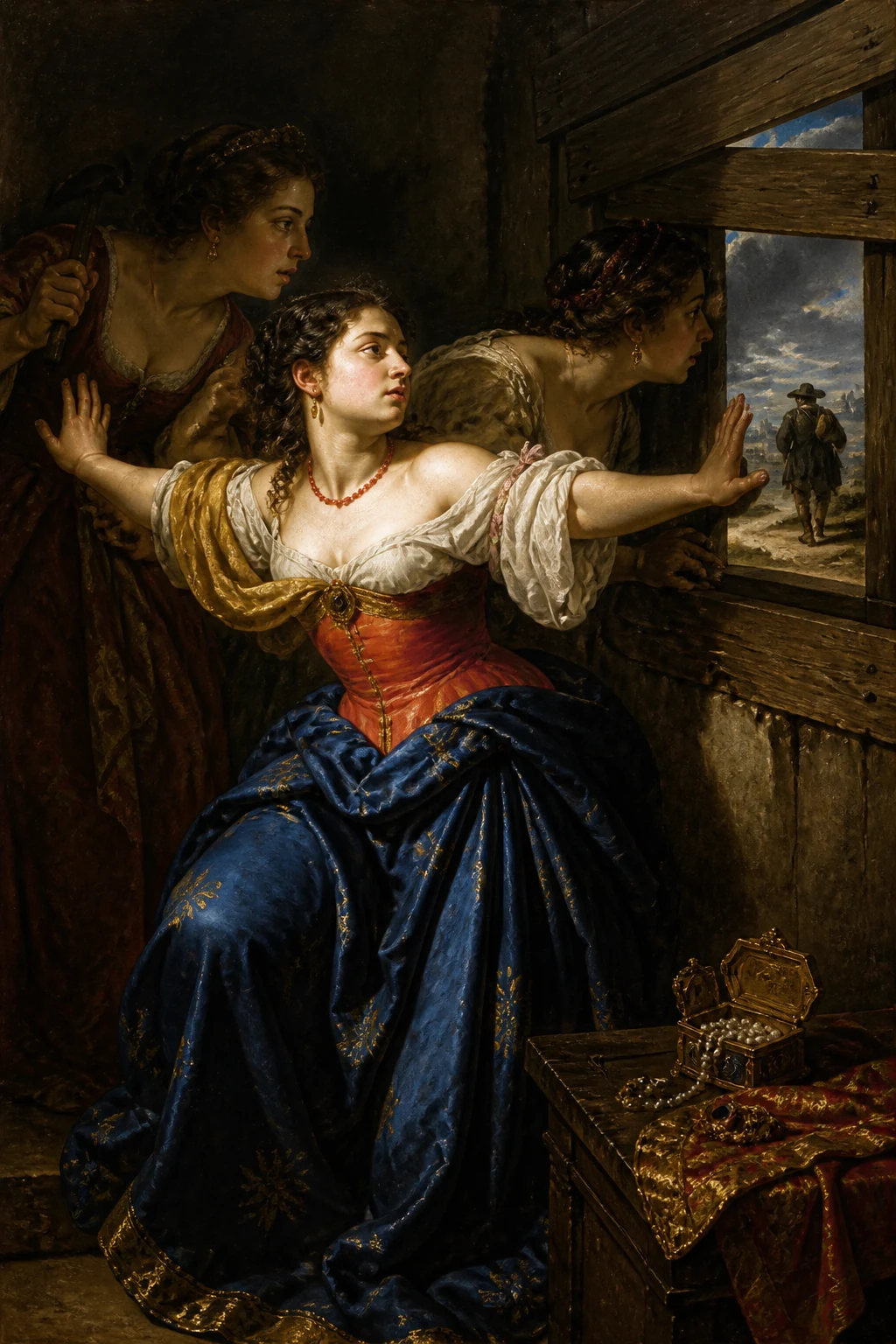
She said: It has reached me, O fortunate king, that the young woman hurried ahead of her husband through the underground passage when he went out the door, and sat down in her house. When her husband came in, she asked, “What did you see?” “I saw her with her master,” he replied, “and she resembles you.” “Then go to your shop,” she said. “Enough of these suspicions! You must no longer think ill of me.” “That is true,” he answered. “Do not hold what I have done against me.” “May God forgive you,” she said. He kissed her on both cheeks and went to his shop. Then she went down through the underground passage to Qamar al-Zaman, carrying four purses of money. “Make ready to leave at once,” she told him, “and prepare to load the money without delay, while I carry out the tricks I have devised for you.” He went out and bought mules, loaded the baggage, prepared a traveling litter, and bought slave boys and servants. He sent them all out of the city, leaving nothing to hinder his departure, then returned and said, “All my arrangements are complete.” She answered, “I too have brought over the rest of his money and all his treasures, leaving him nothing, great or small, that might be of use to him. All this I have done out of love for you, beloved of my heart. A thousand times would I sacrifice my husband for your sake! But you must go to him and bid him farewell. Say, ‘I intend to leave in three days, and I have come to take my leave of you. Reckon up the rent I owe you for the house, so that I may pay it and discharge my debt.’ See what he says, then return and tell me. I am worn out with scheming against him and provoking him, hoping he will divorce me, yet I find him only clinging to me. There is nothing better left for us than to travel to your country.” “How wonderful,” he said, “if dreams come true!” Then he went to the jeweler’s shop, sat with him, and said, “Master, I am leaving in three days and have come only to bid you farewell. Please reckon up the rent I owe you for the house, so that I may pay it and discharge my debt.” “What are you saying?” the jeweler replied. “It is I who am indebted to you. By God, I will take no rent from you! Your coming has brought blessings. But we shall miss you when you go. Were it not wrong, I would stand in your way and keep you from your family and your homeland.” They bade one another farewell and wept bitterly. The jeweler closed his shop at once, saying to himself, “I ought to see my friend off.” Thereafter, whenever Qamar al-Zaman went out on an errand, he went with him. Whenever he entered Qamar al-Zaman’s house, he found her there, standing before them and serving them; and whenever he returned home, he found her sitting there. Throughout those three days he continued to see her in his own house whenever he entered it, and in Qamar al-Zaman’s house whenever he entered that. Then she said to her lover, “I have brought over all his treasures, money, and furnishings. Nothing remains with him but the slave girl who brings you both your drinks. But I cannot bear to part with her: she is my kinswoman, dear to me, and the keeper of my secrets. I mean to beat her and pretend to be angry with her. When my husband comes, I shall tell him, ‘I will no longer put up with this slave girl, nor will I live under the same roof with her. Take her away and sell her.’ He will take her out to sell her, and you must buy her, so that we may take her with us.” “Very well,” he said. She beat the girl, and when her husband came in, he found the slave girl weeping. He asked why she was crying, and she replied, “My mistress beat me.” He went in and said, “What has this accursed girl done that you should beat her?” His wife replied, “Man, I have only one thing to say to you: I can no longer bear the sight of this girl. Take her away and sell her, or divorce me.” “I will sell her,” he said. “I would not disobey you.” He took her with him as he went out to his shop, passing by Qamar al-Zaman’s house. As soon as her husband had left with the slave girl, his wife slipped swiftly through the underground passage to Qamar al-Zaman, who put her in the traveling litter before the old jeweler arrived. When he reached the house and Qamar al-Zaman saw the slave girl with him, he asked, “Who is this?” “My slave girl, who used to serve us our drinks,” he answered. “But she disobeyed her mistress, who grew angry and ordered me to sell her.” “Since her mistress has taken a dislike to her,” said Qamar al-Zaman, “she can no longer stay with her. Sell her to me, so that I may have something of you about me, and I will make her a servant to my slave girl Halima.” “Very well,” he said. “Take her.” “For how much?” “I will take nothing from you, for you have shown us such kindness.” He accepted her and called to the young woman, “Kiss your master’s hand.” She emerged from the litter, kissed the jeweler’s hand, then climbed back into the litter as he watched. Qamar al-Zaman said to him, “I commend you to God, Master Ubayd. Release me from any obligation to you.” “May God absolve you,” he replied, “and bring you safely to your family.” He bade him farewell and went back to his shop in tears. Parting with Qamar al-Zaman grieved him deeply, for he had been his companion, and companionship has its claims. Yet he was glad to be rid of the doubts that had troubled him concerning his wife, now that the young man had departed without his suspicions being confirmed.
Such was his case. As for Qamar al-Zaman, the young woman said to him, “If you wish to escape unharmed, take us by a road other than the usual route.” And dawn overtook Shahrazad, and she fell silent, leaving her tale untold.
When it was the nine hundred and seventy-sixth night,
She said: It has reached me, O fortunate king, that when Qamar al-Zaman set out, the young woman told him, “If you wish to escape unharmed, take us by a road other than the usual route.” “I hear and obey,” he answered. He took a road different from the one travelers ordinarily used, and journeyed from land to land until he reached the borders of Egypt. There he wrote a letter and sent it to his father by a courier. His father, the merchant Abd al-Rahman, was sitting in the market among the merchants, his heart burning with grief at his son’s absence, for he had received no news of him since the day he left. While he sat there, the courier approached and said, “My masters, which of you is the merchant Abd al-Rahman?” “What do you want with him?” they asked. “I have a letter from his son Qamar al-Zaman,” he replied, “whom I left at al-Arish.” The father rejoiced and his heart expanded with delight, while the merchants shared his joy and congratulated him on his son’s safe return. He took the letter and read it. It was addressed from Qamar al-Zaman to the merchant Abd al-Rahman, and said, “Greetings to you and to all the merchants. If you ask after us, praise and thanks be to God! We have bought and sold and made a profit, and have returned in health, safety, and well-being.” At this he threw open the gates of rejoicing, gave banquets, entertained lavishly, and invited many guests. He brought musicians and devised all manner of marvels for the celebration. When his son reached al-Salihiyya, his father and all the merchants went out to meet him. His father embraced him, clasped him to his breast, and wept until he fainted. When he revived, he said, “A blessed day, my son, on which the Almighty Protector has reunited us!” Then he recited these verses:
To be near the beloved is perfect delight, and the cup of happiness passes among us. Welcome, welcome, and a thousand greetings to the light of the age, the fullest of moons! Then tears poured from his eyes in the intensity of his joy, and he recited these two verses:
The Moon of the Age shines forth in splendor, radiant as he returns from his travels. His hair is dark as the night of his absence, but the sun rises from the opening of his robe. Then the merchants came forward to greet him. They saw that he had brought much baggage, servants, and a traveling litter, and was surrounded by a great retinue. They escorted him into the house. When the young woman emerged from the litter, his father saw a beauty who would enchant all who beheld her. They opened for her a lofty suite, like a treasure chamber whose magic seals had been broken. When his mother saw her, she too was enchanted and took her for a queen, the wife of some king. Delighted with her, she questioned her, and the young woman said, “I am your son’s wife.” “Since he has married you,” she replied, “we must hold a splendid celebration for you, so that we may rejoice in you and in my son.”
Such was her case. As for the merchant Abd al-Rahman, when the guests had dispersed and each had gone his way, he sat alone with his son and said, “My son, what is this slave girl to you? How much did you pay for her?” “Father,” he replied, “she is no slave girl. She is the reason I went abroad.” “How is that?” his father asked. “She is the woman the dervish described to us on the night he stayed here. From that moment my hopes were fixed upon her, and it was only for her sake that I asked to travel. Then I was stripped on the road, the Arabs took my money, and I entered Basra alone. Such and such things happened to me…” And he told his father the whole story from beginning to end. When he had finished, his father said, “My son, after all this, have you married her?” “No,” he said, “but I promised to marry her.” “Do you wish to marry her?” “If you command me to do so, I will; otherwise, I shall not.” His father said, “If you marry her, I will disown you in this world and the next, and my anger against you will be terrible! How can you marry a woman who treated her husband in this fashion? Just as she did this to her husband for your sake, so she will do it to you for another man’s sake. She is treacherous, and there is no trusting the treacherous. If you disobey me, you will incur my anger. But if you listen to me, I will find you a girl more beautiful than she is, pure and virtuous, and marry you to her, even if I spend all my wealth upon her. I will give you a wedding celebration without equal, and take pride in you both. Better that people should say, ‘So-and-so has married the daughter of so-and-so,’ than that they should say you have married a slave girl with neither family nor standing.” He continued urging his son not to marry her, supporting his counsel with sayings, witty observations, poems, proverbs, and admonitions. At last Qamar al-Zaman said, “Father, since that is how matters stand, I have no desire to marry her.” When he heard this, his father kissed him between the eyes and said, “You are truly my son! By your life, my son, I shall marry you to a girl without equal.” Then the merchant Abd al-Rahman put Ubayd the jeweler’s wife and her slave girl in an upper suite, locked them in, and appointed a black slave girl to bring them food and drink. He told her, “You and your slave girl will remain confined here until I find someone to buy you both and sell you to him. If you disobey, I will kill you and your slave girl, for you are treacherous, and there is no good in you.” “Do as you wish,” she replied. “I deserve everything you do to me.” He locked the door upon them and gave orders to the women of his household: “No one is to go up to them or speak to them except the black slave girl who passes their food and drink through the little window.” So she and her slave girl sat weeping, and she repented of what she had done to her husband.
Such was her case. As for the merchant Abd al-Rahman, he sent matchmakers to seek a girl of good family and noble lineage for his son. They searched continually, and whenever they saw one girl, they heard of another more beautiful, until at last they entered the house of the Shaykh al-Islam. There they saw his daughter, who had no equal in Egypt, a girl of beauty and loveliness, graceful and well proportioned, a thousand times fairer than Ubayd the jeweler’s wife. They told the merchant about her, and he went with the city’s dignitaries to her father and asked for her hand. They drew up the marriage contract and held a splendid celebration. He gave banquets, inviting the jurists on the first day, when they held a noble celebration of the Prophet’s birth. On the second day he invited all the merchants. Drums were beaten and pipes sounded, and the quarter and its streets were hung with lanterns. Every evening all manner of entertainers came to perform their different arts, and each day he feasted another class of people, until he had entertained the scholars, the emirs, the district governors, and the magistrates. The festivities continued for forty days. Every day the merchant sat receiving the guests, with his son beside him, watching the people eat at the banquet tables. It was a celebration without equal. On the last day he invited the poor and needy, strangers and townsfolk alike, and they came in groups and ate, while the merchant sat with his son beside him. As they sat there, old Ubayd, the young woman’s husband, entered among the poor. He was ragged and weary, and his face bore the marks of travel. Qamar al-Zaman saw and recognized him, and said to his father, “Father, look at that poor man who has just come through the door.” He looked and saw a man in tattered clothes, wearing a worn-out robe worth two dirhams. His face was yellow beneath a coating of dust, and he looked like one of those pilgrims left destitute on the road. He moaned like a sick man in want, and staggered from side to side as he walked. Truly the poet’s words applied to him:
Poverty forever lowers a man, as the sun grows pale at its setting. He passes among people seeking to hide himself, and when alone, he weeps with streaming tears. If he is absent, no one asks after him; if he is present, he receives no share. By God, a man afflicted with poverty is a stranger even among his own kin. And another poet says:
The poor man walks with all things set against him, and the earth shuts its doors in his face. You see him hated, though he has committed no offense; he sees hostility, but cannot see its cause. Even dogs, when they see a prosperous man, fawn upon him and wag their tails; but if one day they see a wretched pauper, they bark at him and bare their teeth. How well the poet said:
When honor and good fortune attend a man, misfortunes and calamities keep clear of him. His beloved comes unbidden, an uninvited guest, and the jealous watcher serves as his procurer. People count his noisy fart as music, and if he lets a silent one, they say, “What fragrance fills the air!” And dawn overtook Shahrazad, and she fell silent, leaving her tale untold.
When it was the nine hundred and seventy-seventh night,
She said: It has reached me, O fortunate king, that when his son said to the merchant Abd al-Rahman, “Look at that poor man,” he asked, “My son, who is he?” “That is Master Ubayd the jeweler,” he replied, “the husband of the woman confined in our house.” “Is this the man you told me about?” “Yes, I know him well.” Now the reason for his coming was this: after bidding farewell to Qamar al-Zaman, he had gone to his shop, where a piece of work was brought to him, and he spent the rest of the day upon it. In the evening he closed the shop and went home. He put his hand against the door, and it opened. Entering, he found neither his wife nor the slave girl, and the house was in a sorry state, fitting the poet’s words:
They were hives of bees when life filled them; when their bees departed, they became empty cells. Today it is as though no inhabitants ever dwelt there, or as though death’s decrees had carried them all away. When he saw the house deserted, he looked right and left, then wandered about like a madman, but found no one. He opened his treasury and found none of his money or valuables. At last he awoke from his drunken stupor and came to his senses, realizing that his wife had been playing trick after trick upon him until she betrayed him. He wept over what had befallen him, but concealed his misfortune lest any enemy gloat over him or any friend be distressed. He knew that revealing his secret would bring him nothing but disgrace and reproach, and said to himself, “You there, conceal the folly and disaster that have befallen you, and act upon the poet’s words:
If a man’s own breast is too narrow to hold his secret, the breast of the man entrusted with it will be narrower still.” Then he locked his house and went to the shop, putting one of his craftsmen in charge. He told him, “My friend, the young merchant, has urged me to accompany him to Egypt for pleasure, and sworn that he will not leave without taking me and my wife with him. You, my son, will be my agent in the shop. If the king asks about me, tell him, ‘He has gone with his wife to the Sacred House of God.’” He sold some of his property and bought camels, mules, and slave boys. He also bought a slave girl and placed her in a traveling litter. Ten days later he left Basra, his friends bidding him farewell, and everyone believing that he had taken his wife on pilgrimage. The people rejoiced that God had delivered them from being shut up in mosques and houses every Friday. Some said, “May God never bring him back to Basra, so that we need never again be locked in mosques and houses every Friday!” For this practice had caused the people of Basra great distress. Others said, “I doubt he will ever return from his journey, after all the prayers the people of Basra have uttered against him.” Still others said, “If he does return, it will only be in ruin.” After their long misery, the people of Basra were overjoyed at his departure; even their cats and dogs were relieved. But when Friday came, the crier proclaimed through the city as usual that they must enter the mosques two hours before the Friday prayer or hide themselves in their houses, and the same applied to cats and dogs. Their hearts sank, and they gathered together and went to the royal court. Standing before the king, they said, “King of the age, the jeweler has taken his wife and gone on pilgrimage to the Sacred House of God. The reason for our confinement no longer exists. Why should we be confined now?” The king said, “How could that traitor leave without informing me? When he returns from his journey, we shall settle matters! Go to your shops, buy and sell. This restriction is lifted.”
Such was the case with the king and the people of Basra. As for Master Ubayd the jeweler, he traveled ten stages, and then suffered the same fate that had befallen Qamar al-Zaman before he entered Basra. The Arabs of Baghdad fell upon him, stripped him, and took everything he had. He saved himself by pretending to be dead. After the Arabs had gone, he rose and walked naked until he entered a town, where God moved kindly people to pity him, and they covered his nakedness with scraps of old clothing. He went from town to town, begging and subsisting on alms, until he reached Cairo the Protected. Tormented by hunger, he wandered through the markets begging. An Egyptian said to him, “Poor man, go to the house where the wedding is being celebrated. Eat and drink, for today they are laying out a feast for the poor and strangers.” “I do not know the way to the wedding house,” he replied. “Follow me,” the man said, “and I will show you.” He followed him until they reached the house. “This is the wedding house,” the man told him. “Go in and do not be afraid: there are no doorkeepers barring the wedding door.” When he entered, Qamar al-Zaman saw and recognized him, and told his father about him. The merchant Abd al-Rahman said to his son, “Leave him for now, my son. He may be hungry. Let him eat his fill and recover his composure; then we shall send for him.” They waited until he had eaten enough, washed his hands, and drunk coffee and sweet sherbets flavored with musk and ambergris. When he was about to leave, Qamar al-Zaman’s father sent after him. The messenger said, “Come, stranger, and speak with the merchant Abd al-Rahman.” “Who is this merchant?” he asked. “The host of the wedding,” the messenger replied. He returned, thinking the merchant meant to give him alms. But as he approached, he saw his friend Qamar al-Zaman, and was beside himself with shame. Qamar al-Zaman rose to his feet, embraced him, and greeted him, and they wept bitterly together. Then he seated him beside him. His father said, “Have you no manners? Is this the way to welcome a friend? Send him first to the bath, and send him a suit of clothes suitable to his station. After that you may sit and talk with him.” He called some servants and ordered them to take the jeweler to the bath, sending him a suit of choice clothing worth a thousand dinars or more. They washed his body and dressed him in it, and he looked like the chief of the merchants. While he was away in the bath, the guests asked Qamar al-Zaman about him. “Who is he? How do you know him?” “He is my friend,” he replied. “He lodged me in his house, and his kindnesses to me are beyond counting. He honored me most generously. He is a man of wealth and distinction, a jeweler without equal, dearly loved by the king of Basra, with whom he enjoys great standing and whose ear he commands.” He continued praising him lavishly, saying, “He did such and such for me, and I am ashamed before him, not knowing how to repay the honor he showed me.” He went on extolling him until the man’s worth rose greatly in the eyes of those present, and they regarded him with respect. “For your sake,” they said, “we shall all fulfill our duty toward him and honor him. But we should like to know what brought him to Egypt, why he left his own country, and what God has visited upon him to bring him to such a state.” He answered, “Good people, do not be astonished. The son of Adam is subject to fate and destiny, and as long as he remains in this world he is never safe from calamity. Truly spoke the poet who composed these verses:
Time preys upon men: do not be one whom rank and office make reckless. Beware of slips, and shun sorrow; know that destruction is the way of time. How many blessings have vanished at the slightest stroke of misfortune! Everything has a cause for its reversal. Know that I entered Basra in a state worse than his, and after suffering harsher trials. This man entered Egypt with his nakedness covered by rags, but I entered his country stark naked, with one hand behind me and one in front. None helped me but God and this worthy man. The reason was that the Arabs stripped me, took my camels, mules, and baggage, and killed my servants and men. I lay among the slain, and they thought me dead, so they went away and left me. Then I rose and walked naked until I entered Basra. This man met me, clothed me, lodged me in his house, and supplied me with money. Everything I brought back with me came only from God’s bounty and his. When I left, he gave me a great deal, and I returned to my country with my spirits restored. I left him prosperous and honored. Perhaps some calamity of time befell him afterward, compelling him to leave his family and homeland, and on the road he suffered what I suffered. There is nothing strange in that. Now I must repay him for his generous deeds toward me and act upon the poet’s words:
You who think well of time, do you know what time may do? Do all the kindness that you can: as a man deals, so shall he be dealt with. While they were speaking of these and similar matters, Master Ubayd approached, looking like the chief of the merchants. Everyone rose to greet him, and they seated him in the place of honor. Qamar al-Zaman said to him, “My friend, may your day be blessed and happy! Tell me of nothing that befell you, for it befell me before you. If the Arabs stripped you and took your money, wealth is a ransom for the body. Do not grieve. I entered your country naked, and you clothed and honored me. Your kindnesses to me are many, and I shall repay you.” And dawn overtook Shahrazad, and she fell silent, leaving her tale untold.
When it was the nine hundred and seventy-eighth night,
She said: It has reached me, O fortunate king, that Qamar al-Zaman said to Master Ubayd the jeweler, “I entered your country naked, and you clothed me. Your kindnesses to me are many, and I shall repay you, treating you as you treated me, and better still. So take heart and be at ease.” He comforted him and kept him from speaking, lest he mention his wife and what she had done to him. He continued to console him with admonitions, proverbs, poems, witty sayings, stories, and accounts of past events, until the jeweler understood Qamar al-Zaman’s hint that he should keep silent. He concealed what was in his heart and took comfort in the tales and anecdotes he heard, then recited the poet’s words:
Upon the brow of time there is a line which, if you read it, would make your eyes weep blood: never does time greet anyone with its right hand but its left gives him the bitter draught of death. Then Qamar al-Zaman and his father, the merchant Abd al-Rahman, took the jeweler into the women’s quarters and sat alone with him. The merchant Abd al-Rahman said, “We only kept you from speaking for fear of disgrace to you and to ourselves. But now we are alone, so tell me what happened between you, your wife, and my son.” He related the matter from beginning to end. When he had finished, the merchant asked, “Does the fault lie with your wife or with my son?” He replied, “By God, your son is not at fault. Men covet women, and it is for women to resist men. The blame lies with my wife, who betrayed me and treated me in this fashion.” The merchant rose and took his son aside. “My son,” he said, “we have tested his wife and know that she is treacherous. Now I wish to test him and discover whether he is a man of honor and self-respect or a complacent cuckold.” “How will you do that?” his son asked. “I intend to urge him to reconcile with his wife. If he agrees and forgives her, I shall strike him with my sword and kill him, then kill her and her slave girl, for there is no good in the lives of a complacent cuckold and an adulteress. But if he rejects her, I shall marry him to your sister and give him more than the wealth you took from him.” Then he returned to the jeweler and said, “Master, living with women requires patience, and anyone who loves them must have a tolerant heart. They torment and injure men, knowing how dearly they are prized for their beauty and loveliness. They think highly of themselves and despise men, especially when they see how much their husbands love them. Then they repay them with airs, coyness, and every kind of disagreeable behavior. If a man grows angry whenever his wife does something he dislikes, no life together is possible. Only a man of great patience and endurance can live in harmony with women. Unless he bears with his wife and meets her offenses with forgiveness, he will never prosper in married life. It has been said of women, ‘Were they in heaven, men would crane their necks toward them.’ Whoever has the power to punish and yet forgives will have his reward from God. This woman is your wife and companion; she has lived with you for many years. You ought to forgive her, for forgiveness is one of the signs of success in married life. Women are deficient in reason and religion. Though she has done wrong, she has repented, and, God willing, she will not return to her former ways. My advice is that you make peace with her, and I will restore more than your lost wealth. If you stay with me, you and she are welcome, and you shall have nothing but what pleases you. If you wish to return to your country, I shall give you enough to satisfy you. The traveling litter is ready: put your wife and her slave girl in it and go home. Many things pass between husband and wife. Be accommodating, and do not take the path of hardship.” The jeweler said, “My lord, where is my wife?” “She is here, in this upper suite,” he replied. “Go up to her, and for my sake treat her well and do not distress her. When my son brought her here and wished to marry her, I forbade him, put her in this suite, and locked the door upon her. I said to myself, ‘Perhaps her husband will come, and I can give her back to him.’ For she is beautiful, and a husband could never let a woman like her go. What I expected has come to pass, and praise be to God Most High for reuniting you with your wife! As for my son, I sought another bride for him and married him to her. These banquets and festivities are for his wedding, and tonight he will go in to his bride. Here is the key to the suite where your wife is. Take it, open the door, and go in to your wife and slave girl. Enjoy her company; food and drink will be brought to you. Do not come down until you have had your fill of her.” “May God reward you with every blessing on my behalf, my lord,” the jeweler replied. He took the key and went up joyfully. The merchant thought his words had pleased him and that he had accepted his proposal, so he took his sword and followed unseen, then stood watching to see what would happen between the jeweler and his wife.
Such was the case with the merchant Abd al-Rahman. As for the jeweler, he went in to his wife and found her weeping bitterly because Qamar al-Zaman had married another woman. He heard the slave girl saying to her, “How often I advised you, my lady, and told you, ‘No good will come to you from this young man. Give up his company.’ But you would not listen, until you had plundered all your husband’s wealth and given it to him. Then you left your home, clung to your love for him, and came with him to this country. After all that, he cast you out of his thoughts and married someone else, and the final reward of your attachment to him was imprisonment.” She answered, “Be silent, accursed girl! Though he has married another, I shall surely cross his mind one day. I cannot forget the nights we spent in conversation. Whatever happens, I take comfort in the poet’s words:
“O my lords, does he ever cross your minds, whose mind holds none but you? Far be it from you to neglect the plight of one who, absorbed in yours, forgets his own! He must surely remember our companionship and the days we spent together, and ask after me. I shall never forsake my love for him or turn from my passion, even if I die in prison. He is my beloved and my physician, and I hope he will return to me and be tender with me again.” When her husband heard her say these words, he went in and said, “You faithless woman! Your hope of him is like the Devil’s hope of Paradise! Have you all these vices, while I knew nothing of them? Had I known you possessed even one of them, I would not have kept you with me for a single hour. But now that I am certain of it, I must kill you, even if they put me to death for your sake, you traitress!” Then he seized her with both hands and recited these two verses:
“O fair ones, by your unjust cruelty you have destroyed my faithful love, and shown no regard for what was due to me. How often I clung to you in ardent longing! But after all this anguish, I have come to loathe attachment.” Then he bore down upon her windpipe and crushed it. The maid cried, “Alas, my mistress!” He said to her, “You harlot, the blame is all yours! You knew she had this vice, yet never told me.” Then he seized the maid and strangled her. All this took place while the merchant stood behind the door, sword in hand, hearing with his own ears and seeing with his own eyes. When Ubayd the jeweller had strangled the two women in the merchant’s mansion, fearful thoughts crowded upon him, and he dreaded the consequences. He said to himself, “When the merchant learns that I have killed them in his mansion, he will surely kill me. I can only ask God to take my soul while I am still firm in the faith.” He was bewildered and did not know what to do. While he was in this state, the merchant Abd al-Rahman came in and said, “Have no fear. You deserve to come to no harm. Look at this sword in my hand: I had intended to kill you if you made peace with her and took her back into favour, and to kill the maid as well. But since you have done what you have, welcome, and welcome once again! No reward will do for you but that I should give you my daughter, Qamar al-Zaman’s sister, in marriage.” Then he took him downstairs and ordered that the woman who washed the dead be brought. Word spread that Qamar al-Zaman, the son of the merchant Abd al-Rahman, had brought two slave girls with him from Basra, and that both had died. People came to offer their condolences, saying, “May your own life be spared, and may God make good your loss.” Then the women were washed, shrouded, and buried, and no one learned the truth of the matter.
Such was the affair of Ubayd the jeweller, his wife, and his maid. As for the merchant Abd al-Rahman, he summoned the Sheikh al-Islam and all the dignitaries and said, “Sheikh al-Islam, draw up the marriage contract between my daughter Kawkab al-Sabah and Master Ubayd the jeweller. I have received her marriage gift in full.” So he drew up the contract, and the merchant served them sherbet, and they made one celebration of the two weddings. The daughter of the Sheikh al-Islam, Qamar al-Zaman’s bride, and his sister Kawkab al-Sabah, Master Ubayd the jeweller’s bride, were borne in the same bridal litter on the same night. That evening they conducted Qamar al-Zaman and Master Ubayd to their brides together, bringing Qamar al-Zaman in to the daughter of the Sheikh al-Islam, and Master Ubayd in to the daughter of the merchant Abd al-Rahman. When Ubayd entered her chamber, he found her a thousand times fairer and lovelier than his former wife. He took her maidenhead, and in the morning went to the bathhouse with Qamar al-Zaman. He remained with them for some time in joy and happiness. At last he began to yearn for his own country, so he went to the merchant Abd al-Rahman and said, “Uncle, I long for my homeland. I have property and sources of income there, and I left one of my craftsmen to act as my agent. I wish to return to my country, sell my property, and come back to you. Will you give me leave to go there for this purpose?” He replied, “My son, you have my leave, and there is nothing blameworthy in what you say. Love of one’s homeland is part of faith, and a man who is no good to his own country will be no good to another. But if you travel without your wife, you may reach your country and find life there so pleasant that you wish to stay. Then you will be torn between returning to your wife and remaining in your homeland. The wisest course is to take your wife with you. Afterwards, if you wish to return to us, come back with her, and you will both be welcome. For we are people who know no divorce; no woman of our family marries twice, nor do we cast anyone off out of caprice.” Ubayd said, “Uncle, I fear your daughter may not agree to travel with me to my country.” He replied, “My son, our women do not disobey their husbands, nor do we know of a woman among us who turns against her husband.” Ubayd said, “God bless you and your women!” Then he went in to his wife and said, “I wish to travel to my homeland. What do you say?” She answered, “My father’s authority over me lasted only while I was a maiden. Now that I am married, all authority rests in my husband’s hands, and I shall not disobey him.” He said, “God bless you and your father, and have mercy upon the womb that bore you and the loins that begot you!” Then he settled his affairs and began preparing for the journey. His father-in-law gave him many gifts, and they bade each other farewell. He took his wife and set out, travelling until he reached Basra. His relatives and friends came out to meet him, supposing that he had been in the Hijaz. Some people rejoiced at his arrival, while others were distressed by his return to Basra, saying to one another, “Now he will make our lives a misery every Friday, as he used to do, shutting us up in the mosques and houses, and even shutting up our cats and dogs!”
Such was his affair. As for the King of Basra, when he heard of Ubayd’s return, he was angry with him and sent for him. When Ubayd was brought before him, the king rebuked him, saying, “How could you go away without telling me of your journey? Was there anything you lacked that I could not have given you to help you make the pilgrimage to the Sacred House of God?” He replied, “Pardon me, my lord. By God, I did not make the pilgrimage. What happened to me was this…” And he told him everything that had happened with his wife and with the Egyptian merchant Abd al-Rahman, and how the merchant had given him his daughter in marriage, ending with, “And I have brought her here to Basra.” The king said, “By God, were it not that I fear God Most High, I would kill you and marry this noble-born girl after you, even if I had to spend whole treasuries upon her, for she is fit for none but kings. But God has allotted her to you. May He bless you in her, and see that you treat her well.” Then he bestowed gifts upon the jeweller, who left his presence and lived with his wife for five years. After that, he passed into the mercy of God Most High. The king sought her hand in marriage, but she refused, saying, “O King, I have never known a woman of my family to marry again after her husband’s death. I shall marry no one after my husband, and I will not marry you, even if you kill me.” He sent to ask her, “Do you wish to return to your own country?” She replied, “If you do a good deed, you will be rewarded for it.” So he gathered all the jeweller’s wealth for her and added gifts of his own befitting his royal station. Then he sent with her one of his viziers, a man renowned for goodness and righteousness, and gave him five hundred horsemen as an escort. The vizier travelled with her until he delivered her to her father. She remained unmarried until she died, and in time they all died. If this woman would not exchange her husband for a sultan even after his death, how can she be compared to one who exchanges hers, while he is still alive, for a youth of unknown birth and lineage—especially when she does so in fornication, and not according to the lawful rites of marriage? Whoever thinks that all women are alike suffers from a madness for which there is no cure. Glory be to Him to whom belong sovereignty and dominion, the Ever-Living who never dies!
Izvirnik
حكاية قمر الزمان وزوجة الجوهري - الليالي ٩٦٣ إلى ٩٧٨
Naslednje strani prikazujejo izvirno besedilo za primerjavo.
فلما كانت الليلة ٩٦٣
ومما يُحكى أيضًا أيها الملك السعيد أنه كان في قديم الزمان رجلٌ تاجر اسمه عبد الرحمن، قد رزقه الله بنتًا وولدًا، فسمَّى البنتَ كوكب الصباح؛ لشدة حُسنها وجمالها، وسمَّى الولد قمر الزمان لشدة حُسنه، ولما نظر ما أعطاهما الله من الحُسْن والجمال والبهاء والاعتدال خاف عليهما من أعين الناظرين وألسنة الحاسدين ومكر الماكرين وتحيُّل الفاسقين، فحجبهما عن الناس في قصرٍ مدةَ أربعَ عشرةَ سنة، ولم يَرَهما أحدٌ غير والدَيْهما وجارية تتعاطى خدمتهما، وكان والدهما يقرأ القرآن كما أنزله الله، وكذلك أمهما تقرأ القرآن، فصارت الأم تُقرئ بنتها والرجل يُقرئ ولده حتى حفِظَا القرآن، وتعلَّما الخط والحساب والفنون والآداب من أبيهما وأمهما، ولم يحتاجا إلى معلم، فلما بلغ الولد مبلغ الرجال قالت للتاجر زوجتُه: إلى متى وأنت حاجبٌ ولدَك قمر الزمان عن أعين الناس؟ أهو بنت أو غلام؟ فقال لها: غلام. قالت: حيث كان غلامًا لِمَ لم تأخذه معك إلى السوق وتُقعِده في الدكان حتى يعرف الناس ويعرفوه لأجل أن يشتهر عندهم أنه ابنك، وتعلِّمه البيع والشراء؟ وربما يحصل لك أمر فيكون الناس قد عرفوا أنه ولدك، فيضع يده على مخلَّفاتك، وأما إذا متَّ على هذه الحالة وقال للناس: أنا ابن التاجر عبد الرحمن. فإنهم لا يصدِّقونه، بل يقولون له: ما رأيناك ولا نعرف أن له ولدًا. وتأخذ أموالَك الحكَّام ويصير ولدك محرومًا، وكذلك البنت، مرادي أن أُشهِرَها عند الناس؛ لعل أحدًا كفوًا لها يخطبها فنزوِّجها له ونفرح بها. فقال لها: مخافةً عليهما من أعين الناس. وأدرك شهرزاد الصباح، فسكتَتْ عن الكلام المباح.
فلما كانت الليلة ٩٦٤
قالت: بلغني أيها الملك السعيد، أن زوجة التاجر لما قالت له ذلك الكلام، قال لها: مخافةً عليهما من أعين الناس؛ لأني محبٌّ لهما، والمُحِبُّ شديدُ الغيرات، وقد أحسَنَ مَن قال هذه الأبيات:
أَغَارُ عَلَيْكَ مِنْ نَظَرِي وَمِنِّي وَمِنْكَ وَمِنْ مَكَانِكَ وَالزَّمَانِ
وَلَوْ أَنِّي وَضَعْتُكَ فِي عُيُونِي دَوَامًا مَا سَئِمْتُ مِنَ التَّدَانِي
وَلَوْ وَاصَلْتَنِي فِي كُلِّ يَوْمٍ إِلَى يَوْمِ الْقِيَامَةِ مَا كَفَانِي
فقالت له زوجته: توكَّل على الله، ولا بأس على مَن يحفظه الله، وخذه في هذا اليوم معك إلى الدكان. ثم إنها ألبسته بدلة من أفخر الملابس، فصار فتنة للناظرين وحسرة في قلوب العاشقين، وأخذه أبوه معه ومضى به إلى السوق، فصار كل مَن رآه يفتتن به ويتقدَّم إليه ويبوس يده ويسلِّم عليه، وصار أبوه يشتم الناس حيث تبعوه لقصد الفرجة، وصار البعض من الناس يقول: إن الشمس قد طلعت في المحل الفلاني وأشرقت في السوق. والبعض يقول: مطلع البدر في الجهة الفلانية. والبعض يقول: ظهر هلال العيد على عباد الله. وصاروا يلمِّحون إلى الولد بالكلام ويدعون له، وقد حصل لأبيه خجل من كلام الناس، ولا يقدر أن يمنع أحدًا منهم عن الكلام، وصار يشتم أمه ويدعو عليها؛ لأنها هي التي كانت سببًا في خروجه. والتفت أبوه فرأى الخلائق مزدحمين عليه خلفه وقدامه، وهو ماشٍ إلى أن وصل إلى الدكان، ففتح الدكان وجلس وأجلس ولده قدامه، والتفت إلى الناس فرآهم قد سدوا الطريق، وصار كلُّ مَن مرَّ به من رائح وغادٍ يقف قدام الدكان وينظر إلى ذلك الوجه الجميل، ولا يقدر أن يفارقه. وانعقد عليه إجماع النساء والرجال متمثلين بقول مَن قال:
خَلَقْتَ الْجَمَالَ لَنَا فِتْنَةً وَقُلْتَ لَنَا يَا عِبَادِي اتَّقُونْ
فَأَنْتَ جَمِيلٌ تُحِبُّ الْجَمَالَ فَكَيْفَ عِبَادُكَ لَا يَعْشَقُونْ
فلما رأى التاجر عبد الرحمن الناس مزدحمين عليه وواقفين صفوفًا نساءً ورجالًا لديه، شاخصين لولده، خجل غاية الخجل وصار متحيرًا في أمره، ولم يدرِ ماذا يصنع. فلم يشعر إلا ورجل درويش من السياحين وعليه شعار عباد الله الصالحين قد أقبل عليه من طرف السوق، ثم تقدَّمَ إلى الغلام وصار ينشد الأشعار ويُرخِي الدموع الغِزار، فلما رأى قمر الزمان جالسًا كأنه قضيب البان، نابت على كثيب من الزعفران، أفاض دمع العين وأنشد هذين البيتين:
رَأَيْتُ غُصْنًا عَلَى كَثِيبٍ شَبِيهَ بَدْرٍ إِذَا تَلَالَا
فَقُلْتُ: مَا الاسْمُ؟ قَالَ: لُولُو فَقُلْتُ: لِي لِي. فَقَالَ: لَالَا
ثم إن الدرويش صار يمشي الهوينا ويمسح شيبته بيده اليمنى، فانشقَّ لِهَيْبتِه قلبُ الزحام، فلما نظر إلى الغلام اندهش منه العقل والنظر، وانطبق عليه قول الشاعر:
فَبَيْنَمَا ذَاكَ الْمَلِيحُ فِي مَحَلْ مِنْ وَجْهِهِ هِلَالُ عِيدِ الْفِطْرِ طَلْ
إِذَا بِشَيْخٍ ذِي وَقَارٍ قَدْ أَهَلْ يَمْشِي وَلَكِنْ مَشْيُهُ عَلَى مَهَلْ
قَدْ مَارَسَ الْأَيَّامَ وَاللَّيَالِي وَخَاضَ فِي الْحَرَامِ وَالْحَلَالِ
وَهَامَ بِالنِّسَاءِ وَالرِّجَالِ وَرَقَّ حَتَّى صَارَ كَالْخِلَالِ
وَكَانَ فِي ذَا الْفَنِّ أَعْجَمِيَّا الشَّيْخُ عِنْدَهُ يُرَى صَبِيَّا
وَفِي مَحَبَّةِ النِّسَاءِ عُذْرِيَّا فِي الْخَصْلَتَيْنِ مَاهِرًا غَوِيَّا
يَهِيمُ بِالْحَسْنَا وَيَهْوَى الْحُسْنَا وَيَنْدُبُ الرَّبْعَ وَيَبْكِي الدِّمَنَا
تَخَالُهُ مِنْ فَرْطِ شَوْقٍ غُصْنَا مَعَ الصِّبَا إِلَى هُنَاكَ أَوْ هُنَا
وَكَانَ فِي فَنِّ الْهَوَى خَبِيرًا مُسْتَيْقِظًا فِي أَمْرِهِ بَصِيرَا
وَجَابَ مِنْهُ السَّهْلَ وَالْعَسِيرَا وَعَانَقَ الظَّبْيَةَ وَالْغَرِيرَا
ثم تقدَّم إلى الولد وأعطاه عرق ريحان، فمدَّ أبوه يده إلى جيبه وأخرَجَ له ما تيسَّرَ من الدراهم، وقال: خذ نصيبك يا درويش واذهبْ إلى حال سبيلك. فأخذ منه الدراهم وجلس على مصطبة الدكان قدام الولد، وصار ينظر إلى الولد ويبكي ويتحسَّر حسرات متتابعة ودموعه كالعيون النابعة، فصارت الناس تنظر إليه وتعترض عليه، وبعضهم يقول: كل الدراويش فسَّاق. وبعضهم يقول: إن الدرويش في قلبه من عشق للولد احتراق. وأما أبوه فإنه لما عاين هذا الحال قام وقال: قُمْ يا ولدي حتى نقفل الدكان ونروح إلى بيتنا، ولا يتبقى لنا في هذا اليوم بيع ولا شراء، الله تعالى يجازي أمك بما فعلت معنا؛ فإنها هي التي تسبَّبت في هذا كله. ثم قال: يا درويش، قم حتى أقفل الدكان. فقام الدرويش وقفل التاجر دكانه وأخذ ولده ومشى. فتبعهما الدرويش والناس إلى أن وصلا إلى منزلهما، فدخل الولد المنزل، والتفت التاجر إلى الدرويش وقال له: ما تريد يا درويش؟ وما لي أراكَ تبكي؟ فقال: يا سيدي، أريد أن أكون ضيفك في هذه الليلة، والضيف ضيف الله تعالى. فقال: مرحبًا بضيف الله، ادخل يا درويش. وأدرك شهرزاد الصباح، فسكتَتْ عن الكلام المباح.
فلما كانت الليلة ٩٦٥
قالت: بلغني أيها الملك السعيد، أن الدرويش لما قال للتاجر والد قمر الزمان: أنا ضيف الله. فقال له التاجر: مرحبًا بضيف الله، ادخل يا درويش. وقال التاجر في نفسه: إن كان هذا الدرويش عاشقًا للولد وطلب منه فاحشة فلا بد أن أقتله في هذه الليلة، وأُخفي قبره، وإن كان ما عنده فساد، فإن الضيف يأكل نصيبه. ثم إنه أدخل الدرويش هو وقمر الزمان في قاعة وقال سرًّا لقمر الزمان: يا ولدي، اجلس بجانب الدرويش وناغشه ولاعبه بعد أن أخرج من عندكما، فإن طلب منك فسادًا فأنا أكون ناظرًا لكما من الطاقة المطلة على القاعة، فأنزل إليه وأقتله. ثم إن الولد لما اختلى به الدرويش في تلك القاعة قعد بجانب الدرويش، فصار الدرويش ينظر إليه ويتحسَّر ويبكي، وإذا كلَّمه الولد يرد عليه برفق وهو يرتعش ويلتفت إلى الولد ويتنهد ويبكي، إلى أن أتى العشاء، فصار يأكل وعينه من الولد ولا يفتر عن البكاء، فلما مضى ربع الليل وفرغ الحديث وجاء وقت النوم، قال أبو الولد: يا ولدي، تقيَّد بخدمة عمك الدرويش ولا تخالفه. وأراد أن يخرج، فقال له الدرويش: يا سيدي، خذ ولدك معك أو نَمْ عندنا. قال: لا، وها هو ولدي نائم عندك، ربما تشتهي نفسك شيئًا فولدي يقضي حاجتك ويقوم بخدمتك. ثم خرج وخلَّاهما وقعد في قاعة ثانية فيها طاقة تطل على القاعة التي هما فيها.
هذا ما كان من أمر التاجر، وأما ما كان من أمر الولد، فإنه تقدَّم إلى الدرويش، وصار يناغشه ويعرض نفسه عليه، فاغتاظ الدرويش وقال له: ما هذا الكلام يا ولدي؟ أعوذ بالله من الشيطان الرجيم! اللهم إن هذا منكر لا يرضيك، ابعد عني يا ولدي! ثم قام الدرويش من مكانه وقعد بعيدًا عن الولد، فتبعه الولد ورمى روحه عليه وقال له: لأي شيء يا درويش تحرم نفسك من لذَّةِ وِصالي وأنا قلبي يحبك؟ فازداد غيظ الدرويش وقال له: إن لم تمتنع عني ناديتُ أباك وأخبره بخبرك! فقال له: إن أبي يعرف أنني بهذه الصفة، ولا يمكن أن يمنعني، فاجبر بخاطري، لأي شيء تمتنع عني؟ أَمَا أعجبتك؟ فقال له: والله يا ولدي ما أفعل ذلك ولو قُطِّعتُ بالسيوف البواتر. وأنشد قول الشاعر:
إِنَّ قَلْبِي يَهْوَى الْمِلَاحَ ذُكُورًا وَإِنَاثًا وَلَسْتُ بِالْمُتَوَانِي
بَلْ أَرَاهُمْ أَصَائِلًا وَبُكُورًا لَمْ أَكُنْ لَائِطًا وَلَا أَنَا زَانِي
ثم بكى وقال له: قم افتح لي الباب حتى أروح إلى حال سبيلي، أنا ما بقيت أنام في هذا المكان. ثم قام على قدميه، فتعلَّق به الولد وصار يقول له: انظر لإشراق وجهي وحُمْرة خدِّي ولِين مَعاطفي ورِقَّة شفايفي. ثم كشف له عن ساقٍ تُخجِل الخَمْر والساقي، ورَنَا إليه بلَحْظٍ يُعجِز السِّحْر والراقي، وكان بديعَ الجمال رخيمَ الدلال كما قال فيه بعض مَن قال:
لَمْ أَنْسَهُ مُذْ قَامَ يَكْشِفُ عَامِدًا عَنْ سَاقِهِ كَاللُّؤْلُؤِ الْبَرَّاقِ
لَا تَعْجَبُوا مِنْ أَنْ تَقُومَ قِيَامَتِي إِنَّ الْقِيَامَةَ يَوْمَ كَشْفِ السَّاقِ
ثم بيَّنَ له الغلام صدره وصار يقول له: انظر إلى نهودي، فإنها أحسن من نهود البنات، وريقي أحلى من السكر النبات، فدَعِ الورع والزهادة وخلِّنا من النسك والعبادة، واغتنم وصالي وتملَّ بجمالي، ولا تخَفْ من شيء أبدًا، وعليك الأمان من الردى، واترك هذه البلادة فإنها بئسَتِ العادة. وصار يريه ما خفي من محاسنه ويبديه ويثني عنان عقله بتثنيه، والدرويش يلفت وجهه ويقول: أعوذ بالله! استحِ يا ولدي، إن هذا شيء حرام لا أفعله ولا في المنام. فشدَّد عليه الغلام، فانفلت منه الدرويش واستقبل القِبلة وصار يصلي، فلما رآه يصلِّي تركه حتى صلَّى ركعتين وسلَّم وأراد أن يتقدَّم إليه فنوى الصلاة ثاني مرة، وصلَّى ركعتين، ولم يَزَل يفعل هكذا ثالثًا ورابعًا وخامسًا. فقال له الولد: وما هذه الصلاة؟ وهل مرادك أن تطير على السحاب؟ أضعت حظنا وأنت طول الليل في المحراب. ثم إن الغلام ارتمى عليه وصار يبوسه بين عينيه. فقال له: يا ولدي، اخزِ عنك الشيطان، وعليك بطاعة الرحمن. فقال له: إن لم تفعل بي ما أريد أنادي أبي وأقول له إن الدرويش يريد أن يفعل بي الفاحشة، فيدخل عليك ويضربك حتى يكسر عظمك على لحمك. كل هذا وأبوه ينظر بعينه ويسمع بأذنه، فثبت عند أبي الولد أن الدرويش ما عنده فساد، وقال في نفسه: لو كان هذا الدرويش مفسودًا ما كان يتحمَّل هذه المشقة كلها. ثم إن الولد صار يحاول الدرويش، وكلما نوى الصلاة قطعها عليه حتى اغتاظ الدرويش غاية الغيظ، وأغلظ على الولد وضربه، فبكى الولد، فدخل عليه أبوه ومسح دموعه وأخذ بخاطره، وقال للدرويش: يا أخي، حيث كنت على هذه الحالة، لأي شيء تبكي وتتحسَّر حين رأيتَ ولدي؟ هل لهذا من سبب؟ قال له: نعم. فقال له: أنا لما رأيتك تبكي عند رؤيته ظننتُ فيك السوء، فأمرت الولد بهذا الأمر حتى أجرِّبك، وأضمرتُ أني إذا رأيتك تطلب منه فاحشةً أدخل عليك وأقتلك، فلما رأيتُ ما وقع منك عرفتُ أنك من الصلاح على غاية، ولكن بالله عليك أن تخبرني بسبب بكائك. فتنهَّد الدرويش وقال له: يا سيدي، لا تحرِّك عليَّ ساكن الجراح. فقال: لا بد أن تخبرني. فقال: اعلم أنني درويش سَيَّاح في البلاد والأقطار؛ لأعتبر بآثار خالق الليل والنهار، فاتفق أنني دخلت مدينة البصرة في يوم جمعة ضحوة النهار … وأدرك شهرزاد الصباح، فسكتَتْ عن الكلام المباح.
فلما كانت الليلة ٩٦٦
قالت: بلغني أيها الملك السعيد، أن الدرويش لما قال للتاجر: اعلم أنني درويش سَيَّاح، فاتفق أني دخلتُ مدينة البصرة في يوم جمعة ضحوية النهار، فرأيت الدكاكين مفتوحة وفيها من سائر الأصناف والبضائع والمأكول والمشروب، وهي خالية ليس فيها رجل ولا امرأة ولا بنت ولا ولد، وليس في الشوارع والأسواق كلاب ولا قطط ولا حس حسيس ولا إنس، فتعجَّبت من ذلك وقلت: يا ترى، أين راح أهل هذه المدينة بقططهم وكلابهم؟ وما فعل الله بهم؟ وكنت جائعًا فأخذت عيشًا سخنًا من فرن خباز ودخلت دكان زيات وبسَسْتُ العيش بالسمن والعسل، وأكلت، وطلعت دكان شربات فشربت ما أردت، ورأيت القهوة مفتوحة فدخلتها ورأيت فيها البكارج على النار ممتلئة بالقهوة، وليس فيها أحد فشربت كفايتي، وقلت: إن هذا الشيء عجيب! كأنَّ أهل هذه المدينة أتاهم الموت فماتوا كلهم في هذه الساعة، أو خافوا من شيء نزل بهم فهربوا وما قدروا أن يقفلوا دكاكينهم. فبينما أنا أفكر في هذا الأمر، وإذا بصوت نوبة تدق، فخفت واختفيت حصة من الزمان، وصرت أنظر من خلال الخروق، فرأيت جواريَ كأنهن الأقمار وقد مشين في السوق زوجًا زوجًا من غير غطاء، بل مكشوفات الوجوه، وهنَّ أربعون زوجًا بثمانين جارية، ورأيت وليدة راكبة على جواد لا يقدر أن ينقل أقدامه مما عليه وعليها من الذهب والفضة والجواهر، وتلك الوليدة مكشوفة الوجه من غير غطاء وهي مزيَّنة بأفخر الزينة ولابسة أفخر الملبوس، وفي عنقها عقد من الجوهر، وفي صدرها قلائد من الذهب، وفي يديها أساور تضيء كالنجوم، وفي رجلَيْها خلاخل من الذهب مرصَّعة بالمعادن، والجواري قدامها وخلفها وعن يمينها وشمالها، وبين يديها جارية مقلَّدة بسيف عظيم قبْضتُهُ من زمرد وعلائقه من ذهب مرصَّع بالجواهر، فلما وصلت تلك الصبية إلى الجهة التي قدامي حبستْ عنان الجواد وقالت: يا بنات، إني قد سمعت حس شيء في داخل هذا الدكان، ففتِّشْنَه لئلا يكون فيه أحد مستخفٍ ومراده أن يتفرج علينا ونحن مكشوفات الوجوه. ففتَّشْنَ الدكان الذي قدام القهوة التي أنا مستخفٍ فيها، وبقيت أنا خائفًا، فرأيتهن قد خرجْنَ برجل وقلن لها: يا سيدتنا، قد رأينا هنا رجلًا، وها هو بين يديك. فقالت للجارية التي معها السيف: ارمي عنقه. فتقدَّمت إليه الجارية وضربت عنقه، ثم تركْنَه مطروحًا على الأرض ومضَيْنَ. ففزعتُ أنا لمَّا رأيت هذه الحالة، ولكن تعلَّقَ قلبي بعشق الصبية، وبعد ساعة ظهر الناس وصار كلُّ مَن كان له دكان يدخلها، ودرجت الناس في الأسواق والتمُّوا على المقتول يتفرَّجون عليه، فخرجتُ أنا من المكان الذي كنت فيه سرًّا، ولم ينتبه لي أحد، ولكن تملَّك قلبي عشق تلك الصبية، فصرت أتجسَّس عليها سرًّا، فلم يخبرني أحد عنها بخبر. ثم إني خرجت من البصرة وفي قلبي من عشقها حسرة، فلما رأيت ابنك هذا رأيته أشبه الناس بتلك الصبية، فأذكرني بها وهيَّج عليَّ نار الغرام، وأضرم بقلبي لهيبًا، وهذا سبب بكائي. ثم إنه بكى بكاءً شديدًا ما عليه من مزيد، وقال: يا سيدي، بالله عليك أن تفتح لي الباب حتى أذهب إلى حال سبيلي. ففتح له الباب وخرج.
هذا ما كان من أمره، وأما ما كان من أمر قمر الزمان، فإنه لما سمع كلام الدرويش اشتغل باله بعشق تلك الصبيَّة، وتمكَّن منه الغرام، وهاج به الوَجْد والهيام، فلما أصبح الصباح قال لأبيه: كل أولاد التجار يسافرون البلاد لتحصيل المراد، وليس منهم واحد إلا وأبوه يجهِّز له بضاعة فيسافر بها ويربح فيها. ولأي شيء يا أبي لم تجهِّز لي تجارة حتى أسافر بها وأنظر سعدي؟ فقال له: يا ولدي، إن التجار مقلُّون من المال، فيسفِّرون أولادهم من أجل الفوائد والمكاسب وجلب الدنيا، وأما أنا فعندي أموال كثيرة، وليس عندي طمع، فكيف أغرِّبك وأنا لا أقدر على فراقك ساعة؟ خصوصًا وأنت فريد في الجمال والحُسن والكمال وأخاف عليك. فقال له: يا أبي، لا يمكن إلا أن تجهز لي متجرًا لأسافر به، وإلا أغافلك وأهرب ولو من غير مال ولا تجارة، وإن أردت تطييب خاطري فجهِّز لي بضاعة حتى أسافر وأتفرج على بلاد الناس. فلما رآه أبوه متعلقًا بالسفر أخبر زوجته بهذا الخبر وقال لها: إن ولدك يريد أن أجهِّز له متجرًا ليسافر به إلى بلاد الغربة، مع أن الغربة كربة. فقالت له زوجته: ماذا يضرك من ذلك؟ إن هذه عادة أولاد التجار؛ فكلهم يتفاخرون بالأسفار والمكاسب. فقال لها: إن غالب التجار فقراء يطلبون كثرة المال، وأما أنا فمالي كثير. فقالت له: زيادة الخير لا تضر، وإن كنتَ أنت لا تسمح له بذلك فأنا أجهِّز له متجرًا من مالي. فقال التاجر: إني أخاف عليه من الغربة؛ لأنها بئست الكربة. قالت: لا بأس بالاغتراب الذي فيه الاكتساب، وإلا يذهب ولدنا ونطلبه فلا نراه ونفتضح بين الناس. فقبل التاجر كلام زوجته وجهَّزَ متجرًا لولده بتسعين ألف دينار، وأعطته أمه كيسًا فيه أربعون فصًّا من ثمين الجواهر، أقل قيمة الواحد خمسمائة دينار، وقالت: يا ولدي، احتفظْ بهذه الجواهر فإنها تنفعك. فأخذ قمر الزمان جميع ذلك وسافَرَ إلى البصرة. وأدرك شهرزاد الصباح، فسكتَتْ عن الكلام المباح.
فلما كانت الليلة ٩٦٧
قالت: بلغني أيها الملك السعيد، أن قمر الزمان أخذ جميع ذلك وسافر إلى البصرة، وكان وضَعَ الجواهر في كمرٍ وشدَّه على وسطه، ولم يزل مسافرًا حتى لم يبْقَ بينه وبين البصرة إلا مرحلة واحدة، فخرج عليه العرب وعرَّوْه وقتلوا رجاله وخَدَمه، فرقد بين قتيلَيْن ولطَّخ روحه بالدم، فظنَّ العرب أنه مقتول، فتركوه ولم يتقرَّب منه أحد، ثم أخذوا أمواله وراحوا، فلما راح العرب إلى حال سبيلهم قام قمر الزمان من بين القتلى ومشى وهو لا يملك شيئًا غير الفصوص التي على حزامه، ولم يزل سائرًا حتى دخل البصرة، فاتفق أن دخوله كان في يوم جمعة، وكانت المدينة خالية من الناس كما أخبر الدرويش، فرأى الأسواق خالية والدكاكين مفتوحة وهي ممتلئة بالبضائع، فأكل وشرب وصار يتفرَّج. فبينما هو كذلك إذ سمع النوبة تدق، فاختفى في دكان إلى أن جاءت البنات، فتفرَّج عليهن، ولما رأى الصبيَّة راكبة أخذه العشق والغرام وملكه الوَجْد والهيام، حتى صار لا يستطيع القيام. وبعد حصة من الزمان ظهرت الناس وملأت الأسواق، فذهب إلى السوق وتوجَّه إلى رجل جوهري، وأخرج له حجرًا من الأربعين يساوي ألف دينار، فباعه له ورجع إلى محله، ثم بات تلك الليلة، فلما أصبح الصباح غيَّرَ حوائجه ودخل الحمام وطلع كأنه البدر التمام. ثم باع أربعة فصوص بأربعة آلاف دينار، وصار يتفرَّج في شوارع البصرة وهو لابس أفخر الملابس حتى وصل إلى سوق، فرأى فيه رجلًا مزينًا، فدخل عنده وحلق رأسه وعمل معه صحبة، ثم قال: يا والدي، أنا غريب البلاد، وبالأمس دخلت هذه المدينة فرأيتها خالية من السكان وما فيها أحد من إنس ولا جان، ثم إني رأيت بناتًا وبينهن صبيَّة راكبة في موكب … وأخبره بما رأى، فقال له: يا ولدي، هل أخبرتَ غيري بهذا الخبر؟ قال: لا. فقال له: يا ولدي، إياك أن تذكر هذا الكلام قدَّام أحد غيري، فإن كل الناس لا يكتمون الكلام والأسرار، وأنت ولد صغير فأخاف عليك أن ينتقل الكلام من ناسٍ إلى ناس حتى يصل إلى أصحابه فيقتلوك، واعلم يا ولدي أن هذا الذي رأيته ما أحد رآه ولا يعرفه في غير هذه المدينة، وأما أهل البصرة فإنهم يموتون بهذه الحسرة، وفي كل يوم جمعة عند ضحوة النهار يحبسون الكلاب والقطط ويمنعونها عن المشي في الأسواق، وجميع أهل المدينة يدخلون الجوامع ويغلقون عليهم الأبواب، ولا يقدر أحد منهم أن يمر في السوق، ولا أن يطل من طاقة، ولا يعرف أحدٌ ما سبب هذه البليَّة، ولكن يا ولدي في هذه الليلة أسأل زوجتي عن سببها؛ فإنها داية تدخل بيوت الأكابر وتعرف أخبار هذه المدينة، فإن شاء الله تعالى تأتي عندي في غدٍ وأنا أخبرك بما تخبرني به. فكبش كبشة من الذهب وقال: يا والدي، خذ هذا الذهب وأعطِهِ لزوجتك، فإنها صارت أمي. وكبش كبشة ثانية وقال: خذ هذا لك. فقال المزين: يا ولدي، اجلس مكانك حتى أروح إلى زوجتي وأسألها وأجيء إليك بالخبر الصحيح.
ثم تركه في الدكان وراح إلى زوجته وأخبرها بشأن الغلام، وقال لها: مرادي أن تخبريني بحقيقة أمر هذه المدينة حتى أخبر بها هذا الشاب التاجر؛ فإنه متولِّع بالاطِّلاع على حقيقة أمرها من امتناع الناس والحيوانات عن الأسواق في ضحوة يوم الجمعة، وأظن أنه عاشق وهو كريم سخي، فإذا أخبرناه يحصل لنا منه خير كثير. فقالت له: رُحْ هاتِه وقل له: تعالَ كلِّم أمك زوجتي، فإنها تُقرئك السلام وتقول لك: إن الحاجة مقضية. فذهب إلى الدكان فرأى قمر الزمان قاعدًا ينتظره، فأخبره بالخبر وقال له: يا ولدي، اذهب بنا إلى أمك زوجتي، فإنها تقول لك: إن الحاجة مقضية. ثم أخذه وسار به حتى دخل على زوجته، فرحَّبت به وأجلسته، ثم إنه أخرج مائة دينار وأعطاها لها وقال لها: يا أمي، أخبريني عن هذه الصبيَّة مَن تكون؟ فقالت: يا ولدي، اعلم أن سلطان البصرة قد جاءته جوهرة من عند ملك الهند، فأراد أن يثقبها، فأحضر جميع الجوهرجية وقال لهم: أريد منكم أن تثقبوا لي هذه الجوهرة، والذي يثقبها له عليَّ تَمْنية، فمهما تمنَّاه أعطيته له، وإنْ كسرها فإني أرمي رأسه. فخافوا وقالوا: يا ملك الزمان، إن الجوهر سريع العطب، وقلَّ أن يثقبه أحد ويسلم؛ لأن الغالب عليه الكسر، فلا تحمِّلنا ما لا نطيق، فنحن لا يخرج من أيدينا أن نثقب هذه الجوهرة، وإنما شيخنا أخبر منا. فقال الملك: ومَن شيخكم؟ قالوا له: المعلم عبيد، وهو أخبر منَّا بهذه الصناعة، وعنده أموال كثيرة، وله معرفة جيدة، فأرسِلْ إليه وأحضِرْه بين يديك، وأمره أن يثقب لك هذه الجوهرة. فأرسل إليه وأمره بثقبها، وشرط عليه الشرط المذكور، فأخذها وثقبها على مزاج الملك، فقال له: تمنَّ عليَّ يا معلم. فقال: يا ملك الزمان، أمهلني إلى غدٍ. والسبب في ذلك أنه أراد أن يشاور زوجته، وكانت زوجته تلك الصبية التي رأيتها في الموكب، وكان يحبها محبةً شديدة، ومِن عِظَمِ محبته لها أنه كان لا يفعل شيئًا إلا إذا شاوَرَها فيه، ولأجل ذلك أمهل التمنية حتى يشاورها. فلما أتى إليها قال لها: إني ثقبت للملك جوهرة وأعطاني تمنية، وقد أمهلتها حتى أشاورك، فأي شيء تريدين حتى أتمناه؟ قالت: نحن عندنا أموال لا تأكلها النيران، ولكن إن كنت تحبني فتمنَّ على الملك أنه ينادي في شوارع البصرة أن أهلها يدخلون الجوامع يوم الجمعة قبل الصلاة بساعتين، ولا يبقَ في البلد كبير ولا صغير حتى يكون في المسجد أو في البيت، وتُقفَل عليهم أبواب المساجد والبيوت ويَتركون دكاكين البلد مفتوحة، وأنا أركب بجواريَّ وأشق في المدينة ولا ينظرني أحد من طاقة ولا من شباك، وكل مَن عثرتُ به قتلته. فراح إلى الملك وتمنَّى عليه هذه الأمنية، فأعطاه ما تمنَّاه، ونادى بين أهل البصرة … وأدرك شهرزاد الصباح، فسكتَتْ عن الكلام المباح.
فلما كانت الليلة ٩٦٨
قالت: بلغني أيها الملك السعيد، أن الملك لما أعطى الجوهري ما تمنَّاه، ونادى بين أهل البصرة بما تمنَّاه، قالوا: إننا نخاف على البضائع من القطط والكلاب. فأمر الملك بحبسها في ذلك اليوم حتى تخرج الناس من صلاة الجمعة، وصارت تلك الجارية تخرج في كل يوم جمعة قبل الصلاة بساعتين وتركب بجواريها في شوارع البصرة، ولا يقدر أحد أن يمر في السوق ولا أن يطل من طاقة ولا من شباك. فهذا هو السبب، وقد عرَّفتك بالجارية، ولكن يا ولدي هل مرادك معرفة خبرها أو مرادك الاجتماع بها؟ فقال: يا أمي، مرادي الاجتماع بها. فقالت: أخبرني بما عندك من الذخائر الفاخرة. فقال: يا أمي، عندي من ثمين المعادن أربعة أصناف؛ صنف ثمن كل واحد منه خمسمائة دينار، وصنف ثمن كل واحد منه سبعمائة دينار، وصنف ثمن كل واحد منه ثمانمائة دينار، وصنف ثمن كل واحد منه ألف دينار. قالت له: وهل تسمح نفسك بأربعة منها؟ قال: نفسي تسمح بالجميع. قالت: قُمْ يا ولدي من غير مطرود، وأخرج منها فصًّا يكون ثمنه خمسمائة دينار، واسأل عن دكان المعلم عبيد شيخ الجوهرية، واذهب إليه تَرَه جالسًا في دكانه وعليه ثياب فاخرة وتحت يده الصناع، فسلِّم عليه واجلس على الدكان وأخرج الفص وقل له: يا معلم، خذ هذا الحجر وصِغْه لي خاتمًا بالذهب، ولا تجعله كبيرًا، بل اجعله قدر مثقال من غير زيادة، واصنعه صنعًا جيدًا. ثم أعطِهِ عشرين دينارًا وأعطِ الصنَّاع كلَّ واحد دينارًا، واقعد عنده حصةً وتحدَّث معه، وإذا أتاك سائل فأعطِهِ دينارًا، وأظهِرِ الكرمَ حتى يتولَّع بمحبتك، ثم قُمْ من عنده ورُحْ إلى منزلك وبِتْ هناك، فإذا أصبحت فهاتِ معك مائة دينار وأعطها لأبيك فإنه فقير. قال: وهو كذلك. ثم خرج من عندها وذهب إلى الوكالة وأخذ فصًّا ثمنه خمسمائة دينار، وعمد به إلى سوق الجواهر وسأل عن دكان المعلم عبيد شيخ الجوهرية، فدلُّوه على دكانه، فلما وصل إلى الدكان رأى شيخ الجوهرية رجلًا مهابًا، وعليه ثياب فاخرة وتحت يده أربعة صناع، فقال لهم: السلام عليكم. فردَّ عليه السلام ورحَّب به وأجلسه، فلما جلس أخرج له الفص وقال له: يا معلم، أريد منك أن تصوغ لي هذا الحجر خاتمًا بالذهب، ولكن اجعله قدر مثقال من غير زيادة، وصِغْه صياغة طيبة. ثم أخرج له عشرين دينارًا وقال له: خذ هذه في نظير نقشه، والأجرة باقية. ثم أعطى كل صانع دينارًا، فأحبَّه الصنَّاع وأحبَّه المعلم عبيد، وقعد يتحدَّث معه، وصار كلُّ مَن أتاه من السائلين يعطيه دينارًا، فتعجبوا من كرمه. ثم إن المعلم عبيد كان عنده عدة في بيته مثل العدة التي في الدكان، وكان من عادته أنه إذا أراد أن يصنع شيئًا غريبًا يشغله في بيته، حتى إن الصنَّاع لا يتعلَّمون منه الصنعة الغريبة. وكانت الصبيَّة زوجته تجلس قدامه، فإذا كانت قدامه ونظر إليها فإنه يصنع كل شيء غريب في صناعته، بحيث لا يليق إلا بالملوك. فقعد يصنع هذا الخاتم صنعة عجيبة في البيت، فلما رأته زوجته قالت له: ما مرادك أن تصنع بهذا الفص؟ قال: أريد أن أصوغه خاتمًا بالذهب، فإن ثمنه خمسمائة دينار. فقالت له: لمن؟ قال: لغلام تاجر جميل الصورة له عيون تجرح وخدود تقدح، وله فم كخاتم سليمان، ووجنتان كشقائق النعمان، وشفايف حمر كالمرجان، وله عنق مثل أعناق الغزلان، وهو أبيض مشرب بحمرة، ظريف لطيف كريم، فعل كذا وكذا. وصار تارةً يصف لها حُسْنَه وجماله، وتارةً يصف لها كرمه وكماله، وما زال يذكر لها محاسنه وكرم أخلاقه حتى عشَّقها فيه، ولم يكن أحد أعرص من الذي يصف لزوجته إنسانًا بالحُسْن والجمال وفرط سخائه بالمال! فلما فاض بها الغرام قالت له: هل يوجد فيه شيء من محاسني؟ فقال لها: جميع محاسنك كلها فيه، وهو شبيهك في الصفة، وربما كان عمره قدر عمرك، ولولا أني أخاف على خاطرك لَقلتُ: إنه أحسن منك بألف مرة. فسكتت، ولكن التهبت نار محبته في قلبها. ثم إن الصايغ لم يزل يتحدث في تعداد محاسنه حتى فرغ من صياغة هذا الخاتم، ثم ناوله لها فلبسته، فجاء على قدر إصبعها، فقالت له: يا سيدي، إن قلبي حب هذا الخاتم، وأشتهي أنه يكون لي ولا أنزعه من إصبعي. فقال لها: اصبري، فإن صاحبه كريم، وأنا أطلب أن أشتريه منه، فإن باعني إياه جئت به إليك، وإن كان عنده حجر آخر أشتريه لك وأصوغه مثله. وأدرك شهرزاد الصباح، فسكتَتْ عن الكلام المباح.
فلما كانت الليلة ٩٦٩
قالت: بلغني أيها الملك السعيد، أن الجوهري قال لزوجته: اصبري، فإن صاحبه كريم وأنا أطلب أن أشتريه منه، فإن باعني إياه جئت به إليك، وإن كان عنده حجر آخر أشتريه وأصوغه لك مثله.
هذا ما كان من أمر الجوهري وزوجته، وأما ما كان من أمر قمر الزمان فإنه بات في منزله، فلما أصبح أخذ مائة دينار وأتى إلى العجوز زوجة المزين وقال لها: خذي هذه المائة دينار. فقالت له: أعطِها لأبيك. فأعطاها له، ثم إنها قالت له: هل فعلت كما قلت لك؟ قال: نعم. قالت له: قُمْ وتوجَّه الآن إلى شيخ الجوهرية، فإذا أعطاك الخاتم فضعه في رأس إصبعك وانزعه بسرعة وقل له: يا معلم، أخطأتَ، إن الخاتم جاء ضيِّقًا. فيقول لك: يا تاجر، هل أكسره وأصوغه واسعًا؟ فقل له: لا أحتاج إلى كسره وصياغته ثانيًا، ولكن خذه وأعطِهِ لجارية من جواريك. وأخرِجْ له حجرًا آخَر يكون ثمنه سبعمائة دينار وقل له: خذ هذا الحجر صِغْه لي، فإنه أحسن من ذلك. وأعطِهِ ثلاثين دينارًا وأعطِ لكل صانع دينارين وقل له: هذه الدنانير في نظير نقشه، والأجرة باقية. ثم ارجع إلى منزلك وبت هناك وتعالَ في الصباح ومعك مائتا دينار وأنا أكمل لك بقية الحيلة. ثم إنه ذهب إلى الجوهري فرحَّب به وأجلسه على الدكان، فلما جلس قال له: قضيتَ الحاجة؟ قال: نعم. وأخرج له الخاتم، فأخذه وحطَّه في رأس إصبعه، ثم نزعه سريعًا وقال له: أخطأتَ يا معلم! ورماه له وقال له: إنه ضيِّق على إصبعي. فقال له الجوهري: يا تاجر، هل أوسِّعه؟ قال: لا، ولكن خذه إحسانًا وألبِسْه لإحدى جواريك، فإن ثمنه تافه؛ لأنه خمسمائة دينار، فلا يحتاج إلى صياغته ثانيًا. ثم أخرَجَ له فصًّا آخر ثمنه سبعمائة دينار وقال له: اصنع هذا. ثم أعطاه ثلاثين دينارًا وأعطي كل صانع دينارين. فقال له: يا سيدي، لمَّا نصوغ الخاتم نأخذ أجرته. قال: هؤلاء في نظير نقشه، والأجرة باقية. ثم تركه ومضى، فاندهش الجوهري من شدة كرم قمر الزمان وكذلك الصنَّاعُ. ثم إن الجوهري ذهب إلى زوجته وقال لها: يا فلانة، ما رأت عيني أكرم من هذا الشاب، وأنت بختك طيب؛ لأنه أعطاني الخاتم بلا ثمن وقال لي: أعطِهِ لبعض جواريك. وحكى لها القصة، ثم قال لها: أظن أن هذا الولد ما هو من أولاد التجار، وإنما هو من أولاد الملوك والسلاطين. وصار كلما مدَحَه تزداد فيه غرامًا ووَجْدًا وهيامًا. ثم لبست الخاتم والجوهري صاغ له الثاني أوسع من الأول بقليل، فلما فرغ من صناعته لبسته في إصبعها من داخل الخاتم الأول، ثم قالت: يا سيدي، انظر، ما أحسنَ الخاتمين في إصبعي! فأشتهي أن يكون الخاتمان لي. فقال لها: اصبري، لعلي أشتري الثاني لك. ثم بات، فلما أصبح أخذ الخاتم وتوجَّه إلى الدكان.
هذا ما كان من أمره، وأما ما كان من أمر قمر الزمان فإنه أصبح متوجِّهًا إلى العجوز زوجة المزين، وأعطاها مائتي دينار، فقالت له: توجَّه إلى الجوهري، فإذا أعطاك الخاتم فضَعْه في إصبعك وانزعه سريعًا وقل: أخطأتَ يا معلم، إن الخاتم جاء واسعًا، والمعلم الذي يكون مثلك إذا أتاه مثلي بشغل ينبغي له أن يأخذ القياس، فلو كنتَ أخذتَ قياس إصبعي ما أخطأتَ! وأخرِجْ له حجرًا آخر يكون ثمنه ثمانمائة دينار وقل له: خذ هذا اصنعه، وأعطِ هذا الخاتم إلى جارية من جواريك. ثم أعطِهِ أربعين دينارًا، وأعطِ كل صانع ثلاثة دنانير وقل له: هذا في نظير نقشه، وأما الأجرة فإنها باقية. وانظر ماذا يقول لك، ثم تعالَ ومعك ثلاثمائة دينار وأعطِها لأبيك يستعين بها على وقته؛ فإنه رجل فقير الحال. فقال: سمعًا وطاعة. ثم إنه توجه إلى الجوهري فرحَّبَ به وأجلسه، ثم أعطاه الخاتم فوضعه في إصبعه ونزعه بسرعة وقال له: ينبغي للمعلم الذي مثلك إذا أتاه مثلي بشغل أن يأخذ قياسه، فلو كنتَ أخذتَ قياس إصبعي ما أخطأت، ولكن خذه وأعطِهِ لإحدى جواريك. ثم أخرَجَ له حجرًا ثمنه ثمانمائة دينار وقال له: خذ هذا واصنعه لي خاتمًا على قدر إصبعي. فقال: صدقتَ والحق معك. فأخذ القياس وأخرَجَ له أربعين دينارًا وقال له: خذ هذه في نظير نقشه والأجرة باقية. فقال له: يا سيدي، كم أجرة أخذناها منك، فإحسانك علينا كثير! فقال له: لا بأس. ثم إنه تحدَّث معه حصة وصار كلما يمرُّ به سائل يعطيه دينارًا، وبعد ذلك تركه وانصرف.
هذا ما كان من أمره، وأما ما كان من أمر الجوهري فإنه توجَّهَ إلى بيته وقال لزوجته: ما أكرم هذا الشاب التاجر! فما رأيت أكرم منه ولا أجمل منه ولا أحلى من لسانه! وصار يذكر لها محاسنه وكرمه ويبالغ في مدحه، فقالت له: يا عديم الذوق، حيث كنتَ تعرف فيه هذه الصفات، وقد أعطاك خاتمين مثمَّنين ينبغي لك أن تعزمه وتعمل له ضيافة وتتودَّد إليه، فإذا رأى منك المودة وجاء منزلنا ربما تنال منه خيرًا كثيرًا، وإن كنتَ لا تسمح له بضيافة، فاعزمه وأنا أعمل له الضيافة من عندي. فقال لها: هل أنت تعرفين أنني بخيل حتى تقولي هذا الكلام؟! قالت له: ما أنت بخيل ولكنك عديم الذوق، فاعزمه في هذه الليلة ولا تَجِئْ بدونه، وإن امتنع فاحلف عليه بالطلاق وأكِّد عليه. فقال لها: على الرأس والعين. ثم إنه صاغ الخاتم ونام وأصبح في ثالث يوم متوجهًا إلى الدكان وجلس فيها.
هذا ما كان من أمره، وأما ما كان من أمر قمر الزمان فإنه أخذ ثلاثمائة دينار وتوجه إلى العجوز وأعطاها لزوجها، فقالت له: ربما يعزم عليك في هذا اليوم، فإذا عزم عليك وبتَّ عنده فمهما جرى لك فأخبرني به في الصباح، وهاتِ معك أربعمائة دينار وأعطها لأبيك. فقال: سمعًا وطاعة. وصار كلما فرغت منه الدراهم يبيع من الأحجار، ثم إنه توجَّه إلى الجوهري فقام له وأخذه بالأحضان وسلَّم عليه، وعقد معه صحبة، ثم إنه أخرج له الخاتم فرآه على قدر إصبعه. فقال له: بارك الله فيك يا سيد المعلمين، إن الصياغة موافقة، ولكن الفص ليس على مرادي. وأدرك شهرزاد الصباح، فسكتَتْ عن الكلام المباح.
فلما كانت الليلة ٩٧٠
قالت: بلغني أيها الملك السعيد، أن قمر الزمان لما قال للجوهري: إن الصياغة موافقة، ولكن الفص ليس على مرادي؛ لأن عندي أحسن منه، فخذه وأعطِهِ لإحدى جواريك. وأخرَجَ له غيره وأخرَجَ له مائة دينار وقال له: خذ أجرتك، ولا تؤاخذنا فإننا أتعبناك. فقال له: يا تاجر، إن الذي تعبنا فيه قد أعطيتنا إياه، وتفضَّلت علينا بشيء كثير، وأنا قلبي تعلَّق بحبك، ولا أقدر على فراقك، فبالله عليك أن تكون ضيفي في هذه الليلة وتجبر بخاطري. فقال: لا بأس، ولكن لا بد أن أتوجَّه إلى الخان لأجل أن أوصي أتباعي وأخبرهم بأنني غير بائت في الخان حتى لا ينتظروني. فقال له: أنت نازل في أي خان؟ قال: في الخان الفلاني. فقال: أجيء إليك هناك. فقال: لا بأس. ثم إن الجوهري توجَّه إلى ذلك الخان قبل المغرب خوفًا من غضب زوجته عليه إن دخل البيت بدونه، ثم إنه أخذه ودخل به في بيته، وجلسا في قاعة ليس لها نظير، وكانت الصبيَّة رأته حين دخوله فافتتنت به، ثم صارا يتحدثان إلى أن جاء العشاء، فأكلا وشربا وبعد ذلك جاءت القهوة والشربات، ولم يزل يسامره إلى وقت العشاء فصلَّيَا الفريضة، ثم دخلت عليهما جارية ومعها فنجانان من المشروب، فلما شربا غلب عليهما النوم فنامَا، ثم جاءت الصبيَّة فرأتهما نائمَيْن، فنظرت في وجه قمر الزمان فاندهش عقلها من جماله، وقالت: كيف ينام من عشِقَ المِلَاح؟ ثم قلبته على قفاه وركبت على صدره، ومن شدة غيظها من غرامه نزلت على خدوده بعلقة بوس حتى أثَّر ذلك في خده، فاشتدت حمرته وزهت وجنته، ونزلت على شفته بالمص، ولم تزل تمصُّ شفته حتى خرج الدم من فمها، ومع ذلك لم تنطفئ نارها، ولم يُرْوَ أوارها. ولم تزل معه بين بوس وعناق والتفاف ساق على ساق حتى أشرَقَ جبين الصباح، وتبلَّج الفجر ولاح، ثم وضعتْ في جيبه أربعة عواشق وتركته وراحت، وبعد ذلك أرسلت جاريتها بشيء مثل النشوق فوضعَتْه في مناخيرهما، فعطسا وأفاقا، فقالت لهما الجارية: اعلموا يا أسيادي أن الصلاة وجبتْ، فقوموا لصلاة الصبح. وأتت لهما بالطشت والإبريق، ثم قال قمر الزمان: يا معلم، إن الوقت جاء، وقد تجاوزنا الحد في النوم. فقال الجوهري للتاجر: يا صاحبي، إن نوم هذه القاعة ثقيل، كلما أنام فيها يجري لي هذا الأمر. فقال: صدقتَ. ثم إن قمر الزمان أخذ يتوضأ، فلما وضع الماء على وجهه أحرقته خدوده وشفته. فقال: عجائب! إذا كان هواء القاعة ثقيلًا واستغرقنا في النوم فما بال خدودي وشفتي تحرقني؟! ثم قال: يا معلم، إن خدودي وشفتي تحرقني. فقال: أظن أن هذا من أكل الناموس. فقال: عجائب! وهل يجري لك فيها مثلي؟ قال: لا، ولكن إذا كان عندي ضيف مثلك يصبح يشكو من قرص الناموس، ولا يكون ذلك إلا إذا كان الضيف مثلك أمرد، وأما إذا كان ملتحيًا فلا يعفُّ عليه الناموس، وما منع الناموس عني إلا لحيتي، كأن الناموس لا يهوى أصحاب اللحى. فقال له: صدقتَ.
ثم إن الجارية جاءت لهما بالفطور، فأفطرا وخرجا وراح قمر الزمان إلى العجوز، فلما رأته قالت له: إني أرى آثار الحظ على وجهك، فأخبرني بما رأيت. قال: ما رأيت شيئًا، وإنما تعشَّيت أنا وصاحب المحل في قاعة وصلينا العشاء، ثم نمنا، فما أفقنا إلا الصبح. فضحكت وقالت: ما هذا الأثر الذي في خدك وعلى شفتك؟ قال لها: إن ناموس القاعة فعل معي هذه الفعال. فقالت: صدقتَ، وهل جرى لصاحب البيت مثل ما جرى لك؟ قال: لا، ولكنه أخبرني أن ناموس تلك القاعة لا يضرُّ أصحاب اللحى، ولا يعفُّ إلا على المُرْد، وكلما يكون عنده ضيف، فإن كان أمرد يصبح يشكو من قرص الناموس، وإن كان ملتحيًا فلا يجري له شيء من ذلك. فقالت: صدقتَ، فهل رأيتَ شيئًا غير هذا؟ قال: رأيت في جيبي أربعة عواشق. قالت: أرني إياها. فأعطاها لها، فأخذتها وضحكت وقالت: إن معشوقتك قد وضعت هذه العواشق في جيبك. قال: وكيف ذلك؟ قالت: إنها تقول لك بالإشارة: لو كنتَ عاشقًا ما نمت، فإن الذي يعشق لا ينام، ولكن أنت لم تزل صغيرًا ولا يليق بك إلا اللعب بهذه العواشق، فما حمَلَك على عِشْق المِلَاح؟ وقد جاءتك في الليل فرأتك نائمًا فقطَّعت خدودك بالبوس، وحطَّت لك هذه الأمارة، ولكنها لا يكفيها منك ذلك، بل لا بد أن ترسل إليك زوجها فيعزم عليك في هذه الليلة، فإذا رحت معه فلا تنَمْ عاجلًا، وهاتِ معك خمسمائة دينار وتعالَ أخبرني بما حصل، وأنا أكمل لك الحيلة. قال لها: سمعًا وطاعة. ثم توجَّه إلى الخان.
هذا ما كان من أمره، وأما ما كان من أمر زوجة الجوهري فإنها قالت لزوجها: هل راح الضيف؟ قال: نعم، ولكن يا فلانة إن الناموس شوَّشَ عليه في هذه الليلة وقطَّع خدوده وشفته، وأنا استحيت منه. فقالت: هذه عادة ناموس قاعتنا؛ فإنه لا يهوى إلا المُرْد، ولكن اعزمه في الليلة الآتية. فتوجَّهَ إليه في الخان الذي هو فيه وعزمه وأتى به إلى القاعة، فأكلا وشربا وصلَّيَا العشاء، فدخلت عليهما الجارية وأعطت كل واحد فنجانًا. وأدرك شهرزاد الصباح، فسكتَتْ عن الكلام المباح.
فلما كانت الليلة ٩٧١
قالت: بلغني أيها الملك السعيد، أن الجارية دخلتْ عليهما وأعطت كل واحد فنجانًا، فشربا وناما، فأتت الصبية وقالت له: يا علق، كيف تنام وتدَّعِي أنك عاشق، والعاشق لا ينام؟ ثم ركبت على صدره ولا زالت نازلة عليه ببوس وعض ومص وهراش إلى الصباح، ثم حطَّت له في جيبه سكينًا وأرسلت جاريتها عند الصباح فنبَّهَتْهما، وخدوده كأنها ملتهبة بالنار من شدة الاحمرار وشفاهه كالمرجان بسبب المص والتقبيل. فقال له الجوهري: لعل الناموس شوَّش عليك. قال: لا، لأنه لما عرف النكتة ترك الشكاية، ثم إنه رأى السكين في جيبه فسكت، ولما أفطر وشرب القهوة خرج من عند الجوهري وتوجَّهَ إلى الخان، وأخذ خمسمائة دينار وذهب إلى العجوز، وأخبرها بما رأى، وقال لها: إني نمت غصبًا عني، ولما أصبحت ما رأيت شيئًا غير سكين في جيبي. فقالت له: الله يحميك منها في الليلة القابلة، إنها تقول لك: إن نمتَ مرةً أخرى ذبحتك. وأنت معزوم عندهم الليلة القابلة، فإن نمتَ ذبحَتْك. فقال: وكيف يكون العمل؟ فقالت: أخبرني بما تأكله وما تشربه قبل النوم. قال: نتعشى على عادة الناس، ثم تدخل علينا جارية بعد العشاء وتعطي كل واحد منَّا فنجانًا، فمتى شربت فنجاني نمت ولا أفيق إلا في الصباح. فقالت له: إن الداهية في الفنجان، فخذه منها ولا تشربه حتى يشرب سيدها ويرقد، وحين تعطيه لك الجارية قل لها: اسقيني ماءً. فتذهب لتجيء إليك بالقلة فكبَّ الفنجان خلف المخدة واجعل روحك نائمًا، فلما ترجع إليك بالقلة تظن أنك نمتَ بعد أن شربت الفنجان، فتروح عنك، وبعد حصةٍ يظهر لك الحال، وإياك أن تخالف أمري. فقال: سمعًا وطاعة. ثم توجه إلى الخان.
هذا ما كان من أمره، وأما ما كان من أمر زوجة الجوهري، فإنها قالت لزوجها: إكرام الضيف ثلاث ليالٍ، فاعزمه مرةً ثالثة. فتوجَّهَ إليه وعزمه وأخذه ودخل به إلى القاعة، فلما تعشَّيَا وصلَّيَا العشاء وإذا بالجارية دخلت وأعطت كلَّ واحد فنجانًا، فشرب سيدها ورقد، وأما قمر الزمان فإنه لم يشرب، فقالت له الجارية: أَمَا تشرب يا سيدي؟ فقال لها: أنا عطشان، هاتي القلة. فذهبت لتجيء إليه بالقلة، فكبَّ الفنجان خلف المخدة ورقد، فلما رجعت الجارية رأته راقدًا، فأخبرت سيدتها بذلك وقالت: إنه لما شرب الفنجان رقد. فقالت الصبيَّة في نفسها: إن موته أحسن من حياته. ثم أخذت سكينًا ماضية ودخلت عليه وهي تقول: ثلاثَ مرات وأنت لم تلحظ الإشارة يا أحمق! الآن أشق بطنك. فلما رآها مقبلة عليه وفي يدها السكين فتح عينيه وقام ضاحكًا، فقالت له: ما فهْمُ هذه الإشارةِ من فطنتك، بل بدلالةِ ماكرٍ، فأخبرني من أين لك هذه المعرفة؟ قال: من عجوز، وجرى لي معها كذا وكذا … وأخبرها بالخبر. فقالت له: في غدٍ اخرج من عندنا ورُحْ إلى العجوز وقل لها: هل بقي معك من الحِيَل زيادة عن هذا المقدار؟ فإن قالت لك: معي. فقل لها: اجتهدي في الوصول إليها جهارًا. وإن قالت: ما لي مقدرة وهذا آخِر ما معي، فاتركها عن بالك وفي ليلةِ غدٍ يأتي إليك زوجي ويعزمك، فتعالَ معه وأخبرني وأنا أعرف بقية التدبير. فقال: لا بأس.
ثم بات معها بقية الليلة على ضمٍّ وعناق وأعمال حرف الجر باتفاق، واتصال الصلة بالموصول، وزوجها كتنوين الإضافة معزول، ولم يزالا على هذه الحالة إلى الصباح، ثم قالت له: أنا ما يكفيني منك ليلة ولا يوم ولا شهر ولا سنة، وإنما قصدي أن أقيم معك بقية العمر، ولكن اصبر حتى أعمل لك مع زوجي حِيَلًا تحيِّر ذوي الألباب ونبلغ بها الآراب، وأُدخِل عليه الشكَّ حتى يطلِّقني وأتزوَّج بك وأروح معك إلى بلادك، وأنقل جميع ماله وذخائره عندك، وأتحيَّل لك على خراب دياره ومحو آثاره، ولكن اسمع كلامي وطاوِعْني فيما أقوله لك ولا تخالفني. فقال لها: سمعًا وطاعة، وما عندي خلاف. فقالت له: رُحْ إلى الخان، وإن جاء زوجي وعزمك فقل له: يا أخي، إن ابن آدم ثقيل، ومتى أكثَرَ الترداد اشمأزَّ منه الكريمُ والبخيل، وكيف أروح عندك كلَّ ليلة وأرقد أنا وأنت في القاعة؟ فإن كنتَ أنت لا تغتاظ مني فربما يغتاظ حريمك مني بسبب منعك عنهن، فإن كان مرادك عشرتي فخذ لي بيتًا بجانب بيتك، وتبقى أنت تارةً تسهر عندي إلى وقت النوم، وأنا تارةً أسهر عندك إلى وقت النوم، ثم أروح إلى منزلي وأنت تدخل مع حريمك، وهذا الرأي أحسن من حجبك عن حريمك كل ليلة. فإنه بعد ذلك يأتي إليَّ ويشاورني فأشير عليه أن يُخرِج جارنا، فإن البيت الذي هو ساكن فيه بيتنا، والجار ساكن بالكِرا، ومتى أتيت البيتَ يهون الله علينا بقية تدبيرنا. ثم إنها قالت له: رُحِ الآن وافعل كما أمرتك. فقال لها: سمعًا وطاعة. ثم تركته وراحت وهو جعل روحه نائمًا، وبعد مدة أتت الجارية فنبَّهَتْهما، فلما أفاق الجوهري قال: يا تاجر، لعل الناموس شوَّشَ عليك. قال: لا. فقال الجوهري: لعلك اعتدت عليه. ثم إنهما أفطرا وشربا القهوة وخرجا إلى أشغالهما، وتوجَّه قمر الزمان إلى العجوز وأخبرها بما جرى. وأدرك شهرزاد الصباح، فسكتَتْ عن الكلام المباح.
فلما كانت الليلة ٩٧٢
قالت: بلغني أيها الملك السعيد، أن قمر الزمان لمَّا توجَّه إلى العجوز وأخبرها بما جرى وقال لها: إنها قالت لي كذا وكذا، وقلتُ لها كذا وكذا، فهل عندك أكثر من هذا التدبير حتى توصليني إلى الاجتماع بها جهارًا؟ فقالت: يا ولدي، إلى هنا انتهى تدبيري وفرغت حيلي. فعند ذلك تركها وتوجَّهَ إلى الخان، ولما أصبح الصباح توجَّه إليه الجوهري عند المساء وعزمه. فقال له: لا يمكن أني أروح معك. فقال له: لماذا وأنا أحببتك وما بقيت أقدر على فراقك؟ فبالله عليك أن تمضي معي. فقال له: إن كان مرادك طول العشرة معي ودوام الصحبة بيني وبينك فخذ لي بيتًا بجانب بيتك، وإنْ شئتَ تسهر عندي وأنا أسهر عندك، وعند النوم يروح كلٌّ منا إلى بيته وينام فيه. فقال له: إن عندي بيتًا بجانب بيتي، وهو ملكي، فامضِ معي في هذه الليلة وفي غدٍ أخليه لك. فمضى معه وتعشَّيَا وصلَّيَا العشاء، وشرب زوجها الفنجان الذي فيه العمل فرقَدَ، وفنجان قمر الزمان لا غشَّ فيه، فشربه ولم يرقد، فجاءته وقعدت تسامره إلى الصباح وزوجها مَرْميٌّ مثل الميت. ثم إنه صحا من النوم على العادة وأرسَلَ أحضر الساكن وقال له: يا رجل، أخلِ لي بيتي فإني قد احتجت إليه. فقال له: على الرأس والعين. فأخلاه له وسكن فيه قمر الزمان ونقل جميع مصالحه فيه. وفي تلك الليلة سهر الجوهري عند قمر الزمان، ثم راح إلى بيته، وفي ثاني يوم أرسلت الصبيَّة إلى معماري ماهر، فأحضرته وأرغبته بالمال حتى عمل لها سردابًا من قصرها يوصل إلى قمر الزمان، وجعل له طابقًا تحت الأرض، فما يشعر قمر الزمان إلا وهي داخلة عليه ومعها كيسان من المال. فقال لها: من أين جئتِ؟ فأرته السرداب وقالت له: خذ هذين الكيسين من ماله. وقعدت تهارشه وتلاعبه إلى الصباح، ثم قالت له: انتظرني حتى أروح له وأنبِّهه ليذهب إلى دكانه وآتي لك. فقعد ينتظرها وانصرفت لزوجها وأيقظته، وتوضَّأَ وصلى وذهب إلى الدكان، وبعد ذهابه أخذت أربعة أكياس وراحت إلى قمر الزمان من السرداب وقالت له: خذ هذا المال. وجلست عنده، ثم انصرف كلٌّ منهما إلى حال سبيله، فتوجَّهَتْ إلى بيتها وتوجَّهَ قمر الزمان إلى السوق، ولما رجع في وقت المغرب رأى عنده عدة أكياس وجواهر وغير ذلك، ثم إن الجوهري جاءه في بيته وأخذه إلى القاعة، وسهر فيها هو وإياه، فدخلت الجارية على العادة وأسقتهما، فرقد سيدها، وقمر الزمان ما أصابه شيء لأن فنجانه سالم لا غشَّ فيه، ثم أقبلت إليه الصبيَّة وجلست تلاعبه، وصارت الجارية تنقل المصالح إلى بيته من السرداب، ولم يزالوا على هذه الحالة إلى الصباح، ثم إن الجارية نبَّهت سيدها وأسقَتْهما القهوة، وكلٌّ منهما راح إلى حال سبيله، وفي ثالث يوم أخرجتْ له سكينًا كانت لزوجها وهي صياغته بيده وكلفها خمسمائة دينار، لم يوجد لها مثيل في حسن الصياغة، ومن كثرة ما طلبها منه الناس وضعها في صندوق ولم تسمح نفسه ببيعها لأحد من المخلوقين، ثم قالت له: خذ هذه السكين وحطَّها في حزامك، ورُحْ إلى زوجي واجلس عنده وأخرِجْها من حزامك وقل له: يا معلم، انظر هذه السكين، فإني اشتريتها في هذا اليوم، وأخبِرْني هل أنا مغلوب فيها أو غالب؟ فإنه يعرفها ويستحي أن يقول لك: هذه سكيني، فإن قال لك: من أين اشتريتها؟ وبكم أخذتها؟ فقل له: رأيت اثنين من اللاوندية يتقاتلان مع بعضهما، فقال واحد منهما للآخر: أين كنتَ؟ قال: كنت عند صاحبتي، وكلما أجتمع معها تعطيني دراهم، وفي هذا اليوم قالت لي: إن يدي لا تطول دراهم في هذا الوقت، ولكن خذ هذه السكين فإنها سكين زوجي، فأخذتُها منها ومرادي بيعها، فأعجبَتْني السكين، ولما سمعتُه يقول ذلك قلت له: أتبيعها لي؟ فقال: اشترِ. فأخذتها منه بثلاثمائة دينار. فيا ترى هل هي رخيصة أو غالية؟ وانظر ما يقول لك، ثم تحدَّثْ معه مدةً وقُمْ من عنده وتعالَ إليَّ بسرعةٍ فتراني قاعدة في فم السرداب أنتظرك، فأَعْطِني السكين. فقال لها: سمعًا وطاعة. ثم أخذ تلك السكين وحطَّها في حزامه وراح إلى دكان الجوهري، فسلَّمَ عليه، فرحَّب به وأجلسه، فرأى السكين في حزامه فتعجَّبَ وقال في نفسه: إن هذه سكيني، ومَن أوصَلَها إلى هذا التاجر؟ وصار يفكِّر في نفسه ويقول: يا تُرَى هي سكيني أو سكين تشابهها؟ وإذا بقمر الزمان أخرَجَها وقال: يا معلم، خذ هذه السكين تفرَّج عليها. فلما أخذها من يده عرفها حقَّ المعرفة، واستحى أن يقول هذه سكيني. وأدرك شهرزاد الصباح، فسكتَتْ عن الكلام المباح.
فلما كانت الليلة ٩٧٣
قالت: بلغني أيها الملك السعيد، أن الجوهري لما أخذ السكين من قمر الزمان عرفها، واستحى أن يقول هذه سكيني، ثم قال له: من أين اشتريتها؟ فأخبره بما أوصته به الصبيَّة. فقال له: هذه بهذا الثمن رخيصة؛ لأنها تساوي خمسمائة دينار. واتقدت النار في قلبه وارتبطت أياديه عن الشغل في صنعته، وصار يتحدَّث معه وهو غريق في بحر الأفكار، وكلما كلَّمه الغلام خمسين كلمة يردُّ عليه بكلمة واحدة، وصار قلبه في عذاب وجسمه في اضطراب، وتكدَّر منه الخاطر وصار كما قال الشاعر:
لَمْ أَدْرِ قَوْلًا إِذَا حَبُّوا مُكَالَمَتِي أَوْ كَلَّمُونِي يَرَوْنِي غَائِبَ الْفِكْرِ
غَرْقَانُ فِي بَحْرِ فِكْرٍ لَا قَرَارَ لَهُ لَا أَفْرُقُ النَّاسَ أُنْثَاهَا مِنَ الذَّكَرِ
فلما رآه تغيَّرت حالته قال له: لعلك مشغول في هذه الساعة. ثم قام من عنده وتوجَّهَ إلى البيت بسرعة، فرآها واقفةً في باب السرداب تنتظره، فلما رأته قالت له: هل فعلتَ كما أمرتُك؟ قال: نعم. قالت له: ما قال لك؟ قال لها: قال لي إنها رخيصة بهذا الثمن؛ لأنها تساوي خمسمائة دينار، ولكن تغيَّرت أحواله فقمتُ من عنده ولم أدرِ ما جرى له بعد ذلك. فقالت: هاتِ السكين وما عليك منه. ثم أخذت السكين وحطَّتْها في موضعها وقعدت.
هذا ما كان من أمرها، وأما ما كان من أمر الجوهري فإنه بعد ذهاب قمر الزمان من عنده التهبتْ بقلبه النار، وكثر عنده الوسواس وقال في نفسه: لا بدَّ أن أقوم وأتفقَّد السكين وأقطع الشك باليقين. فقام وأتى البيت ودخل على زوجته وهو ينفخ مثل الثعبان، فقالت له: ما لك يا سيدي؟ فقال لها: أين سكيني؟ قالت: في الصندوق. ثم دقَّتْ صدرها بيدها وقالت: يا همِّي، لعلك تخاصَمْتَ مع أحد فأتيتَ تطلب السكين لتضربه بها! قال لها: هاتي أَرِيني إياها. قالت: حتى تحلف أنك لا تضرب بها أحدًا. فحلف لها، ففتحت الصندوق وأخرجَتْها له، فصار يقلِّبها ويقول: إن هذا شيء عجيب! ثم إنه قال لها: خذيها وحطِّيها في مكانها. قالت له: أخبرني ما سبب ذلك؟ قال لها: إني رأيت مع صاحبنا سكينًا مثلها … وأخبرها بالخبر كله، ثم قال لها: ولما رأيتها في الصندوق قطعتُ الشكَّ باليقين. فقالت له: لعلك ظننتَ بي سوءًا وجعلْتَني صاحبةَ اللاوندي وأعطيتُه السكين؟! فقال لها: نعم، إني شككتُ في هذا الأمر، ولكن لما رأيت السكين ارتفع الشك من قلبي. فقالت له: يا رجل، أنت ما بقي فيك خير. فصار يعتذر إليها حتى أرضاها، ثم خرج وتوجَّه إلى دكانه، وفي ثاني يوم أعطت قمر الزمان ساعة زوجها، وكان صنَعَها بيده، ولم يكن عند أحد مثلها، ثم إنها قالت له: رُحْ إلى دكانه واجلس عنده وقل له: إن الذي رأيته بالأمس رأيته في هذا اليوم وفي يده ساعة، وقال لي: أتشتري هذه الساعة؟ فقلت له: من أين لك هذه الساعة؟ قال: كنت عند صاحبتي فأعطتني إياها. فاشتريتها منه بثمانية وخمسين دينارًا، فانظر هل هي رخيصة بهذا الثمن أو غالية؟ وانظر ما يقول لك، وإذا قمت من عنده فأتني بسرعة وأعطني إياها. فراح إليه قمر الزمان وفعل معه ما أمرته به، فلما رآها الجوهري قال: هذه تساوي سبعمائة دينار! وداخَلَه الهَمُّ، ثم إن الغلام تركه وراح إلى الصبيَّة وأعطاها تلك الساعة، وإذا بزوجها دخل ينفخ وقال لها: أين ساعتي؟ قالت له: ها هي حاضرة. قال لها: هاتيها. فأتت له بها، فقال: لا حول ولا قوة إلا بالله العلي العظيم. فقالت له: يا رجل، ما أنت بلا خبر، فأخبرني بخبرك. فقال لها: ماذا أقول؟ إني تحيَّرت في هذه الحالات. ثم أنشد هذه الأبيات:
تَحَيَّرْتُ وَالرَّحْمَنُ لَا شَكَّ فِي أَمْرِي وَحَاقَتْ بِيَ الْأَحْزَانُ مِنْ حَيْثُ لَا أَدْرِي
سَأَصْبِرُ حَتَّى يَعْلَمَ الصَّبْرُ أَنَّنِي صَبَرْتُ عَلَى شَيْءٍ أَمَرَّ مِنَ الصَّبْرِ
وَمَا مِثْلُ مُرِّ الصَّبْرِ صَبْرِي وَإِنَّمَا صَبَرْتُ عَلَى شَيْءٍ أَحَرَّ مِنَ الْجَمْرِ
وَمَا الْأَمْرُ أَمْرِي فِي الْمُرَادِ وَإِنَّمَا أُمِرْتُ بِحُسْنِ الصَّبْرِ مِنْ صَاحِبِ الْأَمْرِ
ثم قال: يا امرأة، إني رأيت مع التاجر صاحبنا أولًا سكيني، وقد عرفتُها لأنَّ صياغتها اختراع من عقلي، وليس يوجد مثلها، وأخبَرَني بأخبارٍ تغمُّ القلب، وأتيتُ فرأيتها، ورأيت معه الساعة ثانيًا وصياغتها أيضًا اختراع من عقلي، وليس يوجد مثلها في البصرة، وأخبَرَني أيضًا بأخبارٍ تغمُّ القلب، فتحيَّرتُ في عقلي وما بقيتُ أعرف ما جرى لي. فقالت له: مقتضى كلامك أني أنا خليلةُ ذلك التاجر وصاحبته وأعطيته مصالحك وجوَّزت خيانتي، فجئتَ تسألني، ولو كنتَ ما رأيت السكين والساعة عندي كنتَ أثبَتَّ خيانتي! لكن يا رجل، حيث إنك ظننتَ بي هذا الظن ما بقيتُ أُواكِلُك في زادٍ ولا أشارِبُك في ماءٍ بعدَ هذا، فإني كرهتك كراهةَ التحريم. فصار يأخذ بخاطرها حتى أرضاها، ثم خرج وتندَّمَ على مقابلتها بهذا الكلام، وتوجَّهَ إلى دكانه وجلس. وأدرك شهرزاد الصباح، فسكتَتْ عن الكلام المباح.
فلما كانت الليلة ٩٧٤
قالت: بلغني أيها الملك السعيد، أن الجوهري لما خرج من عند زوجته صار يتندَّم على هذا الكلام، ثم ذهب إلى الدكان وجلس معه في الدكان، وصار في قلق شديد، وفِكْرٍ ما عليه من مزيد، وهو ما بين مصدِّق ومكذِّب. وعند المساء أتى إلى البيت وحده، ولم يأتِ بقمر الزمان معه، فقالت له الصبية: أين التاجر؟ قال: في منزله. قالت: هل بردتِ الصحبةُ التي بينك وبينه؟ قال: والله إني كرهته مما جرى منه. فقالت له: قم هاتِه من شأن خاطري. فقام ودخل عليه بيته فرأى حوائجه منشورة فيه فعرفها، فاتقدت النار في قلبه وصار يتنهَّد. فقال قمر الزمان: ما لي أراك في فِكْر؟ فاستحى أن يقول له: إن حوائجي عندك! مَن أوصلها إليك؟ وإنما قال له: حصل عندي تشويش، ولكن قم بنا إلى البيت لنتسلَّى هناك. فقال: دَعْني في محلِّي، فلا أروح معك. فحلف عليه وأخذه، ثم تعشَّى معه وسهرا تلك الليلة، وصار يتحدث معه وهو غريق في بحر الأفكار، وإذا تكلَّم الغلام التاجر مائة كلمة يرد عليه الجوهري بكلمة واحدة، ثم دخلت عليهما الجارية بفنجانين على العادة، فلما شربا رقد التاجر ولم يرقد الغلام؛ لأن فنجانه غير مغشوش، ثم دخلت الصبية على قمر الزمان وقالت له: كيف رأيت هذا القرنان الذي هو في غفلته سكران، ولا يعرف مكائد النسوان؟ فلا بد أن أخدعه حتى يطلِّقني، ولكن في غدٍ أتهيأ بهيئة جارية وأروح خلفك إلى الدكان، وقل له: يا معلم، إني دخلت اليوم خان اليسيرجية فرأيت هذه الجارية فاشتريتها بألف دينار. فانظرها لي هل هي رخيصة بهذا الثمن أو غالية؟ ثم اكشف له عن وجهي ونهودي وفرِّجه عليَّ، ثم خذني وارجع بي إلى منزلك، وأنا أدخل بيتي من السرداب حتى أنظر آخر أمرنا معه. ثم إنهما أمضيا ليلتهما على أنس وصفاء ومنادَمة وهراش وبسط وانشراح إلى الصباح، وبعد ذلك ذهبت إلى مكانها وأرسلت الجارية فأيقظتْ سيدها وقمر الزمان، فقاما وصلَّيا الصبح وأفطرا وشربا القهوة وخرج الجوهري إلى دكانه وقمر الزمان دخل بيته، وإذا بالصبيَّة خرجت له من السرداب وهي بصفة جارية، وكان أصلها جارية، ثم توجَّه إلى دكان الجوهري ومشت خلفه، ولم يزل ماشيًا وهي خلفه حتى وصل بها إلى دكان الجوهري، فسلَّم عليه وجلس وقال: يا معلم، إني دخلت اليوم خان اليسيرجية بقصد الفرجة فرأيت هذه الجارية في يد الدلَّال، فأعجبتني فاشتريتها بألف دينار، وقصدي أن تتفرج عليها وتنظرها هل هي رخيصة بهذا الثمن أم لا؟ وكشف له عن وجهها فرآها زوجته وهي لابسة أفخر ملبوسها ومتزينة بأحسن الزينة ومكحلة ومخضَّبة كما كانت تتزين قدامه في بيته، فعرفها حق المعرفة بوجهها وملبوسها وصيغتها؛ لأنه صاغها بيده، ورأى الخواتم التي صاغها جديدًا لقمر الزمان في إصبعها، وتحقَّق عنده أنها زوجته من سائر الجهات. فقال لها: ما اسمك يا جارية؟ قالت: حليمة. وزوجته اسمها حليمة، فذكرت له الاسم بعينه، فتعجَّبَ من ذلك، وقال له: بكم اشتريتها؟ قال: بألف دينار. قال: إنك أخذتها بلا ثمن؛ لأن الألف دينار أقلُّ من ثمن الخواتم وملبسها ومصاغها بلا شيء. فقال له: بشَّرَك الله بالخير، وحيث أعجبتك فأنا أذهب بها إلى بيتي. فقال: افعل مرادك. فأخذها وراح إلى بيته ونزلت من السرداب وقعدت في قصرها.
هذا ما كان من أمرها، وأما ما كان من أمر الجوهري، فإن النار اشتعلت في قلبه، وقال في نفسه: أنا أروح أنظر زوجتي، فإن كانت في البيت تكون هذه الجارية شبيهتها، وجلَّ مَن ليس له شبيه، وإن لم تكن زوجتي في البيت تكون هي من غير شك. ثم إنه قام يجري إلى أن دخل البيت، فرآها قاعدة بملبسها وزينتها التي رآها بها في الدكان، فضرب يدًا على يد وقال: لا حول ولا قوة إلا بالله العلي العظيم. فقالت له: يا رجل، هل حصل لك جنون؟ أو ما خبرك؟ فما هذه عادتك، لا بد أن يكون لك أمر من الأمور. فقال لها: إذا كان مرادك أن أخبرك فلا تغتَمِّي. فقالت له: قل. قال: التاجر صاحبنا اشترى جارية قدُّها مثل قدِّك، وطولها مثل طولك، واسمها مثل اسمك، وملبسها مثل ملبسك، وهي تشبهك في جميع صفاتك، وفي إصبعها خواتم مثل خواتمك، ومصاغها مثل مصاغك، فلما فرَّجني عليها ظننت أنها أنت، وقد تحيَّرت في أمري، ليتنا ما رأينا هذا التاجر ولا صاحبناه ولا جاء من بلاده ولا عرفناه؛ فإنه كدَّر عيشتي بعد الصفاء، وكان سببًا في الجفاء بعد الوفاء، وأدخَلَ الشك في قلبي. فقالت له: طُلَّ في وجهي لعلي أكون أنا التي كنتُ معه والتاجر صاحبي، وقد تلبَّستُ بصفة جارية واتفقت معه على أن يفرِّجك عليَّ حتى يكيدك. فقال: أي شيء هذا الكلام؟! أنا ما أظن بك أن تفعلي مثل هذه الفعال. وكان ذلك الجوهري مغفَّلًا عن مكايدة النساء وما يفعلْنَ مع الرجال، ولم يسمع بقول مَن قال:
طَحَا بِكَ قَلْبٌ فِي الْحِسَانِ طَرُوبُ بُعَيْدَ الشَّبَابِ عَصْرَ حَانَ مَشِيبُ
يُكَلِّفُنِي لَيْلِي وَقَدْ شَطَّ وَلْيُهَا وَعَادَتْ عَوَادٍ بَيْنَنَا وَخُطُوبُ
وَإِنْ تَسْأَلُونِي بِالنِّسَاءِ فَإِنَّنِي خَبِيرٌ بَأَدْوَاءِ النِّسَاءِ طَبِيبُ
إِذَا شَابَ رَأْسُ الْمَرْءِ أَوْ قَلَّ مَالُهُ فَلَيْسَ لَهُ مِنْ وُدِّهِنَّ نَصِيبُ
وقول الآخر:
اعْصِ النِّسَاءَ فَتِلْكَ الطَّاعَةُ الْحَسَنَةْ فَلَنْ يَفُوزَ فَتًى يُعْطِي النِّسَا رَسَنَهْ
يُعِقْنَهُ عَنْ كَمَالٍ فِي فَضَائِلِهِ وَلَوْ سَعَى طَالِبًا لِلْعِلْمِ أَلْفَ سَنَهْ
وقول الآخر:
إِنَّ النِّسَاءَ شَيَاطِينٌ خُلِقْنَ لَنَا نَعُوذُ بِاللهِ مِنْ كَيْدِ الشَّيَاطِينِ
وَمَنْ بِهِنَّ رَمَاهُ الْعِشْقُ مُبْتَلِيًا قَدْ ضَيَّعَ الْحَزْمَ مِنْ دُنْيَا وَمِنْ دِينِ
ثم قالت له: ها أنا قاعدة في قصري، ورُحْ أنت إليه في هذه الساعة واطرق الباب واحتَلْ على الدخول عليه بسرعة، فإذا دخلتَ ورأيتَ الجارية عنده تكون جاريته تشبهني، وجلَّ مَن ليس له شبيه، وإنْ لم ترَ الجارية عنده أكون أنا الجارية التي رأيتها معه، ويكون ظنك بي السوء محقَّقًا. فقال: صدقتِ. ثم تركها وخرج، فقامت هي ونزلت من السرداب، وقعدت عند قمر الزمان وأخبرته بذلك، وقالت له: افتح الباب بسرعة وفرِّجْه عليَّ. فبينما هما في الكلام، وإذا بالباب يطرق، فقال: مَن بالباب؟ قال: أنا صاحبك؛ فإنك فرَّجتني على الجارية في السوق وفرحت لك بها، ولكن ما كملت فرحتي بها، فافتح الباب وفرِّجني عليها. قال: لا بأس بذلك. ثم فتح له الباب فرأى زوجته قاعدة، فقامت وقبَّلت يده ويد قمر الزمان، وتفرَّج عليها وتحدَّث معه مدة، فرآها لا تتميز عن زوجته بشيء. فقال: يخلق الله ما يشاء. ثم إنه خرج وكثر في قلبه الوسواس، ورجع إلى بيته فرأى زوجته جالسة؛ لأنها سبقته من السرداب حين خرج من الباب. وأدرك شهرزاد الصباح، فسكتَتْ عن الكلام المباح.
فلما كانت الليلة ٩٧٥
قالت: بلغني أيها الملك السعيد، أن الصبيَّة سبقت زوجها من السرداب حين خرج من الباب، ثم قعدت في قصرها، فلما دخل عليها زوجها، قالت له: أي شيء رأيتَ؟ قال: رأيتها عند سيدها وهي تشبهك. فقالت: توجَّه إلى دكانك وحسبك سوء الظن، فما بقيت تظن بي سوءًا. فقال لها: الأمر كذلك، فلا تؤاخذيني بما صدر مني. قالت: سامحك الله. ثم قبَّلها ذات اليمين وذات الشمال، وراح إلى دكانه، فنزلت من السرداب إلى قمر الزمان ومعها أربعة أكياس، وقالت له: جهِّز حالك لسرعة السفر، واستعِدَّ لتحميل المال بلا إمهال، حتى أفعل لك ما عندي من الحِيَل. فطلع واشترى بغالًا وحمَّل أحمالًا وجهَّز تختروانًا واشترى مماليك وخَدَمًا، وأخرَجَ الجميع من البلد وما بقي له عاقة، وأتى وقال: إني تمَّمت أموري. فقالت له: وأنا الأخرى قد نقلت بقية ماله وجميع ذخائره عندك، وما خلَّيت له قليلًا ولا كثيرًا ينتفع به، وكل هذا محبةً فيك يا حبيب قلبي، فأنا أفديك ألف مرة بزوجي، ولكن ينبغي أن تذهب إليه وتودِّعه وتقول له: أنا أريد السفر بعد ثلاثة أيام، وجئتُ لأودِّعك، فاحسب ما انجمل لك عندي من أجرة البيت حتى أورده لك وتُبرئ ذمتي. وانظر ما يكون من جوابه، وارجع إليَّ وأخبرني، فإني عجزتُ وأنا أحتال عليه وأغيظه لأجل أن يطلِّقني، فما أراه إلا متعلقًا بي، وما بقي لنا أحسن من السفر إلى بلادك. فقال لها: يا حبَّذا، إن صحت الأحلام. ثم راح إلى دكانه وجلس عنده وقال: يا معلم، أنا مسافر بعد ثلاثة أيام، وما جئت إلا لأودعك، والمراد أنك تحسب ما انجمل لك عندي من أجرة البيت حتى أعطيه لك وتُبرئ ذمتي. فقال له: ما هذا الكلام؟ إن فضلك عليَّ، والله ما آخذ منك شيئًا من أجرة البيت، وحلَّت البركات، ولكنك توحشنا بسفرك، ولولا أنه يحرم عليَّ لتعرَّضت لك ومنعتك عن عيالك وبلادك. ثم ودَّعه وتباكَيَا بكاءً شديدًا ما عليه من مزيد، وقفل الدكان من ساعته وقال في نفسه: ينبغي أن أشيِّع صاحبي. وصار كلما راح يقضي حاجة يروح معه، وإذا دخل بيت قمر الزمان يجدها فيه، وتقف بين أيديهما وتخدمهما، وإذا رجع إلى بيته يراها قاعدة هناك. ولم يزل يراها في بيته إذا دخله ويراها في بيت قمر الزمان إذا دخله مدة الثلاثة أيام، ثم إنها قالت له: إني نقلت جميع ما عنده من الذخائر والأموال والفروش، ولم يبقَ عنده إلا الجارية التي تدخل عليكما بالشراب، ولكني لا أقدر على فراقها؛ لأنها قريبتي وعزيزة عندي وكاتمة لسري، ومرادي أن أضربها وأغضب عليها، وإذا أتى زوجي أقول له: أنا ما بقيت أقبل هذه الجارية ولا أقعد أنا وإياها في بيتٍ، فخُذْها وبِعها. فيأخذها ليبيعها، فاشترِها أنت حتى نأخذها معنا. فقال: لا بأس. ثم إنها ضربتها، فلما دخل زوجها رأى الجارية تبكي، فسألها عن سبب بكائها، فقالت: إن سيدتي ضربتني. فدخل وقال: ما فعلتْ هذه الجارية الملعونة حتى ضربتِها؟ فقالت له: يا رجل، إني أقول لك كلمة واحدة، أنا ما بقيت أقدر أن أنظر هذه الجارية، فخُذْها وبِعها، وإلا فطلِّقْني. فقال: أبيعها ولا أخالِف لكِ أمرًا. ثم إنه أخذها معه وهو خارج إلى الدكان، ومرَّ بها على قمر الزمان، وكانت زوجته بعد خروجه بالجارية مرقت من السرداب بسرعة إلى قمر الزمان، فأدخلها في التختروان قبل أن يصل إليه الشيخ الجوهري. فلما وصل إليه ورأى قمر الزمان الجارية معه، قال له: ما هذه؟ قال: جاريتي التي كانت تسقينا الشراب، ولكنها خالفت سيدتها فغضبت عليها وأمرتني أن أبيعها. فقال: إنها حيث بغضتها سيدتها ما بقي لها قعود عندها، ولكن بِعها لي حتى أشمَّ رائحتكَ فيها، وأجعلها خادمة لجاريتي حليمة. فقال: لا بأس، خذها. فقال له: بكم؟ فقال: أنا لا آخذ منك شيئًا؛ لأنك تفضَّلت علينا. فقبِلَها منه وقال للصبيَّة: قبِّلي يد سيدك. فبرزت له من التختروان وقبَّلت يده، ثم ركبت في التختروان وهو ينظر إليها، ثم قال له قمر الزمان: أستودعك الله يا معلم عبيد، أبرئ ذمتي. فقال له: أبرأ الله ذمتك، وحملك بالسلامة إلى عيالك. وودَّعه وتوجَّه إلى دكانه وهو يبكي، وقد عزَّ عليه فراق قمر الزمان؛ لكونه كان رفيقًا له، والرفيق له حق، ولكنه فرح بزوال الوهم الذي حصل عنده من أمر زوجته؛ حيث سافر ولم يتحقَّق ما ظنه في زوجته.
هذا ما كان من أمره، وأما ما كان من أمر قمر الزمان، فإن الصبيَّة قالت له: إن أردتَ السلامة فسافِرْ بنا على غير طريق معهودة. وأدرك شهرزاد الصباح، فسكتَتْ عن الكلام المباح.
فلما كانت الليلة ٩٧٦
قالت: بلغني أيها الملك السعيد، أن قمر الزمان لمَّا سافر، قالت له الصبيَّة: إن أردتَ السلامة فسافِرْ بنا على غير طريق معهودة. فقال: سمعًا وطاعة. ثم سلك طريقًا غير الطريق التي تعهَّدَ الناس المشي فيها. ولم يزل مسافرًا من بلاد إلى بلاد حتى وصل إلى حدودِ قُطْرِ مصر، ثم كتب كتابًا وأرسله إلى والده مع ساعٍ، وكان والده التاجر عبد الرحمن قاعدًا في السوق بين التجار، وفي قلبه من فراق ولده لهيب النار؛ لأنه من يومِ توجَّهَ ما أتاه من عنده خبر. فبينما هو كذلك، وإذا بالساعي مقبل وقال: يا سادتي، مَن فيكم اسمه التاجر عبد الرحمن؟ فقالوا له: ما تريد منه؟ قال لهم: إن معي كتابًا من عند ولده قمر الزمان، وقد فارقتُه عند العريش. ففرح وانشرح، وفرح له التجار وهنَّوه بالسلامة، ثم أخذ الكتاب وقرأه، فرآه مِن عند قمر الزمان إلى التاجر عبد الرحمن، وبعد السلام عليك وعلى جميع التجار، فإن سألتم عنَّا فلله الحمد والمنة، وقد بعنا واشترينا وكسبنا، ثم قدِمْنا بالصحة والسلامة والعافية. فعند ذلك فتح باب الفرح وعمل الولائم وأكثر الضيافات والعزائم، وأحضَرَ آلات الطرب، وأتى في الفرح بأنواع العجب، فلما وصل ولده الصالحية، خرج إلى مقابلته أبوه وجميع التجار، فقابلوه واعتنقه والده وضمَّه إلى صدره وبكى حتى أُغمِي عليه، ولما أفاق قال له: يوم مبارك يا ولدي؛ حيث جمَعَنا بك المهيمِن القادر. ثم أنشد قول الشاعر:
وَقُرْبُ الْحَبِيبِ تَمَامُ السُّرُور وَكَأْسُ الْهَنَاءِ عَلَيْنَا يَدُورْ
فَأَهْلًا وَسَهْلًا يَلِي مَرْحَبًا بِنُورِ الزَّمَانِ وَبَدْرِ الْبُدُورْ
ثم أفاضَ من شدة الفرحِ دمعَ العين، وأنشد هذين البيتين:
قَمَرُ الزَّمَانِ يَلُوحُ فِي إِسْفَارِهِ إِشْرَاقُهُ إِذْ جَاءَ مِنْ أَسْفَارِهِ
فَشُعُورُهُ فِي اللَّوْنِ لَيْلُ غِيَابِهِ لَكِنْ شُرُوقُ الشَّمْسِ مِنْ أَزْرَارِهِ
ثم إن التجار تقدَّموا إليه وسلَّموا عليه، فرأوا معه أحمالًا كثيرة وخدمًا وتختروانًا، وهو في دائرة واسعة، فأخذوه ودخلوا به البيت، فلما خرجت الصبيَّة من التختروان رآها أبوه فتنةً لمَن يراها، ففتحوا لها قصرًا عاليًا كأنه كنز نُحِلت عنه الطلاسم، ولما رأتها أمه افتتنت بها وظنَّتْ أنها مَلِكة من زوجات الملوك، وفرحت بها وسألتها، فقالت لها: أنا زوجة ولدك. قالت: حيث تزوَّجَ بكِ ينبغي لنا أننا نقيم لكِ فرحًا عظيمًا حتى نفرح بك وبولدي.
هذا ما كان من أمرها، وأما ما كان من أمر التاجر عبد الرحمن، فإنه بعد انفضاض الناس ورواح كل واحد إلى حال سبيله، اجتمع بولده وقال له: يا ولدي، ما تكون هذه الجارية عندك؟ وبكم اشتريتها؟ فقال له: يا والدي، إنها ليست جارية، وإنما هي التي كانت سبب غربتي. قال والده: وكيف ذلك؟ قال: إنها التي كان يصفها لنا الدرويش ليلةَ ما بات عندنا، فإن آمالي تعلَّقت بها من ذلك الوقت، ولا طلبتُ السفر إلا من أجلها حتى تعرَّيت في الطريق وأخذتِ العربُ أموالي، وما دخلتُ البصرةَ إلا وحدي، وحصل لي كذا وكذا … وصار يحكي لوالده من المبتدأ إلى المنتهى. فلما فرغ من حديثه قال له: يا ولدي، وبعد ذلك كله هل تزوجتَها؟! قال: لا، ولكن وعدتها أن أتزوَّج بها. قال له: هل مرادك الزواج بها؟ قال: إنْ كنتَ تأمرني أفعل ذلك، وإلا فلا أتزوَّجها. قال له: إن تزوَّجتَ بها أكون بريئًا منك في الدنيا والآخرة، وأغضب عليك غضبًا شديدًا! كيف تتزوَّج بها وهي عملت هذه الفعال مع زوجها؟ وكما عملتها مع زوجها على شأنك تعمل معك مثلها على شأن غيرك؛ فإنها خائنة، والخائن ليس له أمان. فإن كنتَ تخالفني أكون غضبانًا عليك، وإن سمعتَ كلامي أفتِّش لك على بنتٍ أحسن منها، تكون طاهرةً زاكية، فأزوِّجك بها ولو كنتُ أنفقُ عليها جميع مالي، وأعمل لك فرحًا ليس له نظير، وأفتخر بك وبها، وإذا قال الناس: فلان تزوَّج بنت فلان، أحسن من أن يقولوا تزوَّج جارية معدومة النَّسَب والحسب. وصار يرغِّب ولده في عدم زواجها، ويذكر له في شأن ذلك عبارات ونكتًا وأشعارًا وأمثالًا ومواعظ، فقال قمر الزمان: يا والدي، حيث كان الأمر كذلك، فلا علاقةَ لي بزواجها. فلما قال قمر الزمان ذلك الكلام قبَّله أبوه بين عينيه، وقال له: أنت ولدي حقًّا، وحياتك يا ولدي لا بدَّ لي من أن أزوِّجك بنتًا ليس لها نظير. ثم إن التاجر عبد الرحمن حطَّ زوجة عبيد الجوهري وجاريتها في قصر عالٍ، وقفل عليهما، وقيَّد بهما جارية سوداء توصِّل لهما أكلهما وشربهما، وقال لها: أنتِ وجاريتك تستمران محبوستين في هذا القصر حتى أنظر لكما مَن يشتريكما وأبيعكما له، وإن خالفتِ قتلتُك أنتِ وجاريتك؛ فإنك خائنة ولا خيرَ فيكِ. فقالت له: افعل مرادك؛ فإني أستحقُّ جميع ما تفعله معي. ثم قفل عليهما الباب ووصَّى عليهما حريمه، وقال: لا يطلع عندهما أحد ولا يكلِّمهما غير الجارية السوداء التي تعطيهما أكلهما وشربهما من طاقة القصر. فقعدت هي وجاريتها تبكي وتتندَّم على ما فعلت بزوجها.
هذا ما كان من أمرها، وأما ما كان من أمر التاجر عبد الرحمن، فإنه أرسل الخُطَّاب يخطبون بنتًا ذات حَسَبٍ ونَسَبٍ لولده، فلا زلن يفتشن، وكلما رأين واحدة يسمعن بأحسن منها، حتى دخلن بيت شيخ الإسلام، فرأيْنَ بنته لم يكن لها نظير في مصر، وهي ذات حُسْن وجمال، وقَدٍّ واعتدال؛ لأنها أحسن من زوجة عبيد الجوهري بألف طبقة. فأخبرته بها، فذهب هو والأكابر إلى والدها وخطبوها منه، وكتبوا الكتاب وعملوا لها فرحًا عظيمًا، ثم عمل الولائم وعزم في أول يوم الفقهاء، فعملوا مولدًا شريفًا. وثاني يوم عزم التجار تمامًا، ثم دُقَّت الطبول وزمرت الزمور وزُيِّنت الحارة والخط بالقناديل، وفي كل ليلة تأتي سائر أرباب الملاعب ويلعبون بأنواع اللعب، وكل يوم يعمل ضيافة لصنف من أصناف الناس حتى عزم العلماء والأمراء والصناجق والحكام، ولم يزل الفرح قائمًا مدة أربعين يومًا، وكل يوم يقعد التاجر ويستقبل الناس، وولده يقعد بجانبه ليتفرَّج على الناس وهم يأكلون من السماط. وكان فرحًا ليس له نظير. وفي آخر يوم عزم الفقراء والمساكين، غريبًا وقريبًا، فصاروا يأتون زُمُرًا ويأكلون، والتاجر جالس وابنه بجنبه. فبينما هم كذلك، وإذا بالشيخ عبيد زوج الصبيَّة داخل في جملة الفقراء وهو عريان تعبان، وعلى وجهه أثر السفر، فلما رآه قمر الزمان عرفه، فقال لأبيه: انظر يا أبي إلى هذا الرجل الفقير الذي دخل من الباب. فنظر إليه فرآه رثَّ الثياب وعليه خلق جلباب يساوي درهمين، وفي وجهه اصفرار يعلوه غبار، وهو مثل مقاطيع الحجاج، ويئِنُّ أنينَ المريض المحتاج، ويمشي بتهافُت في مشْيِه ذات اليمين وذات الشمال، وتحقَّق فيه قول مَن قال:
الْفَقْرُ يُزْرِي بِالْفَتَى دَائِمًا كَمَا اصْفِرَارُ الشَّمْسِ عِنْدَ الْمَغِيبْ
يَمُرُّ بَيْنَ النَّاسِ مُسْتَخْفِيًا وَإِنْ خَلَا يَبْكِي بِدَمْعٍ صَبِيبْ
وَإِنْ يَغِبْ فَلَيْسَ يُعْنَى بِهِ وَمَا لَهُ عِنْدَ حُضُورٍ نَصِيبْ
وَاللهِ مَا الْإِنْسَانُ فِي أَهْلِهِ إِذَا ابْتَلَى بِالْفَقْرِ إِلَّا غَرِيبْ
ويقول الآخر:
يَمْشِي الْفَقِيرُ وَكُلُّ شَيْءٍ ضِدَّهُ وَالْأَرْضُ تُغْلِقُ دُونَهُ أَبْوَابَهَا
وَتَرَاهُ مَمْقُوتًا وَلَيْسَ بِمُذْنِبٍ وَيَرَى الْعَدَاوَةَ لَا يَرَى أَسْبَابَهَا
حَتَّى الْكِلَابُ إِذَا رَأَتْ ذَا نِعْمَةٍ أَوْمَتْ إِلَيْهِ وَحَرَّكَتْ أَذْنَابَهَا
وَإِذَا تَرَى يَوْمًا فَقِيرًا بَائِسًا نَبَحَتْ عَلَيْهِ وَكَشَّرَتْ أَنْيَابَهَا
وما أحسن قول الشاعر:
إِذَا صَحِبَ الْفَتَى عِزًّا وَسَعْدًا تَحَامَتْهُ الْمَكَارِهُ وَالْخُطُوبُ
وَوَاصَلَهُ الْحَبِيبُ بِغَيْرِ وَعْدٍ طُفْيْلِيًّا وَقَادَ لَهُ الرَّقِيبُ
وَعَدَّ النَّاسُ ضَرْطَتَهُ غِنَاءً وَقَالُوا إِنْ فَسَا قَدْ فَاحَ طِيبُ
وأدرك شهرزاد الصباح، فسكتَتْ عن الكلام المباح.
فلما كانت الليلة ٩٧٧
قالت: بلغني أيها الملك السعيد، أن التاجر عبد الرحمن لما قال له ولده: انظر إلى هذا الرجل الفقير. قال: يا ولدي، مَن هذا؟ قال له: هذا المعلم عبيد الجوهري زوج المرأة المحبوسة عندنا. فقال له: هذا الذي كنتَ تحدِّثني عنه؟ قال: نعم، وقد عرفتُه معرفةً جيدة. وكان السبب في مجيئه أنه لما ودَّعَ قمر الزمان توجَّهَ إلى دكانه، فجاءته دقة شغل فأخذها واشتغلها في بقية النهار، وعند المساء قفل الدكان وذهب إلى البيت، ووضع يده على الباب فانفتح، فدخل فلم يرَ زوجته ولا الجارية، ورأى البيت في أسوأ الحال، منطبقًا عليه قول مَن قال:
كَانَتْ خَلِيَّاتِ نَحْلٍ وَهْيَ عَامِرَةٌ لَمَّا خَلَا نَحْلُهَا عَادَتْ خَلِيَّاتِ
كَأَنَّهَا الْيَوْمَ بِالسُّكَّانِ مَا عَمَرَتْ أَوْ غَالَ سُكَّانَهَا فَصْلُ الْمَنِيَّاتِ
فلما رأى الدار خالية التفَتَ يمينًا وشمالًا، ثم دار فيه مثل المجنون، فلم يجد أحدًا، وفتح خزينته فلم يجد فيها شيئًا من ماله ولا من ذخائره، فعند ذلك فاق من سكرته وتنبَّه من غشيته، وعرف أن زوجته هي التي كانت تتقلَّب عليه بالحِيَل حتى غدرته، فبكى على ما حصل له، ولكنه كتم أمره حتى لا يشمت به أحدٌ من أعدائه، ولا يتكدَّر أحد من أحبابه، وعلم أنه إذا باحَ بالسرِّ لا يناله إلا الهتيكة والتعنيف من الناس، وقال في نفسه: يا فلان، اكتم ما حصل لك من الخبال والوبال، وعليك بالعمل بقول مَن قال:
إِذَا كَانَ صَدْرُ الْمَرْءِ بِالسِّرِّ ضَيِّقًا فَصَدْرُ الَّذِي يُسْتَوْدَعُ السِّرَّ أَضْيَقُ
ثم إنه قفل بيته وقصد الدكان ووكَّل بها صانعًا من صنَّاعه، وقال له: إن الغلام التاجر صاحبي عزم عليَّ أن أروح معه على مصر بقصد الفرجة، وحلف أنه ما يرحل حتى يأخذني معه بحريمي، وأنت يا ولدي وكيلي في الدكان، وإن سألكم عني الملِك فقولوا له: توجَّهَ بحريمه إلى بيت الله الحرام. ثم باع بعض مصالحه واشترى له جِمَالًا وبِغالًا ومماليك، واشترى له جارية وحطَّها في تختروان وخرج من البصرة بعد عشرة أيام، فودَّعه أحبابه وسافر والناس لا يظنون إلا أنه أخذ زوجته وتوجَّه إلى الحج. وفرحت الناس وقد أنقذهم الله من حبسهم في المساجد والبيوت في كل يوم جمعة، وصار بعض الناس يقول: لا ردَّه الله إلى البصرة مرةً أخرى حتى لا نُحبَس في المساجد والبيوت في كل يوم جمعة؛ لأن هذه الخصلة أورثت أهل البصرة حسرةً عظيمة. وبعضهم يقول: أظنُّه لا يرجع من سفره بسبب دعاء أهل البصرة عليه. وبعضهم يقول: إن رجع لا يرجع إلا منكَّس الحال. وفرح أهل البصرة بسفره فرحًا عظيمًا بعد أن كانوا في حسرة عظيمة حتى ارتاحت قططهم وكلابهم، فلما أتى يوم الجمعة نادى المنادي في البلد على العادة بأنهم يدخلون المساجد قبل صلاة الجمعة بساعتين أو يستخفون في البيت، وكذلك القطط والكلاب، فضاقت صدورهم، فاجتمعوا جميعًا وتوجَّهوا إلى الديوان ووقفوا بين يدي الملك وقالوا له: يا ملك الزمان، إن الجوهري أخذ حريمه وسافر إلى حج بيت الله الحرام، وزال السبب الذي كنا نُحبَس لأجله. فبأي سبب نُحبَس الآن؟ فقال الملك: كيف سافَرَ هذا الخائن ولم يُعلِمْني؟! لكن إذا جاء من سفره لا يكون إلا خيرًا، روحوا إلى دكاكينكم وبيعوا واشتروا؛ فقد ارتفعت عنكم هذه الحالة.
هذا ما كان من أمر الملك وأهل البصرة، وأما ما كان من أمر المعلم عبيد الجوهري، فإنه سافر عشرة مراحل فحلَّ به ما حلَّ بقمر الزمان قبل دخوله البصرة، وطلعت عليه عرب بغداد فعرَّوْه وأخذوا ما كان معه، وجعل روحه ميتًا حتى خلص، وبعد ذهاب العرب قام ومشى وهو عريان إلى أن دخل بلدًا، فحنَّن الله عليه أهل الخير، فستروا عورته بقِطَع من الثياب الخَلقة، وصار يسأل ويتقوَّت من بلد إلى بلد حتى وصل إلى مصر المحروسة، فأحرَقَه الجوع فدار يسأل في الأسواق، فقال له رجل من أهل مصر: يا فقير، عليك ببيت الفرح، كُلْ واشرب، فإن هناك في هذا اليوم سماطَ الفقراء والغرباء. فقال: لا أعرف طريق الفرح. فقال له: اتبعني وأنا أريه لك. فتبعه إلى أن وصل إلى البيت. فقال له: هذا هو بيت الفرح، فادخل ولا تخَفْ، فما على باب الفرح من حجَّاب. فلما دخل رآه قمر الزمان فعرفه وأخبر به أباه. ثم إن التاجر عبد الرحمن قال لولده: يا ولدي، اتركه في هذه الساعة، ربما يكون جائعًا، فدَعْه يأكل حتى يشبع ويسكن روعه وبعد ذلك نطلبه. فصبرا عليه حتى أكل واكتفى وغسل يديه وشرب القهوة والشربات السكر الممزوجة بالمسك والعنبر، وأراد أن يخرج، فأرسل خلفه والد قمر الزمان، فقال له الرسول: تعالَ يا غريب كلِّم التاجر عبد الرحمن. فقال: ما يكون هذا التاجر؟ فقال له: صاحب الفرح. فرجع وظن أنه يعطيه إحسانًا، فلما أقبل التاجر رأى صاحبه قمر الزمان، فغاب عن الوجود من الحياء منه، وقام له قمر الزمان على الأقدام، وأخذه بالأحضان، وسلَّمَ عليه، وتباكَيَا بكاءً شديدًا، ثم إنه أجلَسَه بجانبه. فقال له أبوه: يا عديمَ الذوق، ما هذا شأن ملاقاة الأصحاب! أرسِلْه أولًا إلى الحمام، وأرسِلْ إليه بدلةً تليق به، وبعد ذلك اقعد معه وتحدَّث أنت وإياه. فصاحَ على بعض الخدَّام وأمرهم أن يُدخِلوه الحمام، وأرسَلَ إليه بدلة من خاص الملبوس تساوي ألف دينار وأكثر من ذلك المبلغ، وغسلوا جسده وألبسوه البدلة، فصار كأنه شاه بندر التجار. وكان الحاضرون سألوا قمر الزمان عنه حين غيابه في الحمام وقالوا: مَن هذا؟ ومن أين تعرفه؟ فقال: هذا صاحبي، وقد أنزلني في بيته، وله عليَّ إحسان لا يُحصَى؛ فإنه أكرمني إكرامًا زائدًا، وهو من أهل السعادة والسيادة، وصنعته جوهري ليس له نظير، وملك البصرة يحبه حبًّا كثيرًا، وله عنده مقام عظيم وكلام نافذ. وصار يبالغ لهم في مدحه ويقول: إنه فعل معي كذا وكذا، وأنا صرتُ في حياءٍ منه، ولا أدري ما أجازيه به في مقابلة ما صنعه معي من الإكرام. ولم يزل يُثنِي عليه حتى عظُمَ قدْرُه عند الحاضرين، وصار مُهابًا في أعينهم. فقالوا: نحن كلنا نقوم بواجبه وإكرامه من شأنك، ولكن مرادنا أن نعرف ما سبب مجيئه إلى مصر؟ وما سبب خروجه من بلاده؟ وما فعل الله به حتى صار في هذه الحالة؟ فقال لهم: يا ناس، لا تتعجبوا، إن ابن آدم تحت القضاء والقدر، وما دام في هذه الدنيا لا يسلم من الآفات، وقد صدق مَن قال هذه الأبيات:
الدَّهْرُ يَفْتَرِسُ الرِّجَالَ فَلَا تَكُنْ مِمَّنْ تُطَيِّشُهُ الْمَنَاصِبُ وَالرُّتَبْ
وَاحْذَرْ مِنَ الزَّلَّاتِ وَاجْتَنِبِ الْأَسَى وَاعْلَمْ بِأَنَّ الدَّهْرَ شِيمَتُهُ الْعَطَبْ
كَمْ نِعْمَةٍ زَالَتْ بِأَصْغَرِ نِقْمَةٍ وَلِكُلِّ شَيْءٍ فِي تَقَلُّبِهِ سَبَبْ
اعلموا أني أنا دخلت البصرة في أسوأ من هذه الحالة، وأشد من هذا النكال؛ لأن هذا الرجل دخل مصر مستور العورة بالخلقان، وأما أنا فإني دخلت بلاده مكشوف العورة، يد من خلف ويد من قدام، ولا نفعني إلا الله وهذا الرجل العزيز، والسبب في ذلك أن العرب عرَّوني وأخذوا جمالي وبغالي وأحمالي وقتلوا غلماني ورجالي، ورقدت بين القتلى فظنوا أني ميت، فذهبوا وفاتوني، وبعد ذلك قمت ومشيت عريانًا إلى أن دخلت البصرة، فقابلني هذا الرجل وكساني وأنزلني في بيته وقوَّاني بالمال، وجميع ما أتيت به معي ليس إلا من خير الله وخيره. فعندما سافرت أعطاني شيئًا كثيرًا ورجعت إلى بلادي مجبور الخاطر، وفارقته وهو في سيادة وسعادة، فلعله حدث له بعد ذلك نكبة من نكبات الزمان أوجبت له فراق الأهل والأوطان، وجرى له في الطريق مثل ما جرى لي، ولا عجب في ذلك، ولكن ينبغي لي الآن أن أجازيه على ما صنع معي من كريم الفعال، وأعمل بقول مَن قال:
يَا مُحْسِنًا بِالزَّمَانِ ظَنًّا هَلْ تَدْرِي مَا يَفْعَلُ الزَّمَانُ
مَا شِئْتَ فَاصْنَعْ جَمِيلَ فِعْلٍ كَمَا يَدِينُ الْفَتَى يُدَانُ
فبينما هم في هذا الكلام وأمثاله، وإذا بالمعلم عبيد مقبلٌ عليهم كأنه شاه بندر التجار، فقام إليه الجميع وسلموا عليه وأجلسوه في الصدر، وقال له قمر الزمان: يا صاحبي، نهارك مبارك سعيد، لا تحكِ لي على شيء جرى عليَّ قبلك، فإن كان العرب عرَّوك وأخذوا منك مالًا، فإن المال فدى الأبدان، فلا تغمَّ نفسك، فإني دخلت بلادك عريانًا، وقد كسوتني وأكرمتني ولك عليَّ الإحسان الكثير فأنا أجازيك. وأدرك شهرزاد الصباح، فسكتَتْ عن الكلام المباح.
فلما كانت الليلة ٩٧٨
قالت: بلغني أيها الملك السعيد، أن قمر الزمان لما قال للمعلم عبيد الجوهري: إني دخلت بلادك عريانًا، وقد كسوتني ولك عليَّ الإحسان الكثير، فأنا أجازيك وأفعل معك كما فعلت معي، بل أكثر من ذلك، فطِبْ نفسًا وقرَّ عينًا. وصار يأخذ بخاطره ومنعه من الكلام لئلا يذكر زوجته وما فعلت معه، ولم يزل يعِظه بمواعظ وأمثال وأشعار ونكت وحكايات وأخبار ويسليه، حتى لحظ الجوهري ما أشار عليه قمر الزمان من الكتمان، فكتم ما عنده وتسلَّى بما سمعه من الأخبار والنوادر، وأنشد قول الشاعر:
فِي جَبْهَةِ الدَّهْرِ سَطْرٌ لَوْ نَظَرْتُ لَهُ أَبْكَاكَ مَضْمُونُهُ مِنْ مُقْلَتَيْكَ دِمَا
مَا سَلَّمَ الدَّهْرُ بِالْيُمْنَى عَلَى أَحَدٍ إِلَّا وَيُسْرَاهُ تَسْقِيهِ الرَّدَى كَظِمَا
ثم إن قمر الزمان ووالده التاجر عبد الرحمن أخذا الجوهري ودخلا به في قاعة الحريم، واختليا به، فقال له التاجر عبد الرحمن: نحن ما منعناك من الكلام إلا خوفًا من الفضيحة في حقك وحقنا، ولكن نحن الآن في خلوة، فأخبرني بما جرى بينك وبين زوجتك وولدي. فأخبره بالقضية من المبتدأ إلى المنتهى، فلما فرغ من قصته، قال له: هل الذنب من زوجتك أو من ولدي؟ قال له: والله إن ولدك ما عنده ذنب؛ لأن الرجال لها الطمع في النساء، والنساء عليهن أن يمتنعن من الرجال، فالعيب عند زوجتي التي خانتني وفعلت معي هذه الفعال. فقام التاجر واختلى بولده وقال له: يا ولدي، إننا اختبرنا زوجته وعرفنا أنها خائنة، ومرادي الآن أن أختبره وأعرف هل هو صاحب عِرْض ومروءة أو هو دَيُّوث؟ فقال له: وكيف ذلك؟ فقال: مرادي أن أحمله على الصلح مع زوجته، فإن رضي بالصلح وسامحها فإني أضربه بالسيف فأقتله، وبعد ذلك أقتلها هي وجاريتها؛ لأنْ لا خيرَ في حياة الدَّيُّوث والزانية، وإن نفر منها فإني أزوِّجه أختك وأعطيه بأكثر من ماله الذي أخذتَه منه. ثم إنه رجع إليه وقال له: يا معلم، إن معاشرة النساء تحتاج إلى طول البال، ومَن كان يهواهن فإنه يحتاج إلى سعة الصدر؛ لأنهن يعربدن في الرجال ويؤذينهم لعزتهن عليهم بالحُسْن والجمال، فيستعظمن أنفسَهن ويستحقرن الرجال، ولا سيما إذا بانت لهن المحبة من بعولهن، فيقابلنهم بالتيه والدلال وكريه الفعال من جميع الجهات، فإن كان الرجل يغضب كلما رأى من زوجته ما يكره فلا يحصل بينه وبينها عشرة، ولا يوافقهن إلا مَن كان واسعَ البال كثيرَ الاحتمال، وإن لم يتحمَّل الرجل زوجته ويقابل إساءتها بالسماح فإنه لا يحصل له في عِشْرتها نجاح، وقد قيل في حقهن: لو كنَّ في السماء لَمالتْ إليهن أعناق الرجال. ومَن قدر وعفى كان أجره على الله. وهذه المرأة زوجتك ورفيقتك، وطالت عشرتها معك، فينبغي أن يكون عندك لها السماح، وهذا في العِشرة من علامات النجاح. والنساء ناقصات عقل ودين، وهي إن أساءت فإنها قد تابت، وإن شاء الله لا ترجع إلى فعل ما كانت تفعله أولًا. فالرأي عندي أنك تصطلح أنت وإياها، وأنا أرد لك أكثر من مالك، وإنْ أقمت عندي فمرحبًا بك وبها، وليس لكما إلا ما يسُرُّكما، وإن كنتَ تطلب التوجُّهَ إلى بلادك فأنا أعطيك ما يرضيك. وها هو التختروان حاضر فركِّب زوجتك وجاريتها فيه وسافر إلى بلادك، والذي يجري بين الرجل وزوجته كثير، فعليك بالتيسير، ولا تسلك سبيل التعسير. فقال الجوهري: يا سيدي، وأين زوجتي؟ فقال له: ها هي في هذا القصر، فاطلع إليها واستوصِ بها من شأني، ولا تشوِّش عليها، فإن ولدي لما جاء بها وطلب زواجها منعته، وحطَطْتُها في هذا القصر وقفلت عليها الباب وقلت في نفسي: ربما يجيء زوجها فأسلِّمها إليه؛ لأنها جميلة الصورة، والتي مثل هذه لا يمكن زوجها أن يفوتها، والذي حسبته حصل والحمد لله تعالى على اجتماعك بزوجتك. وأما من جهة ابني فإني خطبت له وزوَّجته غيرها، وهذه الولائم والضيافات من أجل فرحه، وفي هذه الليلة دُخْلتُه على زوجته. وها هو مفتاح القصر الذي فيه زوجتك، فخُذْه وافتح الباب وادخل على زوجتك وجاريتك وانبسط معها، ويأتيكم الأكل والشرب، ولا تنزل من عندها حتى تشبع منها. فقال له: جزاك الله عني كل خير يا سيدي. ثم أخذ المفتاح وطلع فرحانًا، فظن التاجر أن هذا الكلام أعجبه، وأنه رضي به، فأخذ السيف وتبعه من خلفه بحيث لم يرَه، ثم وقف ينظر ما يحصل بينه وبين زوجته.
هذا ما كان من أمر التاجر عبد الرحمن، وأما ما كان من أمر الجوهري، فإنه دخل على زوجته فرآها تبكي بكاءً شديدًا بسبب أن قمر الزمان تزوَّج بغيرها، ورأى الجارية تقول لها: كم نصحتك يا سيدتي وقلت لك إن هذا الغلام لا ينالك منه خير فاتركي عِشْرته، فما سمعتِ كلامي حتى نهبتِ جميعَ مال زوجك وأعطيتِه له، وبعد ذلك فارقتِ مكانك وتعلَّقتِ في هواه وجئتِ معه في هذه البلاد، وبعد ذلك رماكِ من باله وتزوَّج بغيرك، ثم جعل آخِر تعلُّقِك به الحبس. فقالت لها: اسكتي يا ملعونة، فإنه وإنْ تزوَّجَ بغيري لا بد أن أخطر يومًا على باله، فأنا لا أسلو مسامرته، وأنا على كل حال أتسلَّى بقول مَن قال:
يَا سَادَتِي هَلْ يَخْطُرَنَّ بِبَالِكُمْ مَنْ لَيْسَ يَخْطُرُ غَيْرُكُمْ فِي بَالِهِ
حَاشَاكُمُ أَنْ تَغْفَلُوا عَنْ حَالِ مَنْ هُوَ غَافِلٌ فِي حَالِكُمْ عَنْ حَالِهِ
فلا بد أن يتذكَّر عِشْرتي وصُحْبتي ويسأل عني، وأنا لا أرجع عن محبته، ولا أُحوَّل عن هواه ولو متُّ في السجن؛ فإنه حبيبي وطبيبي، وعشمي فيه أن يرجع إليَّ ويعمل معي انبساطًا. فلمَّا سمعها زوجها تقول هذا الكلام دخل عليها وقال لها: يا خائنة، إن عشمك فيه مثل عشم إبليس في الجنة! كل هذه العيوب فيكِ وأنا ما عندي خبر؟! ولو علمتُ أن فيكِ عيبًا من هذه العيوب ما كنتُ قنيتك عندي ساعةً واحدة، ولكن حيث تيقَّنتُ فيك ذلك ينبغي أن أقتلك ولو قتلوني فيكِ يا خائنة. ثم قبض عليها بيدَيْه الاثنتين وأنشَدَ هذين البيتين:
يَا مِلَاحًا أَذْهَبْتُمُ صِدْقَ وُدِّي بِالتَّجَنِّي وَلَمْ تُرَاعُوا حُقُوقَا
كَمْ بِكُمْ صَبْوَةٍ عَلِقْتُ وَلَكِنْ بَعْدَ هَذَا الْأَسَى كَرِهْتُ الْعُلُوقَا
ثم اتَّكَأ على زمارة حلقها وكسرها، فصاحت الجارية: وا سيدتاه! فقال لها: يا عاهرة، العيب كله منك؛ حيث كنتِ تعرفين أن فيها هذه الخصلة ولم تخبريني. ثم قبض على الجارية وخنقها، كل ذلك حصل والتاجر ماسك السيف بيده وهو واقف خلف الباب يسمع بأذنه ويرى بعينه. ثم إن عبيدًا الجوهري لما خنقهما في قصر التاجر كثرت عليه الأوهام، وخاف عاقبة الأمر، وقال في نفسه: إن التاجر إذا علم أني قتلتهما في قصره لا بد أنه يقتلني، ولكن أسأل الله أن يجعل قبض روحي على الإيمان. وصار متحيرًا في أمره ولم يدرِ ماذا يفعل. فبينما هو كذلك، وإذا بالتاجر عبد الرحمن دخل عليه وقال له: لا بأس عليك، إنك تستأهل السلامة، وانظر هذا السيف الذي في يدي، فإني كنتُ ضامرًا على أن أقتلك إن صالحتها ورضيت عليها وأقتل الجارية، وحيث فعلت هذه الفعال فمرحبًا بك، ثم مرحبًا، وما جزاؤك إلا أن أزوِّجك ابنتي أخت قمر الزمان. ثم إنه أخذه ونزل به وأمر بإحضار الغاسلة، وشاع الخبر أن قمر الزمان ابن التاجر عبد الرحمن جاء بجاريتين معه من البصرة فماتتا، فصار الناس يعزُّونه ويقولون له: تعيش رأسك وعوَّض الله عليك. ثم غسَّلوهما وكفَّنوهما ودفنوهما ولم يعرف أحد حقيقة الأمر.
هذا ما كان من أمر عبيد الجوهري وزوجته وجاريته، وأما ما كان من أمر التاجر عبد الرحمن، فإنه أحضر شيخ الإسلام وجميع الأكابر وقال: يا شيخ الإسلام، اكتب كتاب بنتي كوكب الصباح على المعلم عبيد الجوهري، ومهرها قد وصلني بالتمام والكمال. فكتب الكتاب وسقاهم الشربات وجعلوا الفرح واحدًا، وزفُّوا بنت شيخ الإسلام زوجة قمر الزمان وأخته كوكب الصباح زوجة المعلم عبيد الجوهري في تختروان واحد في ليلة واحدة. وفي المساء زفوا قمر الزمان والمعلم عبيدًا سواءً، وأدخلوا قمر الزمان على بنت شيخ الإسلام، وأدخلوا المعلم عبيدًا على بنت التاجر عبد الرحمن، فلما دخل عليها رآها أحسن من زوجته وأجمل منها بألف طبقة، ثم إنه أزال بكارتها، ولما أصبح دخل الحمام مع قمر الزمان، ثم أقام عندهم مدةً في فرح وسرور. وبعد ذلك اشتاق إلى بلاده، فدخل على التاجر عبد الرحمن وقال: يا عمِّ، إني اشتقت إلى بلادي، ولي فيها أملاك وأرزاق، وكنت أقمت فيها صانعًا من صنَّاعي وكيلًا عني، وفي خاطري أن أسافر إلى بلادي لأبيع أملاكي وأرجع إليك، فهل تأذن لي في التوجه إلى بلادي من أجل ذلك؟ فقال له: يا ولدي، قد أذنت لك، ولا لومَ عليك في هذا الكلام، فإن حب الوطن من الإيمان، والذي ما له خير في بلاده ما له خير في بلاد الناس، وربما أنك إذا سافرت بغير زوجتك ودخلت بلادك يطيب لك فيها القعود وتصير متحيرًا بين رجوعك إلى زوجتك وقعودك في بلادك، فالرأي الصواب أن تأخذ زوجتك معك، وبعد ذلك إن شئتَ الرجوع إلينا فارجع أنت وزوجتك، ومرحبًا بك وبها؛ لأننا ناس لا نعرف طلاقًا، ولا تتزوج منا امرأة مرتين، ولا نهجر إنسانًا بطرًا. فقال: يا عمِّ، أخاف أنَّ ابنتك لا ترضى بالسفر معي إلى بلادي. فقال له: يا ولدي، نحن ما عندنا نساء تخالف بعولهن، ولا نعرف امرأةً تغضب على بعلها. فقال له: بارك الله فيكم وفي نسائكم. ثم إنه دخل على زوجته وقال لها: أنا مرادي السفر إلى بلادي فما تقولين؟ قالت: إن أبي لا زال يحكم عليَّ ما دمت بكرًا، وحيث تزوَّجت فقد صار الحكم كله في يد بعلي فإني لا أخالفه. فقال لها: بارك الله فيك وفي أبيك، ورحم الله بطنًا حملك وظهرًا ألقاك. ثم بعد ذلك قطع علائقه وأخذ في أسباب السفر، فأعطاه عمه شيئًا كثيرًا، وودَّعا بعضهما، ثم أخذ زوجته وسافر، ولم يزل مسافرًا حتى دخل البصرة، فخرجت لملاقاته الأقارب والأصحاب وهم يظنون أنه كان في الحجاز، وصار بعض الناس فرحانًا بقدومه وبعضهم مغمومًا لرجوعه إلى البصرة، وقال الناس لبعضهم: إنه يضيِّق علينا في كل جمعة بحسب العادة، ويحبسنا في الجوامع والبيوت وحتى يحبس قططنا وكلابنا.
هذا ما كان من أمره، وأما ما كان من أمر ملك البصرة، فإنه لما علم بقدومه غضب عليه وأرسل إليه وأحضره بين يديه، وعنَّفه وقال له: كيف تسافر ولم تُعلمني بسفرك؟ فهل كنتَ عاجزًا عن شيء أعطيه لك لتستعين به على الحج إلى بيت الله الحرام؟ فقال له: العفو يا سيدي، والله ما حججت، ولكن جرى لي كذا وكذا … وأخبره بما جرى له مع زوجته ومع التاجر عبد الرحمن المصري، وكيف زوَّجه ابنته، إلى أن قال له: وقد جئت بها إلى البصرة. فقال له: والله، لولا أني أخاف من الله تعالى لَقتلتُكَ وتزوَّجت بهذه البنت الأصيلة من بعدك، ولو كنتُ أنفِقُ عليها خزائن الأموال؛ لأنها لا تصلح إلا للملوك، ولكن جعلها الله من نصيبك، وبارك لك فيها، فاستوصِ بها خيرًا. ثم إنه أنعم على الجوهري، ونزل من عنده وقعد معها خمس سنوات، وبعد ذلك تُوفي إلى رحمة الله تعالى، فخطبها الملك، فما رضيت وقالت: أيها الملك، أنا ما وجدت في طائفتي امرأة تزوَّجت بعد بعلها، فأنا لا أتزوج أحدًا بعد بعلي، فلا أتزوجك ولو كنت تقتلني. فأرسل يقول لها: هل تطلبين التوجُّهَ إلى بلادك؟ فقالت: إذا فعلتَ خيرًا تُجازَى به. فجمع لها جميع أموال الجوهري، وزادها من عنده على قدر مقامه، ثم أرسل معها وزيرًا من وزرائه مشهورًا بالخير والصلاح، وأرسل معه خمسمائة فارس، فسار بها ذلك الوزير حتى أوصلها إلى أبيها، وأقامت من غير زواج حتى ماتت ومات الجميع. وإذا كانت هذه المرأة ما رضيتْ أن تبدِّل زوجها بعد موته بسلطان، كيف تستوي بمَن تبدِّله في حال حياته بغلام مجهول الأصل والنَّسَب؟ وخصوصًا إذا كان ذلك في السِّفاح وعلى غير طريق سُنَّة النكاح! ومَن ظن أن النساء كلهن سواء، فإن داء جنونه ليس له دواء. فسبحان مَن له الملك والملكوت، وهو الحي الذي لا يموت.
Nadaljuj z branjem