Waltey
Zgodba o čevljarju Marufu
Tisoč in ena noč · arabska pripovedna tradicijaO besedilu
Zgodba o čevljarju Marufu
- Vir
- Tisoč in ena noč
- Avtor
- arabska pripovedna tradicija
- Jezik branja
- English
- Jezik izvirnika
- Arabic
- Čas branja
- 98 min branja
- Obseg
- 78 strani
- Naslov izvirnika
- حكاية الإسكافي معروف - الليالي ٩٨٩ إلى ١٠٠١
O izvirniku
Tisoč in ena noč
Zgodbe v zgodbah, polne trgovcev, dvorov, preoblek in nočnih zapletov. Bralni jezik je English, izvirnik pa prihaja iz vira Tisoč in ena noč v jeziku Arabic.
Besedilo
Zgodba o čevljarju Marufu
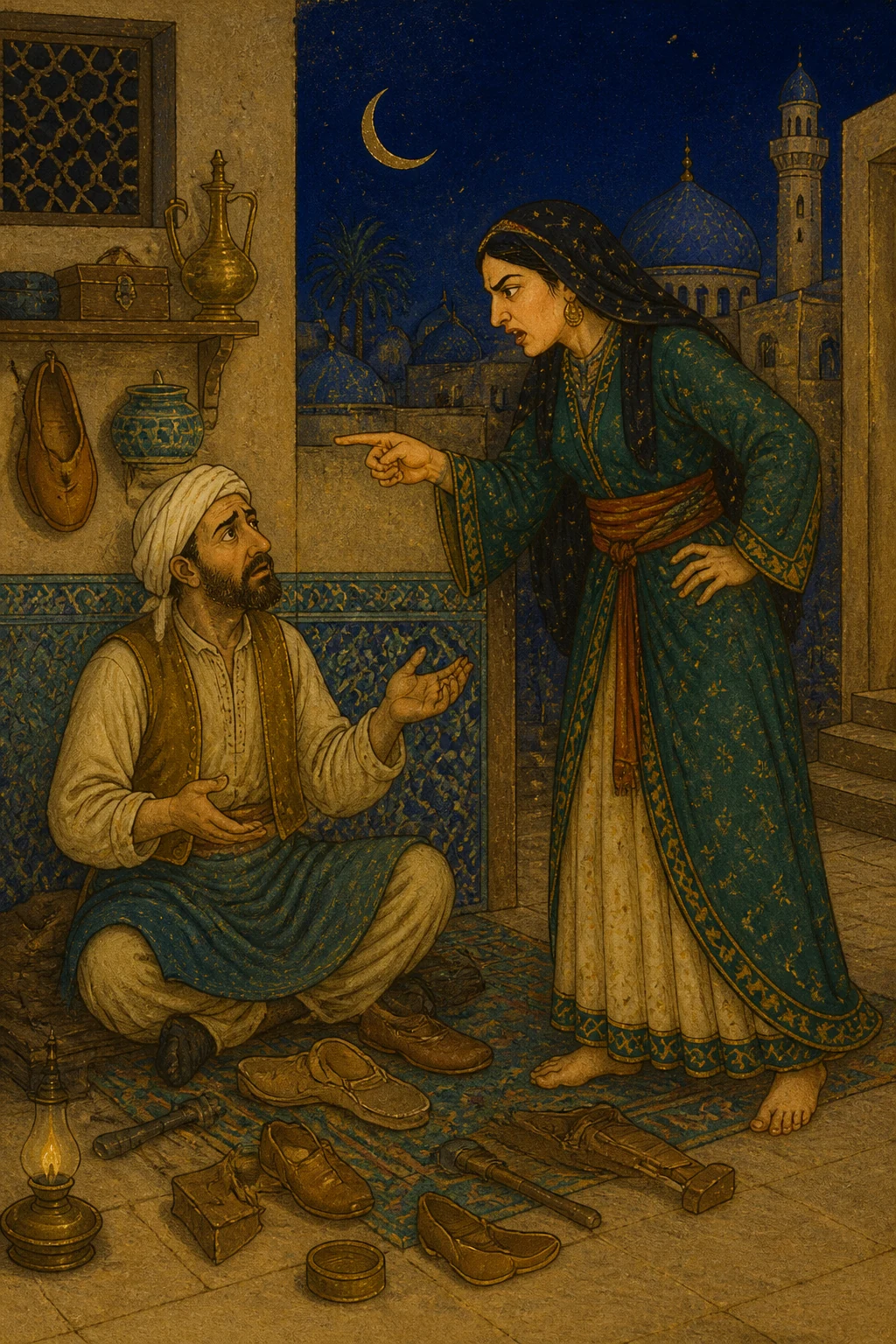
It is related, O fortunate King, that in the well-protected city of Cairo there lived a cobbler who patched old slippers. His name was Ma‘ruf, and he had a wife named Fatimah, nicknamed the Scourge. They called her this only because she was wicked, malicious, shameless, and forever stirring up trouble. She ruled her husband, abusing and cursing him a thousand times a day. He dreaded her malice and feared the harm she might do him, for he was a sensible man who cherished his good name. But he was poor: if he earned much, he spent it on her, and if he earned little, she took her revenge on his body that very night, leaving him no peace and making his night as black as the record of her deeds. Of such a wife the poet said:
How many a night beside my wife I lay, And passed its hours in misery and dismay! Would that, upon the night I took my bride, I had brought poison and let her drink and die! Among the things that befell this man with his wife was that she said to him one day, “Ma‘ruf, tonight I want you to bring me kunafah with bees’ honey.” “May Almighty God provide me with its price,” he replied, “and I shall bring it to you tonight. By God, I have not had a dirham today, but our Lord will provide.” “I know nothing of such talk,” she said. And dawn overtook Shahrazad, and she fell silent, leaving her tale untold.
When it was the nine hundred and ninetieth night,
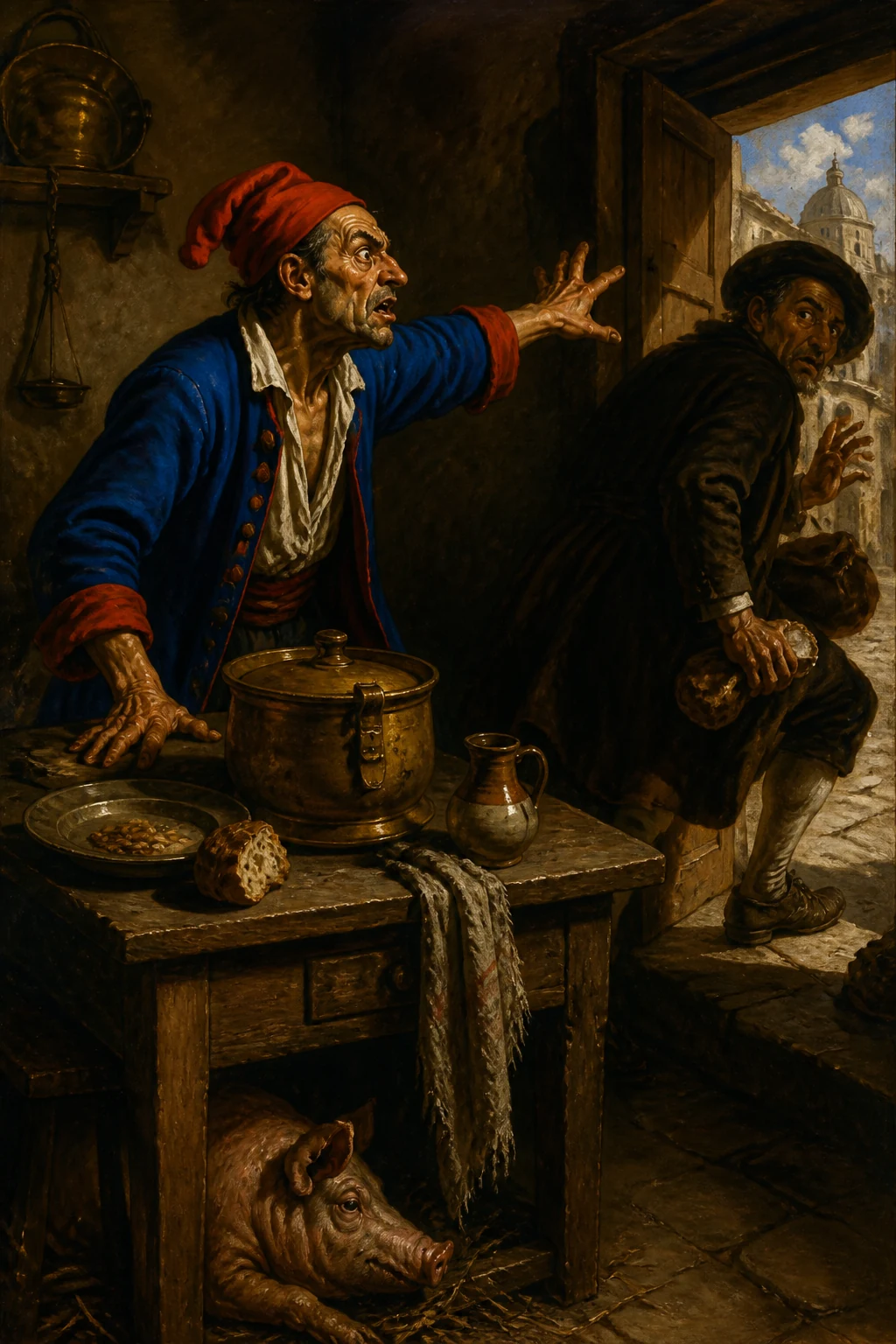
She said: It has reached me, O fortunate King, that Ma‘ruf the cobbler said to his wife, “May God provide me with its price, and I shall bring it to you tonight. By God, I have not had a dirham today, but our Lord will provide.” She answered, “I know nothing of such talk. Whether He provides or not, do not come home without kunafah made with bees’ honey. If you come without it, I shall make your night as wretched as your fortune was when you married me and fell into my hands.” “God is generous,” he said. Then the poor man went out, grief seeming to spill from his very hands. He prayed the dawn prayer, opened his shop, and said, “Lord, I ask You to grant me the price of this kunafah and spare me the wickedness of this woman tonight.” He sat in his shop until noon, but no work came his way. His fear of his wife grew so great that he rose and shut the shop, utterly at a loss over the kunafah, when he had not even the price of bread. Passing the pastry cook’s shop, he stopped in bewilderment, and his eyes filled with tears. The pastry cook noticed him and said, “Master Ma‘ruf, why are you weeping? Tell me what has happened.” He told him his story, saying, “My wife is a tyrant. She has demanded kunafah, and I have sat in my shop until past noon without earning even the price of bread. I am afraid of her.” The pastry cook laughed. “Never mind. How many ratls do you want?” “Five,” he replied. The man weighed out five ratls for him and said, “I have clarified butter, but no bees’ honey. I do have sugar syrup, better than bees’ honey. What harm if it is made with syrup?” Ma‘ruf was ashamed to object, since the man was allowing him credit, and said, “Let it be with syrup.” So the pastry cook fried the kunafah in clarified butter and drenched it in syrup, until it was fit to be presented to kings. Then he asked, “Do you need bread and cheese?” “Yes,” Ma‘ruf replied. He bought him four half-dirhams’ worth of bread and half a dirham’s worth of cheese; the kunafah cost ten half-dirhams. “Know, Ma‘ruf,” he said, “that you now owe fifteen half-dirhams. Go home to your wife and enjoy yourselves. Take this half-dirham for the bathhouse, too. You may have a day or two or three, until God provides for you. Do not stint your wife on my account; I can wait until you have money to spare beyond your expenses.” Ma‘ruf took the kunafah, bread, and cheese and went away blessing him, his spirits restored. “Glory be to You, my Lord!” he said. “How generous You are!” When he went in to his wife, she asked, “Have you brought the kunafah?” “Yes,” he said, setting it before her. She looked at it, saw that it was made with cane syrup, and cried, “Did I not tell you to bring it with bees’ honey? You go against my wishes and have it made with cane syrup!” He tried to excuse himself. “I could only buy it on credit.” “Nonsense!” she said. “I will eat kunafah only with bees’ honey.” Flying into a rage, she struck him in the face with it and said, “Get up, you cuckold, and bring me another!” Then she punched him in the temple, knocking out one of his teeth, and blood ran down his chest. In his fury he gave her one light blow on the head, whereupon she seized his beard and began to scream, “Help, Muslims!” The neighbours came in, freed his beard from her grasp, and began reproaching her. “Every one of us would be glad to eat kunafah made with cane syrup,” they said. “Why do you tyrannize over this poor man? Shame on you!” They went on soothing her until they made peace between the pair. But once the neighbours had gone, she swore she would not eat a morsel of the kunafah. Hunger gnawed at him, and he thought, “She has sworn not to eat it, so I shall.” He began eating, and when she saw him she said, “God willing, may it turn to poison and rot your cursed body!” “Your words will not make it so,” he replied, and went on eating and laughing. “You swore you would not eat any of this. God is generous: tomorrow night, God willing, I shall bring you kunafah made with bees’ honey, and you can eat it all yourself.” He tried to soothe her, while she called down curses on him, and she continued reviling and abusing him until morning.
When morning came, she rolled up her sleeves to beat him. “Give me time,” he said, “and I shall bring you another.” He went out to the mosque, prayed, and then made his way to his shop, opened it, and sat down. Scarcely had he settled himself when two men came from the judge and said, “Come and speak to the judge. Your wife has lodged a complaint against you; she is a woman of such and such a description.” He recognized her and said, “May Almighty God make her miserable!” Then he rose and went with them to the judge. There he saw his wife standing with her arm bound up and her veil stained with blood, weeping and wiping away her tears. “Man,” said the judge, “have you no fear of Almighty God? How could you beat this woman, break her arm, knock out her tooth, and treat her in this fashion?” “If I struck her or knocked out her tooth,” he replied, “pass whatever sentence you choose upon me. But this is what happened, and the neighbours made peace between us.” He told him the whole story from beginning to end. The judge was a kindly man; he took out a quarter-dinar and said, “Here, take this and have some kunafah made for her with bees’ honey, and make peace with one another.” “Give it to her,” said Ma‘ruf. She took it, and the judge reconciled them, saying, “Woman, obey your husband. And you, man, be gentle with her.” They left, having been reconciled by the judge. The woman went one way, and her husband went another, back to his shop. He had sat down when the officers came and said, “Pay us our fee.” “The judge took nothing from me,” he replied. “On the contrary, he gave me a quarter-dinar.” “It is no concern of ours whether the judge gave you money or took it from you. Unless you pay us our fee, we shall take it by force.” They began dragging him through the market, until he sold his tools and gave them half a dinar. Then they left him, and he sat with his cheek resting on his hand, grieving, for now he had no tools with which to work.
While he sat there, two ill-favoured men approached him and said, “Get up, man, and come speak to the judge. Your wife has complained against you.” “But he has already made peace between us!” he said. “We come from another judge,” they replied. “Your wife has complained to our judge.” He rose and went with them, praying that God would requite her. When he saw her, he said, “Did we not make peace, good woman?” “There is no peace left between you and me,” she answered. He stepped forward and told the judge his story, saying, “Judge So-and-so reconciled us only this hour.” “You harlot,” the judge said to her, “if you have made peace, why have you come to complain to me?” “He beat me afterwards,” she replied. The judge said to them, “Make peace. You must not beat her again, and she must not disobey you.” So they made peace, and the judge told him, “Pay the officers their fee.” He paid them and returned to his shop, opened it, and sat down, dazed as a drunken man by all the trouble that had befallen him. While he was sitting there, a man came up and said, “Ma‘ruf, get up and hide! Your wife has complained against you to the High Court, and Abu Tabaq is coming after you.” He rose, shut his shop, and fled towards Bab al-Nasr. Of the money from his lasts and tools, he still had five silver half-dirhams; as he fled from her, he bought four half-dirhams’ worth of bread and half a dirham’s worth of cheese. It was winter, and the time of the afternoon prayer. When he came out among the rubbish mounds, rain poured down on him as though from the mouths of waterskins, soaking his clothes. He went into al-‘Adiliyyah and saw a ruined place containing an abandoned storeroom without a door. He entered it to shelter from the rain, his clothes drenched, and tears streamed from his eyes. Bemoaning his plight, he said, “Where can I flee from this harlot? Lord, I ask You to send me someone who will carry me to a distant land where she cannot trace me.” As he sat weeping, the wall suddenly split open, and out came a tall figure whose appearance made the flesh creep. “Man,” he said, “why have you disturbed me tonight? I have lived here for two hundred years, and never have I seen anyone enter this place and behave as you have done. Tell me what you want, and I shall grant your wish, for my heart is moved to pity for you.” “Who are you?” Ma‘ruf asked. “What sort of being are you?” “I am the spirit who inhabits this place,” he replied. Ma‘ruf told him everything that had happened with his wife. “Would you like me to carry you to a land where your wife cannot trace you?” the spirit asked. “Yes,” he replied. “Climb on my back.” He mounted, and the spirit bore him away, flying with him from after the night prayer until dawn, when he set him down on the summit of a lofty mountain. And dawn overtook Shahrazad, and she fell silent, leaving her tale untold.
When it was the nine hundred and ninety-first night,
She said: It has reached me, O fortunate King, that when the mighty jinni had carried Ma‘ruf the cobbler through the air and set him down on a lofty mountain, he said, “Mortal, descend this mountain, and you will see the gates of a city. Enter it, for your wife will never discover your whereabouts and cannot reach you here.” Then he left him and went away. Ma‘ruf remained bewildered and at a loss until the sun rose. Then he said to himself, “I had better get up and descend this mountain to the city. There is no use sitting here.” He went down to the foot of the mountain and saw a city with lofty walls, towering palaces, and richly ornamented buildings, a delight to the beholder. He entered its gate and found it a place to gladden a sorrowful heart. As he walked through the market, the townspeople began staring at him and gathering round, marvelling at his clothes, which were unlike their own. One of them said, “Man, are you a stranger?” “Yes,” he replied. “From what country?” “From the fortunate city of Cairo.” “Have you been away from it long?” “Since yesterday afternoon.” The man laughed and called, “People, come and look at this fellow and hear what he says!” “What does he say?” they asked. “He claims to be from Cairo, and says he left it yesterday afternoon.” They all laughed and crowded round him. “Man,” they said, “are you mad, to talk like this? How can you claim to have left Cairo yesterday afternoon and be here this morning, when our city is a whole year’s journey from Cairo?” “You are the mad ones,” he replied. “I am telling the truth. Here is bread from Cairo, still fresh in my possession!” He showed them the bread, and they stared at it in wonder, for it was unlike the bread of their own country. The crowd around him grew, and they began saying to one another, “This is bread from Cairo. Come and look!” News of him spread through the city: some believed him, while others called him a liar and mocked him.
While they were thus occupied, a merchant approached on a mule, with two slaves following him. He scattered the crowd, saying, “People, have you no shame, gathering round this stranger to mock him and laugh at him? What business is he of yours?” He went on berating them until he drove them away, and none dared answer him. Then he said to Ma‘ruf, “Come, brother. Never mind these people; they have no shame.” He took him along to a spacious, richly decorated house, seated him on a royal couch, and ordered the slaves to open a chest. They brought out the clothes of a merchant worth thousands and dressed him in them. Ma‘ruf was a handsome man, and now he looked like the chief of the merchants. Then the merchant called for food, and they set before them a table laden with every kind of sumptuous dish. They ate and drank, and afterwards he asked, “Brother, what is your name?” “My name is Ma‘ruf, and I am a cobbler. I patch old slippers.” “What country are you from?” “Cairo.” “Which quarter?” “Do you know Cairo?” “I was born there.” “I am from al-Darb al-Ahmar.” “Whom do you know in al-Darb al-Ahmar?” “So-and-so, and So-and-so,” he replied, naming many people. “Do you know Shaykh Ahmad the perfumer?” “He is my next-door neighbour; our houses share a wall.” “Is he well?” “Yes.” “How many children has he?” “Three: Mustafa, Muhammad, and ‘Ali.” “What has God made of his sons?” “Mustafa is well; he is a scholar and teacher. Muhammad is a perfumer. He opened a shop beside his father’s after he married, and his wife bore him a son named Hasan.” “May God bring you good tidings!” said the merchant. “As for ‘Ali,” Ma‘ruf continued, “he was my companion when we were little, and we were always playing together. We used to pass ourselves off as Christian boys, go into the church, steal the Christians’ books, and sell them for spending money. Once the Christians saw us and caught us with a book. They complained to our families and said to his father, ‘Unless you stop your son from troubling us, we shall complain to the king.’ His father appeased them and gave him a sound beating. Because of this, he ran away, and no one has known what became of him since. He has been gone twenty years, and no one has brought any news of him.” “I am that ‘Ali, son of Shaykh Ahmad the perfumer,” said the merchant, “and you are my old companion, Ma‘ruf!” And they embraced.
After their greetings, he said, “Ma‘ruf, tell me what brought you from Cairo to this city.” He told him about his wife Fatimah the Scourge and all she had done to him. “When her persecution became unbearable,” he said, “I fled towards Bab al-Nasr. Rain overtook me, and I went into a ruined storeroom in al-‘Adiliyyah and sat there weeping. The spirit who lived there, an ‘ifrit of the jinn, came out and questioned me. I told him my plight, and he took me on his back and flew with me all night between heaven and earth. Then he set me down on the mountain and told me about the city. I came down and entered it. The people gathered round and questioned me, and when I said I had left Cairo yesterday, they would not believe me. Then you came, drove the people away, and brought me to this house. That is why I left Cairo. But what brought you here?” ‘Ali replied, “I was seven years old when my recklessness got the better of me. From that time I wandered from country to country and city to city, until I entered this city, which is called Ikhtiyan al-Khutan. I found its people generous and compassionate. I saw that they trusted poor men and lent them money, believing whatever they said. So I told them, ‘I am a merchant and have come ahead of my caravan. I want a place in which to lodge my goods.’ They believed me and cleared a place for me. Then I said, ‘Will anyone lend me a thousand dinars until my caravan arrives, when I shall repay what I have borrowed? I have certain expenses to meet before it comes.’ They gave me what I wanted. I went to the merchants’ market, found some goods, and bought them. The next day I sold them at a profit of fifty dinars and bought more. I began mixing with people and treating them generously, so that they grew fond of me. I continued buying and selling, and my wealth increased. Know, brother, that, as the saying goes, ‘The world is bluff and cunning; in a land where no one knows you, do whatever you please.’ If you tell everyone who asks you, ‘I am a poor cobbler who ran away from his wife, and I left Cairo yesterday,’ they will not believe you, and you will remain their laughingstock as long as you live in this city. If you say, ‘An ‘ifrit carried me here,’ they will shun you, and no one will come near you. They will say, ‘This man is haunted by an ‘ifrit; anyone who approaches him will come to harm.’ Such a rumour would bring disgrace on both you and me, since they know I am from Cairo.” “What am I to do?” Ma‘ruf asked. “I shall teach you,” he replied. “Tomorrow, Almighty God willing, I shall give you a thousand dinars, a mule to ride, and a slave to walk before you and conduct you to the entrance of the merchants’ market. Go in; I shall be sitting among the merchants. As soon as I see you, I shall rise, greet you, kiss your hand, and show you the greatest respect. Whenever I ask about some kind of cloth, saying, ‘Have you brought any of such and such a fabric?’ answer, ‘A great deal.’ If they ask me about you, I shall praise you and raise you in their esteem. Then I shall tell them to find you a warehouse and a shop, and describe your wealth and generosity. If a beggar comes to you, give him whatever you can. They will trust my words, believe in your greatness and generosity, and grow fond of you. Afterwards I shall invite you and all the merchants to a feast in your honour, and bring you together so that they all come to know you, and you them.” And dawn overtook Shahrazad, and she fell silent, leaving her tale untold.
When it was the nine hundred and ninety-second night,
She said: It has reached me, O fortunate King, that the merchant ‘Ali said to Ma‘ruf, “I shall invite you and all the merchants to a feast in your honour, and bring you together so that they all come to know you, and you them. Then you may buy and sell and do business with them, and before long you will be a wealthy man.” When morning came, he gave him a thousand dinars, dressed him in a fine suit, mounted him on a mule, and assigned him a slave. “May God free you of any obligation to repay any of this,” he said. “You are my old companion, and it is my duty to honour you. Have no worries, and put your wife out of your mind. Do not mention her to anyone.” “May God reward you with good,” Ma‘ruf replied. Then he mounted the mule, and the slave walked before him until they reached the entrance of the merchants’ market. The merchants were all seated there, with ‘Ali among them. When he saw Ma‘ruf, he rose and flung himself upon him, saying, “A blessed day to you, Merchant Ma‘ruf, man of bounty and good deeds!” He kissed his hand before the merchants and said, “Brothers, Merchant Ma‘ruf honours us with his presence. Greet him!” He kept signalling to them to treat him with respect, and they formed a lofty opinion of him. Then he helped him down from his mule, and they greeted him. ‘Ali began taking them aside one by one and praising him. “Is this man a merchant?” they asked. “Indeed,” he replied, “the greatest of merchants. No one is richer than he. His wealth, and that of his father and grandfathers, is famous among the merchants of Cairo. He has partners in India, Sind, and Yemen, and his generosity is immense. Recognize his worth, honour him, and attend to his needs. Know that he has not come to this city to trade, but only to see foreign lands. He has no need to travel abroad for profit and gain: he possesses riches that even fire could not consume. I am merely one of his servants.”
He continued praising him until they would gladly have carried him on their heads, and they began telling one another of his qualities. Then they gathered round him, bringing him gifts of refreshments and sherbets. Even the chief of the merchants came to greet him. In the merchants’ presence, ‘Ali began asking, “My lord, perhaps you have brought some of such and such a cloth?” “A great deal,” he replied. Earlier that day ‘Ali had shown him the costly fabrics and taught him the names of both the expensive and the cheap varieties. One of the merchants asked, “My lord, have you brought any yellow broadcloth?” “A great deal.” “And gazelle-blood red?” “A great deal.” Whatever they asked about, he answered, “A great deal.” At last the merchant said, “‘Ali, if your countryman wished to supply a thousand loads of costly fabrics, he could do so.” “He could supply them from just one of his warehouses,” ‘Ali replied, “without its stock seeming any the less.”
While they sat there, a beggar made his way among the merchants. Some gave him a silver half-dirham, others a small coin, while most gave him nothing. When he reached Ma‘ruf, Ma‘ruf scooped up a handful of gold and gave it to him. The beggar blessed him and went away. The merchants marvelled. “This is the giving of kings!” they said. “He has given the beggar gold without counting it. Had he not immense wealth and boundless resources, he would never have given a beggar a handful of gold.” A little later a poor woman approached him. He scooped up another handful and gave it to her. She went away blessing him and told the other poor people, who began coming to him one after another. To everyone who came, he gave a handful, until he had spent the thousand dinars. Then he struck his palms together and said, “God is sufficient for us, and He is the best guardian!” “What troubles you, Merchant Ma‘ruf?” asked the chief of the merchants. “It seems that most of the people in this city are poor and needy,” he replied. “Had I known, I should have brought a quantity of money in my saddlebags to give them in charity. I fear my stay here may be prolonged, and it is not in my nature to turn a beggar away. Now I have no gold left. If a poor man comes to me, what am I to tell him?” “Tell him, ‘May God provide for you.’” “That is not my custom, and it is this that weighs on me. I should like a thousand dinars to give in charity until my caravan arrives.” “That is easily done,” said the chief of the merchants. He sent one of his attendants to fetch a thousand dinars and gave them to him. Ma‘ruf began giving to every poor person who passed until the call to the noon prayer. They entered the mosque and prayed, and he scattered what remained of the thousand dinars over the heads of the worshippers. The people took notice of him and began blessing him, while the merchants marvelled at his boundless generosity. Then he turned to another merchant, borrowed a thousand dinars, and distributed them. The merchant ‘Ali watched what he was doing but could say nothing. Ma‘ruf continued in this fashion until the call to the afternoon prayer, when he entered the mosque, prayed, and gave away what remained. Before the market gates were shut, he had borrowed five thousand dinars and given them all away. To everyone from whom he borrowed, he said, “Wait until my caravan arrives. If you want gold, I shall give you gold; if you want cloth, I shall give you cloth. I have a great deal.” That evening ‘Ali invited him to a feast, with all the merchants, and seated him in the place of honour. Ma‘ruf spoke of nothing but fabrics and jewels, and whenever they mentioned anything, he said, “I have a great deal of it.” The next day he went to the market and began turning to the merchants for money and distributing it among the poor.
He continued in this fashion for twenty days, until he had borrowed sixty thousand dinars, yet no caravan arrived—not so much as a hot dumpling. The people grew anxious about their money. “Merchant Ma‘ruf’s caravan has not come,” they said. “How long is he to go on taking people’s money and giving it to the poor?” One of them said, “We had better speak to his countryman, the merchant ‘Ali.” So they went to him and said, “Merchant ‘Ali, Merchant Ma‘ruf’s caravan has not arrived.” “Be patient,” he told them. “It is bound to arrive soon.” Then he took Ma‘ruf aside and said, “Ma‘ruf, what are you doing? Did I tell you to toast the bread or burn it? The merchants are clamouring for their money. They tell me you owe sixty thousand dinars, which you have borrowed and given to the poor. How will you repay people’s debts when you neither buy nor sell?” “What does it matter?” Ma‘ruf replied. “What is sixty thousand dinars? When my caravan arrives, I shall give them cloth if they want it, or gold and silver if they prefer.” “God is great!” ‘Ali exclaimed. “Do you actually have a caravan?” “A great deal.” “May God and His saints deal with you and your foolishness! Did I teach you those words so that you could use them on me? I know you better than anyone!” “Go away and stop chattering,” Ma‘ruf said. “Am I a poor man? There is a great deal in my caravan. When it arrives, they shall have twice what they lent. I have no need of them.” ‘Ali grew angry. “You ill-mannered fellow!” he said. “I shall teach you to lie to me without shame.” “Do whatever lies in your power,” Ma‘ruf replied. “They can wait until my caravan arrives, and they shall have their money back with something extra.” ‘Ali left him and went away, saying to himself, “I praised him before. If I denounce him now, I shall appear a liar and fall under the saying, ‘He who praises and then condemns has lied twice.’” He did not know what to do. Then the merchants came and asked, “Merchant ‘Ali, have you spoken to him?” “Friends,” he replied, “I am ashamed to press him. He owes me a thousand dinars, and I cannot bring myself to ask him for it. You did not consult me when you lent him money, and you have no claim upon me. Demand it from him yourselves. If he will not repay you, complain to the king of the city and say, ‘He is a swindler who has cheated us.’ The king will recover your money for you.” They went to the king, told him what had happened, and said, “King of the age, we are at a loss over this extraordinarily generous merchant. He does such and such, and everything he borrows he distributes to the poor by the handful. Were he a man of little means, he could not bear to scoop up gold and give it away to beggars. Yet if he were truly wealthy, the arrival of his caravan would have proved his honesty by now. We have seen no caravan, though he claims to have one and says he has come ahead of it. Whenever we mention any kind of fabric, he says, ‘I have a great deal of it.’ Some time has passed, and there is still no news of his caravan. He now owes us sixty thousand dinars, all of which he has given to the poor.” And they continued praising him and extolling his generosity. Now this king was a greedy man, greedier than Ash‘ab. When he heard of Ma‘ruf’s liberality and bounty, greed overcame him, and he said to his vizier, “If this merchant did not possess immense riches, he could not be so generous. His caravan is bound to arrive, and these merchants will gather round him, and he will lavish money upon them. I have a better right to that money than they do. I mean to cultivate his friendship and win his affection until his caravan comes. Then I shall take what these merchants would have taken from him, marry him to my daughter, and add his wealth to mine.” “King of the age,” the vizier replied, “I believe he is nothing but a swindler, and the swindler is the ruin of the greedy man.” And dawn overtook Shahrazad, and she fell silent, leaving her tale untold.
When it was the nine hundred and ninety-third night,
She said: It has reached me, O fortunate King, that when the vizier said to the king, “I believe he is nothing but a swindler, and the swindler is the ruin of the greedy man,” the king answered, “Vizier, I shall test him and discover whether he is a swindler or an honest man, and whether or not he was brought up in wealth.” “How will you test him?” asked the vizier. “I have a jewel,” said the king. “I shall send for him, and when he is seated, I shall honour him and hand him the jewel. If he recognizes it and knows its value, he must be a man accustomed to wealth and plenty. If he does not recognize it, he is an upstart swindler, and I shall put him to a most dreadful death.” The king sent for Ma‘ruf and had him brought before him. When he entered, he greeted the king, who returned his greeting, seated him beside him, and said, “Are you Merchant Ma‘ruf?” “Yes,” he replied. “The merchants claim that you owe them sixty thousand dinars. Is what they say true?” “Yes.” “Why have you not repaid them?” “Let them wait until my caravan arrives, and I shall give them twice what they lent. If they want gold, I shall give them gold; if they want silver, I shall give them silver; if they want merchandise, I shall give them merchandise. To anyone who lent me a thousand I shall give two thousand, in return for having saved my face before the poor. I have a great deal.” Then the king said, “Merchant, take this and see what kind of stone it is and what it is worth.” He handed him a jewel the size of a hazelnut, which he had bought for a thousand dinars. It was the only one he possessed, and he treasured it greatly. Ma‘ruf took it and pinched it between his thumb and forefinger, breaking it, for the gem was delicate and could not withstand the pressure. “Why did you break the jewel?” the king asked. Ma‘ruf laughed. “King of the age, this is no jewel! It is a bit of mineral worth a thousand dinars. How can you call it a jewel? A jewel is worth seventy thousand dinars; this can only be called a bit of mineral. Unless a jewel is the size of a walnut, it has no value in my eyes, and I pay it no attention. How can you be a king and call this a jewel, when it is a bit of mineral worth a thousand dinars? But you are excused, for you are poor and possess no treasures of value.” “Merchant,” the king asked, “do you have jewels of the kind you describe?” “A great deal.” Greed overcame the king. “Will you give me some unbroken jewels?” he asked. “Wait until my caravan arrives, and I shall give you many. Whatever you ask for, I have a great deal of it, and I shall give it to you without payment.” The king was delighted and said to the merchants, “Go about your business and be patient with him until his caravan arrives. Then come and receive your money from me.” And they departed.
Such was the affair of Ma‘ruf and the merchants. As for the king, he turned to his vizier and said, “Treat Merchant Ma‘ruf pleasantly and engage him in conversation. Mention my daughter to him, so that he may marry her and we may gain these riches of his.” “King of the age,” the vizier replied, “I do not like the look of this man. I believe he is a swindler and a liar. Abandon this idea, lest you throw away your daughter for nothing.” Now the vizier had previously urged the king to give him the princess in marriage, wishing to marry her himself, but when she heard of it, she refused. The king said, “You traitor! You wish me no good because you once asked for my daughter and she would not marry you. Now you seek to obstruct her marriage, hoping she will remain unwanted until you can take her yourself! Listen to me: this is none of your concern. How can he be a swindler and a liar, when he knew the jewel’s price to be exactly what I paid for it, and broke it because it did not please him and he possesses better jewels? Once he goes in to my daughter and sees her beauty, she will captivate him. He will love her and give her jewels and treasures. You wish to deprive both my daughter and me of these riches.” The vizier fell silent, fearing the king’s anger, and said to himself, “Set the dogs upon the cattle.” Then he turned to Merchant Ma‘ruf and said, “His Majesty has taken a liking to you. He has a daughter of great beauty whom he wishes to give you in marriage. What do you say?” “I have no objection,” Ma‘ruf replied, “but let him wait until my caravan arrives. The dowries of kings’ daughters are great, and their rank demands a dowry suited to their station. At present I have no money, so let him wait for my caravan. I have abundant wealth. I must give her five thousand as her marriage portion, and I shall need a thousand purses to distribute among the poor and needy on the wedding night, another thousand purses for those who walk in the bridal procession, and another thousand to provide food for the soldiers and everyone else. I shall need a hundred jewels to give the princess on the morning after the wedding, and a hundred more to distribute among her maidservants and attendants, one to each, in honour of the bride. I must also clothe a thousand naked poor people, and there must be charitable gifts. None of this can be done until the caravan arrives. I have a great deal, and once it comes, all this expense will mean nothing to me.” The vizier returned and reported his words to the king. “If that is his intention,” said the king, “how can you call him a swindler and a liar?” “I still say he is,” replied the vizier. The king shouted at him and rebuked him. “By my head, unless you stop saying this, I shall have you killed! Go back and bring him to me. I shall settle matters with him myself.” The vizier went to Ma‘ruf and said, “Come and speak to the king.” “I hear and obey,” he replied, and went with him. The king said, “Do not make these excuses. My treasury is full. Take the keys and spend whatever you need. Give as you please, clothe the poor, and do whatever you wish. Do not concern yourself about the princess or her attendants. When your caravan arrives, honour your wife with whatever gifts you please. We shall wait for her marriage portion until the caravan comes. Between you and me there is no distinction at all.”
Then he ordered the Sheikh of Islam to draw up the marriage contract, and the king’s daughter was married to the merchant Ma‘ruf. Preparations for the wedding began, and the king commanded that the city be decorated. Drums were beaten, tables were spread with every kind of food, and entertainers flocked in. The merchant Ma‘ruf sat upon a chair in a reception hall, while performers, tumblers, dancing girls, and masters of strange feats and marvelous diversions appeared before him. He would summon the treasurer and say, “Bring gold and silver!” The treasurer brought it, and Ma‘ruf went among the spectators, rewarding every performer by the handful, giving alms to the poor and needy, and clothing the naked. It was a riotous celebration. The treasurer could scarcely bring money from the treasury fast enough, and the vizier’s heart nearly burst with rage, yet he dared not speak. The merchant Ali marveled at this lavish spending and said to Ma‘ruf, “May God and His saints bring you to your senses! Was it not enough to squander the merchants’ money, that you must squander the king’s as well?” Ma‘ruf replied, “It is no concern of yours. When the caravan comes, I shall repay the king many times over.” And he went on scattering money, saying to himself, “Into the fire with it! What happens will happen, and there is no escaping what is decreed.” The festivities continued for forty days. On the forty-first, they led the bride in procession, with all the emirs and soldiers walking before her. As they brought her in, Ma‘ruf scattered gold over the people’s heads. It was a magnificent bridal procession, and a prodigious sum was spent upon it. Then they brought him to the princess, and he sat upon the raised couch. They lowered the curtains, closed the doors, and withdrew, leaving him alone with his bride. He struck one hand against the other and sat sorrowfully for a while, clapping his palms together and saying, “There is no power and no strength save in God, the Most High, the Almighty!” The princess said, “May no harm befall you, my lord! Why are you troubled?” “How should I not be troubled,” he replied, “when your father has upset all my plans and done me an injury like setting fire to a green crop?” “What has my father done to you? Tell me.” He said, “He has brought me to you before my caravan arrives. I had intended to distribute at least a hundred jewels among your handmaids, one for each, so that she might rejoice and say, ‘My master gave me a jewel on the night he first went in to my mistress.’ Such a gift would have exalted your station and added to your honor, for I would not begrudge the jewels: I have plenty of them.” She replied, “Do not trouble yourself over that, or let it grieve you. As for me, you need not worry: I shall wait patiently until the caravan comes. And as for the handmaids, you need not concern yourself with them. Come, take off your clothes and be at ease. When the caravan arrives, there will be time enough for those jewels and more.” So he rose, took off his clothes, and sat upon the bed. He sought her playful caresses, and their amorous wrestling began. He laid his hand upon her knee, and she sat in his lap and offered her lips to his mouth. It was an hour to make a man forget his father and mother. He embraced her and drew her close, squeezed her in his arms, pressed her to his breast, and sucked her lips until honey flowed from her mouth. He slipped his hand beneath her left arm, and every limb of his and hers yearned for union. He nudged her between the breasts, and she yielded between the thighs; he girded himself with her legs, plied his double task, and cried, “Ho, father of the two veils!” Then he set the charge, lit the fuse, took aim at the touchhole, and fired. The tower collapsed at all four corners, the deed that needs no questions was done, and she gave the cry that must be given. But morning overtook Shahrazad, and she fell silent, leaving off her permitted tale.
When it was the nine hundred and ninety-fourth night,
She said: It has reached me, O fortunate king, that when the king’s daughter gave the cry that must be given, the merchant Ma‘ruf took her maidenhead. That night was one not counted among the days of a lifetime, filled as it was with the union of lovers, with embracing and amorous wrestling, kissing and sucking, until morning. Then he went to the bath and dressed in a suit of royal robes. Leaving the bath, he entered the king’s council chamber, where everyone rose to his feet and received him with honor and respect, congratulating him and invoking blessings upon him. He sat beside the king and asked, “Where is the treasurer?” “Here he is, before you,” they replied. “Bring robes of honor,” he said, “and clothe all the viziers, emirs, and officers of state.” The treasurer brought everything he asked for, and Ma‘ruf sat giving to everyone who came, bestowing gifts upon each according to his rank. He continued in this fashion for twenty days, yet no caravan appeared, nor any sign of one. At last the treasurer grew exceedingly distressed and went to the king in Ma‘ruf’s absence. The king was sitting alone with the vizier. The treasurer kissed the ground before him and said, “O king of the age, I must tell you something, lest you should later blame me for keeping it from you. Know that the treasury is empty, with only a little money left. In ten days we shall close its doors upon nothing.” The king said, “Vizier, my son-in-law’s caravan is late, and no news of it has come.” The vizier laughed and replied, “May God be merciful to you, O king of the age! You are utterly blind to the tricks of this lying swindler. By your head, he has no caravan, nor so much as a calamity to rid us of him! He has merely kept cheating you until he has squandered your money and married your daughter for nothing. How long will you remain blind to this liar?” The king asked, “Vizier, how are we to discover the truth about him?” He replied, “O king of the age, no one knows a man’s secrets but his wife. Send for your daughter and have her come behind the curtain, so that I may question her about him and she may put him to the test and discover his true circumstances for us.” “There is no harm in that,” said the king. “By my head, if he proves to be a lying swindler, I shall put him to the most dreadful death!”
Then he took the vizier into the sitting room and sent for his daughter. She came behind the curtain while her husband was away and asked, “Father, what do you wish?” He said, “Speak to the vizier.” “Vizier,” she asked, “what is the matter?” He replied, “My lady, know that your husband has squandered your father’s wealth and married you without paying a dowry. He keeps making promises and breaking them, and there is no news of his caravan. In short, we want you to tell us about him.” She said, “He talks a great deal. He is forever coming to me and promising jewels, treasures, and costly fabrics, but I have seen nothing.” The vizier said, “My lady, can you draw him into conversation tonight and say, ‘Tell me the truth and fear nothing. You are my husband now, and I will not forsake you. Tell me how matters really stand, and I shall devise a plan to set your mind at ease.’ Then lead him gently this way and that in your talk, show him your love, and get him to confess. Afterward, tell us the truth about him.” She replied, “Father, I know how to put him to the test.” Then she went away. After supper, her husband Ma‘ruf came to her as usual. She rose to greet him, took him by the arm, and beguiled him with the utmost artfulness—and what guile can rival a woman’s when she has something she wants from a man? She continued coaxing him and speaking to him in words sweeter than honey until she stole his wits away. When she saw that he had yielded to her entirely, she said, “My beloved, light of my eyes and fruit of my heart, may God never leave me desolate without you, nor time ever part us! Love for you has made its home within my heart, and the fire of my passion has burned my very soul. I will never forsake you, but I want you to tell me the truth. Lies and tricks are useless: they cannot succeed forever. How long will you go on cheating my father and lying to him? I fear he will discover you before we can devise some plan, and then he will strike you down. Tell me the truth, and you shall have only what pleases you. Once you have told me how matters stand, you need fear no harm. How long have you been claiming to be a wealthy merchant with a caravan? All this time you have been saying, ‘My caravan! My caravan!’ Yet no news of it has come, and I can see the anxiety on your face. If there is no truth in your words, tell me, and, God willing, I shall devise a way to save you.” He replied, “My lady, I shall tell you the truth, and you may do whatever you wish.” She said, “Speak, and speak truthfully, for truth is the ship of salvation. Beware of lying, for it disgraces the liar. Well did the poet say:
Cling to the truth, though it should burn you in the fire of threatened punishment. Seek God’s good pleasure: the greatest fool alive is he who angers the Lord to please His servants. He said, “My lady, know that I am no merchant. I have neither a caravan nor a blazing calamity. In my own country I was a cobbler, and I had a wife named Fatima al-‘Arra. This and that befell me with her…” And he told her his story from beginning to end. She laughed and said, “You are indeed a master of lying and swindling!” He replied, “My lady, may Almighty God preserve you to cover faults and dispel sorrows.” She said, “Know that you have cheated my father and so beguiled him with your boasting that, out of greed, he married me to you. Then you squandered his money. The vizier resents you for this, and time and again he has spoken against you to my father, saying, ‘He is a lying swindler.’ But my father would not listen, because the vizier had asked for my hand and I had refused to take him as my husband and become his wife. Now, however, so much time has passed that my father has grown anxious and told me, ‘Make him confess.’ I have made you confess, and the hidden truth has come to light. My father is determined to harm you on this account. But you are my husband now, and I will not forsake you. If I tell my father, he will know for certain that you are a lying swindler who cheats kings out of their daughters and squanders their fortunes. In his eyes your offense will be unforgivable, and he will certainly kill you. Then word will spread that I married a lying swindler, and I shall be disgraced. If my father kills you, he may think fit to marry me to another, and that I would never accept, even if I died. So rise now, dress yourself as a mamluk, take fifty thousand dinars of my own money, mount a horse, and travel to a land beyond my father’s power. Set yourself up there as a merchant, and write me a letter. Send it by a messenger who will bring it to me secretly, so that I may know what country you are in. Then I shall send you everything I can lay my hands on, and your wealth will grow. If my father dies, I shall send for you, and you may return in honor and glory. If you or I should pass into the mercy of Almighty God, the Resurrection will bring us together. This is the right course. As long as you are alive and I am alive, I shall never cease sending you letters and money. Rise before daylight overtakes you, leaving you helpless and surrounded by destruction.”
He said to her, “My lady, I beseech you by your honor to let me bid you farewell in your embrace.” “Gladly,” she replied. So he lay with her, then washed and dressed himself as a mamluk. He ordered the grooms to saddle one of the finest horses for him, and they did so. Then he bade her farewell, left the city in the last hours of the night, and rode away. Everyone who saw him took him for one of the sultan’s mamluks traveling on an errand. When morning came, her father and the vizier entered the sitting room, and the king sent for her. She came behind the curtain, and he asked, “Daughter, what have you to say?” She replied, “I say, may God blacken your vizier’s face! He meant to blacken mine in my husband’s eyes.” “How so?” asked the king. She said, “Yesterday my husband came to me, and before I could mention the matter, Faraj the eunuch appeared with a letter in his hand. He said, ‘Ten mamluks are standing beneath the palace window. They gave me this letter and said, “Kiss our master Ma‘ruf’s hands for us and give him this letter. We are some of his mamluks who were with the caravan. We have heard that he has married the king’s daughter, and have come to tell him what befell us on the road.”’ My husband took the letter and read it. It said, ‘From the five hundred mamluks to His Honor our master, the merchant Ma‘ruf. To proceed: we inform you that after you left us, the Arabs fell upon us and gave us battle. They numbered about two thousand horsemen, while we were five hundred mamluks. A great battle broke out between us and the Arabs, and they barred our way. For thirty days we have been fighting them, and this is why we have been delayed…’” But morning overtook Shahrazad, and she fell silent, leaving off her permitted tale.
When it was the nine hundred and ninety-fifth night,
She said: It has reached me, O fortunate king, that the king’s daughter said to her father, “My husband received a letter from his followers saying, ‘The Arabs have barred our way, and this is why we have been delayed. They have taken two hundred loads of cloth from the caravan and killed fifty of our mamluks.’ When he heard this, he said, ‘God confound them! Why should they fight the Arabs over two hundred loads of merchandise? What are two hundred loads worth? They ought not to have delayed over such a trifle. The two hundred loads are worth seven thousand dinars, but I must go to them and hurry them along. What the Arabs have taken will scarcely diminish the caravan and is of no consequence to me. I shall reckon it as alms I have given them.’ Then he went down from my chamber laughing, untroubled by the loss of his wealth or the slaughter of his mamluks. When he had gone down, I looked from the palace window and saw the ten mamluks who had brought him the letter. They were like moons, and each wore a suit worth a thousand dinars. My father has not one mamluk to compare with any of them. Then he set off with those who had brought the letter, to bring back his caravan. Praise be to God, who kept me from mentioning any of the things you told me to say! He would have laughed at both you and me, and perhaps looked down on me and come to hate me. The fault lies entirely with your vizier, who speaks so shamefully of my husband.” The king replied, “Daughter, your husband has great wealth and thinks nothing of such losses. Since the day he entered our land, he has been giving alms to the poor. God willing, he will soon bring his caravan, and much good will come to us from him.” He went on soothing her and rebuking the vizier, completely taken in by her trick.
Such was the king’s case. As for the merchant Ma‘ruf, he mounted his horse and rode through the desolate wilderness, bewildered, not knowing to what country he should go. He lamented the anguish of parting, suffered the torments of longing, and recited these verses:
Time betrayed our union, and we were torn apart; estrangement melted and consumed my heart. My eyes shed tears for those I love, now gone: when shall this parting end in reunion? O face of the radiant full moon, for love of you I have left my heart in shreds. Would that I had never met you for an hour, since after the sweetness of union I have tasted misery. Ma‘ruf has never ceased to love Dunya; if longing kills him, may she live on. O splendor of the shining sun, come to the aid of Ma‘ruf’s love-scorched heart! Will the days, I wonder, bring us together, granting us joy and reunion? Will my beloved’s palace shelter us in happiness, while I embrace her slender, swaying form? O countenance of the full moon, whose sun is radiant, your face still shines with every beauty. I am content with love and all its grief, for happiness in love is misery itself. When he had finished his verses, he wept bitterly. Every road seemed closed to him, and he preferred death to life. Then he went on like a drunken man, so great was his bewilderment, and traveled until noon, when he came upon a small village. Nearby he saw a plowman working with a pair of oxen. By then Ma‘ruf was desperately hungry, so he approached the plowman and said, “Peace be upon you.” The man returned his greeting and said, “Welcome, my lord! Are you one of the sultan’s mamluks?” “Yes,” he replied. “Then dismount and be my guest.” Ma‘ruf saw that he was a generous man and said, “Brother, I see nothing here for you to feed me with. How can you invite me?” The plowman answered, “My lord, there is plenty to be had. Dismount. The village is nearby, and I shall go and fetch you dinner and fodder for your horse.” Ma‘ruf said, “Since the village is close, I can reach it as quickly as you, buy what I want in the market, and eat.” The man replied, “My lord, it is only a little hamlet. There is no market there, nor any buying and selling. I ask you in God’s name to dismount and oblige me. I shall go there and return to you quickly.” So Ma‘ruf dismounted, and the peasant left him and went to the village to fetch his dinner. Ma‘ruf sat waiting, then said to himself, “I have kept this poor fellow from his work. I shall get up and plow in his place until he returns, to make up for the time I have cost him.” He took hold of the plow and drove the oxen forward. He had plowed only a little way when the plow caught on something. He saw that it was hooked through a golden ring. Clearing away the earth, he found that the ring was set in the middle of a marble slab as broad as a millstone. He struggled with it until he lifted it from its place, revealing an opening with a flight of steps beneath. He descended the steps and found a chamber like a bathhouse, with four vaulted recesses. The first was filled from floor to ceiling with gold; the second was filled from floor to ceiling with emeralds, pearls, and coral; the third was full of rubies, spinels, and turquoise; and the fourth was full of diamonds and precious stones of every kind. At the far end stood a chest of pure crystal, filled with matchless jewels, each as large as a walnut. On top of the chest was a little golden box the size of a lemon. At the sight, he was astonished and overjoyed, and said, “I wonder what is in this little box?” He opened it and found a gold ring inscribed with names and talismans as fine as the tracks of ants. He rubbed the ring, and at once a voice said, “At your service, at your service, my master! Ask, and you shall receive. Do you wish to build a town, destroy a city, kill a king, dig a river, or perform some other such deed? Whatever you ask shall be done, by permission of the Almighty King, Creator of night and day.” Ma‘ruf said, “Creature of my Lord, who are you, and what are you?” He replied, “I am the servant of this ring, bound to serve its owner. Whatever he desires, I fulfill, and I have no excuse for disobeying his commands. I am a sultan over hosts of jinn. My army consists of seventy-two tribes, each numbering seventy-two thousand. Each one of those thousands commands a thousand marids; each marid commands a thousand helpers; each helper commands a thousand devils; and each devil commands a thousand jinn. All are subject to me, and none can disobey me. I am bound to this ring and cannot disobey whoever possesses it. Now you possess it, and I have become your servant. Ask whatever you wish: I hear your words and obey your commands. Whenever you need me, on land or at sea, rub the ring and you will find me beside you. But beware of rubbing it twice in succession, for then you will burn me with the fire of the names and destroy me, and afterward you will regret losing me. Now I have told you my nature, and peace be upon you.” But morning overtook Shahrazad, and she fell silent, leaving off her permitted tale.
When it was the nine hundred and ninety-sixth night,
She said: It has reached me, O fortunate king, that when the servant of the ring had told Ma‘ruf of his nature, Ma‘ruf asked, “What is your name?” “My name is Abu al-Sa‘adat,” he replied. Ma‘ruf said, “Abu al-Sa‘adat, what is this place, and who confined you in this little box?” He answered, “My master, this place is a treasure vault called the Treasure of Shaddad son of ‘Ad, who built Iram of the Pillars, whose like was never made in any land. I was his servant during his lifetime. This is his ring, and he placed it among his treasures, but it was destined for you.” Ma‘ruf asked, “Can you bring everything in this vault up to the surface?” “Yes,” he replied. “Nothing could be easier.” “Bring out everything in it,” said Ma‘ruf, “and leave nothing behind.” Abu al-Sa‘adat pointed at the earth, and it split open. Then he descended and was gone for a little while. Presently, graceful young boys with beautiful faces emerged carrying golden baskets filled with gold. They emptied them, went away, and returned with more. They continued carrying out gold and jewels, and before an hour had passed they said, “There is nothing left in the vault.” Then Abu al-Sa‘adat came up and said, “My master, as you see, we have brought out everything in the treasure.” Ma‘ruf asked, “Who are these handsome boys?” He replied, “They are my sons. This task was not worth assembling my hosts for, and my sons have fulfilled your wish and been honored to serve you. Ask what else you desire.” Ma‘ruf said, “Can you bring me mules and chests, put these riches in the chests, and load the chests upon the mules?” “Nothing could be easier,” he replied. Then he gave a mighty cry, and his sons appeared before him, eight hundred in number. He said to them, “Let some of you take the form of mules, some the form of handsome mamluks, the least of whom no king possesses the like of, some the form of muleteers, and some the form of servants.” They did as he commanded. Then he called to his helpers, and they appeared before him. He ordered some to take the form of horses saddled with golden saddles studded with jewels. When Ma‘ruf saw this, he asked, “Where are the chests?” They brought them before him. “Pack the gold and precious stones,” he said, “each kind separately.” They packed them and loaded them upon three hundred mules. Then Ma‘ruf said, “Abu al-Sa‘adat, can you bring me loads of costly fabrics?” He asked, “Would you have Egyptian fabrics, Syrian, Persian, Indian, or Byzantine?” “Bring a hundred loads from each country,” Ma‘ruf replied, “on a hundred mules.” He said, “My master, allow me time to arrange my helpers for this task. I shall command each company to go to a country and fetch a hundred loads of its cloth, while other helpers take the form of mules and return bearing the goods.” “How much time do you need?” “The hours of darkness. Before daybreak, everything you desire will be here.” “I grant you that time,” said Ma‘ruf. Then he ordered them to pitch a tent for him. They pitched it, and he sat down, and they brought him a feast. Abu al-Sa‘adat said, “My master, sit in the tent. My sons are here before you to guard you, so fear nothing. I am going to gather my helpers and send them to carry out your wishes.”
Then Abu al-Sa‘adat went his way, and Ma‘ruf sat in the tent with the feast before him and Abu al-Sa‘adat’s sons attending him in the forms of mamluks, servants, and retainers. While he sat thus, the peasant came up carrying a large bowl of lentils and a nosebag full of barley. Seeing the tent pitched and the mamluks standing with their hands upon their breasts, he thought the sultan had arrived and encamped there. He stood dumbfounded and said to himself, “Would that I had slaughtered two chickens and fried them in cow’s butter for the sultan!” He was about to turn back and slaughter two chickens to entertain the sultan, when Ma‘ruf saw him and called out, saying to the mamluks, “Bring him here.” They picked him up, lentil bowl and all, and brought him before Ma‘ruf, who asked, “What is this?” He replied, “Your dinner and fodder for your horse. Do not blame me, for I never imagined the sultan would come to this place. Had I known, I would have slaughtered two chickens and entertained him handsomely.” Ma‘ruf said, “The sultan has not come. I am his son-in-law. I had a grievance against him, but he sent his mamluks to reconcile us, and now I wish to return to the city. You offered me hospitality without knowing me, and your offering is welcome, even if it is only lentils. I shall eat nothing but what you have brought.” Then he told him to set the bowl in the middle of the feast and ate from it until he was satisfied. As for the peasant, he filled his belly with those sumptuous dishes. Then Ma‘ruf washed his hands and gave the mamluks leave to eat. They fell upon what remained of the feast and ate. When the bowl was empty, he filled it with gold and said to the peasant, “Take this home, then come to me in the city, and I shall treat you generously.” The peasant took the bowl full of gold, drove off his oxen, and returned to his village, believing his guest to be the king’s son-in-law. Ma‘ruf passed that night in delight and contentment. They brought him maidens from among the treasure-brides, who played instruments and danced before him, and he spent a night not counted among the days of a lifetime.
When morning came, suddenly a cloud of dust rose and billowed, then cleared to reveal mules bearing loads: seven hundred mules laden with fabrics, surrounded by young muleteers, baggage handlers, and torchbearers. Abu al-Sa‘adat rode a mule in the form of a caravan master. Before him was a litter with four supports of glowing red gold, studded with jewels. When he reached the tent, he dismounted, kissed the ground, and said, “My master, your wish has been fulfilled in every detail. In this litter is a suit of robes from the treasure, such as no king possesses. Put it on, take your seat in the litter, and command us as you please.” Ma‘ruf said, “Abu al-Sa‘adat, I wish to write a letter for you to take to the city of Khaytan al-Khatan. Go in to my father-in-law the king, but appear before him only in the form of a human courier.” “I hear and obey,” he replied. Ma‘ruf wrote a letter and sealed it. Abu al-Sa‘adat took it and went on his way until he entered the king’s presence. He found him saying, “Vizier, my heart is troubled for my son-in-law. I fear the Arabs may kill him. Would that I knew where he had gone, so that I could follow him with the army! If only he had told me before he left!” The vizier replied, “May God be merciful to you in this blindness of yours! By your head, the man realized we had seen through him, feared exposure, and fled. He is nothing but a lying swindler.” Just then the courier entered, kissed the ground before the king, and prayed that his glory, blessings, and life might endure. The king asked, “Who are you, and what is your business?” He replied, “I am a courier sent by your son-in-law. He is approaching with the caravan and has sent you a letter in my keeping. Here it is.” The king took it and read: “After abundant greetings to our dear father-in-law the king: I have brought the caravan. Come out with the army to meet me.” The king said, “May God blacken your face, vizier! How often have you slandered my son-in-law and called him a lying swindler! Now he has brought the caravan. You are nothing but a traitor!” The vizier lowered his head in shame and embarrassment and said, “O king of the age, I spoke only because the caravan had been absent so long, and I feared that the money he spent would be lost.” “Traitor!” said the king. “What is my money, now that his caravan has come? He will give me many times as much in return.” Then he ordered the city to be decorated and went in to his daughter, saying, “Good news for you! Your husband will soon arrive with his caravan. He has sent me a letter to that effect, and I am going out to meet him.” The princess was astonished and said to herself, “How strange this is! Was he mocking me and making a fool of me, or was he testing me when he told me he was poor? But praise be to God that I did not fail in my duty toward him.”
So much for them. As for the merchant Ali the Egyptian, when he saw the decorations, he asked the reason and was told, “The caravan of the merchant Ma‘ruf, the king’s son-in-law, has arrived.” He said, “God is most great! What marvel is this? He came to me fleeing his wife, and he was penniless! Where has he found a caravan? Perhaps the king’s daughter has devised some trick for him to save herself from disgrace. Nothing is beyond the power of kings. May Almighty God shield him and not expose him!” But morning overtook Shahrazad, and she fell silent, leaving off her permitted tale.
When it was the nine hundred and ninety-seventh night,
She said: It has reached me, O fortunate king, that when the merchant Ali asked about the decorations, they told him what had happened, and he prayed for Ma‘ruf, saying, “May God shield him and not expose him!” All the other merchants were delighted and rejoiced at the prospect of recovering their money. Then the king assembled his army and rode out. Abu al-Sa‘adat had already returned to Ma‘ruf and told him that he had delivered the message. Ma‘ruf said, “Load up!” They loaded the baggage, and he put on the robes from the treasure and took his seat in the litter, appearing a thousand times grander and more imposing than the king. He traveled halfway, and there the king met him with the army. When the king drew near and saw him wearing those robes and riding in that litter, he threw himself upon him, greeted him, and welcomed him. All the great officers of state paid their respects, and it was plain that Ma‘ruf had spoken the truth and had told no lies. He entered the city in a procession that would have burst a lion’s gall with awe. The merchants hurried to him and kissed the ground before him. Then the merchant Ali said, “You have pulled it off, you prince of swindlers! But you deserve it. May Almighty God increase His bounty to you!” Ma‘ruf laughed. When he entered the palace, he sat upon the throne and said, “Take the loads of gold into my father-in-law the king’s treasury. Bring the loads of cloth and present them to him.” They opened them, load after load, and brought out their contents until all seven hundred had been opened. Ma‘ruf chose the finest and said, “Take these in to the princess, so that she may distribute them among her handmaids. And take this chest of jewels in to her, so that she may divide them among the handmaids and servants.” Then he began giving cloth to the merchants to whom he owed money, in settlement of their debts. To a man owed a thousand he gave cloth worth two thousand or more. After that he began distributing gifts among the poor and needy, while the king watched with his own eyes and dared not object. He continued giving and bestowing until he had distributed the seven hundred loads. Then he turned to the soldiers and began handing out precious stones, emeralds, rubies, pearls, coral, and other treasures. He gave jewels only by the handful, without counting them. The king said, “My son, enough of this giving! There is little left of the caravan.” Ma‘ruf replied, “I have plenty.” His truthfulness became renowned, and no one could any longer call him a liar. He gave without a care, for the servant would bring him whatever he asked for. Then the treasurer came to the king and said, “O king of the age, the treasury is full and cannot hold the remaining loads. Where shall we put the rest of the gold and precious stones?” The king pointed out another place. When Ma‘ruf’s wife saw all this, her joy increased, and she wondered, saying to herself, “Where can he have found all these riches?” The merchants too rejoiced at what he had given them and prayed for him. As for the merchant Ali, he remained astonished and said to himself, “What lies and tricks can he have used to gain possession of all these treasures? If they had come from the king’s daughter, he would not be scattering them among the poor. How well the poet said:
“When the King of Kings bestows a gift, do not inquire into the cause. God gives to whom He wills, so keep within the bounds of reverence.” Such was his case. As for the king, he was utterly astonished by what he had seen of Ma‘ruf’s generosity and the lavishness with which he gave away his wealth. After this, Ma‘ruf went in to his wife, who greeted him smiling, laughing, and full of joy. She kissed his hand and said, “Were you making fun of me, or were you testing me when you said, ‘I am a poor man, fleeing from my wife’? Praise be to God that I did not fail in my duty to you! You are my beloved, and nothing is dearer to me than you, whether you are rich or poor. But I want you to tell me what you meant by those words.” He replied, “I wished to test you and discover whether your love was sincere or whether it was for money and the lure of worldly riches. Now I have seen that your love is true, and since you are sincere in your affection, you are welcome indeed. I know your worth.” Then he withdrew to a place where he was alone and rubbed the ring. Abu al-Sa‘adat appeared and said, “At your service! Ask for whatever you wish.” He said, “I want a robe from the hidden treasures for my wife, and jewels from those treasures, including a necklace of forty matchless gems.” “I hear and obey,” he replied, and brought him what he had ordered. After dismissing the servant, Ma‘ruf took the robe and jewels, went in to his wife, and laid them before her. “Take these and put them on,” he said. “You are most welcome.” When she saw them, she was beside herself with delight. Among the ornaments she found two gold anklets set with jewels, wrought by ancient priests, as well as bracelets, earrings, and a nose ring whose value no fortune could equal. She put on the robe and jewels, then said, “My lord, I should like to save these for festivals and holidays.” “Wear them always,” he replied. “I have many more besides.” When her slave girls saw her dressed in them, they rejoiced and kissed his hands. He left them and withdrew alone, then rubbed the ring. The servant appeared, and he said, “Bring me a hundred robes, each with its ornaments.” “I hear and obey,” he replied. Then he brought the robes, with the ornaments for each folded inside it. Ma‘ruf took them and called for the slave girls. When they came, he gave each one a robe. They put them on and became like the dark-eyed maidens of Paradise, while the queen among them was like the moon among the stars. Some of the slave girls told the king, who went in to his daughter and found her and her attendants a sight to dazzle any beholder. He was utterly amazed, then went out and summoned his vizier. “Vizier,” he said, “such and such has happened. What do you make of it?” The vizier replied, “King of the age, merchants do not behave in this fashion. A merchant will keep a length of linen for years rather than sell it without a profit. Where would merchants acquire such generosity? And how could they possess riches and jewels of which kings have only a few? How should merchants have them by the load? There must be some cause behind this. If you follow my advice, I shall reveal the truth to you.” “I shall follow your advice, Vizier,” said the king. He replied, “Seek his company, show him affection, and talk with him. Say to him, ‘My son-in-law, I should like you and me and the vizier, and no one else, to go to a garden for an outing.’ Once we are there, we shall set out the wine. Press him to drink and give him cup after cup. When he has drunk, his wits will desert him and his judgment will fail. Then we shall question him about his true circumstances, and he will tell us his secrets. Wine is a betrayer of secrets. How well the poet said:
“When we had drunk it, and its creeping warmth reached the place where secrets dwell, I said to it, ‘Stop there!’ For fear its radiance might overpower me and reveal my hidden secret to my drinking companion. Once he has told us the truth, we shall understand his circumstances and do with him whatever we please. For I fear the consequences of his present position for you. He may set his heart on the throne, win over the army with generosity and gifts of money, depose you, and seize your kingdom.” The king said, “You are right.” And morning overtook Shahrazad, and she fell silent, ceasing her permitted tale.
When it was the nine hundred and ninety-eighth night
She said: It has reached me, O fortunate king, that when the vizier proposed this scheme, the king said, “You are right,” and they passed the night agreed upon it. When morning came, the king went out to his audience chamber and sat down. Presently the servants and grooms came in, looking distressed. “What has happened to you?” he asked. They replied, “King of the age, the grooms rubbed down the horses and hung feedbags on them and on the mules that brought the goods. But this morning we found that the mamluks had stolen the horses and mules. We searched the stables and found neither horse nor mule, then went to the mamluks’ quarters and found no one there. We do not know how they escaped.” The king was amazed, for he supposed that these attendants had truly been horses, mules, and mamluks, not knowing that they were the helpers of the spirit who guarded the talisman. He said, “You accursed wretches! A thousand beasts, five hundred mamluks, and all those other servants—how could they escape without your noticing?” They answered, “We do not know what came over us, allowing them to escape.” “Go away,” he said, “and when your master comes out of the women’s quarters, tell him the news.” They withdrew from the king’s presence and sat bewildered. While they were sitting thus, Ma‘ruf came out of the women’s quarters and saw their downcast faces. “What is the matter?” he asked. They told him what had happened, and he said, “What are they worth, that you should grieve over them? Go about your business.” He sat laughing, neither angered nor troubled by the matter. The king looked at the vizier and said, “What sort of man is this, to whom money means nothing? There must be some reason for it.” They spoke with him for a while, and then the king said, “My son-in-law, I should like you and me and the vizier to go to a garden for an outing. What do you say?” “Gladly,” he replied. So they set out for a garden containing two kinds of every fruit, with flowing streams, towering trees, and singing birds. There they entered a pavilion that banished sorrow from the heart and sat talking. The vizier related strange tales, amusing jests, and delightful sayings, while Ma‘ruf listened attentively, until luncheon was brought and they laid out the food and a bowl of wine. When they had eaten and washed their hands, the vizier filled a cup and handed it to the king, who drank it. Then he filled a second cup and said to Ma‘ruf, “Take a cup of the drink before whose majesty even men of understanding bow their heads.” “What is this, Vizier?” Ma‘ruf asked. The vizier replied, “This is the gray-haired virgin, the maiden grown old, who brings joy to the heart’s secret chambers, of whom the poet said:
“The feet of foreign peasants circled over her, treading her down; she took her vengeance on the heads of Arabs. A moon of the dark night, born of unbelievers, pours her for you, his glances the surest incitement to sin. And how fine are these lines:
“She and the bearer of her cup, as he rose to display her to the drinkers, were like the morning sun dancing while the moon of night spangled her face with the stars of Orion. So subtle did her essence grow that she all but flowed through the limbs as the soul flows through the body. And how beautiful are the poet’s words:
“All night the full moon of beauty lay in my embrace, while the sun in the orbit of the cups never set. I watched the fire to which the Magians bow come bowing to me from the pitcher. And another poet said:
“She stole through their joints as healing steals through sickness. And another: I marvel that those who pressed her should have died, when they left us the water of life. Better still are the words of Abu Nuwas:
“Spare me your blame, for blame only tempts me; cure me with the very thing that was my sickness. Golden wine, whose dwelling sorrow never enters—if a stone should touch her, joy would touch the stone. She rose with the pitcher while the night was dark, and its light cast a glitter through the house. She passed among young men to whom Time bowed, striking them only as they wished, served by a girl with a woman’s sex in a young man’s clothes, with two admirers: a lover of boys and a lover of women. Say to the man who claims a mastery of learning: You have learned one thing, but many things escape you. And finest of all are these lines of Ibn al-Mu‘tazz:
“May pouring rain water the island with its shade and trees, and the monastery of ‘Abdun! How often, at the first gleam of dawn, before the sparrow flew, the voices of its monks at prayer woke me there to my morning cup, black-robed, chanting in the dark before daybreak. How many a handsome youth among them, his eyes lined with kohl, coyly lowering his lids over eyes of dazzling black and white! One came to visit me, wrapped in the cloak of night, hastening his steps in fear and caution. I rose to spread my cheek upon his path in humble devotion, my robe trailing behind me. The light of a crescent nearly betrayed us, thin as a paring cut from a fingernail. Then what happened happened—I shall not speak of it; think well of it, and do not ask the tale. And how excellent is the poet who said:
“I have become one of the richest of men, radiant with joy: I have molten gold, and measure it out by the cup. And how fine are these words: By God, true alchemy is found in nothing else; all that is said of its other branches is false. One carat of wine poured upon a hundredweight of sorrow transforms it in an instant into joy. And another said:
“Heavy were the bottles when they came to us empty; but once filled with pure wine, they grew so light they nearly flew upon the breeze. So too are bodies lightened by their spirits. And another said:
“The cup and golden wine have a mighty claim upon us, and among their rights is that their rights should not be lost. When I die, bury me beside a vine, that after death its roots may moisten my bones. Do not bury me in the wilderness, for I fear that once I am dead I shall never taste her.” He continued tempting him to drink, praising its delightful qualities and reciting poems and charming tales about it, until Ma‘ruf longed to sip at the lip of the cup and desired nothing else. The vizier kept filling his cup, and he kept drinking, savoring it and making merry, until his senses deserted him and he could no longer tell right from wrong. When the vizier saw that his drunkenness had reached its height and passed all bounds, he said, “Merchant Ma‘ruf, by God, I am astonished! Where did you acquire these jewels, whose like is not to be found among royal sovereigns or Persian emperors? Never in our lives have we seen a merchant with riches like yours, nor one more generous. Your deeds are the deeds of kings, not merchants. By God, tell me, that I may know your true rank and station.” He kept coaxing and deceiving him while his reason was gone. Ma‘ruf said, “I am neither a merchant nor a king’s son…” and told him his story from beginning to end. The vizier said, “By God, my lord Ma‘ruf, show us this ring, so that we may see its workmanship.” In his drunkenness Ma‘ruf took off the ring and said, “Here, take it and look.” The vizier took it, turned it over, and asked, “If I rub it, will the servant appear?” “Yes,” he replied. “Rub it, and he will come to you. You can look at him.” He rubbed it, and at once a voice said, “At your service, my lord! Ask, and you shall be given. Shall I destroy a city, build a city, or kill a king? Whatever you ask, I shall do without question.” The vizier pointed to Ma‘ruf and told the servant, “Carry this wretch away and cast him into the most desolate wilderness, where he will find neither food nor drink, so that he may perish of hunger and die of misery, with no one the wiser.” The servant snatched him up and flew with him between heaven and earth. When Ma‘ruf saw this, he felt certain of death and dreadful disaster. He wept and said, “Abu al-Sa‘adat, where are you taking me?” He replied, “I am taking you to cast you into the Empty Quarter, you ill-mannered fool! What man possesses a talisman like this and hands it to people to look at? You deserve what has happened to you. Were it not that I fear God, I would drop you from a height of a thousand fathoms, and the winds would tear you apart before you reached the ground.” Ma‘ruf fell silent and spoke to him no more, until they reached the Empty Quarter. There the servant cast him down, then returned, leaving him in that desolate land. And morning overtook Shahrazad, and she fell silent, ceasing her permitted tale.
When it was the nine hundred and ninety-ninth night
She said: It has reached me, O fortunate king, that the servant took Ma‘ruf and cast him into the Empty Quarter, then returned and left him there. Such was his case. As for the vizier, when he had gained possession of the ring, he said to the king, “Well, what do you think? Did I not tell you that this man was a liar and a swindler? Yet you would not believe me.” The king replied, “You were right, my vizier. May God grant you health! Give me the ring, so that I may look at it.” The vizier turned on him furiously, spat in his face, and said, “You fool! How could I give it to you and remain your servant when I have become your master? But I shall spare you no longer.” He rubbed the ring, and the servant appeared. “Carry this insolent fellow away,” he said, “and cast him into the same place where you cast his swindling son-in-law.” The servant picked him up and flew away with him. The king said, “Creature of my Lord, what crime have I committed?” The servant replied, “I do not know. My master has ordered me to do this, and I cannot disobey whoever possesses the ring of this talisman.” He flew on until he cast him down where Ma‘ruf was, then returned and left him there. The king heard Ma‘ruf weeping, went over to him, and told him what had happened. They sat weeping over their misfortune, finding neither food nor drink.
Such was their case. As for the vizier, after disposing of Ma‘ruf and the king, he rose and left the garden, summoned all the army, and held an assembly. He told them what he had done to Ma‘ruf and the king, explained the secret of the ring, and said, “Unless you make me your sultan, I shall command the servant of the ring to carry you all away and cast you into the Empty Quarter, where you will die of hunger and thirst.” They replied, “Do us no harm. We accept you as our sultan and shall disobey none of your commands.” Thus, against their will, they agreed to his rule. He bestowed robes of honor upon them and began asking Abu al-Sa‘adat for whatever he wished, which was instantly brought before him. Then he seated himself upon the throne, and the army obeyed him. He sent to the king’s daughter, saying, “Make yourself ready, for I shall come to you tonight. I yearn for you.” She wept, grieving for her father and her husband, then sent him this reply: “Grant me time until my prescribed waiting period is over. Then draw up our marriage contract and come to me lawfully.” He sent back, “I know nothing of waiting periods or delays. I have no need of a marriage contract and make no distinction between lawful and forbidden. I shall certainly come to you tonight.” She sent to him, saying, “You are welcome. There is no objection.” This was a trick on her part. When her answer reached him, he rejoiced and his heart expanded with delight, for he was infatuated with her. He ordered food to be set before all the people and said, “Eat this food, for it is a wedding feast. Tonight I intend to go in to the queen.” The Sheikh al-Islam said, “It is not lawful for you to go in to her until her waiting period is over and you have drawn up a marriage contract with her.” He replied, “I know nothing of waiting periods or delays. Do not trouble me with further talk.” The Sheikh al-Islam fell silent, fearing his malice, and said to the soldiers, “This man is an unbeliever, with neither religion nor creed.” When evening came, the vizier went in to her and found her dressed in her finest clothes and adorned with her loveliest ornaments. At the sight of him she greeted him with a smile and said, “A blessed night! Had you killed my father and husband, it would have pleased me even more.” “I shall certainly kill them,” he replied. She seated him and began to tease him playfully and show him affection. Her caresses and smiles turned his head, but she was only beguiling him with tenderness so that she might seize the ring and turn his happiness into misery upon his own head. In all this she acted according to the poet’s words:
“By cunning I attained what swords could never reach, then turned away with spoils whose fruit was sweet to gather.” When he saw her tenderness and smiles, his passion flared and he sought to embrace her. But as he approached, she drew away, wept, and said, “My lord, do you not see the man watching us? By God, shield me from his eyes! How can you make love to me while he is looking at us?” He grew angry and asked, “Where is the man?” “There he is,” she replied, “in the stone of the ring, putting out his head and watching us.” Supposing that the servant of the ring was looking at them, he laughed and said, “Do not be afraid. That is the servant of the ring, and he is under my command.” She said, “I am afraid of ifrits. Take it off and throw it far away from me.” He took it off and set it on the pillow, then approached her. She kicked him in the chest so hard that he toppled backward unconscious, then cried out to her attendants, who hurried in. “Seize him!” she said. Forty slave girls took hold of him, while she hastily snatched the ring from the pillow and rubbed it. Abu al-Sa‘adat appeared, saying, “At your service, my lady.” She said, “Carry this unbeliever to prison and load him with heavy chains.” He took him away and confined him in the dungeon of wrath, then returned and said, “I have imprisoned him.” She asked, “Where did you take my father and husband?” “I cast them into the Empty Quarter,” he replied. “I command you to bring them to me this instant,” she said. “I hear and obey.” He flew away from her presence and continued until he reached the Empty Quarter. Descending beside them, he found them sitting together, weeping and lamenting to one another. “Have no fear,” he said. “Deliverance has come.” He told them what had happened to the vizier, saying, “With my own hands I imprisoned him at her command, and then she ordered me to bring you back.” They rejoiced at the news. He picked them up and flew with them, and within an hour brought them before the king’s daughter. She rose, greeted her father and husband, seated them, and set food and sweetmeats before them. They spent the remainder of the night there. The next day she clothed her father in a splendid robe and her husband in another, then said, “Father, resume your throne and reign as you did before. Make my husband your vizier of the right hand, and tell your soldiers what has happened. Have the vizier brought from prison, put him to death, and then burn him, for he is an unbeliever who wished to take me in fornication without marriage. He bore witness against himself that he was an unbeliever, with no religion to follow. And take good care of your son-in-law, whom you have made your vizier of the right hand.” He replied, “I hear and obey, my daughter. But give me the ring, or give it to your husband.” She said, “It is fit for neither you nor him. The ring shall remain with me, for perhaps I can guard it better than either of you. Whatever you wish, ask me, and I shall request it for you from the servant of the ring. Fear no harm while I am alive and well. After my death, you may do as you please with the ring.” Her father said, “That is the wisest course, my daughter.” Then he took his son-in-law and went up to the council hall. The soldiers had passed the night in great distress over the king’s daughter and the vizier’s conduct in going in to her in fornication without marriage, and over his mistreatment of the king and his son-in-law. They feared that the laws of Islam would be violated, for it had become plain to them that he was an unbeliever. They gathered in the council hall and began reproaching the Sheikh al-Islam, saying, “Why did you not prevent him from going in to the queen in fornication?” He replied, “People, the man is an unbeliever and has gained possession of the ring. Neither you nor I have any power against him. May God Most High requite him for his deeds. Keep quiet, lest he kill you.” While the soldiers were gathered in the hall discussing this, the king entered with his son-in-law Ma‘ruf. And morning overtook Shahrazad, and she fell silent, ceasing her permitted tale.
When it was the thousandth night
She said: It has reached me, O fortunate king, that the soldiers, filled with anger, sat in the council hall discussing the vizier and what he had done to the king, his son-in-law, and his daughter. Suddenly the king entered with his son-in-law Ma‘ruf. When the soldiers saw him, they rejoiced at his arrival, rose to their feet, and kissed the ground before him. He seated himself upon the throne and told them the story, and their distress was lifted. He ordered the city to be decorated and had the vizier brought from prison. As he passed the soldiers, they cursed, reviled, and reproached him until he reached the king. When he stood before him, the king ordered him put to death in the most dreadful manner. They killed him, then burned him, and he went to Hell in the worst of states. Well did the poet say of him:
“May the Merciful show no mercy to the dust that holds his bones, and may Munkar and Nakir never leave him there!” Then the king made Ma‘ruf his vizier of the right hand. Their days grew pleasant and their joys untroubled, and so they continued for five years. In the sixth year the king died, and his daughter made Ma‘ruf sultan in her father’s place, but did not give him the ring. During this time she had conceived by him and borne a boy of wondrous beauty, surpassing loveliness, and perfect form. He remained in the care of his nurses until he was five years old, when his mother fell mortally ill. She summoned Ma‘ruf and said, “I am ill.” He replied, “May you be spared, beloved of my heart.” She said, “I may die. I need not commend your own child to your care, but I charge you to guard the ring, for I fear for you and for this boy.” He replied, “No harm can befall one whom God protects.” She took off the ring and gave it to him, and the next day she departed into the mercy of God Most High. Ma‘ruf remained king and administered the affairs of his realm. One day, he shook his handkerchief to dismiss the soldiers, and they dispersed from his presence to their posts. He went into his sitting room and remained there until the day had passed and night came gathering in darkness. His boon companions among the great men entered, as was their custom, and kept him company in pleasure and merriment until midnight. Then they asked leave to depart, and he gave them permission, so they went home. Afterward a slave girl charged with tending his bed came in, spread his mattress, removed his robes, and dressed him in his sleeping clothes. He lay down, and she massaged his feet until sleep overcame him. Then she left him, went to her own bed, and slept.
Such was her case. As for King Ma‘ruf, he was sleeping when suddenly he became aware of something beside him in bed. He woke in terror and said, “I seek refuge in God from Satan the accursed!” Then he opened his eyes and saw an ugly woman beside him. “Who are you?” he asked. She replied, “Do not be afraid. I am your wife, Fatimah al-Urrah.” He looked at her face and recognized her by her hideous features and long fangs. “How did you get in here?” he asked. “Who brought you to this country?” She said, “What country are you in now?” “In the city of Khaytan al-Khatan,” he replied. “And when did you leave Cairo?” “This very hour,” she said. “How can that be?” he asked. She replied, “Know that when I quarreled with you, and Satan tempted me to harm you, I complained of you to the authorities. They searched for you but could not find you, and the judges made inquiries but learned nothing of you. After two days I was overcome with remorse and knew that the fault was mine, but regret could do me no good. I spent days weeping over our separation. The little I had dwindled away, and I was forced to beg for food. I begged from everyone, fortunate and wretched alike. Ever since you left me, I have eaten the bread of humiliating charity and lived in the worst of circumstances. Every night I sat weeping over our separation and the abasement, humiliation, misery, and loss I had suffered since you disappeared.” She went on telling him what had happened while he stared at her in amazement, until she said, “Yesterday I spent the whole day begging, but no one gave me anything. Whenever someone approached and I asked him for a crust, he insulted me and gave me nothing. When night came, I went without supper. Hunger burned within me, and my suffering became more than I could bear. I sat weeping, when suddenly a person appeared before me and said, ‘Woman, why are you crying?’ I answered, ‘I had a husband who supported me and saw to my needs, but he has disappeared, and I do not know where he went. Since losing him, I have endured great hardship.’ He asked, ‘What is your husband’s name?’ I said, ‘His name is Ma‘ruf.’ He replied, ‘I know him. Your husband is now the sultan of a city. If you wish, I can take you to him.’ I said, ‘I appeal to your honor: take me to him!’ He lifted me up and flew with me between heaven and earth until he brought me to this palace. He said, ‘Go into this chamber, and you will find your husband asleep on the bed.’ I came in and found you in all this splendor. I never thought you would abandon me, your companion. Praise be to God who has reunited us!” He said, “Was it I who abandoned you, or you who abandoned me, complaining of me from one judge to another and ending by taking your complaint to the Sublime Porte, until you brought Abu Tabaq down upon me from the citadel and forced me to flee?” He told her everything that had happened to him until he became sultan and married the king’s daughter, then explained that she had died, leaving him a son who was now seven years old. She said, “What happened was decreed by God Most High. I have repented, and I appeal to your honor not to abandon me. Let me eat your bread as an act of charity.” She continued humbling herself before him until his heart softened toward her. He said, “Repent of your wickedness and stay with me, and you shall have nothing but what pleases you. But if you do any harm, I shall kill you and fear no one. Do not imagine you can complain of me to the Sublime Porte and bring Abu Tabaq down on me from the citadel. I have become a sultan; people fear me, and I fear none but God Most High. I possess a ring of command. Whenever I rub it, the servant of the ring appears, whose name is Abu al-Sa‘adat, and whatever I ask of him, he brings me. If you wish to return to your own country, I shall give you enough to last your whole life and send you there swiftly. If you wish to remain with me, I shall set aside a palace for you, furnish it with the finest silk, appoint twenty slave girls to serve you, and provide you with delicious food and magnificent clothes. You shall become a queen and live in great comfort until you die or I do. What do you say?” “I wish to remain with you,” she replied. Then she kissed his hand and repented of her wickedness. He gave her a palace of her own and bestowed slave girls and eunuchs upon her, and she became a queen. The boy began visiting her as well as his father, but she hated him because he was not her son. When he saw the anger and hatred in her eyes, he shrank from her and came to hate her. Ma‘ruf, meanwhile, occupied himself with the love of beautiful slave girls and gave no thought to his wife Fatimah al-Urrah, for she had become a gray-haired old woman, hideous in form and repellent in countenance, uglier than a speckled snake. Above all, she had wronged him beyond measure, and as the proverb says, “Injury cuts affection at the root and sows hatred in the soil of hearts.” How well the poet said:
“Take care to keep hearts safe from hurt, for once estranged they are hard to win back. When hearts turn from their love, they are like glass: once broken, they cannot be mended.” Ma‘ruf had not sheltered her for any good quality she possessed; he had shown her this kindness only to seek the pleasure of God Most High.
Then Dunyazad said to her sister Shahrazad, “How delightful are these words, which capture hearts more surely than enchanting glances! How beautiful are these strange tales and marvelous stories!” Shahrazad replied, “What are these beside what I shall tell you tomorrow night, if I live and the king spares me?” When morning came and its light shone bright, the king awoke lighthearted and eager for the rest of the story. He said to himself, “By God, I shall not kill her until I have heard the remainder of her tale.” Then he went out to his place of judgment, and the vizier came up as usual with a shroud beneath his arm. The king spent the whole day administering justice among the people. Afterward he went to his women’s quarters and entered the chamber of his wife Shahrazad, the vizier’s daughter, as was his custom. And morning overtook Shahrazad, and she fell silent, ceasing her permitted tale.
When it was the thousand and first night
The king went to his women’s quarters and entered the chamber of his wife Shahrazad, the vizier’s daughter. Her sister Dunyazad said to her, “Finish the story of Ma‘ruf for us.” She replied, “With love and pleasure, if the king permits me to speak.” He said, “I give you leave to speak, for I am eager to hear the rest.” She said: It has reached me, O king, that Ma‘ruf no longer sought his wife’s bed but merely fed her for the sake of God Most High. When she saw that he shunned her embraces and occupied himself with other women, she came to hate him and was overcome with jealousy. Iblis whispered to her that she should take the ring from him, kill him, and make herself queen in his place. One night she left her palace and made her way toward the palace where her husband, King Ma‘ruf, lived. By the decree of destiny and the written judgment of fate, Ma‘ruf had been lying with one of his concubines, a woman of beauty and loveliness, graceful in figure and well proportioned. Out of piety, whenever he wished to make love, he removed the ring from his finger in reverence for the holy names inscribed upon it, and he wore it only in a state of ritual purity. His wife Fatimah al-Urrah had not set out until she had learned that when he lay with a woman he took off the ring and placed it on the pillow until he had purified himself. It was his habit, after intercourse, to send the concubine away out of concern for the ring. When he went to the bath, he locked the palace door until he returned, took the ring, and put it on. After that, anyone might enter the palace without restriction. She knew all this, and so she went out at night intending to enter his palace while he was deep asleep and steal the ring without being seen. At the moment she came out, the king’s son had gone into the privy to relieve himself without a light. He was sitting in the darkness on the privy seat, leaving the door open. As she left her palace, he saw her hurrying toward his father’s residence. He said to himself, “I wonder why this old witch has left her palace in the dead of night, and why she is heading toward my father’s palace. There must be some reason for this.” He came out and followed her without being seen. He had a short sword of fine watered steel, which he always wore when he went to his father’s court, for he took great pride in it. Whenever his father saw him, he would laugh and say, “What God has willed! Your sword is splendid, my son, but you have never carried it into battle or cut off a head with it.” He would answer, “One day I shall cut a neck that deserves to be cut.” His father would laugh at his words.
As he followed his father’s wife, he drew the sword from its sheath and went after her until she entered his father’s palace. He stood at the palace door and watched her. He saw her searching and heard her say, “Where has he put the ring?” Understanding that she was looking for it, he waited patiently until she found it. “Here it is!” she said. She picked it up and made to leave. He hid behind the door. When she came out, she looked at the ring, turned it over in her hand, and was about to rub it when he raised his sword and struck her across the neck. She gave a single cry and fell dead. Ma‘ruf awoke and saw his wife lying there with her blood flowing, and his son standing with a drawn sword in his hand. “What is this, my son?” he asked. The boy replied, “Father, how often have you said to me, ‘Your sword is splendid, but you have never carried it into battle or cut off a head with it,’ and I have answered, ‘One day I shall cut a neck that deserves to be cut’? Now I have cut off a head for you that deserved it.” He told him what she had done. Ma‘ruf searched for the ring but could not see it. He went on searching her body until he found her hand closed around it. He took it from her hand, then said to his son, “You are my son beyond all doubt. May God grant you ease in this world and the next, as you have relieved me of this wicked woman! All her scheming served only to bring about her own destruction. How well the poet said:
When God’s help comes swiftly to a man, he gains his heart’s desire in every undertaking; but if a man has no help from God, his own striving is the first thing to bring him harm. Then King Ma‘ruf shouted for some of his followers, who came hurrying to him. He told them what his wife, Fatimah the Shrew, had done, and ordered them to take her away and put her somewhere until morning. They did as he commanded. Then he charged a company of servants with her care; they washed her, shrouded her, held her funeral, and buried her. She had come from Egypt only to meet the earth of her grave. How true are the words of the poet:
We walked the steps that fate prescribed for us, and whoever has steps prescribed must walk them. Whoever is destined to die in one land shall never meet his death in any other. And how fine are these words of another poet:
When I set out for a land in search of good, I do not know which of the two will meet me: the good that I am seeking, or the evil that is seeking me. Then King Ma‘ruf sent for the ploughman whose guest he had been while he was a fugitive. When the man arrived, he made him his right-hand vizier and trusted counsellor. He then learned that the man had a daughter of exquisite beauty, noble character, distinguished lineage, and honourable birth, and he married her. After some time, he found a bride for his son as well. They lived for many years in the greatest comfort; their days were untroubled and their pleasures sweet, until there came to them the Destroyer of Delights, the Sunderer of Companions, the Ravager of Flourishing Homes, and the Orphaner of Sons and Daughters. Glory be to the Ever-Living, who never dies, in whose hand are the keys of earthly and heavenly dominion.
Izvirnik
حكاية الإسكافي معروف - الليالي ٩٨٩ إلى ١٠٠١
Naslednje strani prikazujejo izvirno besedilo za primerjavo.
فلما كانت الليلة ٩٨٩
ومما يُحكَى أيها الملك السعيد أنه كان في مدينة مصر المحروسة رجل إسكافي يرقِّع الزرابين القديمة، وكان اسمه معروفًا، وكان له زوجة اسمها فاطمة ولقبها العرَّة، وما لقَّبوها بذلك إلا لأنها كانت فاجرةً شرَّانيةً قليلة الحياء كثيرة الفتن، وكانت حاكمةً على زوجها، وفي كل يومٍ تسبُّه وتلعنه ألف مرة، وكان يخشى شرَّها ويخاف من أذاها؛ لأنه كان رجلًا عاقلًا يستحي على عِرْضه، لكنه كان فقير الحال، فإذا اشتغل بكثيرٍ صرفه عليها، وإذا اشتغل بقليلٍ انتقمت من بدنه في تلك الليلة وأعدمته العافية، وتجعل ليلته مثل صحيفتها، وهي كما قال في حقها الشاعر:
كَمْ لَيْلَةٍ قَدْ بِتُّ مَعْ زَوْجَتِي فِي أَشْأَمِ الْأَحْوَالِ قَضَّيْتُهَا
يَا لَيْتَنِي عِنْدَ دُخُولِي بِهَا أَحْضَرْتُ سُمًّا ثُمَّ سَمَّيْتُهَا
ومن جملة ما اتفق لهذا الرجل مع زوجته أنها قالت له: يا معروف، أريد منك في هذه الليلة أن تجيء لي معك بكنافةٍ عليها عسل نحلٍ. فقال لها: الله تعالى يسهِّل لي حقها وأنا أجيء بها لك في هذه الليلة، والله لم يكن معي دراهم في هذا اليوم، ولكن ربنا يسهل. فقالت له: أنا ما أعرف هذا الكلام. وأدرك شهرزاد الصباح، فسكتَتْ عن الكلام المباح.
فلما كانت الليلة ٩٩٠
قالت: بلغني أيها الملك السعيد، أن معروفًا الإسكافي قال لزوجته: الله يسهل بكلفتها وأنا أجيء بها إليك في هذه الليلة، والله لم يكن معي دراهم في هذا اليوم، لكن ربنا يسهل. فقالت له: أنا ما أعرف هذا الكلام، إن سهَّل أو لم يسهِّل لا تجئني إلا بالكنافة التي بعسل نحلٍ، وإن جئتَ من غير كنافةٍ جعلت ليلتك مثل بختك حين تزوَّجتني ووقعت في يدي. فقال لها: الله كريم. ثم خرج ذلك الرجل والغمُّ يتناثر من يديه، فصلى الصبح وفتح الدكان وقال: أسألك يا رب أن ترزقني بحق هذه الكنافة، وتكفيني شر هذه الفاجرة في هذه الليلة. وقعد في الدكان إلى نصف النهار فلم يأتِهِ شغل، فاشتدَّ خوفه من زوجته، فقام وقفل الدكان وصار متحيرًا في أمره من شأن الكنافة مع أنه لم يكن معه من حق الخبز شيءٌ. ثم إنه مر على دكان الكنفاني ووقف باهتًا، وغرغرت عيناه بالدموع، فلحظ عليه الكنفاني وقال: يا معلم معروف، ما لكَ تبكي؟ فأخبِرْني بما أصابك. فأخبره بقصته وقال له: إن زوجتي جبَّارةٌ، وطلبت مني كنافةً، وقد قعدتُ في الدكان حتى مضى نصف النهار فلم يجِئْني ولا حق الخبز، وأنا خائفٌ منها. فضحك الكنفاني وقال: لا بأس عليك، كم رطلًا تريد؟ قال: خمسة أرطال. فوزن له خمسة أرطال وقال له: السمن عندي، ولكن ما عندي عسل نحلٍ، وإنما عندي عسل قطر أحسن من عسل النحل، وماذا يضر إذا كانت بعسل قطر؟ فاستحى منه لكونه يصبر عليه بثمنها. فقال له: هاتِها بعسل قطر. فقلى له الكنافة بالسمن وغرَّقها بعسل قطر فصارت تُهدى للملوك. ثم إنه قال له: أتحتاج عيشًا وجبنًا؟ قال: نعم. فأخذ له بأربعة أنصافٍ عيشًا وبنصفٍ جبنًا، والكنافة بعشرة أنصاف، وقال له: اعلم يا معروف أنه قد صار عندك خمسة عشر نصفًا، رُحْ إلى زوجتك واعمل حظًّا، وخذ هذا النصف حق الحمَّام، وعليك مهلٌ يومٌ أو يومان أو ثلاثة حتى يرزقك الله، ولا تضيِّق على زوجتك، فأنا أصبر عليك متى يبقى عندك دراهم فاضلةٌ عن مصروفك. فأخذ الكنافة والعيش والجبن وانصرف داعيًا له، وراح مجبور الخاطر وهو يقول: سبحانك ربي، ما أكرمك! ثم إنه دخل عليها فقالت له: هل جئت بالكنافة؟ قال: نعم. ثم وضعها قدامها، فنظرت إليها فرأتها بعسل قصبٍ فقالت له: أَمَا قلتُ لك هاتِها بعسل نحل؟ تعمل على خلاف مرادي وتعملها بعسل قصبٍ؟! فاعتذر إليها وقال لها: أنا ما اشتريتها إلا مؤجِّلًا ثمنها. فقالت: هذا كلامٌ باطلٌ، أنا ما آكل الكنافة إلا بعسل نحلٍ. وغضبت عليه وضربته بها في وجهه، وقالت له: قم يا معرص هاتِ لي غيرها. ولكمته في صدغه فقلعت سنًّا من أسنانه، ونزل الدم على صدره، ومن شدة الغيظ ضربها ضربةً واحدةً لطيفةً على رأسها، فقبضت على لحيته وصارت تصيح وتقول: يا مسلمين! فدخل الجيران وخلَّصوا لحيته من يدها، وقاموا عليها باللوم وعيَّبوها وقالوا: نحن كلنا في قبل أكل الكنافة التي بعسل القصب، ما هذا التجبُّر على هذا الرجل الفقير؟! إن هذا عيبٌ عليكِ. ولا زالوا يلاطفونها حتى أصلحوا بينها وبينه، ولكنها بعد ذهاب الناس حلفت ما تأكل من الكنافة شيئًا، فأحرقه الجوع، فقال في نفسه: هي حلفت ما تأكل فأنا آكل. ثم أكل، فلما رأته يأكل صارت تقول له: إن شاء الله يكون أكلها سمًّا يهري بدن البعيد. فقال لها: ما هو بكلامك. وصار يأكل ويضحك ويقول: أنتِ حلفت ما تأكلين من هذه، فالله كريم، فإن شاء الله في ليلة غدٍ أجيء لك بكنافةٍ تكون بعسل نحلٍ وتأكلينها وحدك. وصار يأخذ بخاطرها وهي تدعو عليه، ولم تزل تسبُّه وتشتمه إلى الصبح.
فلما أصبح الصباح شمرت عن ساعدها لضربه، فقال لها: أمهليني وأنا أجيء إليك بغيرها. ثم خرج إلى المسجد وصلَّى وتوجَّه إلى الدكان وفتحها وجلس، فلم يستقرَّ به الجلوس حتى جاءه اثنان من طرف القاضي وقالا له: قُمْ كلِّم القاضي، فإن امرأتك اشتكتك إليه وصفتها كذا وكذا. فعرفها وقال: الله تعالى ينكِّد عليها! ثم قام مشى معهما إلى أن دخل على القاضي، فرأى زوجته رابطةً ذراعها وبرقعها ملوثٌ بالدم، وهي واقفةٌ تبكي وتمسح دموعها. فقال له القاضي: يا رجل، ألم تخَف من الله تعالى؟! كيف تضرب هذه الحرمة وتكسر ذراعها وتقلع سنها وتفعل بها هذه الفعال؟ فقال له: إن كنتُ ضربتها أو قلعت سنها فاحكم فيَّ بما تختار، وإنما القصة كذا وكذا، والجيران أصلحوا بيني وبينها. وأخبره بالقصة من الأول إلى الآخر، وكان ذلك القاضي من أهل الخير، فأخرج له ربع دينارٍ وقال له: يا رجل، خذ هذا واعمل لها به كنافة بعسل نحل، واصطلِحْ أنت وإياها. فقال له: أعطِهِ لها. فأخذته وأصلح بينهما، وقال: يا امرأة، أطيعي زوجك، وأنتَ يا رجل، ترفَّقْ بها. وخرجا مصطلحين على يد القاضي، وراحت المرأة من طريق وزوجها راح من طريقٍ آخر إلى دكانه وجلس، وإذا بالرسل أتوا له وقالوا: هات خدمتنا. فقال لهم: إن القاضي لم يأخذ مني شيئًا، بل أعطاني ربع دينار. فقالوا: لا علاقةَ لنا بكون القاضي أعطاك أو أخذ منك، فإن لم تُعطِنا خدمتنا أخذناها قهرًا عنك. وصاروا يجرُّونه في السوق، فباع عدته وأعطاهم نصف دينارٍ، ورجعوا عنه وحطَّ يده على خده وقعد حزينًا حيث لم يكن عنده عدةً يشتغل بها.
فبينما هو قاعدٌ، وإذا برجلين قبيحَي المنظر أقبلا عليه وقالا له: قم يا رجل كلِّم القاضي، فإن زوجتك اشتكتك إليه. فقال لهما: قد أصلح بيني وبينها! فقالا له: نحن من عند قاضٍ آخر، فإن زوجتك اشتكتك إلى قاضينا. فقام معهما وهو يحتسب عليها، فلما رآها قال لها: أَمَا اصطلحنا يا بنت الحلال؟ فقالت: ما بقي بيني وبينك صُلح. فتقدَّمَ وحكى للقاضي حكايته وقال له: إن القاضي فلانًا أصلح بيننا في هذه الساعة. فقال لها القاضي: يا عاهرة، حيث اصطلحتما لماذا جئتِ تشكين إليَّ؟ قالت: إنه ضربني بعد ذلك. فقال لهما القاضي: اصطلحا ولا تَعُد إلى ضربها، وهي لا تعود إلى مخالفتك. فاصطلحا وقال له القاضي: أعطِ الرُّسَل خدمتَهم. فأعطى الرسل خدمتهم وتوجَّه إلى الدكان وفتحها وقعد فيها وهو مثل السكران من الهمِّ الذي أصابه. فبينما هو قاعدٌ، وإذا برجلٍ أقبل عليه وقال له: يا معروف، قُم واستخفِ، فإن زوجتك اشتكتك إلى الباب العالي، ونازلٌ عليك أبو طبق. فقام وقفل الدكان وهرب في جهة باب النصر، وكان قد بقي معه خمسة أنصاف فضة من حق القوالب والعدة، فاشترى بأربعة أنصافٍ عيشًا وبنصفٍ جبنًا وهو هارب منها، وكان ذلك في فصل الشتاء وقت العصر، فلما خرج بين الكيمان نزل عليه المطر مثل أفواه القِرَب، فابتلت ثيابه، فدخل العادلية فرأى موضعًا خَرِبًا فيه حاصلٌ مهجورٌ من غير بابٍ، فدخل يستكنُّ فيه من المطر وحوائجه مبتلةٌ بالماء، فنزلت الدموع من أجفانه وصار يتضجَّر مما به ويقول: أين أهرب من هذه العاهرة؟ أسألك يا رب أن تقيِّض لي مَن يوصلني إلى بلادٍ بعيدةٍ لا تعرف طريقي فيها. فبينما هو جالس يبكي، وإذا بالحائط قد انشقَّ وخرج له منها شخصٌ طويلُ القامة ورؤيته تقشعرُّ منها الأبدان، وقال له: يا رجل، ما لك أقلقتَني في هذه الليلة! أنا ساكنٌ في هذا المكان منذ مائتَيْ عامٍ فما رأيتُ أحدًا دخل هذا المكان وعمل مثل ما عملتَ أنت! فأخبِرْني بمقصودك وأنا أقضي حاجتك، فإن قلبي أخذته الشفقة عليك. فقال له: مَن أنت؟ وما تكون؟ فقال له: أنا عامر هذا المكان. فأخبره بجميع ما جرى له مع زوجته، فقال له: أتريد أن أوصلك إلى بلادٍ لا تعرف لك زوجتك فيها طريقًا؟ قال: نعم. قال له: اركب فوق ظهري. فركب وحمله وطار به من بعد العشاء إلى طلوع الفجر، وأنزله على رأس جبلٍ عالٍ. وأدرك شهرزاد الصباح، فسكتَتْ عن الكلام المباح.
فلما كانت الليلة ٩٩١
قالت: بلغني أيها الملك السعيد، أن معروفًا الإسكافي لمَّا حمله المارد طار به وأنزله على جبلٍ عالٍ وقال: يا إنسي، انحدِرْ من فوق هذا الجبل ترَ عتبةَ مدينةٍ فادخلها، فإنَّ زوجتك لا تعرف لك طريقًا، ولا يمكنها أن تصل إليك. ثم تركه وراح، فصار معروف باهتًا متحيرًا في نفسه إلى أن طلعت الشمس، فقال في نفسه: أقوم وأنزل من على هذا الجبل إلى المدينة، فإن قعودي هنا ليس فيه فائدة. فنزل إلى أسفل الجبل فرأى مدينةً بأسوارٍ عاليةٍ وقصورٍ مشيدةٍ وأبنيةٍ مزخرفةٍ، وهي نزهةٌ للناظرين، فدخل من باب المدينة فرآها تشرح القلب الحزين، فلما مشى في السوق صار أهل المدينة ينظرون إليه ويتفرجون عليه، واجتمعوا عليه وصاروا يتعجَّبون من ملبسه؛ لأن ملبسه لا يشبه ملابسهم. فقال له رجلٌ من أهل المدينة: يا رجل، هل أنت غريبٌ؟ قال: نعم. قال له: من أي البلاد؟ قال: من مدينة مصر السعيدة. قال له: ألك زمانٌ مُفارِقها؟ قال له: البارحة العصر. فضحك عليه وقال: يا ناس، تعالوا انظروا هذا الرجل واسمعوا ما يقول! فقالوا: ما يقول؟ قال: إنه يزعم أنه من مصر وخرج منها البارحة العصر. فضحكوا كلهم واجتمع عليه الناس وقالوا: يا رجل، أأنت مجنون حتى تقول هذا الكلام؟ كيف تزعم أنك فارقتَ مصرَ بالأمس في وقت العصر وأصبحت هنا، والحال أن بين مدينتنا وبين مصرَ مسافةَ سنةٍ كاملةٍ؟ فقال لهم: ما مجنونٌ إلا أنتم، وأمَّا أنا فإني صادقٌ في قولي، وهذا عيشُ مصرَ لم يزل معي طريًّا! وأراهم العيش، فصاروا يتفرَّجون عليه ويتعجَّبون منه؛ لأنه لا يشبه عيش بلادهم، وكثر الخلائق عليه وصاروا يقولون لبعضهم: هذا عيش مصر، تفرَّجوا عليه. وصارت له شهرةٌ في تلك المدينة، ومنهم ناسٌ يصدِّقون وناس يكذِّبون ويهزءون به.
فبينما هم في تلك الحالة، وإذا بتاجرٍ أقبَلَ عليهم وهو راكبٌ بغلة وخلفه عبدان، ففرَّق الناس وقال: يا ناس، أَمَا تَسْتحون وأنتم ملتمُّون على هذا الرجل الغريب وتسخرون منه وتضحكون عليه؟ ما علاقتكم به؟ ولم يزَل يسبُّهم حتى طردهم عنه ولم يقدر أحدٌ أن يردَّ عليه جوابًا وقال له: تعالَ يا أخي، ما عليك بأسٌ من هؤلاء، إنهم لا حياءَ عندهم. ثم أخذه وسار به إلى أن أدخَلَه دارًا واسعةً مزخرفةً، وأجلَسَه في مقعد ملوكي وأمر العبيد ففتحوا له صندوقًا، وأخرجوا له بدلةَ تاجرٍ ألفي وألبسه إياها، وكان معروف وجيهًا، فصار كأنه شاه بندر التجار. ثم إن ذلك التاجر طلب السفرة، فوضعوا قدامهما سفرة فيها جميع الأطعمة الفاخرة من سائر الألوان، فأكلا وشربا، وبعد ذلك قال له: يا أخي، ما اسمك؟ قال: اسمي معروف وصنعتي إسكافي أرقع الزرابين القديمة. قال له: من أي البلاد أنت؟ قال: من مصر. قال: من أي الحارات؟ قال له: هل أنت تعرف مصر؟ قال له: أنا من أولادها. فقال له: أنا من الدرب الأحمر. قال له: مَن تعرف من الدرب الأحمر؟ قال له: فلانًا وفلانًا. وعَدَّ له ناسًا كثيرة. قال له: هل تعرف الشيخ أحمد العطار؟ قال: هو جاري الحيط في الحيط. قال له: هل هو طيبٌ؟ قال: نعم. قال له: كم له من الأولاد؟ قال: ثلاثةٌ؛ مصطفى، ومحمد، وعلي. قال له: ما فعل الله بأولاده؟ قال: أمَّا مصطفى فإنه طيِّب، وهو عالمٌ مدرس. وأما محمد فإنه عطارٌ، قد فتح له دكانًا بجنب دكان أبيه بعد أن تزوَّجَ وولدتْ له زوجته ولدًا اسمه حسن. قال: بشَّرَك الله بالخير. قال: وأمَّا علي فإنه كان رفيقي ونحن صغار، وكنت دائمًا ألعب أنا وإياه، وبقينا نروح بصفة أولاد النصارى وندخل الكنيسة ونسرق كتب النصارى ونبيعها ونشتري بثمنها نفقة، فاتفق في بعض المرات أن النصارى رأونا ومسكونا بكتاب، فاشتكونا إلى أهلنا وقالوا لأبيه: إذا لم تمنع ولدك من أذانا شكوناك إلى الملك. فأخذ بخاطرهم وضربه علقة، فبهذا السبب هرب من ذلك الوقت ولم يعرف له طريقًا، وهو غائبٌ له عشرون سنةً، ولم يخبر عنه أحدٌ بخبر. فقال له: هو أنا علي ابن الشيخ أحمد العطار، وأنت رفيقي يا معروف. وسلَّما على بعضهما.
وبعد السلام قال: يا معروف، أخبرني بسبب مجيئك من مصر إلى هذه المدينة. فأخبره بخبر زوجته فاطمة العرة وما فعلت معه، وقال له: إنه لما اشتد عليَّ أذاها هربت منها في جهة باب النصر، ونزل عليَّ المطر فدخلت في حاصل خَرِب في العادلية، وقعدت أبكي، فخرج لي عامر المكان وهو عفريتٌ من الجن وسألني، فأخبرته بحالي، فأركبني على ظهره وطار بي طول الليل بين السماء والأرض، ثم حطَّني على الجبل وأخبرني بالمدينة، فنزلت من الجبل ودخلت المدينة، والتمَّ الناس عليَّ وسألوني فقلت لهم: إني طلعت البارحة من مصر فلم يصدِّقوني، فجئتَ أنت ومنعتَ عني الناس وجئتَ بي إلى هذه الدار، وهذا سبب خروجي من مصر. وأنت ما سبب مجيئك هنا؟ قال له: غلب عليَّ الطيش وعمري سبع سنين، فمن ذلك الوقت وأنا دائر من بلدٍ إلى بلد، ومن مدينةٍ إلى مدينة، حتى دخلت هذه المدينة واسمها اختيان الختن، فرأيت أهلها ناسًا كرامًا وعندهم الشفقة، ورأيتهم يأتمنون الفقير ويداينونه، وكل ما قاله يصدِّقونه فيه، فقلت لهم: أنا تاجر، وقد سبقتُ الحملة، ومرادي مكان أنزل فيه حملتي. فصدَّقوني وأخلَوْا لي مكانًا، ثم إني قلت لهم: هل فيكم مَن يُداينني ألف دينارٍ حتى تجيء حملتي وأردَّ له ما آخذه منه؟ فإني محتاجٌ إلى بعض مصالح قبل دخول الحملة. فأعطوني ما أردتُ وتوجَّهت إلى سوق التجار، فرأيت شيئًا من البضاعة فاشتريته، وفي ثاني يوم بِعته فربحت فيه خمسين دينارًا، واشتريت غيره، وصرت أعاشر الناس وأُكرمهم فحبوني، وصرت أبيع وأشتري فكثر مالي. واعلم يا أخي أن صاحب المثل يقول: الدنيا فشر وحيلة، والبلاد التي لا يعرفك أحدٌ فيها مهما شئتَ فافعل فيها. وأنت إذا قلتَ لكلِّ مَن سألك: أنا صنعتي إسكافي وفقير وهربت من زوجتي والبارحة طلعت من مصر، فلا يصدِّقونك، وتصير عندهم مسخرةً مدة إقامتك في هذه المدينة. وإن قلتَ: حملني عفريت. نفروا منك ولا يقرب منك أحدٌ، ويقولون: هذا رجلٌ معفرتٌ، وكلُّ مَن تقرَّبَ منه يحصل له ضررٌ. وتبقى هذه الإشاعة قبيحةٌ في حقي وحقك؛ لكونهم يعرفون أني من مصر. قال: وكيف أصنع؟ قال: أنا أعلِّمك كيف تصنع، إن شاء الله تعالى أعطيك في غدٍ ألفَ دينارٍ، وبغلةً تركبها، وعبدًا يمشي قدامك حتى يوصلك إلى باب سوق التجار، فادخلْ عليهم وأكون أنا قاعدًا بين التجار، فمتى رأيتك أقوم لك وأسلِّم عليك وأقبِّل يدك وأعظِّم قدرك، وكلما سألتك عن صنفٍ من القماش وقلت لك: هل جئتَ معك بشيء من الصنف الفلاني؟ فقل: كثيرٌ. وإن سألوني عنك أشكرك وأعظِّمك في أعينهم، ثم إني أقول لهم: خذوا له حاصلًا ودكانًا، وأصفك بكثرة المال والكرم، وإذا أتاك سائلٌ فأعطِهِ ما تيسَّرَ، فيثقون بكلامي ويعتقدون عظمتك وكرمك ويحبونك، وبعد ذلك أعزمك وأعزم جميع التجار من شأنك، وأجمع بينك وبينهم حتى يعرفوك جميعهم وتعرفهم. وأدرك شهرزاد الصباح، فسكتَتْ عن الكلام المباح.
فلما كانت الليلة ٩٩٢
قالت: بلغني أيها الملك السعيد، أن التاجر عليًّا قال لمعروف: أعزمك وأعزم جميع التجار من شأنك، وأجمع بينك وبينهم حتى يعرفوك جميعهم وتعرفهم؛ لأجل أن تبيع وتشتري وتأخذ وتعطي معهم، فما تمضي عليك مدةٌ حتى تصير صاحبَ مالٍ. فلما أصبح الصباح أعطاه ألف دينارٍ، وألبسه بدلةً، وأركبه بغلةً، وأعطاه عبدًا، وقال: أبرأ الله ذمتك من الجميع لأنك رفيقي، فواجبٌ عليَّ إكرامك، ولا تحمل همًّا، ودَعْ عنك سيرة زوجتك ولا تذكرها لأحدٍ. فقال له: جزاك الله خيرًا. ثم إنه ركب البغلة ومشى قدامه العبد إلى أن أوصله إلى باب سوق التجار، وكانوا جميعًا قاعدين والتاجر عليٌّ قاعد بينهم، فلما رآه قام ورمى روحه عليه وقال له: نهار مبارك يا تاجر معروف، يا صاحب الخيرات والمعروف. ثم قبَّل يده قدام التجار وقال: يا إخواننا، آنسكم التاجر معروف، فسلِّموا عليه. وصار يشير لهم بتعظيمه، فعظُمَ في أعينهم، ثم أنزله من فوق ظهر البغلة، وسلَّموا عليه، وصار يختلي بواحدٍ بعد واحدٍ منهم ويشكره عنده، فقالوا له: هل هذا تاجرٌ؟ فقال لهم: نعم، بل هو أكبر التجار، ولا يوجد واحدٌ أكثر مالًا منه؛ لأن أمواله وأموال أبيه وأجداده مشهورةٌ عند تجار مصر، وله شركاء في الهند والسند واليمن، وهو في الكرم على قدرٍ عظيمٍ، فاعرفوا قدره وارفعوا مقامه واخدموه واعلموا أن مجيئه إلى هذه المدينة ليس من أجل التجارة، وما مقصده إلا الفرجة على بلاد الناس؛ لأنه غير محتاج إلى التغرُّب من أجل الربح والمكاسب؛ لأن عنده أموالًا لا تأكلها النيران، وأنا من بعض خَدَمه.
ولم يزل يشكره حتى جعلوه فوق رءوسهم، وصاروا يخبرون بعضهم بصفاته. ثم اجتمعوا عنده وصاروا يهادونه بالفطورات والشربات حتى شاه بندر التجار أتى له وسلَّم عليه وصار يقول له التاجر علي بحضرة التجار: يا سيدي، لعلك جئتَ معك بشيء من القماش الفلاني. فيقول له: كثير. وكان في ذلك اليوم فرَّجه على أصناف القماش المثمَّنة، وعرَّفه أسامي الأقمشة، الغالي والرخيص. فقال له تاجرٌ من التجار: يا سيدي، هل جئتَ معك بجوخٍ أصفر؟ قال: كثيرٌ. قال: وأحمر دم غزال؟ قال: كثيرٌ. وصار كلما سأله عن شيءٍ يقول له: كثيرٌ. فعند ذلك قال: يا تاجر علي، إن بلديك لو أراد أن يحمل ألف حمل من القماشات المثمنة يحملها. فقال له: يحملها من حاصلٍ من جملة حواصله، ولا ينقص منه شيءٌ.
فبينما هم قاعدون وإذا برجلٍ سائلٍ دارَ على التجار، فمنهم مَن أعطاه نصف فضة، ومنهم مَن أعطاه جديدًا، وغالبهم لم يعطِهِ شيئًا، حتى وصل إلى معروف، فكبش له كبشة ذهبٍ وأعطاه إياها، فدعا له وراح، فتعجَّبَ التجار من ذلك وقالوا: إن هذه عطايا ملوكٍ؛ فإنه أعطى السائل ذهبًا من غير عددٍ، ولولا أنه من أصحاب النِّعَم الجزيلة وعنده شيءٌ كثيرٌ ما كان أعطى السائلَ كبشة ذهبٍ. وبعد حصةٍ أتته امرأة فقيرةٌ، فكبش وأعطاها وذهبت تدعو له وحكت للفقراء، فأقبلوا عليه واحدًا بعد واحد، وصار كل مَن أتى له يكبش ويعطيه حتى أنفَقَ الألف دينارٍ، وبعد ذلك ضرب كفًّا على كفٍّ وقال: حسبنا الله ونعم الوكيل. فقال له شاه بندر التجار: ما لك يا تاجر معروف؟ قال: كأنَّ غالبَ أهل هذه المدينة فقراء ومساكين! ولو كنت أعرف أنهم كذلك كنتُ جئتُ معي في الخرج بجانب من المال وأُحسِن به إلى الفقراء، وأنا خائفٌ أن تطول غربتي، ومن طبعي أني لا أردَّ السائل، ولم يبقَ معي ذهب، فإذا أتاني فقيرٌ ماذا أقول له؟ قال له: قل له الله يرزقك. قال: ما هي عادتي، وقد ركبني الهمُّ بهذا السبب، وكان مرادي ألف دينارٍ أتصدَّق بها حتى تجيء حملتي. فقال: لا بأس. وأرسَلَ بعض أتباعه فجاء له بألف دينارٍ، فأعطاه إياها، فصار يعطي كلَّ مَن مرَّ به من الفقراء حتى أُذِّن الظهر، فدخلوا الجامع وصلوا الظهر، والذي بقي معه من الألف دينارٍ نثره على رءوس المصلين، فانتبه له الناس وصاروا يدعون له، وصارت التجار تتعجَّب من كثرة كرمه وسخائه. ثم إنه مال على تاجر آخَر وأخذ منه ألف دينار وفرَّقها، وصار التاجر عليٌّ ينظر فعله ولا يقدر أن يتكلم، ولم يزل على هذه الحالة حتى أُذِّن العصر، فدخل المسجد وصلَّى وفرَّق الباقي، فما قفلوا باب السوق حتى أخذ خمسة آلاف دينارٍ وفرَّقها، وكل مَن أخذ منه شيئًا يقول له: حتى تجيء الحملة، إنْ أردتَ ذهبًا أعطيك، وإنْ أردتَ قماشًا أعطيك؛ فإن عندي شيئًا كثيرًا. وعند المساء عزمه التاجر علي، وعزم معه التجار جميعًا، وأجلَسَه في الصدر، وصار لا يتكلم إلا بالقماشات والجواهر، وكلما ذكروا له شيئًا يقول: عندي منه كثيرٌ. وثاني يومٍ توجَّه إلى السوق وصار يميل على التجار ويأخذ منهم الأموال ويفرِّقها على الفقراء.
ولم يزل على هذه الحالة مدة عشرين يومًا، حتى أخذ من الناس ستين ألف دينار ولم تأتِهِ حملة ولا كبة حامية. فضجَّت الناس على أموالهم وقالوا: ما أتت حملة التاجر معروف، وإلى متى وهو يأخذ أموال الناس ويعطيها للفقراء؟ فقال واحدٌ منهم: الرأي أن نتكلَّم مع بلديه التاجر علي. فأتوه وقالوا له: يا تاجر علي، إن حملة التاجر معروف لم تأتِ. فقال لهم: اصبروا؛ فإنها لا بد أن تأتي عن قريبٍ. ثم إنه اختلى به وقال له: يا معروف، ما هذه الفعال؟ هل أنا قلت لك قمِّر الخبز أو احرقه؟ إن التجار ضجوا على أموالهم، وأخبروني أنه صار عليك ستون ألف دينار أخذتها وفرَّقتها على الفقراء، ومن أين تسدُّ دَيْن الناس وأنت لا تبيع ولا تشتري؟ فقال له: أي شيء يجري؟ وما مقدار الستين ألف دينار؟ لما تجيء الحملة أعطيهم إن شاءوا قماشًا وإن شاءوا ذهبًا وفضةً. فقال له التاجر علي: الله أكبر! وهل أنت لك حملة؟ قال: كثير. قال له: الله، والرجال عليك وعلى سماجتك! هل أنا علمتك هذا الكلام حتى تقوله لي؟ فأنا أخبر بك الناس. قال: رُحْ بلا كثرة كلامٍ، هل أنا فقيرٌ؟ إنَّ حملتي فيها شيءٌ كثير؛ فإذا جاءت يأخذون متاعهم المِثل مثلَيْن، أنا غير محتاجٍ إليهم. فعند ذلك اغتاظ التاجر علي وقال له: يا قليل الأدب، لا بد أن أريك كيف تكذب عليَّ ولا تستحي. فقال له: الذي يخرج من يدك افعله، ويصبرون حتى تجيء حملتي ويأخذون متاعهم بزيادة. فتركه وراح وقال في نفسه: أنا شكرته سابقًا، وإنْ ذممتُه الآن صرتُ كاذبًا وأدخل في قول مَن قال: مَن شكر وذم، كذَبَ مرتين. وصار متحيرًا في أمره، ثم إن التجار أتوه وقالوا: يا تاجر علي، هل كلَّمته؟ قال لهم: يا ناس، أنا أستحي منه، ولي عنده ألف دينارٍ، ولم أقدر أن أكلمه عليها، وأنتم لمَّا أعطيتموه ما شاورتموني، وليس لكم عليَّ كلامٌ، فطالِبوه منكم له، وإن لم يعطِكم فاشكوه إلى ملك المدينة وقولوا له: إنه نصاب، نصب علينا. فإنَّ الملك يخلِّصكم منه. فراحوا للملك وأخبروه بما وقع وقالوا: يا ملك الزمان، إننا تحيَّرنا في أمرنا مع هذا التاجر الذي كرمُهُ زائدٌ؛ فإنه يفعل كذا وكذا، وكل شيءٍ أخذه يفرِّقه على الفقراء بالكبشة، فلو كان مقلًّا ما كانت تسمح نفسه أن يكبش الذهب ويعطيه للفقراء، ولو كان من أصحاب النِّعَم كان صِدْقُه ظهر لنا بمجيء حملته، ونحن لا نرى له حملةً مع أنه يدَّعي أن له حملةً وقد سبقها، وكلما ذكرنا له صنفًا من أصناف القماش يقول: عندي منه كثير. وقد مضت مدةٌ ولم يُبِن عن حملته خبرٌ، وقد صار لنا عنده ستون ألف دينار، وكل ذلك فرَّقه على الفقراء. وصاروا يشكرونه ويمدحون كرمه. وكان ذلك الملك طمَّاعًا، أطمع من أشعب، فلما سمع بكرمه وسخائه غلب عليه الطمع، وقال لوزيره: لو لم يكن هذا التاجر عنده أموالٌ كثيرةٌ ما كان يقع منه هذا الكرم كله، ولا بد أن تأتي حملته ويجتمع هؤلاء التجار عنده ويبعثر عليهم أموالًا كثيرة، فأنا أحقُّ منهم بهذا المال، فمرادي أن أعاشره وأتودَّد إليه حتى تأتي حملته، والذي يأخذه منه هؤلاء التجار آخذه أنا وأزوِّجه ابنتي، وأضم ماله إلى مالي. فقال له الوزير: يا ملك الزمان، ما أظنه إلا نصَّابًا، والنصَّاب قد أخرب بيت الطمَّاع. وأدرك شهرزاد الصباح، فسكتَتْ عن الكلام المباح.
فلما كانت الليلة ٩٩٣
قالت: بلغني أيها الملك السعيد، أن الوزير لمَّا قال للملك: ما أظنه إلا نصَّابًا، والنصَّاب قد أخرب بيت الطمَّاع. قال له الملك: يا وزير، أنا أمتحنه وأعرف هل هو نصَّابٌ أو صادقٌ، وهل هو تربية نعمة أو لا! قال الوزير: بماذا تمتحنه؟ قال الملك: إن عندي جوهرة، فأنا أبعث إليه وأحضره عندي، وإذا جلس أُكرِمه وأعطيه الجوهرة، فإن عرفها وعرف ثمنها يكون صاحبَ خيرٍ ونِعَمٍ، وإنْ لم يعرفها فهو نصَّاب محدث، فأقتله أقبح قِتْلة. ثم إن الملك أرسل إليه وأحضره، فلما دخل عليه سلَّم عليه، فردَّ عليه السلام وأجلسه إلى جانبه وقال له: هل أنت التاجر معروف؟ قال: نعم. قال له: إن التجار يزعمون أنَّ لهم عندك ستين ألف دينارٍ، فهل ما يقولونه حق؟ قال: نعم. قال له: لِمَ لَمْ تُعْطِهم أموالهم؟ قال: يصبرون حتى تجيء حملتي وأعطيهم المثل مثلَيْن، وإن أرادوا ذهبًا أُعطِهم، وإن أرادوا فضةً أُعطِهم، وإن أرادوا بضاعةً أُعطِهم، والذي له ألفٌ أُعطيه ألفَيْن في نظير ما ستر به وجهي مع الفقراء، فإن عندي شيئًا كثيرًا. ثم إن الملك قال له: يا تاجر، خذ هذه وانظر ما جنسها وما قيمتها. وأعطاه جوهرةً قدر البندقة كان الملك اشتراها بألف دينارٍ، ولم يكن عنده غيرها، وكان مستعزًّا بها، فأخذها معروف بيده وقرط عليها بالإبهام والشاهد فكسرها؛ لأن الجوهر رقيق لا يتحمل. فقال له الملك: لأي شيء كسرت الجوهرة؟ فضحك وقال: يا ملك الزمان، ما هذه جوهرةٌ! هذه قطعة معدن تساوي ألف دينار، كيف تقول عليها إنها جوهرة؟ إن الجوهرة يكون ثمنها سبعين ألف دينارٍ، وإنما يقال على هذه: قطعة معدن. والجوهرة ما لم تكن قدر الجوزة فلا قيمةَ لها عندي ولا أعتني بها. كيف تكون مَلِكًا وتقول على هذه جوهرة وهي قطعة معدنٍ قيمتها ألف دينارٍ؟! ولكن أنتم معذورون لكونكم فقراء وليس عندكم ذخائر لها قيمة. فقال له الملك: يا تاجر، هل عندك جواهر من الذي تخبر به؟ قال: كثيرٌ. فغلب الطمع على الملك، فقال له: هل تعطيني جواهر صحاحًا؟ قال له: حتى تجيء الحملة أعطيك كثيرًا، ومهما طلبتَه فعندي منه كثيرٌ، وأعطيك من غير ثمن. ففرح الملك وقال للتجار: روحوا إلى حال سبيلكم، واصبروا عليه حتى تجيء الحملة، ثم تعالوا خذوا مالكم مني. فراحوا.
هذا ما كان من أمر معروف والتجَّار، وأمَّا ما كان من أمر الملك، فإنه أقبل على الوزير وقال له: لاطِف التاجرَ معروفًا وخذ وأعطِ معه في الكلام، واذكر له ابنتي حتى يتزوَّج بها ونغتنم هذه الخيرات التي عنده. فقال الوزير: يا ملك الزمان، إن حال هذا الرجل لم يعجبني، وأظن أنه نصَّابٌ وكذَّابٌ، فاتركْ هذا الكلام لئلا تضيع بنتك بلا شيء. وكان الوزير سابقًا ساقَ على الملك أن يزوِّجه البنت، وأراد زواجها له، فلما بلغها ذلك لم ترضَ. ثم إن الملك قال له: يا خائن، أنت لا تريد لي خيرًا لكونك خطبتَ ابنتي سابقًا ولم ترضَ أن تتزوَّج بك، فصرتَ الآن تقطع طريقَ زواجها، ومرادك أن بنتي تبور حتى تأخذها أنت! فاسمعْ مني هذه الكلمة، ليس لك علاقة بهذا الكلام، كيف يكون نصَّابًا كذَّابًا مع أنه عرف ثمن الجوهرة مثل ما اشتريتها به، وكسرها لكونها لم تعجبه وعنده جواهر؟ فمتى دخل على ابنتي يرَها جميلةً فتأخذ عقله ويحبها ويُعْطِها جواهرَ وذخائر، وأنت مرادك أن تحرم ابنتي وتحرمني من هذه الخيرات. فسكت الوزير وخاف من غضب الملك عليه، وقال في نفسه: أغْرِ الكلابَ على البقر. ثم ميَّلَ على التاجر معروف وقال له: إن حضرة الملك حبَّك، وله بنت ذات حُسْن وجمال يريد أن يزوِّجها لك، فما تقول؟ فقال له: لا بأس، ولكن يصبر حتى تأتي حملتي، فإن مهر بنات الملوك واسعٌ، ومقامهن ألَّا يُمْهَرْنَ إلا بمهرٍ يناسب حالهن، وفي هذه الساعة ما عندي مال، فَلْيصبر عليَّ حتى تجيء الحملة، فالخير عندي كثير، ولا بد أن أدفع صَداقها خمسة آلاف، وأحتاج إلى ألفِ كيسٍ أفرِّقها على الفقراء والمساكين ليلةَ الدخلة، وألفِ كيسٍ أعطيها للذين يمشون في الزَّفَّة، وألفِ كيسٍ أعمل بها الأطعمة للعساكر وغيرهم، وأحتاج إلى مائة جوهرة أعطيها للملكة صبيحة العُرْس، ومائة جوهرة أفرِّقها على الجواري والخَدَم، فأعطي كل واحدةٍ جوهرةً تعظيمًا لمقام العروسة، وأحتاج إلى أن أكسي ألف عريانٍ من الفقراء، ولا بد من صدقاتٍ، وهذا شيء لا يمكن إلا إذا جاءت الحملة، فإن عندي شيئًا كثيرًا، وإذا جاءت الحملة لا أبالي بهذا المصروف كله. فراح الوزير وأخبر الملك بما قاله، فقال الملك: حيث كان مراده ذلك، كيف تقول عنه إنه نصابٌ كذابٌ؟ قال الوزير: ولم أزل أقول ذلك. ففزع فيه الملك ووبَّخه وقال له: وحياة رأسي، إن لم تترك هذا الكلام لَأقتلنك! فارجع إليه وهاتِه عندي، وأنا مني له أصطفل. فراح إليه الوزير وقال: تعالَ كلِّم الملك. فقال: سمعًا وطاعةً. ثم جاء إليه، فقال له الملك: لا تعتذرْ بهذه الأعذار، فإنَّ خزنتي ملآنة، فخذ المفاتيح عندك وأنفِقْ جميع ما تحتاج إليه، وأعطِ ما تشاء، واكْسُ الفقراءَ وافعل ما تريد، وما عليك من البنت والجواري، وإذا جاءت حملتك فاعمل مع زوجتك ما تشاء من الإكرام، ونحن نصبر عليك بصداقها حتى تجيء الحملة، وليس بيني وبينك فرقٌ أبدًا.
ثم أمر شيخ الإسلام أن يكتب الكتاب، فكتب كتاب بنت الملك على التاجر معروف، وشرع في عمل الفرح، وأمر بزينة المدينة، ودُقَّت الطبول ومُدَّت الأطعمة من سائر الألوان، وأقبلت أرباب الملاعب، وصار التاجر معروف يجلس على كرسي في مقعدٍ، وتأتي قدامه أرباب الملاعب والشطار والجنك وأرباب الحركات الغريبة والملاهي العجيبة، وصار يأمر الخازندار ويقول له: هاتِ الذهب والفضة. فيأتيه بالذهب والفضة، وصار يدور على المتفرجين ويعطي كل مَن لعب بالكبشة ويُحسِن للفقراء والمساكين، ويكسو العريانين، وصار فرحًا عجاجًا. وما بقي الخازندار يلحق أن يجيء بالأموال من الخزنة، وكاد قلب الوزير أن ينفقع من الغيظ، ولم يقدر أن يتكلم، وصار التاجر عليٌّ يتعجب من بذل هذه الأموال ويقول للتاجر معروف: الله والرجال على صدغك! أَمَا كفاك أن أضعتَ مال التجار حتى تضيع مال الملك؟ فقال له التاجر معروف: لا علاقةَ لك، وإذا جاءت الحملة أعوض ذلك على الملك بأضعافه. وصار يبدِّد في الأموال ويقول في نفسه: كبةٌ حامية، فالذي يجري يجري والمقدَّر ما منه مفر. ولم يزل الفرح مدة أربعين يومًا، وفي اليوم الحادي والأربعين عملوا الزفة للعروسة ومشى قدامها جميع الأمراء والعساكر، ولما دخلوا بها صار ينثر الذهب على رءوس الخلائق، وعملوا لها زفةً عظيمةً، وصرف أموالًا لها مقدار عظيم، وأدخلوه على الملكة فقعد على المرتبة العالية، وأرخَوا الستائر وقفلوا الأبواب وخرجوا وتركوه عند العروسة، فخبط يدًا على يدٍ وقعد حزينًا مدةً وهو يضرب كفًّا على كفٍّ ويقول: لا حول ولا قوة إلا بالله العلي العظيم. فقالت له الملكة: يا سيدي، سلامتك، ما لكَ مغمومًا؟ فقال: كيف لا أكون مغمومًا وأبوكِ قد شوَّش عليَّ وعمل معي عَمْلةً مثل حرق الزرع الأخضر؟! قالت: وما عمل معك أبي؟ قل لي. قال: أدخَلَني عليك قبل أن تأتي حملتي، وكان مرادي أقل ما يكون مائة جوهرةٍ أفرِّقها على جواريك، لكل واحدةٍ جوهرةٌ تفرح بها وتقول: إن سيدي أعطاني جوهرةً في ليلة دخلته على سيدتي. وهذه الخصلة كانت تعظيمًا لمقامك وزيادةً في شرفك، فإني لا أقصِّر ببذل الجواهر؛ لأن عندي منها كثيرًا. فقالت له: لا تهتم بذلك، ولا تغمَّ نفسك بهذا السبب، أما أنا فما عليك مني؛ لأني أصبر عليك حتى تجيء الحملة، وأمَّا الجواري فما عليك منهن. قم اقلع ثيابك واعمل انبساطًا، ومتى جاءت الحملة فإننا لاحقون على تلك الجواهر وغيرها. فقام وقلع ما كان عليه من الثياب، وجلس على الفراش وطلب النغاش ووقع الهراش، وحطَّ يده على ركبتها، فجلست هي في حجره وألقمته شفتها في فمه، وصارت هذه الساعة تُنسِي الإنسان أباه وأمه، فحضنها وضمها إليه وعصرها في حضنه، وضمَّها إلى صدره ومصَّ شفتها حتى سال العسل من فمها، ووضع يده من تحت إبطها الشمال، فحنَّتْ أعضاؤه وأعضاؤها للوصال، ولكزها بين النهدَيْن فراحت بين الفخذَيْن، وتحزَّم بالساقين ومارس العملين ونادى: يا أبا اللثامين! وحطَّ الذخيرة وأشعل الفتيل، وحرَّر على بيت الإبرة وأعطى النار، فخسف البرج من الأربعة أركان، وحصلت النكتة التي لا يُسأل عنها، وزعقت الزعقة التي لا بد منها. وأدرك شهرزاد الصباح، فسكتَتْ عن الكلام المباح.
فلما كانت الليلة ٩٩٤
قالت: بلغني أيها الملك السعيد، أن بنت الملك لما زعقت الزعقة التي لا بد منها، أزال التاجر معروف بكارتها، وصارت تلك الليلة لا تُعَد من الأعمار؛ لاشتمالها على وصل المِلَاح من عِناقٍ وهراشٍ ومص ورضع إلى الصباح، ثم دخل الحمَّام ولبس بدلةً من ملابس الملوك، وطلع من الحمام ودخل ديوان الملك، فقام له مَن فيه على الأقدام، وقابلوه بإعزازٍ وإكرامٍ، وهنَّوْه وباركوا له، وجلس بجانب الملك وقال: أين الخازندار؟ فقالوا: ها هو حاضر بين يديك. قال: هاتِ الخلع وألبس جميع الوزراء والأمراء وأرباب المناصب. فجاء له بجميع ما طلب، وجلس يعطي كلَّ مَن أتى له، ويهَبُ لكل إنسانٍ على قدر مقامه، واستمرَّ على هذه الحالة مدة عشرين يومًا، ولم يَظهر له حملة ولا غيرها. ثم إن الخازندار تضايق منه غاية الضيق، ودخل على الملك في غياب معروفٍ، وكان الملك جالسًا هو والوزير لا غير، فقبَّلَ الأرض بين يديه وقال: يا ملك الزمان، أنا أُخبرك بشيءٍ؛ لأنك ربما تلومني على عدم الإخبار به. اعلم أن الخزنة فرغتْ ولم يبقَ فيها شيء من المال إلا القليل، وبعد عشرة أيام نقفلها على الفارغ. فقال الملك: يا وزير، إن حملة نسيبي تأخَّرت ولم يَبِنْ عنها خبر. فضحك الوزير وقال له: الله يلطف بك يا ملك الزمان، ما أنت إلا مغفلٌ عن فعل هذا النصَّاب الكذَّاب، وحياة رأسك إنه لا حملةَ له ولا كبة تريحنا منه، وإنما هو لم يزل ينصب عليك حتى أتلَفَ أموالك وتزوَّج بنتك بلا شيء، وإلى متى وأنت غافل عن هذا الكذَّاب؟ فقال له: يا وزير، كيف العمل حتى نعرف حقيقة حاله؟ فقال: يا ملك الزمان، لا يطَّلِع على سر الرجل إلا زوجته، فأرسِلْ إلى بنتك لتأتي خلف الستارة حتى أسألها عن حقيقة حاله؛ لأجل أن تختبره وتُطلِعنا على طبيعة حاله. فقال: لا بأس بذلك، وحياة رأسي إنْ ثبت أنه نصَّابٌ كذَّابٌ لَأقتلَنَّه أشأمَ قِتْلة!
ثم إنه أخذ الوزير ودخل به إلى قاعة الجلوس، وأرسل إلى بنته فأتت خلف الستارة، وكان ذلك في غياب زوجها، فلما أتت قالت: يا أبي، ما تريده؟ قال: كلِّمي الوزير. قالت: أيها الوزير، ما بالك؟ قال: يا سيدتي، اعلمي أن زوجك أتلف مال أبيك، وقد تزوَّجَ بك بلا مهرٍ، وهو لم يزل يَعِدُنا ويخلف الميعاد، ولم يَبِن لحملته خبر، وبالجملة نريد أن تخبرينا عنه. فقالت: إن كلامه كثير، وهو في كل وقتٍ يجيء ويَعِدُني بالجواهر والذخائر والقماشات المثمنة، ولم أرَ شيئًا. فقال: يا سيدتي، هل تقدرين في هذه الليلة أن تأخذي وتعطي معه في الكلام وتقولي له: أخبرني بالصحيح ولا تخَفْ من شيءٍ، فإنك صرتَ زوجي ولا أفرِّط فيك، فأخبِرْني بحقيقة الأمر وأنا أدبِّر لكَ تدبيرًا ترتاح به. ثم قرِّبي وبعِّدي له في الكلام، وأَرِيه المحبةَ وقرِّريه، ثم بعد ذلك أخبرينا بحقيقة أمره. فقالت: يا أبتِ، أنا أعرف كيف أختبره. ثم إنها ذهبت، وبعد العشاء دخل عليها زوجها معروف على جري عادته، فقامت له وأخذته من تحت إبطه، وخادعَتْه خداعًا زائدًا، وناهيك بمُخادَعة النساء إذا كان لهنَّ عند الرجال حاجةٌ يُرِدْنَ قضاءها. وما زالت تخادعه وتلاطفه بكلامٍ أحلى من العسل حتى سرقت عقله، فلما رأته مال إليها بكُلِّيته قالت له: يا حبيبي، يا قرَّة عيني، يا ثمرة فؤادي، لا أوحش الله ولا فرَّق الزمان بيني وبينك، فإن محبَّتك سكنتْ فؤادي، ونار غرامك أحرقت أكبادي، وليس فيكَ تفريطٌ أبدًا، ولكن مرادي أن تخبرني بالصحيح؛ لأن حِيَل الكذب غير نافعةٍ، لا تنطلي في كل الأوقات، وإلى متى وأنت تنصب وتكذب على أبي؟! وأنا خائفةٌ أن يفتضح أمرك عنده قبل أن ندبِّر له حيلةً فيبطش بك. فأخبِرْني بالصحيح، وما لك إلا ما يسرُّك، ومتى أخبرتَني بحقيقة الأمر فلا تخشَ من شيء يضرك، فكم تدَّعي أنك تاجرٌ وصاحب أموالٍ ولك حملةٌ، وقد مضت لك مدة طويلة وأنت تقول: حملتي حملتي، ولم يَبِن عن حملتك خبر، ويلوح على وجهك الهم بهذا السبب، فإن كان كلامك ليس له صحةٌ فأخبرني وأنا أدبِّر لك تدبيرًا تخلص به إن شاء الله. فقال لها: يا سيدتي، أنا أخبرك بالصحيح، ومهما أردتِ فافعلي. فقالت: قُلْ وعليك بالصدق؛ فإن الصدق سفينة النجاة، وإياك والكذب؛ فإنه يفضح صاحبه، ولله درُّ مَن قال:
عَلَيْكَ بِالصِّدْقِ وَلَوْ أَنَّهُ أَحْرَقَكَ عَمْدًا بِنَارِ الْوَعِيدْ
وَابْغِ رِضَا اللهِ فَأَغْبَى الْوَرَى مَنْ أَسْخَطَ الْمَوْلَى وَأَرْضَى الْعَبِيدْ
فقال: يا سيدتي، اعلمي أني لستُ تاجرًا، ولا لي حملة ولا كبة حامية، وإنما كنتُ في بلادي رجلًا إسكافيًّا، ولي زوجة اسمها فاطمة العرَّة، وجرى لي معها كذا وكذا … وأخبرها بالحكاية من أولها إلى آخرها. فضحكت وقالت: إنك ماهرٌ في صناعة الكذب والنصب. فقال: يا سيدتي، الله تعالى يبقيكِ لستر العيوب وفك الكروب. فقالت: اعلم أنك نصبت على أبي وغرَّرتَه بكثرة فشرك حتى زوَّجني بك من طمعه، ثم أتلفتَ ماله، والوزير مُنكِر ذلك عليك، وكم مرة يتكلَّم فيك عند أبي ويقول له: إنه نصَّابٌ كذَّابٌ. ولكن أبي لم يُطِعه فيما يقول بسبب أنه كان خطبني وأنا لم أرضَ به أن يكون لي بَعْلًا وأكون له أهلًا، ثم إن المدة طالت، وقد تضايق أبي وقال لي: قرِّريه. وقد قرَّرتك وانكشف المغطَّى، وأبي مصرٌّ لك على الضرر بهذا السبب، ولكنك صرتَ زوجي وأنا لا أفرِّط فيك، فإن أخبرتُ أبي بهذا الخبر ثبت عنده أنك نصَّابٌ كذَّابٌ، وقد نصبتَ على بنات الملوك وأذهبتَ أموالهم، فذنبك عنده لا يُغتفَر، ويقتلك بلا محالةٍ، ويشيع بين الناس أني تزوَّجتُ برجلٍ نصَّابٍ كذَّابٍ، وتكون فضيحة في حقي، وإذا قتلك أبي ربما يحتاج إلى أن يزوِّجني إلى آخر، وهذا شيء لا أقبله ولو مت، ولكن قُمِ الآن والبس بدلة مملوكٍ، وخذ معك خمسين ألف دينارٍ من مالي، واركب على جوادٍ وسافر إلى بلاد يكون حكم أبي لا ينفذ فيها، واعمل تاجرًا هناك واكتب لي كتابًا وأرسله مع ساعٍ يأتيني به خفيةً لأعلم في أي البلاد أنت، حتى أرسلَ إليك كل ما طالته يدي ويكثر مالك، فإن مات أبي أرسلت إليك فتجيء بإعزازٍ وإكرامٍ، وإذا مت أنت أو مت أنا إلى رحمة الله تعالى، فالقيامة تجمعنا، وهذا هو الصواب، وما دمت طيبًا وأنا طيبة فلا أقطع عنك المراسَلة والأموال. قم قبل أن يطلع النهار عليك وتحتار ويحيط بك الدمار.
فقال لها: يا سيدتي، أنا في عرضك أن تودِّعيني بوصالك. فقالت: لا بأس. ثم واصلها واغتسل ولبس بدلة مملوكٍ، وأمر السُّيَّاس أن يشدُّوا له جواده من الخيل الجياد، فشدوا له جوادًا، ثم ودَّعها وخرج من المدينة في آخر الليل وسار، فصار كل مَن رآه يظن أنه مملوكٌ من مماليك السلطان مسافرٌ في قضاء حاجةٍ. فلما أصبح الصباح جاء أبوها هو والوزير إلى قاعة الجلوس، وأرسل إليها أبوها فأتت خلف الستارة، فقال لها أبوها: يا بنتي، ما تقولين؟ قالت: أقول: سوَّد الله وجه وزيرك؛ فإنه كان مراده أن يسوِّد وجهي مع زوجي. قال: وكيف ذلك؟ قالت: إنه دخل عليَّ أمس قبل أن أذكر له هذا الكلام، وإذا بفرج الطواشي جاء عليَّ وبيده كتابٌ وقال: إن عشرة مماليك واقفون تحت شباك القصر، وأعطوني هذا الكتاب وقالوا لي: قبِّلْ لنا أيادي سيدي معروف وأعطِه هذا الكتاب؛ فإننا من مماليكه الذين مع الحملة، وقد بلغنا أنه تزوَّجَ بنت الملك فأتينا له لنخبره بما حلَّ بنا في الطريق. فأخذتُ الكتاب وقرأته فرأيت فيه: «من المماليك الخمسمائة إلى حضرة سيدنا التاجر معروف. وبعد؛ فالذي نعلمك به أنك بعدما فتَّنا خرج العرب علينا وحارَبونا وهم قدر ألفين من الفرسان ونحن خمسمائة مملوك، ووقع بيننا وبين العرب حربٌ عظيمة، ومنعونا عن الطريق، ومضى لنا ثلاثون يومًا ونحن نحاربهم، وهذا سبب تأخيرنا عنك …» وأدرك شهرزاد الصباح، فسكتَتْ عن الكلام المباح.
فلما كانت الليلة ٩٩٥
قالت: بلغني أيها الملك السعيد، أن بنت الملك قالت لأبيها: إن زوجي جاءه مكتوبٌ من أتباعه مضمونه: «إن العرب منعونا عن الطريق، وهذا سبب تأخيرنا عنك، وقد أخذوا منا مائتَيْ حمل قماش من الحملة، وقتلوا منا خمسين مملوكًا.» فلما بلغه الخبر قال: خيَّبَهم الله! كيف يتحاربون مع العرب لأجل مائتَيْ حمل بضاعة؟ وما مقدار مائتَيْ حمل؟ فما كان ينبغي لهم أن يتأخَّروا من أجل ذلك، فإن قيمة المائتي حمل سبعة آلاف دينارٍ، ولكن ينبغي أن أروح إليهم وأستعجلهم، والذي أخذه العرب لا تنقص به الحملة ولا يؤثِّر عندي شيئًا، وأقدِّر أني تصدَّقتُ به عليهم. ثم نزل من عندي ضاحكًا ولم يُغَمَّ على ما ضاع من ماله ولا على قتل مماليكه، ولما نزل نظرتُ من شباك القصر فرأيت العشرة مماليك الذين أتوا له بالكتاب كأنهم الأقمار؛ كل واحدٍ منهم لابس بدلة تساوي ألف دينارٍ، وليس عند أبي مملوكٌ يشبه واحدًا منهم. ثم توجَّه مع المماليك الذين جاءوا له بالمكتوب ليجيء بحملته، والحمد لله الذي منعني أن أذكر له شيئًا من هذا الكلام الذي أمرتني به؛ فإنه كان يستهزئ بي وبك، وربما كان يراني بعين النقص ويبغضني، ولكن العيب كله من وزيرك الذي يتكلَّم في حق زوجي كلامًا لا يليق به. فقال الملك: يا بنتي، إن مال زوجك كثير، ولا يفكر في ذلك، ومن يوم دخل بلادنا وهو يتصدَّق على الفقراء، وإن شاء الله عن قريبٍ يأتي بالحملة ويحصل لنا منه خيرٌ كثيرٌ. وصار يأخذ بخاطرها ويوبِّخ الوزير، وانطلت عليه الحيلة.
هذا ما كان من أمر الملك، وأما ما كان من أمر التاجر معروف، فإنه ركب الجواد وسار في البر الأقفر وهو متحيِّر لا يدري إلى أي البلاد يروح، وصار من ألم الفراق ينوح، وقاسى الوَجْد واللوعات، وأنشد هذه الأبيات:
غَدَرَ الزَّمَانُ بِشَمْلِنَا فَتَفَرَّقَا وَالْقَلْبُ ذَابَ مِنَ الْجَفَا وَتَحَرَّقَا
وَالْعَيْنُ تَقْطُرُ مِنْ فِرَاقِ أَحِبَّتِي هَذَا الْفِرَاقُ مَتَى يَكُونُ الْمُلْتَقَى
يَا طَلْعَةَ الْبَدْرِ الْمُنِيرِ أَنَا الَّذِي فِي حُبِّكُمْ تَرَكَ الْفُؤَادَ مُمَزَّقَا
يَا لَيْتَنِي لَمْ أَجْتَمِعْ بِك سَاعَةً مِنْ بَعْدِ طِيبِ وِصَالِكُمْ ذُقْتُ الشَّقَا
مَا زَالَ مَعْرُوفٌ بِدُنْيَا مُغْرَمًا إِنْ كَانَ مَاتَ صَبَابَةً فَلَهَا الْبَقَا
يَا بَهْجَةَ الشَّمْسِ الْمُنِيرَةِ أَدْرِكِي قَلْبًا لِمَعْرُوفِ الْمَحَبَّةِ مُحْرَقَا
يَا هَلْ تُرَى الْأَيَّامُ تَجْمَعُ شَمْلَنَا وَنَفُوزُ مِنْهَا بِالْمَسَرَّةِ وَاللِّقَا
وَيَضُمُّنَا قَصْرُ الْحَبِيبَةِ بِالْهَنَا وَأَضُمُّ فِيهِ مُعَانِقًا غُصْنَ النَّقَا
يَا طَلْعَةَ الْبَدْرِ الْمُنِيرَةِ شَمْسُهُ مَا زَالَ وَجْهُكِ بِالْمَحَاسِنِ مُشْرِقَا
إِنِّي لَرَاضٍ بِالْغَرَامِ وَهَمِّهِ حَيثُ السَّعَادَةُ فِي الْهَوَى عَيْنُ الشَّقَا
فلما فرغ من شعره بكى بكاءً شديدًا، وقد انسدَّت الطرقات في وجهه، واختار الممات على الحياة، ثم إنه مشى كالسكران من شدة حيرته، ولم يزل سائرًا إلى وقت الظهر حتى أقبل على بلدةٍ صغيرةٍ، فرأى رجلًا حرَّاثًا قريبًا منها يحرث على ثورين، وكان قد اشتد به الجوع، فقصد الحرَّاث وقال له: السلام عليكم. فردَّ عليه السلام وقال: مرحبًا بك يا سيدي، هل أنت من مماليك السلطان؟ قال: نعم. قال: انزل عندي للضيافة. فعرف أنه من الأجاويد، فقال له: يا أخي، ما أنا ناظرٌ عندك شيئًا حتى تطعمني إياه، فكيف تعزم عليَّ؟ فقال الحرَّاث: يا سيدي، الخير موجودٌ، انزل أنت وها هي البلدة قريبةٌ، فأروح وأجيء لك بغداء وعليق لحصانك. قال: حيث كانت البلدة قريبةٌ فأنا أصل إليها في مقدار ما تصل أنت إليها وأشتري مرادي من السوق وآكل. فقال له: يا سيدي، إن البلدة كفرٌ صغير، وليس فيها سوق ولا بيع ولا شراء. سألتك بالله أن تنزل عندي وتجبر بخاطري وأنا أذهب إليها وأرجع إليك بسرعةٍ. فنزل، ثم إن الفلاح تركه وراح البلد ليجيء له بالغداء، فقعد معروف ينتظره، ثم قال في نفسه: إنَّا شغلنا هذا الرجل المسكين عن شغله، ولكن أنا أقوم وأحرث عوضًا عنه حتى يأتي في نظير ما عوَّقته عن شغله. ثم أخذ المحراث وساق الثيران، فحرث قليلًا، وعثر المحراث فرآه مشبوكًا في حلقةٍ من الذهب، فكشف عنها التراب فوجد تلك الحلقة في وسط حجرٍ من المرمر قدر قاعدة الطاحون، فعالج فيه حتى قلعه من مكانه، فبان من تحته طابق بسلالم، فنزل في تلك السلالم فرأى مكانًا مثل الحمَّام بأربعة لواوين؛ الليوان الأول ملآن من الأرض إلى السقف بالذهب، والليوان الثاني ملآن زمردًا ولؤلؤًا ومرجانًا من الأرض إلى السقف، والليوان الثالث ملآن ياقوتًا وبلخشًا وفيروزًا، والليوان الرابع ملآن بالألماس ونفيس المعادن من سائر أصناف الجواهر. وفي صدر المكان صندوق من البلور الصافي ملآن بالجواهر اليتيمة التي كل جوهرةٍ منها قدر الجوزة. وفوق ذلك الصندوق علبة صغيرة قدر الليمونة، وهي من الذهب. فلما رأى ذلك تعجَّب وفرح فرحًا شديدًا وقال: يا هل ترى أي شيءٍ في هذه العلبة؟ ثم إنه فتحها فرأى فيها خاتمًا من الذهب مكتوبًا عليه أسماء وطلاسم مثل دبيب النمل، فدعك الخاتم، وإذا بقائلٍ يقول: لبيك لبيك يا سيدي، فاطلب تُعطَ، هل تريد أن تعمِّر بلدًا أو تخرب مدينةً أو تقتل ملكًا أو تحفر نهرًا أو نحو ذلك؟ فمهما طلبتَه فإنه قد صار بإذن الملك الجبار خالق الليل والنهار. فقال له: يا مخلوق ربي، مَن أنت؟ وما تكون؟ قال: أنا خادم هذا الخاتم القائم بخدمة مالكه، فمهما طلبه من الأغراض قضيته له ولا عذر لي فيما يأمرني به؛ فإني سلطانٌ على أعوانٍ من الجان، وعدَّة عسكري اثنتان وسبعون قبيلةً، كل قبيلةٍ عدَّتها اثنان وسبعون ألفًا، وكل واحدٍ من الألف يحكم على ألف ماردٍ، وكل ماردٍ يحكم على ألف عونٍ، وكل عون يحكم على ألف شيطان، وكل شيطان يحكم على ألف جني، وكلهم من تحت طاعتي، ولا يقدرون على مخالفتي، وأنا مرصود لهذا الخاتم لا أقدر على مخالفة من ملكه، وها أنت قد ملكته وصرتُ أنا خادمك، فاطلب ما شئت فإني سميعٌ لقولك مطيعٌ لأمرك، وإذا احتجت إليَّ في أي وقتٍ في البر أو في البحر فادْعَكِ الخاتم تجدني عندك، وإياك أن تدعكه مرتين متواليتَيْن فتحرقني بنار الأسماء، وتعدمني وتندم عليَّ بعد ذلك، وقد عرَّفتك بحالي والسلام. وأدرك شهرزاد الصباح، فسكتَتْ عن الكلام المباح.
فلما كانت الليلة ٩٩٦
قالت: بلغني أيها الملك السعيد، أن خادم هذا الخاتم لما أخبر معروفًا بأحواله قال له معروف: ما اسمك؟ قال: اسمي أبو السعادات. فقال له: يا أبا السعادات، ما هذا المكان؟ ومَن أرصدك في هذه العلبة؟ قال له: يا سيدي، هذا المكان كنزٌ يقال له كنز شداد بن عاد الذي عمَّر إرم ذات العماد، التي لم يُخلَق مِثلُها في البلاد، وأنا كنت خادمه في حياته، وهذا خاتمه، وقد وضعه في كنزه، ولكنه نصيبك. فقال له معروف: هل تقدر أن تخرج ما في هذا الكنز على وجه الأرض؟ قال: نعم، أسهل ما يكون. قال: أخرج جميع ما فيه ولا تُبقِ منه شيئًا. فأشار بيده إلى الأرض فانشقَّت، ثم نزل وغاب مدةً لطيفةً، وإذا بغلمانٍ صغارٍ ظرافٍ بوجوهٍ حسانٍ قد خرجوا وهم حاملون مشنَّاتٍ من الذهب، وتلك المشنَّات ممتلئة ذهبًا، وفرَّغوها ثم راحوا وجاءوا بغيرها، ولا زالوا ينقلون من الذهب والجواهر، فلم تمضِ ساعة حتى قالوا: ما بقي في الكنز شيءٌ. ثم طلع له أبو السعادات وقال له: يا سيدي، قد رأيت أن جميع ما في الكنز قد نقلناه. فقال له: ما هذه الأولاد الحسان؟ قال: هؤلاء أولادي؛ لأن هذه الشغلة لا تستحق أن أجمع لها الأعوان، وأولادي قضوا حاجتك وتشرَّفوا بخدمتك، فاطلب ما تريد غير هذا. قال له: هل تقدر أن تجيء لي ببغالٍ وصناديقٍ وتحطَّ هذه الأموال في الصناديق وتحمِّل الصناديق على البغال؟ قال: هذا أسهل ما يكون. ثم إنه زعق زعقةً عظيمةً فحضر أولاده بين يديه، وكانوا ثمانمائة. فقال لهم: لينقلب بعضكم في صورة البغال، وبعضكم في صورة المماليك الحسان الذين أقل مَن فيهم لا يوجد مثله عند ملك من الملوك، وبعضكم في صورة المكارية، وبعضكم في صورة الخدَّامين. ففعلوا كما أمرهم، ثم صاح على الأعوان فحضروا بين يديه، فأمرهم أن ينقلب بعضهم في صورة الخيل المسرجة بسروج الذهب المرصَّع بالجواهر. فلما رأى معروف ذلك قال: أين الصناديق؟ فأحضروهم بين يديه. قال: عبُّوا الذهب والمعادن كل صنفٍ وحده. فعبوها وحمَّلوها على ثلاثمائة بغلٍ، فقال معروف: يا أبا السعادات، هل تقدر أن تجيء لي بأحمالٍ من نفيس القماش؟ قال: أتريدها قماشًا مصريًّا أو شاميًّا أو عجميًّا أو هنديًّا أو روميًّا؟ قال: هاتِ من قماش كل بلد مائة حملٍ على مائة بغلٍ. قال: يا سيدي، أعطني مهلةً حتى أرتِّب أعواني لذلك وآمر كل طائفةٍ أن تروح إلى بلدٍ لتجيء بمائة حملٍ من قماشها وينقلب الأعوان في صورة البغال ويأتون حاملين البضائع. قال: ما قدر زمن المهلة؟ قال: مدة سواد الليل، فلا يطلع النهار إلا وعندك جميع ما تريد. قال: أمهلتك هذه المدة. ثم إنه أمرهم أن ينصبوا له خيمةً، فنصبوها وجلس وجاءوا له بسماطٍ، وقال له أبو السعادات: يا سيدي، اجلس في الخيمة، وهؤلاء أولادي بين يديك يحرسونك، ولا تخشَ من شيء، وأنا رايح أجمع أعواني وأبعثهم ليقضوا حاجتك.
ثم ذهب أبو السعادات إلى حال سبيله، وجلس معروف في الخيمة والسماط قدامه وأولاد أبي السعادات بين يديه في صورة المماليك والخدم والحشم. فبينما هو جالسٌ على تلك الحالة، وإذا بالرجل الفلاح أقبل وهو حاملٌ قصعةَ عدسٍ كبيرةٍ، ومخلاةً ممتلئةً شعيرًا، فرأى الخيمة منصوبة والمماليك واقفةٌ وأيديهم على صدورهم، فظنَّ أنه السلطان أتى ونزل في ذلك المكان، فوقف باهتًا وقال في نفسه: يا ليتني كنت ذبحت فرختين وحمَّرتهما بالسمن البقري من شأن السلطان. وأراد أن يرجع ليذبح فرختين يضيِّف بهما السلطان، فرآه معروف فزعق عليه، وقال للمماليك: هاتوه. فحملوه هو وقصعة العدس وأتوا بهما قدامه، فقال له: ما هذا؟ قال: هذا غداؤك وعليق حصانك، فلا تؤاخذني؛ فإني ما كنتُ أظن أن السلطان يأتي إلى هذا المكان، ولو علمت بذلك كنتَ ذبحت له فرختين وضيَّفتُه ضيافةً مليحةً. فقال معروف: إن السلطان لم يجئ، وإنما أنا نسيبه، وكنت مغبونًا منه، وقد أرسل إليَّ مماليكه فصالحوني، وأنا الآن أريد أن أرجع إلى المدينة، وأنت قد عملت لي هذه الضيافة على غير معرفةٍ، وضيافتك مقبولة ولو كانت عدسًا، فأنا ما آكل إلا من ضيافتك. ثم أمره بوضع القصعة في وسط السماط، وأكل منها حتى اكتفى، وأما الفلاح فإنه ملأ بطنه من تلك الألوان الفاخرة، ثم إن معروفًا غسل يديه وأذن للمماليك في الأكل، فنزلوا على بقية السماط وأكلوا، ولما فرغت القصعة ملأها له ذهبًا وقال له: أوصلها إلى منزلك وتعالَ عندي في المدينة وأنا أكرمك. فأخذ القصعة ملآنةً ذهبًا، وساق الثيران وذهب إلى بلده وهو يظن أنه نسيب الملك. وبات معروفًا تلك الليلة في أنسٍ وصفاءٍ، وجاءوا له ببناتٍ من عرائس الكنوز، فدقوا الآلات ورقصوا قدامه، وقضى ليلته وكانت لا تُعَد من الأعمار.
فلما أصبح الصباح لم يشعر إلا والغبار قد علا وطار وانكشف عن بغالٍ حاملةٍ أحمالًا، وهي سبعمائة بغلٍ حاملة أقمشة وحولها غلمانٌ مكاريةٌ وعكامةٌ وضوية، وأبو السعادات راكبٌ على بغلةٍ وهو في صورة مقدِّم الحملة، وقدامه تختروان له أربعة عساكر من الذهب الأحمر الوهَّاج مرصَّعة بالجواهر. فلما وصل إلى الخيمة نزل من فوق ظهر البغلة وقبَّل الأرض وقال: يا سيدي، إن الحاجة قُضِيت بالتمام والكمال، وهذا التختروان فيه بدلة كنوزية لا مثلَ لها من ملابس الملوك، فالبسها واركب في التختروان وأمرنا بما تريد. فقال له: يا أبا السعادات، مرادي أن أكتب لك كتابًا تروح به إلى مدينة خيتان الختن، وتدخل على عمي الملك، ولا تدخل عليه إلا في صورة ساعٍ أنيسٍ. فقال له: سمعًا وطاعةً. فكتب كتابًا وختمه، فأخذه أبو السعادات وذهب به حتى دخل على الملك، فرآه يقول: يا وزير، إن قلبي على نسيبي وأخاف أن تقتله العرب، يا ليتني كنت أعرف أين يذهب حتى كنت أتبعه بالعسكر، ويا ليته كان أخبرني بذلك قبل الذهاب. فقال له الوزير: الله يلطف بك على هذه الغفلة التي أنت فيها، وحياة رأسك إن الرجل عرف أننا انتبهنا له فخاف من الفضيحة وهرب، وما هو إلا كذَّابٌ نصَّابٌ. وإذا بالساعي داخلٌ، فقبَّل الأرض بين يدي الملك ودعا له بدوام العز والنِّعَم والبقاء، فقال له الملك: مَن أنت؟ وما حاجتك؟ فقال له: أنا ساعٍ أرسلني إليك نسيبك، وهو مُقبِل بالحملة، وقد أرسل إليك معي كتابًا، وها هو. فأخذه وقرأه فرأى فيه: «بعد مزيد السلام على عمنا الملك العزيز، فإني جئتُ بالحملة، فاطلع وقابلني بالعسكر.» فقال الملك: سوَّدَ الله وجهك يا وزير! كم تقدح في عرض نسيبي وتجعله كذابًا نصابًا، وقد أتى بالحملة، فما أنت إلا خائنٌ. فأطرق الوزير رأسه على الأرض حياءً وخجلًا وقال: يا ملك الزمان، أنا ما قلت هذا الكلام إلا لطول غياب الحملة، وكنت خائفًا على ضياع المال الذي صرفه. فقال: يا خائن، أي شيءٍ أموالي حيثما أتت حملته؟ فإنه يعطيني عوضًا عنها شيئًا كثيرًا. ثم أمر الملك بزينة المدينة، ودخل على بنته وقال لها: لكِ البشارة، إن زوجك عن قريبٍ يجيء بحملته، وقد أرسل إليَّ مكتوبًا بذلك، وها أنا طالعٌ لملاقاته. فتعجَّبت البنت من هذه الحالة وقالت في نفسها: إن هذا شيءٌ عجيبٌ! هل كان يهزأ بي ويتمسخر عليَّ أو كان يختبرني حين أخبرني بأنه فقيرٌ؟ ولكن الحمد لله حيث لم يقع مني تقصير في حقه.
هذا ما كان من أمره، وأما ما كان من أمر التاجر علي المصري، فإنه لمَّا رأى الزينة سأل عن سبب ذلك فقالوا له: إن التاجر معروفًا نسيب الملك قد أتت حملته. فقال: الله أكبر! ما هذه الداهية؟ إنه قد أتاني هاربًا من زوجته، وكان فقيرًا! فمن أين جاءت له حملة؟ ولكن لعل بنت الملك دبَّرت له حيلةً خوفًا من الفضيحة، والملوك لا تعجز عن شيء، فالله تعالى يستره ولا يفضحه. وأدرك شهرزاد الصباح، فسكتَتْ عن الكلام المباح.
فلما كانت الليلة ٩٩٧
قالت: بلغني أيها الملك السعيد، أن التاجر عليًّا لما سأل عن الزينة أخبروه بحقيقة الحال، فدعا له وقال: الله يستره ولا يفضحه. وسائر التجار فرحوا وانسرُّوا لأجل أخذ أموالهم. ثم إن الملك جمع العسكر وطلع، وكان أبو السعادات قد رجع إلى معروفٍ وأخبره بأنه بلَّغ الرسالة. فقال معروف: حمِّلوا. فحمَّلوا ولبس البدلة الكنوزية وركب في التختروان، وصار أعظم وأهيب من الملك بألف مرةٍ، ومشى إلى نصف الطريق، وإذا بالملك قابله بالعسكر، فلما وصل إليه رآه لابسًا تلك البدلة وراكبًا في التختروان، فرمى روحه عليه وسلَّم عليه وحيَّاه بالسلام، وجميع أكابر الدولة سلَّموا عليه، وبان أن معروفًا صادق ولا كذب عنده، ودخل المدينة بموكبٍ يفقع مرارة الأسد، وسعت إليه التجار وقبَّلوا الأرض بين يديه. ثم إن التاجر عليًّا قال: قد عملت هذه العملة وطلعت بيدك يا شيخ النصابين، ولكن تستأهل، فالله تعالى يزيدك من فضله. فضحك معروف، ولما دخل السراية قعد على الكرسي وقال: أدخلوا أحمال الذهب في خزانة عمي الملك، وهاتوا أحمال الأقمشة فقدِّموها له. وصاروا يفتحونها حملًا بعد حملٍ، ويخرجون ما فيها حتى فتحوا السبعمائة حمل، فنقَّى أطيبها وقال: أدخلوه للملكة لتفرِّقه على جواريها، وخذوا هذا صندوق الجواهر وأدخلوه لها لتفرِّقه على الجواري والخدم. وصار يعطي التجار الذين لهم عليه دينٌ من الأقمشة في نظير ديونهم، والذي له ألف يعطيه قماشًا يساوي ألفين أو أكثر، وبعد ذلك صار يفرِّق على الفقراء والمساكين، والملك ينظر بعينه ولا يقدر أن يعترض عليه. ولم يزل يعطي ويهب حتى فرَّق السبعمائة حمل، ثم التفت إلى العسكر وجعل يفرِّق عليهم معادن وزمردًا ويواقيت ولؤلؤًا ومرجانًا وغير ذلك، وصار لا يعطي الجواهر إلا بالكبش من غير عددٍ. فقال له الملك: يا ولدي، يكفي هذا العطاء؛ لأنه لم يبقَ من الحملة إلا القليل. فقال له: عندي كثيرٌ. واشتهر صدقه، وما بقي أحد يقدر أن يكذبه، وصار لا يبالي بالعطاء؛ لأن الخادم يحضر له مهما طلب. ثم إن الخازندار أتى للملك وقال: يا ملك الزمان، إن الخزنة امتلأت وصارت لا تسع بقية الأحمال، وما بقي من الذهب والمعادن أين نضعه؟ فأشار له إلى مكانٍ آخر. ولما رأت زوجته هذه الحالة ازداد فرحها، وصارت متعجبةً وتقول في نفسها: يا هل ترى من أين جاء له كل هذا الخير؟ وكذلك التجار فرحوا بما أعطاهم ودعوا له. وأما التاجر علي فإنه صار متعجبًا ويقول في نفسه: يا ترى كيف نصب وكذب حتى ملك هذه الخزائن كلها؟ فإنها لو كانت من عند بنت الملك ما كان يفرِّقها على الفقراء، ولكن ما أحسن قول من قال:
مَلِكُ الْمُلُوكِ إِذَا وَهَبْ لَا تَسْأَلَنَّ عَنِ السَّبَبْ
اللهُ يُعْطِي مَنْ يَشَا ءُ فَكُنْ عَلَى حَدِّ الْأَدَبْ
هذا ما كان من أمره، وأمَّا ما كان من أمر الملك، فإنه تعجَّبَ غايةَ العجب مما رأى من معروف، ومن كرمه وسخائه ببذل المال، ثم بعد ذلك دخل معروف على زوجته، فقابلَتْه وهي متبسِّمةٌ ضاحكةٌ فرحانةٌ، وقبَّلت يده وقالت: هل كنتَ تتمسخر عليَّ أو كنتَ تجرِّبني بقولك أنا فقيرٌ وهاربٌ من زوجتي؟ والحمد لله حيث لم يقع مني في حقك تقصيرٌ، وأنت حبيبي، وما عندي أعز منك؛ سواءٌ كنتَ غنيًّا أو فقيرًا، وأريد أن تخبرني ما قصدتَ بهذا الكلام؟ قال: أردت تجريبك حتى أنظر هل محبتك خالصةٌ أو على شأن المال وطمع الدنيا، فظهر لي أن محبتك خالصةٌ، وحيث كنتِ صادقة في المحبة فمرحبًا بك، وقد عرفت قيمتك. ثم إنه اختلى في مكان وحده ودعك الخاتم، فحضر له أبو السعادات وقال له: لبيك، فاطلب ما تريد. قال: أريد منك بدلةً كنوزية لزوجتي، وحليًّا كنوزيًّا مشتملًا على عقد فيه أربعون جوهرةً يتيمةً. قال: سمعًا وطاعةً. ثم أحضر له ما أمره به، فحمل البدلة والحلي بعد أن صرف الخادم، ثم دخل على زوجته ووضعهما بين يديها وقال لها: خذي والبسي، فمرحبًا بكِ. فلما نظرت إلى ذلك طار عقلها من فرحتها، ورأت من جملة الحلي خلخالين من الذهب مرصَّعين بالجواهر صنعة الكهنة، وأساور وحلقًا وخزامًا لا يتقوَّم بثمنها أموال، فلبست البدلة والحلي، ثم قالت: يا سيدي، مرادي أن أدَّخِرها للمواسم والأعياد. قال: البسيها دائمًا، فإن عندي غيرها كثيرًا. فلما لبستها ونظرها الجواري فرحن وقبَّلن يديه، فتركهنَّ واختلى بنفسه، ثم دعك الخاتم فحضر له الخادم، فقال له: هاتِ مائة بدلةٍ بمصاغها. فقال: سمعًا وطاعةً. ثم أحضر له البدلات، وكل بدلةٍ مصاغها في قلبها، فأخذها وزعق على الجواري، فأتين إليه، فأعطى كل واحدةٍ بدلةً، فلبسن البدلات وصرن مثل الحور العين، وصارت الملكة بينهن مثل القمر بين النجوم، ثم إن بعض الجواري أخبر الملك بذلك، فدخل الملك على ابنته فرآها تدهش مَن رآها هي وجواريها، فتعجَّب من ذلك غاية العجب، ثم خرج وأحضر وزيره وقال له: يا وزير، إنه حصل كذا وكذا، فما تقول في هذا الأمر؟ قال: يا ملك الزمان، إن هذه الحالة لا تقع من التجَّار؛ لأن التاجر تقعد عنده القطع الكتان سنين ولا يبيعها إلا بمكسب، فمن أين للتجار كرم مثل هذا الكرم؟ ومن أين لهم أن يحوزوا مثل هذه الأموال والجواهر التي لا يوجد منها عند الملوك إلا قليل؟ فكيف يوجد عند التجار منها أحمال؟ فهذا لا بد له من سبب، ولكن إن طاوعتني أُبيِّن لك حقيقة الأمر. فقال له: أطاوعك يا وزير. فقال له: اجتمِعْ عليه ووادِدْه وتحدَّث معه وقل له: يا نسيبي، في خاطري أن أروح أنا وأنت والوزير من غير زيادة بستانًا لأجل النزهة؛ فإذا خرجنا إلى بستان نحطُّ سفرة المدام، واغصب عليه واسقِهِ، ومتى شرب المدام ضاع عقله وغاب رشده، فنسأله عن حقيقة أمره، فإنه يخبرنا بأسراره، والمدام فضَّاح، ولله درُّ مَن قال:
وَلَمَّا شَرِبْنَاهَا وَدَبَّ دَبِيبُهَا إِلَى مَوْضِعِ الْأَسْرَارِ قُلْتُ لَهَا: قِفِي
مَخَافَةَ أَنْ يَسْطُو عَلَيَّ شُعَاعُهَا فَتُظْهِرُ نَدْمَانِي عَلَى سِرِّي الْخَفِي
ومتى أخبرنا بحقيقة الأمر فإننا نطَّلع على حاله ونفعل به ما نحب ونختار، فإن الحالة التي هو فيها أخشى عليك من عواقبها؛ فربما تطمع نفسه في المُلك، فيشتمل العسكر بالكرم وبذل المال، ويعزلك ويأخذ المُلك منك. فقال له الملك: صدقتَ. وأدرك شهرزاد الصباح، فسكتَتْ عن الكلام المباح.
فلما كانت الليلة ٩٩٨
قالت: بلغني أيها الملك السعيد، أن الوزير لما دبَّر للمَلك هذا التدبير، قال له: صدقتَ. وباتا متفقَيْن على هذا الأمر. فلما أصبح الصباح خرج الملك إلى المقعد وجلس، وإذا بالخدامين والسُّياس دخلوا عليه مكروبين. فقال لهم: ما الذي أصابكم؟ قالوا: يا ملك الزمان، إن السُّياس تمروا الخيل وعلقوا عليها وعلى البغال التي جاءت بالحملة، فلما أصبحنا وجدنا المماليك سرقوا الخيل والبغال، وفتَّشنا الإصطبلات فما رأينا خيلًا ولا بغالًا، ودخلنا محل المماليك فلم نرَ فيه أحدًا، ولم نعرف كيف هربوا. فتعجَّبَ الملك من ذلك؛ لأنه ظن أن الأعوان كانوا خيلًا وبغالًا ومماليك، ولم يعلم أنهم كانوا أعوان خادم الرصد، فقال لهم: يا ملاعين! ألف دابة وخمسمائة مملوك وغيرهم من الخدام، كيف هربوا ولم تشعروا بهم؟ فقالوا: ما عرفنا كيف جرى لنا حتى هربوا. فقال: انصرفوا حتى يخرج سيدكم من الحريم وأخبروه بالخبر. فانصرفوا من قدام الملك وجلسوا متحيِّرين في هذا الأمر. فبينما هم جالسون على تلك الحالة، وإذا بمعروف قد خرج من الحريم، فرآهم مغتمِّين، فقال لهم: ما الخبر؟ فأخبروه بما حصل، فقال: وما قيمتهم حتى تغتمُّوا عليهم؟ امضوا إلى حال سبيلكم. وقعد يضحك، ولم يغتَظْ ولم يغتمَّ من هذا الأمر. فطلَّ الملك في وجه الوزير وقال له: أيُّ شيءٍ هذا الرجل الذي ليس للمال عنده قيمة؟! فلا بد لذلك من سبب. ثم إنهم تحدَّثوا معه ساعة وقال الملك: يا نسيبي، خاطري أن أروح أنا وأنت والوزير بستانًا لأجل النزهة، فما تقول؟ قال: لا بأس. ثم إنهم ذهبوا وتوجَّهوا إلى بستان فيه من كل فاكهةٍ زوجان، أنهاره دافقةٌ وأشجاره باسقةٌ وأطياره ناطقةٌ، ودخلوا فيه قصرًا يزيل عن القلوب الحزن، وجلسوا يتحدَّثون والوزير يحكي غريبَ الحكايات، ويأتي بالنكت المُضحِكات والألفاظ المطرِبات، ومعروف مُصغٍ إلى الحديث حتى طلع الغداء وحطوا سفرة الطعام وباطية المدام، وبعد أن أكلوا وغسلوا أيديهم ملأ الوزير الكأس وأعطاه للملك، فشربه، وملأ الثاني وقال لمعروف: هاكَ كأس الشراب الذي تخضع لهيبته أعناق ذوي الألباب. فقال معروف: ما هذا يا وزير؟ قال الوزير: هذه البِكر الشمطاء، والعانس العذراء، ومهدية السرور إلى السرائر، التي قال فيها الشاعر:
كَانَتْ لَهَا أَرْجُلُ الْأَعْلَاجِ دَائِرَةً بِالدَّوْسِ فَانْتَصَفَتْ مِنْ أَرْؤُسِ الْعَرَبِ
يَسْقِيكُهَا مِنْ بَنِي الْكُفَّارِ بَدْرُ دُجى أَلْحَاظُهُ لِلْمَعَاصِي أَوْكَدُ السَّبَبِ
ولله در القائل:
فَكَأَنَّهَا وَكَأَنَّ حَامِلَ كَأْسِهَا إِذْ قَامَ يَجْلُوهَا عَلَى النُّدَمَاءِ
شَمْسُ الضُّحَى رَقَصَتْ فَنَقَّطَ وَجْهَهَا بَدْرُ الدُّجَى بِكَوَاكِبِ الْجَوْزَاءِ
رَقَّتْ فَكَادَتْ مِنْ لَطِيفِ مِزَاجِهَا تَجْرِي كَمَجْرَى الرُّوحِ فِي الْأَعْضَاءِ
وما أحسن قول الشاعر:
وَبَاتَ بَدْرُ تَمَامِ الْحُسْنِ مُعْتَنِقِي وَالشَّمْسُ فِي فَلَكِ الْكَاسَاتِ لَمْ تَأْفَلِ
وَبِتُّ أَنْظُرُ لِلنَّارِ الَّتِي سَجَدَتْ لَهَا الْمَجُوسُ مِنَ الْإِبْرِيقِ تَسْجُدُ لِي
وقول الآخر:
وَتَمَشَّتْ فِي مَفَاصِلِهِمْ كَتَمَشِّي الْبُرْءِ فِي السَّقَمِ
وقول الآخر:
عَجِبْتُ لِعَاصِرِيهَا كَيْفَ مَاتُوا وَقَدْ تَرَكُوا لَنَا مَاءَ الْحَيَاةِ
وأحسن من ذلك قول أبي نواس:
دَعْ عَنْكَ لَوْمِي فَإِنَّ اللَّوْمَ إِغْرَاءُ وَدَاوِنِي بِالَّتِي كَانَتْ هِيَ الدَّاءُ
صَفْرَاءُ لَا تَنْزِلُ الْأَحْزَانُ سَاحَتَهَا لَوْ مَسَّهَا حَجَرٌ مَسَّتْهُ سَرَّاءُ
قَامَتْ بِإِبْرِيقِهَا وَاللَّيْلُ مُعْتَكِرٌ فَلَاحَ مِنْ ضَوْئِهَا فِي الْبَيْتِ لَأْلَاءُ
طَافَتْ عَلَى فِتْيَةٍ ذَلَّ الزَّمَانُ لَهُمْ فَلَا تُصِيبُهُمُ إِلَّا بِمَا شَاءُوا
مِنْ كَفِّ ذَاتِ حِرٍ فِي زِيِّ ذِي ذَكَرٍ لَهَا مُحِبَّانِ لُوطِيٌّ وَزَنَّاءُ
وَقُلْ لِمَنْ يَدَّعِي فِي الْعِلْمِ مَعْرِفَةٌ حَفِظْتَ شَيْئًا وَغَابَتْ عَنْكَ أَشْيَاءُ
وأحسن من الجميع قول ابن المعتز:
سَقَى الْجَزِيرَةَ ذَاتَ الظِّلِّ وَالشَّجَرِ وَدَيْرَ عَبْدُونَ هَطَّالٌ مِنَ الْمَطَرِ
فَطَالَمَا نَبَّهَتْنِي لِلصَّبُوحِ بِهَا فِي غُرَّةِ الْفَجْرِ وَالْعُصْفُورُ لَمْ يَطِرِ
أَصْوَاتُ رُهْبَانِ دَيْرٍ فِي صَلَاتِهِمِ سُودِ الْمَدَارِعِ نَعَّائِينَ فِي السَّحَرِ
كَمْ فِيهِمِ مِنْ مَلِيحِ الشَّكْلِ مُكْتَحِلِ بِالْغُنْجِ يُطْبِقُ جَفْنَيْهِ عَلَى حَوَرِ
وَزَارَنِي فِي قَمِيصِ اللَّيْلِ مُسْتَتِرًا يَسْتَعْجِلُ الْخَطْوَ مِنْ خَوْفٍ وَمِنْ حَذَرِ
وَقُمْتُ أَفْرِشُ خَدِّي فِي الطَّرِيقِ لَهُ ذُلًّا وَأَسْحَبُ أَذْيَالِي عَلَى أَثَرِي
وَلَاحَ ضَوْءُ هِلَالٍ كَادَ يَفْضَحُنَا مِثْلُ الْقُلَامَةِ قَدْ قُدَّتْ مِنَ الظُّفُرِ
وَكَانَ مَا كَانَ مِمَّا لَسْتُ أَذْكُرُهُ فَظُنَّ خَيْرًا وَلَا تَسْأَلْ عَنِ الْخَبَرِ
ولله درُّ القائل:
أَصْبَحْتُ مِنْ أَغْنَى الْوَرَى مُسْتَبْشِرًا بِالْفَرَحِ
عِنْدِي نُضَارٌ ذَائِبٌ أَكْتَالُهُ بِالْقَدَحِ
وما أحسن قول الشاعر:
تَاللهِ مَا الْكِيمِيَا فِي غَيْرِهَا وُجِدَتْ وَكُلُّ مَا قِيلَ فِي أَبْوَابِهَا كَذِبُ
قِيرَاطُ خَمْرٍ عَلَى الْقِنْطَارِ مِنْ حَزَنِ يَعُودُ فِي الْحِينِ أَفْرَاحًا وَيَنْقَلِبُ
وقول الآخر:
ثَقُلَتْ زُجَاجَاتٌ أَتَيْنَا فُرَّغَا حَتَّى إِذَا مُلِئَتْ بِصَرْفِ الرَّاحِ
خَفَّتْ فَكَادَتْ أَنْ تَطِيرَ مَعَ الْهَوَى وَكَذَا الْجُسُومُ تَخِفُّ بِالْأَرْوَاحِ
وقول الآخر:
وَلِلْكَاسِ وَالصَّهْبَاءِ حَقٌّ مُعَظَّمٌ وَمِنْ حَقِّهَا أَلَّا تَضِيعَ حُقُوقُهَا
إِذَا مِتُّ فَادْفِنِّي إِلَى جَنْبِ كَرْمَةٍ تُرَوِّي عِظَامِي بَعْدَ مَوْتِي عُرُوقُهَا
وَلَا تَدْفِنَنِّي فِي الْفَلَاةِ فَإِنَّنِي أَخَافُ إِذَا مَا مِتُّ أَنْ لَا أَذُوقَهَا
وما زال يرغِّبه في الشراب ويذكر له من محاسنه ما استطاب، ويُنشِده ما ورد فيه من الأشعار ولطائف الأخبار، حتى مال إلى ارتشافِ ثَغْرِ القَدَح، ولم يبقَ له غيرها مقترح. وما زال يملأ له وهو يشرب ويستلذ ويطرب حتى غاب عن صوابه، ولم يميِّز خطأه من صوابه، فلما علم أن السُّكْر بلغ به الغاية وتجاوَزَ النهاية قال له: يا تاجر معروف، والله إني متعجبٌ من أين وصلتْ إليك هذه الجواهر التي لا يوجد مثلها عند الملوك الأكاسرة؟ وعمرنا ما رأينا تاجرًا حاز أموالًا كثيرة مثلك ولا أكرم منك، فإن أفعالك أفعالُ ملوك وليست أفعالَ تجار، فبالله عليك أن تخبرني حتى أعرف قدرك ومقامك. وصار يمارسه ويخادعه وهو غائب العقل. فقال له معروف: أنا لست تاجرًا ولا من أولاد الملوك … وأخبره بحكايته من أولها إلى آخرها. فقال له: بالله عليك يا سيدي معروف إنك تفرِّجنا على هذا الخاتم حتى ننظر كيف صنعته. فقلع الخاتم وهو في حال سُكْره وقال: خذوا تفرَّجوا عليه. فأخذه الوزير وقلبه وقال: هل إذا دعكتُه يحضر الخادم؟ قال: نعم ادعكْه يحضر لك وتفرَّج عليه. فدعكه، وإذا بقائلٍ يقول: لبيك يا سيدي، اطلبْ تُعْطَ، هل تخرب مدينة أو تعمر مدينة أو تقتل ملكًا؟ فمهما طلبتَه فإني أفعله لك من غير خلاف. فأشار الوزير إلى معروف وقال للخادم: احمل هذا الخاسر ثم ارمِهِ في أوحش الأراضي الخراب حتى لا يجد فيها ما يأكل ولا ما يشرب، فيهلك من الجوع ويموت كمدًا ولم يدرِ به أحد. فخطفه الخادم وطار به بين السماء والأرض. فلما رأى معروف ذلك أيقَنَ بالهلاك وسوء الارتباك، فبكى وقال: يا أبا السعادات، إلى أين أنت رايح بي؟ فقال له: أنا رايح أرميك في الربع الخراب يا قليل الأدب، مَن يملك رصدًا مثل هذا ويعطيه للناس يتفرَّجون عليه؟ لكن تستأهل ما حلَّ بك، ولولا أني أخاف الله لرميتك من مسافة ألف قامة فلا تصل إلى الأرض حتى تمزِّقك الرياح. فسكت وصار لا يخاطبه حتى وصل به إلى الربع الخراب ورماه هناك، ورجع وخلَّاه في الأرض الموحشة. وأدرك شهرزاد الصباح، فسكتَتْ عن الكلام المباح.
فلما كانت الليلة ٩٩٩
قالت: بلغني أيها الملك السعيد، أن الخادم أخذ معروفًا ورماه في الربع الخراب ورجع وخلاه. هذا ما كان من أمره، وأما ما كان من أمر الوزير، فإنه لما ملك الخاتم قال للملك: كيف رأيتَ؟ أَمَا قلتُ لك إن هذا كذَّابٌ نصَّابٌ فما كنتَ تصدقني؟ فقال له: الحق معك يا وزيري، الله يعطيك العافية، هاتِ هذا الخاتم حتى أتفرَّج عليه. فالتفت الوزير بالغضب وبصق في وجهه وقال له: يا قليل العقل، كيف أعطيه لك وأبقى خدَّامك بعد أن صرتُ سيدك؟ ولكن أنا ما بقيت أبقيك. ثم دعك الخاتم فحضر الخادم، فقال له: احمل هذا القليل الأدب وارمِهِ في المكان الذي رميتَ فيه نسيبَه النصَّاب. فحمله وطار به، فقال له الملك: يا مخلوق ربي، أي شيءٍ ذنبي؟ فقال له الخادم: لا أدري، وإنما أمرني سيدي بذلك، وأنا لا أقدر أن أخالف مَن ملكَ خاتمَ هذا الرصد. ولم يزل طائرًا به حتى رماه في المكان الذي فيه معروف، ثم رجع وتركه هناك. فسمع معروفًا يبكي، فأتى له وأخبره وقعدا يبكيان على ما أصابهما، ولم يجدا أكلًا ولا شربًا.
هذا ما كان من أمرهما، وأما ما كان من أمر الوزير، فإنه بعدما شتَّتَ معروفًا والملك قام وخرج من البستان، وأرسَلَ إلى جميع العسكر وعمل ديوانًا وأخبَرَهم بما فعل مع معروف والملك، وأخبرهم بقصة الخاتم وقال لهم: إن لم تجعلوني عليكم سلطانًا أمرتُ خادم الخاتم أن يحملكم جميعًا ويرميكم في الربع الخراب فتموتوا جوعًا وعطشًا. فقالوا له: لا تفعل معنا ضررًا؛ فإننا قد رضينا بك علينا سلطانًا، ولا نعصي لك أمرًا. ثم إنهم اتفقوا على سلطنته عليهم قهرًا عنهم، وخلع عليهم الخلع، وصار يطلب من أبي السعادات كل ما أراده فيُحضِره بين يديه في الحال. ثم إنه جلس على الكرسي وأطاعه العسكر، وأرسل إلى بنت الملك يقول لها: حضِّري روحك؛ فإني داخلٌ عليك في هذه الليلة؛ لأني مشتاقٌ إليك. فبكت وصعب عليها أبوها وزوجها، ثم إنها أرسلت تقول له: أمهلني حتى تنقضي العدَّة، ثم اكتب كتابي وادخل عليَّ في الحلال. فأرسَلَ يقول لها: أنا لا أعرف عدَّة ولا طول مدَّة، ولا أحتاج إلى كتاب، ولا أعرف حلالًا من حرام، ولا بد من دخولي عليك في هذه الليلة. فأرسلتْ تقول له: مرحبًا بك، ولا بأس بذلك. وكان ذلك مكرًا منها، فلما رجع له الجواب فرح وانشرح صدره؛ لأنه كان مغرَمًا بحبها، ثم إنه أمر بوضع الأطعمة بين جميع الناس وقال: كلوا هذا الطعام؛ فإنه وليمة الفرح، فإني أريد الدخول على الملكة في هذه الليلة. فقال شيخ الإسلام: لا يحلُّ لك الدخول عليها حتى تنقضي عدَّتها وتكتب كتابك عليها. فقال له: أنا لا أعرف عدَّة ولا مدَّة، فلا تُكثِر عليَّ كلامًا. فسكت شيخ الإسلام وخاف من شره، وقال للعسكر: إن هذا كافرٌ ولا دين له ولا مذهب له. فلما جاء المساء دخل عليها فرآها لابسة أفخر ما عندها من الثياب، ومزيَّنة بأحسن الزينة، فلما رأته قابلته وهي ضاحكة وقالت له: ليلة مباركة، ولو كنتَ قتلتَ أبي وزوجي لَكان أحسن عندي. فقال لها: لا بد أن أقتلهما. فأجلسَتْه وصارت تمازحه وتظهر له الوداد، فلما لاطفَتْه وتبسَّمت في وجهه طار عقله، وإنما خادعته بالملاطَفة حتى تظفر بالخاتم وتبدِّل فرحه بالنكد على أم ناصيته، وما فعلت معه هذه الفعال إلا على رأي مَن قال:
وَلَقَدْ بَلَغْتُ بِحِيلَتِي مَا لَيْسَ يُبْلَغُ بِالسُّيُوف
ثُمَّ انْثَنَيْتُ بِمَغْنَمٍ حُلْوِ الْمَجَانِي وَالْقُطُوف
فلمَّا رأى الملاطَفة والابتسام هاج عليه الغرام وطلب منها الوصال، فلما دنا منها تباعَدت عنه وبكت وقالت: يا سيدي، أَمَا ترى الرجل الناظر إلينا؟ بالله عليك أن تسترني عن عينه، فكيف تواصلني وهو ينظر إلينا؟ فاغتاظ وقال: أين الرجل؟ قالت: ها هو في فص الخاتم يطلع رأسه وينظر إلينا. فظنَّ أن خادم الخاتم ينظر إليهما، فضحك وقال: لا تخافي، إن هذا خادم الخاتم، وهو تحت طاعتي. قالت: أنا أخاف من العفاريت، فاقلعه وارمِهِ بعيدًا عني. فقلعه وحطَّه على المخدة، ودنا منها فرفسَتْه برِجْلها في قلبه، فانقلب على قفاه مغشيًّا عليه، وزعقت على أتباعها فأتوها بسرعةٍ، فقالت: أمسكوه. فقبض عليه أربعون جارية، وعجَّلت بأخذ الخاتم من فوق المخدة ودعكته، وإذا بأبي السعادات أقبَلَ يقول: لبيكِ يا سيدتي. فقالت: احمل هذا الكافر وضعه في السجن، وثقِّل قيوده. فأخذه وسجنه في سجن الغضب ورجع وقال لها: قد سجنته. فقالت له: أين ذهبت بأبي وزوجي؟ قال: رميتهما في الربع الخراب. قالت: أمرتُك أن تأتيني بهما في هذه الساعة. فقال: سمعًا وطاعةً. ثم طار من قدامها. ولم يزل طائرًا إلى أن وصل إلى الربع الخراب ونزل عليهما فرآهما قاعدَيْن يبكيان ويشكوان لبعضهما، فقال لهما: لا تخافا، قد أتاكما الفرج. وأخبرهما بما فعل الوزير، وقال لهما: إني قد سجنتُه بيدي طاعةً لها، ثم أمرتني بإرجاعكما. ففرحا بخبره، ثم حملهما وطار بهما، فما كان غير ساعة حتى دخل بهما على بنت الملك، فقامت وسلَّمتْ على أبيها وزوجها وأجلستهما وقدَّمت لهما الطعام والحلوى، وباتا بقية الليلة. وفي ثاني يومٍ ألبسَتْ أباها بدلةً فاخرة، وألبسَتْ زوجها بدلةً فاخرة، وقالت: يا أبتِ، اقعدْ أنتَ على كرسيك ملِكًا على ما كنتَ عليه أولًا، واجعل زوجي وزيرَ ميمنة عندك، وأخبر عسكرك بما جرى، وهات الوزير من السجن واقتله، ثم احرقه؛ فإنه كافرٌ وأراد أن يدخل عليَّ سفاحًا من غير نكاح، وشهد على نفسه أنه كافر، وليس له دين يتديَّن به، واستوصِ بنسيبك الذي جعلته وزيرَ ميمنةٍ عندك. فقال لها: سمعًا وطاعةً يا بنتي، ولكن أعطيني الخاتم أو أعطيه لزوجك. فقالت: إنه لا يصلح لك ولا له، وإنما الخاتم يكون عندي، وربما أحميه أكثر منكما، ومهما أردتماه فاطلباه مني وأنا أطلب لكما من خادم الخاتم، ولا تخشيا بأسًا ما دمتُ أنا طيبة، وبعد موتي فشأنكما والخاتم. فقال أبوها: هذا هو الرأي الصواب يا بنتي. ثم أخذ نسيبه وطلع إلى الديوان، وكان العسكر قد باتوا في كربٍ عظيمٍ بسبب بنت الملك وما فعل معها الوزير من أنه دخل عليها سفاحًا من غير نكاح، وأساء الملك ونسيبه، وخافوا أن تُنتهَك شريعة الإسلام؛ لأنه بان لهم أنه كافرٌ. ثم اجتمعوا في الديوان وصاروا يعنِّفون شيخ الإسلام ويقولون له: لماذا لم تمنعه من الدخول على الملكة سفاحًا؟ فقال لهم: يا ناس، إن الرجل كافرٌ وصار مالكًا للخاتم، وأنا وأنتم لا يخرج من أيدينا في حقة شيء، فالله تعالى يجازيه بفعله، واسكتوا أنتم لئلا يقتلكم. فبينما العساكر مجتمعون في الديوان يتحدثون في هذا الكلام، وإذا بالملك دخل عليهم في الديوان ومعه نسيبه معروف. وأدرك شهرزاد الصباح، فسكتَتْ عن الكلام المباح.
فلما كانت الليلة ١٠٠٠
قالت: بلغني أيها الملك السعيد، أن العساكر من شدة غيظهم جلسوا في الديوان يتحدثون في شأن الوزير وما فعل بالملك ونسيبه وبنته، وإذا بالملك دخل عليهم في الديوان ومعه نسيبه معروف، فلما رأته العساكر فرحوا بقدومه، وقاموا له على الأقدام وقبَّلوا الأرض بين يديه، ثم جلس على الكرسي وأخبرهم بالقصة، فزالت عنهم تلك الغصَّة، وأمر بزينة المدينة، وأحضر الوزيرَ من الحبس، فلما مرَّ بالعساكر صاروا يلعنونه ويشتمونه ويوبخونه حتى وصل إلى الملك، فلما تمثَّل بين يديه أمر بقتله أشنع قِتْلة، فقتلوه ثم حرقوه وراح إلى سقر في أسوأ الأحوال، وأجاد فيه مَن قال:
فَلَا رَحِمَ الرَّحْمَنُ تُرْبَةَ عَظْمِهِ وَلَا زَالَ فِيهَا مُنْكَرٌ وَنَكِيرُ
ثم إن الملك جعل معروفًا وزيرَ ميمنةٍ عنده، وطابت لهم الأوقات وصَفَتْ لهم المسرَّات، واستمروا على ذلك خمس سنوات. وفي السنة السادسة مات الملك فجعلته بنت الملك سلطانًا مكانَ أبيها ولم تعطِهِ الخاتم، وكانت في هذه المدة حملتْ منه ووضعتْ غلامًا بديع الجمال بارع الحُسْن والكمال، ولم يزَل في حِجر الدادات حتى بلغ من العمر خمس سنوات، فمرضت أمه مرض الموت، فأحضرت معروفًا وقالت له: أنا مريضة. قال لها: سلامتك يا حبيبة قلبي. قالت له: ربما أموت فلا تحتاج إلى أن أوصيك على ولدك، وإنما أوصيك بحفظ الخاتم خوفًا عليك وعلى هذا الغلام. فقال: ما على مَن يحفظه الله بأس. فقلعت الخاتم وأعطته له، وفي ثاني يومٍ تُوفِّيتْ إلى رحمة الله تعالى، وأقام معروف ملكًا وصار يتعاطى الأحكام، فاتفق له في بعض الأيام أنه نفض المنديل فانفضَّت العساكر من قدامه إلى أماكنهم، ودخل هو قاعة الجلوس وجلس فيها إلى أن مضى النهار وأقبل الليل بالاعتكار، فدخل عليه أرباب منادَمته من الأكابر على عادتهم، وسهروا عنده من أجل البسط والانشراح إلى نصف الليل، ثم طلبوا الإجازة بالانصراف، فأذِنَ لهم، وخرجوا من عنده إلى بيوتهم، وبعد ذلك دخلت عليه جاريةٌ كانت مقيَّدة بخدمة فراشه، ففرشت له المرتبة وقلَّعته البدلة وألبسَتْه بدلة النوم، واضطجع، فصارت تكبِّس أقدامه حتى غلب عليه النوم، فخرجت من عنده وراحت إلى مرقدها ونامت.
هذا ما كان من أمرها، وأما ما كان من أمر الملك معروف، فإنه كان نائمًا فلم يشعر إلا وشيء بجانبه في الفراش، فانتبه مرعوبًا وقال: أعوذ بالله من الشيطان الرجيم! ثم فتح عينَيْه فرأى في جانبه امرأة قبيحة المنظر، فقال لها: مَن أنتِ؟ قالت: لا تخَف، أنا زوجتك فاطمة العرَّة. فنظر في وجهها فعرفها بمسخة صورتها وطول أنيابها، وقال: مِن أين دخلتِ عليَّ؟ ومَن جاء بك إلى هذه البلاد؟ فقالت له: في أي البلاد أنت في هذه الساعة؟ قال: في مدينة خيتان الختن، وأنتِ متى فارقتِ مصر؟ قالت: في هذه الساعة. قال لها: وكيف ذلك؟ قالت: اعلم أني لمَّا تشاجرتُ معك وقد أغراني الشيطان على ضررك واشتكيتك إلى الحكَّام، ففتشوا عليك فما وجدوك، وسأل القضاة عنك فما رأوك، وبعد أن مضى يومان لحقتني الندامة، وعلمت أن العيب عندي، وصار الندم لا ينفعني، وقعدت مدةَ أيامٍ وأنا أبكي على فراقك، وقَلَّ ما في يدي واحتجتُ إلى السؤال لأجل القوت، فصرتُ أسأل كل مغبوطٍ وممقوتٍ، ومن حين فارقتَني وأنا آكل من ذلِّ السؤال، وصرت في أسوأ الأحوال، وكل ليلةٍ أقعد أبكي على فراقك وعلى ما قاسيتُ بعد غيابك من الذلِّ والهوان، والتعاسة والخسران. وصارت تحدِّثه بما جرى لها وهو باهت فيها، إلى أن قالت: وفي أمس درت طول النهار أسأل فلم يعطني أحد شيئًا، وصرت كلَّما أقبَلَ عليَّ أحد وأسأله كِسرة يشتمني ولا يعطيني شيئًا، فلما أقبل الليل بتُّ من غير عشاء، فأحرقني الجوع وصعب عليَّ ما قاسيت، وقعدت أبكي، وإذا بشخصٍ تصوَّر قدامي وقال لي: يا امرأة، لأي شيءٍ تبكين؟ فقلت: إنه كان لي زوجٌ يصرف عليَّ ويقضي أغراضي، وقد فُقِد مني ولم أعرف أين راح، وقد قاسيتُ الغلبَ من بعده. فقال: ما اسم زوجك؟ قلت: اسمه معروف. قال: أنا أعرفه. اعلمي أن زوجك الآن سلطانٌ في مدينة، وإن شئتِ أن أوصلك إليه أفعل ذلك. فقلت له: أنا في عِرْضك أن توصلني إليه. فحملني وطار بي بين السماء والأرض حتى أوصلني إلى هذا القصر وقال: ادخلي في هذه الحجرة ترَيْ زوجك نائمًا على السرير. فدخلتُ فرأيتك في هذه السيادة، وأنا ما كان في أملي أنك تفوتني وأنا رفيقتك، والحمد لله الذي جمعني عليك. فقال لها: هل أنا فُتُّكِ أو أنتِ التي فُتِّني وأنت تشكينني من قاضٍ إلى قاضٍ، وختمتِ ذلك بشكايتي إلى الباب العالي حتى نزَّلتِ عليَّ أبا طبق من القلعة فهربت قهرًا عني؟! وصار يحكي لها على ما جرى له إلى أن صار سلطانًا وتزوَّج بنت الملك، وأخبرها بأنها ماتت وخلَّف منها ولدًا صار عمره سبع سنين. فقالت له: والذي جرى مقدَّر من الله تعالى، وقد ثُبْتُ، وأنا في عِرْضك أنك لا تفوتني، ودعني آكل عندك العيش على سبيل الصدقة. ولم تزل تتواضع له حتى رقَّ قلبه لها وقال لها: توبي عن الشر واقعدي عندي، وليس لكِ إلا ما يسرُّك، فإن عملتِ شيئًا من الشر أقتلك ولا أخاف من أحدٍ، فلا يخطر ببالك أنكِ تشكينني إلى الباب العالي وينزل لي أبو طبق من القلعة؛ فإني صرت سلطانًا والناس تخاف مني، وأنا لا أخاف إلا من الله تعالى، فإن معي خاتم استخدام، متى دعكته يظهر لي خادم الخاتم واسمه أبو السعادات، ومهما طلبته منه يجيئني به، فإن كنتِ تريدين الذهاب إلى بلدك أعطيك ما يكفيك طول عمرك وأرسلك إلى بلادك بسرعة، وإن كنتِ تريدين القعود عندي فإني أُخلي لك قصرًا وأفرش لك من خاص الحرير، وأجعل لك عشرين جاريةً تخدمك، وأرتب لك المآكل الطيبة والملابس الفاخرة وتصيرين ملكة وتقيمين في نعيمٍ زائدٍ حتى تموتي أو أموت أنا. فما تقولين في هذا الكلام؟ قالت: أنا أريد الإقامة عندك. ثم قبَّلتْ يده وتابت عن الشر، فأفرد لها قصرًا وحدها، وأنعم عليها بجوارٍ وطواشية، وصارت ملكة. ثم إن الولد صار يذهب عندها وعند أبيه، فكرهت الولد لكونه ما هو ابنها، فلما رأى الولد منها عين الغضب والكراهة نفر منها وكرِهَها. ثم إن معروفًا اشتغل بحب الجواري الحِسَان، ولم يفكر في زوجته فاطمة العرَّة؛ لأنها صارت عجوزًا شمطاء بصورةٍ شوهاء، وسحنة معطاء، أقبح من الحية الرقطاء، خصوصًا وقد أساءته إساءةً لا مزيدَ عليها، وصاحب المثل يقول: الإساءة تقطع أصلَ المطلوب، وتزرع البغضاء في أرض القلوب. ولله درُّ القائل:
احْرِصْ عَلَى حِفْظِ الْقُلُوبِ مِنَ الْأَذَى فَرُجُوعِهِ بَعْدَ التَّنَافُرِ يَعْسُرُ
إِنَّ الْقُلُوبَ إِذَا تَنَافَرَ وُدُّهَا مِثْلُ الزُّجَاجَةِ كَسْرُهَا لَا يُجْبَرُ
ثم إن معروفًا لم يأوِها لخصلة حميدة فيها، وإنما عمل معها هذا الإكرام ابتغاء مرضاة الله تعالى.
ثم إن دنيازاد قالت لأختها شهرزاد: ما أطيبَ هذه الألفاظ التي هي أشدُّ أخذًا للقلوب من سواحر الألحاظ! وما أحسنَ هذه الكتب الغريبة والنوادر العجيبة! فقالت شهرزاد: وأين هذا مما أحدِّثكم به الليلة القابلة إنْ عشتُ وأبقاني الملك! فلما أصبح الصباح وأضاء بنوره ولاح، أصبح الملك منشرح الصدر ومنتظرًا لبقية الحكاية، وقال في نفسه: والله لا أقتلها حتى أسمع بقية حديثها. ثم خرج إلى محل حكمه وطلع الوزير على عادته بالكفن تحت إبطه، فمكث الملك في الحكم بين الناس طول نهاره، وبعد ذلك ذهب إلى حريمه ودخل على زوجته شهرزاد بنت الوزير على جري عادته. وأدرك شهرزاد الصباح، فسكتَتْ عن الكلام المباح.
فلما كانت الليلة ١٠٠١
ذهب الملك إلى حريمه، ودخل على زوجته شهرزاد بنت الوزير، فقالت لها أختها دنيازاد: أتممي لنا حكاية معروف. فقالت: حبًّا وكرامة، إنْ أذِنَ لي الملك بالحديث. فقال لها: قد أذِنْتُ لكِ بالحديث؛ لأنني متشوِّق إلى سماع بقيتها. قالت: بلغني أيها الملك، أن معروفًا صار لا يعتني بزوجته من أجل النكاح، وإنما كان يُطعِمها احتسابًا لوجه الله تعالى، فلما رأته ممتنعًا عن وصالها ومشتغلًا بغيرها، بغضته وغلبتْ عليها الغيرة، ووسوس لها إبليس أنها تأخذ الخاتم منه وتقتله وتعمل ملكة مكانه. ثم إنها خرجت ذات ليلة من الليالي ومشت من قصرها متوجِّهةً إلى القصر الذي فيه زوجها الملك معروف، واتفق بالأمر المقدَّر والقضاء المسطَّر أن معروفًا كان راقدًا مع محظية من محاظيه ذات حُسْنٍ وجمال، وقَدٍّ واعتدال، ومن حُسْن تَقْواه كان يقلع الخاتم من إصبعه إذا أراد أن يجامع؛ احترامًا للأسماء الشريفة التي هي مكتوبة عليه، فلا يلبسه إلا على طهارة. وكانت زوجته فاطمة العرَّة لم تخرج من موضعها إلا بعد أن أحاطت علمًا بأنه إذا جامَعَ يقلع الخاتم ويجعله على المخدة حتى يتطهر. وكان من عادته أنه متى جامَعَ يأمر المحظية أن تذهب من عنده خوفًا على الخاتم، وإذا دخل الحمام يقفل باب القصر حتى يرجع من الحمام ويأخذ الخاتم ويلبسه، وبعد ذلك كل مَن دخل القصر لا حرجَ عليه، وكانت تعرف هذا الأمر كله، فخرجت بالليل لأجل أن تدخل عليه في القصر وهو مستغرقٌ في النوم وتسرق هذا الخاتم، بحيث لا يراها. فلمَّا خرجت كان ابن الملك في هذه الساعة قد دخل بيت الراحة ليقضي حاجةً من غير نور، فقعد في الظلام على ملاقي بيت الراحة، وترك الباب مفتوحًا عليه. فلما خرجت من قصرها رآها مجتهدة في المشي إلى جهة قصر أبيه. فقال في نفسه: يا هل تُرَى لأي شيءٍ خرجت هذه الكاهنة من قصرها في جُنح الظلام وأراها متوجِّهةً إلى قصر أبي؟ فهذا الأمر لا بدَّ له من سبب. ثم إنه خرج وراءها وتبع أثرها من حيث لا تراه، وكان له سيف قصير من الجوهر، وكان لا يخرج إلى ديوان أبيه إلا متقلِّدًا بذلك السيف؛ لكونه مستعزًّا به، فإذا رآه أبوه يضحك عليه ويقول: ما شاء الله! إن سيفك عظيمٌ يا ولدي، ولكن ما نزلتَ به حربًا ولا قطعتَ به رأسًا. فيقول له: لا بد أن أقطع به عنقًا يكون مستحِقًّا للقطع. فيضحك من كلامه.
ولما مشى وراء زوجة أبيه سحب السيف من غلافه، وتبعها حتى دخلت قصر أبيه، فوقف لها على باب القصر، وصار ينظر إليها، فرآها وهي تفتِّش وتقول: أين وضع الخاتم؟ ففهم أنها دائرةٌ على الخاتم، فلم يزل صابرًا عليها حتى لقيته، فقالت: ها هو! والتقطته وأرادت أن تخرج، فاختفى خلف الباب، فلما خرجت من الباب نظرت إلى الخاتم وقلبته في يدها، وأرادت أن تدعكه، فرفع يده بالسيف وضربها على عنقها، فزعقت زعقةً واحدةً، ثم وقعت مقتولة، فانتبه معروف فرأى زوجته مرميةً ودمها سائل، وابنه شاهر السيف في يده، فقال له: ما هذا يا ولدي؟ قال: يا أبي، كم مرة وأنت تقول لي: إن سيفك عظيمٌ، ولكنك ما نزلتَ به حربًا ولا قطعتَ به رأسًا، وأنا أقول لك: لا بد أن أقطع به عنقًا مستحِقًّا للقطع؟ أنا قد قطعت لك به عنقًا مستحقًّا للقطع. وأخبره بخبرها، ثم إنه فتَّشَ على الخاتم فلم يرَه، ولم يزل يفتِّش في أعضائها حتى رأى يدها منطبقة عليه، فأخذه من يدها، ثم قال له: أنت ولدي بلا شك ولا ريب، أراحك الله في الدنيا والآخرة كما أرحتني من هذه الخبيثة، ولم يكن سعيها إلا لهلاكها، ولله درُّ مَن قال:
إِذَا كَانَ عَوْنُ اللهِ لِلْمَرْءِ مُسْعِفًا تَأَتَّى لَهُ مِنْ كُلِّ أَمْرٍ مُرَادُهُ
وَإِنْ لَمْ يَكُنْ عَوْنٌ مِنَ اللهِ لِلْفَتَى فَأَوَّلُ مَا يَجْنِي عَلَيْهِ اجْتِهَادُهُ
ثم إن الملك معروفًا زعق على بعض أتباعه فأتوه مُسرِعين، فأخبرهم بما فعلتْ زوجته فاطمة العرَّة، وأمرهم أن يأخذوها ويحطوها في مكانٍ إلى الصباح، ففعلوا كما أمرهم، ثم وكَّل بها جماعة من الخدام فغسَّلوها وكفَّنوها وعملوا لها مشهدًا ودفنوها، وما كان مجيئها من مصر إلا لترابها، ولله درُّ مَن قال:
مَشَيْنَاهَا خُطًى كُتِبَتْ عَلَيْنَا وَمَنْ كُتِبَتْ عَلَيْهِ خُطًى مَشَاهَا
وَمَنْ كَانَتْ مَنِيَّتُهُ بِأَرْضٍ فَلَيْسَ يَمُوتُ فِي أَرْضٍ سِوَاهَا
وما أحسن قول الشاعر:
وَمَا أَدْرِي إِذَا يَمَّمْتُ أَرْضًا أُرِيدُ الْخَيْرَ أَيُّهُمَا يَلِينِي
هَلِ الْخَيْرُ الَّذِي أَنَا أَبْتَغِيهِ أَمِ الشَّرُ الَّذِي هُوَ يَبْتَغِينِي
ثم إن الملك معروفًا أرسل يطلب الرجل الحرَّاث الذي كان ضيفه وهو هارب، فلما حضر جعله وزيرَ ميمنتِه وصاحبَ مشورته، ثم علم أنَّ له بنتًا بديعةَ الحُسْن والجمال، كريمة الخصال، شريفة النسب، رفيعة الحسب، فتزوَّج بها، وبعد مدَّةٍ من الزمان زوَّجَ ابنه وأقاموا مدَّةً في أرغد عيش، وصفَتْ لهم الأوقات، وطابت لهم المسرَّات، إلى أن أتاهم هادم اللذات، ومفرِّق الجماعات، ومخرِّب الديار العامرات، ومُيتِّم البنين والبنات. فسبحان الحي الذي لا يموت، وبيده مقاليد الملك والملكوت.
Nadaljuj z branjem