Prevod
Alexander the Great is one of those historical figures who lend themselves equally to stern censure and extravagant praise. He attracts through the force of contrast. Now light, now darkness, but always great. The complexity of his extraordinary soul can be explained by his family and his education. He was the son of Philip—who combined a lion’s courage with a pig’s sensuality—and Olympias, a queen of manly daring, capable of executing her enemies with her own hand, and of regarding two hundred soldiers sent to murder her with such disdainful majesty that they withdrew without doing so, declaring themselves unable to withstand that terrible, commanding gaze. He was a pupil of Aristotle, whose name alone says everything, and for eight years he had drunk from that fountain the wisdom that tempers and ennobles the soul, and the political science that charts glorious courses for ambition. And in a spirit where the leaven of every human passion fermented alongside notions of every divine ideal, there were bound to arise, amid atrocious impulses and violent lusts, fine instances of restraint, compassion, and magnanimity, and even flights of poetic romance, such as the one that furnishes the subject of this tale.
Chance has brought into my possession several monographs left unpublished by the profoundly learned German Julius Tiefenlehrer, part of the two hundred and seventy-five that this professor at the University of Göttingen devoted to elucidating Alexander’s life, and which the most recent historians consult to great advantage and plunder without scruple. It appears that the legend contained in the monograph I bring to light today is the same one depicted in a Gothic tapestry belonging to Baron de Rothschild, in which, with charming anachronism, Alexander sports a gleaming suit of fourteenth-century armor, while Zenana wears the long bodice, the gown, and the broad headdress of ladies who lived when the Holy See was at Avignon.
It should be known that Alexander, after crushing Darius and making himself master of Persia, was corrupted by the indolent, refined life of Asia and by the servility of those peoples who, unlike the Greeks, prostrated themselves before their king and paid him divine honors. But in the early days, before the conqueror allowed himself to be conquered by pleasures that soften the soul, he struggled to master himself and preserve his moral strength; and this struggle, waged by a man of absolute power, must be reckoned more glorious than his victory at Arbela.
Of course, foremost among the temptations assailing Alexander at every moment was the temptation of woman, that sweetest of snares into which great souls fall as deeply as lesser ones, or perhaps deeper still. The daughters of Susiana are no more beautiful than Greek women, and their forms may not lend themselves so readily to the painter’s brush; but they possess instead a disturbing enchantment that fires the imagination and subjugates the faculties and the senses. Pale faces, elongated like the crescent moon—to borrow the poet Firdusi’s comparison—upon which sinuous, cinnabar-colored lips part like a flower of blood; long eyes with thick, jet-black lashes, lakes in shadow, as a Persian song calls them; supple bodies, slender at the waist and widening above like a vase holding two smooth magnolias; skin steeped in Sabaean perfumes; tiny feet enclosed in delicate snakeskin slippers embroidered with pearls; artful dress; gauzes that skillfully reveal and conceal the treasure of beauty; exquisitely curled hair; languid arms that know how to entwine like a serpent’s coils—all these were hooks and nets from which Alexander could find no way to free himself. And since Persian ladies were forever coming to his tent or his palace to implore mercy or justice, Alexander, knowing himself and unwilling to betray his duties as arbiter of the world, devised a strange safeguard: whenever a woman approached, he covered his face and eyes with a purple cloth, and thus received and heard them, while they believed that what was merely a precaution against human frailty was some mystery of royal majesty.
Now it happened that the satrap Artasiro was being held prisoner by one of Alexander’s generals, and it had been decided that unless he surrendered the rich treasures they supposed he had hidden, he would be put to death by being cut to pieces. The satrap’s only daughter, Zenana, contrived to reach the king, intending to clasp his knees and save her father from torture. Zenana’s innocence and purity revealed themselves in the unstudied simplicity of her attire; already dressed in mourning, without ornaments or jewels, her hair loose, she could please only through the natural effect of youthful grace. And, as a truthful narrator, I must add that Zenana was not what is called a beauty, much less did she possess the wicked enchantment of the great courtesans of Babylon, who know how to ensnare a man’s will with tricks and stratagems. Nevertheless, on hearing that a young woman sought an audience, Alexander threw the cloth over his face and shoulders, and received her thus.
Not seeing that august countenance gave courage to the timid Zenana: she threw herself at the Macedonian’s feet and, bathing them with copious tears, explained the purpose of her visit. Noticing that Alexander listened with the utmost attention and seemingly with a strange pleasure, she set out the case at length. And as soon as she heard his promise that her father’s life would be spared, Zenana clasped Alexander’s knees once more and vanished, going into hiding with her nurse in a cave near Babylon, for she feared pursuit and outrage at the hands of the very men who had sought to kill the satrap.
A few days after this incident, Higinio, Alexander’s closest friend and confidant, noticed that he was unusually pensive, downcast, and melancholy, and asked him the reason. Alexander sighed and replied:
“A strange thing has happened to me, dear Higinio. You know that, as a precaution, I receive women with my face covered, because the beautiful Persian women are harmful to the eyes[1]. Alas! What good has it done me? I see now that the enemy has his stronghold beyond the eyes! You will remember that a lady, the daughter of the satrap Artasiro, recently asked for an audience; and I, faithful to my resolve, did not lift the piece of purple cloth that prevented me from seeing her. But I heard her voice, and no Hebrew harp or Aeolian lyre can compare with its cadence. My heart leaps when I recall the music of that voice. Alone, I repeat words she spoke, the better to summon the memory of the tone in which she said them. I do not know how I kept from casting every scruple aside and holding her captive here, simply to go on hearing her: I believe it was the very spell her voice had cast upon me. I scarcely dared to breathe. And now, by day and by night, that voice is in my ears; I dream of it, and nothing can ease my suffering but to hear it sound again. Now you know. Find Zenana for me, bring her here, for otherwise I know I shall lose my reason.”
Higinio promptly obeyed, setting a numerous cohort in motion to discover the mysterious beauty—for such he imagined her to be. Zenana was well hidden, but at last her refuge was discovered, and before taking her into Alexander’s presence, Higinio told her how the king, enamored of her voice, was pining for her. On hearing this, the young Persian murmured softly in her melodious voice, which emotion made all the more resonant:
“It is an honor to have made such an impression on the great king; but the plate of polished silver in which I look at my face after bathing and dressing tells me I am not beautiful. When Alexander sees me, he will lose his illusions. I fear his indignation, and above all I fear that his anger may fall upon my father. Why not make Alexander believe that a vow to the gods obliges me to appear with my face covered by a veil? I have not seen Alexander; he will not see me... and perhaps in this way I may escape his wrath.”
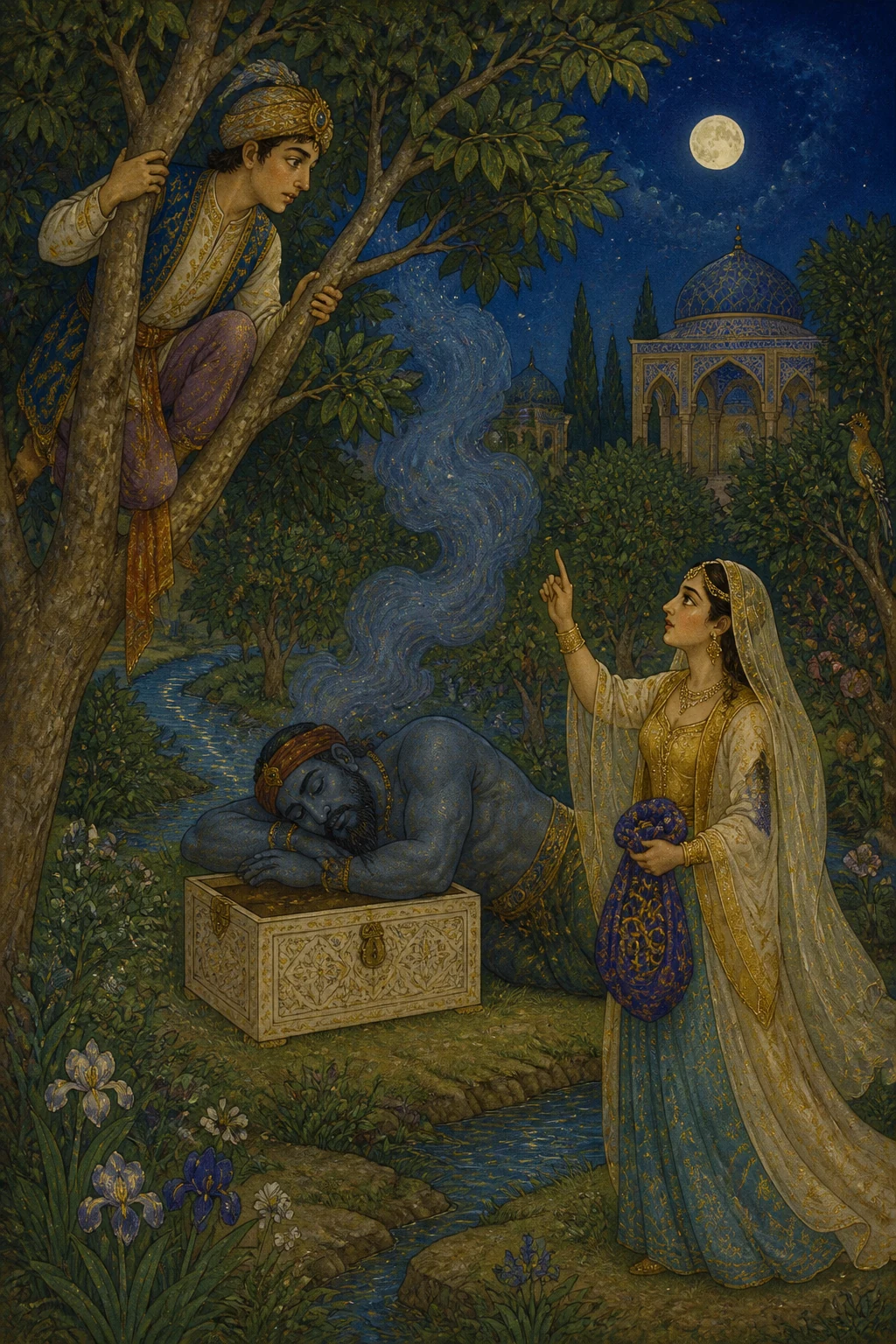
The prudent Zenana’s stratagem seemed so excellent to Higinio that he agreed, and that very night he led her to the gardens of Alexander’s women’s quarters. Intoxicated by the young Persian’s divine voice, Alexander resigned himself to the condition of the veil, and even found in it a tantalizing mystery and a singular charm. It seemed to him that this veiled love, stripped of the commonplace lure of more or less pretty features, was something delicate and original, unlike anything he had ever tasted. The chaste allure of that veil triumphed over the nakedness and shameless license of the other Persian ladies, who persisted in courting the hero. “Speak, and do not unveil yourself,” Alexander would murmur tenderly, seated beside a fountain where the moon made the water of the jets seem an endless scattering of pearls; and the roses of Gulistan, later called roses of Alexandria, shed fragrant petals upon the lovers’ heads. His love for Zenana was the longest and most intense of all the loves Alexander enjoyed in his short life.