Prevod
_Nella is loved by a Prince, who often goes through a crystal passage to take his pleasure with her. But when her jealous sisters break the passage, he is cut all over and lies at death’s door. By a strange stroke of fortune, Nella learns what remedy may cure him, applies it to the sick man, restores him to health, and takes him for her husband._ _Oh, my dears, with what delight they listened to Zeza’s tale to the very end! Had it lasted another hour, it would have seemed no more than a moment. And since it was now Cecca’s turn, she took up the telling in this fashion._ It is truly a remarkable thing, when we stop to reckon it, that the same timber should yield statues of idols and crossbeams for gallows, emperors’ thrones and chamber-pot lids. And it is no less strange that the same rag should be made into paper which, with love letters written on it, receives a beautiful woman’s kisses, or wipes an ugly backside: enough to make the finest astrologer in the world lose his wits. The same may be said of a single mother, who brings forth one good daughter and another who is a curse; one lazybones and one industrious housewife; one beauty and one fright;
one envious and one loving; one chaste Diana and one wanton Kate; one unlucky and one blessed by fortune—though, since they all spring from the same stock, they ought by rights to share the same nature. But leaving that discussion to those who know more about it, I shall give you just one example of what I have mentioned, in the story of a mother’s three daughters. There you will see how their different dispositions brought the wicked ones down into a pit, and raised the good girl to the top of Fortune’s wheel.
Once upon a time there was a mother who had three daughters, two of whom were so unlucky that nothing ever went right for them: all their schemes went awry, and all their hopes turned to chaff. But the youngest, whose name was Nella, had brought good fortune with her from her mother’s womb; and I believe that, when she was born, all things conspired to give her the very best they had to offer. Heaven gave her the cream of its light; Venus, the first choice of beauty; Love, the first flowering of his power; Nature, the finest of dispositions. She never undertook a task that did not come out straight as a plumb line;
she never embarked on an enterprise that did not turn out just as she wished; she never stepped into a dance without coming out of it with honour. And so, much as her wretched sisters envied her, everyone else loved and cherished her; much as her sisters would have liked to put her underground, other people would have carried her in the palms of their hands. Now in that country there lived a Prince endowed with magic, who sailed the seas of her beauty; and so often did he cast the hook of his loving service towards this lovely sea bream that at last he caught her by the gills of affection and made her his own. So that they might enjoy one another without rousing the suspicions of her mother, who was a nasty piece of work, the Prince gave her a certain powder and made a crystal passage that led from the royal palace to beneath Nella’s bed, though she lived eight miles away. He told her, “Whenever you wish to feed me like a little bird on your sweet favours, put a little of this powder on the fire, and I shall come at once through the passage, running hotfoot along a crystal road to delight in that silvery face of yours.” With this arrangement made, not a night passed without the Prince going in and out, back and forth, through that passage. At last the sisters, who kept a watch on Nella’s doings, discovered these merry meetings and took counsel on how to make this tasty morsel stick in her throat. To break the thread of their love, they went and smashed the passage here and there;
so that when the poor girl threw the powder on the fire to signal her lover to come, he, who was accustomed to hurry through stark naked, was so mangled by the broken crystal that it was a pitiful sight to see. Unable to go any farther, he turned back, slashed all over like a German’s breeches, and took to his bed, summoning all the physicians in the city.
But because the crystal was enchanted, the wounds were so deadly that no human remedy could help him. Seeing his son’s case was hopeless, the King had a proclamation issued: whoever cured the Prince, if a woman, should have him for a husband; if a man, should have half the kingdom. When Nella, who was pining for the Prince, heard this, she stained her face and disguised herself completely, then slipped out of the house without her sisters’ knowledge to go and see him before he died. But by now the golden balls with which the Sun plays in the fields of Heaven were rolling towards the West, and night overtook her in a wood near an Ogre’s house. To escape any danger, she climbed a tree. The Ogre and his wife were at table, with the windows open so they could eat in the cool air; and when they had finished emptying their jugs and putting out their lamps, they began to chatter about this and that. The place was so close—no farther than nose from mouth—that Nella heard everything. Among other things, the Ogress said to her husband, “Well, my handsome Hairy One, what news? What are people saying out in the world?” And he answered, “You may take it that there is not a hand’s breadth of clean ground anywhere, and everything is going arse over head and all askew.” “But what is happening?” his wife asked. “There would be plenty to say,” replied the Ogre, “about all the knavery abroad, for you hear things that would make you jump out of your skin: buffoons rewarded, scoundrels esteemed, lazybones honoured, murderers protected, cutpurses defended, and honest men little valued and still less respected. But since these things are enough to make a body burst, I shall tell you only what has happened to the King’s son. He had a crystal road built along which he went naked to enjoy a pretty girl;
somehow—I do not know how—the road was broken, and when he tried to pass through he cut himself so badly that, before he can stop up all those holes, the pipe of his life will have drained quite dry. And though the King has issued a proclamation promising great rewards to whoever cures him, it is all wasted effort: he may as well pick his teeth with it. The best thing he can do is have the mourning clothes ready and prepare the funeral.” When Nella heard the cause of the Prince’s suffering, she sobbed bitterly and said to herself, “What accursed soul has broken the passage through which my pretty painted bird came to me, so that the passage through which my own life flows must break as well?” But as the Ogress continued speaking, she held her tongue and listened without a sound. “Can it be,” the Ogress was saying, “that all hope is lost for this poor lord, and no remedy can be found for his illness? Tell medicine to go and bake itself in an oven! Tell the physicians to stick a halter round their necks!
Tell Galen and Mesue to give their schoolmaster his money back, if they cannot find a fitting prescription to restore the Prince to health.” “Listen, my little Slobberchops,” answered the Ogre, “physicians are not obliged to find remedies beyond the bounds of nature. This is no colic that an oil bath will relieve; no wind to be driven out with suppositories of dried figs and mouse droppings; no fever to be banished with medicine and diet; nor are these ordinary wounds that call for a dressing of tow and St John’s wort oil. The spell upon the broken glass has the same effect as onion juice upon an arrowhead: it makes the wound incurable. There is only one thing that could save his life;
but do not make me tell you, for it is a grave matter.” “Tell me, my Tusky One,” pleaded the Ogress. “Tell me, unless you want to see me dead.” And the Ogre said, “I will tell you, provided you promise not to confide it to a living soul, for it would mean the overthrow of our house and the ruin of our lives.” “Have no fear, my handsome, handsome little husband,” answered the Ogress, “for pigs will grow horns, apes tails, and moles eyes before a word ever slips from my mouth.” And when she had sworn it, with one hand laid upon the other, the Ogre told her, “Know, then, that there is nothing under Heaven or upon the earth that can save the Prince from the claws of death except our fat. If his wounds were anointed with it, it would place an embargo upon that soul which is seeking to quit the house of his body.” When Nella heard this secret, she bided her time until they had finished chattering; then she climbed down from the tree, plucked up her courage, and knocked at the Ogre’s door, crying, “Oh, my most ogrely lord and lady, a little charity! A little mercy for a poor, wretched creature, battered by fortune, far from her homeland, bereft of all human help, overtaken by night in these woods and dying of hunger!” And knock, knock, knock she went.
When the Ogress heard all this clamour, she wanted to throw her half a loaf and send her away. But the Ogre, who was greedier for human flesh than a squirrel for nuts, a bear for honey, a cat for little fish, a sheep for salt, or a donkey for bran mash, said to his wife, “Let the poor thing in. If she sleeps out in the open, some wolf might tear her to pieces.” He said so much that his wife opened the door; and with this self-serving charity he meant to make four mouthfuls of her. But the glutton reckons one way and the innkeeper another: for when the pair had got thoroughly drunk and gone to sleep, Nella took a knife from a cupboard and made a slaughterhouse of them. Then she put all their fat in a jar and set off for court. Presenting herself before the King, she offered to cure the Prince. Overjoyed, the King had her shown into his son’s chamber, where she gave him a good rubbing with the fat; and there and then, as though she had thrown water on a fire, his wounds closed at once, and he became as sound as a fish.
Seeing this, the King said to his son, “This good woman deserves the reward promised in the proclamation: you should take her for your wife.” At these words the Prince replied, “She may take herself off this very moment, for I have no storehouse of hearts inside me to hand out to so many women. Mine is already pledged, and another woman owns it.” When Nella heard this, she answered, “You ought not to remember a woman who was the cause of all your suffering.” “It was her sisters who did me the harm,” replied the Prince, “and they shall shit out their penance for it.” “Then you truly love her so much?” Nella asked again. And the Prince answered, “More than these eyes of mine.”
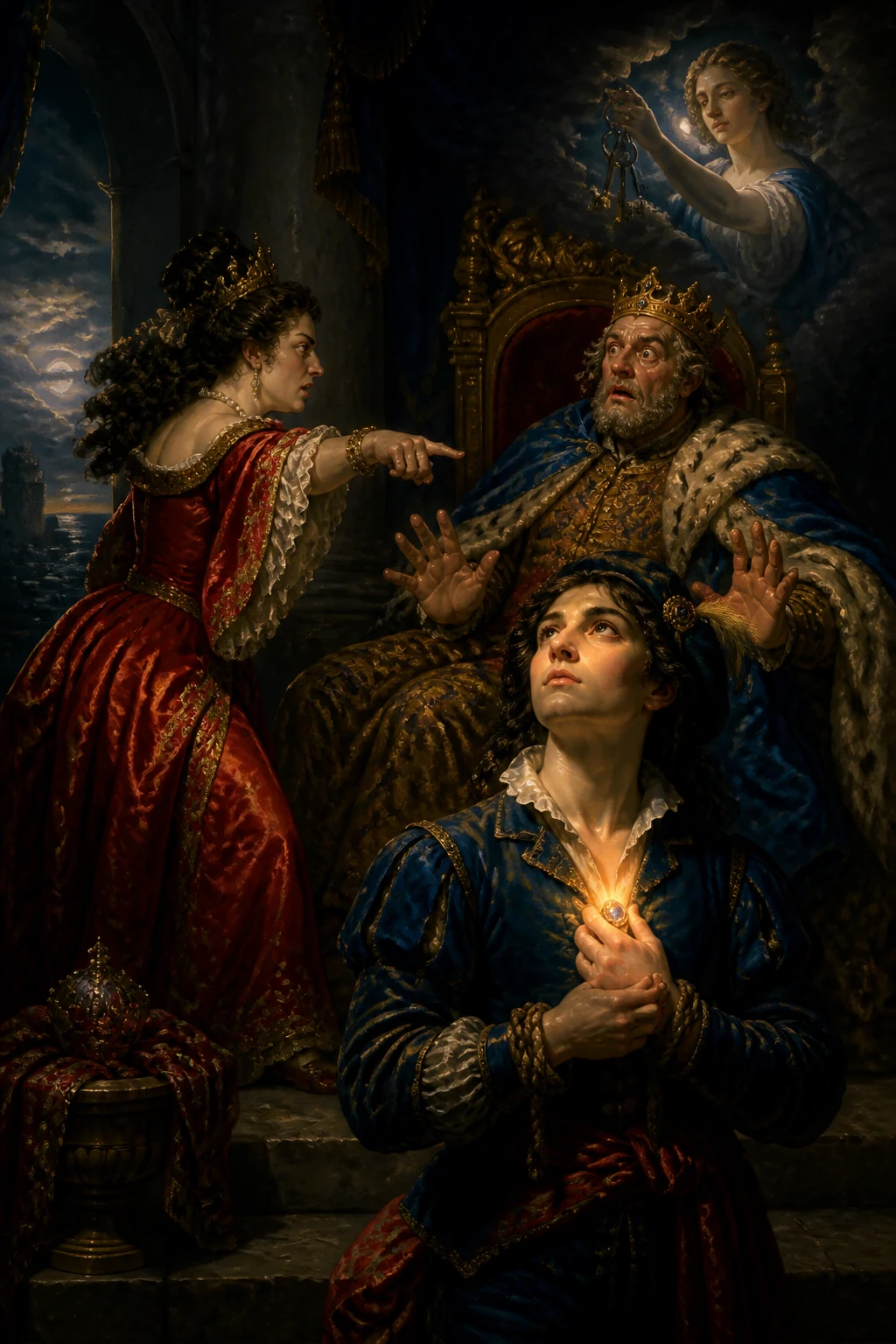
“If that is so,” Nella replied, “embrace me, hold me close, for I am the fire of your heart.” But the Prince, seeing her face so blackened, answered, “You are more likely the coal than the fire; so keep away, lest you smudge me.” Seeing that he did not recognise her, Nella had a basin of fresh water brought, washed her face, and, lifting that cloud of soot, revealed the sun beneath. The Prince recognised her and clasped her like an octopus; and, having taken her for his wife, he had her sisters walled up inside a hearth, so that, like leeches in the ashes, they might purge themselves of the corrupt blood of envy, proving the truth of the saying, _No evil ever went unpunished._