Prevod
_Lucia goes to fetch water from a fountain and meets a slave, who takes her to a splendid palace, where she is treated like a queen. But her envious sisters persuade her to see who sleeps beside her at night; discovering a handsome young man, she loses his favor and is cast out. After wandering for years in misery, heavily pregnant, she reaches her lover’s home, where she gives birth to a son; after various adventures, they are reconciled, and she becomes his wife._ _The misfortunes suffered by poor Lisa moved every heart to great compassion, and more than a few eyes grew red, with tears trembling on their lashes, for nothing stirs pity more than the sight of someone suffering innocently. But now it was Ciommetella’s turn to set the spinning wheel of storytelling in motion, and she began._ The counsels of envy have always fathered misfortune, for beneath the mask of kindness they hide the face of ruin. Whoever finds fortune within his grasp should imagine a hundred people forever stretching cords across his path to trip him up, as happened to a girl who, through her sisters’ wicked advice, fell from the very top of the ladder of happiness; and it was only heaven’s mercy that saved her from breaking her neck.
Once upon a time there was a mother with three daughters. Such dire poverty had taken root in her house—which was a sewer into which every flood of misfortune poured—that she sent them out begging to keep body and soul together. One morning, having come by some cabbage leaves thrown away by the cook of a great house, she wanted to cook them and told her daughters, one after another, to go to the fountain for a little water;
but each tossed the task to the next, like a cat ordering its own tail about, until the poor mother said, “Give an order, and do it yourself!” Taking up the pitcher, she was about to run the errand herself, though she was so old she could scarcely drag her legs along. But Luciella, the youngest, said, “Give it here, Mother dear. Though I hardly have strength enough for myself, I still want to spare you this trouble.” Taking the pitcher, she went outside the city to a fountain which, seeing the flowers swooning with fear of the night, splashed water in their faces. There she found a handsome slave, who said, “My pretty girl, if you will come with me to a grotto not far from here, I will give you all sorts of lovely things.” Luciella, who was always hungry for a kindness, replied, “Let me take this little bit of water to Mother, who is waiting for me, and I will come straight back.” She carried the pitcher home, then, on the pretext of going out to beg for a crust, returned to the fountain. Finding the same slave there, she followed him, and he led her through a grotto of tufa, hung with maidenhair fern and ivy, into a magnificent underground palace, all gleaming with gold. A splendid meal was set before her at once, while two strapping, pretty serving girls came to strip off her few rags and dress her from head to foot. That evening they put her to bed in a bed embroidered all over with pearls and gold; and as soon as the candles were put out, someone came to lie beside her. This went on for many days. At last the girl felt a longing to see her mother and told the slave, who went into a room, spoke to someone—I know not whom—and came out again with a great purse of crowns, telling her to give it to her mother. He urged her not to forget the way, but to return quickly, without saying where she had come from or where she was staying;
so the girl went, and when her sisters saw her so beautifully dressed and so well cared for, they were fit to burst with envy. When Luciella was ready to return, her mother and sisters wanted to go with her, but she refused their company and returned through the same grotto to the same palace. After spending several more months there in peace, she felt the same longing again, and was sent to her mother with the same warning and the same gifts. After this little business had happened three or four times, always fanning the hot winds of envy in her sisters’ swollen bellies, those ugly harpies racked their brains until, through an ogress, they learned the whole story. The next time Luciella came to see them, they said, “Though you have chosen to tell us nothing of your pleasures, you should know that we know everything, and that every night you are given a sleeping draught, so you cannot discover that a most handsome young man sleeps beside you. But you will always have your happiness doled out by halves unless you resolve to take the advice of those who love you. After all, you are our own flesh and blood, and we want your good and your happiness. So when you go to bed tonight and the slave brings your nightcap, ask him to fetch a napkin for you to wipe your mouth, and cleverly pour the wine out of the glass, so that you can stay awake through the night. When you see that your husband is asleep, open this padlock: whether he likes it or not, he will have to break the spell, and you will be the happiest woman in the world.” Poor Luciella, who did not know that beneath this velvet saddle lay a chafing sore, among these flowers a serpent, and in this golden basin poison, believed her sisters’ words. Returning to the grotto, when night came she did as those wicked creatures had told her; and when everything was hushed and silent, she struck a light and lit a candle. Beside her she saw the very flower of beauty, a young man who was all lilies and roses. At the sight of such loveliness she said, “Faith, you shall never slip through my fingers now!” Taking the padlock, she opened it, and saw a crowd of women carrying beautiful spun yarn on their heads;
one of them dropped a skein, and Luciella, who was kindness itself, forgot where she was and called out, “Pick up your yarn, madam!” At her cry, the young man awoke;
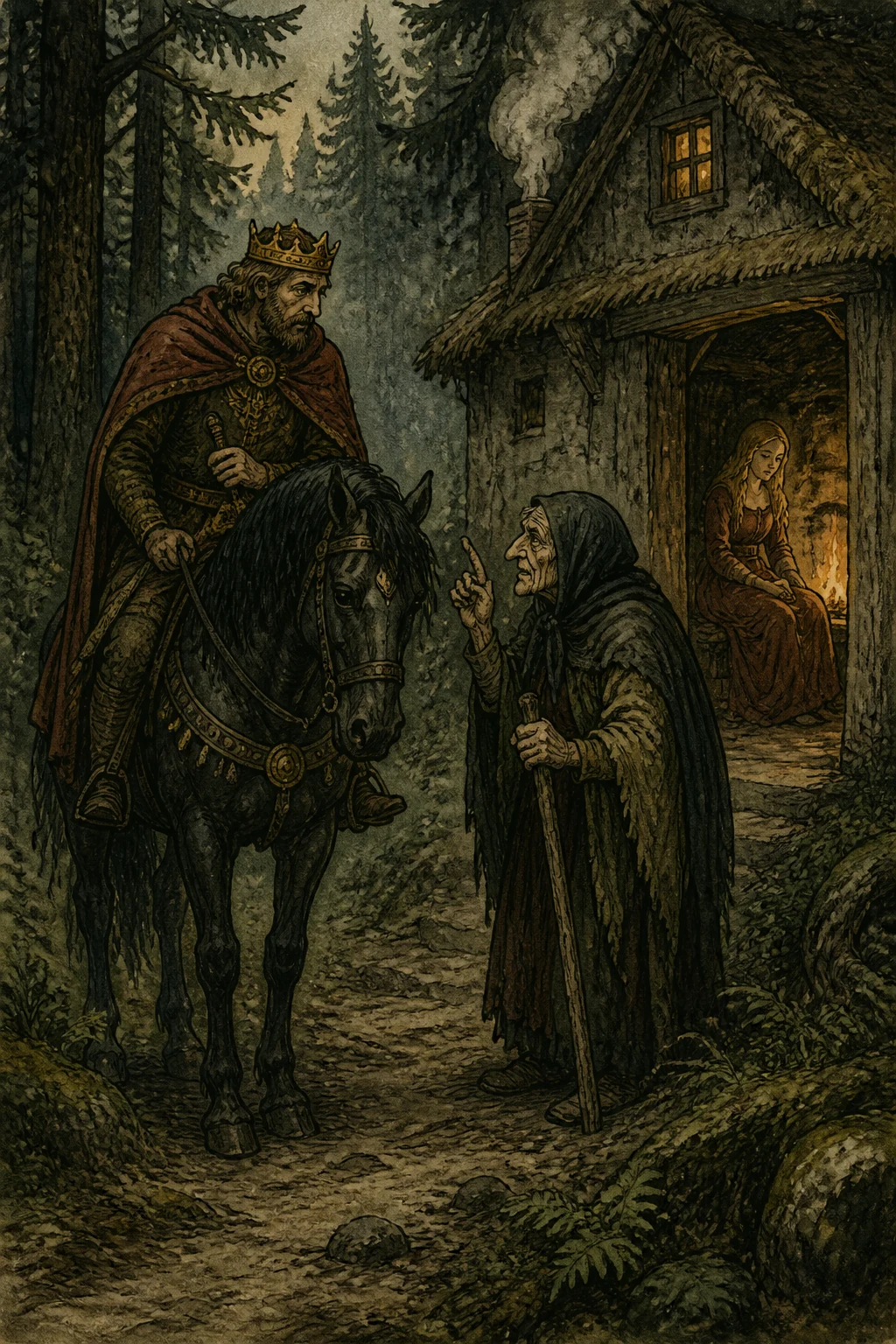
and was so displeased to have been discovered by Luciella that he immediately summoned the slave, had her dressed in her old rags, and sent her away. Looking as pale as someone just out of hospital, she returned to her sisters, who drove her off with harsh words and harsher deeds. So she went begging through the world until, after a thousand hardships, the poor wretch, now heavily pregnant, reached the city of Torre-Longa. Going to the royal palace, she begged for a little shelter on the straw, and a lady-in-waiting, who was a kind soul, took her in. When the time came to unburden her belly, she gave birth to a boy so beautiful he was a nugget of gold. But on the very first night after his birth, while everyone else was asleep, a handsome young man entered the room, saying, “O my beautiful son, if my mother only knew, in a golden basin she would bathe you, in golden swaddling bands she would wrap you; and if no cock ever crowed, never would I leave you.” Having spoken these words, at the first crowing of a cock he slipped away like quicksilver;
the lady-in-waiting noticed this, and when she saw that he came every night to sing the same tune, she told the queen. As soon as the sun, like a physician, had discharged all the stars from the hospital of heaven, the queen issued a most cruel decree that every cock in the city should be killed, making all the hens widows and shorn of their mates at a stroke. That evening, when the same young man returned, the queen, who was on the alert and not wasting time picking over lentils, recognized him as her son and clasped him tightly in her arms. Now an ogress had laid a curse upon this prince, condemning him to wander forever far from home until his mother embraced him and no cock crowed. So the moment he was in his mother’s arms, the enchantment was undone and the dreadful turmoil ended. Thus the mother found she had gained a grandson as precious as a jewel, and Luciella found a husband as handsome as a fairy prince. Her sisters, hearing of her newfound grandeur, had the brazen effrontery to come and visit her; but they were given pie for cake, and paid back in their own coin, learning, to their hearts’ bitter anguish, _That heartache is the child of Envy._