Waltey
Zaljubljenca iz plemena Udhra
Tisoč in ena noč · arabska pripovedna tradicijaO besedilu
Zaljubljenca iz plemena Udhra
- Vir
- Tisoč in ena noč
- Avtor
- arabska pripovedna tradicija
- Jezik branja
- English
- Jezik izvirnika
- Arabic
- Čas branja
- 13 min branja
- Obseg
- 11 strani
- Naslov izvirnika
- عاشقان من بني عذرة - الليالي ٦٨٨ إلى ٦٩١
O izvirniku
Tisoč in ena noč
Zgodbe v zgodbah, polne trgovcev, dvorov, preoblek in nočnih zapletov. Bralni jezik je English, izvirnik pa prihaja iz vira Tisoč in ena noč v jeziku Arabic.
Besedilo
Zaljubljenca iz plemena Udhra
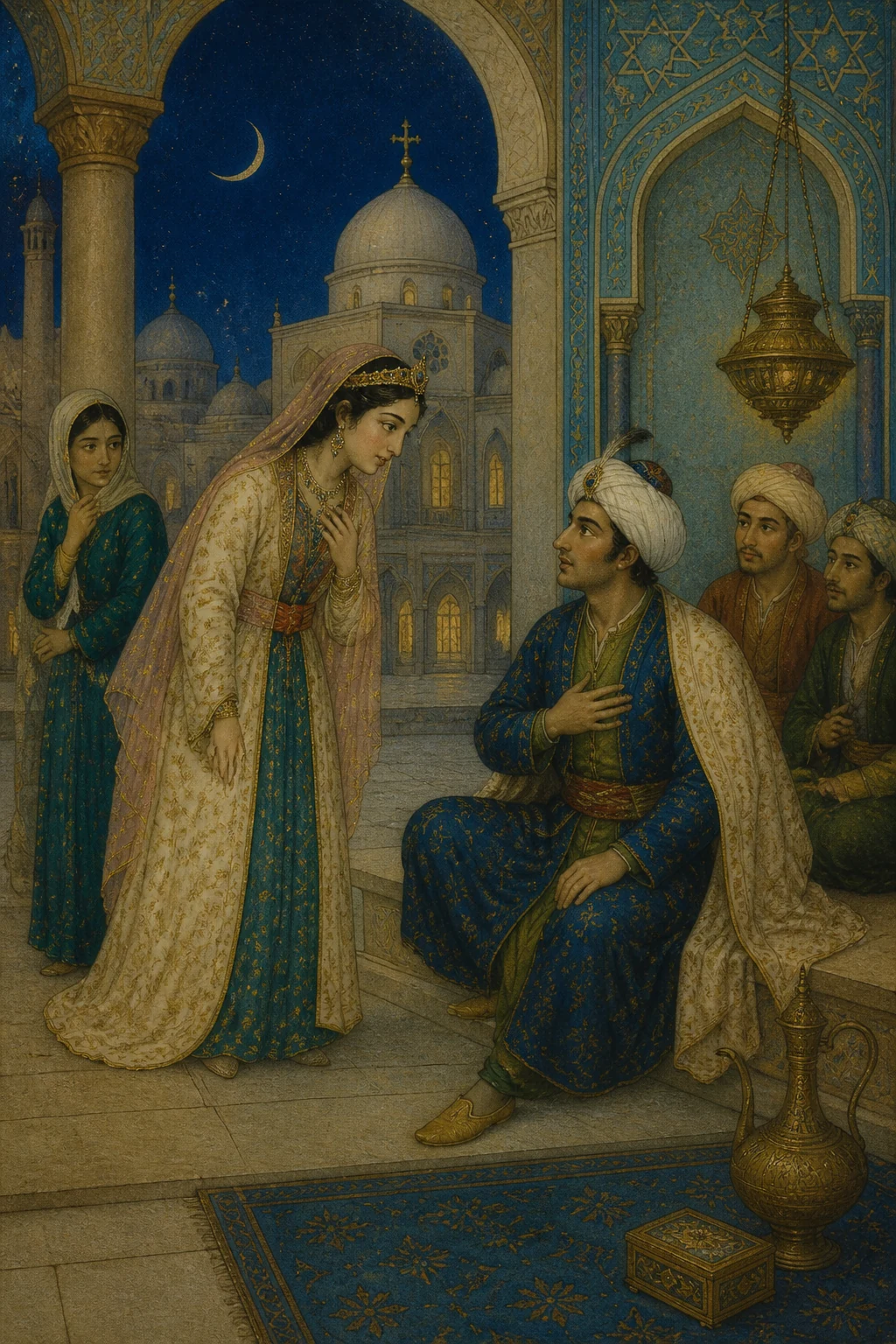
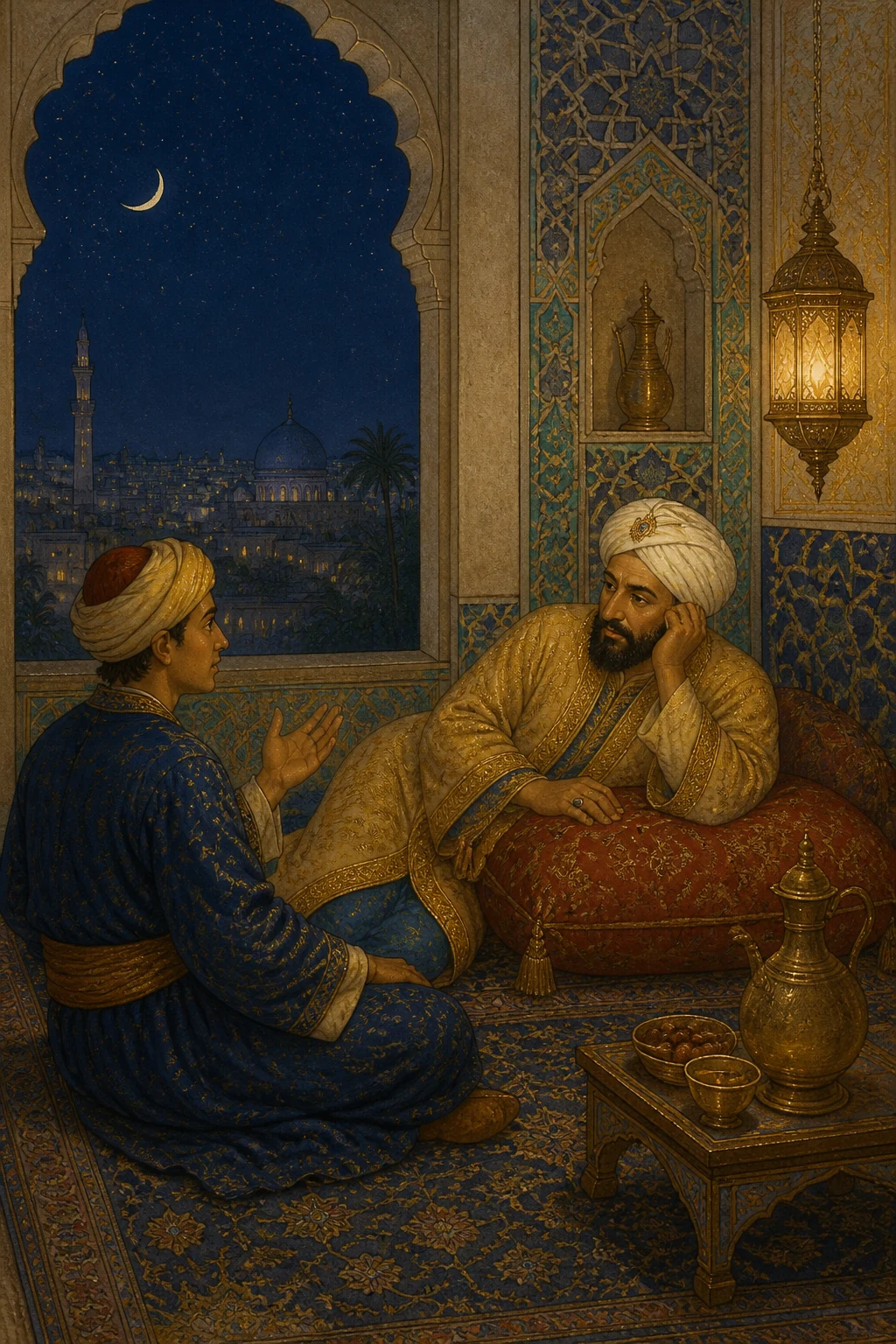
It is also related that Masrur the eunuch said: One night the Commander of the Faithful, Harun al-Rashid, was sorely troubled by sleeplessness, and said to me, “Masrur, which of the poets is at the door?” I went out into the vestibule and found Jamil ibn Ma‘mar al-‘Udhri. “The Commander of the Faithful summons you,” I told him. “I hear and obey,” he replied. I went in, and he followed me until he stood before Harun al-Rashid. He gave him the greeting due to the Caliph, who returned his salutation and bade him sit. Then al-Rashid said, “Jamil, have you any marvelous tales to tell?” “Yes, Commander of the Faithful,” he answered. “Which would you prefer: something I witnessed and saw, or something I heard and remember?” “Tell me something you witnessed and saw.” “Gladly, Commander of the Faithful. Give me your full attention and listen closely.” Al-Rashid took a cushion of red brocade embroidered with gold and stuffed with ostrich feathers, placed it beneath his thighs, and settled his elbows upon it. “Let us hear your tale, Jamil,” he said. Jamil began, “Know, Commander of the Faithful, that I was once deeply enamored of a maiden, whom I loved and often visited.” But morning overtook Shahrazad, and she fell silent, leaving her tale untold.
When it was the six hundred and eighty-ninth night
She said: It has reached me, O fortunate King, that when the Commander of the Faithful, Harun al-Rashid, had leaned upon the brocade cushion, he said, “Let us hear your tale, Jamil.” Jamil replied, “Know, Commander of the Faithful, that I was once deeply enamored of a maiden, whom I loved and often visited, for she was all I sought and desired in this world. Then her people moved away because the pasture had grown scarce, and for some time I did not see her. At last longing gave me no peace and drew me toward her, and I began to think of setting out to find her. One night my yearning so stirred me that I rose, fastened my saddle upon my she-camel, wound on my turban, put on my threadbare clothes, girded on my sword, and took up my spear. Then I mounted and set out in search of her, traveling swiftly. One night I rode through darkness black and impenetrable, struggling down valleys and up mountains, while on every side I heard lions roaring, wolves howling, and wild beasts crying out. My wits were bewildered and my senses reeled, yet my tongue never ceased invoking Almighty God. As I traveled thus, sleep overcame me, and my camel strayed from the road I had been following. I slept on until something struck me on the head, and I awoke in fear and alarm. There I was among trees and streams, with birds upon the branches singing in their various tongues and melodies, while the trees of that meadow were all entwined. I dismounted and took my camel’s rein in my hand, carefully working my way out until I brought her clear of the trees into open country. I set her saddle straight and mounted again, not knowing where to go or to what place fate would lead me. Gazing across that wilderness, I glimpsed a fire in its midst. I urged my camel toward it until I reached it, then drew nearer and looked about. There stood a tent, a spear planted in the ground, a tethered mount, horses standing nearby, and camels at pasture. I said to myself, ‘There must be some remarkable story behind this tent, for I see no other in all this wilderness.’
“Then I approached the tent and called, ‘Peace be upon you, people of the tent, and the mercy and blessings of God!’ A youth of nineteen came out to meet me, fair as the full moon when it rises, with courage shining in his eyes. ‘And upon you be peace, and the mercy and blessings of God, brother Arab,’ he said. ‘I think you have lost your way.’ ‘Indeed I have,’ I replied. ‘Guide me, and may God have mercy on you.’ He said, ‘Brother Arab, this country of ours is infested with beasts of prey, and tonight is dark and desolate, bitterly cold and black. I fear some wild beast may devour you. Dismount and be my welcome guest, and tomorrow I shall show you the road.’ So I dismounted and hobbled my camel with the spare length of her rein. I took off my outer garments, made myself comfortable, and sat for a while. Meanwhile, the youth went to a sheep and slaughtered it, then kindled a fire and made it blaze. He entered the tent and brought out finely ground spices and good salt, and began cutting pieces of meat, roasting them over the fire, and handing them to me. Now he sighed, now he wept; then he gave a great sob and burst into bitter tears, reciting these verses:
“‘Nothing remains but a faltering breath, And an eye whose pupil stares blankly. Not one joint in all his limbs Is free of settled sickness. His tears flow and his heart burns, Yet he utters not a word. Even his enemies weep for pity— Alas for him whom the gloating pity!’ Jamil continued: “Then I knew, Commander of the Faithful, that the youth was a distracted lover, for none knows love save one who has tasted it. I said to myself, ‘Shall I question him?’ But I thought again: ‘How can I intrude upon his secrets when I am a guest in his home?’ So I restrained myself and ate my fill of the meat. When we had finished eating, the youth rose and went into the tent. He brought out a basin, a handsome ewer, a silken towel with its edges embroidered in red gold, and a flask filled with musk-scented rosewater. I marveled at his refinement and delicacy of manner, saying to myself, ‘I never knew such elegance existed in the desert.’ We washed our hands and talked for a while. Then he rose, entered the tent, and hung a curtain of red brocade between his quarters and mine. ‘Come in, noble Arab,’ he said, ‘and take your rest, for you have suffered weariness tonight and great hardship on your journey.’ I entered and found a bed of green brocade. I took off my clothes and spent a night the like of which I had never known.” But morning overtook Shahrazad, and she fell silent, leaving her tale untold.
When it was the six hundred and ninetieth night
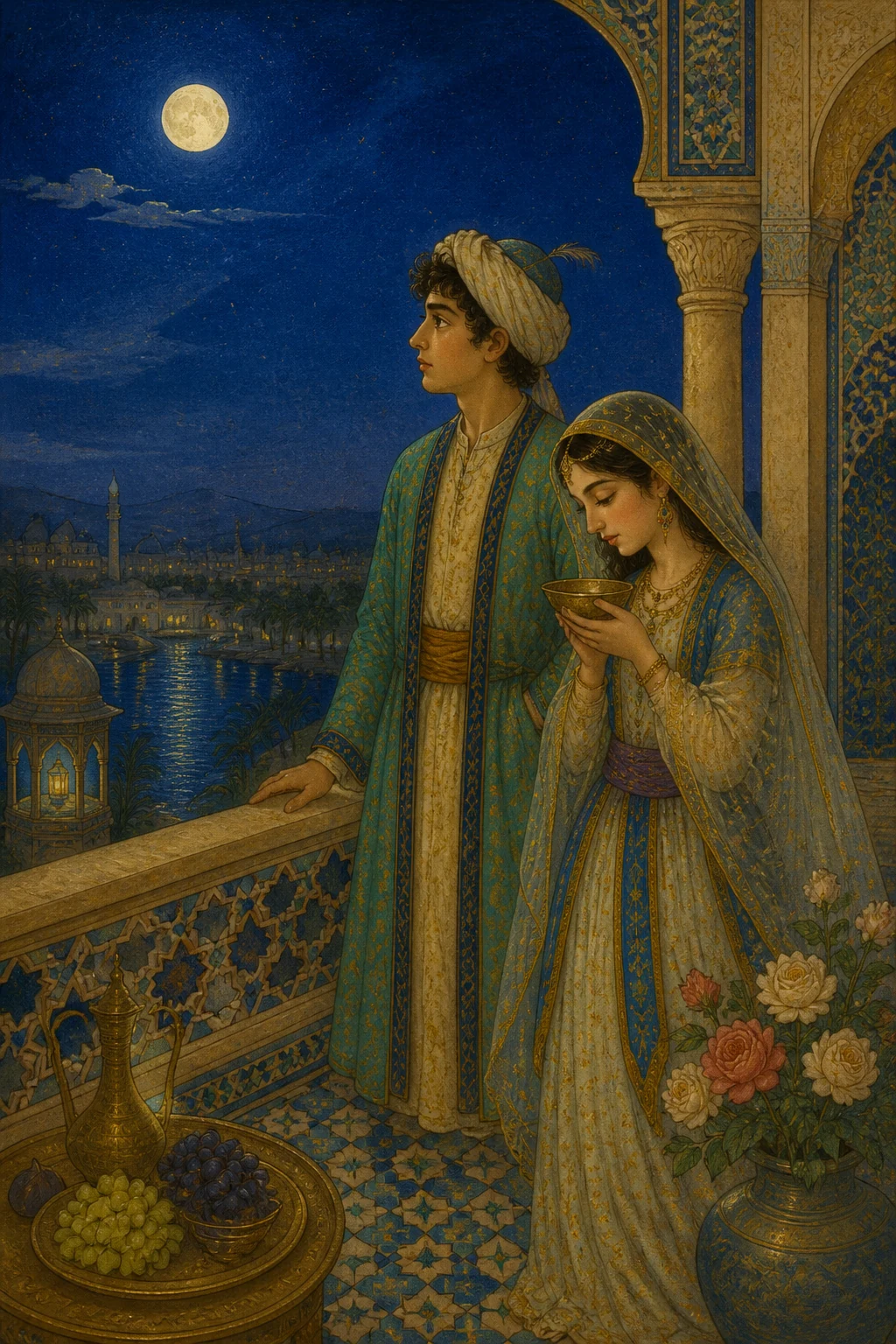
She said: It has reached me, O fortunate King, that Jamil said: “I spent a night the like of which I had never known. All the while I lay pondering the youth’s affairs, until night had deepened and all eyes were asleep. Suddenly I heard a soft voice, the sweetest and most tender I had ever heard. I lifted the curtain hung between us, and there beside him was a girl whose beauty surpassed any I had ever seen. The two were weeping and lamenting to one another the pain of love, their passion and heartache, and their fierce longing to meet. I said to myself, ‘By God, how strange! Who is this second person? When I entered this tent, I saw no one but the youth, and there was nobody with him.’ Then I thought, ‘She must be a maiden of the jinn who loves this youth, and here they have withdrawn to be alone with one another.’ But I looked more closely and saw that she was a mortal Arab maiden. When she unveiled her face, she put the shining sun to shame, and the tent glowed with her radiance. Once I was certain that she was his beloved, I remembered a lover’s jealousy, let the curtain fall, covered my face, and slept. In the morning I put on my clothes, made my ablutions, and performed my obligatory prayers. Then I said to him, ‘Brother Arab, after all your kindness, will you now show me the road?’ He looked at me and said, ‘Not so fast, noble Arab. Hospitality lasts three days, and I would never let you leave before those three days are over.’
Jamil continued: “So I stayed with him for three days. On the fourth day we sat talking, and in the course of our conversation I asked his name and lineage. ‘As for my lineage,’ he replied, ‘I am of the Banu ‘Udhra. My name is so-and-so, son of so-and-so, and my uncle is so-and-so.’ He proved to be my own cousin, Commander of the Faithful, and belonged to one of the noblest houses of the Banu ‘Udhra. I said, ‘Cousin, what has driven you to live alone in this wilderness? How could you abandon your prosperity and that of your forefathers? How could you leave your slaves and serving women and withdraw alone to this place?’ When he heard my words, Commander of the Faithful, his eyes brimmed with tears, and he said, ‘Cousin, I fell in love with my uncle’s daughter. I was bewitched by her, lost in my love for her, mad with passion, and unable to bear being parted from her. My love grew until I asked my uncle for her hand, but he refused and married her to a man of the Banu ‘Udhra. Her husband consummated the marriage and took her to his encampment a year ago. When she was far away and I could no longer see her, the anguish of love, the violence of longing, and the ache in my heart drove me to leave my family, my tribe, my friends, and all my comforts. I withdrew to this tent in the wilderness and grew accustomed to solitude.’ ‘Where are their tents?’ I asked. ‘Close by, on the summit of this mountain,’ he said. ‘Every night, when all eyes are asleep and the night is still, she slips secretly out of the encampment without anyone noticing her. I satisfy my longing by talking with her, and she does the same. So I remain here, finding solace in her company for an hour each night, until God brings to pass what He has decreed, or grants me my desire despite the envious, or judges in my favor—for He is the best of judges.’” Jamil went on: “When the youth told me this, Commander of the Faithful, his plight distressed me, and concern for his honor left me bewildered. I said, ‘Cousin, shall I suggest a plan which, God willing, will offer the surest course, a path to wisdom and success, and by which God may free you from what you fear?’ ‘Tell me, cousin,’ said the youth. I replied, ‘When night comes and the girl arrives, put her on my she-camel, for she travels swiftly. Mount your own horse, and I shall ride one of these other camels. I will travel with you both the whole night through, and by morning I shall have taken you across deserts and wastes, and you will have attained your wish and won your heart’s beloved. God’s earth is wide. By God, so long as I live, I shall support you with my life, my wealth, and my sword.’” But morning overtook Shahrazad, and she fell silent, leaving her tale untold.
When it was the six hundred and ninety-first night
She said: It has reached me, O fortunate King, that Jamil proposed to his cousin that they take the girl away by night, promising to help and support him for the rest of his life. When the youth heard this, he said, “Cousin, first let me consult her, for she is wise, intelligent, and discerning.” Jamil continued: “When night fell and the hour of her coming drew near, he waited for her at the appointed time, but she was later than usual. I saw the youth step out through the entrance of the tent and draw it open, breathing in the breeze that blew from her direction and inhaling its fragrance as he recited these two verses:
“‘The east wind brings me a gentle breath From the land where my beloved dwells. O wind, you bear a sign of her— Do you know when she will come?’
“Then he entered the tent and sat weeping for a while. At last he said, ‘Cousin, something has happened to my uncle’s daughter tonight. Some misfortune has befallen her, or something has prevented her from coming to me.’ Then he said, ‘Stay here until I bring you news.’ He took his sword and shield and vanished into the night for a while. When he returned, he was carrying something in his arms. He called out to me, and I hurried toward him. ‘Cousin,’ he said, ‘do you know what has happened?’ ‘No, by God,’ I replied. ‘Tonight I have been bereaved of my uncle’s daughter,’ he said. ‘She was on her way to us when a lion crossed her path and devoured her, leaving nothing but what you see.’ He set down what he carried, and there were the girl’s mangled remains and what was left of her bones. He wept bitterly, threw down the bow he held, and took up a bag. ‘Do not stir until I return, God Most High willing,’ he told me. Then he went away and was absent for a while. He returned carrying a lion’s head, which he cast down. He asked for water, and I brought it. He washed the lion’s mouth and began to kiss it and weep. His sorrow deepened, and he recited these verses:
“‘O lion, so proud of your own strength, You are dead, but have stirred new grief for her. You have left me alone, who was once her companion, And made the earth’s belly her grave here. To fate, which grieved me by parting us, I say: I seek refuge in my Lord from seeing her with another lover.’ Then he said, ‘Cousin, I beg you by God, and by the bonds of kinship and blood between us, to carry out my last wishes. In a moment you will see me lying dead before you. When that happens, wash me and shroud me, together with these remaining bones of my uncle’s daughter, in this cloth. Bury us together in one grave, and inscribe these two verses upon it:
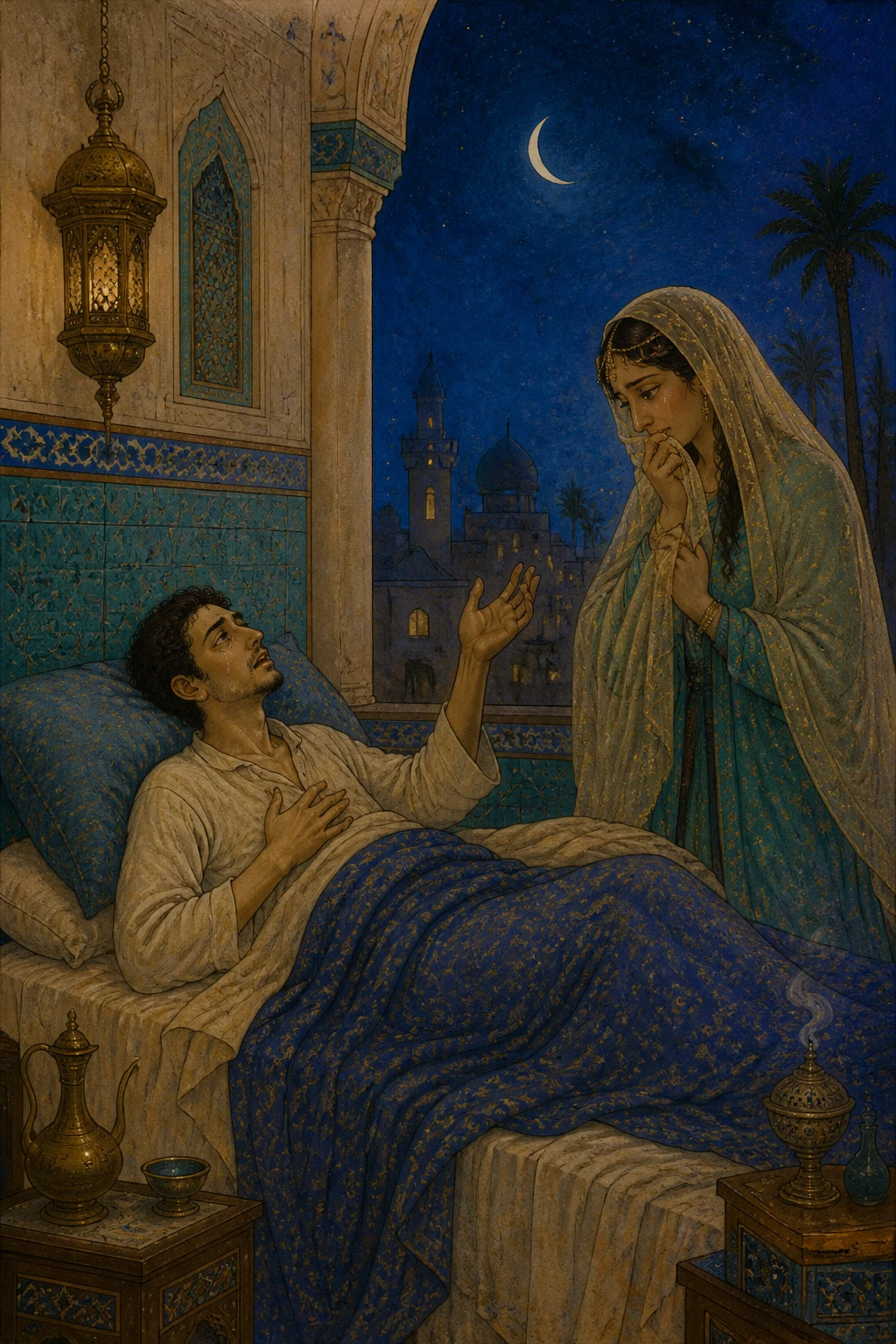
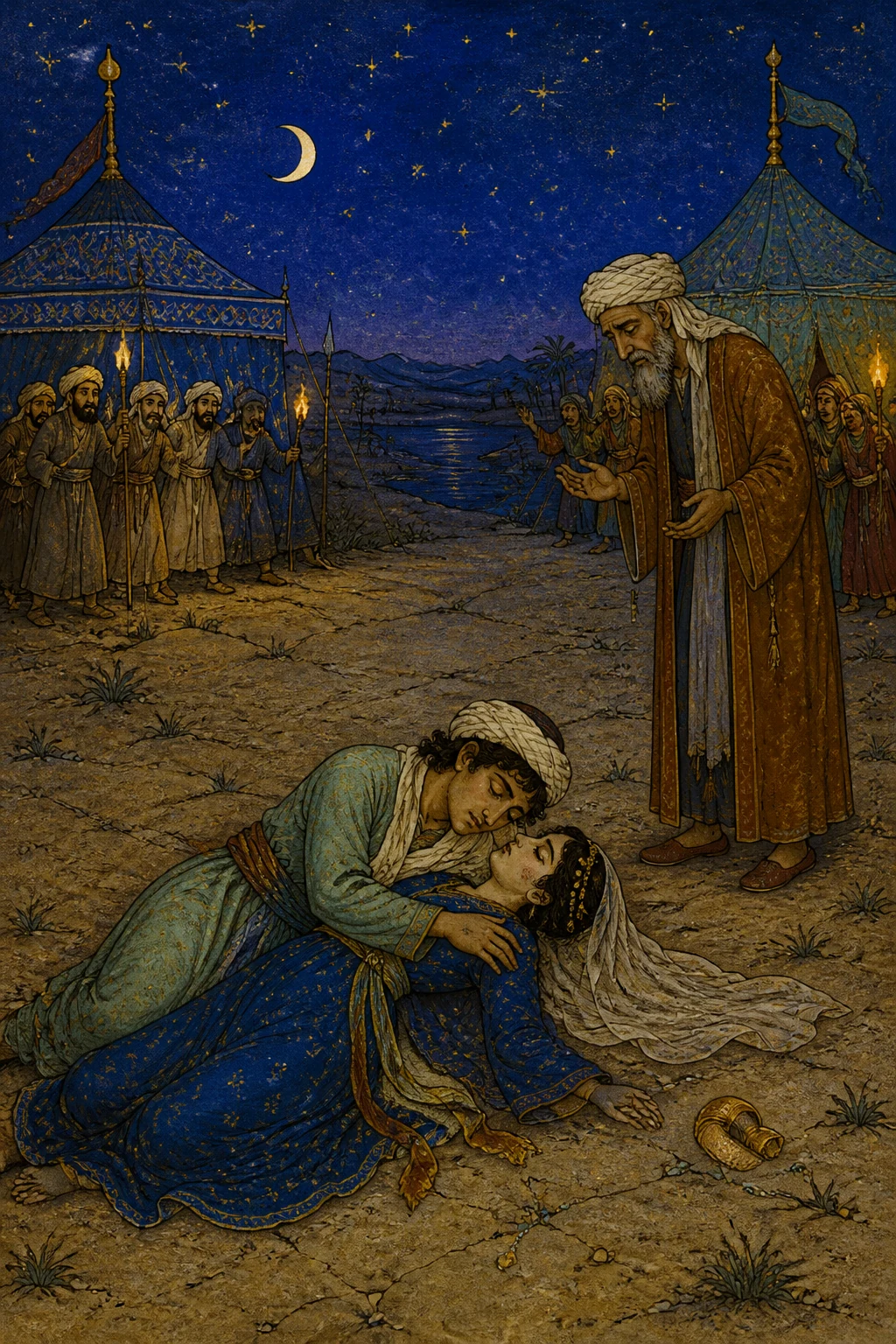
“‘Upon the earth we lived in ease, United in home and homeland. Then time and fate divided our companionship; Now beneath the earth one shroud unites us.’ Then he wept bitterly and entered the tent, remaining out of sight for a while. When he came out, he began sighing and crying aloud. At last he gave a great sob and departed this world. When I saw what had happened, my grief was so great and the blow so grievous that I almost followed him. Then I went to him, laid him out, and did all he had charged me to do. I shrouded them together and buried them in a single grave. I stayed beside their grave for three days, then departed, and for two years I continued to return and visit them. Such is their story, Commander of the Faithful.” When al-Rashid heard his tale, he admired it, bestowed a robe of honor upon him, and rewarded him generously.
Izvirnik
عاشقان من بني عذرة - الليالي ٦٨٨ إلى ٦٩١
Naslednje strani prikazujejo izvirno besedilo za primerjavo.
فلما كانت الليلة ٦٨٨
وحُكِي أيضًا أن مسرور الخادم قال: أرق أمير المؤمنين هارون الرشيد ليلةً أرقًا شديدًا، فقال لي: يا مسرور، مَن بالباب من الشعراء؟ فخرجت إلى الدهليز فوجدتُ جميل بن معمر العذري، فقلت له: أجِبْ أمير المؤمنين. فقال: سمعًا وطاعة. فدخلتُ ودخل معي إلى أن صار بين يدي هارون الرشيد، فسلَّمَ بسلام الخلافة، فردَّ عليه السلام وأمره بالجلوس، ثم قال له الرشيد: يا جميل، أعندك شيء من الأحاديث العجيبة؟ قال: نعم يا أمير المؤمنين، أيما أَحَبُّ إليك؛ ما عاينتُه ورأيتُه، أو ما سمعتُه ووعيتُه؟ فقال: حدِّثني بما عاينتَه ورأيتَه. قال: نعم يا أمير المؤمنين، أقبِلْ عليَّ بكُلِّك، وأصغِ إليَّ بإذنَيْك. فعمد الرشيد إلى مخدة من الديباج الأحمر المزركش بالذهب، محشوَّة بريش النعام، فجعلها تحت فخذيه، ثم مكَّنَ منها مرفقيه، وقال: هلمَّ بحديثك يا جميل. فقال: اعلم يا أمير المؤمنين أني كنت مفتونًا بفتاةٍ مُحِبًّا لها، وكنت أتردَّد إليها. وأدرك شهرزاد الصباح فسكتَتْ عن الكلام المباح.
فلما كانت الليلة ٦٨٩
قالت: بلغني أيها الملك السعيد، أن أمير المؤمنين هارون الرشيد لما اتكأ على مخدة من الديباج قال: هلمَّ بحديثك يا جميل. فقال: اعلم يا أمير المؤمنين أني كنتُ مفتونًا بفتاة محبًّا لها، وكنتُ أتردَّد إليها إذ هي سؤلي وبغيتي من الدنيا، ثم إن أهلها رحلوا لقلة المرعى، فأقمتُ مدةً لم أَرَها، ثم إن الشوق أقلقني وجذبني إليها، فحدَّثتني نفسي بالمسير إليها، فلما كان ذات ليلة من الليالي هزَّني الشوق إليها، فقمت وشددت رحلي على ناقتي وتعمَّمْتُ بعمامتي، ولبست أطماري، وتقلَّدْتُ بسيفي، واعتقلتُ رمحي، وركبت ناقتي، وخرجت طالبًا لها، وكنت أُسرِع في المسير، فسرتُ ذات ليلة وكانت ليلةً مظلمةً مدلهمة، وأنا مع ذلك أكابد هبوط الأودية وصعود الجبال، فأسمع زئيرَ الآساد وعيَّ الذئاب وأصواتَ الوحوش من كل جانب، وقد ذهل عقلي وطاش لبي، ولساني لا يفتر عن ذِكْر الله تعالى. فبينما أنا أسير على هذا الحال إذ غلبني النوم، فأخذت بي الناقة على غير الطريق التي كنتُ فيها، وغلب عليَّ النوم، وإذا أنا بشيء لطمني في رأسي، فانتبهت فَزِعًا مرعوبًا، وإذا بأشجار وأنهار، وأطيار على تلك الأغصان تغرِّد بلغاتها وألحانها، وأشجار تلك المرج مشتبك بعضها ببعض؛ فنزلت عن ناقتي وأخذت بزمامها في يدي، ولم أزل أتلطف في الخلاص إلى أن خرجت بها من تلك الأشجار إلى أرض فلاة، فأصلحتُ كورها واستويت راكبًا على ظهرها، ولا أدري إلى أين أذهب، ولا إلى أي مكان تسوقني الأقدار، فمددتُ نظري في تلك البرية، فلاحت لي نار في صدرها، فوكزتُ ناقتي وصرت متوجِّهًا إليها حتى وصلتُ إلى تلك النار، فقرَّبْتُ منها وتأملت وإذا بخباء مضروب، ورمح مركوز، ودابة قائمة، وخيل واقفة، وإبل سائمة؛ فقلتُ في نفسي: يوشك أن يكون لهذا الخباء شأن عظيم، فإني لا أرى في تلك البرية سواه.
ثم تقدَّمتُ إلى جهة الخباء، وقلت: السلام عليكم يا أهل الخباء ورحمة الله وبركاته. فخرج إليَّ من الخباء غلامٌ من أبناء التسع عشرة سنة، فكأنه البدر إذا أشرق والشجاعة بين عينيه، فقال: وعليك السلام ورحمة الله وبركاته يا أخا العرب، إني أظنك ضالًّا عن الطريق؟ فقلت: الأمر كذلك، أرشدني يرحمك الله. فقال: يا أخا العرب، إن بلدنا هذه مسبعة، وهذه الليلة مظلمة موحشة شديدة الظلمة والبرد، ولا آمن عليك من الوحش أن يفترسك، فانزل عندي على الرحب والسعة، فإذا كان الغد أرشدتُك إلى الطريق. فنزلتُ عن ناقتي وعقلتها بفضل زمامها، ونزعتُ ما كان عليَّ من الثياب، وتخفَّفْتُ وجلستُ ساعةً، وإذا بالشاب قد عمد إلى شاة فذبحها، وإلى نارٍ فأضرمها وأجَّجَها، ثم دخل الخباء وأخرج إبزارًا ناعمة وملحًا طيبًا، وأقبل يقطع من ذلك اللحم قطعًا، ويشويها على النار ويعطيني، ويتنهَّد ساعةً ويبكي أخرى، ثم شهق شهقة عظيمة وبكى بكاءً شديدًا، وأنشد يقول هذه الأبيات:
لَمْ يَبْقَ إِلَّا نَفَسٌ هَافِتُ وَمُقْلَةٌ إِنْسَانُهَا بَاهِتُ
لَمْ يَبْقَ فِي أَعْضَائِهِ مَفْصِلٌ إِلَّا وَفِيهِ سَقَمٌ ثَابِتُ
وَدَمْعُهُ جَارٍ وَأَحْشَاؤُهُ تَوَقَّدُ لَكِنَّهُ سَاكِتُ
تَبْكِي لَهُ أَعْدَاؤُهُ رَحْمَةً يَا وَيْحَ مَنْ يَرْحَمُهُ الشَّامِتُ
قال جميل: فعلمت عند ذلك يا أمير المؤمنين أن الغلام عاشق ولهان، ولا يعرف الهوى إلا مَن ذاق طعم الهوى. فقلت في نفسي: هل أسأله؟ ثم راجعت نفسي وقلت: كيف أتهجم عليه في السؤال وأنا في منزله؟ فردعت نفسي وأكلت من ذلك اللحم كفايتي. فلما فرغنا من الأكل قام الشاب ودخل الخباء، وأخرج طشتًا وإبريقًا حسنًا، ومنديلًا من الحرير وأطرافه مزركشة بالذهب الأحمر، وقمقمًا ممتلئًا من ماء الورد المُمسَّك، فتعجبتُ من ظرفه ورِقَّة حاشيته، وقلت في نفسي: لم أعرف الظرف في البادية. ثم غسلنا أيدينا وتحدَّثنا ساعة، ثم قام ودخل الخباء، وفصل بيني وبينه بفاصل من الديباج الأحمر وقال: ادخل يا وجه العرب وخذ مضجعك، فقد لحقك في هذه الليلة تعب، وفي سفرتك هذه نصب مفرط. فدخلت وإذا أنا بفراش من الديباج الأخضر، فعند ذلك نزعت ما عليَّ من الثياب، وبتُّ ليلة لم أبت في عمري مثلها. وأدرك شهرزاد الصباح فسكتَتْ عن الكلام المباح.
فلما كانت الليلة ٦٩٠
قالت: بلغني أيها الملك السعيد، أن جميلًا قال: فبتُّ ليلةً لم أبت عمري مثلها؛ فكل ذلك وأنا متفكر في أمر هذا الشاب إلى أن جنَّ الليل ونامت العيون، فلم أشعر إلا بصوت خفي لم أسمع ألطف منه، ولا أرق حاشية، فرفعت الفاصل المضروب بيننا، وإذا أنا بصبية لم أَرَ أحسن منها وجهًا وهي في جانبه، وهما يبكيان ويتشاكيان ألمَ الهوى والصبابة والجوى وشدة اشتياقهما إلى التلاقي، فقلت: يا لله العجب من هذا الشخص الثاني! وحين دخلتُ هذا البيت لم أَرَ فيه غير هذا الفتى وما عنده أحد، ثم قلتُ في نفسي: لا شك أن هذه من بنات الجن تهوى هذا الغلام، وقد تفرَّدَ بها في هذا المكان وتفردت به. ثم أمعنت النظر فيها فإذا هي أنسية عربية، إذا أسفرت عن وجهها تخجل الشمس المضيئة، وقد أضاء الخباء من نور وجهها، فلما تحققتُ أنها محبوبته تذكَّرْتُ غيرةَ المحب، فأرخيت الستر وغطيتُ وجهي ونمت. فلما أصبحت لبست ثيابي وتوضأت لصلاتي، وصليت ما كان عليَّ من الفرض، ثم قلت له: يا أخا العرب، هل لك أن ترشدني إلى الطريق، وقد تفضَّلْتَ عليَّ؟ فنظر إليَّ وقال: على رسلك يا وجه العرب، إن الضيافة ثلاثة أيام، وما كنت بالذي يدعك إلا بعد ثلاثة أيام.
قال جميل: فأقمت عنده ثلاثة أيام، فلما كان في اليوم الرابع جلسنا للحديث، فحادثته وسألته عن اسمه ونسبه فقال: أمَّا نسبي فأنا من بني عذرة، وأما اسمي أنا فلان بن فلان، وعمي فلان. فإذا هو ابن عمي يا أمير المؤمنين، وهو من أشرف بيتٍ من بني عذرة، فقلت: يا ابن العم، ما حملك على ما أراه منك من الانفراد في هذه البرية؟ وكيف تركتَ نعمتك ونعمة آبائك؟ وكيف تركت عبيدك وإماءك، وانفردتَ بنفسك في هذا المكان؟ فلما سمع يا أمير المؤمنين كلامي اغرورقَتْ عيناه بالدموع والبكاء، ثم قال: يا ابن العم، إني كنت محبًّا لابنة عمي مفتونًا بها، هائمًا بحبها، مجنونًا في هواها لا أطيق الفراق عنها، فزاد عشقي لها فخطبتها من عمي، فأَبَى وزوَّجها لرجل من بني عذرة ودخل بها، وأخذها إلى المحلة التي هو فيها من العام الأول، فلما بعدَتْ عني واحتجبت عن النظر إليها، حملتني لوعات الهوى وشدة الشوق والجوى على ترك أهلي ومفارقة عشيرتي وخلَّاني وجميع نعمتي، وانفردت بهذا البيت في هذه البرية، وألفت وحدتي. فقلت: وأين بيوتهم؟ قال: هي قريب في ذروة هذا الجبل، وهي كلَّ ليلة عند نوم العيون وهدوء الليل تنسلُّ من الحي سرًّا، بحيث لا يشعر بها أحد، فأقضي منها بالحديث وطرًا، وتقضي هي كذلك، وها أنا مقيم على ذلك الحال أتسلى بها ساعة من الليل ليقضي الله أمرًا كان مفعولًا، أو يأتيني الأمر على رغم الحاسدين، أو يحكم الله لي وهو خير الحاكمين. ثم قال جميل: فلما أخبرني الغلام يا أمير المؤمنين، غمَّني أمره، وصرت من ذلك حيرانًا لما أصابني من الغيرة، فقلت له: يا ابن العم، وهل لك أن أدلك على حيلة أشير بها عليك، وفيها إن شاء الله عين الصلاح وسبيل الرشد والنجاح، وبها يزيل الله عنك الذي تخشاه؟ فقال الغلام: قل لي يا ابن العم. فقلت له: إذا كان الليل وجاءت الجارية، فاطرحها على ناقتي، فإنها سريعة الرواح، واركب أنت جوادك وأنا أركب بعض هذه النياق، وأسير بكما الليلة جميعها، فما يصبح الصباح إلا وقد قطعتُ بكما براري وقفارًا، أو تكون قد بلغتَ مرادك وظفرتَ بمحبوبة قلبك، وأرض الله واسعة فضاها، وأنا والله مساعدك ما حييت بروحي ومالي وسيفي. وأدرك شهرزاد الصباح فسكتَتْ عن الكلام المباح.
فلما كانت الليلة ٦٩١
قالت: بلغني أيها الملك السعيد، أن جميلًا قال لابن عمه أن يأخذ الجارية ويذهبا بها في الليل، ويكون عونًا له ومساعدًا مدة حياته، فلما سمع ذلك قال: يا ابن العم، حتى أشاورها في ذلك، فإنها عاقلة لبيبة بصيرة بالأمور. قال جميل: فلما جنَّ الليل وحان وقت مجيئها وهو ينتظرها في الوقت المعلوم، فأبطأت عن عادتها، فرأيتُ الفتى خرج من باب الخباء، وفتح وجعل يتنسَّم هبوب الريح الذي يهب من نحوها، وينشق ريَّاها، وينشد هذين البيتين:
رِيحُ الصِّبَا تُهْدِي إِلَيَّ نَسِيمُ مِنْ بَلْدَةٍ فِيهَا الْحَبِيبُ مُقِيمُ
يَا رِيحُ فِيكِ مِنَ الْحَبِيبِ عَلَامَةٌ أَفَتَعْلَمِينَ مَتَّى يَكُونُ قُدُومُ؟
ثم دخل الخباء وقعد ساعةً زمانية وهو يبكي، ثم قال: يا ابن العم، إن لابنة عمي في هذه الليلة نبأ، وقد حدث لها حادث أو عاقها عني عائق. ثم قال لي: كن مكانك حتى آتيك بالخبر. ثم أخذ سيفه وترسه، ثم غاب عني ساعة من الليل، ثم أقبل وعلى يديه شيء يحمله، ثم صاح عليَّ فأسرعتُ إليه، فقال: يا ابن العم، أتدري ما الخبر؟ فقلت: لا والله. فقال: لقد فُجِعت في ابنة عمي هذه الليلة؛ لأنها قد توجَّهَتْ إلينا، فتعرَّض لها في طريقها أسد فافترسها، ولم يُبْقِ منها إلا ما ترى. ثم طرح ما كان على يده فإذا هو مشاش الجارية، وما فضل من عظامها، ثم بكى بكاءً شديدًا ورمى القوس من يده، وأخذ كيسًا على يده، ثم قال لي: لا تبرح إلى أن آتيك إن شاء الله تعالى. ثم سار فغاب عني ساعة، ثم عاد وبيده رأس أسدٍ فطرحه من يده، ثم طلب ماء فأتيته به، فغسل فم الأسد، وجعل يقبِّله ويبكي، وزاد حزنه، وجعل ينشد هذه الأبيات:
أَلَا أَيُّهَا اللَّيْثُ الْمُعِزُّ بِنَفْسِهِ هُلِكْتَ وَقَدْ هَيَّجْتَ لِي بَعْدَهَا حُزْنَا
وَصَيَّرْتَنِي فَرْدًا وَقَدْ كُنْتُ إِلْفَهَا وَصَيَّرْتَ بَطْنَ الْأَرْضِ قَبْرًا لَهَا هُنَا
أَقُولُ لِدَهْرٍ سَاءَنِي بِفِرَاقِهَا أَعُوذُ بِرَبِّي أَنْ تُرِينِي لَهَا خِدْنَا
ثم قال: يا ابن العم، سألتك بالله وبحق القرابة والرحم التي بيني وبينك أن تحفظ وصيتي، فستراني الساعة ميتًا بين يديك، فإذا كان ذلك فغسِّلْني وكفِّنْي أنا وهذا الفاضل من عظام ابنة عمي في هذا الثوب، وادفِنَّا جميعًا في قبر واحد، واكتب على قبرنا هذين البيتين:
كُنَّا عَلَى ظَهْرِهَا وَالْعَيْشُ فِي رَغَدٍ وَالشَّمْلُ مُجْتَمِعٌ وَالدَّارُ وَالْوَطَنُ
فَفَرَّقَ الدَّهْرُ وَالتَّصْرِيفُ إِلْفَتَنَا وَصَارَ يَجْمَعُنَا فِي بَطْنِهَا الْكَفَنُ
ثم بكى بكاءً شديدًا، ثم دخل الخباء وغاب عني ساعةً وخرج، وصار يتنهد ويصيح، ثم شهق شهقة ففارَقَ الدنيا، فلما رأيت ذلك منه عظم عليَّ وكبر عندي حتى كدتُ ألحق به من شدة حزني عليه، ثم تقدَّمْتُ إليه فأضجعته وفعلتُ به ما أمرني من العمل وكفَّنْتُهما جميعًا، ودفنتهما جميعًا في قبر واحد، وأقمت عند قبرهما ثلاثة أيام، ثم ارتحلتُ وأقمت سنتين أتردَّد إلى زيارتهما. وهذا ما كان من حديثهما يا أمير المؤمنين. فلما سمع الرشيد كلامه استحسنه، وخلع عليه، وأجازه جائزة حسنة.
Nadaljuj z branjem