Prevod
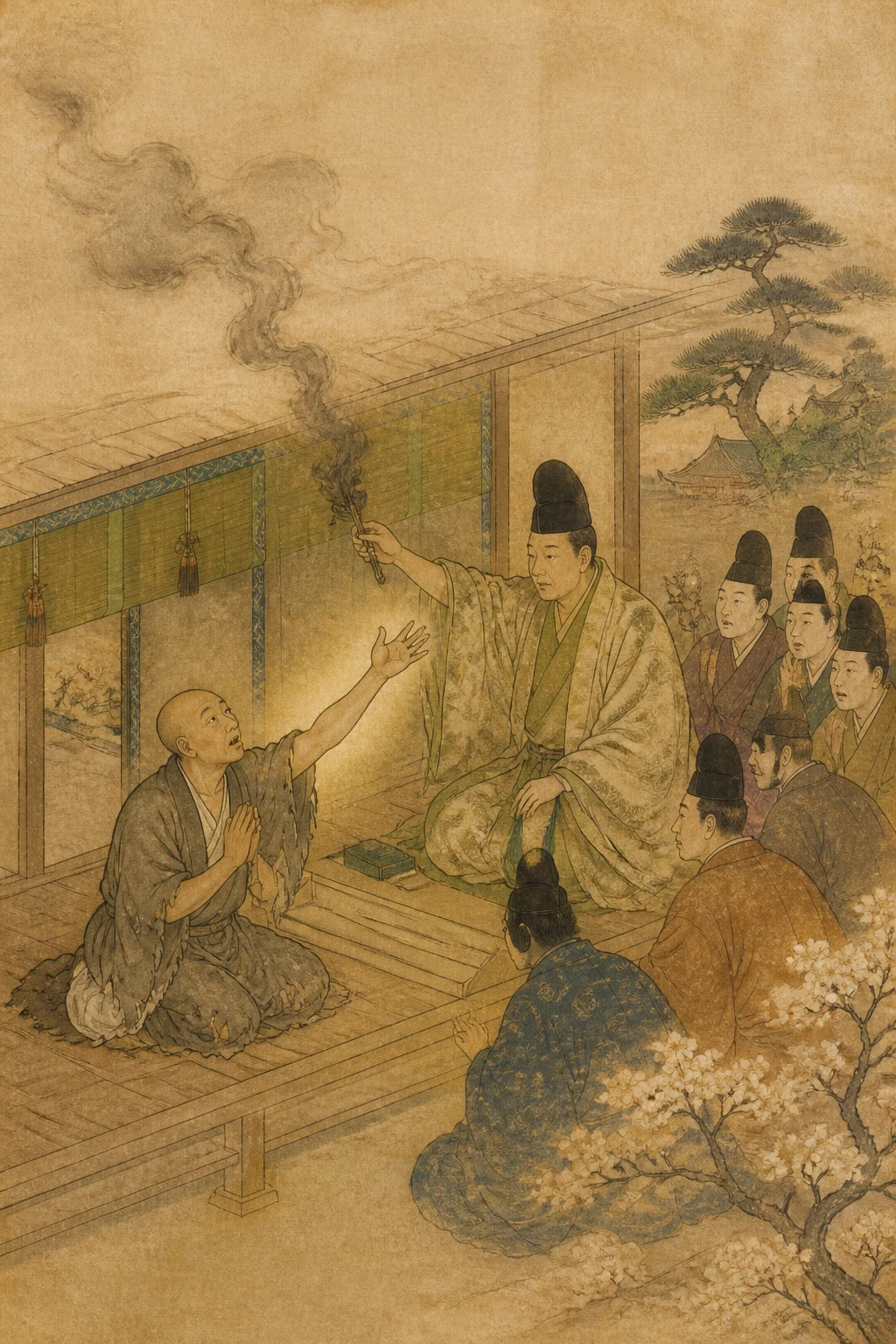
He also made his way west to a place called the Three Falls of Katsuragawa. There, at the waterfall, he entreated Fudō: “Carry me on your back to the Inner Court of Tuṣita Heaven, where the Bodhisattva Maitreya dwells.” He pleaded so insistently that Fudō said, “It is an exceedingly difficult thing you ask, but since you are so determined, I shall take you. Wash your backside.” He bathed at the foot of the falls and washed his backside thoroughly, then climbed onto the Wisdom King’s shoulders and ascended to Tuṣita Heaven. There, on the tablet above the gate to the Inner Court, were written the words “Lotus of the Wonderful Dharma.” The Wisdom King said, “Those who enter here must recite this sutra from memory. Those who cannot are not admitted.” Gazing far upward, Sōō replied, “I have read this sutra, but I have not yet mastered it by heart.” “What a pity,” said the Wisdom King. “In that case, you cannot enter. Go back, learn the Lotus Sutra by heart, and then return.” He took Sōō onto his back and carried him down to Katsuragawa, where Sōō wept and grieved without end. Afterward, he learned to recite the sutra before his principal image of worship and at last fulfilled his desire. That image of Fudō is the life-size statue that remains at Mudōji to this day. Now, because this holy man possessed such wondrous powers, when the Somedono Empress was tormented by a possessing spirit, someone said, “Among the disciples of the Great Teacher Jikaku is a monk called Sōō of Mudōji. He is a practitioner of extraordinary power.” A messenger was therefore sent to summon him. He accompanied the messenger back and stood at the middle gate. Those who saw him beheld a tall monk, fearsome as an ogre, dressed in a robe of Shinano hemp cloth, wearing flat cedar clogs and carrying a rosary of large soapberry seeds. “He is hardly fit to be brought into Her Majesty’s presence, looking as he does. Why, he is nothing but a base-born monk,” they said. “Let him perform his rites standing out by the veranda.” Word was sent down that he was to remain standing by the railing at the steps. Leaning against the railing on the eastern side of the steps, he began his prayers. The Empress lay in the central chamber of the main hall, and from time to time her voice, sounding deeply distressed, could be heard beyond the blinds. At the faintest sound of it, the monk raised his own voice and chanted his invocations. To those attending her, his voice was so terrifying that their hair stood on end, and they felt that the Wisdom King himself had appeared. Before long, the Empress, bundled in nothing but her crimson robes like a ball, came rolling out from behind the blinds and was flung onto the veranda before the monk. Her attendants cried out in alarm. “This is unbearable to see! Take her back inside, and let the monk attend her there!” But he answered, “How could such a beggar as I presume to go up into her presence?” He would not enter. Angered and affronted that they had refused to admit him at first, he remained on the veranda and caused the Empress to be lifted four or five feet into the air and dashed down again. In desperation, her attendants brought out standing curtains to conceal her, shut the middle gate, and cleared everyone away, yet she was still painfully exposed. After she had been dashed down four or five times, the monk prayed, “Cast her back inside! Cast her back inside!” And she was cast back into the chamber as before. The monk then took his leave. They tried to detain him, saying, “Please remain a little longer,” but he replied, “I have been standing so long that my back aches,” and went away without heeding them. Once the Empress had been cast back inside, the possessing spirit left her, and she felt clear and well again. In recognition of the manifest power of his rites, an imperial decree was issued appointing him to the rank of sōzu, but he declined it. “How could a beggar such as I become a prelate?” he said. Though he was summoned again afterward, he would never return. “The capital,” he said, “is a place where people are treated with contempt.”