Waltey
Voli se pogovarjajo s teleti
018 THE OXEN TALK WITH THE CALVES
Živalske zgodbe Clare Dillingham Pierson · Clara Dillingham PiersonO besedilu
Voli se pogovarjajo s teleti
- Vir
- Živalske zgodbe Clare Dillingham Pierson
- Avtor
- Clara Dillingham Pierson
- Jezik branja
- Slovenščina
- Jezik izvirnika
- English
- Čas branja
- 12 min branja
- Obseg
- 10 strani
- Naslov izvirnika
- 018 THE OXEN TALK WITH THE CALVES
O izvirniku
Živalske zgodbe Clare Dillingham Pierson
Devetindevetdeset avtorskih zgodb o živalih na kmetiji, travniku, v gozdu, ob ribniku in ponoči. Bralni jezik je Slovenščina, izvirnik pa prihaja iz vira Živalske zgodbe Clare Dillingham Pierson v jeziku English.
Besedilo
Voli se pogovarjajo s teleti
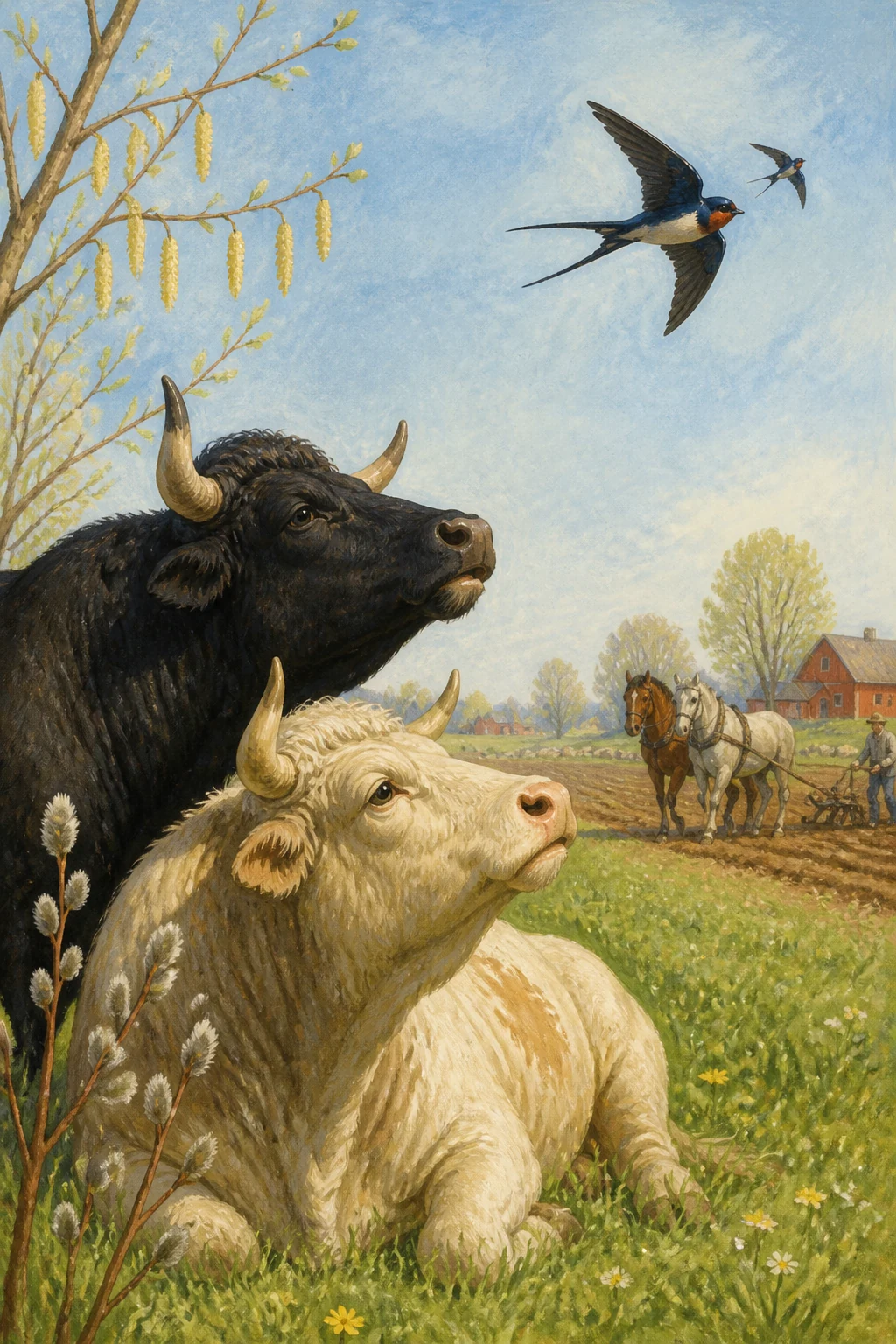
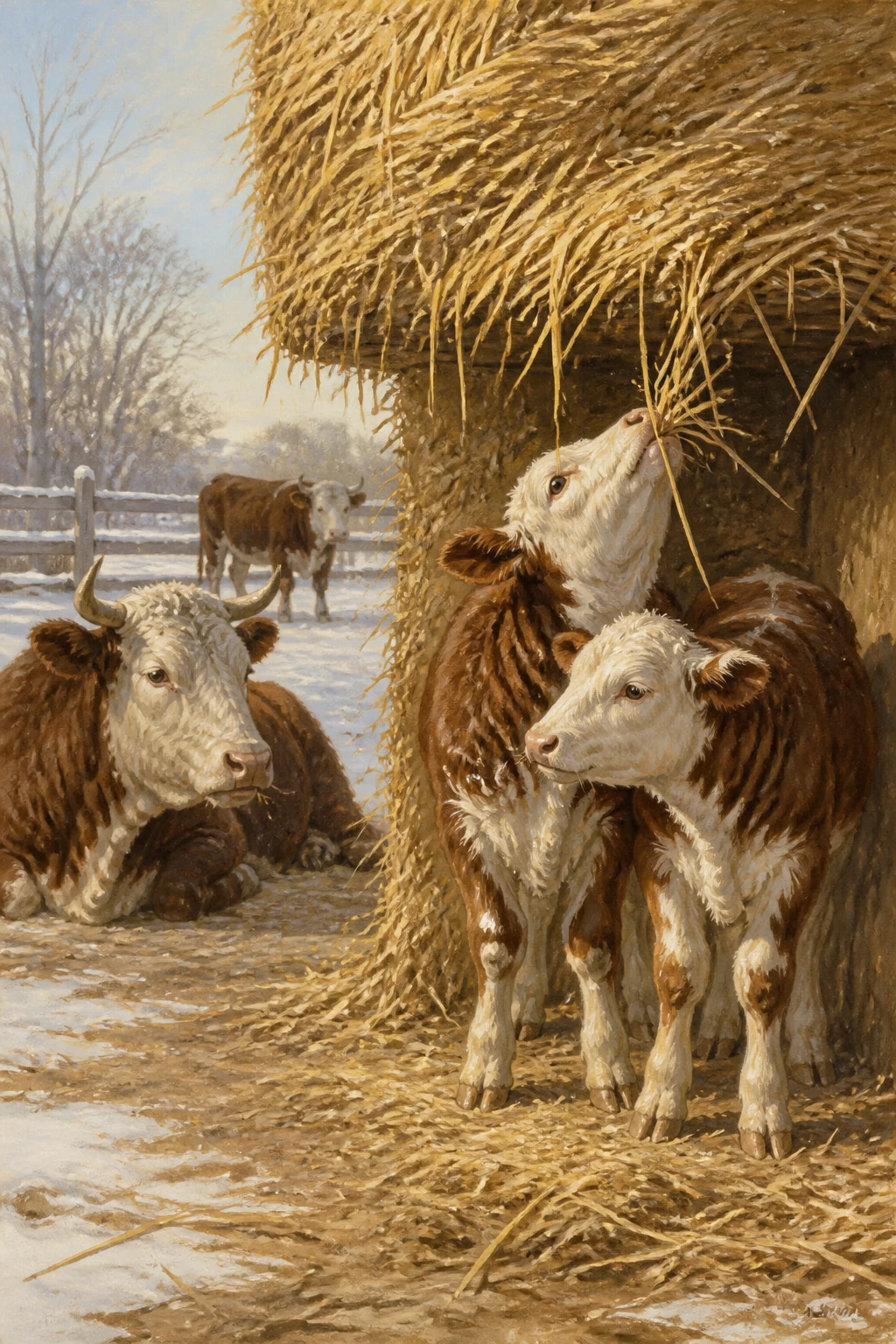
Bilo je jasno, mrzlo zimsko jutro in govedo je stalo na dvorišču ob hlevu, kjer so se dvigale velike rumene kopice slame. Spodaj so jih živali že toliko obgrizle, da je pod njimi nastalo zavetje. Telički so radi postavali na sončni strani, kjer jim je nad glavami visel napušč iz slame. Tu jih veter ni dosegel, in kadar niso imeli drugega opravka, so lahko stegovali vratove in pulili šope slame za pod zob. Ne da bi slamo tako radi jedli, a puliti jo je bilo zabavno. Vendar so navadno imeli še kaj drugega početi, saj jih je vselej čakalo prežvekovanje.
Med vsemi prebivalci dvorišča ni bilo nikogar, ki bi bil pri hrani skrbnejši. Kadar se jim je mudilo ali kadar je bila trava sveža in zelena, so jo morda res jedli na hitro, ko pa so jo pogoltnili in s to napol prežvečeno hrano napolnili prvega od svojih štirih želodcev, so si poiskali miren, udoben kotiček, kjer so lahko sproščeno stali ali ležali in dokončali svoj obed. Za to so morali napol prežvečeno hrano iz prvega želodca spet spraviti v usta. Temu so rekli, da jo »odpogoltnejo«, čeprav bi morali reči, da jo »izbljuvajo«.
Ko je bila hrana spet v ustih, so ji rekli prežvek. Močne mišice ob straneh obraza so jim spodnjo čeljust premikale gor in dol ter sem in tja, hrana pa je vedno znova prihajala med tope kočnike v zadnjem delu ust, ki so jo drobili, stiskali in obračali, dokler ni postala drobna in mehka ter pripravljena, da jo pogoltnejo v drugi želodec.
Potem govedu ni treba več misliti nanjo. Medtem ko počne nekaj povsem drugega in je morda na hrano že čisto pozabilo, pa se številni živci, mišice in drobne rdeče krvne kapljice neutrudno trudijo, da jo spravijo v tretji in četrti želodec ter moč hrane spremenijo v moč goveda. Krave in voli tega ne vedo. Nikoli še niso slišali za mišice in živce in morda tudi vi doslej še niste, pa vendar so to čudoviti mali pomočniki in dobri prijatelji, če lepo ravnamo z njimi. Govedo o jedi ve le to, da mora biti hrana čista, da mora jesti zato, ker je lačno, in ne zgolj zato, ker je jed dobra, ter da jo mora zelo skrbno prežvečiti. In če vse to počne, kakor je treba, bo skoraj zagotovo zdravo in se bo dobro počutilo.
Vola sta stala ob hlevskih vratih, telički pa so se pogovarjali o njiju. Svoja strica vola so imeli zelo radi, toda kakor mnogi drugi telički po svetu so menili, da sta precej počasna in staromodna. Tudi žrebički so govorili enako, zato je teh šest kuštravih mladičev, ki še niso imeli niti sledu o rogovih, razpravljalo, kaj vse bi počeli, če bi bili voli. Včasih so spregovorili glasneje, kot so nameravali, in vola sta jih slišala, ne da bi telički to vedeli.
»Če bi bil jaz vol,« je rekel eden, »ne bi kar mirno stal in pustil kmetu, da mi položi tisti težki jarem na vrat. Umikal bi se in brcal.« »Veste, kaj bi naredil jaz?« je rekel drugi. »Ko bi me hotel pognati, bi obstal kot vkopan in se ne bi ganil, dokler se mi ne bi zahotelo.«
»Jaz pa ne bi naredil tega,« je rekel tretji. »Zbežal bi in zvrnil kamen v jarek. Mislim, da ni pošteno, da morata vedno onadva vleči težke tovore, medtem ko se konji zabavajo s tem, da vozijo kmeta v mesto in vlečejo snopovezalko ter vse druge čudovite stroje.«
»Ali ni škoda, da niste voli?« se je za njimi oglasil globok glas. Telički so poskočili in tik ob njih je stal Desni vol. Bil je tako blizu, da med njega in teličke ne bi mogli postaviti niti kokošnjaka, in slišal je prav vsako besedo. Telički niso vedeli, kam naj pogledajo in kaj naj rečejo, saj niso govorili posebno vljudno. Tisti, ki je pravkar govoril, je hotel pokazati, da je sproščen in da mu je vseeno, zato je dvignil zadnje kopito, da bi se popraskal po ušesu, in zamahnil s čopastim repom čez bok. »Kaj pa vem,« je rekel.
»Ko sem bil teliček, sem tudi jaz prav tako govoril,« je rekel Desni vol in v velikih rjavih očeh mu je poredno zaigralo. »Vsi telički mislijo, da bodo počeli čuda, ko odrastejo.«
»Jaz sem prav gotovo tako mislil,« je rekel Levi vol, ki je prišel za bratom. »No, če sta si to želela,« je vprašal Rdeči teliček, »zakaj pa zdaj tega ne počneta?« Drugi so se čudili, kako si drzne postaviti takšno vprašanje.
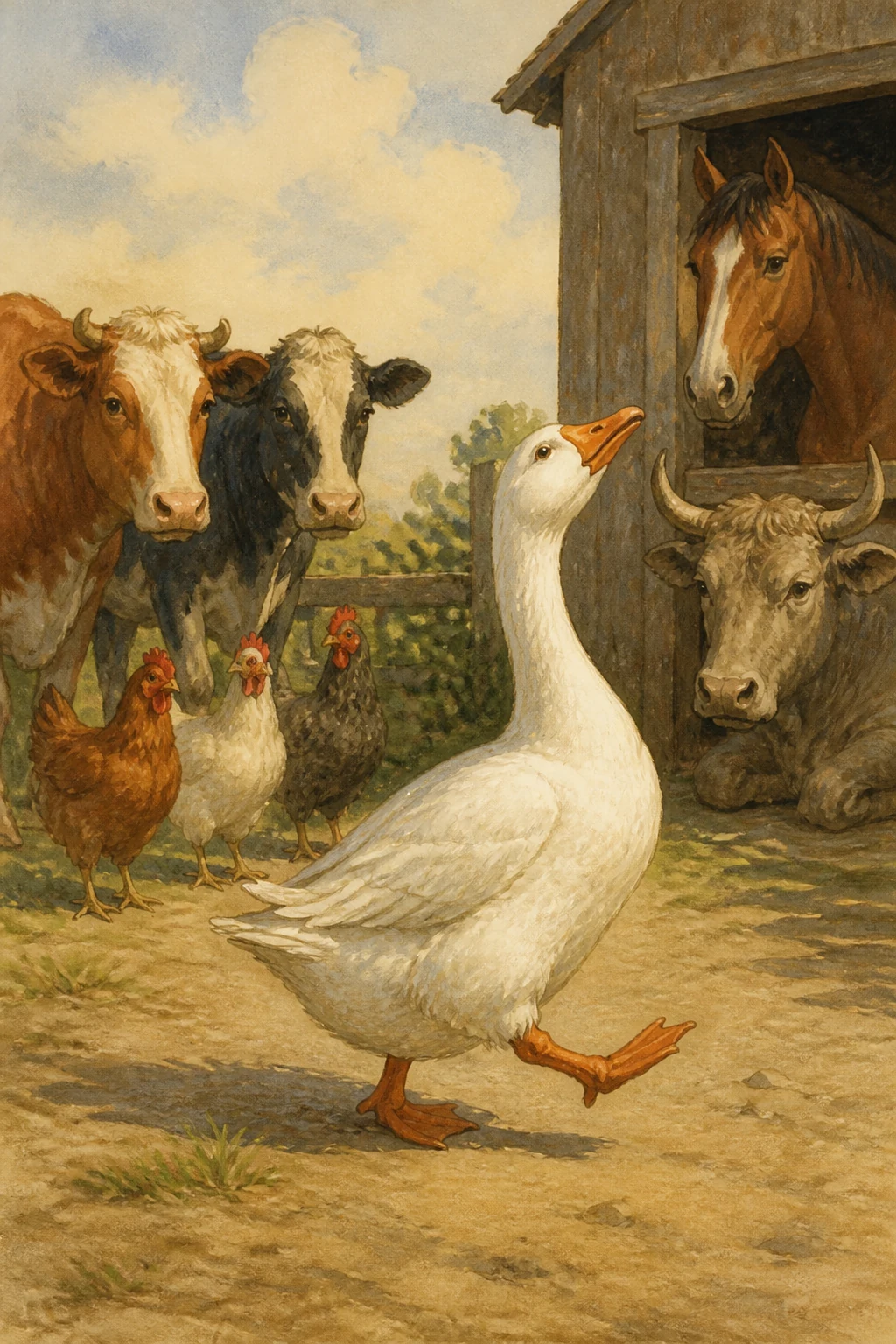
»Ne splača se,« je rekel Levi vol. »Vse svoje vragolije prihranite za čas igre. Zabavo imam rad prav tako kot vsak drug, ko pa snamejo najin jarem s klina, pravim, da je delo pač delo, in čim bolj se ga drživa, tem bolje je. Nekoč sem poznal kokljo, ki je hotela videti vse, kar se je zgodilo. Kar naprej je tekala z gnezda, da bi obiskala tega ali onega, in včasih je ostala zdoma dlje, kot je nameravala. Rekel sem ji, da bi bilo bolje, ko bi ostala na gnezdu, ona pa je odvrnila, da ne misli ves čas samo delati.«
»In kdaj so se ji izvalili piščanci?« so vsi hkrati vprašali telički. »Seveda se sploh niso izvalili,« se je zahihital Levi vol. »Samo sebe je slepila, da dela, in na ves glas tarnala, kako jo bolijo noge in kako se odreka družbi, toda polnega gnezda jajc ni mogla preslepiti. Ohladila so se in to so dobro vedela, zato se iz nobenega ni izvalil piščanec.«
»Je potem ni bilo sram?« so vprašali telički. »Prav nič ni kazalo,« je prhnil Levi vol. »Hodila je naokrog in govorila o svojem velikem razočaranju ter pravila, da ne razume, zakaj imajo druge kokoši toliko več sreče.«
Desni vol se je zahahljal. »Rekel ji je, da po njegovem ni bila kriva samo nesreča in da bi bilo bolje, ko bi prihodnjič več časa presedela na gnezdu. Ona pa ga je vprašala, koliko piščancev je izvalil on. Ho, ho, ho!«
Vsi so se zasmejali, telički pa so se čudili, kako se lahko Levi vol spominja tega, ne da bi se razjezil. »Ne bi se splačalo jeziti,« je rekel. »Čemu bi veliki, imenitni vol tratil svoj mir zaradi nevljudnosti uboge male kokoši?«
To jim je dalo misliti. Spomnili so se, kako pogosto postanejo čemerni, razgreti in slabe volje zaradi čisto drobnih nevšečnosti, in začeli razmišljati, da bi bilo morda vredno paziti tudi na teličji mir.
Naposled je Črna telička, najlepša na dvorišču, vprašala: »Ali rada vlečeta tisti ploščati voz brez koles, ki drsa po prahu?«
»Vlačugo za kamenje?« je vprašal Desni vol. »Nič nimava proti. Svojega dela se nikoli ne braniva. Ne bi pa rada vlekla snopovezalke z bleščečimi rezili in vrtečimi se rokami, kajti kdor jo vleče, mora hitro hoditi, se nenadoma obračati in ustavljati. Ne bi bila rada vprežena v kočijo, da bi vozila kmetovo družino v mesto. Ne bi rada pazila na ovce kakor škotski ovčar ali nosila perja kakor gosi — toda vleči vlačuge za kamenje in vsakršne težke tovore, to pa znava, četudi se sama pohvaliva.«
Rdeči teliček, ki je kar naprej tekal naokrog in poskakoval, je rekel: »Oh, ampak to delo gre tako počasi! Mislil bi, da se vama zdi, kakor da ne bosta nikoli prišla do konca poti.«
»Na to ne misliva,« je odvrnil Levi vol. »Ne splača se. Včasih pa sva. Spominjam se, kako sem si želel, da bi bil lastovka in bi preletel miljo na minuto, namesto da vse življenje stopicam korak za korakom. Moja mati je bila pametna krava in v naši čredi je nosila zvonec. Ona me je ozdravila te neumnosti. Povedala mi je, da morajo tudi lastovke leteti zamah za zamahom in da je treba kosilo pojesti grižljaj za grižljajem ter da se ničesar zares vrednega ne da opraviti v eni minuti. Rekla je, da ne bomo nikoli uživali življenja, če bomo ves čas mislili samo na to, koliko dela nas še čaka in kako je utrudljivo, pa tudi dolgo ne bomo živeli. Leni voli nikoli ne živijo dolgo. Še ena reč, ki se ne splača.«
Rdeči in Beli teliček sta v en glas rekla: »Midva bova vedno pametna. Nikoli se ne bova razjezila. Nikoli se ne bova bala dela. Imenitna goveda bova in dolgo bova živela.«
»Ali ne bi bilo bolje reči, da se bosta trudila biti pametna?« je vprašal Levi vol. »Saj vesta, da vse to ni vedno lahko in da je treba vedno znova začeti od začetka.«
»O, ne,« sta odgovorila. »Midva že veva, kaj zmoreva.« »Morda pa se motita,« sta blago rekla vola. »Jaz se nikoli ne motim,« je rekel Rdeči teliček. »Jaz tudi ne,« je rekel Beli teliček.
»No, pa dobro jutro,« sta zaklicala vola in odšla. »Greva malo poklepetat z najinimi sestrami kravami.« Ko sta odšla, je lepa Črna telička prijazno rekla: »Zdi se mi, da bom prej že stara krava, preden se bom naučila biti tako dobra in pametna kot onadva, ampak trudila se bom.«
»Pha!« je rekel Rdeči teliček. »Biti pameten je čisto lahko, če le hočeš — tako lahko kot jesti.« »Res je,« je rekel Beli teliček. »Zdaj ko zagotovo vem, da se je neumno jeziti, se ne bom nikoli več razjezil.«
»Ljubi moj!« je rekla lepa Črna telička. »Kako močna in dobra morata biti. Jaz se lahko samo še naprej trudim.« »Pha!« je spet rekel Rdeči teliček. Nato je znižal glas in jo nagovoril. »Pomakni se malo,« je rekel, »in mi pusti, da stojim ob tebi v zavetnem kotičku, medtem ko prežvekujem.«
»Nikar!« je zaklical Beli teliček. »Jaz hočem tisti prostor.« »Kar misli si!« je vzkliknil Rdeči teliček. »Prej te bom nabutal.« »Pa poskusi,« je rekel Beli teliček, »ampak tisti prostor bo moj.«
»Oh, prosim, ne pretepajta se!« je vzkliknila Črna telička. »Enemu od vaju prepustim svoj kot.« »Nikar se ne premikaj,« sta zaklicala oba. »Ob tebi hočem stati.« Nato sta spustila glavi in si pogledala v oči. Zatem sta uprla trdi čeli drugo ob drugo ter rinila in rinila in rinila. Včasih je Rdeči teliček potisnil Belega nazaj, včasih pa je bilo obrnjeno. Tu in tam sta obstala in si oddahnila. Potem sta spet začela riniti.
Medtem ko sta se tako prepirala, postajala vse bolj razgreta in jezna ter izgubljala prav tisti mir, za katerega sta zatrjevala, da ga bosta vedno ohranila, je v zavetni kotiček ob Črni telički stopil mlad teliček pasme jersey in sta prijetno kramljala. »Zakaj pa se tista dva pretepata?« je vprašal.
Črna telička se je drobno, navihano nasmehnila. »Pretepata se,« je rekla, »da bi odločila, kateri bo stal tukaj v kotičku ob meni in prežvekoval.«
Teliček pasme jersey je bil bister mladenič iz zelo dobre družine. »Morda,« je rekel, »bi moral ostati tukaj in čuvati prostor, dokler se ne odločita, čigav bo.«
»Prav rada bi, da ostaneš,« je rekla. In tako se je zgodilo, da sta telička, ki sta se razjezila, preživela čemeren, utrudljiv in neprijeten dan, medtem ko je nekdo drug zasedel prav tisti kotiček, ki sta si ga želela. Ko je prišel večer, sta godrnjala, ker ju je teliček pasme jersey prehitel, in to se jima je zdelo zelo čudno. A ni bilo čudno, kajti mirni in dobrovoljni jo na koncu vedno najbolje odnesejo. Tisti pa, ki so tako zelo prepričani, da je lahko biti dober, kadar si to zares želiš, so prav tisti, ki si tega včasih ne želijo takrat, ko bi si morali.
Črna telička je imela prav. Edini način, da postaneš pameten in srečen, je, da se trudiš in trudiš in trudiš, in to se res splača. Med gozdnimi prebivalci. Napisala CLARA D. PIERSON.
Ilustriral F. C. Gordon. Dvanajsterka, 220 strani, vezano v platno, z zlatim zgornjim obrezom — 1,25 dolarja. »Knjiga pred nami nam prinaša nadvse očarljiv niz zgodb za otroke — da, za otroke vseh starosti, tako mlade kot stare. Nihče ne more brati teh živih pogovorov drobnih gozdnih bitij, ne da bi jih prisrčno vzljubil, obenem pa vsaka zgodba razkriva mnogo zanimivih dejstev o življenju in navadah teh malih prebivalcev. Matere in učitelji bodo to knjižico gotovo sprejeli z največjim veseljem. Nobena pohvala ji ne more biti prevelika.« — Boston Transcript.
»V prijetni pripovedni preobleki ponuja obilico znanja, ilustracije pa so pri tem v dodatno pomoč. Bistra in očarljiva knjiga.« — Philadelphia Eve. Telegraph.
»To je knjiga, ki jo bo vsak otrok rad bral.« — Hartford Courant. »Zamisel knjige je posrečena, izpeljana pa s pronicljivim in tenkočutnim razumevanjem načinov, kako pritegniti otroško pozornost in se smiselno vtisniti v otroški spomin. Ilustracije so pri tem v očitno pomoč.« — Troy Daily Press.
»Človek ne ve, kaj naj bolj občuduje — avtoričino domačnost z gozdnim ljudstvom ali njeno razumevajočo naklonjenost do ljubkega otroškega sveta. Zdi se, da sta ji oba enako blizu.« — Churchman.
Ob plačilu kupnine pošljemo po pošti brez poštnine. E. P. DUTTON & CO., založniki, 31 West 23d Street, New York. »Marsikatera mati in učitelj bosta avtorici izrekla hvaležnost.«
~Med travniškimi prebivalci.~ ZGODBE O ŽIVLJENJU NA POLJU, NAPISANE ZA NAJMLAJŠE. Napisala CLARA D. PIERSON. Ilustriral F. C. GORDON. Dvanajsterka, 127 strani, vezano v platno, z zlatim zgornjim obrezom, 1,25 dolarja.
»Ena najbolj prikupnih in v marsičem najbolj privlačnih med številnimi knjigami o spoznavanju narave, ki jih je prineslo preteklo leto.« — Boston Advertiser.
»Spominjajo na znamenite Prilike iz narave gospe Gatty; napisane so v najlepši angleščini, očarljive kakor pravljice, pa vendar ‘zares resnične’, kar, kot vsi vemo, otroški um še posebej pritegne.« — N. Y. Evangelist.
»Za ta namen še nismo videli nič boljšega in upamo, da bo marsikatera vzgojiteljica in marsikatera mati izkoristila priložnost za uporabo teh drobnih pripovedi.« — N.Y. Christian Advocate.
»Ko bodo takšne knjige prišle v širšo rabo, bo to pomenilo velik napredek pri vzgoji v šoli in doma.« — Zion's Herald.
»Te očarljive zgodbe o življenju na polju bodo razveselile marsikaterega predšolskega otroka; in z gotovostjo lahko rečemo, da bodo tudi starejši bratje in sestre hoteli biti deležni njihovega čara.« — Christian Register.
Ob plačilu kupnine pošljemo po pošti brez poštnine. E. P. DUTTON & CO., založniki, 31 West 23d Street, New York.
Izvirnik
018 THE OXEN TALK WITH THE CALVES
Naslednje strani prikazujejo izvirno besedilo za primerjavo.
It was a clear, cold winter morning, and the Cattle stood in the barnyard where the great yellow straw-stacks were. They had nibbled away at the lower part of these stacks until there was a sheltered place underneath. The Calves liked to stand on the sunshiny side with an over-hanging ledge of straw above their heads. The wind did not strike them here, and they could reach up and pull out wisps to eat when they had nothing else to do. Not that they were so fond of eating straw, but it was fun to pull it out. There was, however, usually something else to be done, for there was always their cud to chew.
Among all the farmyard people, there were none more particular about their food. They might eat in a hurry when time was short, or when the grass was fresh and green, but after they had swallowed it and filled the first of their four stomachs with partly chewed food, they would find some quiet and comfortable place where they could stand or lie easily and finish their eating. To do this, they had to bring the partly chewed food from the first stomach to the mouth again. They called this "unswallowing it," although they should have said "regurgitating."
After the food was back in their mouths again, it was spoken of as their cud, and the stout muscles in the sides of their faces pulled their lower jaws up and down and sideways, and the food was caught over and over again between the blunt grinding teeth in the back part of their mouths, and was crushed, squeezed, and turned until it was fine, soft, and ready to swallow into the second stomach.
Then the Cattle do not have to think of it again, but while they are doing something quite different, and perhaps forgetting all about it, there are many nerves and muscles and fine red blood-drops as busy as can be, passing it into the third and fourth stomachs, and changing the strength of the food into the strength of the Cattle. The Cows and the Oxen do not know this. They never heard of muscles and nerves, and perhaps you never did before, yet these are wonderful little helpers and good friends if one is kind to them. All that Cattle know about eating is that they must have clean food, that they must eat because they are hungry and not just because it tastes good, and that they must chew it very carefully. And if they do these things as they should, they are quite sure to be well and comfortable.
The Oxen were standing by the barn door, and the Calves were talking about them. They liked their uncles, the Oxen, very much, but like many other Calves the world over, they thought them rather slow and old-fashioned. Now the Colts had been saying the same thing, and so these half-dozen shaggy youngsters, who hadn't a sign of a horn, were telling what they would do if they were Oxen. Sometimes they spoke more loudly than they meant to, and the Oxen heard them, but they did not know this.
"If I were an Ox," said one, "I wouldn't stand still and let the farmer put that heavy yoke on my neck. I'd edge away and kick."
"Tell you what I'd do," said another. "I'd stand right still when he tried to make me go, and I wouldn't stir until I got ready."
"I wouldn't do that," said a third. "I'd run away and upset the stone in a ditch. I don't think it's fair to always make them pull the heavy loads while the Horses have all the fun of taking the farmer to town and drawing the binder and all the other wonderful machines."
"Isn't it too bad that you are not Oxen?" said a deep voice behind them. The Calves jumped, and there was the Off Ox close to them. He was so near that you could not have set a Chicken coop between him and them, and he had heard every word. The Calves did not know where to look or what to say, for they had not been speaking very politely. The one who had just spoken wanted to act easy and as though he did not care, so he raised one hind hoof to scratch his ear, and gave his brushy tail a toss over one flank. "Oh, I don't know," said he.
"I used to talk in just that way when I was a Calf," said the Off Ox, with a twinkle in his large brown eyes. "All Calves think they'll do wonders when they're grown."
"I know I thought so," said the Nigh Ox, who had followed his brother.
"Well, if you wanted to," asked the Red Calf, "why don't you do those things now?" The others wondered how he dared to ask such a question.
"It doesn't pay," said the Nigh Ox. "Do all your frisking in playtime. I like fun as well as anybody, yet when our yoke is taken from its peg, I say business is business and the closer we stick to it the better. I knew a sitting Hen once who wanted to see everything that happened. She was always running out to see somebody or other, and sometimes she stayed longer than she meant to. I told her she'd better stick to her nest, and she said she didn't believe in working all the time."
"How soon did her Chickens hatch?" asked the Calves all together.
"Never did hatch, of course," chuckled the Nigh Ox. "She fooled herself into thinking she was working, and she made a great fuss about her legs aching and her giving up society, but she couldn't fool that nestful of eggs. They had gotten cold and they knew it, and not one of them would hatch."
"Wasn't she ashamed then?" asked the Calves.
"Didn't act so," snorted the Nigh Ox. "Went around talking about her great disappointment, and said she couldn't see why the other Hens had so much better luck."
The Off Ox chuckled. "He told her that he guessed it might have been something besides bad luck, and that the next time she'd better stay on her nest more. Then she asked him how many broods of Chickens he had hatched. Ho-ho-ho!"
Everybody laughed, and the Calves wondered how the Nigh Ox could think of it without being angry. "It wouldn't pay to be angry," he said. "What's the use of wasting a fine great Ox temper on a poor little Hen rudeness?"
This made them think. They remembered how cross and hot and uncomfortable they often became over very small things that bothered them, and they began to think that perhaps even Calf tempers were worth caring for.
At last the Black Calf, the prettiest one in the yard, said, "Do you like drawing that flat wagon which hasn't any wheels, and scrapes along in the dust?"
"The stone-boat?" asked the Off Ox. "We don't mind it. Never mind doing our kind of work. Wouldn't like to pull the binder with its shining knives and whirling arms, for whoever does that has to walk fast and make sudden turns and stops. Wouldn't like being hitched to the carriage to carry the farmer's family to town. Wouldn't like to take care of the Sheep, like Collie, or to grow feathers like the Geese--but we can draw stone-boats and all sorts of heavy loads, if we do say it."
The Red Calf, who was always running and kicking up his heels, said, "Oh, it's such slow work! I should think you'd feel that you would never reach the end of your journey."
"We don't think about that," answered the Nigh Ox. "It doesn't pay. We used to, though. I remember the time when I wished myself a Swallow, flying a mile a minute, instead of step-step-stepping my way through life. My mother was a sensible Cow, and wore the bell in our herd. She cured me of that foolishness. She told me that Swallows had to fly one wing-beat at a time, and that dinners had to be eaten one mouthful at a time, and that nothing really worth while could be done in a minute. She said that if we were forever thinking how much work we had to do and how tiresome it was, we'd never enjoy life, and we wouldn't live long either. Lazy Oxen never do. That's another thing which doesn't pay."
The Red Calf and the White Calf spoke together: "We will always be sensible. We will never lose our tempers. We will never be afraid to work. We will be fine and long-lived cattle."
"Might you not better say you will try to be sensible?" asked the Nigh Ox. "You know it is not always easy to do those things, and one has to begin over and over again."
"Oh, no," they answered. "We know what we can do."
"You might be mistaken," said the Oxen gently.
"I am never mistaken," said the Red Calf.
"Neither am I," said the White Calf.
"Well, good-morning," called the Oxen, as they moved off. "We are going to talk with our sisters, the Cows."
After they had gone, the pretty Black Calf spoke in her pleasant way: "It seems to me I shall be an old Cow before I can learn to be good and sensible like them, but I am going to try."
"Pooh!" said the Red Calf. "It is easy enough to be sensible if you want to be--as easy as eating."
"Yes," said the White Calf. "I shall never lose my temper again, now that I am sure it is foolish to do so."
"Dear me!" said the pretty Black Calf. "How strong and good you must be. I can only keep on trying."
"Pooh!" said the Red Calf again. Then he lowered his voice and spoke to her. "Move along," said he, "and let me stand beside you in the cubby while I chew my cud."
"Don't you do it," cried the White Calf. "I want that place myself."
"I guess not!" exclaimed the Red Calf. "I'll bunt you first."
"Bunt away, then," said the White Calf, "but I'll have that place."
"Oh, please don't fight!" exclaimed the Black Calf. "I'll let one of you have my corner."
"Don't you move," cried each of them. "I want to stand by you." Then they lowered their heads and looked into each other's eyes. Next, they put their hard foreheads together, and pushed and pushed and pushed. Sometimes the Red Calf made the White Calf go backward, and sometimes it was the other way. Once in a while they stood still and rested. Then they began pushing again.
While they were quarrelling in this way, getting warmer and more angry all the time, and losing those very tempers which they had said they would always keep, a young Jersey had stepped into the cubby beside the Black Calf, and they were having a pleasant visit. "What are those fellows fighting about?" he asked.
The Black Calf smiled a funny little smile. "They are fighting," said she, "to see which one shall stand in the cubby with me and chew his cud."
The Jersey Calf was a shrewd young fellow of very good family. "Perhaps," said he, "I ought to stay and guard the place until it is decided who shall have it."
"I wish you would," said she.
And that was how it happened that the two Calves who lost their tempers had a cross, tiresome, and uncomfortable day, while another had the very corner which they wanted. When night came, they grumbled because the Jersey Calf had come out ahead of them, and they thought it very strange. But it was not strange, for the people who are quiet and good-natured always come out ahead in the end. And the people who are so very sure that it is easy to be good when they really want to, are just the very ones who sometimes do not want to when they should.
The Black Calf was right. The only way to be sensible and happy is to try and try and try, and it does pay.
Among the Forest People.
By CLARA D. PIERSON.
Illustrated by F. C. Gordon.
12mo, 220 pages, cloth, gilt top--$1.25.
"A most charming series of stories for children--yes, and for children of all ages, both young and old--is given us in the volume before us. No one can read these realistic conversations of the little creatures of the wood without being most tenderly drawn toward them, and each story teaches many entertaining facts regarding the lives and habits of these little people. Mothers and teachers must welcome this little book most cordially. One cannot speak too strongly in praise of it."--Boston Transcript.
"In pleasant story-telling guise, much information is conveyed, and the pictures are a further help. A clever and charming book."--Philadelphia Eve. Telegraph.
"Is a book that every child will like to read."--Hartford Courant.
"The scheme of the book is felicitous, and it is worked out with an acute and sympathetic appreciation of methods for enlisting the attention and impressing intelligently the memory of children. The illustrations are distinctly helpful."--Troy Daily Press.
"One does not know which to admire most--the intimate footing upon which the author stands with the forest folk, or the intelligent sympathy she has with sweet child life. She seems to be equally in touch with both."--Churchman.
Sent by mail, post-paid, on receipt of price.
E. P. DUTTON & CO., Publishers, 31 West 23d Street, New York.
"Many a mother and teacher will accord a vote of thanks to the author."
~Among the Meadow People.~
STORIES OF FIELD LIFE, WRITTEN FOR THE LITTLE ONES.
By CLARA D. PIERSON.
Illustrated by F. C. GORDON.
12mo, 127 pages, cloth, gilt top $1.25.
"One of the daintiest and in many ways most attractive of the many books of nature study which the past year has brought forth."--Boston Advertiser.
"They are like Mrs. Gatty's well-known 'Parables from Nature,' written in the best of English, as fascinating as fairy tales, and yet 'really true,' a quality which we all know appeals to the childish mind."--N. Y. Evangelist.
"We have seen nothing better for its purpose, and hope many a teacher of kindergartens and many a mother may avail herself of the privilege of using these little tales."--N.Y. Christian Advocate.
"It will be a great advance in the work of education in the school and the home when such books are more generally utilized."--Zion's Herald.
"These charming stories of field life will delight many a child of kindergarten age; and it is safe to say that older brothers and sisters will also want to claim a share in them."--Christian Register.
Sent by mail, post-paid, on receipt of price.
E. P. DUTTON & CO., Publishers,
31 West 23d Street, New York.
Nadaljuj z branjem