Prevod
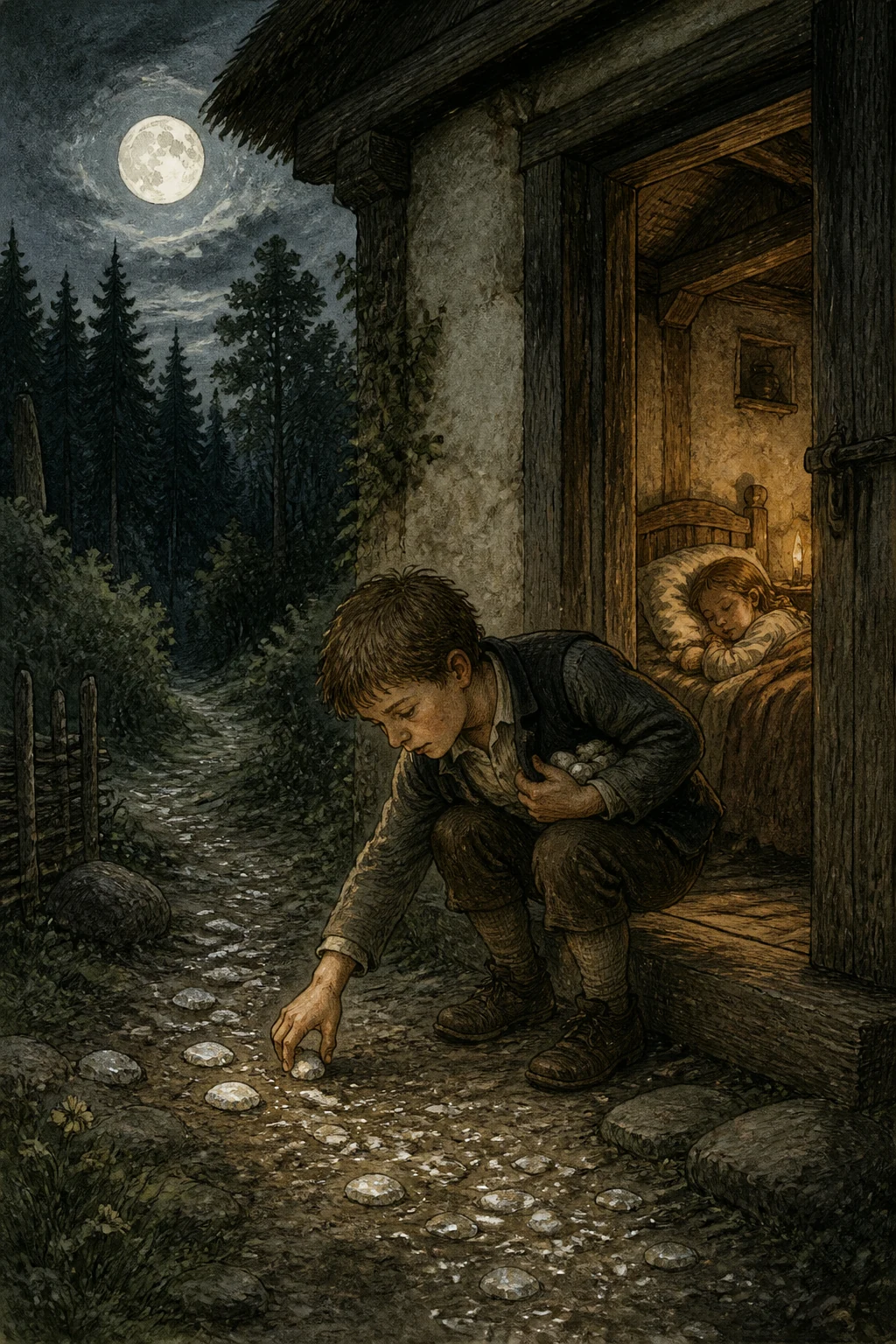
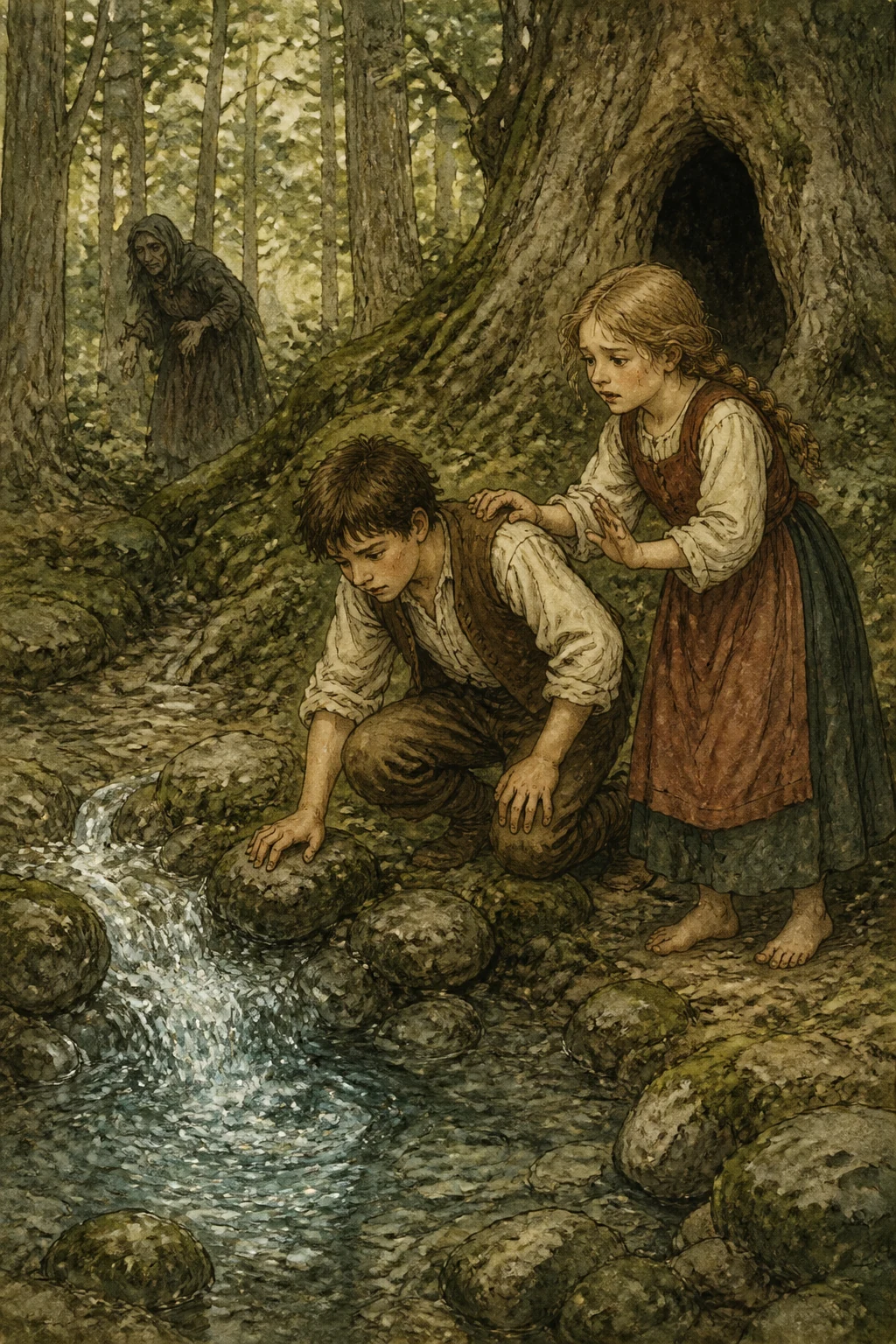
Once upon a time, as once there was, there lived a man. He had a daughter and a son, and when their mother died, some little devil prompted him to marry again. His new wife could no more bear the sight of the children than salt in her eyes. There was not a morning, not an evening, not a single moment God had given that she did not make their lives miserable. Now she beat them, now she scolded them, now she cursed them up and down and drove them away. The poor little things, being children, did not know what to do or how to behave to please her; but all their efforts were in vain. They never knew a happy day, for she was forever at their throats. One day she said to her husband, “Look here, husband: unless you take your children away somewhere into the wilderness and lose them there, I shall never again eat bread and salt from the same platter as you.” “But wife, how can I do away with such dear little children? And where am I to take them?” “I know nothing about that. Do as I tell you, and let that be the end of it.” What was the poor man to do? If he disobeyed her, he feared his household would fall apart and his life be ruined. If he obeyed, his heart ached for the children. After his wife had nagged and badgered him long enough, he made up his mind to do her bidding, for her tongue had driven him out of his senses. So he rose early one morning, took his children, and set off with them, saying they were going to gather firewood. The girl, who was older than the boy, put a couple of handfuls of cornmeal into her apron and scattered it along the road as they went into the forest. When they arrived, their father built them a fire and said, “There, children, I have made you a fire. Stay here and warm yourselves while I go just a little way over there to cut some wood, and when I come back I shall bring you apples.” “Very well, Father,” the children answered, “only do not stay away long, for we are frightened by ourselves.” “Have no fear on that account.” With that he left. He stopped about as far away as one might throw a wood chip, climbed a tree, and tied a piece of plank to its top. Whenever the wind blew, the plank knocked against the tree, and the children said, “Listen, Father is chopping wood.” But he went home to his wife and told her what he had done. When evening came, they laid the table and ate. There were a few scraps left over, and his wife said, “Where might your children be now, husband? They could eat what we have left.” “Here we are! Here we are!” And out they came from behind the chimney of the cottage and ate. After their father had risen from the table, their stepmother asked them how they had found their way back. The girl told her everything she had done, and how, when they reached home, they had hidden behind the chimney for fear of being beaten. You see, they had followed the trail of cornmeal the girl had scattered on the way to the forest. Some time passed, and that witch of a stepmother began pestering her husband again to get rid of them. With no peace to be had, the father took his children and led them into the forest once more. This time too the girl tried to take some cornmeal, but she could find none. She went to the hearth to get ashes instead, but her stepmother struck her hand with the poker. When they reached the forest, their father built a fire and left them there, saying he was going to cut wood. And off he went, and gone he stayed, for he never came back to them. Now let us leave him and turn to the children. They waited and waited, and when they saw that their father was not returning, they set off in the direction he had taken to look for him. They could not find him, and wandered through the forest until evening. The boy, being younger, began to whimper with hunger and weariness. The girl was in distress herself, not knowing what to give him to eat or where they might find shelter. They walked and walked, only to come back to the fire where their father had left them. The boy went on crying, for he was worn out. Twilight overtook them, hungry and unrested. Then, to soothe the child and lull him to sleep with the thought of food so that he would stop crying, the girl put a cowpat she had found nearby into the hot ashes and said to her little brother, “Hush now, Sister’s little darling. Look, I have put a cake in the fire to bake. Meanwhile, lay your head in my lap and have a little sleep.” The boy believed his sister and grew quiet. Just then an old man appeared before them. “Good day to you, my children,” he said. “Thank you kindly,” the girl answered. “But what have you there in the fire?” “What should we have, Grandfather? I have put a cowpat there to soothe this child, who is worn out with weariness and faint with hunger.” A little later the old man told her to take it out of the ashes, for it must be baked by now. The girl obeyed, though with some misgiving. And what do you think she drew out? A loaf of bread as white as the face of God. For that old man was God himself, though the girl knew nothing of it. At the sight of such a miracle she took fright. She knew well enough what she had put into the ashes, and now look what had come out! They all sat down and ate. They ate and ate, but the bread never came to an end. Then the old man took a strand of hair from the girl’s head, made snares and a little bow, and gave them to the boy. “Now you have bread,” he told them. “With these you can catch birds, so that you will have something to eat.” “Thank you, Grandfather, thank you,” they both answered at once. The old man taught the boy how to use the snares and the bow, then left them there and vanished from sight. From that time on, the boy went through the forest catching birds, while his sister cooked them, and so they had food. They grew older, and grew weary of spending their nights in hollow trees and thickets. They longed for a little place of their own where they could lay their heads on a pillow. One day, while the boy was out hunting, he came upon a hare. He drew his bow to shoot it, but the hare said, “Do not shoot me, brave lad, and I shall give you one of my young, who will be of great service to you.” The boy listened to the hare and took its young one. He went farther and met a fox. She spoke to him as the hare had done, and he took one of her cubs. Farther on he met a wolf, and took a cub from him too, for he listened to his plea and did not shoot him. He did the same when he met a bear. Now the boy had four wild creatures, whom he called his little hounds. He returned to his sister with his hounds following him, and cared for them as though they were a great treasure. One day a thought came to the girl, and she said to her brother, “Climb a tall tree, dear brother, and look all around. Perhaps you will see something that looks like a village.” For she was heartily sick of roaming this way and that through the forest like outlaws forsaken by God. The boy climbed up, and his sister asked, “Can you see anything, brother?” “Nothing, except—look, over this way, straight ahead—I can make out something white. But I cannot tell what it is, for it is too far away.” “Look carefully,” the girl told him, “and remember which way it lies. Then come down, and we shall go straight there.” After they had walked for an hour, he climbed another tall tree, looked in that direction, and could clearly see houses. When the girl asked him, he told her what he had seen. They set off again and strode along until they reached the place. And what did they find there? A palace fit for a prince! It was the dwelling of a zmeu. They went inside, but saw no one. So the girl set to work dusting and tidying and putting every little thing in its place. Then she cooked a meal, sat down at the table with her brother, and ate. Afterwards they hid in a chamber. In the evening, home came the zmeu. Seeing that things were no longer in the disorder in which he had left them, he began to say, “Who has done me this kindness, that I may do him a kindness in return?” They came out of hiding, and the girl answered, “I dusted and tidied the house.” The zmeu was more pleased than words can tell. They laid the table, all ate together, and went to bed. The next day the boy took his hounds and went hunting, as was his custom. The zmeu did likewise. When they returned in the evening, they found their food cooked and their supper ready. They sat down to eat and made merry. And so it went, one day after another, the days slipping by as swiftly as sins. After a while the zmeu began coming home from the hunt before the boy. He had taken a liking, you see, to talking with the girl. And as one word led to another, our zmeu began to feel his heart flutter whenever he came near her, or she smiled at him and said some little trifle. The great lout soon understood why he no longer felt any urge to go hunting, and began finding all manner of excuses to stay at home. So matters went until he and the girl were thoroughly in love. The boy minded his own affairs and never noticed that the zmeu had begun playing tricks. He knew only the straight and honest way, and thought no more about it. The zmeu and the girl began to feel that the boy stood in their way. Whatever they did, it seemed to them that he was always an obstacle. But the poor fellow neither saw nor heard anything. He paid no heed to their whispers and took no notice of the schemes and tricks they were forever playing on him. Sometimes they said he had come home too late, and that they had eaten before him so the food would not spoil from overcooking, and gave him whatever was left. Sometimes he had come too early and must wait until the table was laid. Now it was one thing, now another; now his sister grew angry with his hounds, now the zmeu looked at him askance, and there were countless other things of the kind. One day the zmeu and the boy’s sister agreed to kill him and be rid of him. The zmeu wanted to follow him into the forest and eat him. “Do not go, for heaven’s sake!” she said. “His hounds will tear you to pieces.” “Then what are we to do?” “Leave me to arrange things, and afterwards I shall tell you what to do.” Such was their cunning plan. The boy’s sister began pleading with her brother that she was lonely at home by herself. She begged him to leave his hounds to keep her company. At first he would not, for he was used to having them with him. But after much pleading he felt sorry for his sister, and left them to keep her company. As soon as he had gone hunting without them, she took the hounds and shut them in a mountain cave, and with the zmeu’s help rolled a great boulder across its mouth. Then the zmeu went after the boy into the forest. When the boy saw him coming from afar, angry and full of menace, he climbed a tree. As soon as the zmeu reached him, he said, “Come down, enemy of mine, for I am going to eat you.” “Eat me you will,” the boy answered, “but first give me leave to sing a little song from the days when I was younger.” “Well, go on, since you are so set upon it. But sing quickly, for I have no time to waste.” And the boy sang, “Can none of you hear, / Can none of you see? / Heavy as Earth, / And Light as the Wind, / My little hounds, / Your master is dying!” “Now come down so I may eat you,” said the zmeu. “Wait a little longer,” the boy answered, “and let me sing one more song. Here, gnaw this sandal meanwhile.” He sang the same song again. To be allowed another song, he gave the zmeu his other sandal. And when there was still no sign of help, he gave him his cap to gnaw while he sang a fourth time. And what do you think had happened? At the first call, the hare had heard him and said, “Listen, brothers, our dear master is in danger!” “Hold your tongue, rag-ears!” the fox told him, giving him a slap. “How dare you think such a thing of our master?” At the second call, the fox heard him. When she said what the hare had said, the wolf slapped her and answered just as she had answered the hare. At the third call, the wolf heard him. He repeated what the fox had said, and the bear slapped him too, scolding him for thinking such a thing of their master. But at the fourth call, the bear heard him as well. The hare began to fidget, for he had been rebuked unjustly. “We shall settle our quarrels later,” said the bear. “Now let us see you work. Put all your strength into it, every one of you, so we can shift this boulder and fly to save our master from death.” The hare put his shoulder to it, but nothing happened. The fox joined him, and now it seemed as though the boulder might have moved a little. The wolf added his shoulder, and it rocked. But when the bear put his great shoulder to it, the boulder went rolling away, and the bear tumbled after it. Out they all rushed. Then they agreed to travel as fast as the wind, not as fast as thought, lest they destroy themselves. Seeing that his little hounds still had not come, the boy had just begun climbing down, for the zmeu was pressing him hard with threats.
But here came his hounds, my good people, sweeping along like a whirlwind driven by a storm, and in an instant they reached the spot. The boy’s heart returned to its place, for he had been badly frightened. As for the zmeu, the moment he saw them he turned himself into a charred log. When the hounds arrived, they asked, “What are your orders, master?” “Do you see that charred log?” “We see it.” “Tear it to shreds for me. Shake it to pieces and eat its whole body, but leave the heart and liver, for I need those.” And then, worthy gentlemen, those four hounds fell upon the charred log and ripped it apart until there was scarcely a speck left of it. In the blink of an eye, nothing remained but the heart and liver. The boy climbed down from the tree, made a spit, threaded the zmeu’s heart and liver onto it, and slung it over his shoulder. Then he went home with his hounds behind him. When he arrived, he gave the spit to his sister to put over the fire and roast the meat. Once it began to brown, the boy took the spit from her hand, scored the meat all over, and rubbed plenty of salt into it. He put it back over the fire to roast while it was still juicy. Then, taking the spit in his hand, he said to his sister, “Look into my eyes, sister, for in all the time I have known you, I have never had a good look at yours.” She looked at him, and he struck her across the eyes with the spit, blinding her. “Sister,” he told her, “you shall weep until you have filled nine barrels with your tears. When you come to the ninth, I shall come to help you, and only then shall your sight return.” He left her there to atone for her sins, while he set off with his hounds, playing his shepherd’s pipe. He went on and on until he came out of that dreadful forest. After travelling a little farther, he reached a village. Feeling thirsty, he went to a house and asked for some water. The old woman who lived there said, “I have no water, my dear boy, for there is only one well here. A great dragon is master of it, and he allows no one to draw water unless they give him a human being to eat.” “Give me a bucket,” the boy answered, “and I shall fetch some water.” He took the bucket and went to the well. He drew water and drank, then brought the old woman a full bucket. The moment she saw it, she drank it dry, for she was parched with thirst. She asked him to bring another, and when he brought it she drank that too. “May God reward you and grant you good fortune, my dear lad!” the old woman said. “I had forgotten the taste of water, it is so long since I last drank any. There was scarcely a breath of life left in me. I was all but dying of thirst. Bring me one more bucket, and may it be repaid to you in the next world.” Once more the boy went to fetch water. And what should he see? At the mouth of the well stood a girl so beautiful you might have drunk her in a cup, delicately dressed and weeping great tears. “Why are you weeping and lamenting, maiden?” he asked. “How can I help weeping and lamenting, when I expect death at any moment?” “But why should you die, dear girl?” “Do you not know that in this well there is a great dragon, a monstrous serpent that lays waste to the people?” “I have heard something of the sort, but I know nothing of it and have seen nothing, for I come from another land and have only just arrived here. But why should you stay here for the dragon to eat you? Have you no parents?” “Indeed I have parents, and everything else. But here it is the custom for every household to give this insatiable creature a human being so that he will let them draw water from the well, for it is the only well in all this region. Now it is our turn to provide a person for the monster to eat. My father has no child but me, and he has brought me here to fulfil his turn. And my father is the emperor of this land.” The boy felt sorry for her and said, “Fear no one, little maiden, for I am here too.” “What are you thinking of? This accursed beast has brought down many brave men like you, and men handsomer and prouder than you as well.” “Let him have a try at me too. If he kills me, it will be no great loss, for there is no one to mourn me—unless my little hounds remember me and grieve for me.” “Go, brave lad, and save your own life at least, for if you stay here we shall both perish.” “What sign does the dragon give when he is coming out?” “The well begins to roar.” “Very well. Look through my hair a little, and when you hear the roaring, wake me if I have fallen asleep. But on no account meddle with my quiver of arrows.” He laid his head in the girl’s lap and at once fell asleep, as though someone had struck him on the head with the blunt side of an axe. The girl could not restrain herself from handling his weapons, and she lost one of the little arrows he used in his bow. When she heard the well begin to roar, she was afraid to wake him, lest he scold her for disobeying him. She began weeping so bitterly, with tears streaming down her face, that it would have broken your heart to pity her. One of her tears fell on his cheek, and he sprang upright at once, saying, “What was that which fell upon my cheek and burned me so fiercely?” “My tears,” the girl answered. “The well has begun to roar.” Then the boy took his little bow in his hand, went to the mouth of the well, and shouted, “Come out at once, filthy beast!” “What quarrel have you with me, brave lad?” the serpent answered. “I allow you to take water freely.” “Come out, loathsome creature, and fight me!” “I have no quarrel with you. Go about your business and leave me in peace to go about mine, according to my bargain with the people of this land, and as God has ordained for me.” Without another word, the boy drew his bow. The arrow flew, and cut away one of the dragon’s tongues, for that monster had nine tongues.
The serpent came out and fell to fighting him. Its tongues flashed like lightning in its mouth, and it lashed them at the boy with dreadful fury. But he shot another arrow and severed another tongue, and then another, and another, until he had shot away eight tongues. When he reached for the ninth arrow, it was nowhere to be found. He darted to the girl, took a pin from her hair, set it to his bow, and with it cut away the dragon’s ninth tongue. Black, dark blood poured out of the beast, with a stench that turned the stomach. The creature writhed a little longer, then lay stone dead. The boy asked the girl for her handkerchief, tied the tongues inside it, and went off playing his shepherd’s pipe, his hounds behind him. The girl called and called to him, and when she saw that he would not turn back, she gazed after him longingly. Then she began to weep again. Seeing how late it was growing, and believing that the dragon must have eaten his daughter, her father sent a Gypsy with a bucket to fetch water. The Gypsy worked in the kitchen and wore a large knife at his belt. When he reached the well, he took fright at the sight of the girl alive and unharmed, and the dragon dead in an enormous pool of blood. Then he recovered his wits a little, and when he was quite certain that the serpent was dead, what devilish thought should enter his head but to draw his knife from its sheath and slash the serpent this way and that, until he had hacked it to pieces and covered himself in blood from head to foot. Looking like a slaughterman from the shambles, he ran back to the emperor and declared that he had won a great victory: he had killed the serpent that plagued the realm and saved the princess from death. The emperor could scarcely believe the Gypsy’s words, but when he brought the girl and the emperor saw her, he believed him. The girl said that another man had killed the dragon, but the Gypsy shouted at the top of his voice that he had performed the deed, and demanded her hand in marriage, for the emperor had declared that whoever saved his daughter from death should have her for his wife. The girl would not hear of taking the Gypsy for a husband. Then she looked through the hub of a wheel towards the place where the young hero had gone with his hounds, and saw him. She pointed him out to her father and told him about him. The emperor immediately sent messengers after the lad. They caught up with him and begged him to return, for the emperor wished to see him and speak with him. At first he resisted a little. But when they persisted in their entreaties, he relented and went back. As soon as the emperor saw him, he asked, “Young man, was it you who saved my daughter from death?” “It was, Your Majesty.” “He is lying, Your Majesty!” cried the Gypsy. “Can you prove to us, brave lad, that you are the one who killed that filthy beast?” “The creature’s own tongues can bear witness,” he answered. Then he took out the handkerchief and showed them the tongues. “That is my handkerchief, Father,” the girl said. “I gave it to him to put the tongues in.” The Gypsy’s courage failed him. At the sight of the tongues, he stood as though struck by a bolt from heaven. The emperor sent for the dragon’s head, and when they examined it, everyone present saw that it had no tongues. The emperor decreed that his daughter should marry the young hero who had slain the dragon. As for the Gypsy, he ordered him tied to the tails of two unbroken horses, which were then let loose and tore him in two. Afterwards they held a wedding of the most splendid kind. Such a wedding and such rejoicing are seldom seen! But once the young man found himself happy and prosperous, he remembered his sinful sister. Not long after his marriage, he set off with his hounds to find her and deliver her too. He found her weeping for her sins. She had filled eight barrels with tears. He helped her fill the ninth, and when she washed her face and eyes in their mingled tears, her sight returned. But her mind was still bent on wickedness. As soon as she could see again, she said, “Brother, it is a long time since I last looked through your hair. Lay your head here in your sister’s lap and have a little sleep, so that we may remember our childhood.” “Well said, sister. Let us forget our troubles for a while.” He laid down his head and fell asleep. Then his sister took a bone from the zmeu’s remains and thrust it behind his ear, and her brother died at once. She put his body into a barrel, sealed it tightly, and cast it into the water. As soon as the hounds sensed that their master had been killed, they raised such a howling that it was enough to drive a person out of his mind. The wolf began running in every direction with his nose to the wind, until he picked up the trail. They all followed it along the riverbank until the water carried the barrel closer to shore. The bear kept watching for his chance. When the moment came, he plunged into the water, took the barrel in his forelegs, and brought it ashore. He dashed it against the ground, and it broke apart. They took their master’s body out of the barrel and began to weep. While they stood there weeping, a magpie came along, hopping and flicking her tail, and said, “Look here, look here! Catch a magpie—a thieving magpie—but not me, another one like me. Break her neck and let three drops of blood fall upon the dead body you are mourning, and he will come to life.” But the cunning fox answered, “What are you saying? What is that? Come a little closer and say it again, for I cannot hear very well.” The magpie came nearer, still hopping about, and just as she was about to speak again—snap!—the fox put out a paw and caught her. They broke her neck, let three drops of blood fall on their master, and he came to life. “Oh, Lord, what a heavy sleep I have had!” he said. “You might have slept a long time yet, if not for us.” He told them that he did not know what was causing the pain behind his ear. The bear looked, saw the zmeu’s bone, and put his mouth to the wound and sucked until the bone came out. Then he began licking it, and licked and licked until it closed and healed. The young man washed his face, took up his shepherd’s pipe, and set off with his hounds behind him, until he reached his dear wife, who was beside herself with anxiety as she waited for him. He sent the imperial servants to fetch his sister. Then he summoned the great judges, twelve boyars, laid his complaint before them, and asked them to judge fairly between him and his sister. The boyars ruled that she should be put to death. Then the emperor stepped down from the imperial throne and set his son-in-law upon it, for he too now saw that the young man was brave, just, and merciful, as an emperor ought to be. And I mounted my saddle, and so on.