Prevod
It seems that one morning Carlos III rose in a mother-in-law’s temper, and frankly there was reason enough to sour the monarch’s spirits. His Majesty had dreamed that the royal coffers were in danger of becoming what God wishes souls to be—that is, clean—for his subjects in the Americas were proving a trifle sluggish about replenishing them.
“Confound it! I’ll not have happen to me what happened to Don Enrique the Sufferer, who, king though he was, and a stiff-necked one at that, saw the day when he had not a solid morsel to put beneath his nose, and pawned his overcoat so that his cook could make him some garlic soup and a piece of smoked wild boar. Send for Don José Antonio.”
And Don José Antonio de Areche, of the Council of the Indies and a knight of the distinguished Order of Carlos III, was not long in appearing before his king and discoursing with him at length upon the straits of the royal treasury. As a consequence of this conversation between sovereign and subject, there descended upon us in these kingdoms of Peru, in 1777 and bearing the title of Inspector General, a snake of the very finest breed.
Shortly after arriving in Lima, the Inspector became convinced that the country was exceedingly rich and his commission a toothsome dish, easy to swallow. Moreover, without being a wizard, he divined that we Peruvians were mild of temper and therefore likely to bear whatever packsaddle His Lordship pleased to load upon our backs. No sooner thought than done: without beating about the bush or resorting to any hocus-pocus, he came straight at us and decreed taxes, monopolies, tariffs, and heaven knows how many other petty vexations. God forgive me! But they say that, anticipating a municipality of these wonderful times of ours, he came within a toss of the dice of imposing a tax on dogs, with no exemption for the dog of Saint Roch, or Saint Dominic, or Saint Lazarus, or Saint Margaret—saints who, I gather, were fond of mongrels.
But he stretched the rope so far that at last it snapped, and there was an explosion and the very devil to pay. The Inspector was obstinate, would not yield an inch, and went on tightening our strings as though we were somebody else’s guitar. And there was such a hullabaloo of throat-cutting, hanging, and bludgeoning that—well! We must count it a special token of God’s love and blessing that we did not eat our bread in that topsy-turvy century. In the end, the villainous taxes remained, and amid growls and grumbling they had to be paid by everyone who had any affection for his neck and no ambition to bring it into intimate acquaintance with the executioner.
While thus squeezing our paltry maravedís out of us for His Majesty, His Lordship also began investigating every official who handled public funds; and he must have found such a tangle of muddle and chicanery in some of the accounts that he clapped the exalted gentlemen responsible for them into jail. The story goes that, while listening to one official’s explanations, Señor de Areche said wearily:
“Do you know, my dear tax collector, I cannot understand your accounts?” “Nothing strange in that, Señor Inspector. Neither can I, and the accounts are mine.”
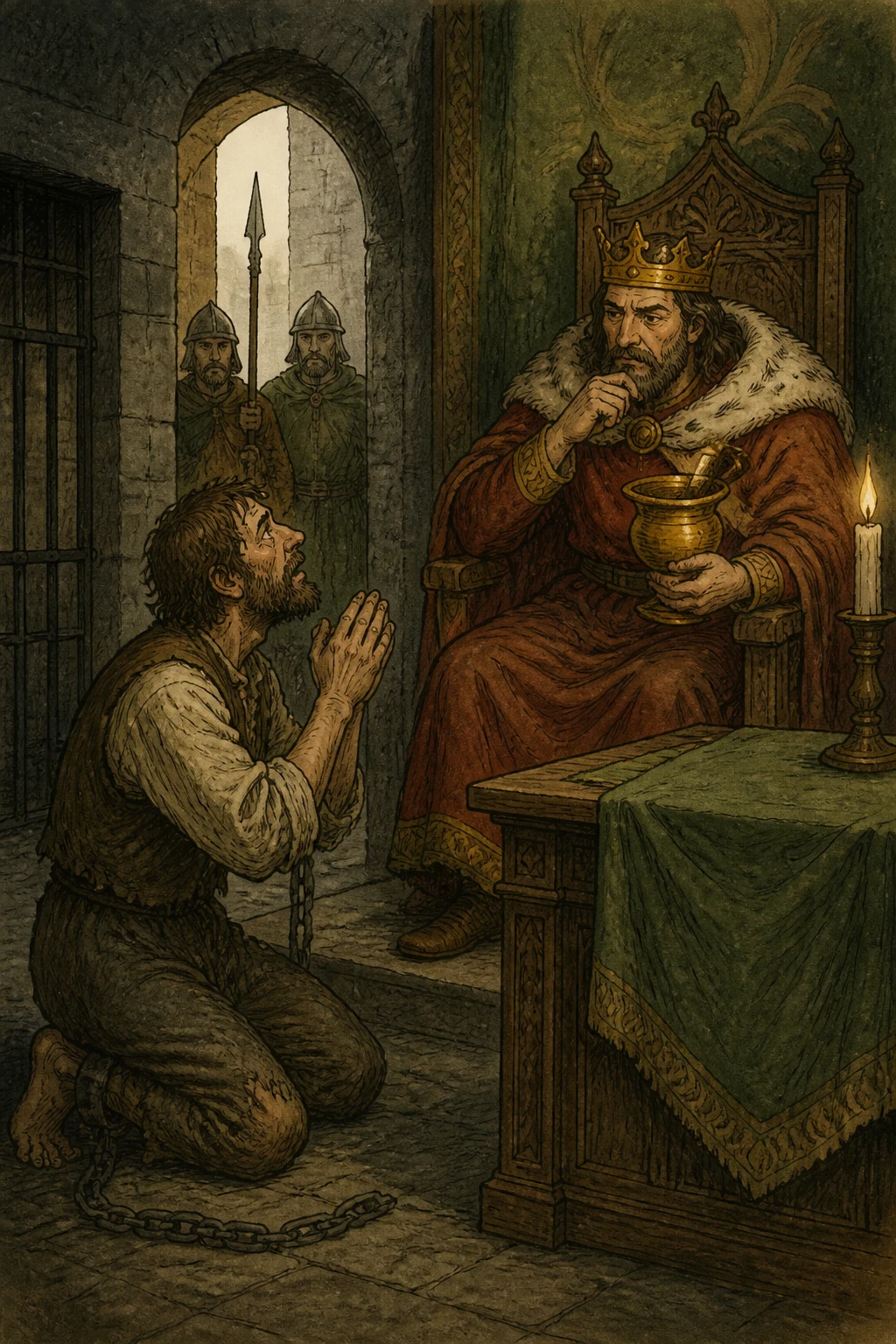
What a tangle the confounded things must have been in! Among the prisoners was a certain corregidor, or district magistrate, who was said to have been more ravenous than a leech in sucking the lifeblood from the towns entrusted to his government. Between evidence, witnesses, confrontations, appeals, and all the other rigmarole of the legal rabble, his case promised to furnish material for litigation for at least three generations. Our man resolved to take a shortcut, and, approaching the jailer, boldly asked to be let out for a couple of hours, pledging his word that he would return to prison before the appointed time was up. The jailer reflected that a word of honor was a poor thing to pawn, since no moneylender would loosen his purse strings on such security, and flatly refused. But, dazzled by the gleam of a few peluconas—gold coins that the prisoner slipped into his hands with studied carelessness—he finally softened, drew back the bolts, and opened the gates.
II It was seven in the evening. The Inspector was in his drawing room, playing a hand of tresillo with some friends, and they had just saddled him with a royal penalty on a solo in diamonds, with matadors, a void, and a singleton king, when his steward came in, drew him aside, and said:
“A gentleman wishes to speak to Your Lordship at once.” “Some nuisance or other! Tell him to come back tomorrow. Didn’t he give you his name?” “No, sir; but he gave me two gold ounces to bring you his message, and since it would hardly have been proper to leave him waiting for an answer in the entrance hall, I showed him into the study.”
“You say he gave you two ounces as a gratuity! Then whatever brings the fellow here must be important.” And turning to his companions, he said:
“With your permission, gentlemen, I shall be back shortly. Let Don Narciso play for me. What a battered life I lead! I wouldn’t wish it on my worst enemy!”
And Don José Antonio made his way to the study, which stood off the courtyard. A man muffled in a cloak was waiting there; when Areche appeared, he uncovered his face and said courteously:
“A good and blessed evening to you.” “And may God grant you the same. Well, well, my good sir! How have you got out of prison without my permission?” “There was no need for it, Señor Inspector. I have given my word to return to prison shortly, and I shall keep it.”
“I suppose I know what brings you here—to speak of your case, no doubt.” “Precisely, Señor Inspector.” “Then you are wasting your time, my friend. You are in a bad way, I can see, and much as it pains me, I shall have to be severe; the king did not send me here to deal in indulgence and favors. Your case contains damning documents and witnesses beyond reproach whose testimony is more than enough to send ten fellows of your stamp to the gallows. I am a man of the strictest integrity, and when it comes to administering justice, I would spare neither friend nor the mother who bore me.”
“Well, Señor Inspector, against all the serious charges Your Lordship says are in my case, I possess a thousand irrefutable arguments; yes, sir, a thousand arguments. And the best thing would be for us to be friends and have done with lawsuits, which serve only to cause vexation, breed bad blood, and fatten the scribes and Pharisees.”
“And why, if you are so confident they will clear you, have you not made use of your arguments? I should like to hear just one, so that I might refute it.”
“If the Señor Inspector promises not to lose his temper, and to keep my secret, I will tell him in confidence what my arguments are.” “Speak plainly, as Christ teaches us. Present just one of your arguments, and keep the remaining nine hundred and ninety-nine, for I have little time, and this is no occasion for considering them.”
Then the corregidor reached into his pocket and drew out a gold ounce between thumb and forefinger. “Does Your Lordship see this argument?” “That is a pelucona, Señor Corregidor!”
“Well, I have a thousand arguments of the same kind ready to bring the proceedings to an end. And good night, Señor Inspector, for the hours fly, and a man’s word is his word.”
And step by step, the corregidor made his way back to prison. As for Señor de Areche, they say he returned deep in thought to his place at the tresillo table, that he did not make a proper play all that blessed evening, and that, for the first time in his life, he twice failed to follow suit—clear proof of his troubled state of mind.
III What the devil! I am no scandalmonger, but history contains things that drive a man to distraction. And the proof that Don José Antonio de Areche did not exactly play fair in carrying out the commission the king had entrusted to him lies in the fact that, despite everything, His Majesty was obliged to dismiss him, recall him to Spain, confiscate his estate, and sentence him to live banished from the city and court of Madrid.
The day after his interview with the Inspector, the prisoner was set free and the case dismissed. And you are supposed to have faith in the incorruptibility of justice!
I tell you, those arguments of the corregidor’s must have been formidable indeed!