Prevod
So in the huts the valiant son of Menoetius tended wounded Eurypylus, while Argives and Trojans fought in close-packed throngs. The Danaans’ ditch and the broad wall above it were not destined to hold much longer—the wall they had built to protect their ships, with a ditch driven around it. They had offered the gods no splendid sacrifices of a hundred beasts, that the wall might guard their swift ships and the great store of plunder it enclosed. It had been built against the will of the immortal gods, and so it was not to stand for long.
As long as Hector lived and Achilles kept his anger, and King Priam’s city remained unsacked, the great wall of the Achaeans stood firm. But when the best of the Trojans had been killed, and many Argives too had fallen while others survived, when Priam’s city had been sacked in the tenth year and the Argives had sailed home to their beloved country, then Poseidon and Apollo planned to sweep the wall away by turning the rivers’ might against it.
All the rivers that run seaward from the mountains of Ida—Rhesus, Heptaporus, Caresus, Rhodius, Grenicus, Aesepus, divine Scamander, and Simois, where many oxhide shields and helmets had fallen in the dust, and with them a race of men half divine—all their mouths Phoebus Apollo turned together, and for nine days drove their waters against the wall. Zeus poured down ceaseless rain, to wash the ramparts into the sea the sooner.
The Earth-shaker himself led the way, trident in hand, and sent all the foundations tumbling into the waves, the timbers and stones the Achaeans had laid with such toil. He made the shore level beside the strong-flowing Hellespont, and, once the wall was gone, covered the great beach with sand again. Then he turned the rivers back into their channels, where their lovely waters had flowed before.
Such were the things Poseidon and Apollo would do in days to come. But now battle and shouting blazed around the well-built wall, and spears clattered as they struck the towers. The Argives, beaten down by the lash of Zeus, were penned beside their hollow ships and held at bay, afraid of Hector, that mighty master of the rout. He fought on as before, like a whirlwind. As a boar or lion wheels among hounds and huntsmen, glaring in its strength, while they draw themselves together like a wall and stand against it, hurling a thick shower of spears—the beast’s proud heart knows neither fear nor flight, though its own boldness brings it death; again and again it turns, testing the ranks of men, and wherever it charges, their ranks give way—so Hector moved through the throng, urging his comrades to cross the ditch. But his swift-footed horses dared not attempt it. They stood on the brink and neighed loudly, frightened by the breadth of the ditch, which was neither easy to leap nor to cross. Steep, overhanging banks rose on either side along its whole length, and above it stood the sharp stakes the sons of the Achaeans had planted, tall and close-set, to ward off their enemies.
No horse drawing a wheeled chariot could easily enter there, though the men on foot were eager to try. Then Polydamas came up beside bold Hector and said, “Hector, and you other leaders of the Trojans and their allies, we are foolish to drive our swift horses across this ditch. It is hard indeed to cross: sharp stakes stand in it, and beyond them rises the Achaeans’ wall. There is no room there for chariot-fighters to dismount and fight. It is a narrow place, and I fear we shall come to harm.
“If Zeus who thunders on high means their utter ruin and is eager to help the Trojans, then gladly would I see it happen now: let the Achaeans perish here without a name, far from Argos. But if they turn and drive us back from the ships, and we become entangled in this deep-dug ditch, I do not think a single man will return to the city even to bring the news, once the Achaeans have turned upon us.
“Come, then, let us all do as I advise. Let our attendants hold the horses here beside the ditch, while we ourselves, fully armed, follow Hector all together on foot. The Achaeans will not stand against us, if the bonds of destruction have indeed been fastened upon them.”
So Polydamas spoke, and his sound advice pleased Hector. At once he leapt to the ground from his chariot in his armor. Nor did the other Trojans remain gathered in their chariots: they all sprang down when they saw noble Hector do so.
Each man then ordered his own charioteer to keep the horses in good order there beside the ditch. They themselves divided their forces, formed into five companies, and followed their leaders.
Those who went with Hector and peerless Polydamas were the most numerous and the bravest, and the keenest to break through the wall and fight beside the hollow ships.
Cebriones went with them as their third leader, for Hector had left a lesser man to tend the chariot in his place. Paris, Alcathous, and Agenor led the second company. The third was led by Helenus and godlike Deiphobus, two sons of Priam, with the hero Asius as their third—Asius son of Hyrtacus, whose great fiery horses had brought him from Arisbe, from the river Selleis.
The fourth company was led by Aeneas, the valiant son of Anchises, and with him were Antenor’s two sons, Archelochus and Acamas, skilled in every kind of battle. Sarpedon led the renowned allies, choosing Glaucus and warlike Asteropaeus to join him, for he thought them far the best of all the rest after himself; and he stood out even among them all.
When they had closed their ranks, shield pressed against well-made oxhide shield, they marched eagerly straight at the Danaans, believing they would no longer hold their ground but fall back upon the black ships. All the other Trojans and their far-famed allies obeyed the counsel of peerless Polydamas. But Asius son of Hyrtacus, a leader of men, would not leave his horses and his attendant charioteer behind. He drove with them toward the swift ships—fool that he was! He was not destined to escape the evil spirits of death and return from the ships to windy Ilios, glorying in his horses and chariot. Before that could happen, hateful fate would engulf him through the spear of glorious Idomeneus, Deucalion’s son.
He made for the left of the ships, where the Achaeans used to return from the plain with their horses and chariots. There he drove his team and chariot, and found no gates shut fast with their long bar. The men were holding them wide open, hoping to save any comrades fleeing from the battle back to the ships.
Straight for them he drove his horses, intent on his purpose, and his men followed with shrill cries. They thought the Achaeans would no longer hold their ground but fall back upon the black ships. Fools! At the gates they found two warriors of the highest courage, proud sons of the spear-fighting Lapiths: mighty Polypoetes, son of Peirithous, and Leonteus, the equal of man-slaying Ares.
The two stood before the lofty gates like high-crowned oaks upon the mountains, which withstand wind and rain through all their days, held fast by great roots reaching deep into the earth. So these two, trusting in their strength and their own hands, awaited the advance of mighty Asius and did not flee.
With their shields of dried oxhide raised high, the Trojans came straight toward the well-built wall with a great battle cry, gathered around Lord Asius, Iamenus, Orestes, Adamas son of Asius, Thoon, and Oenomaus.
Until then the two had stayed within, urging the well-greaved Achaeans to defend the ships. But when they saw the Trojans rushing upon the wall, and shouting and panic broke out among the Danaans, they sprang outside and fought before the gates. They were like two wild boars in the mountains that await the clamorous approach of men and hounds, then charge sideways, snapping the brushwood around them and tearing it up by the roots, while the clash of their tusks rings out until someone strikes and takes their lives. So the bright bronze rang upon their breasts as the blows struck them full on. Fiercely they fought, trusting in their own strength and in the men upon the wall above.
Those men hurled stones down from the well-built towers, defending themselves, their huts, and their swift ships. The stones fell to earth like snowflakes that a fierce wind, shaking the shadowy clouds, pours thick upon the earth that feeds so many. So the missiles streamed from the hands of Achaeans and Trojans alike, and helmets and bossed shields rang hollow all around as the great stones struck them.
Then Asius son of Hyrtacus groaned, struck both his thighs, and cried in anger, “Father Zeus, so even you have become an utter lover of lies! I never thought the Achaean warriors would withstand our strength and our invincible hands.
“But like slender-waisted wasps or bees that build their nests beside a rugged path and will not leave their hollow home, but stay and defend their young against the men who hunt them, so these two, though only two, will not give ground from the gates until they have killed or been killed.”
So he spoke, but his words did not move the heart of Zeus, whose will was to give glory to Hector. Others were fighting at the other gates, but it would be hard for me to tell all this as a god might. All around the wall of stone a fierce, unearthly fire of battle had flared up. The Argives, distressed though they were, had no choice but to defend their ships, and all the gods who supported the Danaans in battle were grieved at heart.
The Lapiths pressed on into the fighting and slaughter. Mighty Polypoetes, son of Peirithous, struck Damasus with his spear through the helmet’s bronze cheekpieces. The bronze helmet did not stop it: the bronze point burst through the bone and spattered all his brains within, bringing him down in the fury of his charge. Then Polypoetes killed Pylon and Ormenus.
Leonteus, a scion of Ares, struck Hippomachus son of Antimachus with his spear, hitting him at the belt. Then he drew his sharp sword from its sheath, rushed through the throng, and first struck Antiphates at close quarters, sending him sprawling backward on the ground. After him he brought down Menon, Iamenus, and Orestes, one after another, upon the earth that feeds so many.
While they stripped the shining armor from the dead, the young men who followed Polydamas and Hector—the most numerous and the bravest, the keenest to break through the wall and burn the ships with fire—still stood beside the ditch, uncertain what to do.
For a bird had appeared as they were eager to cross: a high-flying eagle, keeping the army on its left, carried in its talons a monstrous blood-red snake, still alive and writhing, and not yet forgetful of the fight. Twisting backward, it struck the eagle that held it, biting its breast beside the neck. In the anguish of the pain the eagle let it fall to earth, dropping it into the midst of the throng, then flew away with a cry upon the breath of the wind.
The Trojans shuddered when they saw the writhing snake lying among them, a portent from Zeus who bears the aegis. Then Polydamas came up beside bold Hector and said, “Hector, you always rebuke me in the assemblies when I offer sound advice. Of course, it does not become a man of the people to speak against you, either in council or in war; he must always strengthen your authority. Yet once again I shall say what seems best to me.
“Let us not go to fight the Danaans beside their ships. This, I believe, is how it will end, if indeed this bird came as a sign to the Trojans as they were eager to cross—the high-flying eagle, keeping the army on its left, carrying in its talons a monstrous blood-red snake alive. It let the snake go before reaching its own home, and failed to bring it to its young.
“So with us: even if we break through the Achaeans’ gates and wall by sheer force, and the Achaeans give way, we shall not return in good order from the ships along the same paths. We shall leave many Trojans behind, slain by Achaean bronze as they defend their ships.
“That is how a seer would interpret it, one who truly understood portents in his heart and whom the people trusted.” Hector of the flashing helmet looked darkly at him and replied, “Polydamas, these words of yours no longer please me. You know how to think of something better than this.
“But if you truly speak in earnest, then the gods themselves have surely destroyed your wits. You tell me to forget the counsels of loud-thundering Zeus, the promises he made me himself and confirmed with a nod. You tell me instead to obey long-winged birds! I pay them no heed and care nothing whether they fly to the right, toward dawn and the sun, or to the left, toward the murky darkness.
“Let us obey the counsel of great Zeus, who rules over all mortals and immortals. One omen is best: to fight for one’s country. Why are you afraid of war and slaughter?
“Even if all the rest of us are killed beside the Argive ships, you need have no fear of dying: your heart has neither the courage nor the will to fight. But if you keep away from the battle, or turn another man from fighting with your persuasive words, you will be struck down by my spear at once and lose your life.”
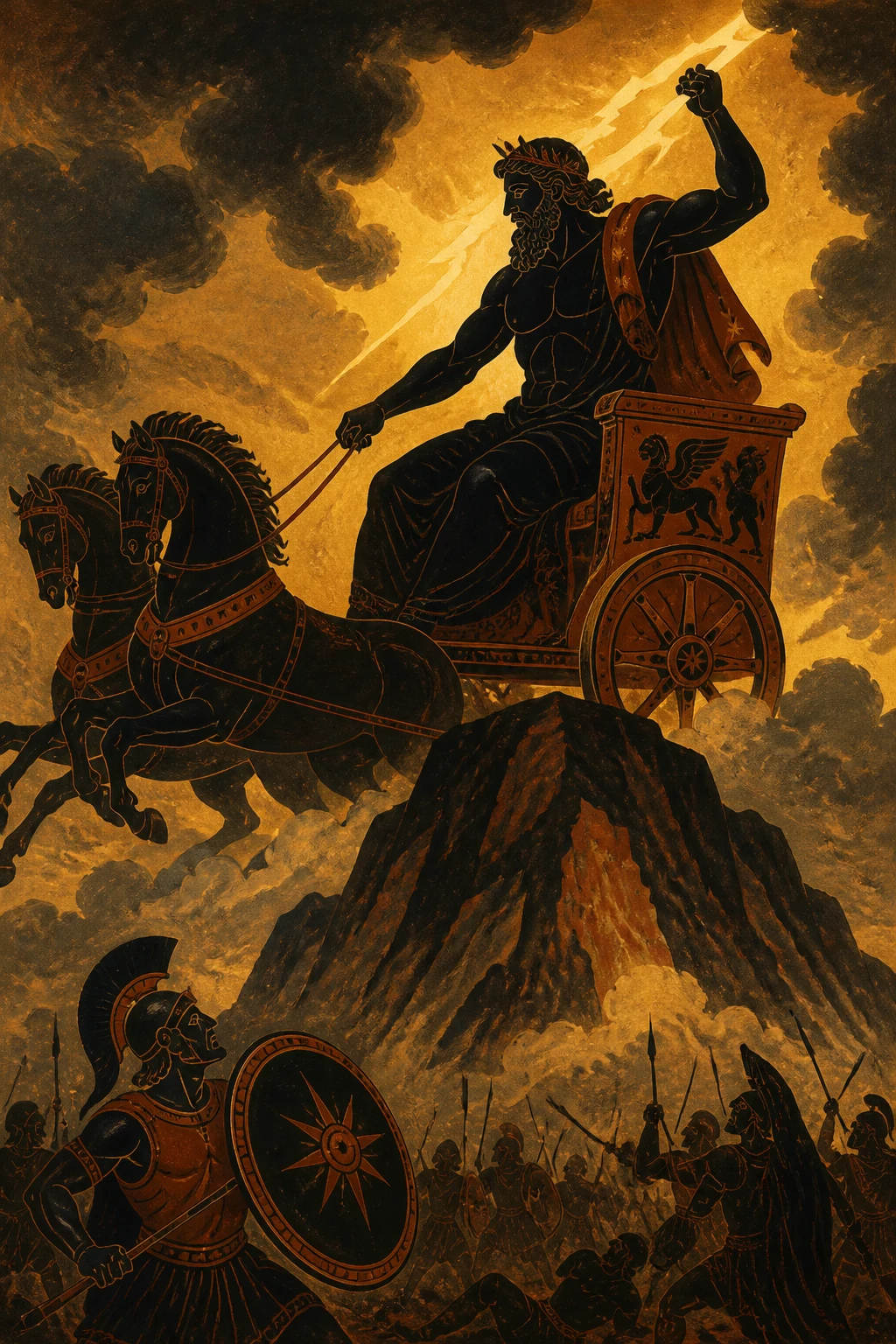
With these words he led the way, and they followed with a tremendous roar. Zeus who delights in thunder raised a storm of wind from the mountains of Ida, driving the dust straight toward the ships. He bewildered the Achaeans and granted glory to the Trojans and Hector.
Trusting in his portents and their own strength, they tried to break through the great wall of the Achaeans. They dragged down the coping stones of the towers, tore away the battlements, and levered out the projecting posts the Achaeans had first planted in the earth to support the towers.
These they wrenched away, hoping to break the Achaeans’ wall. Yet the Danaans still did not yield the passage. They screened the battlements with oxhide shields and from behind them struck at the enemies advancing beneath the wall.
The two Ajaxes moved everywhere along the towers, calling out and rousing the Achaeans’ courage. One man they encouraged gently; another, whom they saw hanging back from the fight, they rebuked with harsh words. “Friends, all you Argives—the outstanding, the middling, and the weaker too, for not all men are equal in war—now there is work for everyone. You know this well yourselves. Let no man turn back toward the ships when he hears a threatening shout. Press forward instead, and urge one another on. Perhaps Olympian Zeus, the lord of lightning, will grant that we beat back their assault and drive the enemy toward the city.”
So the two called out, urging the Achaeans into battle. As snowflakes fall thick on a winter’s day, when Zeus the counselor begins to snow, revealing these shafts of his to men—he lulls the winds and pours it steadily down until he covers the peaks of the high mountains and their jutting ridges, the clover-covered plains and the rich tilled fields of men; it lies along the harbors and shores of the gray sea, though the breaking waves hold it back, while everything else is shrouded beneath the weight of Zeus’s snowfall—so thickly flew the stones on either side, some hurled at the Trojans, others from the Trojans at the Achaeans, and a thunderous din rose along the whole wall.
Even then the Trojans and glorious Hector would not have broken through the gates and their long bar, had Zeus the counselor not roused his own son Sarpedon against the Argives, like a lion against a herd of curving-horned cattle.
At once he held his round shield before him, a beautiful shield of beaten bronze that a smith had hammered out, stitching many layers of oxhide inside with rods of gold running all around the rim.
Holding it before him and brandishing two spears, he strode forward like a mountain-bred lion long deprived of meat, whose proud heart urges it to attack the sheep, even within a stoutly fenced fold. Though it finds shepherds there guarding the flock with dogs and spears, it will not be driven off without attempting the fold: either it leaps in and snatches its prey, or is itself struck down among the foremost by a javelin from a swift hand. So his heart urged godlike Sarpedon to charge the wall and break through the battlements.
At once he spoke to Glaucus, son of Hippolochus: “Glaucus, why are we two honored above all others in Lycia, with seats of honor, meat, and brimming cups? Why do all men look upon us as gods? Why do we hold a great estate beside the banks of Xanthus, a fine stretch of orchard and wheat-bearing land?
“That is why we must now stand in the foremost ranks of the Lycians and face the blaze of battle, so that one of the stoutly armored Lycians may say, ‘Not without glory do our kings rule Lycia. They eat fat sheep and drink choice, honey-sweet wine, but they have strength and courage too, since they fight in the foremost ranks of the Lycians.’
“Dear friend, if escaping this war meant that we should live forever, ageless and immortal, I would neither fight in the front ranks myself nor send you into battle where men win glory. But as it is, ten thousand shapes of death stand over us, and no mortal can escape or slip away from them. Let us go, then, and either give glory to another or win it from him.”
So he spoke, and Glaucus neither turned away nor disobeyed. The two went straight ahead, leading the great host of Lycians. Menestheus son of Peteos shuddered when he saw them, for they were advancing on his tower, bringing disaster.
He looked along the tower, hoping to see some Achaean leader who might ward off ruin from his comrades. He caught sight of the two Ajaxes, insatiable for battle, standing nearby, and Teucer, who had just come from his hut. But there was no hope of making himself heard by shouting: so great was the din, and the clamor rose to heaven as shields, horsehair-crested helmets, and gates were battered. For all the gates were shut, and at each the attackers stood, trying to break through by force and enter.
At once he sent the herald Thootes to Ajax. “Go, noble Thootes, run and call Ajax here—or better still, both Ajaxes. That would be best of all, for utter destruction will soon be upon us here.
“The Lycian leaders are pressing us hard, and they have always been fierce in close battle. But if toil and fighting have beset them there as well, then at least let mighty Ajax son of Telamon come alone, and let Teucer, skilled with the bow, come with him.”
So he spoke, and the herald heard and obeyed. He ran along the wall of the bronze-clad Achaeans, came to the two Ajaxes, and spoke at once: “You two Ajaxes, leaders of the bronze-clad Argives, the dear son of Peteos, cherished by Zeus, asks you to come there and face the fighting, if only for a little while—both of you, if possible. That would be best of all, for utter destruction will soon be upon them there. The Lycian leaders are pressing them hard, and they have always been fierce in close battle.
“But if war and fighting have beset you here as well, then at least let mighty Ajax son of Telamon come alone, and let Teucer, skilled with the bow, come with him.” So he spoke, and great Ajax son of Telamon did not refuse.
At once he addressed the son of Oileus with winged words: “Ajax, you and mighty Lycomedes stay here and urge the Danaans to fight with all their strength. I shall go there and face the battle. I shall soon return, once I have given them the help they need.”
With these words Ajax son of Telamon went away, and Teucer, his brother by the same father, went with him. Pandion accompanied them, carrying Teucer’s curved bow. They made their way inside the wall to the tower of great-hearted Menestheus, and found its defenders hard pressed. Like a dark whirlwind the mighty leaders and lords of the Lycians were mounting the battlements. The two sides clashed face to face, and the battle cry rose.
Ajax son of Telamon was the first to kill a man: great-hearted Epicles, a companion of Sarpedon. He struck him with a jagged rock that lay inside the wall, a great stone at the top of the heap beside the battlement. No man as mortals are today, even in the full strength of youth, could easily have held it in both hands. Ajax lifted it and hurled it down from above, smashing the four-ridged helmet and crushing all the bones of the skull together. Epicles fell like a diver from the lofty tower, and life left his bones.
Teucer struck mighty Glaucus, son of Hippolochus, with an arrow as he charged up the high wall, hitting him where he saw his arm exposed, and put an end to his fighting. Glaucus leapt back down from the wall unseen, lest some Achaean notice his wound and boast over him.
Sarpedon was grieved as soon as he saw Glaucus withdraw, but still he did not forget the fight. He thrust his spear into Alcmaon son of Thestor and drew it out again. Alcmaon followed the spear as he fell headlong, and his armor, worked with bronze, clattered around him. Then Sarpedon seized the battlement in his powerful hands and heaved. The whole section came away, leaving the top of the wall exposed and opening a path for many.
Ajax and Teucer attacked him together. Teucer’s arrow struck the gleaming shield-strap across his chest, the strap of the great shield that sheltered his whole body. But Zeus warded death away from his son, so that he should not fall beside the ships’ sterns. Ajax leapt at him and drove his spear into the shield. The point did not pass through, but the blow staggered Sarpedon and checked his eager charge.
He drew a little back from the battlement, but did not wholly retreat, for his heart still hoped to win glory. Turning, he called to the godlike Lycians: “Lycians, why do you slacken your fierce assault like this?
“Strong though I am, it is hard for me alone to break through and open a road to the ships. Come with me! The work is better done by many.” So he spoke, and, awed by their lord’s rebuke, they pressed harder around their king and counselor.
On the other side the Argives strengthened their ranks within the wall, and the struggle before them seemed immense. For neither could the mighty Lycians break through the Danaans’ wall and open a road to the ships, nor could the Danaan spearmen drive the Lycians back from the wall once they had reached it.
As two men dispute a boundary, measuring rods in hand, in a field they share, and quarrel over their equal rights in a narrow strip of ground, so the battlements divided them. Across them they hacked at the round oxhide shields and the light hide bucklers covering one another’s breasts.
Many were wounded in the flesh by merciless bronze: some as they turned in the fighting and exposed their backs, and many straight through their shields. Everywhere the towers and battlements were spattered on both sides with the blood of men, Trojans and Achaeans alike.
Yet even so they could not put the Achaeans to flight. The struggle held as evenly as scales held by an honest working woman, who lifts the weight and wool in either pan and balances them, to earn a meager wage for her children. So the fighting and the war stood evenly poised, until Zeus gave the greater glory to Hector son of Priam, who was the first to leap inside the Achaeans’ wall.
He shouted in a ringing voice for all the Trojans to hear: “Forward, horse-taming Trojans! Break down the Argives’ wall and fling ravening fire upon their ships!” So he urged them, and all heard his voice. They rushed at the wall in a mass, and some began to climb its coping stones with sharp spears in their hands. Hector seized and carried a boulder that stood before the gates, broad at the base and pointed above. Two of the strongest men in the land, as mortals are today, could not easily have levered it from the ground onto a wagon. Yet he swung it easily alone.
The son of crooked-counseled Cronus had made it light for him. As a shepherd easily carries a ram’s fleece, taking it in one hand and scarcely feeling its weight, so Hector lifted the boulder and carried it straight toward the timbers guarding the gates, tall double doors fitted stoutly and close together. Two crossbars held them on the inside, secured by a single bolt.
He came very close, planted his feet wide, braced himself, and hurled it at their center, putting his full strength into the throw. He shattered both hinges, and the stone crashed inward under its own weight. The gates boomed loudly all around; the bars could not hold, and the timbers splintered in every direction under the boulder’s blow. Glorious Hector leapt inside, his face like sudden night. The terrible bronze about his body blazed, and he held two spears in his hands. None but a god could have met and stopped him as he burst through the gates, his eyes burning with fire.
Turning toward the throng, he called to the Trojans to climb over the wall, and they obeyed his urging. At once some crossed the wall, while others poured through the strongly built gates. The Danaans fled among their hollow ships, and an unceasing tumult rose.