Prevod
Dawn rose from her bed beside glorious Tithonus to bring light to immortals and mortals alike, and Zeus sent cruel Strife down to the swift ships of the Achaeans, bearing in her hands a portent of war.
She stood upon the great black ship of Odysseus, which lay in the middle, so that her voice could carry both ways—to the huts of Ajax, son of Telamon, and to those of Achilles. These two had drawn up their well-balanced ships at the far ends of the camp, trusting in their courage and the strength of their hands. There the goddess stood and gave a terrible, piercing cry, and into every Achaean heart she poured great strength to fight and battle without respite.
At once war grew sweeter to them than sailing home in their hollow ships to their beloved native land. The son of Atreus shouted aloud and ordered the Argives to arm, and he himself put on the gleaming bronze.
First he fitted round his shins fine greaves fastened with silver ankle-clasps. Next he drew about his chest the breastplate that Cinyras had once given him as a guest-gift.
For the great news had reached Cyprus that the Achaeans were about to sail their ships to Troy, and so Cinyras had given it to the king to win his favor. It had ten bands of dark enamel, twelve of gold, and twenty of tin. Enamel serpents stretched up toward the neck, three on either side, like the rainbows the son of Cronus sets in the clouds as a sign to mortal men.
Over his shoulders he slung his sword, bright with golden studs, in a silver scabbard fitted with golden straps. Then he took up his fierce, splendid shield, richly wrought and covering a man from head to foot. Ten bronze circles ran around it, and on it were twenty bosses of white tin, with one of dark enamel at the center.
Upon it the grim-faced Gorgon glared terribly, with Dread and Terror ranged about her. From the shield hung a silver baldric, and along it coiled an enamel serpent with three heads, turned in different directions, growing from a single neck.
On his head he set a double-ridged helmet with four bosses and a horsehair plume; terribly the crest nodded above him. He took two stout spears tipped with sharp bronze, and their bronze flashed far up into heaven. Athena and Hera thundered in answer, honoring the king of Mycenae rich in gold.
Then each man ordered his charioteer to hold his horses in good order there beside the trench, while they themselves, armored and bearing their weapons, rushed forward on foot. An unquenchable cry rose into the dawn.
They formed their ranks at the trench well ahead of the chariots, which followed a little behind. The son of Cronus stirred an evil tumult among them and sent down from the high air drops of dew wet with blood, for he was about to hurl many mighty heads into Hades.
On the other side, upon a rise in the plain, the Trojans gathered around great Hector and blameless Polydamas, around Aeneas, whom the Trojan people honored like a god, and around the three sons of Antenor—Polybus, noble Agenor, and young Acamas, the peer of the immortals.
Hector bore his round shield among the foremost. As a baleful star gleams out in all its brightness from the clouds, then sinks again into their shadow, so Hector appeared now among the front ranks, now among the rear, shouting his commands. All over, his bronze shone like the lightning of father Zeus, who bears the aegis.
As reapers facing one another drive their swathes through a rich man's field of wheat or barley, and the handfuls fall thick, so Trojans and Achaeans sprang upon one another and slaughtered, neither side giving a thought to ruinous flight.
Battle held their heads level, and they raged like wolves. Strife, the bringer of groans, rejoiced to watch them, for she alone of the gods was there among the fighters. The other gods were not with them, but sat at ease in their halls, where each had a splendid dwelling built among the folds of Olympus.
All were blaming the dark-clouded son of Cronus because he wished to grant the Trojans glory. But their father paid them no heed. Withdrawing apart from the others, he sat alone, exulting in his power, and watched the city of the Trojans and the ships of the Achaeans, the flash of bronze, the killers and the killed.
As long as it was morning and the sacred day waxed, the missiles struck on either side and men kept falling. But at the hour when a woodcutter prepares his meal in a mountain glen, when his arms are weary from felling tall trees, exhaustion has entered his heart, and longing for sweet food takes hold of him—then the Danaans, by their courage, broke the enemy ranks, calling to one another along the line. Agamemnon was first to spring forward, and killed Bianor, shepherd of the people, then his companion Oileus, driver of horses.
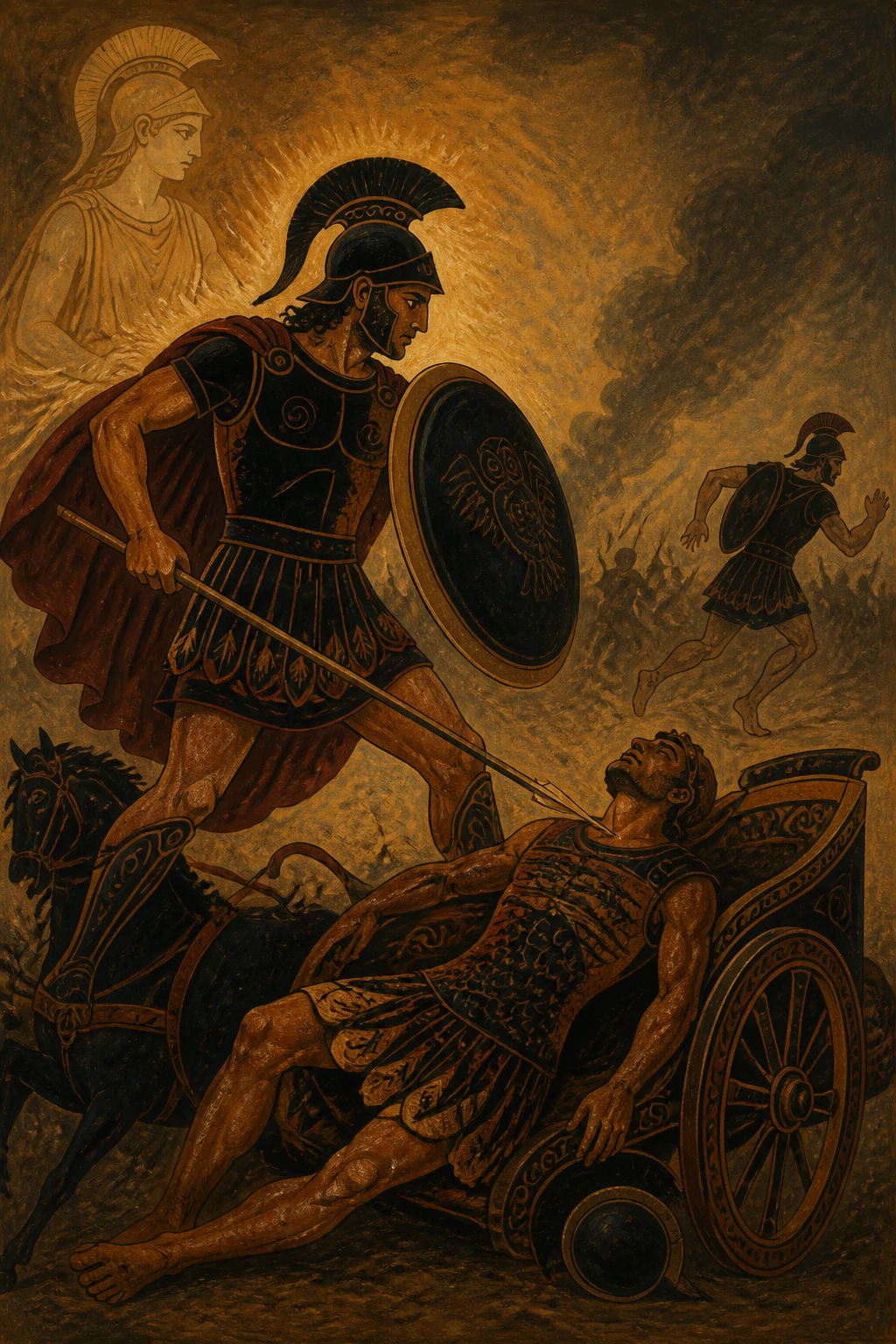
Oileus had leaped from his chariot and stood to face him. As he charged straight at him, Agamemnon struck his forehead with the sharp spear. The helmet's heavy bronze could not stop it: the point went through both helmet and bone, spattering all the brain within. So he brought him down in the fury of his charge.
Agamemnon, lord of men, left them there with their bare chests gleaming, after stripping off their armor, and went on to slay Isus and Antiphus, two sons of Priam, one born out of wedlock and one legitimate, riding together in a single chariot. The bastard drove, while renowned Antiphus stood beside him. Achilles had once caught them tending sheep on the slopes of Ida, bound them with young willow shoots, and released them for a ransom.
Now Agamemnon, son of Atreus, whose rule spread far, struck Isus in the chest above the nipple with his spear, and slashed Antiphus beside the ear with his sword, knocking him from the chariot. He hurried to strip their splendid armor, recognizing them: he had seen them before beside the swift ships, when swift-footed Achilles brought them down from Ida.
As a lion comes upon the bed of a swift deer and easily crushes her young in his strong teeth, robbing them of their tender lives, while their mother, though she may be very near, cannot help them, for a terrible trembling seizes her, and she darts swiftly through the thick brush and woodland, sweating in her haste before the mighty beast's onslaught—so none of the Trojans could save these two from death, but they too fled before the Argives.
Then lord Agamemnon caught Peisander and Hippolochus, staunch in battle, the sons of shrewd Antimachus. It was Antimachus who, having accepted gold from Alexander and splendid gifts, had most strongly opposed returning Helen to fair-haired Menelaus. Agamemnon caught his two sons together in one chariot as they tried to hold their swift horses: the gleaming reins had slipped from their hands, and the pair were thrown into confusion. The son of Atreus charged them like a lion, and from their chariot they begged him: “Take us alive, son of Atreus, and accept a worthy ransom. Many treasures lie in Antimachus' halls—bronze and gold and iron wrought with toil. Our father would gladly give you boundless ransom from these stores if he learned that we were alive beside the ships of the Achaeans.”
So the two wept and pleaded with the king in gentle words, but the voice they heard was merciless: “If you are indeed the sons of shrewd Antimachus, who once urged the Trojan assembly to kill Menelaus there and then, when he came as an envoy with godlike Odysseus, and not allow him to return to the Achaeans—now you shall pay for your father's shameful outrage.”
He spoke and struck Peisander in the chest with his spear, thrusting him from the chariot to the earth, where he fell upon his back. Hippolochus leaped down, but Agamemnon killed him on the ground, cutting off his arms with his sword and severing his head; then he sent him rolling through the throng like a round block.
He left them and rushed to where the ranks were thrown into the greatest confusion, and the other well-greaved Achaeans followed. Foot soldiers killed foot soldiers fleeing in desperation, charioteers killed charioteers, and dust rose beneath them from the plain, churned up by the thunderous hooves of horses as men slaughtered with bronze. Lord Agamemnon pressed on, killing without pause and calling to the Argives.
As when consuming fire falls upon untouched woodland, and the wheeling wind carries it everywhere, while thickets fall uprooted before the fire's assault, so beneath Agamemnon, son of Atreus, fell the heads of fleeing Trojans. Many proud-necked horses rattled empty chariots along the lanes of battle, missing their noble drivers. But these lay upon the earth, far dearer to the vultures than to their wives.
Zeus drew Hector away from the missiles and the dust, from the slaughter, the blood, and the tumult. But the son of Atreus pressed fiercely on, shouting to the Danaans. The Trojans sped past the tomb of ancient Ilus, son of Dardanus, and past the wild fig tree in the middle of the plain, straining toward the city. The son of Atreus followed, shouting all the while, his irresistible hands spattered with gore.
When they reached the Scaean Gates and the oak, they halted and waited for one another. Others were still fleeing across the middle of the plain like cattle that a lion has come upon and scattered in the dead of night. For one of them sheer destruction suddenly appears: first he seizes her in his strong teeth and breaks her neck, then gulps down her blood and all her entrails. So lord Agamemnon, son of Atreus, pursued them, always killing the hindmost as the others fled.
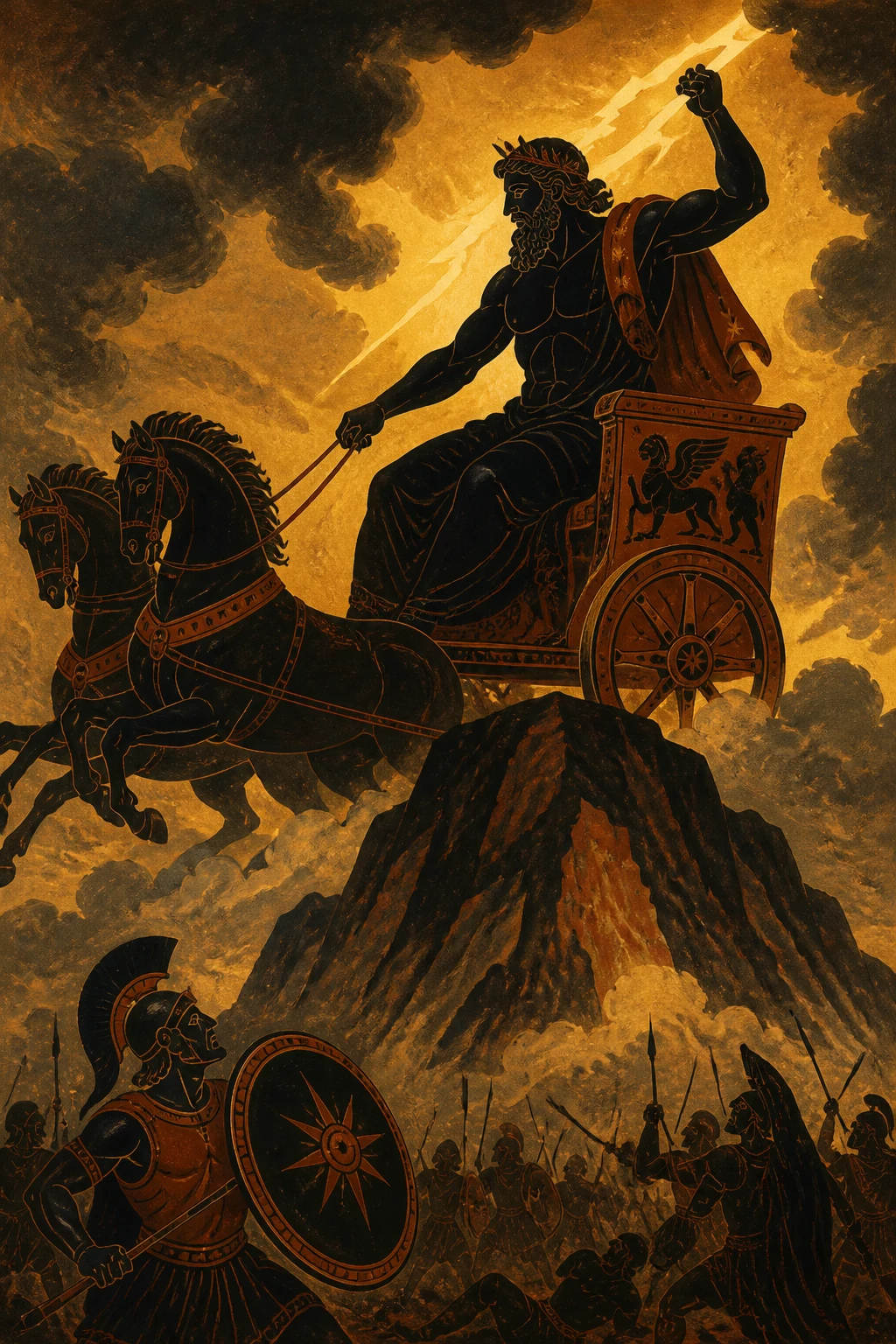
Many fell headlong or backward from their chariots beneath the hands of the son of Atreus, for he raged far ahead with his spear. But just as he was about to reach the city and its lofty wall, the father of gods and men came down from heaven and seated himself upon the peaks of Ida with its many springs, holding a thunderbolt in his hands.
He sent golden-winged Iris with a message: “Go, swift Iris, and tell Hector this: as long as he sees Agamemnon, shepherd of the people, raging among the foremost fighters and cutting down the ranks of men, let him hold back, but order the rest of his people to fight the enemy in the fierce struggle.
“But when Agamemnon, wounded by a spear or struck by an arrow, leaps into his chariot, then I shall grant Hector strength to kill until he reaches the well-benched ships, until the sun sets and sacred darkness falls.”
So he spoke, and swift Iris, wind-footed, obeyed. Down from the mountains of Ida she went to sacred Ilios. She found noble Hector, the son of warlike Priam, standing among the horses and the close-built chariots. Swift-footed Iris stood near him and said: “Hector, son of Priam, the equal of Zeus in counsel, father Zeus has sent me to tell you this.
“As long as you see Agamemnon, shepherd of the people, raging among the foremost fighters and cutting down the ranks of men, hold back from battle, but order the rest of your people to fight the enemy in the fierce struggle.
“But when he, wounded by a spear or struck by an arrow, leaps into his chariot, then Zeus will grant you strength to kill until you reach the well-benched ships, until the sun sets and sacred darkness falls.”
With these words swift-footed Iris departed. Hector leaped from his chariot to the ground in his armor and, brandishing his sharp spears, went everywhere through the army, urging men to fight and rousing the dreadful battle.
They wheeled about and stood to face the Achaeans, while the Argives on their side strengthened their ranks. The battle lines were drawn, and they stood confronting one another. Agamemnon was first to spring forward, eager to fight far ahead of all the rest.
Tell me now, Muses who dwell on Olympus, who first came forward to face Agamemnon, whether among the Trojans themselves or their famed allies. It was Iphidamas, son of Antenor, a tall and valiant man, reared in fertile Thrace, mother of flocks. Cisseus had raised him in his house from childhood—his mother's father, who begot fair-cheeked Theano. When he reached the full measure of glorious youth, Cisseus kept him there and gave him his daughter. But from his bridal chamber he went out in pursuit of the Achaeans' fame, with twelve curved ships following him.
He left those well-balanced ships at Percote and made his way on foot to Ilios. It was he who now came forward against Agamemnon, son of Atreus. When they had drawn close in their advance upon each other, the son of Atreus missed, his spear turning aside. Iphidamas struck him at the belt below the breastplate and leaned upon the thrust, trusting his heavy hand. But he failed to pierce the richly wrought war-belt: long before it could pass through, the spearhead struck the silver and bent like lead.
Lord Agamemnon seized the spear in his hand and dragged it fiercely toward him like a lion, wrenching it from the other's grasp. Then he struck his neck with his sword and loosed his limbs. So Iphidamas fell there and slept the sleep of bronze, poor man, far from his wedded bride, defending his fellow citizens. He had known no joy of his young wife, though he had given much for her: first a hundred cattle, then a promise of a thousand goats and sheep from the countless flocks he pastured.
Then Agamemnon, son of Atreus, stripped him and went through the Achaean throng bearing his splendid armor. When Coon, preeminent among men, the eldest son of Antenor, saw him, bitter grief for his fallen brother clouded his eyes.
He stood to one side with his spear, unseen by noble Agamemnon, and stabbed him in the middle of the forearm below the elbow. The point of the shining spear went straight through. Agamemnon, lord of men, shuddered, but even so he did not give up the battle and the fighting. Instead he rushed upon Coon, holding his wind-nurtured spear.
Coon was eagerly dragging Iphidamas, his own brother, his father's son, by the foot, and calling to all the bravest men. As he dragged him through the throng, Agamemnon struck beneath his bossed shield with his bronze-shod spear and loosed his limbs. Standing over him, he cut off his head above Iphidamas' body.
So the sons of Antenor fulfilled their fate at the hands of the royal son of Atreus and went down into the house of Hades. But Agamemnon ranged through the ranks of the other men with spear and sword and great stones, as long as the blood still welled warm from his wound.
But when the wound dried and the blood ceased flowing, sharp pains assailed the strength of the son of Atreus. As when a woman in labor is seized by the sharp, piercing dart sent by the Eileithyiae, Hera's daughters, who bring the bitter pangs of childbirth—so sharp were the pains that assailed the strength of the son of Atreus.
He leaped into his chariot and ordered his driver to make for the hollow ships, for his heart was weighed down with pain. In a piercing voice he cried out to the Danaans: “Friends, leaders and rulers of the Argives, you must now keep the cruel battle from our seagoing ships, since Zeus the counselor has not allowed me to fight the Trojans all day long.”
So he spoke, and the charioteer lashed the beautiful-maned horses toward the hollow ships. Willingly the pair flew on, their chests flecked with foam, their undersides spattered with dust, bearing the suffering king away from battle.
When Hector saw Agamemnon withdrawing, he called with a great shout to the Trojans and Lycians: “Trojans, Lycians, and Dardanians who fight at close quarters, be men, my friends, and remember your furious courage!
“Their best man is gone, and Zeus, son of Cronus, has granted me great glory. Drive your solid-hoofed horses straight against the mighty Danaans and win still greater glory!” With these words he roused the strength and spirit of every man.
As a huntsman sets his white-toothed hounds upon a wild boar or lion, so Hector, son of Priam, the peer of Ares, scourge of mortals, drove the great-hearted Trojans upon the Achaeans.
He himself strode among the foremost, proud of heart, and fell upon the battle like a raging squall that swoops down and lashes the violet sea. Then whom did Hector, son of Priam, kill first, and whom last, when Zeus granted him glory?
Asaeus first, then Autonous and Opites, Dolops, son of Clytius, Opheltius and Agelaus, Aesymnus and Orus, and Hipp nous, staunch in battle. These leaders of the Danaans he killed, and then the multitude. As when the West Wind strikes the clouds of the bright South Wind and lashes them with a deep storm, and great swollen waves roll on while spray is scattered high by the blast of the wandering wind—so thickly did the heads of men fall beneath Hector.
Then there would have been havoc and deeds beyond remedy, and the Achaeans would have fallen back in flight upon their ships, had not Odysseus called to Diomedes, son of Tydeus: “Son of Tydeus, what has come over us, that we have forgotten our furious courage?
“Come here, my friend, and stand beside me. It will be a disgrace if Hector of the flashing helmet takes our ships.” Strong Diomedes answered him: “I shall stand and endure. But little joy will we bring them, since Zeus the cloud-gatherer plainly wishes to give the victory to the Trojans rather than to us.”
He spoke and struck Thymbraeus below the left nipple with his spear, thrusting him from his chariot to the ground, while Odysseus killed that lord's godlike attendant, Molion. They left them there, having put an end to their fighting, and went through the throng spreading confusion, like two proud boars falling upon the hunting dogs. So they turned again and killed Trojans, while the Achaeans, fleeing from noble Hector, gladly caught their breath.
Then they took a chariot and the two finest men of their people, the two sons of Merops of Percote, who knew the art of prophecy beyond all others. He had forbidden his sons to go to man-destroying war, but they would not obey him, for the spirits of black death were leading them on.
Diomedes, son of Tydeus, famed for his spear, robbed them of life and breath and stripped their glorious armor, while Odysseus killed Hippodamus and Hypeirochus. Then the son of Cronus, looking down from Ida, stretched the battle evenly between them, and they slaughtered one another.
The son of Tydeus struck the warrior Agastrophus, son of Paeon, in the hip with his spear. His horses were not near enough for him to escape—a grave folly on his part. His attendant was holding them far away, while he raged on foot among the foremost fighters until he lost his life.
Hector caught sight of it sharply through the ranks and rushed at them shouting, with the Trojan battalions following. At the sight, Diomedes of the loud war cry shuddered and quickly spoke to Odysseus beside him: “Here comes this rolling disaster upon us—mighty Hector. Come, let us stand firm and hold him off.”
He spoke, poised his long-shadowed spear, and hurled it. His aim at Hector's head was true: he struck the crest of the helmet. But bronze glanced from bronze and did not reach his fair skin, for the three-layered helmet with its high crest-socket checked it, the helmet Phoebus Apollo had given him.
Hector ran swiftly back a long way and mingled with the throng. He sank to his knees and braced his stout hand against the earth, while black night veiled his eyes. But while the son of Tydeus followed his spear's flight far through the foremost fighters to where it had lodged in the earth, Hector recovered his senses. He leaped back into his chariot and drove into the multitude, escaping black death.
Strong Diomedes rushed after him with his spear and cried: “Again you have escaped death, you dog! Yet doom came very close to you. This time too Phoebus Apollo has saved you—the god to whom, I suppose, you pray when you go into the crash of spears.
“But I will finish you when next we meet, if any god stands by me too. For now I shall go after the others, whoever comes within my reach.” So he spoke and began stripping the son of Paeon, famed for his spear.
Meanwhile Alexander, husband of lovely-haired Helen, was drawing his bow against the son of Tydeus, shepherd of the people, leaning against the man-made pillar on the tomb of Ilus, son of Dardanus, an elder of the people long ago.
Diomedes was taking the richly wrought breastplate from the chest of mighty Agastrophus, lifting the shield from his shoulders and removing his heavy helmet. Alexander drew back the bow and shot, and the arrow did not fly in vain from his hand: it struck the instep of Diomedes' right foot, passed straight through, and lodged in the earth. Laughing with delight, Alexander sprang from his hiding place and boasted: “You are hit! My arrow did not fly in vain. If only I had struck you low in the belly and taken your life!
“Then the Trojans would have breathed free of misery: they shudder before you like bleating goats before a lion.” Undaunted, strong Diomedes replied: “Archer, foul slanderer, proud of your horn bow, ogler of girls! If you would face me man to man in armor, your bow and showering arrows would be no help to you. Now you have grazed my foot and boast for nothing.
“I care no more than if a woman or a witless child had struck me. The weapon of a worthless coward is blunt. But the weapon I send flies sharp, even if it barely touches, and quickly leaves a man lifeless.
“His wife's cheeks are torn with grief, his children are orphans, and he rots where he reddens the earth with blood, with more birds than women gathering around him.” So he spoke, and Odysseus, famed for his spear, came near and stood before him. Diomedes sat down behind him and pulled the swift arrow from his foot, and bitter pain shot through his flesh.
He leaped into his chariot and ordered his driver to make for the hollow ships, for his heart was weighed down with pain. Odysseus, famed for his spear, was left alone; not one of the Argives stayed beside him, for fear had seized them all. Troubled, he spoke to his own great heart: “Ah, what shall I do? It would be a great disgrace to flee in fear of their numbers, but worse still to be caught alone. The son of Cronus has put the other Danaans to flight.
“But why has my heart debated this? I know that cowards leave the battle, while the man who excels in fighting must stand his ground with all his strength, whether he is struck or strikes another.”
While he pondered this in mind and heart, the ranks of Trojan shield-bearers came on and hemmed him in, bringing trouble into their own midst. As when dogs and vigorous young men rush around a boar, and he comes out from a deep thicket, whetting his white tusks in his curving jaws, while they dart about him and hear the gnashing of his teeth, yet stand firm despite his terribleness—so the Trojans rushed around Odysseus, dear to Zeus. First he sprang forward and wounded blameless Deiopites high in the shoulder with his sharp spear; then he killed Thoon and Ennomus.
Next Chersidamas leaped from his chariot, and Odysseus stabbed him with his spear in the groin beneath his bossed shield. He fell in the dust and clutched the earth in his hand. Odysseus left them and wounded Charops, son of Hippasus, the own brother of wealthy Socus.
Socus, a godlike man, came to defend him. Drawing very near, he stood and said: “Odysseus of many praises, insatiable in guile and toil, today you shall either boast over both sons of Hippasus, having killed two such men and stripped their armor, or lose your life beneath my spear.”
With these words he struck the round shield. The heavy spear passed through the shining shield and drove through the richly wrought breastplate, tearing all the flesh from his ribs. But Pallas Athena did not allow it to enter the warrior's entrails.
Odysseus knew that the blow had not reached a vital spot. Stepping back, he said to Socus: “Poor fool, sheer destruction has caught you now! You have indeed stopped me from fighting the Trojans, but I tell you that death and black doom shall be yours here this very day. Brought down beneath my spear, you shall give glory to me and your soul to Hades, lord of famous horses.”
He spoke, and Socus turned and started to flee. As he turned, Odysseus planted the spear in his back between the shoulders and drove it through his chest. He fell with a crash, and noble Odysseus boasted over him: “Socus, son of warlike Hippasus, tamer of horses, the end of death has overtaken you too soon, and you have not escaped.
“Poor fool, your father and honored mother will not close your eyes in death. Flesh-eating birds will tear you, beating their crowded wings about you. But if I die, the noble Achaeans will give me burial.”
With these words he drew warlike Socus' heavy spear out of his flesh and his bossed shield. As it came free, blood spurted up, and his heart grew faint. When the great-hearted Trojans saw Odysseus' blood, they called to one another through the throng and all came on against him.
He fell back and shouted to his companions. Three times he cried out as loudly as a man's throat could sound, and three times Menelaus, dear to Ares, heard his cry. At once he spoke to Ajax beside him: “Ajax, son of Telamon, sprung from Zeus, leader of the people, the cry of steadfast Odysseus has reached my ears. It sounds as though the Trojans have cut him off in the fierce fighting and are pressing him hard, alone.
“Come, let us go through the throng. It is better to defend him. I fear that, brave as he is, some harm may come to him alone among the Trojans, and the Danaans will sorely miss him.” So he spoke and led the way, and the godlike warrior followed.
They found Odysseus, dear to Zeus, with Trojans crowding around him like tawny jackals in the mountains around an antlered stag wounded by an arrow from a hunter's bowstring. He escapes the man by running while his blood is warm and his knees are strong; but when the swift arrow has overcome him, the flesh-eating jackals tear him in a shaded mountain glade. Then some god brings a ravening lion there: the jackals scatter, and the lion feasts. So many brave Trojans crowded around warlike Odysseus, master of many wiles, while the hero darted out with his spear and kept the pitiless day of death at bay.
Ajax came near, bearing his shield like a tower, and stood beside him. The Trojans scattered this way and that. Then warlike Menelaus took Odysseus by the hand and led him from the throng, until his attendant drove the horses close.
Ajax sprang upon the Trojans and killed Doryclus, a bastard son of Priam; then he struck Pandocus, Lysander, Pyrasus, and Pylartes. As a river in full flood pours down from the mountains onto the plain, a winter torrent driven by the rain of Zeus, sweeping many withered oaks and many pines along and casting great heaps of driftwood into the sea—so glorious Ajax swept over the plain, routing men and slaying horses and warriors. Hector had not yet heard of it, for he was fighting on the far left of the battle, beside the banks of the river Scamander, where the heads of men were falling thickest and an unquenchable cry rose around great Nestor and warlike Idomeneus.
Hector was among them, working dreadful deeds with his spear and chariot, laying waste the ranks of young men. Yet the noble Achaeans would not have yielded their ground if Alexander, husband of lovely-haired Helen, had not stopped Machaon, shepherd of the people, in the midst of his prowess, striking him in the right shoulder with a three-barbed arrow.
The Achaeans, breathing battle-fury, were greatly afraid for him, lest the enemy take him if the fighting turned against them. At once Idomeneus spoke to noble Nestor: “Nestor, son of Neleus, great glory of the Achaeans, come, mount your chariot and let Machaon climb beside you. Drive your solid-hoofed horses to the ships as quickly as you can. A healer is worth many other men, for cutting out arrows and applying soothing medicines.”
So he spoke, and the Gerenian horseman Nestor obeyed. At once he mounted his chariot, and beside him climbed Machaon, son of Asclepius, the faultless healer. He whipped the horses, and willingly the pair flew toward the hollow ships, for that was where their hearts desired to go.
Meanwhile Cebriones, standing beside Hector, saw the Trojans being thrown into confusion and said to him: “Hector, we two are fighting the Danaans here on the edge of the roaring battle, while the other Trojans are being driven back in a tangled rout, horses and men together.
“Ajax, son of Telamon, is routing them. I know him well: he has that broad shield about his shoulders. Come, let us too turn our horses and chariot that way, where charioteers and foot soldiers have plunged into the bitter struggle and are slaughtering one another, and the shouting never dies.”
With these words he lashed the horses with their flowing manes, and the whip whistled sharply. Feeling the blow, they swiftly drew the speeding chariot among the Trojans and Achaeans, trampling corpses and shields. The axle underneath was spattered all over with blood, and so were the rails around the chariot, struck by drops flung up from the horses’ hooves and the wheel rims. He longed to plunge into the throng of men and break it apart with his charge. He brought grim confusion upon the Danaans, and only briefly held back from the spear.
Then he ranged through the ranks of the other warriors with spear and sword and great stones, but avoided battle with Ajax, son of Telamon. Yet father Zeus, enthroned on high, drove Ajax into retreat. He stood bewildered, slung his sevenfold oxhide shield behind him, and withdrew, peering anxiously at the crowd like a wild beast, turning again and again, scarcely putting one foot before the other.
As dogs and countrymen drive a tawny lion from a cattle yard, keeping watch all night and never letting him seize a fat ox: hungry for flesh, he charges, but achieves nothing, for a shower of javelins flies at him from bold hands, and blazing torches, which he fears for all his fury; at dawn he goes away with a bitter heart. So Ajax withdrew from the Trojans then, bitter at heart and deeply unwilling, for he feared for the Achaeans’ ships.
As a stubborn donkey passing a field defies the boys—many a stick has already been broken over his back—and goes in to crop the deep-standing grain, while the boys beat him with clubs, but their childish strength is feeble, and only with difficulty do they drive him out when he has eaten his fill: so the proud Trojans and their allies, gathered from many lands, pressed hard upon great Ajax, son of Telamon, thrusting their spears continually at the middle of his shield.
At times Ajax remembered his furious courage and turned back, checking the ranks of the horse-taming Trojans; at times he turned again to flee. Yet he kept them all from advancing toward the swift ships, himself standing between Trojans and Achaeans and fighting fiercely. Spears hurled forward from bold hands lodged, some in his great shield, while many others, before they could reach his white flesh, stuck in the ground between, eager to glut themselves on flesh.
When Eurypylus, Euaemon’s glorious son, saw him overwhelmed by the thick shower of missiles, he came and stood beside him, hurled his shining spear, and struck Apisaon, son of Phausius, a shepherd of his people, in the liver beneath the midriff. At once his knees gave way. Eurypylus sprang upon him and began stripping the armor from his shoulders.
But when godlike Alexander saw him stripping Apisaon’s armor, he drew his bow at Eurypylus at once and struck him with an arrow in the right thigh. The reed shaft broke, and the wound weighed heavily upon his thigh.
He fell back among his comrades to escape death, and shouted to the Danaans in a clear, piercing voice: “Friends, leaders and rulers of the Argives, turn and stand your ground! Keep the pitiless day of death from Ajax, who is hard pressed by missiles. I do not think he will escape this dreadful battle. Stand firm around great Ajax, son of Telamon, and face the enemy!”
So spoke the wounded Eurypylus. They came and stood close beside him, their shields braced against their shoulders and their spears raised high. Ajax came toward them, and when he reached the company of his comrades, he turned and stood his ground.
So they fought like blazing fire. Meanwhile the mares of Neleus, streaming with sweat, bore Nestor out of battle, carrying Machaon, shepherd of his people. Swift-footed, noble Achilles saw him and took notice, for he was standing on the stern of his great ship, watching the bitter struggle and the tearful rout.
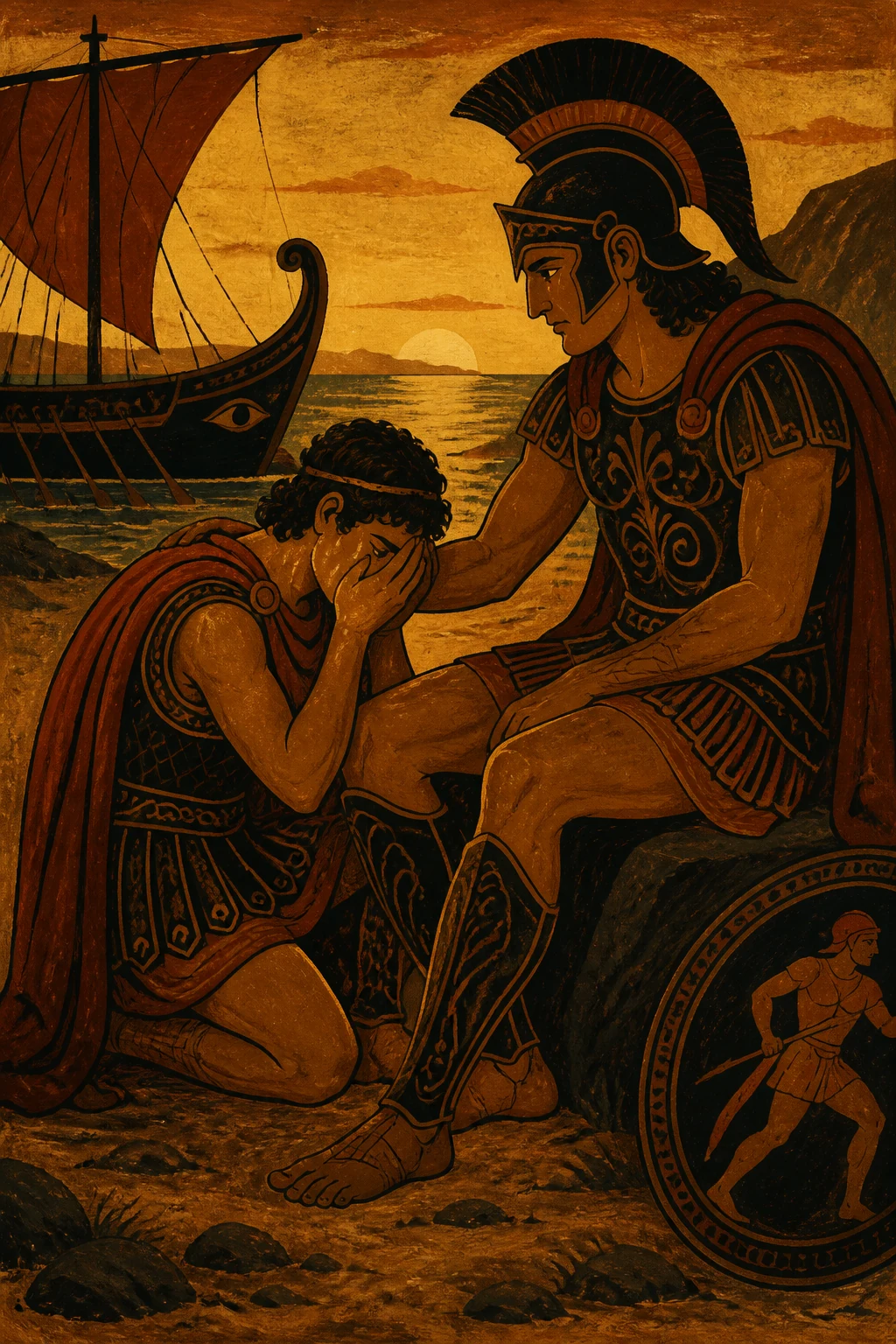
At once he called from the ship to his companion Patroclus. Hearing him, Patroclus came out of the shelter like Ares: this was the beginning of his ruin. The valiant son of Menoetius spoke first: “Why do you call me, Achilles? What do you need of me?”
Swift-footed Achilles answered him: “Noble son of Menoetius, dear to my heart, now, I think, the Achaeans will stand about my knees in supplication, for their need has become unbearable.
“Go now, Patroclus, dear to Zeus, and ask Nestor who this wounded man is whom he is bringing out of battle. From behind he looks in every way like Machaon, the son of Asclepius, but I did not see his face, for the horses rushed past me, straining eagerly ahead.”
So he spoke, and Patroclus obeyed his dear companion and set off running past the Achaeans’ shelters and ships. Meanwhile, when the others reached the shelter of Neleus’ son, they stepped down onto the all-nourishing earth, and Eurymedon, the old man’s attendant, unyoked the horses from the chariot. They stood facing the breeze by the seashore, letting the sweat dry from their tunics, then went into the shelter and sat down on chairs.
Fair-haired Hecamede prepared a mixed drink for them. She was the daughter of great-hearted Arsinous, whom the old man had taken from Tenedos when Achilles sacked it. The Achaeans had chosen her out for him because he surpassed them all in counsel.
First she drew before them a beautiful, well-polished table with dark-blue feet, and on it set a bronze basket, an onion to relish with their drink, pale honey, and a meal of sacred barley. Beside these she placed a splendid cup the old man had brought from home, studded with golden nails. It had four handles, with two golden doves feeding beside each, and beneath it were two supports.
Another man could barely have moved it from the table when it was full, but old Nestor lifted it without effort. In this the woman, lovely as a goddess, mixed their drink with Pramnian wine, grated goat’s cheese over it with a bronze grater, and sprinkled white barley meal on top. When the mixture was ready, she invited them to drink.
When they had drunk and quenched their parching thirst, they took pleasure in talking together. Then Patroclus, a man like a god, appeared at the doorway. Seeing him, the old man rose from his shining chair, took him by the hand, led him in, and invited him to sit.
But Patroclus declined and said: “This is no time to sit, old sir, cherished by Zeus, nor will you persuade me. The man who sent me to ask who this wounded warrior is whom you have brought back is one to be respected and feared. But now I recognize him myself: I see Machaon, shepherd of his people.
“Now I shall go back and give Achilles my report. You know well, old sir, cherished by Zeus, what a formidable man he is. He might find fault even with one who was blameless.” Then the Gerenian horseman Nestor answered him: “Why does Achilles feel such pity now for the sons of the Achaeans, for all those struck by missiles? He knows nothing of the sorrow that has swept through the army. Our best men lie beside the ships, struck down and wounded.
“Mighty Diomedes, son of Tydeus, has been hit; Odysseus, famed for his spear, and Agamemnon have been wounded; Eurypylus too has been struck in the thigh by an arrow. And here is another whom I have just brought from the fighting, wounded by an arrow from a bowstring. Yet Achilles, brave though he is, neither cares for the Danaans nor pities them.
“Is he waiting until the swift Argive ships beside the sea burn in consuming fire despite our efforts, and we ourselves are slaughtered one after another? For the strength in my supple limbs is no longer what it was.
“If only I were young again, my strength unbroken, as when strife arose between the Eleans and ourselves over a cattle raid! Then I killed Itymoneus, the brave son of Hypeirochus who lived in Elis, as I drove off cattle in reprisal. Defending his herd, he was struck among the foremost by a javelin from my hand and fell, and the country folk scattered in terror.
“From the plain we drove together a vast amount of plunder: fifty herds of cattle, as many flocks of sheep, as many droves of swine, as many wide-ranging herds of goats, and a hundred and fifty chestnut horses, all mares, many with foals beneath them.
“These we drove into the city of Neleus’ Pylos by night. Neleus rejoiced at heart that so much had fallen to me, a young man going to war. At the first light of dawn the heralds cried aloud for all to come who were owed a debt in holy Elis. The leading men of Pylos assembled and divided the spoil, for the Epeians owed debts to many of us, since we in Pylos were few and had suffered greatly. Mighty Heracles had come in earlier years and devastated us, and all our finest men had been killed. We had been twelve sons of noble Neleus; I alone survived, and all the others perished.
“Taking advantage of this, the bronze-clad Epeians treated us with contempt and devised outrageous wrongs against us. The old man chose for himself a herd of cattle and a great flock of sheep, three hundred in all, together with their herdsmen.
“For he too was owed a great debt in holy Elis: four prizewinning horses with their chariot, which had gone there to compete. They were to race for a tripod, but Augeias, lord of men, kept them there and sent their driver away grieving for his horses.
“Angered by these words and deeds, the old man took an immense share for himself. The rest he gave to the people to divide, so that no one should go away deprived of his due. While we attended to all this and offered sacrifices to the gods throughout the city, on the third day the enemy came, all together in full force, with a host of men and their single-hoofed horses. With them the two sons of Molione armed for battle, still boys, not yet well versed in furious warfare.
“There is a town called Thryoessa, on a steep hill far away beside the Alpheius, at the edge of sandy Pylos. They laid siege to it, eager to destroy it. But when they had crossed the whole plain, Athena came speeding from Olympus as our messenger by night, bidding us arm. Nor did she gather an unwilling army throughout Pylos: we were eager indeed for battle. Yet Neleus would not let me arm, and hid my horses from me, saying I knew nothing yet of warfare.
“Even so, though I fought on foot, I shone among our charioteers, for Athena guided the battle so. There is a river, the Minyeius, that flows into the sea near Arene. There we, the charioteers of Pylos, waited for holy Dawn, while the companies of foot soldiers streamed in.
“From there we all set out in armor, and at noon reached the sacred stream of the Alpheius. There we offered fine sacrifices to almighty Zeus, a bull to the Alpheius, a bull to Poseidon, and a heifer from the herd to gray-eyed Athena. Then we took our supper throughout the army, company by company, and lay down to sleep beside the river’s streams, each man in his armor. Meanwhile the great-hearted Epeians had surrounded the town, eager to destroy it. But before they could do so, a mighty work of Ares awaited them. When the shining sun rose over the earth, we met in battle, praying to Zeus and Athena.
“When the battle between the Pylians and Epeians began, I was the first to kill a man and capture his single-hoofed horses: the spearman Mulius. He was Augeias’ son-in-law, married to his eldest daughter, fair-haired Agamede, who knew every healing herb the broad earth grows.
“As he came toward me I struck him with my bronze-tipped spear, and he fell in the dust. I leapt into his chariot and took my place among the foremost fighters. The great-hearted Epeians scattered in terror when they saw their charioteers’ leader fallen, the best of them in battle.
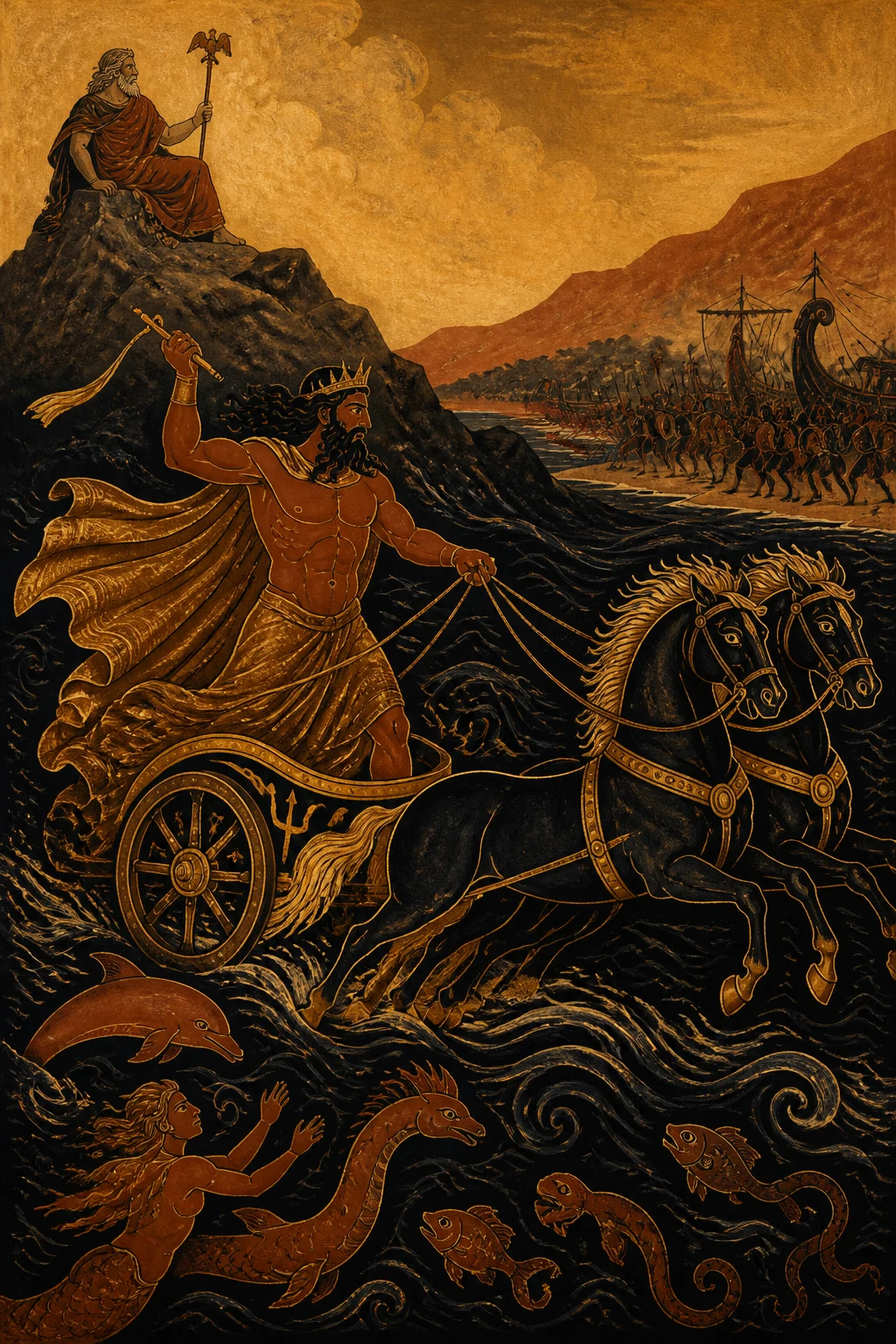
“Then I swept down upon them like a black storm and captured fifty chariots. Beside each, two men bit the earth, brought down by my spear. I would have slain the two sons of Molione, the descendants of Actor, had not their father, the wide-ruling Earthshaker, saved them from battle, shrouding them in thick mist.
“Then Zeus granted the Pylians a mighty victory. We pursued them over the open plain, killing them and gathering their fine armor, until we drove our horses to wheat-rich Buprasium, the Olenian Rock, and the place called the Hill of Alesius. There Athena turned our army back.
“There I killed my last man and left him. Then the Achaeans wheeled their swift horses back from Buprasium toward Pylos, and all gave glory to Zeus among the gods and to Nestor among men.
“Such a man I was among men, if ever I was. But Achilles will enjoy his valor alone. I think he will weep bitterly for it later, when the army has perished. Dear friend, surely Menoetius gave you his instructions on the day he sent you from Phthia to Agamemnon. Noble Odysseus and I were there inside the hall and heard every word he said.
“We had come to the well-appointed house of Peleus, gathering an army throughout the fertile land of Achaea. There we found the warrior Menoetius, and you, and Achilles beside you. The old horseman Peleus was burning the rich thighbones of an ox for Zeus who delights in thunder, in the enclosure of his courtyard. He held a golden cup and poured gleaming wine over the burning offerings.
“You two were busy with the ox’s meat. We stood at the entrance, and Achilles sprang up in surprise, took us by the hand, led us in, and invited us to sit. He set before us the hospitality that is a guest’s due.
“When we had eaten and drunk our fill, I began to speak, urging you to come with us. You were both eager, and your fathers gave you many counsels. Old Peleus charged his son Achilles always to excel and stand above all others. But to you Menoetius, son of Actor, gave this charge: ‘My child, Achilles is nobler by birth, but you are older, though he is far stronger.
“‘Speak wisely to him, give him counsel and guidance, and he will listen for his own good.’ Such was the old man’s charge, but you have forgotten. Even now, speak these words to warlike Achilles and see whether he will listen.
“Who knows? With a god’s help your words might stir his heart. A friend’s persuasion is a powerful thing. But if he is shrinking from some prophecy in his heart, and his honored mother has brought him a warning from Zeus, then let him at least send you out, and let the rest of the Myrmidon army follow, so that you may bring some light of deliverance to the Danaans. Let him give you his fine armor to wear into battle, so that the Trojans may mistake you for him and draw back from the fighting, and the hard-pressed warrior sons of the Achaeans may catch their breath. There is little breathing space in war.
“You are fresh, and could easily drive men exhausted by battle back toward the city, away from the ships and shelters.” So he spoke, and stirred the heart within his breast. Patroclus set off running beside the ships toward Achilles, the descendant of Aeacus.
But as Patroclus ran and reached the ships of noble Odysseus, where their assembly and place of judgment stood, and where they had built altars to the gods, he met Eurypylus, Zeus-born son of Euaemon, limping out of battle with an arrow in his thigh. Sweat poured down his shoulders and head, and dark blood welled from his grievous wound, but his mind remained steady.
The valiant son of Menoetius pitied him when he saw him, and spoke winged words of lament: “Ah, unhappy leaders and rulers of the Danaans! So it was your destiny, far from your friends and native land, to feed the swift dogs of Troy with your white fat.
“But tell me this, heroic Eurypylus, cherished by Zeus: can the Achaeans still hold back mighty Hector, or are they now to perish beneath his spear?” The wounded Eurypylus answered him: “Zeus-born Patroclus, there will be no defense left for the Achaeans. They will fall among the black ships.
“All those who once were our best men now lie beside the ships, struck down and wounded by Trojan hands, while the Trojans’ strength grows continually. But save me: take me to my black ship, cut the arrow from my thigh, wash the dark blood away with warm water, and sprinkle good, soothing medicines over the wound—the remedies they say Achilles taught you, having himself been taught by Chiron, the most just of the Centaurs.
“For of our healers, Podalirius and Machaon, one, I believe, lies wounded in his shelter, needing a good healer himself, while the other is on the plain, facing the Trojans’ fierce assault.”
The valiant son of Menoetius answered him: “How can this be? What are we to do, heroic Eurypylus? I am on my way to tell warlike Achilles what the Gerenian Nestor, guardian of the Achaeans, charged me to say. Yet even so, I will not abandon you in your suffering.”
With these words he put an arm beneath the warrior’s chest and led the shepherd of his people into his shelter. Seeing them, an attendant spread oxhides on the ground. Patroclus laid him down, cut the sharp, piercing arrow from his thigh with a knife, and washed the dark blood away with warm water. Then he crushed a bitter, pain-killing root between his hands and laid it on the wound. It stilled all his pain; the wound began to dry, and the bleeding stopped.