Waltey
Tošihito in jamova kaša
Uji Shūi Monogatari · anonimna srednjeveška zbirkaO besedilu
Tošihito in jamova kaša
- Vir
- Uji Shūi Monogatari
- Avtor
- anonimna srednjeveška zbirka
- Jezik branja
- English
- Jezik izvirnika
- 日本語
- Čas branja
- 12 min branja
- Obseg
- 10 strani
- Naslov izvirnika
- 018 利仁暑預粥事
O izvirniku
Uji Shūi Monogatari
Srednjeveške japonske pripovedi o menihih, duhovih, čudežih, prevarah in vsakdanjih presenečenjih. Bralni jezik je English, izvirnik pa prihaja iz vira Uji Shūi Monogatari v jeziku 日本語.
Besedilo
Tošihito in jamova kaša
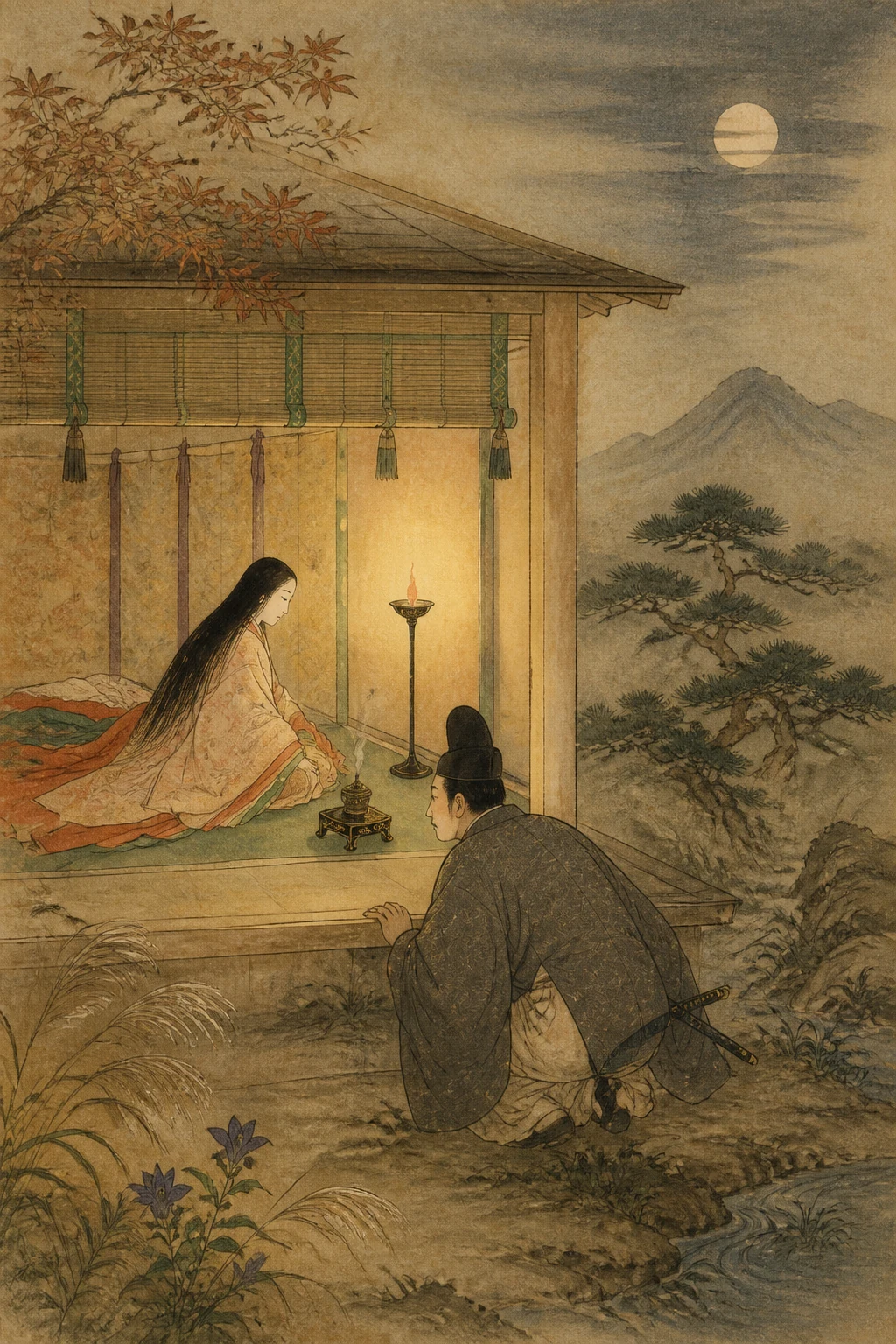
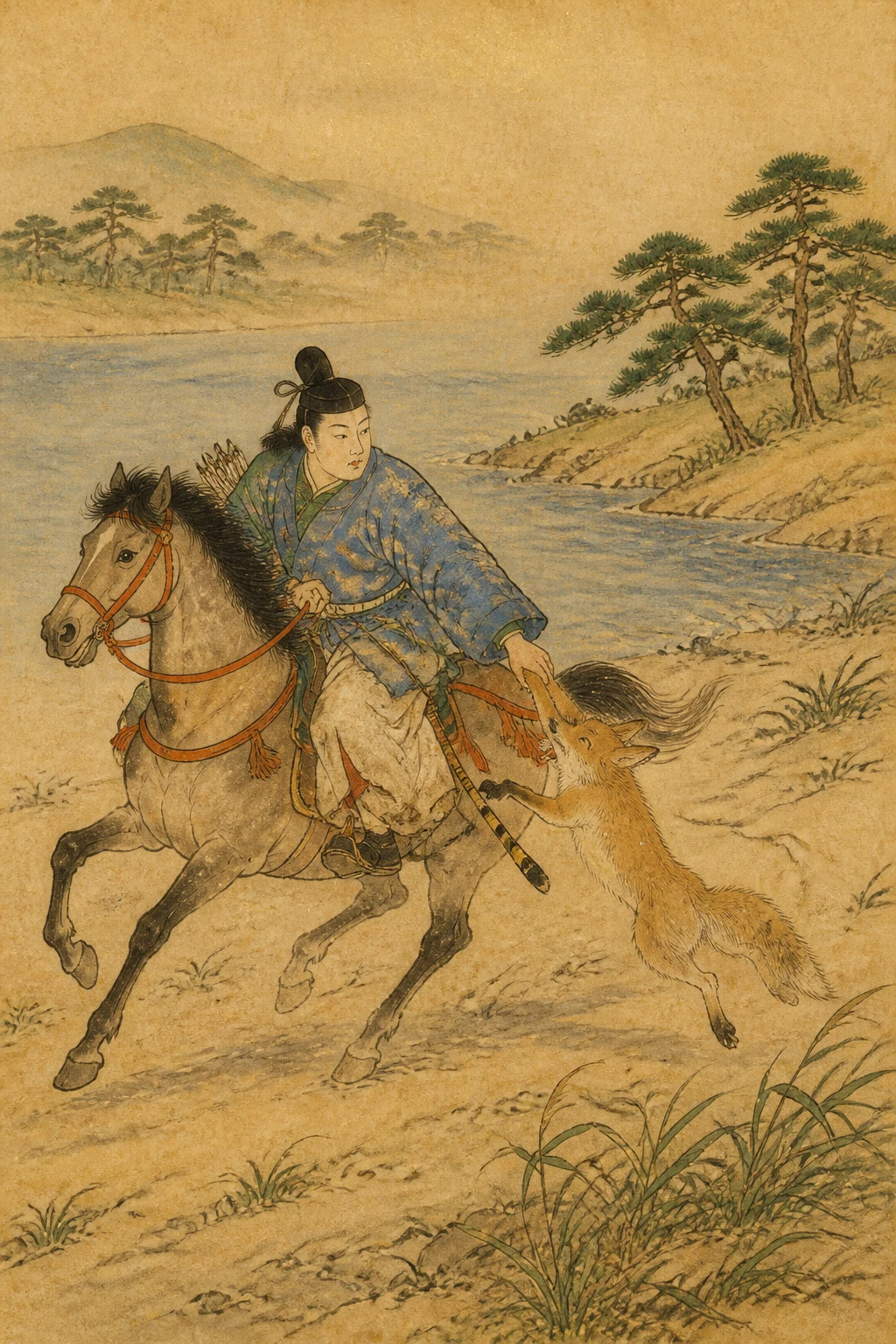
Long ago, when General Toshihito was still young, he served in attendance upon the foremost minister of the day. One New Year, the minister held a great banquet. In those days, when such a banquet was over, the food was not thrown into the vessel called the torihami, but was eaten by the attendants who had served at the feast. This meal was known as the banquet leavings. Among the attendants was a man of the Fifth Rank who had served for many years and enjoyed a certain standing in the household. Sitting down to the leavings, he sipped some yam gruel, smacked his lips, and said, “Ah, if only I might eat my fill of yam gruel!” Toshihito heard him and asked, “My dear sir, have you never yet had your fill of it?” “Never,” replied the man of the Fifth Rank. “Then I shall see that you do.” “I should be most grateful,” said the other, and there the matter rested. Four or five days later, Toshihito came to a corner of the attendants’ room where the man was sitting and said, “Come along, sir. Let us go and take a hot bath.” “How very kind! I was feeling itchy this evening. But I have no horse.” “I have brought a humble mount for you.” “How delightful! How delightful!” he said. He was wearing only two lightly padded robes, a pair of blue-gray gathered trousers with tattered hems, and a hunting robe of the same color, a little torn at the shoulder. He had no under-trousers on. His nose was long, its tip red, and the dampness around his nostrils suggested that he never wiped it. The back of his hunting robe had been dragged awry by his belt, and he had not even troubled to straighten it. He was a most unsightly and comical figure, but Toshihito sent him on ahead, and they both mounted and rode out toward the riverbed. The man of the Fifth Rank had not so much as a shabby page with him; Toshihito was accompanied by a groom carrying his bow and arrows and a single attendant. They passed the riverbed and reached Awataguchi. “Where are we going?” the man asked. “Just here, just here,” Toshihito replied, and they rode on past Yamashina. “What is this? You keep saying ‘just here,’ and now we have gone beyond Yamashina!” “Only a little farther, only a little farther,” said Toshihito, and they passed over the barrier hill. Still saying, “Just here, just here,” he took him to the lodging of a monk he knew at Miidera. Even supposing that the bath was to be heated there, the man thought it a tiresomely long journey. Yet there was no sign of a bath here either. “Where is this bath?” he asked. “The truth is, I am taking you to Tsuruga.” “You must be out of your mind! If you had told me so in the capital, I could at least have brought a servant.” Toshihito laughed. “As long as I am with you, think of yourself as having a thousand men.” They had something to eat and set off at once. It was there that Toshihito put on his quiver. As they went along, a fox came running out onto Mitsu Beach. “Here is a fine messenger!” said Toshihito, and spurred his horse after it. The fox flung itself into flight, but he pressed it so hard that it could not escape. Leaning down from his saddle, he caught it by a hind leg and lifted it up. His horse had not looked particularly fine, but it was an extraordinary animal, and he had overtaken the fox in no time. When the man of the Fifth Rank came riding up, gasping for breath, Toshihito held the fox aloft and said, “You there, fox! Go to my house in Tsuruga tonight and say this: ‘I am coming down unexpectedly with a guest. Tomorrow, at the hour of the Snake, let the men come to meet me near Takashima, bringing two horses with saddles on them.’ If you fail to deliver the message, you had better look out! Foxes have powers of transformation, so get there and tell them before the day is out.” With that he let it go. The man of the Fifth Rank remarked that this was a very hasty way to dispatch a messenger. “Watch,” Toshihito told him. “It will certainly go.” The fox was already running ahead, glancing back again and again. “It seems to be going willingly enough,” said Toshihito, and as he spoke it ran on before them and vanished. They spent that night along the road and set out early the following morning. Sure enough, at about the hour of the Snake, a party of some thirty horsemen came toward them. As the man of the Fifth Rank wondered who they could be, Toshihito said, “Here come my men.” “Surely not!” the other exclaimed. But they drew nearer and nearer, then dismounted one after another. “Look at that! You really are here!” they said. Toshihito smiled faintly and asked, “What has happened?” An elderly retainer came forward. “A most extraordinary thing, sir.” “First, have you brought the horses?” “We have brought two.” They had brought food as well, so the travelers dismounted and sat down to eat. While they were eating, the elderly retainer said, “A strange thing happened last night. At about the hour of the Dog, our mistress began to suffer terrible, piercing pains in her chest. Everyone was alarmed, wondering what could be the matter and saying that a priest must be summoned at once. Then she herself spoke: ‘Why are you making such a commotion? I am a fox. There is nothing else the matter. Today, on Mitsu Beach, I met your lord as he was coming down from the capital. I tried to run away, but he overtook me and caught me. He ordered me to reach his house before the day was out and say, “I am coming down with a guest. Tomorrow, at the hour of the Snake, let the men bring two saddled horses and meet me at the harbor of Takashima.” He said that if I did not get here and deliver his message today, he would make me suffer for it. Tell the men to set out at once! If they are late in meeting him, I shall incur his displeasure!’ She was in such a frightened state that we summoned the men and gave them their orders, whereupon she returned to her usual self. Then we set out at cockcrow and came here.” Toshihito smiled and looked at the man of the Fifth Rank, who was utterly astonished. When they had finished eating, they hurried on and reached the house as darkness fell. “Well, well! It really was true!” the men said to one another in amazement. The man of the Fifth Rank dismounted and looked about the house. Its prosperity and splendor were beyond compare. Though Toshihito had put his own sleeping robe over the two robes the man had worn from home, the cold had surely penetrated him to the bone, and he looked miserably chilled. A great fire had been built up in a long brazier, thick mats had been laid out, and fruit and other food stood ready. He was beginning to feel wonderfully comfortable when someone said, “You must have been cold on the road,” and brought three robes of unbleached silk, thickly padded with floss, laid one upon another, and wrapped them around him. To call it comfort would hardly do it justice. He ate, and when everything had grown quiet, Toshihito’s father-in-law, Arihito, came out and said, “What has brought you here so unexpectedly? And as for that messenger of yours—what a wild business, making our mistress suddenly fall ill! An extraordinary affair!” Toshihito laughed. “I only did it to see what would happen, but it seems the creature really came and delivered the message.” His father-in-law laughed too. “Extraordinary indeed! And is this the gentleman you said you were bringing with you?” “Yes. He told me he had never had his fill of yam gruel, so I have brought him down to give him all he can eat.” “To think that you could never get your fill of such a simple dish!” the father-in-law teased. “He told me he had a bath heated in the Eastern Hills,” said the man of the Fifth Rank. “He lured me out on that pretext, and now this is what he says!” They joked together in this way until the night had grown a little late, and the father-in-law withdrew. The man of the Fifth Rank went into what appeared to be his sleeping quarters and prepared for bed. There he found a sleeping robe padded with four or five inches of floss. His own thinly padded robes were old, scarcely had anything left inside them, and made him itch in places, so he took them off. Over the three robes of unbleached silk he drew this thick sleeping robe and lay down. Unaccustomed to such warmth, he felt as though he might suffocate, and lay there drenched in sweat. Then someone stirred beside him. “Who is there?” he asked. “I was told to attend to your feet, so I have come,” was the reply. The woman’s manner was not displeasing, so he drew her down beside him and lay where a little air could reach him. Presently he heard a loud voice. Listening to discover what it was, he heard a man calling, “Let all the servants in this neighborhood take notice! Tomorrow, at the hour of the Hare, each of you is to bring one yam, three inches across at the cut end and five feet long!” What an astonishingly grand way to give an order, he thought, and fell asleep. Toward dawn, he heard the sound of mats being spread in the courtyard and wondered what was going on. Soon the people in the nearby huts and on night duty began getting up. When the shutters were opened, he saw that four or five long mats had been laid out. As he wondered what they were for, a lowly fellow appeared with something like a log slung over his shoulder, put it down, and went away. Others followed one after another, each carrying a yam two or three inches across and five or six feet long. They went on laying them down until the hour of the Snake, by which time the pile stood as high as the eaves of the building where he sat. The shouting he had heard in the night had come from the top of a mound known as the Men-Calling Hill, where someone had stood to give the order to all the servants in the neighborhood. Even the servants living within reach of that voice had brought so much; one may imagine how many more there were in the villages and outlying places beyond. While he was gazing in astonishment, five or six cauldrons, each holding five koku, were carried in on poles. Stakes were driven into the courtyard, and the cauldrons were set up in a row. He wondered what these could be for. Young, clean-looking women, wearing short jackets of plain silk tied at the waist, came with bright new buckets and briskly poured what looked like water into the cauldrons. Were they heating bathwater? But what he took for water was sweet syrup. Some dozen men then appeared, their hands thrust out from their sleeves, each holding a long, thin knife. They began peeling the yams and slicing them into slivers. Only then did he realize that they were making yam gruel. By now he no longer felt like eating any; indeed, the very thought had become repellent. After much stirring, someone announced, “The yam gruel is ready.” “Bring it in,” came the answer. First they brought a large earthenware bowl, together with three or four metal pitchers, each of which must have held a full to of gruel. “To begin with,” they said as they set them before him. But he was already so surfeited by the sight that he could not eat even a single bowlful. “I have had enough,” he said. They laughed heartily and sat down together, saying to one another, “Thanks to our honored guest, we have had yam gruel to eat!” While all this was going on, Toshihito noticed a fox peering in from under the eaves of the long building opposite. “Look there,” he said. “The fox that served us has come to pay its respects. Give it something to eat.” They gave it some food, and it ate it. To say that the man of the Fifth Rank was comfortable and happy in every way would be an understatement. He stayed about a month. When he returned to the capital, they gave him many sets of everyday clothing, as well as lengths of plain Hachijo silk and padded robes packed into leather-covered chests. The thick sleeping robe from his first night went with him too, of course. They even gave him a horse with its saddle on, and sent him home in style. Such good fortune may sometimes come even to a humble attendant, if he has served for many years and gained a place of trust in a household.
Izvirnik
018 利仁暑預粥事
Naslednje strani prikazujejo izvirno besedilo za primerjavo.
今は昔利仁の将軍のわかかりける時其時の一の人の御本に恪勤して候けるに正月に大饗せられけるにそのかみ大饗はててとりはみ水いふ物をはよひていれすして大饗のおろし米とて給仕したる恪勤のものともの食ける也その所に年比になりてきうしたる物の中には所え
たる五位ありけりそのおろしこめの座にて芋粥すすりて舌うちをしてあはれいかていも粥にあかんといひけれはとし仁これをききて大夫殿いまたいもかゆにあかせ給はすやととふ五位いまたあき侍らすといへはあかせたてまつりてんかしといへはかしこく侍らんとてやみぬさて四五日斗ありてさうしすみにてありける所へ利仁きていふ様いささせ給へ湯あみに大夫殿といへはいとかしこき事かなこよひ身のかゆく侍つるに乗物こそは侍らねといへはここにあやしの馬くして侍りといへはあなうれしあなうれしといひてうすわたのきぬ二斗にあをにひのさしぬきのすそやれたるにおなし色のかり衣のかたすこし落たるにしたの袴もきす鼻たかなるもののさきはあかみて穴のあたりぬれはみたるはすすはなをのこはぬなめりとみゆ狩衣のうしろは帯にひきゆかめられたるままに引もつくろはぬはいみしうみくるしおかしけれともさきにたてて我も人も馬にのりて河原さまにうち出ぬ五位のともにはあやしの童たになし
利仁かともには調度かけとねりさうしきひとりそ有ける河原打過て粟田口にかかるにいすくへそととへはたたここそここそとて山科も過ぬこはいかにここそここそとて山科もすくしつるはといへはあしこあしことて関山もすきぬここそここそとて三井寺にしりたる僧のもとへゆきたれは爰に湯わかすとおもふたにも物くるしう遠かりけりと思にここにも湯ありけにもなしいつらゆはといへはまことはつるかへいてたてまつるなりといへは物くるおしうおはしける京にてさとの給はましかは下人なともくすへかりけるをといへは利仁あさわらひてとし仁独侍らは千人とおほせと云かくて物なと食て急出ぬそこにてそ利仁やなくひとりてをひけるかくて行程にみつの浜に狐の一はしり出たるをみてよきたより出きたりとて利仁狐ををしかくれは狐みをなけて逃れともをひせめられてえにけす落かかりて狐の尻足を取て引あけつ乗たる馬はいとかしこしともみえさりつれ共いみしき逸物
にてありけれはいくはくものはさすしてとらへたる所に此五位はしらせていきつきたれは狐を引あけて云様はわ狐こよひの内に利仁か家のつるかにまかりていはむやうは俄に客人をくしたてまつりてくたる也明日の巳の時に高島辺にをのこともむかへに馬二鞍をきて二疋くしてまうてこといへもしいはぬ物ならはわ狐たた心みよ狐は変化ある物なれはけふのうちに行つきていへとてはなては荒涼の使哉といふよし御らんせよまからてはよにあらしといふにはやく狐み返しみ返しして前に走行よくまかるめりといふにあはせて走先立てうせぬかくて其夜は道に留りてつとめてとく出て行程に誠に巳時斗に卅騎斗こりてくる物ありなににかあらんとみるにをのこともまうてきたりといへは不定の事哉と云程にたたちかにちかく成てはらはらとおるる程にこれみよ誠におはしたるはといへは利仁うちほをえみて何事そととふおとなしき郎等すすみて希有の事の候つる也といふまつ馬はありやといへは二疋さふらふと云食物
なとして来けれはそのほとにおりゐてくふつゐてにおとなしき郎等のいふやう夜部けうの事のさふらひし也戌時斗に大はん所のむねをきりにきりてやませ給しかは如何成事にかとて俄に僧めさんなとさはかせ給し程にてつから仰さふらふやうなにかさはかせ給をのれは狐也別のことなし此□みつの浜にて殿の下らせ給つるに逢たてまつりたりつるに逃つれとも先にけてとらへられたてまつりたりつるにけふのうちにわか家にいきつきて客人くしたてまつりてなんくたるあす巳時に馬二に鞍をきてくしてをのことも高島のつにまいりあへといへもしけふのうちにいきつきていはすはからきめ見せんするそと仰られつるなりをのこともとくとく出立てまいれ遅まいらは我は勘当かうふりなんとをちさはかせ給つれはをのこともにめしおほせさふらひつれは例さまにならせ給にき其後鳥とともに参さふらひつる也といへは利仁うちえみて五位にみあはすれは五位あさましと思たり物なとくひはてて急立てくらくらに行つきぬこれ
みよまことなりけりとあさみあひたり五位は馬よりおりて家のさまを見るににきわわしくめてたき事物にもにすもときたるきぬ二かうへに利仁か宿衣をきせたれとも身の中しすきたるへけれはいみしうさむけに思たるになかすひつに火をおほふおこしたりたたみあつらかにしきてくた物くひ物しまうけてたのしくおほゆるに道の程さむくおはしつらんとてねり色のきぬのわたあつらかなる三つひきかさねてもてきてうちおほひたるにたのしとはおろかなり物くひなとしてことしつまりたるにしうとの有仁いてきていふやうこはいかてかくはわたらせ給へるそこれにあはせて御使のさま物くるおしうてうへにはかにやませたてまつり給ふけうの事也といへは利仁うち笑て物の心みんとおもひてしたりつる事を誠にまうてきてつけて侍にこそあんなれといへはしうとも笑て希有の事也といふくしたてまつらせ給つらん人は此おはします殿の御事かといへはさに侍り芋粥にいまたあかすと仰らるれはあかせたて
まつらんとていてたてまつりたるいへはやすき物ともえあかせ給はさりけるかなとてたはふるれは五位東山に湯わかしたりとて人をはかりいててかくの給なりなといひたはふれて夜すこし更ぬれはしうとも入ぬね所とおほしき所に五位入てねんとするに綿四五寸斗あるひたたれ(宿衣歟)あり我もとのうすわたはむかしうなにのあるにかかゆき所もいてくるきぬなれはぬきおきてねり色のきぬ三かうへにこのひたたれひききてふしたる心いまたならはぬに気もあけつへしあせ水にてふしたるに又かたはらに人のはたらけはたそととへは御あし給へと候へはまいりつる也と云けはひにくからねはかきふせて風のすく所にふせたりかかる程に物たかくいふこゑす何事そときけはをのこのさけひて云やうこのへんの下人うけ給はれあすの卯時に切口三寸なかさ五尺の芋各一筋つつもてまいれといふなりけりあさましうおほのかにもいふ物哉とききてね入ぬ暁かたにきけは庭に筵しくおとのするをなにわさする
にかあらんときくにこやたうはんよりはしめておき立てゐたるほとに蔀あけたるに見れはなかむしろをそ四五枚敷たるなにのれうにかあらんとみる程にけす男の木のやうなる物をかたにうちかけてきて一すちをきていぬ其後うちつつきもてきつつをくをみれは誠に口二三寸斗のいもの五六尺はかりなるを一すちつつもてきてをくとすれと巳時まてをきけれはゐたるやとひとしくをきなしつ夜部さけひしははやうそのへんにある下人のかきりに物いひきかすとて人よひの岡とてあるつかのうへにていふなりけりたたそのこゑのをおよふかきりのめくりの下人のかきりのもてくるにたにさはかりおほかりましてたちのきたるすさとものおほさをおもひやるへしあさましとみたる程に五石なはのかまを五六舁もてきて庭にくゐともうちてすへわたしたり何のれうそとみる程にしほきぬのあをといふ物きて帯してわかやうにきたなけなき女どもの、しろくあたらしき桶に水を入て
此釜ともにさくさくといるなにそ湯わかすかとみれは此水とみるはみせんなりけりわかすおのこともの袂より手出したるうすらかなる刀のなかやかなるもたるか十余人斗いてきて此いもをむきつつすききりにきれははやく芋粥にるなりけりとみるにくふへき心ちもせすかへりてはうとましく成にたりさらさらとかへらかしていもかゆいてまうてきにたりといふまいらせよとて先大なるかはらけくしてかねの提の一斗はかり入ぬへきに三四に入て且とてもてきたるにあきて一もりをたにえくはすあきにたりといへはいみしうわらひてあつまりてゐて客人殿の御とくにいもかゆくひつといひあへりかやうにする程に向のなか屋の軒に狐のさしのそきてゐたるを利仁見つけてかれ御らんせよ候し狐のけさんするをとてかれに物くはせよといひけれはくはするにうちくひてけりかくてよろつの事たのしといへはおろか也一月はかりありてのほりけるにけおさめのさうそくともあまたくたり又たたの八丈
わたきぬなと皮子ともに入てとらせはしめの夜の直垂はたさらなり馬に鞍をきなからとらせてこそをくりけれきう者なれとも所につけて年比になりてゆるされたるものはさるもののをのつからある也けり
Nadaljuj z branjem