Waltey
Duh, ki ga je ukanil sultanov sin
Swahili Tales · Edward Steere; pripovedovalci z ZanzibarjaO besedilu
Duh, ki ga je ukanil sultanov sin
- Vir
- Swahili Tales
- Avtor
- Edward Steere; pripovedovalci z Zanzibarja
- Jezik branja
- English
- Jezik izvirnika
- Kiswahili
- Čas branja
- 8 min branja
- Obseg
- 6 strani
- Naslov izvirnika
- 012 Pepo Aliyedanganywa na Mtoto wa Sultani
O izvirniku
Swahili Tales
Svahilijske pripovedi z Zanzibarja o zvijači, živalih, vladarjih in nenavadnih preobratih. Bralni jezik je English, izvirnik pa prihaja iz vira Swahili Tales v jeziku Kiswahili.
Besedilo
Duh, ki ga je ukanil sultanov sin
There was once a Sultan who had long wished for a child, but had none. He possessed great wealth and many towns. He thought to himself, “When I die, this whole kingdom will be lost, for I have no child.”
Then a devil came to him in the guise of a man and said to the Sultan, “If I give you a medicine and you have a child, what will you give me?” The Sultan replied, “I will give you half my wealth.” “I will not accept that,” he said. “I will give you half my towns.” “I will not accept that.” “What do you want, then?” “If you have two children, give me one and keep the other.” “I agree,” said the Sultan.
He brought the medicine and said, “Give this to your wife to eat.” The Sultan gave it to her, and she ate it and conceived. She bore a first child, a boy, then a second boy, and then a third boy.
Then his friend, the man who had given him the medicine, came and said, “Now, let us divide them.” The Sultan replied, “Not yet. These children have not been taught.” “Give them to me, and I will teach them.” “Take them,” said the Sultan. So he took them home with him. He had a great house, with everything in it.
He taught them until they had mastered all their studies and could write, then took them back to their father. One of the boys was especially clever. He said to their father, “Come, let us divide the children today.” “You divide them,” the Sultan replied. So he set two of them apart, and the third apart on his own, and said, “Choose, Sultan!” The Sultan took the two, and the other man took the one and went away.
When he reached home, he gave the boy all the keys and said, “Open whatever you wish.” The boy stayed in the house, while his father went away on a journey for a month before returning.
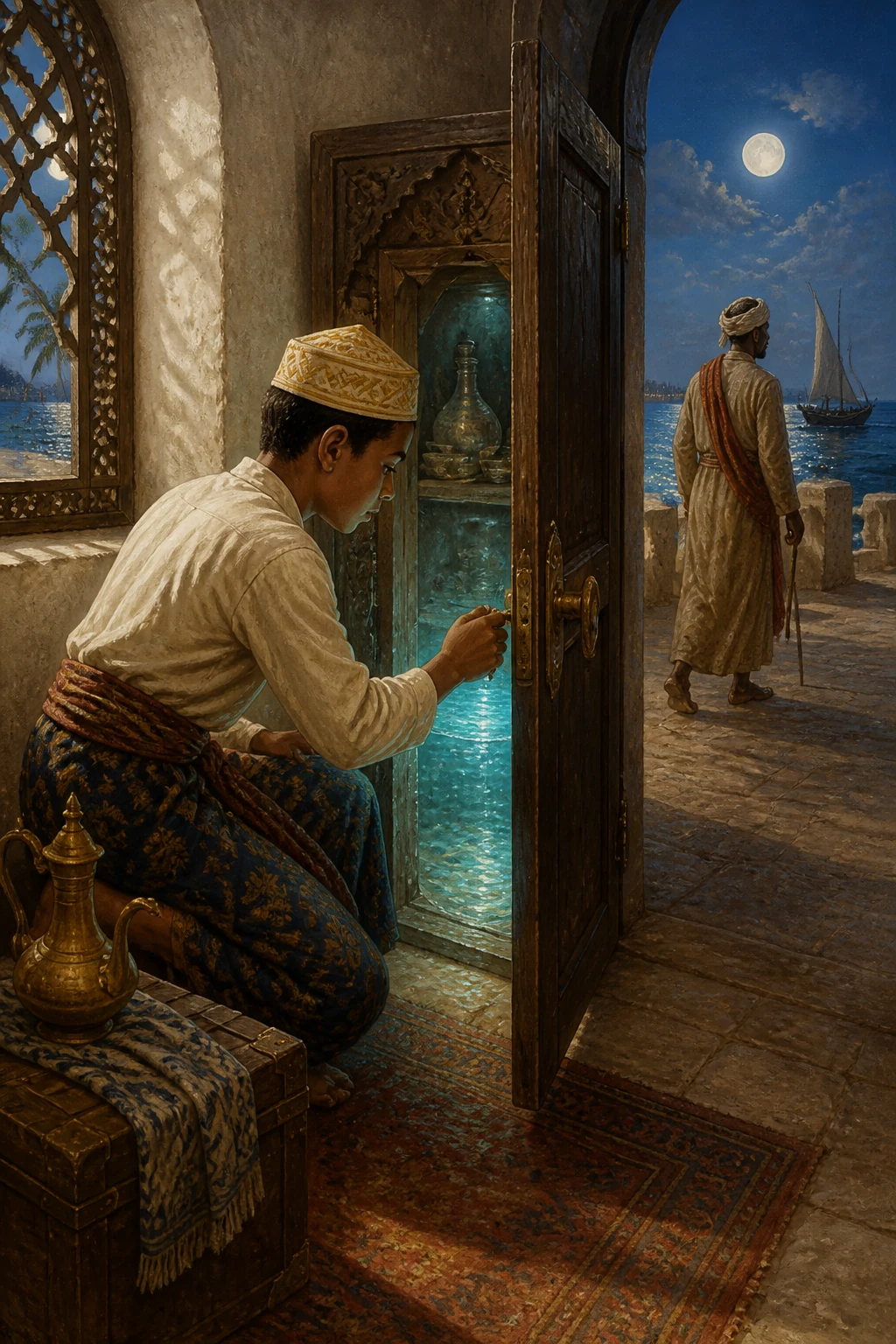
The boy remained there until one day he took a key and opened a room. He saw gold as fluid as water. He dipped his finger into it, and it clung to him. He tried to wipe it off, but it would not come away, so he wrapped his finger in a cloth. When his father returned, he asked, “What is wrong with your finger?” “I cut myself,” the boy replied. He stayed until the next day, when his father went away again.
The boy took all the keys and went to open the rooms. In the first he saw goats’ bones; in the second, sheep’s bones; in the third, cattle bones; in the fourth, donkeys’ bones; in the fifth, horses’ bones; in the sixth, human skulls; and in the seventh, a living horse.
The horse said to him, “You human! Where have you come from?” He replied, “The man here is my father.” The horse said, “His business is eating people, donkeys, horses, cattle, goats—everything. Now only you and I are left.”
“What shall we do?” the boy asked. “Come and untie me,” said the horse, and the boy untied him. Then the horse said, “Now open the treasure room, and I will swallow everything. When your father comes, he will go and invite people to come and eat us. When he returns, he will say, ‘Let us go for firewood.’ Tell him, ‘I do not know how to do that work,’ and he will go alone. When he brings it back, he will set a great pot over the fire and tell you, ‘Stoke the fire.’ Tell him, ‘I cannot,’ and he will stoke it himself. He will bring a great deal of ghee and put it in the pot. When it is hot, he will put up a swing and tell you, ‘Get on and swing.’ Tell him, ‘I do not know this game. Get on yourself so I can watch you first and learn to do as you do.’ When he gets on to show you, push him into the pot of hot ghee, then run away. I will be waiting for you beneath a tree by the road.”
The horse ran off, leaving the boy alone. When his father returned, he said, “Tomorrow let us go for firewood.” “I do not know how to do that work,” the boy replied. “Then stay here.” He went alone and brought back a great deal of firewood. He had already told the people, “Tomorrow I am giving a feast. Come.” He brought out a pot and set it over the hearth, then said to the boy, “Put in the firewood.” “I do not know how.” “Go and fetch the ghee.” “I cannot carry it. I am not strong enough.” So he went himself, brought it, poured it into the pot, and lit the fire. “Stoke it,” he told the boy. “I do not know how to stoke a fire.”
“Have you seen the game we play here?” he asked. “I have not seen it yet,” the boy replied. By now the ghee was very hot. He put up a swing and said, “Get on here, and I will show you.”
The boy said, “Get on first and swing, Father, so that I can watch and learn.” He climbed onto the swing and began to swing. The boy seized him and pushed him into the pot, where he boiled in the ghee and died. Then the boy fled. When he reached the tree, he saw the horse come running. The horse caught him up, settled him on his back, and said, “Now let us be off.” And away they went.
Meanwhile, the others arrived and looked for their companion, but could not find him. They were very hungry. They looked into the pot, saw that the food was ready, and said, “Let us eat this food.” They took the pot off the fire, served it out, and ate. When they had finished, they looked for him again, but could not find him. They went into the house, brought out all the food and rice, cooked, and ate. The next day, seeing that he still had not returned, they went home.
The boy and the horse travelled far away to other towns and stopped on the outskirts of one. “Let us stay here,” the horse said. So they stayed and ate. “Let us build a house here,” he said. They built a great house with everything in it, and stocked it with donkeys, horses, cattle, goats, and slaves, and settled there.
In time the Sultan of that town heard about it and sent people to see whether there really was such a great house. They told him, “It is true, Sultan. It is a great house.”
The Sultan sent his men to find out who this person was. The boy told them, “I am a man like any other.” “Where have you come from?” they asked. “I have come from my own town on a visit.” They went and told the king, “He is a stranger here on a visit.” The Sultan said, “Let someone go tomorrow and tell him that the Sultan will come to see him.” A man went and told him. “He is most welcome. Let him come,” the boy replied.
He ordered a great deal of food to be prepared. In the morning the king came with his people and arrived at the house. The boy welcomed him and led him inside. The Sultan saw the great house and the many slaves within it. He sat down, and they talked. “Why do you not come into town to look about?” he asked. “I am a stranger,” the boy replied. “I need someone to take me and show me the town.” “Let us go, then, and walk about,” said the Sultan.
The king grew very fond of him, and they spent many days together there. The king asked him, “Would you like a wife?” “I would,” he replied. “I will give you my daughter in marriage.” The Sultan held a great wedding and married his daughter to him.
He lived with his wife, and they had one child. And so they lived out their days, he and his wife and their only child, together with his horse, whom he loved as dearly as his own soul.
Izvirnik
012 Pepo Aliyedanganywa na Mtoto wa Sultani
Naslednje strani prikazujejo izvirno besedilo za primerjavo.
Palikuwa na Sultaui akitamaui kijana siku nyiugi, asipatc. Naye aua mali inengi ua miji miugi. Akaoua — nikifa, itapotea mulki liuu pia kwa sababu ya kukosa mtoto.
Akaja slieitani akajifanya kama mtu, akaniwambia Sultani, nikikupa dawa, ukipata mtoto, utauipa niui ? Akamwambia, nitakupa nussu ya mali yangu. Akamwambia, sitakubali. Akamwambia, nitakupa miji yangu nussu. Akamwambia, sikubali. Akamwambia, wataka nini bass? Akamwambia, ukizaa watoto wawili, nipe mmoja, nawe utwas mmoja. Akamwambia, nimekubali.
Akamletea dawa, akamwambia, mpe mkewo, ale. Akampa, akala, akacbukua niimba, akazaa mtoto wa kwanza manamumc, na wa pili manamume, na wa tatu tena manamume.
Akaja i-afiki yakc yule aliompa dawa, akamwambia — haya, tugawanyo. Akamwambia, bado, hawajasoma watoto hawa. Akamwambia nipe mimi nikawasomeshe, akamwa-
mbia, cliiikua. Akacnda nao kwake. Na n^yuniba kubwa kvvake, na killa kitu kimo ndani.
Akawasomeslia hatta wakajua elimu pia, wakafanya bai-ufi, akaisha akawapelekea baba yao. Na wale vijaua mmoja boclari sana. Akamwambia babao, njoo, tugawanye watoto leo, akamwambia, gawa weye. Akagawanya yee, akatwaa wawili akaweka mbali, akatwaa ua mmoja, aka- 'mweka mbali, akamwambia — Cliagua Sultani ! Sultani akatwaa wale wawili, na yule akatwaa mmoja, akaenda zake.
Akaenda kwake, akampa funguo zote, akamwambia, killa utakacho fungua. Yule kijaua akakaa kitako ndani ya nyumba, na yule babaye kutoka akaenda kutembca mwezi, hatta anaporudi.
Bass, kijana akakaa kitako, hatta siku moja, akacbukua ufunguo, akaenda, akafungua cbumba kimoja. Akaona thababu kana maji, akatia kidolc ikasbika, akaislia kufuta haitoki, akafunga kitambaa. Akaja baba yake, akamwuliza, ima nini kidole ? Akamwambia, nimejikata. Akakaa liatta siku ya i^ili, baba yake akatoka, akaenda zake kutembea.
Yule mtoto akacbukua funguo zote, akaenda kufungua cbumba cba kwanza, akaona mifupa ya mbuzi ; akafungua cba pili, akaona mifupa ya kondoo ; akafungua cba tatu, akaona ya ngombe, akafungua cba nne, akaona ya punda ; akafungua cba tano, akaona ya fiirasi ; akafungua cba sita, akaona vitwa vya watu, akafungua cba saba, akaona farasi mzinia.
Akamwambia, ewe binadamu! watoka wapi? Akamwambia, mimi, baba yangu huyu. Akamwambia, kiizi yake ki;la watu, na punda, na farasi, na ngombe, na mbuzi, na killa kitu, na sasa tumosalia mimi nawe.
Akamwambia, tufanyeje ? Akamwambia, njoo unifungue, akamfungua. Akamwambia, sasa fungua cbumba clia mali, mimi nitameza killa kitu, na baba yako akija akaenda kuwaita watu kiija kutula, na akija, atakwambia, twendee kuni, useme mimi sijui kazi hiyo, atakvvenda yeye pekeyake ; akija nazo atateleka sufui-ia kubwa, atakwambia, chocbea moto, mwambia, siwezi, atakwenda mwenyewe kucliochea moto, ataleta samli nyingi, ataitia ndani ya sufuria, hatta ikij^ata moto atafunga jDembea, atakwambia, panda ucheze, mwambia, sijui mimi kucbeza mcbezo buu, panda wcwe mwenyewe nikuangalie kwanza, na mimi nipate kufanyiza kana weye, akipanda yeye kukuonyesha, msukmne ndani ya sufuria ya samli ya moto, uje zako mbio, na miye nitakwenda kukuugoja cLini ya mti Luko njiani.
Farasi akakimbia, akamwacba mtoto pekeyake. Hatta alipokuja baba yake, akamwambia, kesbo twendee kuni. Akamwambia, mimi sijui kazi biyo. Akamwambia, bass, kaa kitako. Akaenda mwenyewe pekeyake, akalcta kuni nyingi, Naye amekwisha waambia watu, kesbo nna karamu, njooni. Akaja akatoa sufm-ia akateleka, akamwambia, tia kuni, akamwambia, sijui mimi. Akamwambia, kaleta samli, akamwambia, siwezi kuicbukua, sina nguvu. Akaenda mwenyewe, akaicliukua, akaitia ndani ya sufm'ia, akatia moto. Akamwambia, cbochea, akamwambia, sijui kucbocbea moto.
Akamwambia, umcwona mcbezo wa kwetu '? Akamwambia, sijauona bado. Na samli imcpata moto sana. Akafunga pembea, akamwambia, panda bapa, nikuouyesbc.
Akamwambia, panda mwenyewe kwanza, uclieze, nami nikiona baba, nipate kuclaeza. Akapanda, akaeheza. Akashika, akamsiikuma ndani ya sufuria, akatokota pamoja na samli, akafa,
Akakimbia mtoto, akaenda hatta cbini ya mti akaona farasi akaja mbio, Farasi akaja, akamkamata, aka'mweka juu ya maungo yake, akamwambia, twende zetu sasa. Wakaenda zao.
Wale wenziwe kule wakaja, wakamtafuta, hawamwoni. Na njaa inawauma sana, wakaaugalia ndani ya sufuria wakaona chakula kimekwisha, wakasema, katule cbakiila liiki, wakaepua wakaj^akua, wakala. Hatta walipokwisha, wakamtafuta, hawamwoni. Wakaingia ndani ya nyumba, wakatoa vyakula pia na michele pia, wakaja wakapika, wakala, siku ya pili tena, wakaona hajaja, wakaenda zao kwao.
Huyu mtoto, yee na farasi wakaenda hatta mbali miji mingine, wakakaa mwisho vva mji. Akamwambia, hapa tukae, wakakaa, wakala chakula. Akamwambia, hapa, tujenge nyumba, wakajenga nyumba kubwa na killa kitu ndani, wakatia punda na farasi na ng'ombe na mbuzi na watumwa, wakakaa.
Hatta siku yule Sultani akasikia, akaenda, akajjcleka watu, wakaenda kutezama kweli habari iko nyumba kubwa, watu waambia, kweli Sultani, ni nyumba kubwa.
Sultani akampelekea watu wake kuangalia nani huyu. Akawaambia, mimi mtu kama watu. Wakamwambia, watoka wa2)i ? Akawaambia, natoka mjini kwetu, nime-
kuja kutembea. Wakaenda wakamwambia mfalme, amekuja kutembea rngeni. Akawaambia, enendo mtu kesho amwambie, Sultaui atakuja kukutezama. Akaeuda mtii, akamwambia. Akamwambia, marahaba na aje.
Akaamrisba kiifanya vyakiila viugi. Hatta assubui mfalme akaeuda, na watu wake, akafika uymnbani. Akamkaribisha, akapita ndani, akaona Sultaui uyumba kubwa ua watumwa weugi ndani. Akakaa kitako, wakazumgumza. Akamwuliza, kwa nini huji mjini kutembea? Akamwambia, mimi rngeni, sliarti nipate watu wanitwae, wauipeleke mjini. Akamwambia, tweude zetu, tukatembee.
Mfalme akampenda sana, wakakaa siku njiugi pale. ^Ifaliue akamwuliza, utake mke kuoa? Akamwambia, uataka. Akamwambia, uitakuoza mwauaugu. Akafauya harusi kubwa Sultaui akamwoza.
Akakaa na mkewe, akazaa mtoto mmoja, wakakaa hatta liatima, yee na mkewe na mtoto wake mmoja, na fi'asi yake, akampenda kama roho yake.
Nadaljuj z branjem