O besedilu
Tifon in Venerin strah
- Vir
- Ovidove preobrazbe
- Avtor
- Ovid
- Jezik branja
- English
- Jezik izvirnika
- Latin
- Čas branja
- 3 min branja
- Obseg
- 3 strani
- Naslov izvirnika
- Typhoeus and the Fear of Venus
O izvirniku
Ovidove preobrazbe
Pesniški tok antičnih preobrazb, kjer bogovi, ljudje in narava stalno menjavajo obliko. Bralni jezik je English, izvirnik pa prihaja iz vira Ovidove preobrazbe v jeziku Latin.
Besedilo
Tifon in Venerin strah
Thus far she had sung to the lyre: then we, the Muses, were challenged. But perhaps you have no leisure, and cannot spare the time to listen to our songs.” “Do not hesitate; tell me your song in its proper order,” said Pallas, and sat down in the grove’s light shade. The Muse replied: “We entrusted the contest to one of our number. Calliope rose, her flowing hair gathered up with ivy, and tested the plaintive strings with her thumb, then struck them and began this song: “Ceres first turned the clods with the curved plough, first gave the earth grain and gentle nourishment, first gave it laws: all things are Ceres’ gift.
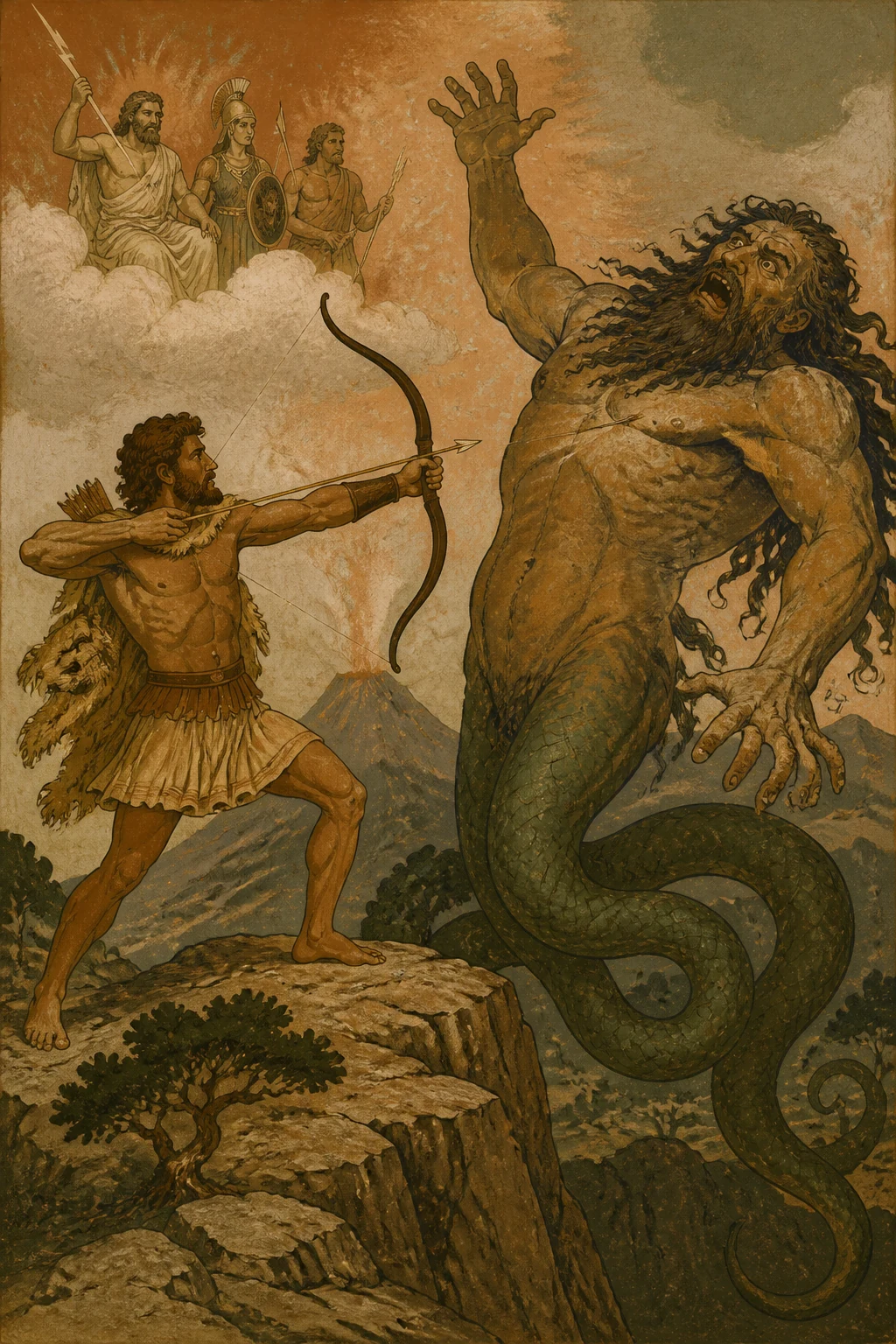
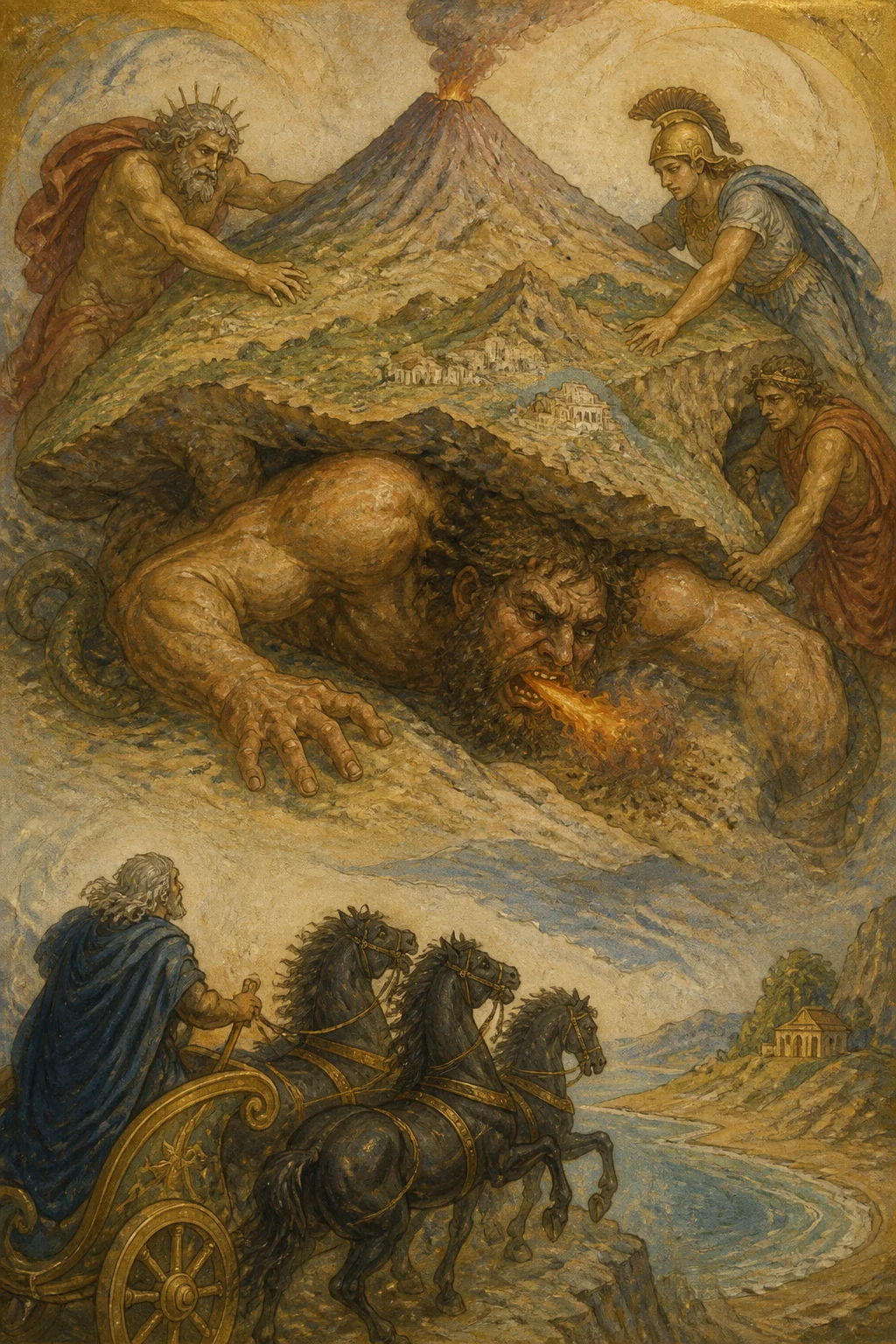
She must be my song. If only I could sing verses worthy of the goddess: surely the goddess is worthy of verse. The vast island of Trinacris lies heaped upon a giant’s limbs, and with its mighty mass weighs down Typhoeus, who dared to aspire to a throne in heaven. He strains, indeed, and often struggles to rise again, but his right hand lies beneath Ausonian Pelorus, his left beneath you, Pachynus; Lilybaeum pins his legs, and Etna weighs upon his head: beneath it, lying on his back, fierce Typhoeus spews sand and vomits flame from his mouth.
Often he struggles to thrust away the weight of earth and roll the towns and mighty mountains off his body. Then the earth trembles, and even the king of the silent dead is afraid that the ground may split and open in a yawning chasm, and daylight, streaming in, strike terror into the trembling shades. Fearing this disaster, the tyrant had left his dark abode and, borne in a chariot drawn by black horses, was cautiously circling the foundations of Sicily.
When he had explored enough to find that nowhere was unstable, and had laid his fears aside, Venus, seated on her mountain, saw him wandering there and, embracing her winged son, said, “My weapons, my hands, my power, my son, take up those shafts with which you conquer everyone, Cupid, and drive your swift arrows into the breast of the god to whom the last share of the threefold kingdom fell by lot.
You subdue the gods above and Jupiter himself; you conquer the powers of the sea, and him who rules those powers. Why is Tartarus left untouched? Why not extend your mother’s empire and your own? A third of the world is at stake. And yet in heaven—such is our patience now— we are scorned, and Love’s power dwindles with my own. Do you not see how Pallas and Diana, the huntress, have broken away from me? Ceres’ daughter too will remain a virgin, if we allow it: she cherishes the same hopes.
But you, for the sake of our shared dominion, if that means anything to you, unite the goddess with her uncle.” So Venus spoke. He opened his quiver and, at his mother’s bidding, chose from a thousand arrows one than which none was sharper, none surer, none more obedient to the bow; then, bracing his knee against the pliant horn, he bent it and struck Dis in the heart with the barbed shaft.
Izvirnik
Typhoeus and the Fear of Venus
Naslednje strani prikazujejo izvirno besedilo za primerjavo.
Source ID: ovid_metamorphoses_story_035 Citation: Ovid, Metamorphoses 5.332-5.384 Original language: Latin Source: PerseusDL canonical-latinLit Source URL: https://github.com/PerseusDL/canonical-latinLit/blob/master/data/phi0959/phi006/phi0959.phi006.perseus-lat2.xml Segmentation certainty: medium 332: Hactenus ad citharam vocalia moverat ora: 333: poscimur Aonides. Sed forsitan otia non sint, 334: nec nostris praebere vacet tibi cantibus aures.”
335: “Ne dubita, vestrumque mihi refer ordine carmen” 336: Pallas ait nemorisque levi consedit in umbra. 337: Musa refert: “Dedimus summam certaminis uni. 338: Surgit et inmissos hedera conlecta capillos 339: Calliope querulas praetemptat pollice chordas, 340: atque haec percussis subiungit carmina nervis: 341: “Prima Ceres unco glaebam dimovit aratro, 342: prima dedit fruges alimentaque mitia terris, 343: prima dedit leges: Cereris sunt omnia munus.
344: Illa canenda mihi est. Utinam modo dicere possem 345: carmina digna dea: certe dea carmine digna est. 346: Vasta giganteis ingesta est insula membris 347: Trinacris et magnis subiectum molibus urget 348: aetherias ausum sperare Typhoea sedes. 349: Nititur ille quidem pugnatque resurgere saepe, 350: dextra sed Ausonio manus est subiecta Peloro, 351: laeva, Pachyne, tibi, Lilybaeo crura premuntur, 352: degravat Aetna caput: sub qua resupinus harenas 353: eiectat flammamque ferox vomit ore Typhoeus.
354: Saepe remoliri luctatur pondera terrae 355: oppidaque et magnos devolvere corpore montes. 356: Inde tremit tellus, et rex pavet ipse silentum, 357: ne pateat latoque solum retegatur hiatu 358: inmissusque dies trepidantes terreat umbras. 359: Hanc metuens cladem tenebrosa sede tyrannus 360: exierat, curruque atrorum vectus equorum 361: ambibat Siculae cautus fundamina terrae.
362: Postquam exploratum satis est loca nulla labare, 363: depositoque metu, videt hunc Erycina vagantem 364: monte suo residens, natumque amplexa volucrem 365: “arma manusque meae, mea, nate, potentia”, dixit, 366: “illa, quibus superas omnes, cape tela, Cupido, 367: inque dei pectus celeres molire sagittas, 368: cui triplicis cessit fortuna novissima regni. 369: Tu superos ipsumque Iovem tu numina ponti 370: victa domas ipsumque, regit qui numina ponti.
371: Tartara quid cessant? cur non matrisque tuumque 372: imperium profers? agitur pars tertia mundi. 373: Et tamen in caelo, quae iam patientia nostra est, 374: spernimur, ac mecum vires minuuntur Amoris. 375: Pallada nonne vides iaculatricemque Dianam 376: abscessisse mihi? Cereris quoque filia virgo, 377: si patiemur, erit: nam spes adfectat easdem. 378: At tu, pro socio, siqua est ea gratia, regno 379: iunge deam patruo.” Dixit Venus. Ille pharetram 380: solvit et arbitrio matris de mille sagittis 381: unam seposuit, sed qua nec acutior ulla 382: nec minus incerta est nec quae magis audiat arcus,
383: oppositoque genu curvavit flexile cornum 384: inque cor hamata percussit harundine Ditem.
Nadaljuj z branjem