Prevod
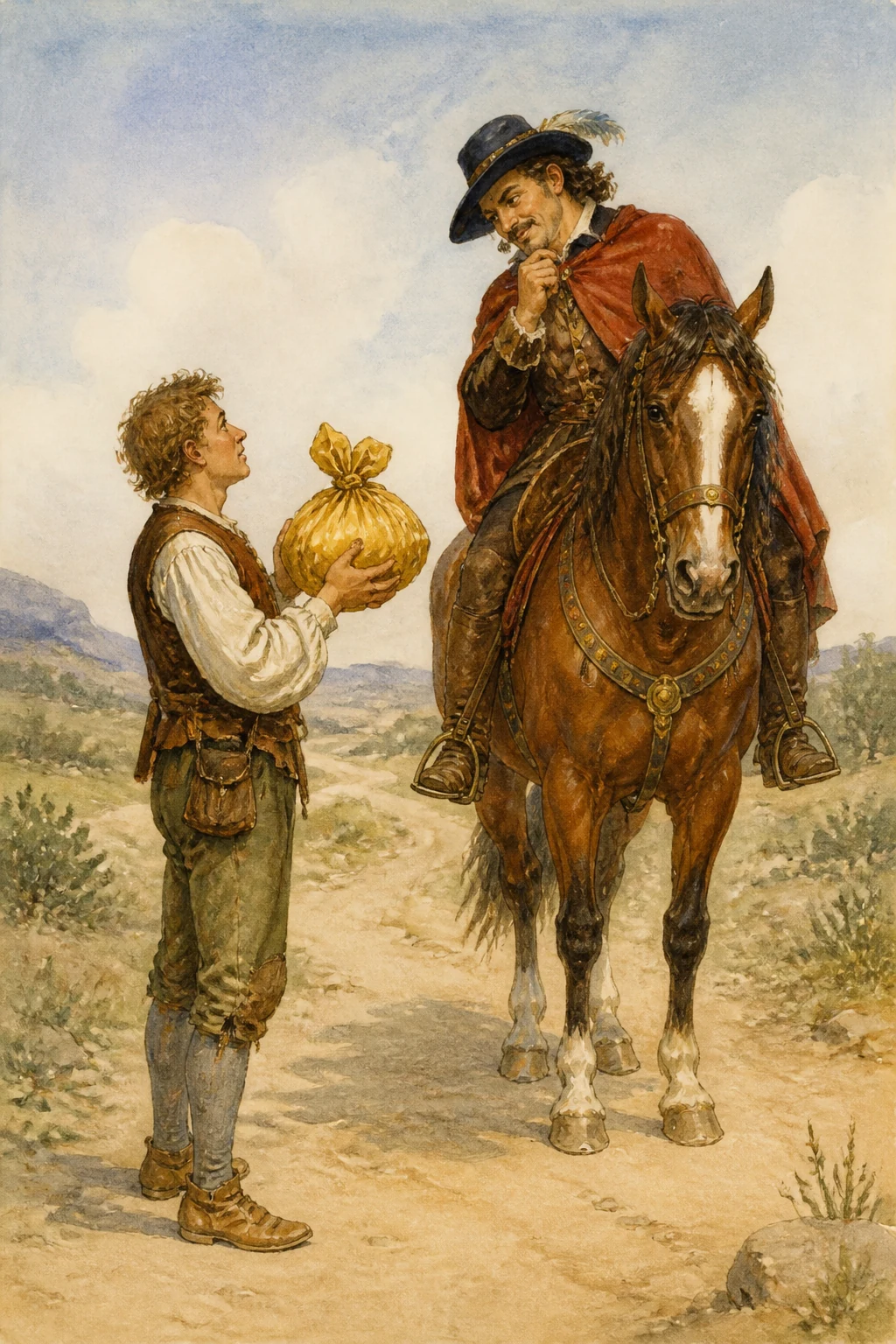
Hans had served his master for seven years when he said to him, “Master, my time is up, and now I should like to go home to my mother. Give me my wages.” His master answered, “You have served me faithfully and honestly, and your wages shall be worthy of your service,” and gave him a lump of gold as big as Hans’s head. Hans took a little cloth out of his pocket, wrapped the lump in it, hoisted it onto his shoulder, and set off for home. As he walked along, putting one foot in front of the other, he caught sight of a rider trotting merrily past on a lively horse. “Ah,” said Hans aloud, “what a fine thing riding is! You sit as though you were in a chair, never strike your foot against a stone, save your shoes, and get along without knowing how.” The rider, who had heard him, stopped and called out, “Well, Hans, why are you going on foot?” “I have little choice,” he answered. “I have this lump to carry home. It is gold, to be sure, but I cannot hold my head straight under it, and it weighs terribly on my shoulder.” “Do you know what?” said the rider. “Let us trade. I will give you my horse, and you give me your lump of gold.” “With all my heart,” said Hans, “but I warn you, you will have a heavy load to carry.” The rider dismounted, took the gold, and helped Hans onto the horse. Then he put the reins firmly into his hands and said, “If you want to go really fast, just click your tongue and call, ‘Hop, hop!’”
Hans was overjoyed to be sitting on the horse and riding along so free and easy. After a while it occurred to him that he ought to be going faster, and he began clicking his tongue and calling, “Hop, hop!” The horse broke into a brisk trot, and before Hans knew what had happened, he had been thrown off and was lying in a ditch that separated the fields from the road. The horse would have bolted, too, if a farmer coming along the road, driving a cow before him, had not stopped it. Hans gathered himself together and got back on his feet. But he was in a bad temper and said to the farmer, “Riding is a sorry business, especially when you come upon a nag like this, that jolts you about and throws you off so you might break your neck. Never again will I get on its back. Now, your cow is more to my liking. You can walk behind her at your leisure, and besides, you are sure of milk, butter, and cheese every day. What would I not give for a cow like that!” “Well,” said the farmer, “if it would please you so much, I am willing to trade you the cow for the horse.” Hans agreed with the greatest delight, and the farmer swung himself onto the horse and rode hastily away.
Hans drove his cow quietly before him, thinking over his lucky bargain. “As long as I have a piece of bread—and I am hardly likely to go without that—I can have butter and cheese with it whenever I please. If I am thirsty, I need only milk my cow and drink the milk. What more could my heart desire?” When he came to an inn, he stopped, and in his great delight ate up every scrap of food he had brought with him, both his dinner and his supper, and spent his last few hellers on half a glass of beer. Then he drove his cow onward, always toward his mother’s village. The nearer it drew to noon, the more oppressive the heat became, and Hans found himself on a heath that would take a good hour yet to cross. He grew so hot that his tongue stuck to the roof of his mouth with thirst. “There is a remedy for this,” thought Hans. “I shall milk my cow and refresh myself with the milk.” He tied her to a withered tree and, having no pail, put his leather cap beneath her. But try as he might, not a drop of milk appeared. And because he went about it so clumsily, the impatient animal at last gave him such a kick on the head with one of her hind feet that he tumbled to the ground and for a while could not tell where he was. Fortunately, a butcher happened to come along just then, with a young pig lying in a wheelbarrow. “What sort of mischief is this?” he cried, helping good Hans to his feet. Hans told him what had happened. The butcher handed him his flask and said, “Here, take a drink and recover yourself. That cow will never give you milk. She is an old beast, fit for nothing now but pulling a cart or being slaughtered.” “Dear, dear,” said Hans, smoothing down his hair. “Who would have thought it! Of course, it is a fine thing to have such a beast slaughtered at home. What a lot of meat there would be! But I do not much care for beef; it is not juicy enough for me. Now, if only I had a young pig like that! That is quite another taste, and then there are the sausages, too.” “Listen, Hans,” said the butcher. “To oblige you, I will make a trade and let you have the pig for the cow.” “God reward you for your kindness,” said Hans. He handed over the cow, had the little pig untied from the wheelbarrow, and took hold of the rope by which it was tethered.
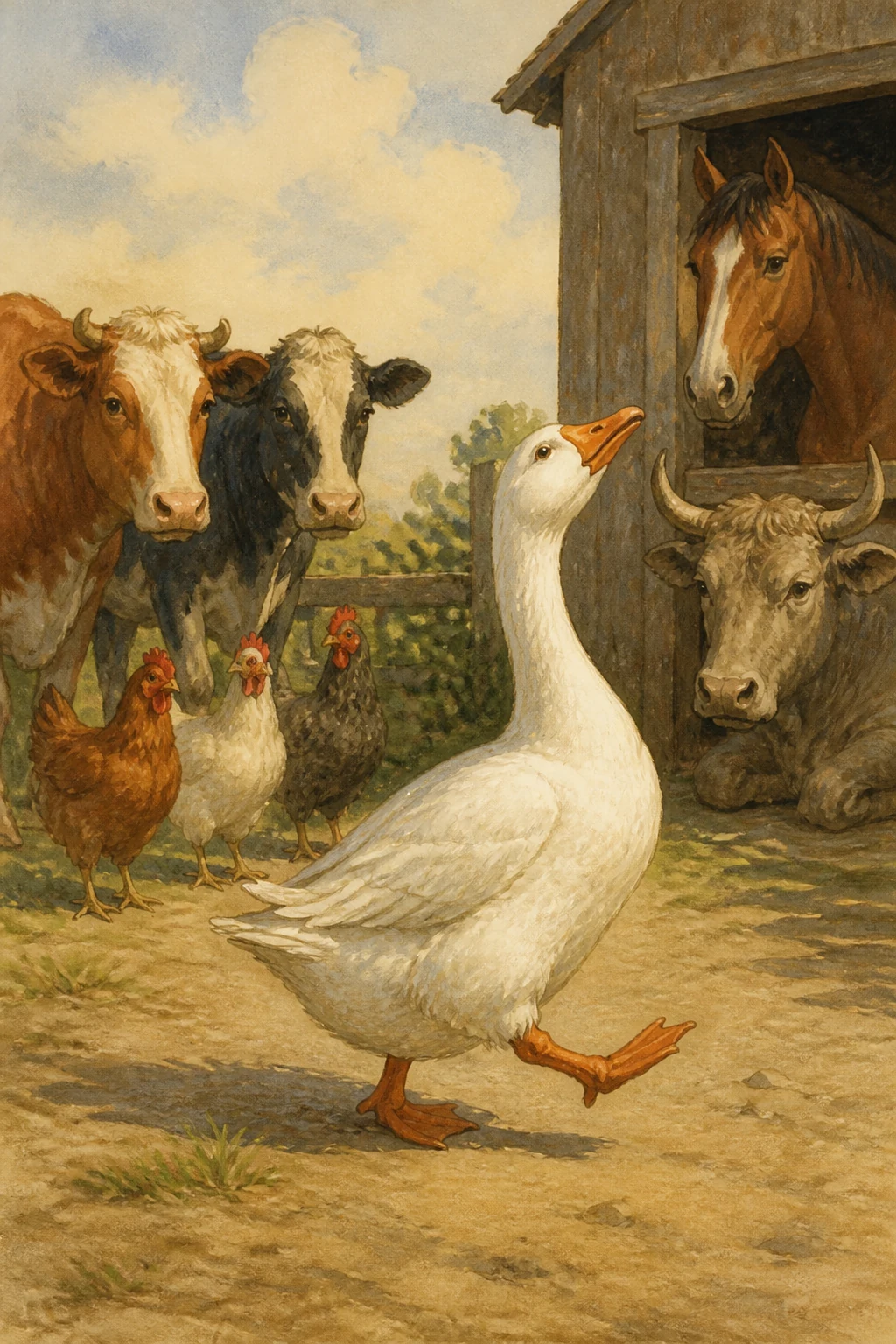
Hans went on his way, reflecting that everything was turning out just as he wished: whenever he met with a misfortune, it was set right again at once. Presently a young fellow joined him, carrying a fine white goose under his arm. They greeted one another, and Hans began to tell him of his good luck and how every trade he made had been to his advantage. The young fellow told him that he was taking the goose to a christening feast. “Just lift her,” he went on, taking her by the wings, “and feel how heavy she is. She has been fattened for eight whole weeks. Whoever bites into that roast will have to wipe the grease from both sides of his mouth.” “Yes,” said Hans, weighing her in one hand, “she is a good weight, but my pig is no runt either.” Meanwhile, the young fellow looked anxiously about him in every direction and shook his head. “Listen,” he said at last, “there may be something not quite right about that pig of yours. In the village I have just come through, one has been stolen from the headman’s sty. I fear, I fear you have it there on the end of your rope. They have sent people out to search, and it would be a bad business if they caught you with the pig. At the very least, you would be thrown into a dark dungeon.” Good Hans grew frightened. “Oh, dear God,” he said, “help me out of this trouble! You know your way about these parts better than I do. Take my pig and let me have your goose.” “I shall be running something of a risk,” answered the young fellow, “but I cannot let you come to grief on my account.” So he took the rope in his hand and quickly drove the pig away down a side road, while good Hans, relieved of his worries, went on toward home with the goose under his arm. “When I think it over properly,” he said to himself, “I have still come out the better for the trade. First there is the fine roast, then all the fat that will drip from it—that will give me goose fat to spread on my bread for three months—and finally the lovely white feathers. I shall have those stuffed into my pillow, and then I shall need no rocking to send me to sleep. How pleased my mother will be!”
When he had passed through the last village, he came upon a scissors-grinder standing beside his cart. His wheel whirred, and as he worked he sang, “I sharpen the scissors, my wheel spins round, and I turn my coat as the wind comes round.”
Hans stopped and watched him. At last he spoke. “You must be doing well, to be so merry at your grinding.” “Yes,” answered the grinder, “a good trade is a mine of gold. A proper grinder is a man who finds money in his pocket every time he puts his hand into it. But where did you buy that fine goose?” “I did not buy her. I traded my pig for her.” “And the pig?” “I got it for a cow.” “And the cow?” “I got her for a horse.” “And the horse?” “For that I gave a lump of gold as big as my head.” “And the gold?” “Why, that was my wages for seven years’ service.” “You have always known how to look after yourself,” said the grinder. “Now, if you can only get to the point where you hear money jingling in your pocket whenever you stand up, your fortune is made.” “How am I to do that?” asked Hans. “You must become a grinder like me. All you really need is a whetstone; the rest will come of itself. I have one here. It is a little damaged, to be sure, but I will ask nothing more for it than your goose. Will you take it?” “How can you even ask?” answered Hans. “Why, I shall be the happiest man on earth! If I find money whenever I put my hand into my pocket, what need have I to worry any longer?” He handed over the goose and took the whetstone. “Now,” said the grinder, picking up an ordinary heavy fieldstone that lay beside him, “here is another good stone into the bargain. It makes a fine surface to hammer on, and you can use it to beat your old nails straight. Take it, and look after it well.”
Hans shouldered the stone and went on with a joyful heart, his eyes shining with delight. “I must have been born with a lucky caul!” he cried. “Everything I wish for comes true, just as it does for a child born on Sunday.” But since he had been on his feet since daybreak, he was beginning to grow tired. Hunger troubled him too, for in his delight at getting the cow he had eaten all his provisions at once. At last he could scarcely drag himself along and had to stop every few moments, while the stones weighed on him most painfully. He could not help thinking how pleasant it would be if he did not have to carry them just now. Creeping along like a snail, he came to a well in the fields and meant to rest there and refresh himself with a cool drink. But so as not to damage the stones when he sat down, he carefully laid them beside him on the edge of the well. Then he sat down and was about to bend over to drink when, quite by accident, he gave them a little nudge, and both stones splashed into the water. When Hans had watched them sink into the depths, he sprang up for joy, then knelt down and thanked God with tears in his eyes for showing him this further kindness and freeing him so neatly, and without any cause for self-reproach, from the heavy stones, which were all that still stood in his way. “There is no one under the sun as happy as I am!” he cried. And with a light heart, free of every burden, he skipped away until he reached his mother’s home.