Prevod
Now I shall tell you a story about good fortune. We all know good fortune: some see it year in, year out, others only in certain years, on a single day; indeed, there are people who see it only once in their lives, but see it we all do.
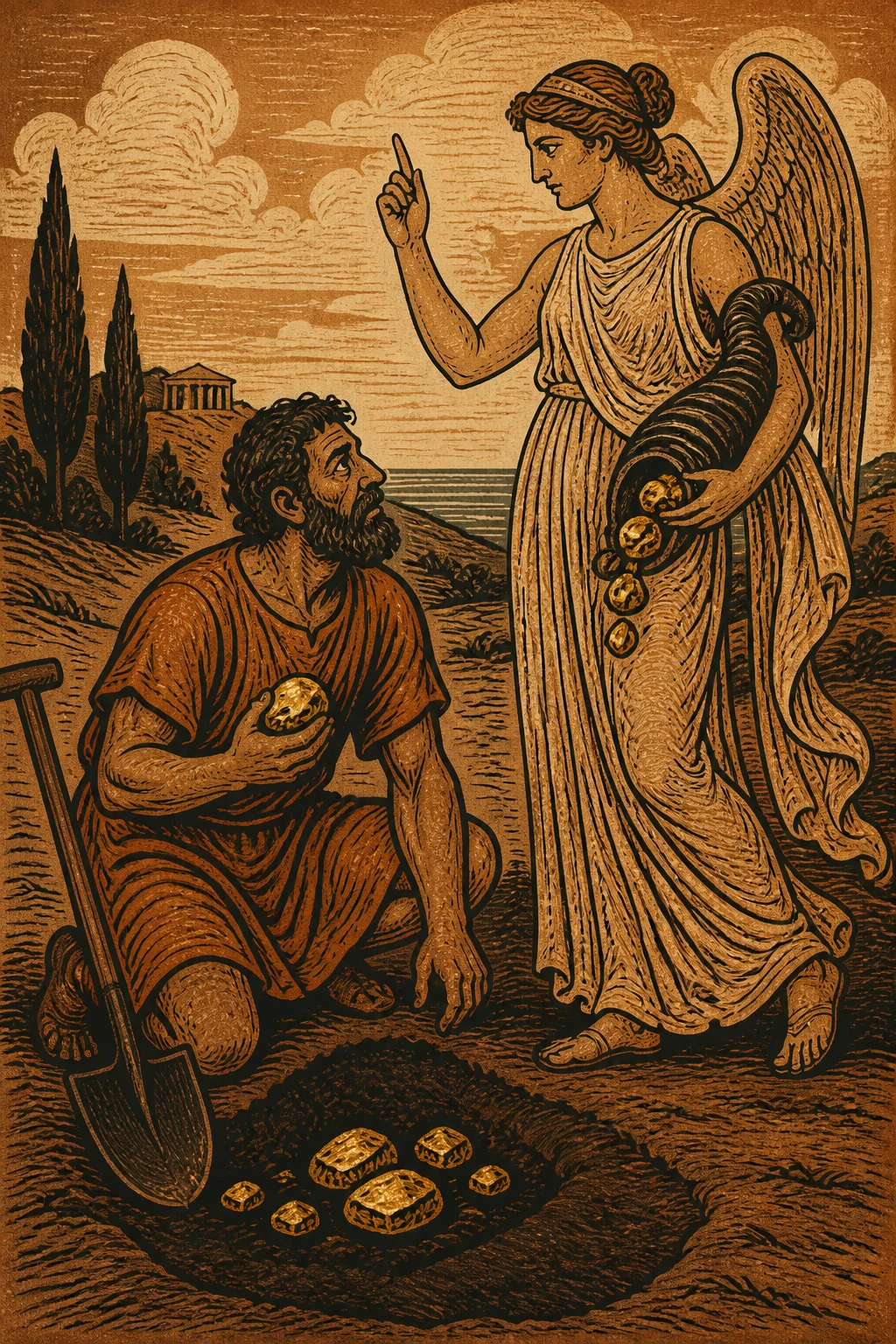
There is no need for me to tell you, for everyone knows, that our Lord brings the little child and lays it in a mother’s lap—it may be in a splendid castle or a prosperous home, but it may also be in an open field where the cold wind blows. Yet not everyone knows, though it is true all the same, that when our Lord brings the child, he also brings it a gift of good fortune. But this is not laid in plain sight beside it; it is placed somewhere in the world where one would least think of finding it, and yet it is always found—that is the happy thing. It may be hidden in an apple, as it was for a learned man named Newton: the apple fell, and he found his good fortune. If you do not know the story, ask someone who does to tell it to you; I have another story to tell, and it is a story about a pear.
There was a poor man who had been born in poverty, grown up in poverty, and married with nothing else to his name. His trade was woodturning, and he chiefly made umbrella handles and rings; but he could scarcely keep body and soul together.
“I shall never find good fortune!” he said. This is a story that really happened, and one could name the country and the place where the man lived, but that is neither here nor there.
The red, sour rowanberries grew in rich profusion around his house and garden. There was also a pear tree in the garden, but it did not bear a single pear, and yet his good fortune had been placed in that very tree, hidden in its invisible pears.
One night the wind blew with terrible force; the newspapers reported that the great stagecoach had been lifted off the road by the storm and tossed aside like a rag. Small wonder, then, that a large branch was broken off the pear tree.
The branch was brought into the workshop, and, for a joke, the man turned a large pear from it, then another large one, then a smaller one, and then some very tiny ones. The tree had to bear pears sometime, the man said, and he gave them to the children to play with.
Now, in a wet country, an umbrella is certainly one of life’s necessities. The whole household had only one to share; if the wind blew too hard, it turned inside out, and a couple of times it even broke, but the man soon put it to rights again. The most vexing thing, though, was that the button meant to hold it together when it was folded kept coming off, or the ring slipped around it would break.
One day the button came off; the man searched for it on the floor and picked up one of the very smallest wooden pears, one of those he had given the children to play with.
“The button is nowhere to be found!” said the man. “But this little thing will surely do just as well!” So he bored a hole through it, threaded a cord through the hole, and the little pear fitted snugly into the broken ring. It was certainly the best fastening the umbrella had ever had.
The following year, when the man was sending umbrella handles to the capital, where he supplied such things, he included a couple of the little turned wooden pears with half a ring around them, and asked that they be tried out. In this way they came to America. There it was soon noticed that the little pear held far better than any other button, and the merchant was now asked to see that all umbrellas sent after that should fasten with a little pear.
Well, now there was work to be done! Pears by the thousand! Wooden pears on every umbrella! The man had to set to work. He turned and turned. The whole pear tree was used up in little wooden pears! They brought in shillings, they brought in dollars!
“My good fortune was hidden in that pear tree!” said the man. He now had a large workshop with journeymen and apprentices. He was always in good spirits and would say, “Good fortune may lie in a stick!”
And so say I, who tell the story. There is an old saying: “Put a white stick in your mouth, and you will be invisible!” But it must be the right stick, the one our Lord gives us as our gift of good fortune. I was given mine, and, like the man, I too can gather ringing gold, shining gold, the very best kind: the gold that shines from children’s eyes and rings out from children’s lips, and from father’s and mother’s too. They read the stories, and I stand in the middle of their room, but invisible, for I have the white stick in my mouth; and when I sense that they are happy with what I tell them, why, then I too say: Good fortune may lie in a stick!