Prevod
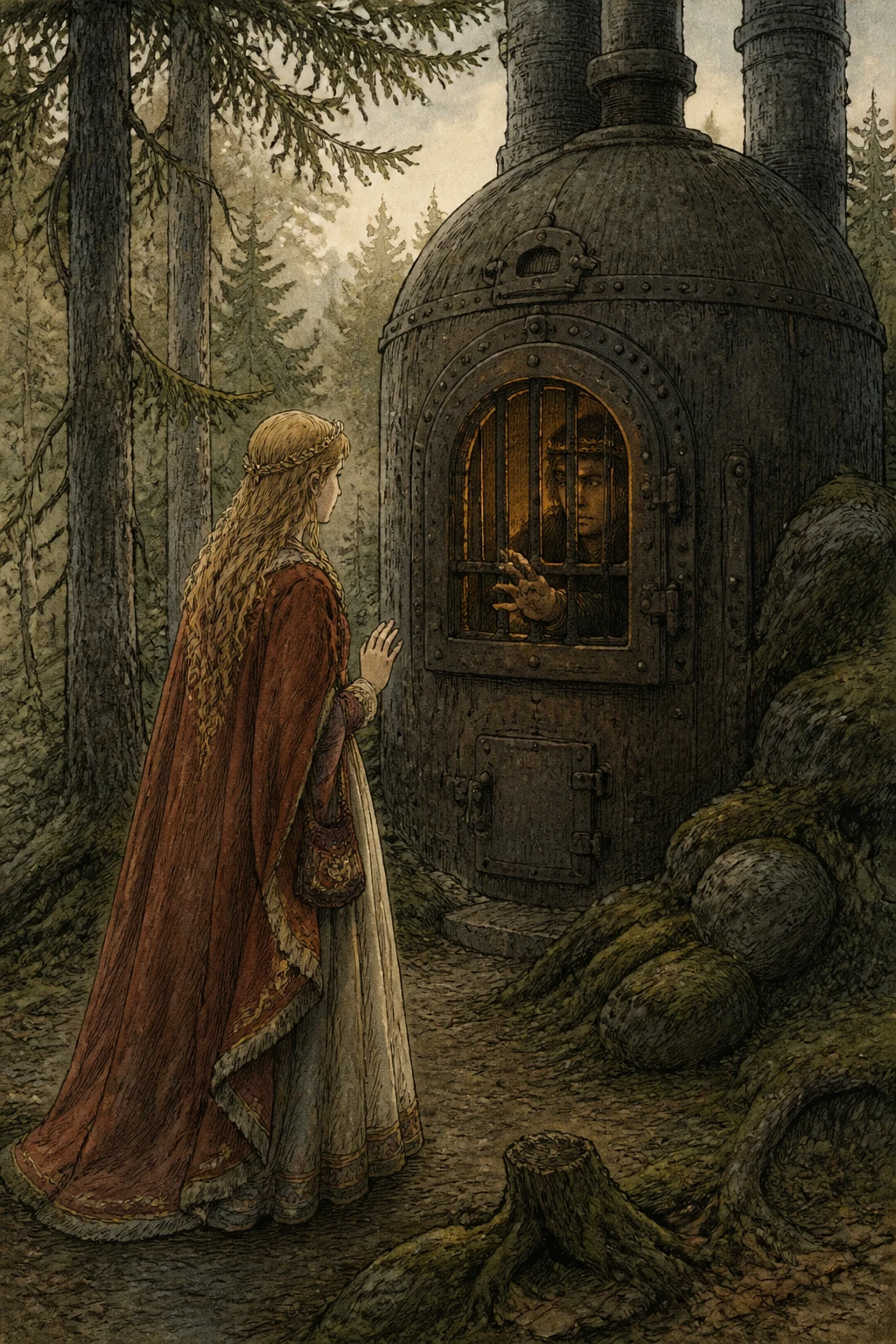
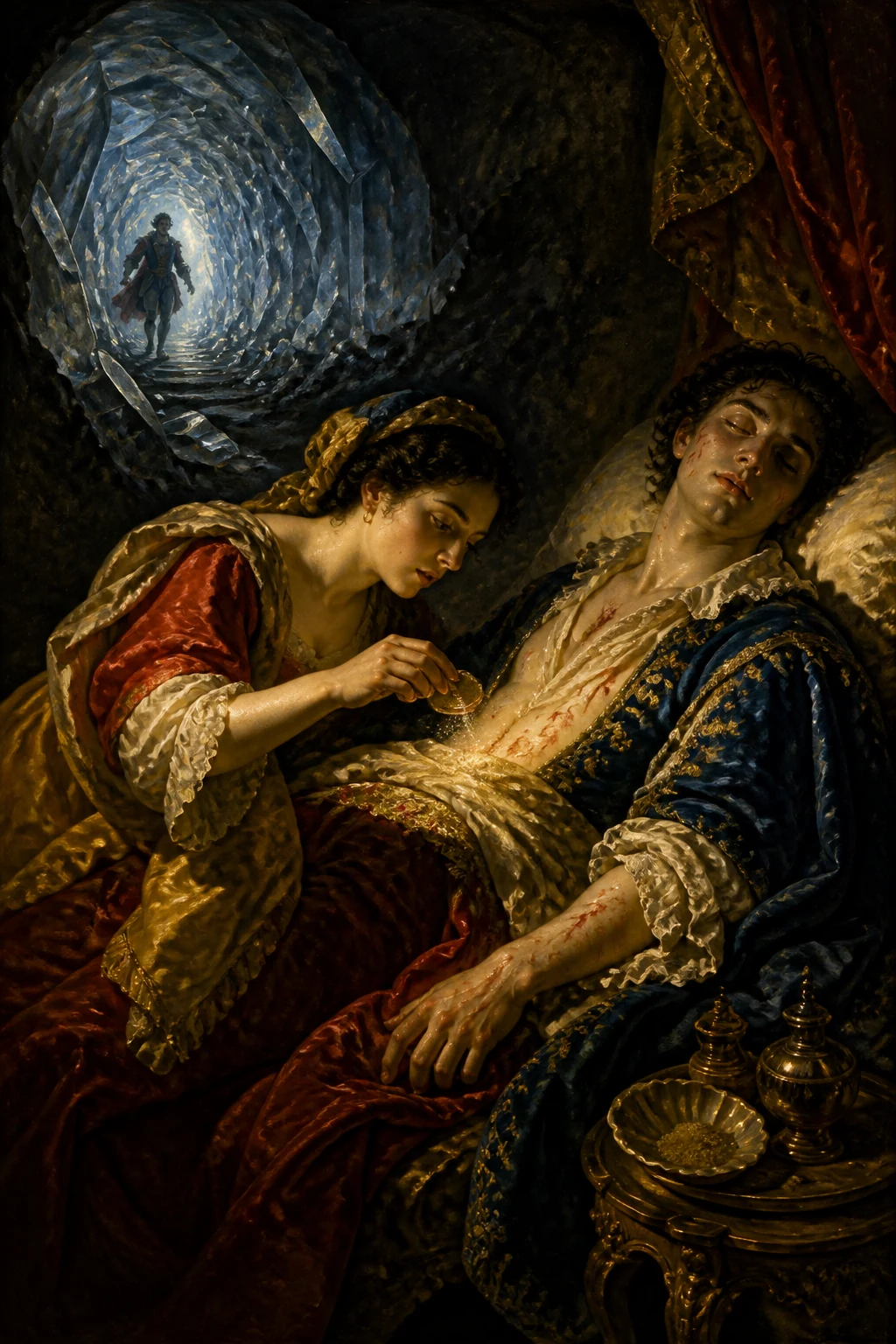
There was once an empress who had no child of her own, and she prayed continually to God to let her bear one. One evening, as she prayed, she sighed and said, “Only grant me a child of my own, O God, even if it should be a venomous snake!” Some time later she found herself with child, and when her time came, she gave birth to a snake. She began to tend it, feed it, and nurse it at her breast, as any mother would her child. For twenty-two years the snake made no sound at all, but when those twenty-two years were over, it spoke and said to its father and mother, “Now I want you to find me a wife.” They answered, “Who would give his daughter to a snake, and what maiden would marry one?” “Well,” the snake replied, “do not look among the daughters of emperors or noblemen, but for one who would be glad to come and live in a palace.” His father and mother then told him to choose for himself whichever girl he wished. So he found a poor girl and sent his father to ask for her hand. His father went and made the proposal, and the girl, living as she did in poverty, accepted gladly and joyfully. They gave her a betrothal ring, brought her to the palace, and married them. The snake began to live with his bride, and before long she was with child. Then her mother-in-law said to her, “For heaven’s sake, daughter, how did you come to be with child by a snake?” At first she would not tell her, but when her mother-in-law pressed her with the same question for several days, she at last said that he was no snake, but a young man whose equal in beauty could not be found in all the world. “By day,” she said, “he is a snake, but as soon as evening comes, he slips off his snakeskin and steps out a young man, the fairest in the world. If only he were by day what he is at night! But as soon as dawn begins to break, he slips back into his skin and becomes a snake again.” When her mother-in-law heard this, she was overjoyed and said, “Well, if that is so, we shall see to it that he remains as he is with you at night.” Then they agreed on what to do. That evening he took off his snakeskin, put it beneath his pillow as usual, and lay down to sleep. When he had fallen into his first deep sleep, his wife gently drew the skin from beneath his head and passed it through the window to his mother, who at once threw it into the fire. The moment the skin began to burn, he sprang from his sleep and cried, “What have you done? May God punish you! You see me now, but you shall not see me again until you have worn out iron opanci and worn down an iron staff in your search for me. Nor shall you be delivered of the child beneath your heart until I lay my arm across you.” With these words he vanished. She carried the child for three full years, until at last she could bear it no longer and resolved to seek her husband. So she had a pair of iron opanci and an iron staff made, and set out into the world. Wandering on and searching everywhere, she came to the Sun’s mother and found her heating an oven and raking out the fire with her bare hands. Seeing this, she quickly cut a piece from the hem of her dress and wrapped the woman’s hands in it. The Sun’s mother asked her, “What brings you here, dear earthly soul?” She answered, “Trouble drove me here, mother,” and told her all she had suffered, how her husband had cursed her, and how she was wandering through the world in search of him. “So I have come,” she said, “to ask your son whether he can tell me anything of him, whether he has seen him anywhere, for he passes over the whole world.” The Sun’s mother felt great pity for her and told her to hide behind the door for a while. “The Sun will soon be home, weary from his journey, and perhaps the clouds have angered him as well. In his anger he might do you harm, so keep out of sight until he has rested.” She hid behind the door, and just then the Sun came home. He wished his mother a good evening and said, “Mother, I smell an earthly soul here.” His mother answered, “There is no one here, my son. Why, not even a bird can fly this far, so how could an earthly soul come here?” The Sun replied, “There is someone here, Mother, there is. Let her come out without fear. I shall do her no harm.” Then she came out and told him all her troubles, saying at last, “O radiant Sun! You shine over the whole world. Have you seen anywhere a man such as this?” And she described her husband to him. The Sun answered that he had seen no such man anywhere by day, and sent her to the Moon to ask whether he had seen him somewhere by night. As she was leaving, the Sun’s mother gave her a golden distaff with golden flax and a golden spindle. When she came to the Moon’s house, she found his mother at home, kissed her hand, and greeted her. “God be with you, mother of the Moon!” “And may God be with you, dear earthly soul,” she replied. “What brings you here?” Then the woman told her all her troubles, and how she had been to the Sun. She showed her the gifts his mother had given her, and said that the Sun had sent her to ask the Moon whether he had seen her husband anywhere. The Moon’s mother told her to hide behind the door for a little while, for the Moon would soon be home, weary and cross. She hid, and just then the Moon arrived. He wished his mother a good morning and said, “I smell an earthly soul here.” His mother answered, “There is no one here, my son. Why, not even a bird can fly this far, so how could an earthly soul come here?” But the Moon said again, “There is someone here, Mother, there is. Let her come out without fear. I shall do her no harm.” Then she came out and told him everything that had happened, and at last she said, “O shining Moon! You shine all night over the whole world. Have you seen anywhere a man such as this?” And she described her husband. The Moon answered, “Dear earthly soul, I have seen no such man anywhere on earth at night. But go to the Wind and ask whether he has seen him. He turns over trees and stones and makes his way into every nook and cranny.” As she was leaving, the Moon’s mother gave her a golden hen with golden chicks. After that she came to the Wind’s mother and told her all she had suffered, and how she had come to ask her son, the Wind, whether he had seen a man such as the one she described. The Wind’s mother said, “Hide behind the door for a little while, dear earthly soul, for my son will soon come home in a rage, and he might tear you to pieces.” She hid behind the door, and just then the Wind came rushing in, blowing, toppling, breaking, and overturning whatever lay in his path, all scratched and tattered himself. As he came in, he greeted his mother with “God be with you!” and said, “Mother, I smell an earthly soul here.” She answered, “God be with you, my son! Not even a bird can fly this far, so how could an earthly soul come here?” The Wind replied, “There is someone here, Mother, there is. Let her come out without fear. I shall do her no harm.” So she came out before the Wind and told him her troubles. The Wind answered, “I have seen him. He is far away in another empire, where he has married and now rules as emperor. My mother will give you a golden loom with golden yarn and a spinning wheel. When you reach that city, set up the loom opposite the emperor’s palace and begin to weave. Let the hen and chicks loose and feed them, and bring out the distaff as well.” She did just as he said. When she reached the city, her iron opanci wore through and her staff broke. She set up the loom opposite the emperor’s palace, let the hen and chicks loose, brought out the distaff, and began to weave. The empress caught sight of her from the palace and said to herself, “Oh, my God! I am an empress, yet I have neither a golden loom nor a golden distaff, nor a golden hen and chicks.” She sent her servant to ask the woman whether she would sell these things. The woman answered, “I will not sell them. But if the empress will let me spend one night with her emperor, I will give her the distaff.” The empress drugged the emperor and allowed the woman to spend the night with him. As soon as the emperor lay down in bed, he sank into a stupor and lay as still as the dead. When she was alone with him, the woman began to say, “Illustrious emperor, may the sun shine upon you! Lay your right arm across me, that I may be delivered of your child.” But the emperor neither saw nor heard anything. The next day she gave the empress the golden distaff with its golden flax and golden spindle. Then the empress asked for the hen and chicks as well, and the woman said she would give them to her if she would let her spend another night with her emperor. The empress agreed to this too, and drugged the emperor once more. Again he sank into a stupor and did not hear the woman crying, “Illustrious emperor, may the sun shine upon you! Lay your right arm across me, that I may be delivered of your child.” In the morning, the guards told the emperor that this woman had spent two nights with him, crying all the while for him to lay his right arm across her so that she might be delivered of his child. When the empress received the hen and chicks, she asked for the loom with its golden yarn and spinning wheel as well. The woman promised to give them to her if she would allow her to spend one more night with her husband. The empress agreed, intending to drug her husband again. But he, having learned from the servants what was happening, placed a sponge beneath his chin that evening and poured into it the drink the empress brought him, so that he remained in his senses. When they lay down in bed, he pretended to be asleep, and the woman cried, “Illustrious emperor, may the sun shine upon you! Lay your arm across me, that I may be delivered of your child.” As soon as the emperor heard this, he laid his arm across her, and that very moment her labour began. She bore him a son with golden hands and golden hair. Then he left that land and its empress, and returned with his first wife and their child to his former empire.