Prevod
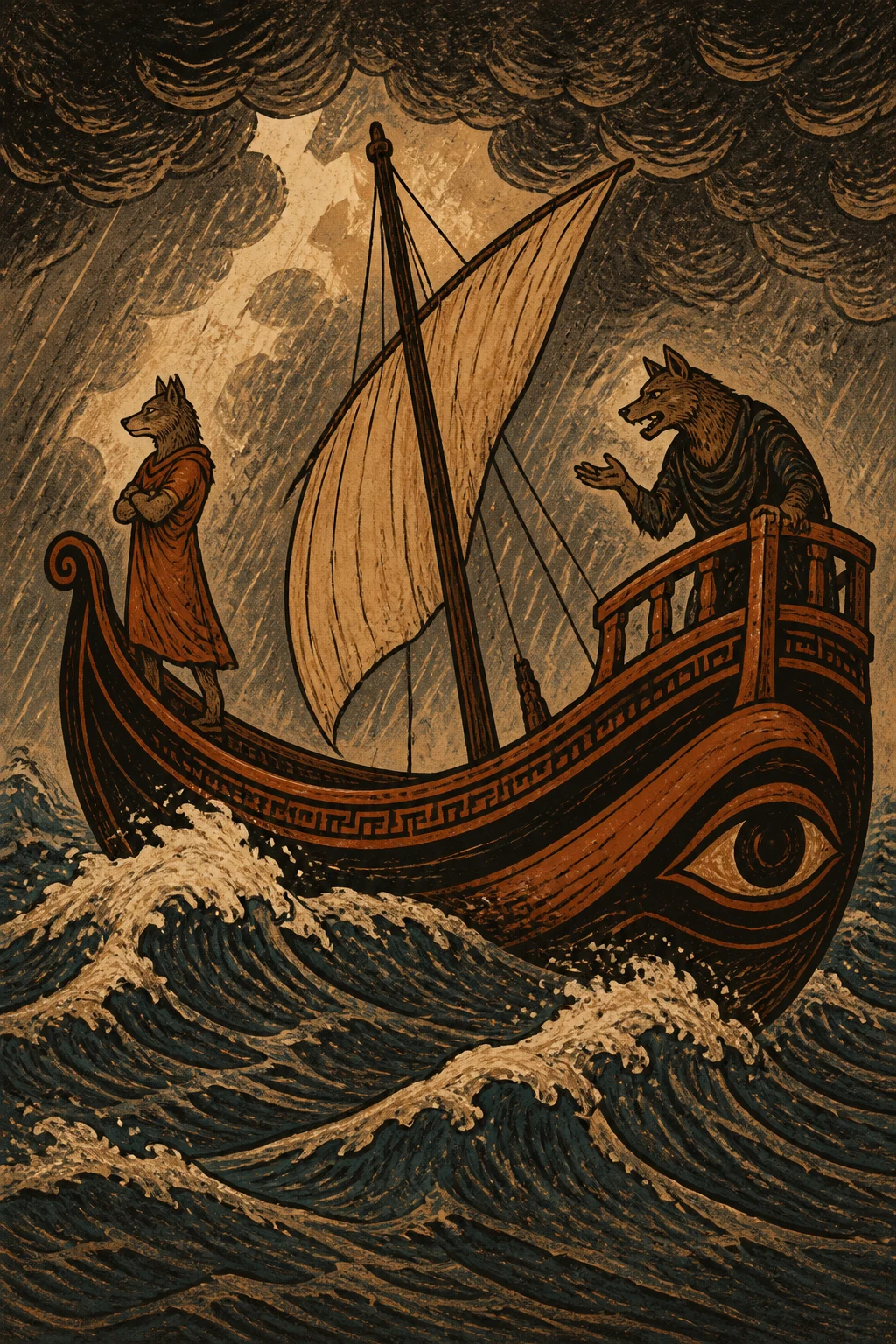
Two men who were enemies were sailing on the same ship, one seated at the stern, the other at the bow. When a storm arose and the ship was about to sink, the man at the stern asked the helmsman which end of the ship would go under first. “The bow,” he replied. “Then death holds no sorrow for me,” said the man, “if I am to see my enemy die before me.” The fable shows that many people care nothing for their own misfortune, so long as they see their enemies suffer first.
Izvirnik
Δύο τινὲς, ἀλλήλοις ἐχθραίνοντες, ἐπὶ τῆς αὐτῆς νεὼς ἔπλεον, ὧν ἅτερος μὲν ἐπὶ τῆς πρύμνης, ἅτερος δὲ ἐπὶ τῆς πρώρας ἐκάθητο. λειμῶνος δὲ ἐπιγενομένου, καὶ τῆς νεὼς μελλούσης ἤδη καταποντίζεσθαι, ὁ ἐπὶ τῆς πρύμνης τὸν κυβερνήτην ἢρετο, πότερον τῶν μερῶν τοῦ πλοίου πρότερον μέλλει καταβαπτίζεσθαι. Τοῦ δὲ ,,τὴν πρῴραν“ εἰπόντος, ,,ἀλλ’ ἔμοιγε οὐκ ἔστι λυπηρὸν“ εἶπεν ,,ὁ θάνατος, εἴγε ὁρᾶν μέλλω πρὸ ἐμοῦ τὸν ἐχθρὸν ἀποθνήσκοντα.“
Ὁ μῦθος δηλοῖ, ὅτι πολλοὶ τῶν ἀνθρώπων οὐδὲν τῆς ἑαυτῶν βλάβης φροντίζουσιν, ἐὰν τοὺς ἐχθροὺς μόνον ἴδωσι πρὸ αὐτῶν κακουμένους.