Prevod
Once upon a time there were two poor folk who lived in a wretched little hut far away in the forest. They lived from hand to mouth, and barely managed even that; but they had three sons, and the youngest was Askeladden, for he did nothing but lie about grubbing in the ashes.
One day the eldest lad said he wanted to go out and find work. His parents readily gave him leave, and off he went into the world. He walked and walked all day, and towards evening he came to a royal palace. The King was standing outside on the steps and asked where he was bound. “Oh, I’m looking for work, sir,” said the lad. “Will you take service with me and tend my seven colts?” asked the King. “If you can tend them for a whole day and tell me in the evening what they eat and drink, you shall have the Princess and half the kingdom; but if you cannot, I shall have three red strips cut from your back.” The lad thought that sounded easy enough; he was sure he could do it.
In the morning, at the first light of dawn, the stablemaster let out the seven colts. Away they dashed, with the lad behind them, and you may be sure they went over hill and dale, through bushes and thickets. When the lad had run like this for a good while, he began to tire, and after keeping it up a little longer he had quite enough of tending colts. Just then he came to a cleft in the hillside, where an old woman sat spinning with a spindle. When she saw the lad running after the colts, with sweat pouring off him, she called out, “Come here, come here, my handsome boy, and let me pick the lice from your hair!” The lad was glad to do so. He sat down beside the old woman in the cleft and laid his head in her lap, and she picked through his hair all day while he lay there idling. Towards evening the lad wanted to leave. “I might as well wander straight home again,” he said, “for there’s no use my going back to the palace.” “Wait a little, till dusk,” said the old woman, “and the King’s colts will come past here again. Then you can run home with them;
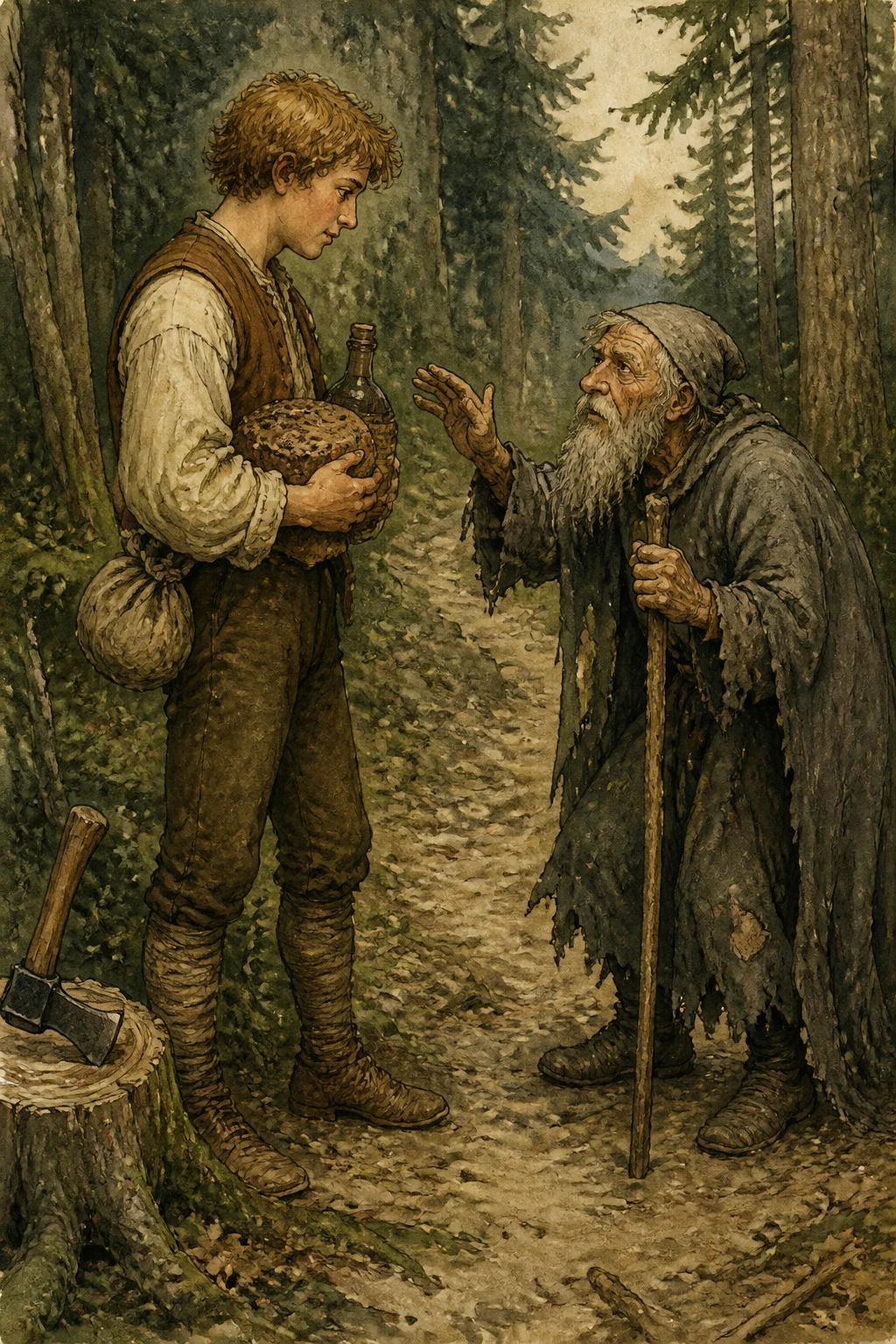
no one will know you’ve been lying here all day instead of tending the colts.” When they came, she gave the lad a flask of water and a tuft of moss, which he was to show the King and say were what the seven colts ate and drank. “Well, have you tended them faithfully all day?” asked the King when the lad came before him that evening. “Yes, indeed I have,” said the lad. “Then I suppose you can tell me what my seven colts eat and drink?” asked the King. The lad held out the water jug and the tuft of moss the old woman had given him.
“There you see their food, and there you see their drink,” he said. But the King knew well enough then how he had tended them, and grew so angry that he ordered the lad to be driven home that very instant—but first they were to cut three red strips from his back and rub salt into the wounds. You can imagine how the lad felt when he came home again. Once he had gone out to find work, he said, but he would never do so again.
The next day the second son said he wanted to go out into the world and try his luck. His parents said no, and told him to look at his brother’s back; but the lad would not give in. He stuck to his purpose, and at long last they gave him leave, and he set off. After walking all day, he too came to the royal palace. There stood the King on the steps, asking where he was bound, and when the lad answered that he was looking for work, the King said he could take service with him and tend his seven colts. Then the King set him the same punishment and the same reward as he had his brother. The lad agreed at once and entered the King’s service, for he was sure he could look after the colts and tell the King what they ate and drank.
At daybreak the stablemaster let out the seven colts, and away they went again over hill and dale, with the lad behind them. But he fared just like his brother. When he had run after the colts for a long, long time and was hot and tired, he passed a cleft in the hillside where an old woman sat spinning with a spindle. She called out to him, “Come here, come here, my handsome boy, and let me pick the lice from your hair.” That suited the lad very well. He let the colts go their own way and sat down beside the old woman in the cleft. There he sat, and there he lay, idling the whole day long.
When the colts came back towards evening, he too was given a tuft of moss and a flask of water by the old woman, to show the King. But when the King asked him, “Can you tell me now what my seven colts eat and drink?” and the lad held out the tuft of moss and the water jug, saying, “Yes, there you see their food, and there you see their drink,” the King grew angry again. He ordered them to cut three red strips from the lad’s back, rub salt into the wounds, and drive him home that very instant.
When the lad came home again, he too told them how he had fared, and said that once he had gone out to find work, but he would certainly never do so again.
On the third day Askeladden wanted to set off. He would like to try tending the seven colts too, he said. The others laughed and made fun of him. “After what happened to us, you’re surely the one to manage it! You look just the fellow—you who have never done anything but lie grubbing in the ashes,” they said. “Well, I mean to go all the same,” said Askeladden, “for I’ve set my heart on it.” And though the others laughed and his parents pleaded, it was no use; Askeladden set off. When he had walked all day, he too came to the royal palace at dusk. There stood the King on the steps, and he asked where he was bound. “I’m looking for work,” said Askepot. “Where do you come from, then?” asked the King, for this time he wanted to know a little more before taking anyone into service. Askeladden told him where he came from and said he was the brother of the two who had tended the King’s seven colts. Then he asked whether he might try tending them the next day. “Oh, plague take you!” said the King—he grew quite angry at the very thought of the others. “If you’re their brother, you’re likely no better yourself;
I’ve had enough of your sort!” “Yes, but now that I’ve come all this way, surely I might be allowed to try as well,” said Askeladden. “Oh, very well! If you’re so set on having your back flayed, you’re welcome to it as far as I’m concerned,” said the King. “I’d sooner have the Princess,” said Askeladden. At daybreak the next morning the stablemaster let out the seven colts again, and away they went over hill and dale, through bushes and thickets, with Askeladden behind them. After he had run like this for a good while, he too came to the cleft in the hillside;
there sat the old woman again, spinning with her spindle, and she called out to Askepot, “Come here, come here, my handsome boy, and let me pick the lice from your hair!” “Kiss my backside, kiss my backside!” said Askepot, skipping and leaping along, holding fast to a colt’s tail. When he was well past the cleft, the youngest colt said, “Climb onto my back, for we still have a long way to go.” And so he did.
Then they travelled a long, long way farther. “Do you see anything now?” asked the colt. “No,” said Askeladden. They went on another good stretch. “Do you see anything now?” asked the colt. “Oh, no,” said the lad. When they had travelled a long, long way, the colt asked again, “Do you see anything now?” “Yes, I think I can see something white,” said Askepot. “It looks like a great, thick birch stump.” “Yes, that’s where we must go in,” said the colt.
When they reached the stump, the eldest colt wrenched it aside, and there was a door where the stump had stood. Inside was a little room, with scarcely anything in it but a small fireplace and a couple of stools; but behind the door hung a great rusty sword and a little jug. “Can you wield the sword?” asked the colt. Askeladden tried, but he could not. So he had to take a drink from the flask, first once, then again, and then once more, and after that he could wield it as though it weighed nothing. “Now you must take the sword with you,” said the colt. “On your wedding day you must use it to cut off the heads of all seven of us, and then we shall become princes again, as we were before. For we are the brothers of the Princess you are to marry when you can tell the King what we eat and drink; but a wicked troll has enchanted us into these shapes. When you have cut off our heads, you must take great care to lay each head by the tail of the body it belonged to. Then the spell will have no more power over us.” Askeladden promised to do this, and they travelled on.
When they had gone a long, long way, the colt asked, “Do you see anything?” “No,” said Askeladden. So they travelled on for another good while. “What about now?” asked the colt. “Do you see anything now?” “Oh, no,” said Askeladden. Then they went many, many miles farther, over hill and dale. “And now?” said the colt. “Do you still see nothing?” “Yes,” said Askeladden, “now I can see something like a blue streak far, far away.” “Yes, that’s a river,” said the colt. “We must cross it.” A fine, long bridge spanned the river, and when they had reached the other side they travelled a long, long way again. Then the colt asked once more whether Askeladden could see anything. Yes, this time he could see something dark far away, rather like a church tower. “Yes, that’s where we must go in,” said the colt.
When the colts entered the churchyard, they became human again and looked like princes, in clothes so splendid that they shone. Then they went into the church and received bread and wine from the priest, who stood before the altar.
Askeladden went in too; but when the priest had laid his hands upon the princes and pronounced the blessing, they went out of the church again, and so did Askeladden, taking a flask of wine and a communion wafer with him. The moment the seven princes stepped into the churchyard, they became colts again. Askeladden climbed onto the youngest one’s back, and off they went by the same road they had come, but much, much faster than before. First they crossed the bridge, then passed the stump, and then the old woman sitting in the cleft, spinning. They went so fast that Askeladden could not make out what she shrieked after him, but he heard enough to know she was terribly angry.
It was almost dark when they returned to the palace that evening, and the King himself stood in the courtyard waiting for them. “Well, have you tended them faithfully all day?” he asked Askeladden. “I’ve done my best,” Askeladden answered. “Then I suppose you can tell me what my seven colts eat and drink?” asked the King. Askeladden took out the communion wafer and the flask of wine and showed them to the King. “There you see their food, and there you see their drink,” he said. “Yes, you have tended them faithfully,” said the King, “and you shall have the Princess and half the kingdom.” So preparations were made for the wedding, and the King declared that it should be so splendid and grand that people everywhere would hear of it and talk about it. But when they were seated at the wedding feast, the bridegroom rose and went down to the stable, saying he had forgotten something there and must go and fetch it. When he got there, he did as the colts had told him and cut off the heads of all seven, beginning with the eldest and taking the others in order of age. He was very careful to lay each head by the tail of the colt it belonged to, and as he did so, they became princes again. When he returned to the wedding feast with the seven princes, the King was so happy that he kissed and embraced Askeladden, and his bride loved him even more than she had before. “You have already been given half the kingdom,” said the King, “and you shall have the other half when I die; for now that my sons are princes again, they can win lands and kingdoms for themselves.” You may be sure there was joy and merriment at that wedding;
I was there too, but no one had time to spare a thought for me. All I got was a slice of bread and butter. I put it on the stove, and the bread burned away, and the butter ran astray, and never a crumb came back my way.