O besedilu
Rdeča kapica
- Vir
- Perraultove pravljice
- Avtor
- Charles Perrault
- Jezik branja
- English
- Jezik izvirnika
- Français
- Čas branja
- 4 min branja
- Obseg
- 3 strani
- Naslov izvirnika
- Le petit chaperon rouge
O izvirniku
Perraultove pravljice
Francoske dvorne pravljice, kjer eleganca pogosto skrije ostro svarilo. Bralni jezik je English, izvirnik pa prihaja iz vira Perraultove pravljice v jeziku Français.
Besedilo
Rdeča kapica
Once upon a time there was a little village girl, the prettiest anyone had ever seen. Her mother doted on her, and her grandmother doted on her even more. The good woman had a little red hood made for her, which suited her so well that everyone called her Little Red Riding Hood.
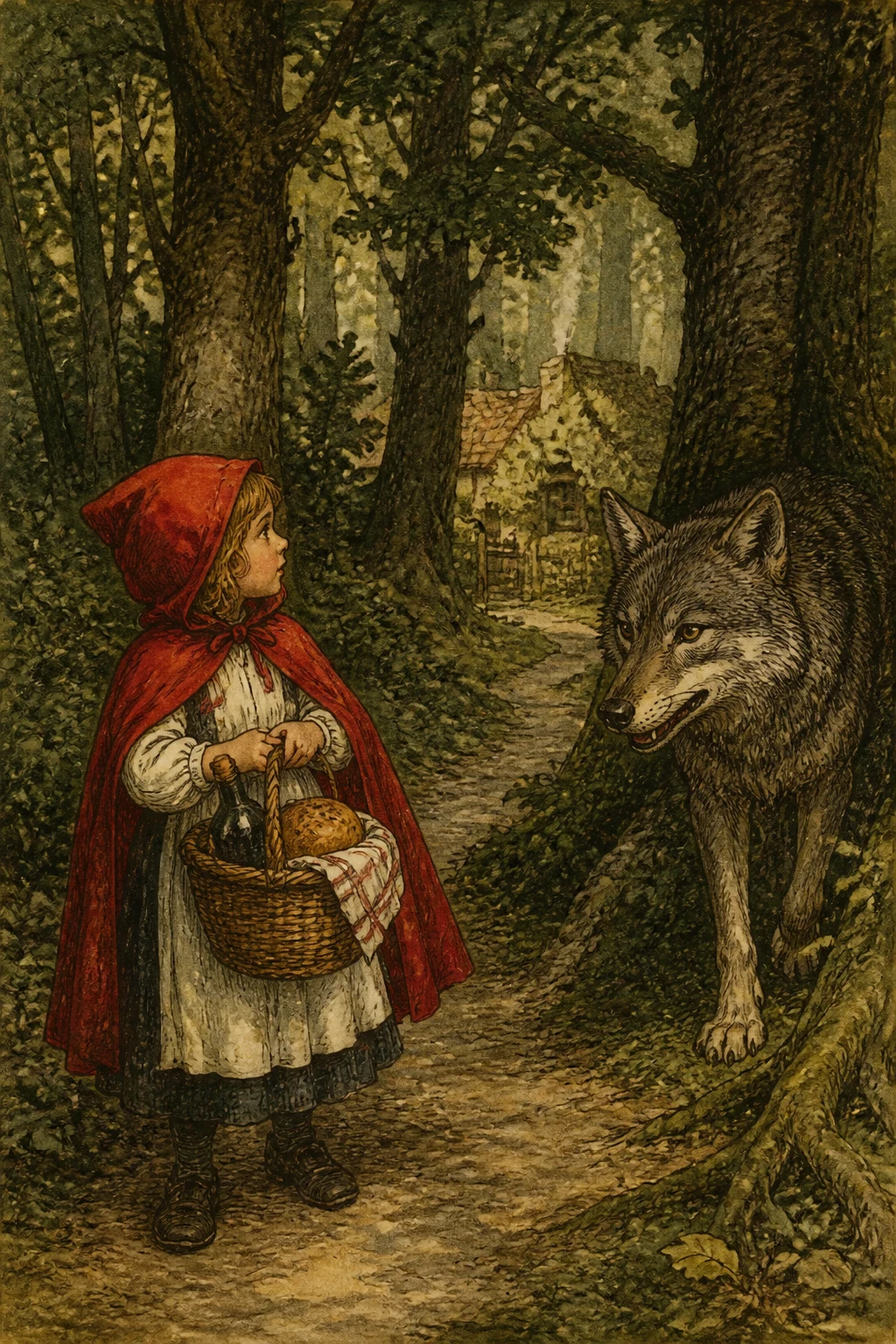
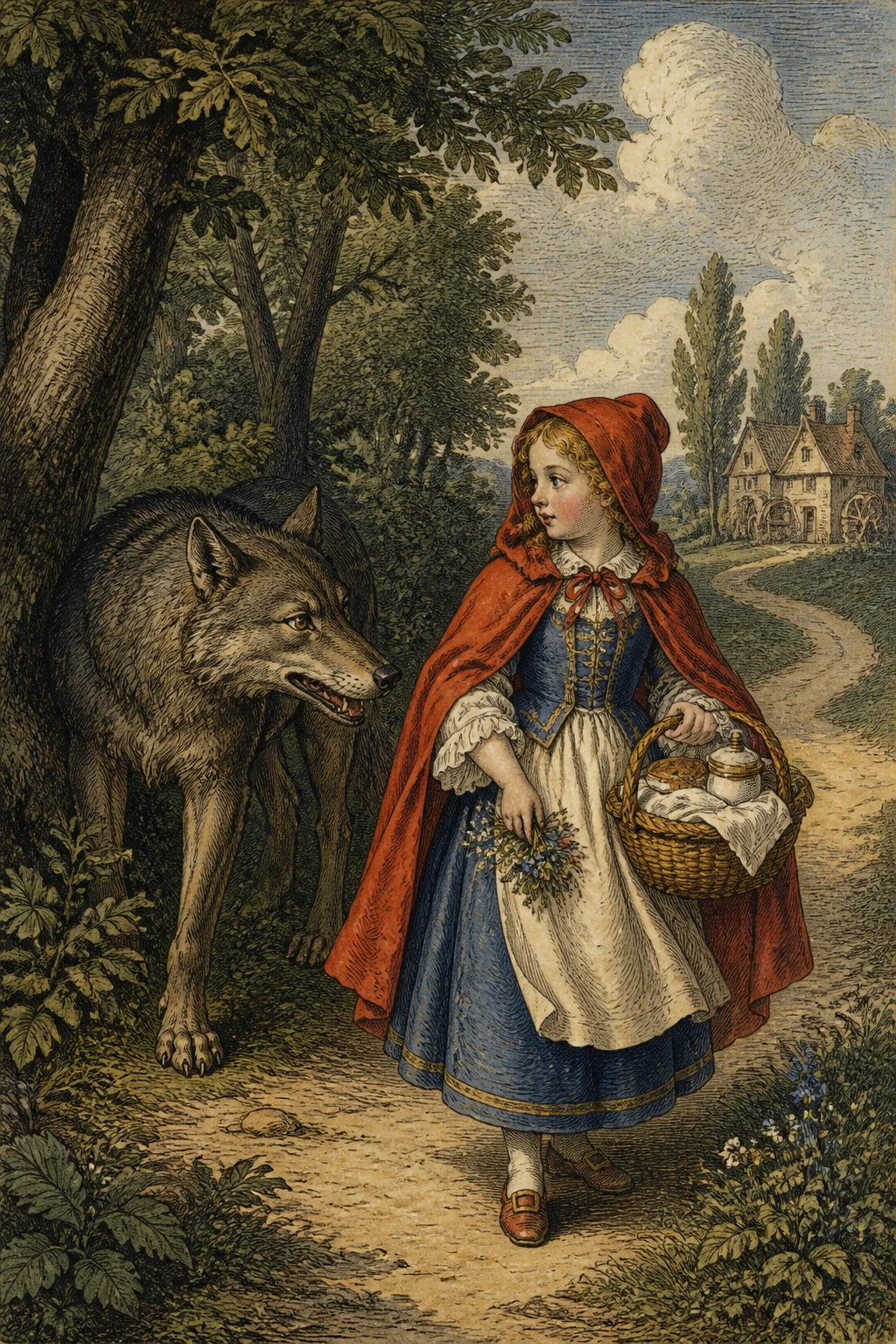
One day, after baking some cakes, her mother said to her, “Go and see how your grandmother is, for I hear she is ill. Take her a cake and this little pot of butter.” Little Red Riding Hood set off at once for her grandmother’s house, which was in another village. As she was passing through a wood, she met Master Wolf, who very much wanted to eat her, but dared not because there were some woodcutters in the forest. He asked her where she was going. The poor child, who did not know how dangerous it is to stop and listen to a wolf, said, “I am going to see my grandmother and take her a cake and a little pot of butter that my mother is sending her.” “Does she live very far away?” asked the Wolf. “Oh yes,” said Little Red Riding Hood. “Beyond the mill you can see far, far over there, in the first house in the village.” “Well,” said the Wolf, “I should like to visit her too. I shall take this path, and you take that one, and we shall see who gets there first.”
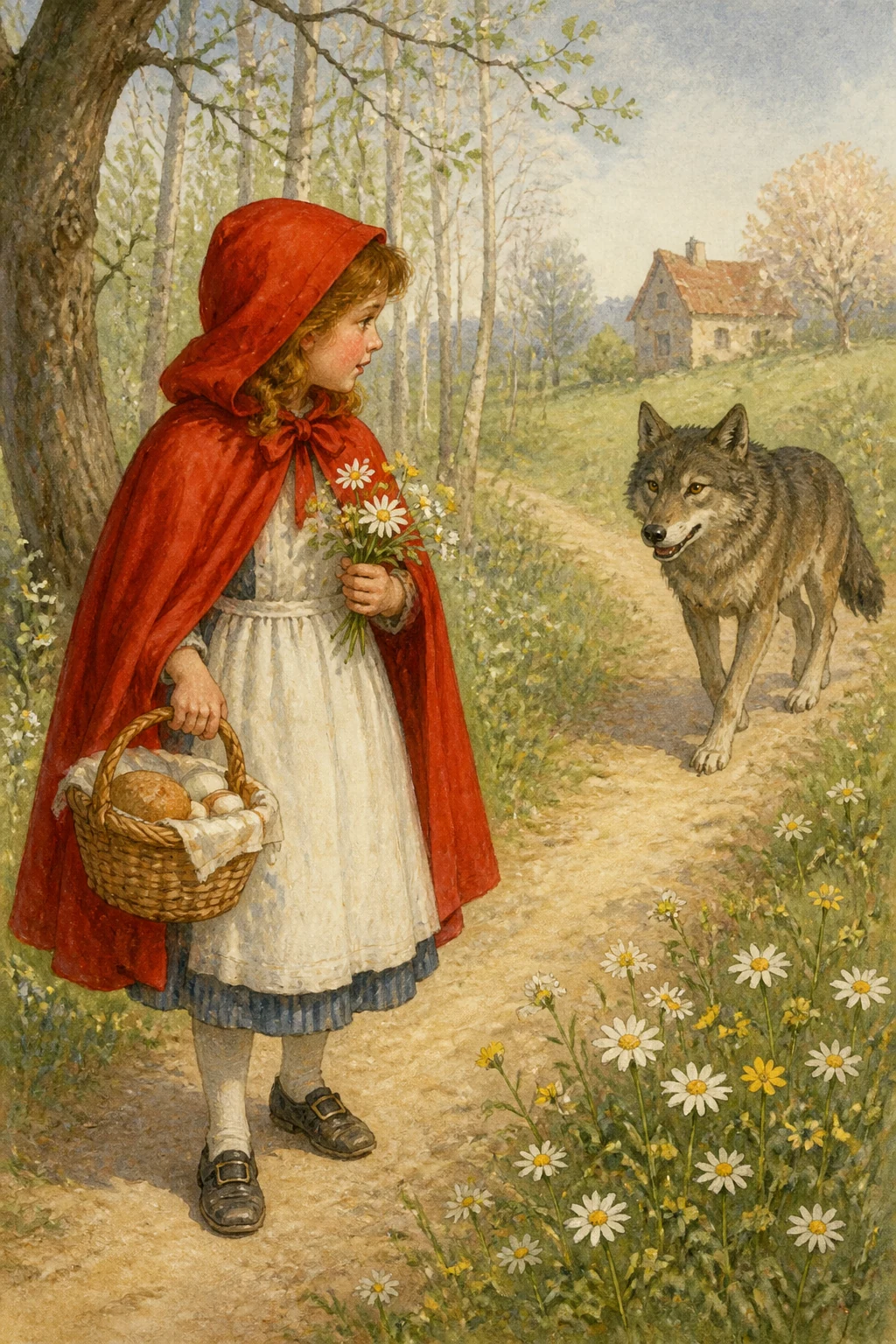
The Wolf ran as fast as he could along the shorter path, while the little girl took the longer one, amusing herself by gathering hazelnuts, chasing butterflies, and making posies of the little flowers she found along the way. It did not take the Wolf long to reach the grandmother’s house. He knocked: tap, tap. “Who is there?” “It is your little girl, Little Red Riding Hood,” said the Wolf, imitating her voice, “bringing you a cake and a little pot of butter that my mother is sending you.” The good grandmother, who was in bed because she felt a little unwell, called out, “Pull the peg, and the latch will fall.” The Wolf pulled the peg, and the door opened. He pounced on the good woman and devoured her in no time at all, for he had eaten nothing for more than three days. Then he shut the door and lay down in the grandmother’s bed to wait for Little Red Riding Hood, who came knocking at the door some time later. Tap, tap. “Who is there?” Hearing the Wolf’s deep voice, Little Red Riding Hood was frightened at first, but thinking that her grandmother had a cold, she answered, “It is your little girl, Little Red Riding Hood, bringing you a cake and a little pot of butter that my mother is sending you.” Softening his voice a little, the Wolf called out, “Pull the peg, and the latch will fall.” Little Red Riding Hood pulled the peg, and the door opened. When the Wolf saw her come in, he hid beneath the bedclothes and said, “Put the cake and the little pot of butter on the bread chest, and come to bed with me.” Little Red Riding Hood undressed and climbed into bed, where she was much surprised to see what her grandmother looked like without her clothes. She said to her, “Grandmother, what big arms you have!” “All the better to hug you with, my girl.” “Grandmother, what big legs you have!” “All the better to run with, my child.” “Grandmother, what big ears you have!” “All the better to hear with, my child.” “Grandmother, what big eyes you have!” “All the better to see with, my child.” “Grandmother, what big teeth you have!” “All the better to eat you with.” And with these words, the wicked Wolf pounced on Little Red Riding Hood and ate her up.
MORAL. Here we see that young children, especially young girls, pretty, well-formed, and sweet, do very wrong to listen to all sorts of people, and that it is no wonder so many are eaten by the wolf.
I say the wolf, for not all wolves are of the same kind. Some have a charming manner, quiet, free of spite or anger, who, tame, obliging, and gentle, follow young ladies right into their houses, right into their bedchambers;
But alas! Who does not know that these sweet-talking wolves are the most dangerous wolves of all?
Izvirnik
Le petit chaperon rouge
Naslednje strani prikazujejo izvirno besedilo za primerjavo.
PETIT CHAPERON
ROUGE
CONTE
Il estoit une fois une petite fille de Vilage, la plus jolie qu’on eut sçû voir ; sa mere en estoit folle, & sa mere grand plus folle encore. Cette bonne femme luy fit faire un petit chaperon rouge, qui lui seïoit si bien, que par tout on l’appelloit le Petit chaperon rouge.
Un jour sa mere ayant cui & fait des galetes, luy dit, va voir comme se porte ta mere-grand, car on m’a dit qu’elle estoit malade, portes luy une galette & ce petit pot de beurre. Le petit chaperon rouge partit aussi-tost pour aller chez sa mere-grand, qui demeuroit dans un autre Village. En passant dans un bois elle rencontra compere le Loup, qui eut bien envie de la manger, mais il n’osa, à cause de quelques bucherons qui estoient dans la Forest. Il luy demanda où elle alloit ; la pauvre enfant qui ne sçavoit pas qu’il est dangereux de s’arrester à écouter un Loup, luy dit, je vais voir ma Mere-grand, & luy porter une galette avec un petit pot de beurre que ma Mere luy envoye. Demeure-t-elle bien loin, lui dit le Loup ? Oh ouy, dit le petit chaperon rouge, c’est par de-là le Moulin que vous voyez tout là-bas, là-bas, à la premiere maison du Village. Et bien, dit le Loup, je veux l’aller voir aussi ; je m’y en vais par ce chemin icy, & toy par ce chemin-là, & nous verrons à qui plutost y sera.
Le Loup se mit à courir de toute sa force par le chemin qui estoit le plus court, & la petite fille s’en alla par le chemin le plus long, s’amusant à cueïllir des noisettes, à courir aprés des papillons, & à faire des bouquets des petites fleurs qu’elle rencontroit. Le Loup ne fut pas long-temps à arriver à la maison de la Mere-grand, il heurte : Toc, toc, qui est là ? C’est votre fille le petit chaperon rouge, dit le Loup, en contrefaisant sa voix, qui vous apporte une galete, & un petit pot de beurre que ma Mere vous envoye. La bonne Mere-grand qui estoit dans son lit à cause qu’elle se trouvoit un peu mal, luy cria, tire la chevillette, la bobinette chera, le Loup tira la chevillette, & la porte s’ouvrit. Il se jetta sur la bonne femme, & la devora en moins de rien ; car il y avoit plus de trois jours qu’il n’avoit mangé. Ensuite il ferma la porte, & s’alla coucher dans le lit de la Mere-grand, en attendant le petit chaperon rouge, qui quelque temps aprés vint heurter à la porte. Toc, toc, qui est là ? Le petit chaperon rouge, qui entendit la grosse voix du Loup, eut peur d’abord, mais croyant que sa mere-grand estoit enrhumée, répondit, c’est vostre fille le petit chaperon rouge, qui vous apporte une galette & un petit pot de beurre que ma Mere vous envoye. Le Loup luy cria, en adoucissant un peu sa voix ; tire la chevillette, la bobinette chera. Le petit chaperon rouge tira la chevillette, & la porte s’ouvrit. Le Loup la voyant entrer, luy dit en se cachant dans le lit sous la couverture : mets la galette & le petit pot de beurre sur la huche, & viens te coucher avec moy. Le petit chaperon rouge se deshabille, & va se mettre dans le lit, où elle fut bien estonnée de voir comment sa Mere-grand estoit faite en son deshabillé, elle luy dit ; ma mere-grand que vous avez de grands bras ! c’est pour mieux t’embrasser, ma fille : ma mere-grand, que vous avez de grandes jambes ! c’est pour mieux courir mon enfant : ma mere-grand que vous avez de grandes oreilles ! c’est pour mieux écouter, mon enfant. Ma mere-grand que vous avez de grands yeux ! c’est pour mieux voir, mon enfant. Ma mere-grand, que vous avez de grandes dens ! c’est pour te manger. Et, en disant ces mots, ce méchant loup se jetta sur le petit chaperon rouge, & la mangea.
MORALITÉ.
ON voit icy que de jeunes enfans,
Sur tout de jeunes filles,
Belles, bien faites & gentilles,
Font tres-mal d’écouter toute sorte de gens,
Et que ce n’est pas chose estrange,
S’il en est tant que le loup mange.
Ie dis le loup, car tous les loups ;
Ne sont pas de la mesme sorte ;
Il en est d’une humeur accorte,
Sans bruit, sans fiel & sans courroux,
Qui privez, complaisans & doux
Suivent les jeunes Demoiselles
Iusque dans les maisons, jusque dans les ruelles ;
Mais, hélas ! qui ne sçait que ces loups doucereux,
De tous les loups sont les plus dangereux.
Nadaljuj z branjem