Prevod
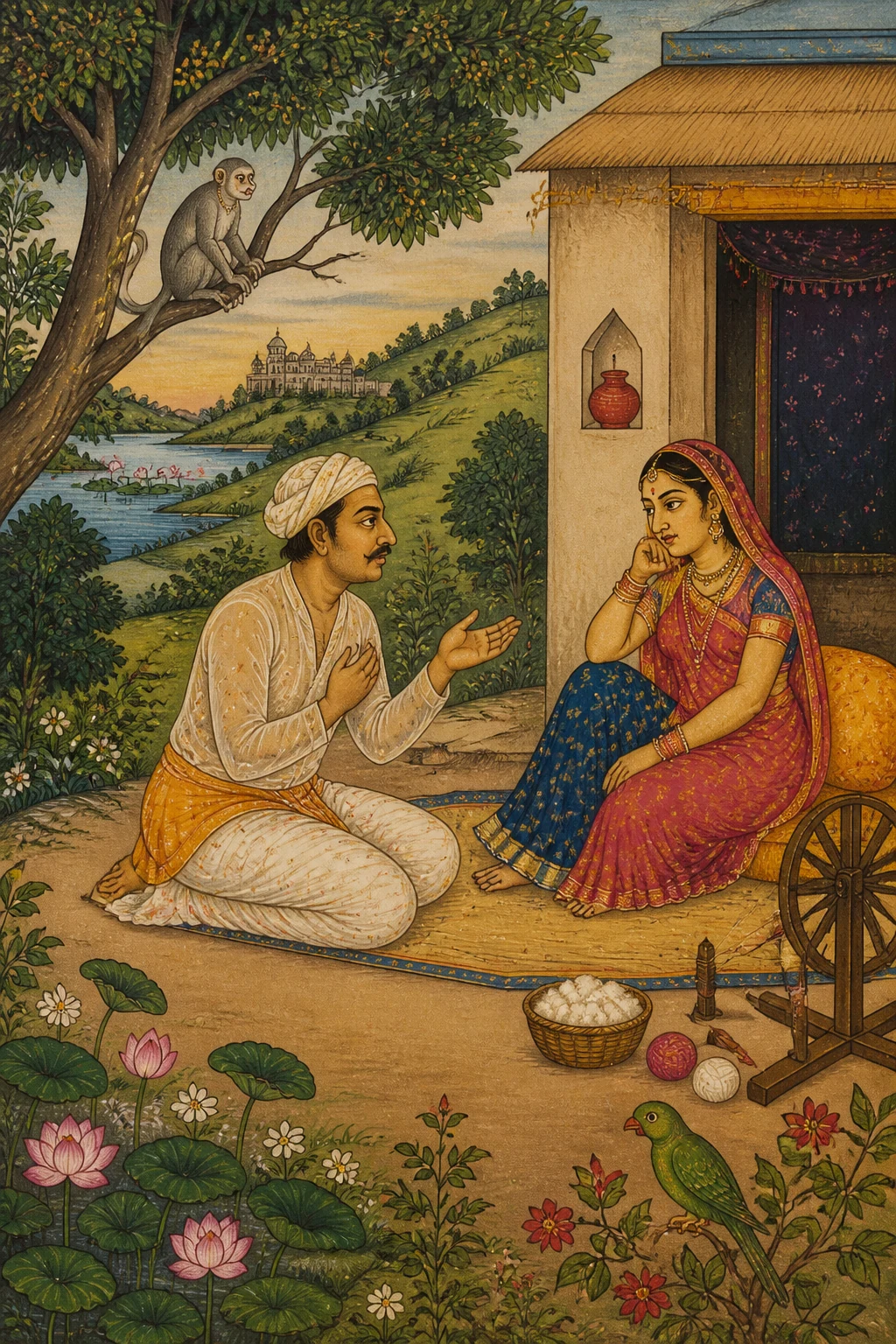
Now begins the first book, called “The Parting of Friends.” Its opening verse is this: The great affection that grew between a lion and a bull in the forest Was destroyed by a slanderous, grasping jackal. This is how the story is told. In the southern country stood a city called Mahilaropya. There lived a merchant’s son named Vardhamanaka, who had acquired great wealth by honest means. One night, as he lay in bed, a thought occurred to him: “Even when one has abundant wealth, one must consider ways of increasing it and put them into practice. For it is said: There is nothing that cannot be accomplished with money; Therefore a wise man should devote his efforts to acquiring wealth.
He who has wealth has friends; he who has wealth has kin. He who has wealth is a man of consequence; he who has wealth is accounted wise. No learning, generosity, craft, or art, No steadfastness is lacking in the rich—so their petitioners proclaim. In this world, even strangers become kinsmen to the wealthy, While even kinsmen are forever hostile to the poor. From wealth amassed and increased by every means, All undertakings flow, as rivers flow from mountains.
The unworthy are honored, the unapproachable approached, And those who deserve no homage receive it: such is the power of wealth. All undertakings thrive on wealth as the senses thrive on food. For this reason, wealth is called the means to every end. In its hunger for money, this world will serve even a cremation ground, Yet abandon its own father and keep him at a distance if he is penniless.
Even men advanced in years are young if they have wealth; Those without it are old even in their youth. “Men acquire wealth in six ways: begging, royal service, farming, earning through learning, moneylending, or trade. Of all these, trade offers the least objectionable means of gain. For it is said: Begging is practiced by too many; alas, a king does not give what is due; Farming is arduous, and learning is hard to gain through humble attendance on a teacher.
Lending brings poverty when one’s capital, placed in others’ hands, dwindles away. I can think of no livelihood in this world better than trade. Of all means of making money, the gathering of merchandise Alone is praised; every other means is uncertain. “Trade, in turn, brings wealth in seven ways: dealing in perfumes, receiving deposits, conducting business on commission, attracting regular customers, lying about purchase prices, using false weights and measures, and importing goods from distant lands. For it is said: Among wares, perfumes are the wares to sell—what need of gold or anything else?
What is bought for one can be sold for a hundred. When a deposit comes into his house, the merchant praises his chosen god: ‘If the depositor dies, I shall give you the offering I have vowed.’ A merchant entrusted with business on commission thinks with a joyful heart: ‘Today I have gained the earth and all its riches. What more could I want?’ He eagerly watches for the arrival of a familiar customer, And rejoices at gaining his money as though a son had been born to him.
And again: Giving short measure where full measure is due, constantly cheating familiar customers, And lying about purchase prices—such is the nature of these rogues. Those skilled in buying merchandise travel to far-off countries And, through enterprise, double or triple their money.” Having thought the matter through, he gathered goods bound for Mathura and, on an auspicious day, took leave of his elders, mounted a fine cart, and set out. Two auspicious bulls, born in his own household and named Sanjivaka and Nandaka, were harnessed to draw it. As they descended to the lowlands beside the Yamuna, Sanjivaka stepped into deep mud. His leg became trapped, and he broke the yoke and collapsed. Seeing him in this condition, Vardhamana was deeply distressed. His heart softened by affection, he halted the journey for three nights on the bull’s account. Seeing his grief, the other merchants said, “Good merchant, why have you endangered the entire caravan for the sake of a single bull, here in this perilous forest, teeming with lions and tigers? For it is said:
A wise man should not sacrifice much for the sake of little. Wisdom lies precisely in preserving the greater at the cost of the less.” He accepted their advice, appointed men to guard Sanjivaka, and continued his journey with the whole caravan. But the guards, too, knew how dangerous the forest was. They abandoned Sanjivaka, followed after the caravan, and the next day falsely told its leader, “Master, Sanjivaka is dead. Knowing how dear he was to you, we cremated him.” Hearing this, the caravan leader, grateful for the bull’s service and moved by affection, performed all the funeral rites for him, including the release of a bull. Sanjivaka, however, still had life allotted to him. His body was refreshed by the cool breezes laden with moisture from the Yamuna, and somehow he struggled to his feet and reached the riverbank. There he fed on tender blades of grass green as emeralds, and within a few days grew stout, strong, and high-humped, like Shiva’s bull. Each day he tore apart the tops of anthills with his horns and stood bellowing. Well is it said: Unguarded, what fate protects stands safe;
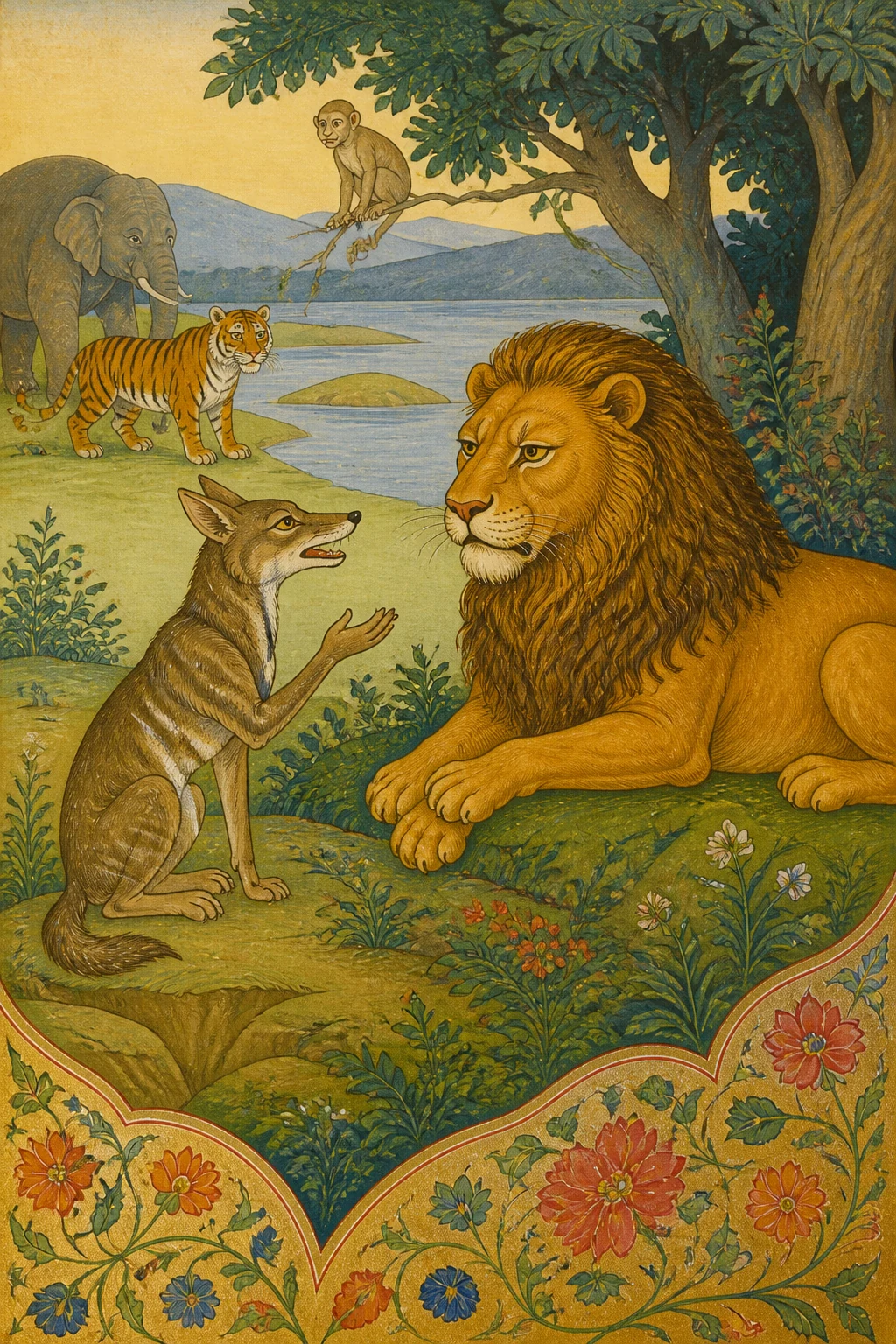
Well guarded, what fate strikes down is lost. One abandoned helpless in the forest lives, While another dies at home despite every care. One day a lion named Pingalaka, surrounded by all his attendant beasts and tormented by thirst, came down to the bank of the Yamuna to drink. From a distance he heard Sanjivaka’s deep bellow. At the sound his heart was greatly troubled. Concealing his fear, he withdrew beneath a banyan tree and arranged his followers in four circles. This fourfold formation consisted of the lion, the lion’s followers, the clamorous attendants, and those on the outer fringe. Among his constant followers were two jackals, Karataka and Damanaka, sons of ministers who had lost their offices. The two began to confer. Damanaka said, “My dear Karataka, our master Pingalaka came down to the Yamuna to drink. Why, then, though still tormented by thirst, has he turned back, drawn up his followers, and settled beneath this banyan tree, overcome with distress?” Karataka replied, “My dear fellow, what business is that of ours? For it is said:
The man who meddles in affairs that do not concern him Meets his end, like the monkey who pulled out the wedge.” Story 1: The Monkey Who Pulled Out the Wedge. Near a certain town, a merchant’s son had begun building a temple in a grove of trees. At midday the workers—the master builders and the rest—would go into town for their meal. One day a troop of monkeys, wandering here and there, happened to arrive at the site. One of the craftsmen had left a log of anjana wood half split, with a wedge of khadira wood driven into the middle. The monkeys began playing as they pleased among the treetops, the summits of the building, and the piles of timber. One of them, whose death was near, mischievously sat astride the half-split log, grasped the wedge with both hands, and began to pull it out. His testicles hung in the cleft; when the wedge came loose, what happened to him was just what I have already told you. “That is why I say, ‘The man who meddles in affairs that do not concern him.’ We have food enough in the leftovers. Why meddle in this business?” Damanaka replied, “Do you care for nothing but food? That is not right. For it is said:
The wise seek a king’s protection to benefit their friends and harm their enemies. Who cannot merely fill his belly? And again: Let that man truly live whose life sustains the lives of many. Do not birds, too, fill their bellies with their beaks? And further: Even a moment’s life, if honored among men For knowledge, courage, prosperity, and noble qualities, Is what those who understand call life indeed.
A crow, too, lives long and feeds on offerings. He who neither by his own efforts nor through others Shows kindness to his needy kin or to his fellow men— What fruit does his life bear in this human world? A crow, too, lives long and feeds on offerings. A little stream is easily filled, as are a mouse’s cupped paws. A paltry man is easily satisfied: a trifle contents him.
And again: What use was the birth of one who merely robbed his mother of her youth, If he does not rise like a banner above his lineage? In the turning wheel of existence, who dies and is not born again? But he alone is counted truly born who shines with surpassing distinction. And again: Even a blade of grass growing on a riverbank fulfills the purpose of its birth When it offers a handhold to someone struggling in the water.
And further: Rare in this world are good men who, like rain clouds, Move serenely on high and relieve the suffering of others. The wise acknowledge the incomparable dignity Of a mother for this reason: She may bear within her womb one Who becomes greater even than the great. Even a capable man is slighted if he does not reveal his strength. Fire hidden in wood may be stepped over—but not when it blazes.”
Karataka said, “But we hold no office. What business have we with this?” For it is said: The fool who, holding no office, speaks unasked before a king Receives not merely disrespect, but humiliation. And further: One should speak where one’s words will bear fruit And leave a lasting impression, like dye upon white cloth. Damanaka replied, “No, do not say that. A man without office may gain high office if he serves a king; Even a high official may lose his place if he neglects that service.
For it is said: A king favors the man who is close at hand, Though he be unlearned, lowborn, or uncultivated. Kings, women, and climbing vines, as a rule, Embrace whatever happens to be beside them. And further: Servants who discern what causes anger and what brings favor Gradually gain ascendancy over a king, even when he shakes them off. For the learned, the ambitious, those endowed with skill and valor, And those who know the art of service, there is no patron like a king.
Those who, despite noble birth and other advantages, fail to approach energetic kings Are condemned to lifelong begging as their penance. The fainthearted who declare that kings are hard to please Merely advertise their own carelessness, laziness, and stupidity. When snakes, tigers, elephants, and lions can be subdued by skillful means, What is a mere king to the intelligent and vigilant?
Only by seeking a king’s patronage does a learned man attain the highest station. Sandalwood grows nowhere but on Mount Malaya. White parasols, splendid horses, And elephants ever in rut are yours when the king is pleased.” Karataka said, “Then what do you intend to do?” Damanaka replied, “At present our master Pingalaka is afraid, and his followers are afraid as well. I shall go to him, discover the cause of his fear, and manage the matter through one of the six policies: peace, war, advance, waiting, seeking protection, or pursuing a double course.” Karataka asked, “How do you know that our master is afraid?”
He replied, “What is there to puzzle over? For it is said: Even an animal understands what is spoken; Horses and elephants obey a command. A wise man understands even what remains unsaid: The fruit of intelligence is insight into another’s gestures. And Manu, too, says (8.26): By appearance, gestures, gait, movements, and speech, By changes in the eyes and face, the hidden mind is discerned.
“So today I shall approach him in his fear, use the power of my intelligence to free him from it, bring him under my influence, and regain my position as minister.” Karataka said, “You know nothing of the duties of service. How will you bring him under your influence?” Damanaka replied, “How can you say I know nothing of service? As a child playing in my father’s lap, I listened to learned visitors reciting works on statecraft, and I stored in my heart what I heard of the essence of service. Listen: Three kinds of men gather the golden blossoms of the earth: The brave, the learned, and those who know how to serve.
True service benefits the master; his wishes must be discerned above all from his words. A wise man should seek a king’s favor by that means alone, and no other. A wise man should not serve a master who does not recognize his worth. No fruit will come of it, any more than from a salt waste, however well plowed. A man endowed with the qualities of a worthy master should be served, even if he lacks wealth and power.
A livelihood will come from him in time, even if the reward is delayed. Though he sit motionless as a stump, wasting away with hunger, A wise man should not seek a living from one steeped in ignorance. A servant hates his master for being miserly and harsh of speech. Why does he not hate himself for failing to distinguish whom to serve and whom to avoid? A king under whose shelter servants find rest but remain hungry Should be abandoned like the arka tree, though it always bears flowers and fruit.
Toward the queen mother, the queen, the prince, and the chief minister, The royal priest and the doorkeeper, one should always behave as toward the king. He who answers when addressed, ‘Long live Your Majesty!’ and understands what should and should not be done, Carrying out his duties without hesitation, becomes dear to the king. He who acknowledges with gratitude the wealth bestowed by his master’s favor, And wears the garments and other gifts he receives, becomes dear to the king.
He who holds no secret counsel with those who frequent the inner apartments, Nor with the king’s wives, becomes dear to the king. He who regards gambling as death’s messenger, liquor as deadly poison, And other women as a source of idle entanglements, becomes dear to the king. He who stands foremost in battle, follows behind his lord in the city, And attends at his door in the palace, becomes dear to the king.
He who never presumes upon his master’s constant favor to overstep his bounds, Even in difficult circumstances, becomes dear to the king. He who always hates the king’s enemies And does what pleases the king’s favorites becomes dear to the king. He who does not contradict his master when addressed, Nor laugh loudly in his presence, becomes dear to the king. He who fearlessly regards the battlefield as a place of refuge, And life abroad as life in his own city, becomes dear to the king.
He who avoids intimacy with the king’s women, And keeps clear of slander and quarrels, becomes dear to the king.” Karataka said, “Then tell me this: when you go there, what will you say first?” Damanaka replied: As men converse, one reply gives rise to another, As seed produces further seed when blessed with plentiful rain. The wise describe the failure That comes from perceiving a mistaken course, And the success that comes from perceiving the right one, As though the workings of statecraft lay vividly before their eyes.
Wise sayings live on some men’s tongues, as with parrots; in others’ hearts, as with the mute; But in others they play gracefully both in the heart and on the tongue. “Nor shall I speak out of season. Long ago, while sitting in my father’s lap, I heard this essential rule of statecraft: Even Brihaspati, if he speaks at an untimely moment, Meets with great contempt and abundant humiliation.”
Karataka said: Kings, like mountains, are always hard to approach: Beset with dangerous creatures, treacherous, unyielding, and frequented by the wicked. And further: Kings are like serpents: pleasure-loving and encased in armor, Crooked, cruel in their actions, dangerous, and mastered only through spells or counsel. Double-tongued, cruel in deed, unfaithful, and searching for weaknesses, Kings, like snakes, keep watch even from afar.
Even favorites who do the slightest injury to a king Are burned like reckless moths in a flame. The station of kings, difficult to attain and honored by all the world, Is sullied by even a slight offense, as is the standing of a Brahmin. Royal favor is hard to win, hard to attain, and hard to hold. Like water in a vessel, it remains long only with one fit to contain it.
Damanaka said, “All that is quite true. Yet: Whatever a man’s disposition, one should conduct oneself accordingly. By entering into his feelings, a wise man soon brings him under his influence. To follow the master’s inclinations is good conduct in a servant. Even demons are won over by those who constantly humor their wishes. Praise when the king is angry, love for his favorites, hatred for his enemies, And applause for his generosity—these win him over without spell or charm.”
Karataka said, “If that is your intention, then may your path be auspicious. Do as you wish.” Damanaka bowed and set off toward Pingalaka.