Prevod
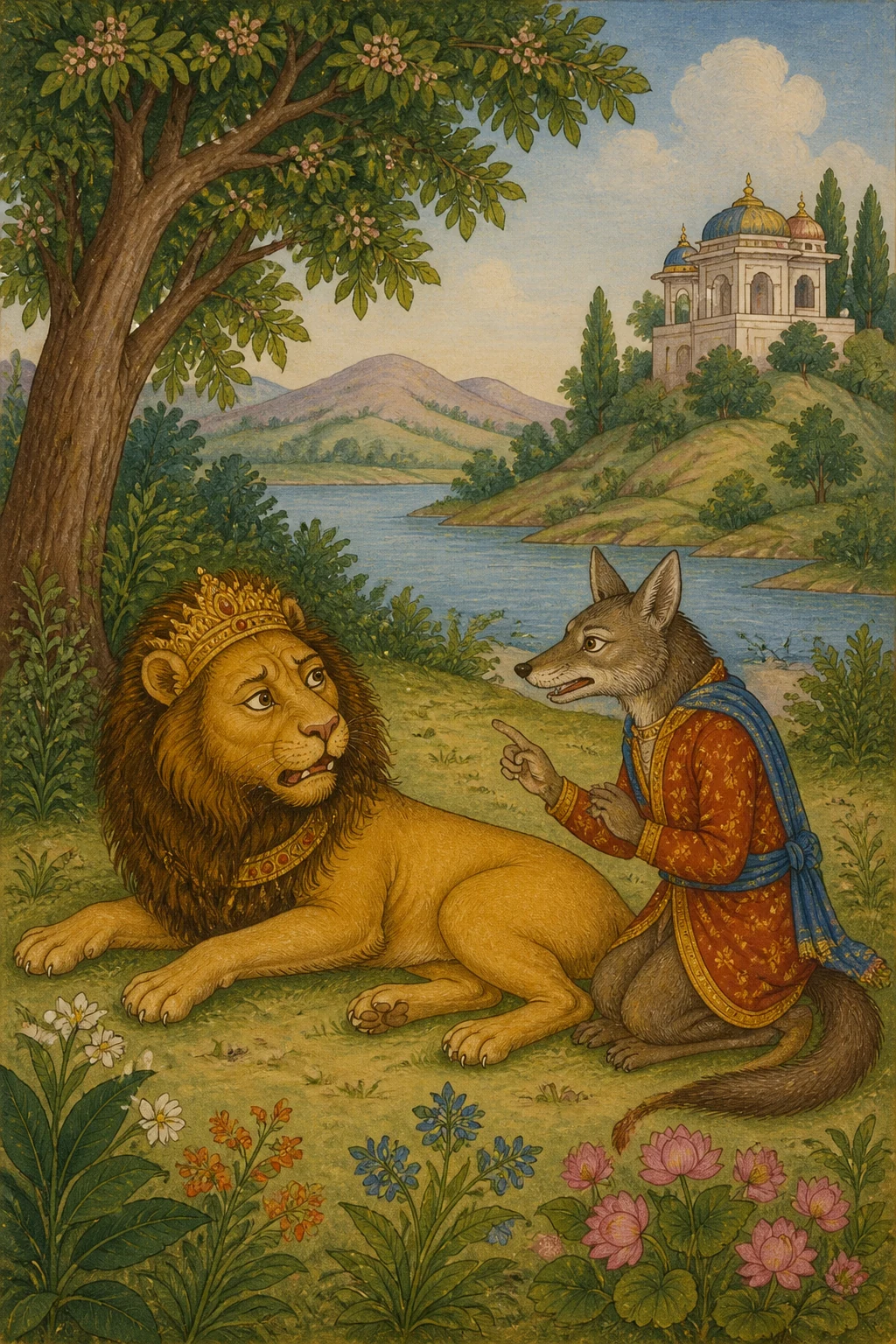
Seeing Damanaka approach, Piṅgalaka said to the doorkeeper, “Move aside the cane barrier. This is Damanaka, the son of our former minister; he has unrestricted access. Admit him to the second circle of the court.” “As Your Majesty commands,” he replied. Damanaka approached, bowed to Piṅgalaka, and, with his permission, sat in the place assigned to him. Piṅgalaka laid his right paw, adorned with thunderbolt-like claws, upon him and said graciously, “Are you well? Why has it been so long since we last saw you?”
Damanaka replied, “Your Majesty has had no occasion to employ us. Yet there is something that ought to be said at the proper time: kings have need of everyone, whether high, middling, or low. As the saying goes: A mere straw serves a ruler daily to pick his teeth or scratch his ear. If even a straw can be of use, how much more a man endowed with speech and hands!
“Moreover, we are Your Majesty’s hereditary servants, following you even in adversity. Though we have not received our rightful office, such treatment scarcely becomes Your Majesty. For it is said: Servants and ornaments alike should be placed where they belong. A crest-jewel is not tied to the foot merely because one has the power to do so. “For: A king who cannot recognize merit will find no servants following him, though he be rich, nobly born, and heir to an ancient throne.
“And it is said: When a servant is ranked with his inferiors, denied the honors given to his equals, or not entrusted with responsibility—these three will make him leave his wealthy master. “When a king, through lack of judgment, appoints servants fit for the highest posts to low and menial positions, the fault lies with the ruler, not with them. As the saying goes: If a gem fit to adorn a golden ornament is mounted instead in tin, it neither cries out nor shines; the blame falls upon the one who set it there.
“And as for Your Majesty’s remark that I have not been seen for so long, hear this: Where no distinction is made between the left hand and the right, what worthy man with somewhere else to go would remain even a moment? Those whose judgment mistakes glass for a gem and a gem for glass will not retain even a servant in name alone. In a land where there are no judges of worth, even jewels born of the sea fetch no price.
In the land of the Ābhīras, they say, the cowherds sell a moonstone for three cowries. Where no distinction is made between a common red stone and a ruby, how can there be any trade in precious gems? When a master treats all his servants alike, making no distinctions, those capable of enterprise lose their enthusiasm. A king cannot do without servants, nor servants without a king; their dealings with one another rest upon mutual dependence.
Without servants who work for the welfare of his people, even a glorious king has no splendor, like the sun without its rays. The spokes support the hub, and in the hub the spokes are fixed: so turns the wheel of livelihood for master and servant. Even hair, always borne upon the head and lovingly tended with oil, loses its luster without oil—how much more servants without affection?
A king, when pleased, gives his servants only wealth; yet for the mere gift of honor they will serve him with their lives. Knowing this, a king should appoint servants who are discerning, nobly born, courageous, capable, loyal, and hereditary retainers. He who accomplishes a difficult deed of the greatest benefit to his king, yet says nothing of it out of modesty—such a man gives a king a true ally.
He to whom a task may be entrusted, leaving the mind free from anxiety, is a true servant, like a second wife. He who comes unbidden, remains always at the door, and, when questioned, speaks truthfully and briefly is a servant worthy of kings. He who, even without orders, sees a danger threatening his king and strives to remove it is a servant worthy of kings. He who, though struck, abused, or punished by his king, harbors no evil thought is a servant worthy of kings.
He who does not grow proud when honored or grieve when slighted, but maintains his composure, is a servant worthy of kings. He whom neither hunger nor sleep can overcome, nor cold nor heat nor other hardships, is a servant worthy of kings. He whose face brightens when he hears that war is coming against his master is a servant worthy of kings. He under whose administration the kingdom’s borders expand like the moon in its waxing fortnight is a servant worthy of kings.
But he under whom the borders shrink like hide laid in a fire must be dismissed by a king who seeks to prosper. “And if my master despises me, thinking, ‘He is only a jackal,’ that too is unjust. For it is said: Silk comes from a worm, gold from stone, and sacred dūrvā grass from a cow’s hair; the lotus comes from mud, the moon from the ocean, the blue water lily from cow dung.
Fire comes from wood, a jewel even from a serpent’s hood, and yellow pigment from a cow’s bile. The worthy rise to eminence through their own virtues: what does birth matter? A mouse, though born in the house, must be killed because it does harm; a cat, because it is useful, is welcomed with offerings of food. Castor stalks, reeds, and arka stems, though gathered in great heaps, cannot do the work of timber; just as little use are fools.
What use is a loyal man without ability, or an able man who does harm? I am both loyal and able, O King: you should not despise me.” Piṅgalaka said, “Let that rest for now. Able or unable, you are the son of our old minister. Speak freely, then, whatever you wish to say.” Damanaka said, “Your Majesty, there is something I wish to submit to you.” Piṅgalaka said, “Then tell me what is on your mind.”
He replied: “Even the smallest matter concerning a king should not be spoken of in open court: so Bṛhaspati declared. “May Your Majesty therefore hear what I have to say in private. For: A secret heard by six ears is broken; heard by four, it remains secure. The wise should therefore take every care to keep it from six ears.” At these words, the assembled animals, led by the tigers, leopards, and wolves, understood Piṅgalaka’s wishes and immediately withdrew to a distance. Then Damanaka said, “My lord set out to drink water. Why have you turned back and stopped here?”
With an embarrassed smile, Piṅgalaka replied, “For no particular reason.” Damanaka said, “Your Majesty, if it is something that must not be told, let it remain so. For it is said: Some things must be kept from one’s wife, some from one’s own kin, some from friends, and some from sons. Weighing whether it is fitting to speak or not, a wise man should speak only when there is good reason.” ||Panc_1.[*100] Hearing this, Piṅgalaka thought, “He seems a capable fellow. I shall tell him what is on my mind. For it is said: “To a master who appreciates merit, a capable servant, an obedient wife, or a friend unwavering in affection, one may tell one’s sorrow and find relief.” ||Panc_1.[*101] “Damanaka, do you hear that great sound in the distance?”
He replied, “I hear it, my lord. What of it?” Piṅgalaka said, “My good fellow, I wish to leave this forest.” Damanaka said, “Why?” Piṅgalaka replied, “Some strange creature has entered our forest today. That great noise you hear is its voice, and its strength must surely match the sound.” Damanaka said, “It is not fitting that my lord should take fright at a mere sound. For it is said: Water breaches a dam; a secret is betrayed if left unguarded; slander breaks friendship, and words break a frightened man.
“Your Majesty should not abandon the forest you won in former days. Sounds are of many kinds: those of kettledrums, flutes, lutes, hand drums, cymbals, war drums, conches, trumpets, and the like. One should not be afraid merely because of a sound. For it is said: The king whose courage does not fail when a fierce and mighty enemy approaches will never be defeated.
The brave do not lose their courage even when fate shows them cause for fear. In summer, when the lakes dry up, the ocean rises all the more proudly. “And again: Rarely does a mother bear such a son, an ornament to the three worlds, who neither despairs in adversity, exults in prosperity, nor fears in battle. “And again: A man bowed down by weakness, worthless and without dignity, shares the fate of a blade of grass.
“Moreover: What use is the fine appearance of a man who cannot stand firm before another’s might? He is like an ornament made of lac, which melts before the heat. “Knowing this, Your Majesty must take your stand upon courage and not be frightened by sound alone. Moreover: “At first I thought it must be full of fat; but when I entered it, I found only leather and wood.”
Piṅgalaka asked, “How was that?” Damanaka replied, “Tale 2. The Jackal and the Drum. A jackal named Gomāyu, his throat wasted with hunger, was wandering through a forest when he came upon a place where two armies had fought. There he heard the sound of a fallen war drum, struck by the tips of climbing branches stirred by the wind. His heart trembling, he thought, ‘Alas, I am done for! I must go elsewhere before the creature making that terrible noise catches sight of me. And yet it would be wrong to act so hastily.
“‘He who reflects when fear or joy overtakes him, and does not act in haste, will have no cause for regret. “‘First I shall find out what is making this noise.’ Summoning his courage, he cautiously advanced, little by little, until he saw the drum. Recognizing what it was, he went up to it and struck it himself out of curiosity. Then he thought joyfully, ‘Ah, at last a splendid meal has come my way! It must be filled with flesh, fat, and blood.’ With great difficulty he tore through its tough leather covering, made a hole in one spot, and eagerly crawled inside. But tearing the leather had broken his fangs. When he saw that nothing remained within but wood, his hopes vanished, and he recited the verse beginning, ‘At first I thought it must be full of fat.’ So one should not be frightened by sound alone.”
Piṅgalaka said, “But look! My entire retinue is distraught with fear and wishes to flee. How am I to stand firm and be brave?” Damanaka replied, “My lord, the fault is not theirs. Servants become like their master. For it is said: “A horse, a weapon, a treatise, a lute, speech, a man, or a woman— each proves useful or useless according to the person who directs them.
“Therefore, summon your courage and wait here while I go and discover the source of this sound. After that, we can do whatever is appropriate.” Piṅgalaka said, “Do you really dare to go there?” He replied, “When his master commands him, is there anything a good servant may or may not do? For it is said: “At his master’s command, a good servant knows no fear: he will enter a serpent’s mouth or plunge into the boundless ocean.
“And again: “A servant who, when ordered by his master, weighs whether a task is easy or difficult should not be retained by a king who desires prosperity.” Piṅgalaka said, “Good. If that is so, go. May your path be blessed.” Damanaka bowed to him and set off in the direction of Saṃjīvaka’s bellowing. When Damanaka had gone, Piṅgalaka, his mind troubled by fear, thought, “Ah, I have acted unwisely in trusting him and revealing my thoughts. Since he has been deprived of office, this Damanaka may become a paid agent of both sides and plot against me. For it is said: “Those whom a king first honors and then dishonors, though nobly born, will always strive for his destruction.
“I shall move elsewhere and wait until I discover what he intends. Perhaps Damanaka means to bring that creature here and have me killed. For it is said: “The wary, though weak, are not slain by the strong; but the trusting, though strong, are slain even by the weak. A wise man who desires prosperity, long life, and happiness should not place his trust even in Bṛhaspati.
Never trust an enemy, even when bound to him by sworn agreements: Vṛtra, who aspired to sovereignty, was slain by Śakra through just such oaths. Even the gods cannot overcome an enemy without first winning his trust: through trust the lord of the gods gained access to Diti’s womb and tore apart her unborn child.” Having considered the matter thus, Piṅgalaka went to another place and stood alone, watching the road by which Damanaka would return. Meanwhile, Damanaka approached Saṃjīvaka and, discovering that he was a bull, thought delightedly, “Ah, what a fortunate turn! By arranging peace or war between these two, I shall bring Piṅgalaka under my control. For it is said: “Neither noble birth nor friendship makes a king heed his ministers’ words
until trouble and sorrow come upon him. A king in distress is always a source of profit to his ministers; that is why ministers wish their king to be in trouble. Just as a healthy man has no wish for a skilled physician, a king free from danger feels no need of a counselor.” Thinking thus, he set off toward Piṅgalaka. Seeing him approach, Piṅgalaka concealed his feelings and resumed his former posture. Damanaka came up, bowed, and sat down. Piṅgalaka asked, “Did you see that creature?”
Damanaka replied, “By Your Majesty’s favor, I did.” Piṅgalaka said, “Truly?” Damanaka replied, “Would I report a falsehood in Your Majesty’s presence? For it is said: “He who utters even the smallest falsehood before kings or gods swiftly perishes, however great he may be. “And again: “Manu has declared that the king embodies all the gods. Therefore one should regard him as a god and never deal falsely with him.
Yet, though he embodies all the gods, the king differs from them in this: from a king the fruit of good or evil comes at once; from a god, in another life.” Piṅgalaka said, “No doubt you really did see him. The great do not grow angry with the lowly; that is why he did not strike you down. For: The tempest does not uproot the tender grasses that bow low before it on every side.
Such is the very nature of the high-minded: the mighty display their strength only against the mighty. “Moreover: Though the bees, intoxicated with desire for the ichor on his temples, circle about and strike him with their tiny feet, the elephant, for all his immense strength, does not grow angry; the powerful are roused to wrath only by an equal in strength.” Damanaka replied, “Let him be mighty, then, and us insignificant. Even so, if Your Majesty commands it, I shall bring him into your service.”
Drawing a deep breath, Piṅgalaka asked, “Can you really do that?” Damanaka replied, “What is beyond the power of intelligence? For it is said: “Neither weapons, mighty elephants, horses, nor foot soldiers can accomplish a task as surely as well-directed intelligence.” Piṅgalaka said, “If that is so, I appoint you to the office of minister. From this day forward, the granting of favors, the infliction of punishments, and all such matters shall be in your hands.”
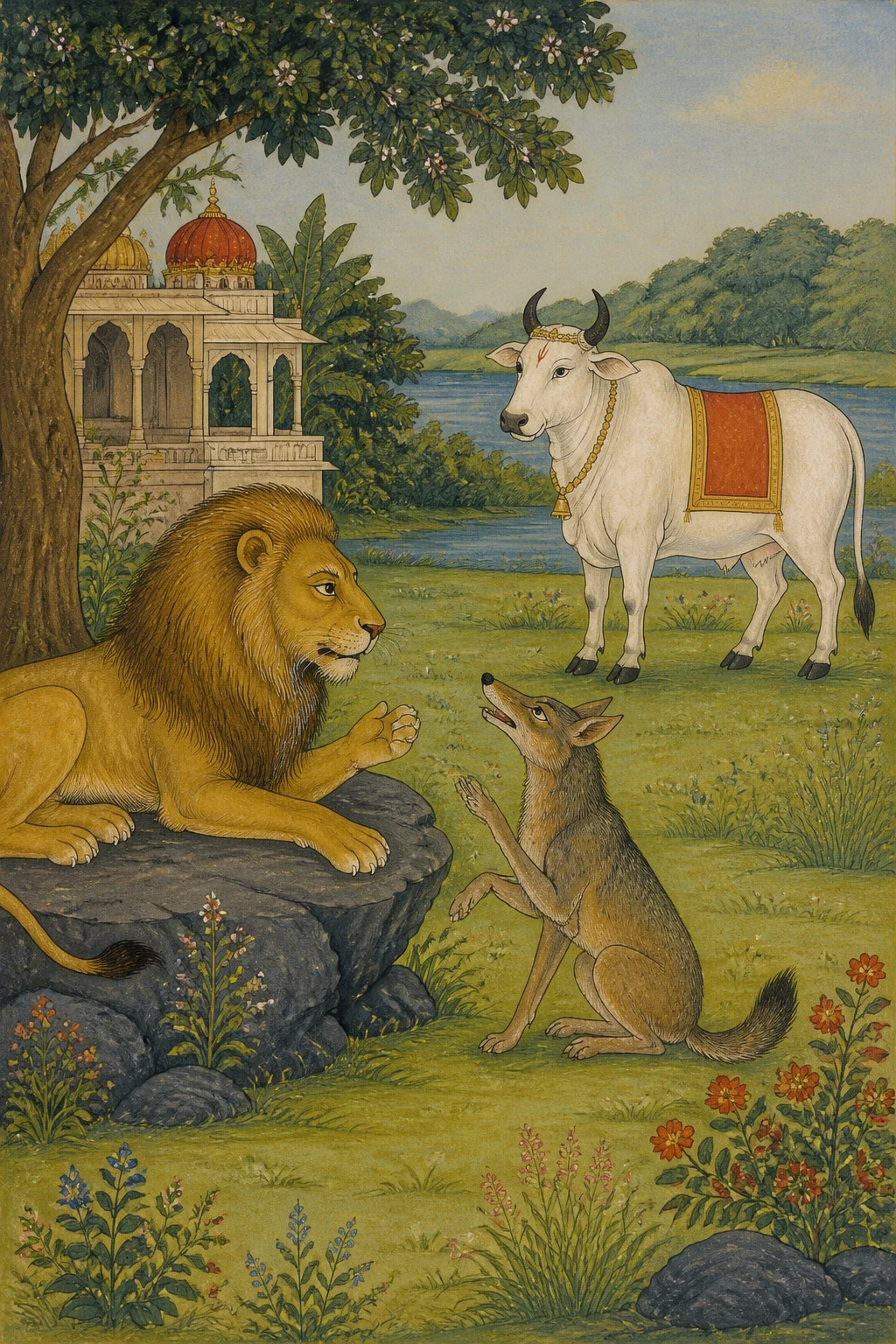
Damanaka hurried back and addressed the bull sharply: “Come here, you wicked bull! Our lord Piṅgalaka summons you. Why do you keep bellowing so idly and fearlessly?” Hearing this, Saṃjīvaka asked, “My good fellow, who is this Piṅgalaka?” Damanaka replied, “What! You do not even know our lord Piṅgalaka? Wait a moment—you will learn soon enough from the consequences. There beneath the banyan tree stands our master, the lion named Piṅgalaka, surrounded by all the beasts.”
Hearing this, Saṃjīvaka thought his life was over and sank into deep despair. He said, “My good fellow, you seem a man of honorable conduct and skillful speech. If you must take me there, please win your master’s favor for me by obtaining his promise of safety.” Damanaka replied, “Indeed, you have spoken wisely. Such is the rule of policy, for—”