Waltey
Pripoved o starki
Tisoč in ena noč · arabska pripovedna tradicijaO besedilu
Pripoved o starki
- Vir
- Tisoč in ena noč
- Avtor
- arabska pripovedna tradicija
- Jezik branja
- English
- Jezik izvirnika
- Arabic
- Čas branja
- 61 min branja
- Obseg
- 49 strani
- Naslov izvirnika
- حكاية العجوز - الليالي ٨٣ إلى ٩٥
O izvirniku
Tisoč in ena noč
Zgodbe v zgodbah, polne trgovcev, dvorov, preoblek in nočnih zapletov. Bralni jezik je English, izvirnik pa prihaja iz vira Tisoč in ena noč v jeziku Arabic.
Besedilo
Pripoved o starki
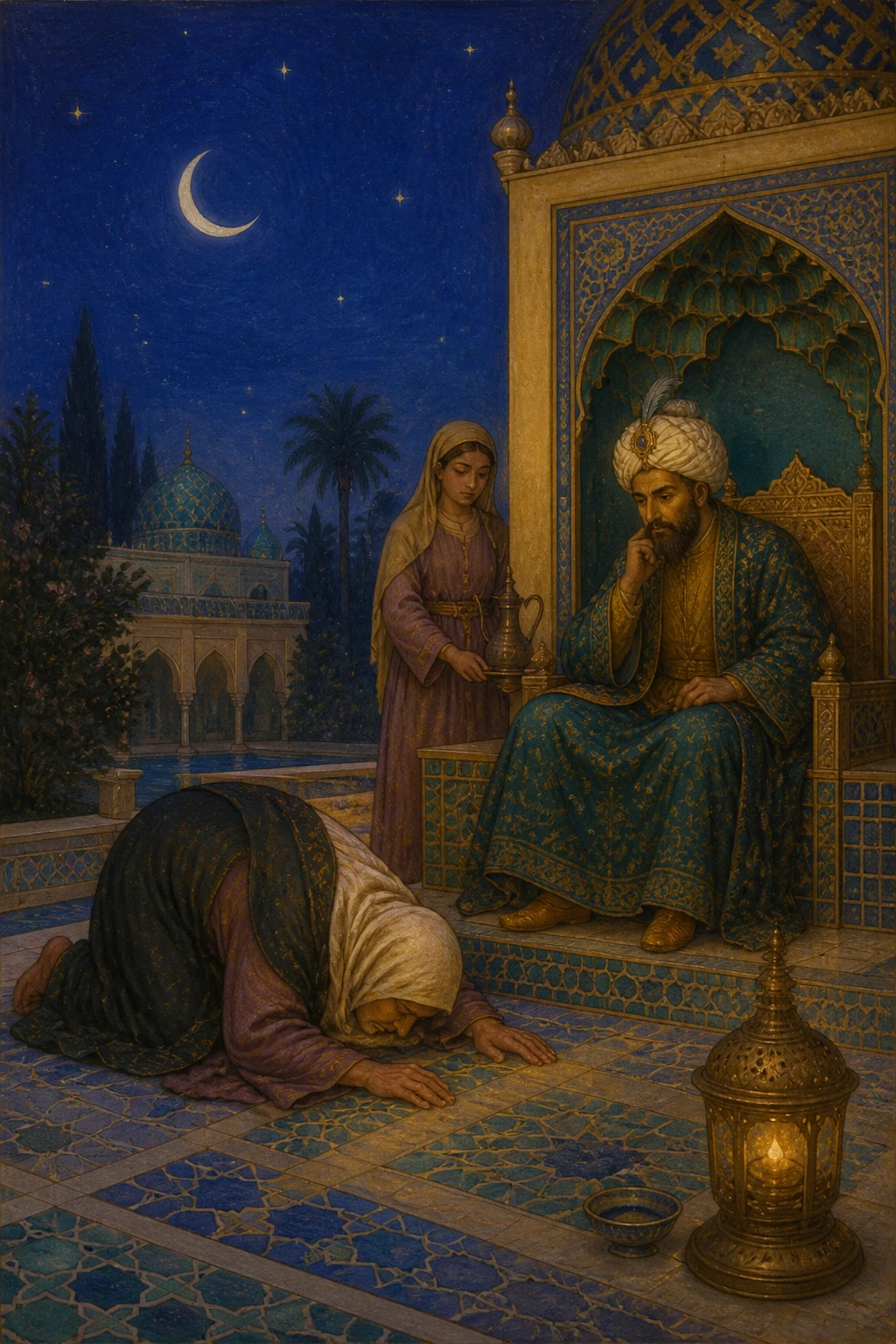
Then the fifth slave girl stepped back, and the old woman came forward, kissed the ground before your father nine times, and said, “You have heard, O King, what they have all said concerning renunciation. I follow in their footsteps, and shall relate some of what has reached me about the great men of old. It is said that Imam al-Shafi‘i divided the night into three parts: the first for learning, the second for sleep, and the third for prayer. Imam Abu Hanifa used to spend half the night in prayer. One day, as he was walking, a man pointed him out to another and said, ‘This man spends the whole night in prayer.’ When he heard this, he said, ‘I am ashamed before God to be credited with a virtue I do not possess.’ From then on, he spent the whole night in prayer. Al-Rabi‘ said, ‘During the month of Ramadan, al-Shafi‘i would recite the entire Quran seventy times, all of it in prayer.’ Al-Shafi‘i, may God be pleased with him, said, ‘For ten years I have not eaten my fill of barley bread, for a full belly hardens the heart, dulls the understanding, brings on sleep, and weakens a man for his nightly prayers.’ It is related that ‘Abd Allah ibn Muhammad al-Sukkari said, ‘I was talking with ‘Umar, and he told me, “I have never seen anyone more scrupulous in his piety or more eloquent than Muhammad ibn Idris al-Shafi‘i.” It happened that I went out with al-Harith ibn Labib al-Saffar, a pupil of al-Muzani’s who had a beautiful voice. He recited the words of the Most High: “This is the day when they shall not speak, nor shall they be given leave to offer excuses.” I saw Imam al-Shafi‘i change color; his skin shivered, he began to tremble violently, and he fell unconscious. When he came to himself, he said, “I seek refuge in God from the station of liars and the heedlessness of the negligent. O God, before You the hearts of those who know You bow in humility. O God, out of Your bounty grant me forgiveness for my sins; adorn me with the veil of Your protection, and in Your gracious generosity pardon my shortcomings.” Then I rose and departed.’ One trustworthy man said, ‘When I entered Baghdad, al-Shafi‘i was there. I sat down on the riverbank to perform my ablutions for prayer, and a man passed me and said, “Young man, perform your ablutions well, and God will be good to you in this world and the next.” I turned and saw a man followed by a company of people. I hurried through my ablutions and followed in his footsteps. He turned to me and asked, “Do you need something?” “Yes,” I replied. “Teach me something of what God Most High has taught you.” He said, “Know that whoever is true to God shall be saved; whoever is watchful over his faith shall escape destruction; and whoever renounces this world shall find delight in the world to come. Shall I tell you more?” “Yes,” I said. “Renounce this world,” he said, “and desire the next. Be truthful in all your affairs, and you shall be saved among those who are saved.” Then he went on his way. I asked who he was, and was told, “That is Imam al-Shafi‘i.”’ Imam al-Shafi‘i used to say, ‘I wish people might benefit from this knowledge without any of it being attributed to me.’” And dawn overtook Shahrazad, and she fell silent, leaving her tale untold.
When it was the eighty-fourth night,
She said, “It has reached me, O fortunate King, that the vizier Dandan said to Daw al-Makan: ‘The old woman said to your father, “Imam al-Shafi‘i used to say, ‘I wish people might benefit from this knowledge without any of it being attributed to me.’ He also said, ‘Whenever I have debated with anyone, I have wished that God Most High would guide him to the truth and help him make it plain. I have never debated with anyone except to bring the truth to light, and I care nothing whether God reveals it through my tongue or his.’ He said, may God be pleased with him, ‘If you fear that your learning may make you vain, remember whose approval you seek, what bliss you desire, and what punishment you dread.’ Abu Hanifa was told, ‘The Commander of the Faithful, Abu Ja‘far al-Mansur, has appointed you judge and ordered that you receive ten thousand dirhams.’ But he would not consent. On the day when he expected the money to be brought, he performed the dawn prayer, then wrapped himself in his robe and remained silent. The Commander of the Faithful’s messenger arrived with the money, entered, and addressed him, but he gave no reply. The caliph’s messenger said, ‘This money is lawfully yours.’ He answered, ‘I know that it is lawful for me, but I fear that affection for tyrants may find its way into my heart.’ The messenger said, ‘Why not visit them while guarding yourself against affection for them?’ He replied, ‘Can I be sure of entering the sea without wetting my clothes?’ Among the sayings of al-Shafi‘i, may God Most High be pleased with him, are these:
‘O soul, if you will heed my words, you shall forever be honored and rich. Abandon greed and vain desires: how many a wish has brought death in its train!’ Among the counsels Sufyan al-Thawri gave ‘Ali ibn al-Hasan al-Sulami were these: ‘Hold fast to truthfulness, and beware of lying, treachery, hypocrisy, and vanity, for God brings good deeds to nothing through any one of these faults. Take instruction in your faith only from one who is watchful over his own. Let your companion be someone who turns your heart away from worldly things. Remember death often, ask forgiveness often, and ask God to keep you safe through the rest of your life. Give sincere counsel to every believer who asks you about his religion, and beware of betraying a believer, for whoever betrays a believer has betrayed God and His Messenger. Beware of argument and contention. Leave what troubles your conscience for what does not, and you shall be safe. Enjoin what is right and forbid what is wrong, and you shall be beloved of God. Make your inward life good, and God will make your outward life good. Accept the excuses of those who apologize to you, and hate no Muslim. Keep faith with those who cut you off, and pardon those who wrong you, and you shall be a companion of the prophets. Entrust all your affairs to God, in secret and in public. Fear God as one who knows that he must die and be raised again, be gathered with all mankind, and stand before the Almighty. Remember that your destination is one of two abodes: a lofty garden or a blazing fire.’
“Then the old woman sat down beside the slave girls. When your late father heard their words, he knew them to be the finest women of their age. Seeing their loveliness and beauty and their surpassing refinement, he took them into his household. He turned to the old woman and honored her, setting aside for her and her girls the palace in which Queen Ibriza, daughter of the King of the Greeks, had lived. He had every good thing they needed brought to them. She remained with him for ten days, and whenever he entered her rooms, he found her absorbed in worship, praying by night and fasting by day. Affection for her took root in his heart, and he said to me, ‘Vizier, this old woman is one of the righteous, and my heart is filled with reverence for her.’ On the eleventh day he met with her to pay her the price of the slave girls, but she said, ‘O King, know that the price of these girls is beyond anything people ordinarily trade in. I ask for neither gold nor silver nor jewels, be they few or many.’
“When your father heard her words, he marveled and said, ‘My lady, what, then, is their price?’ She replied, ‘I will sell them to you only for a full month’s fast: you must fast by day and keep vigil in prayer by night, for the sake of God Most High. If you do this, they shall be yours, in your palace, to do with as you please.’ The king marveled at the perfection of her piety, her renunciation, and her godliness. She rose still higher in his esteem, and he said, ‘May God grant us benefit through this righteous woman.’ He agreed to fast for the month on the terms she had laid down, and she told him, ‘I shall help you with prayers that I will offer on your behalf. Bring me a jug of water.’ He brought her one, and she took it, recited over it, and murmured. For an hour she sat uttering words we could neither understand nor make anything of. Then she covered it with a cloth, sealed it, and handed it to your father, saying, ‘When you have fasted the first ten days, break your fast on the eleventh night with what is in this jug. It will draw the love of this world from your heart and fill it with light and faith. Tomorrow I shall go out to my brothers, the men of the Unseen, for I long to see them. I shall return to you when the first ten days are over.’ Your father took the jug, rose, and set aside a secluded chamber in the palace. He placed the jug inside and put the key to the chamber in his pocket. When day came, the sultan began his fast, and the old woman went on her way.’” And dawn overtook Shahrazad, and she fell silent, leaving her tale untold.
When it was the eighty-fifth night,
She said, “It has reached me, O fortunate King, that the vizier Dandan said to Daw al-Makan: ‘When day came, the sultan began his fast, and the old woman went on her way. The king completed his ten days of fasting, and on the eleventh day he opened the jug and drank its contents, finding that they had a pleasant effect upon his heart. During the second ten days of the month, the old woman came carrying a sweetmeat wrapped in green paper resembling the leaves of a tree. She entered your father’s presence and greeted him. When he saw her, he rose and said, “Welcome to the righteous lady!” She told him, “O King, the men of the Unseen send you greetings. I told them about you, and they rejoiced in you. They have sent this sweetmeat with me. It is one of the sweetmeats of the world to come, so break your fast with it at the day’s end.” Your father was overjoyed and said, “Praise be to God, who has given me brothers among the men of the Unseen!” He thanked the old woman, kissed her hands, and treated her and the slave girls with the utmost honor. Twenty days passed, with your father still fasting. At the end of the twentieth day, the old woman approached him and said, “O King, know that I have told the men of the Unseen of the affection between you and me, and informed them that I left the slave girls with you. They rejoiced to hear that the girls were with such a king as you, for whenever they saw them, they would offer fervent prayers for them, prayers that were answered. I wish to take the girls to the men of the Unseen so that they may receive their blessings. Perhaps they will not return to you without a treasure from the treasures of the earth. Then, when your fast is over, you can see to their clothing and use the wealth they bring you to further your purposes.”
“When your father heard her words, he thanked her and said, ‘Were I not afraid of going against your wishes, I would accept neither treasure nor anything else. But when will you take them?’ She replied, ‘On the twenty-seventh night, and I shall bring them back to you at the beginning of the new month. By then you will have completed your fast, their waiting period will have established that they are not with child, and they will be yours, at your command. By God, each one of these girls is worth many times your kingdom!’ ‘I know it, righteous lady,’ he replied. Then she said, ‘You must also send with them someone from your palace who is dear to you, so that she may find comfort and seek the blessing of the men of the Unseen.’ He told her, ‘I have a Greek slave girl named Safiyya, who bore me two children, a girl and a boy, but they disappeared two years ago. Take her with them, so that she too may receive a blessing.’” And dawn overtook Shahrazad, and she fell silent, leaving her tale untold.
When it was the eighty-sixth night,
She said, “It has reached me, O fortunate King, that the vizier Dandan said to Daw al-Makan: ‘When the old woman asked your father for the slave girls, he told her, “I have a Greek slave girl named Safiyya, who bore me two children, a girl and a boy, but they disappeared two years ago. Take her with them, so that she may receive a blessing. Perhaps the men of the Unseen will pray to God to restore her children to her and reunite them.” The old woman said, “An excellent suggestion!” This was her chief object. Your father continued working toward the completion of his fast, and she said to him, “My son, I am leaving for the men of the Unseen. Have Safiyya brought to me.” He summoned her, and she came at once. He entrusted her to the old woman, who placed her among the slave girls. Then the old woman went into her chamber and came out to the sultan with a sealed cup. She handed it to him and said, “On the thirtieth day, go to the bath. When you come out, enter one of the secluded chambers in your palace, drink this cup, and sleep. Then you will have attained what you seek. Peace be upon you from me.”
“The king rejoiced, thanked her, and kissed her hand. ‘I leave you in God’s keeping,’ she said. He asked, ‘When shall I see you again, righteous lady? I wish never to be parted from you.’ She prayed for him and departed with the slave girls and Queen Safiyya. The king remained for three days after her departure. Then the new month began, and he rose and went to the bath. On leaving it he entered the secluded chamber in the palace, ordered that no one should come in, and shut the door behind him. He drank the cup and lay down to sleep. We sat waiting for him until the end of the day, but he did not come out of the chamber. We said, ‘Perhaps he is tired from the bath, the nightly vigils, and the daily fasts, and that is why he has fallen asleep.’ We waited until the next day, but still he did not emerge. We stood at the chamber door and called loudly, hoping he would wake and ask what was happening, but there was no response. We broke down the door and entered, and found that his flesh had torn apart and his bones had crumbled. The sight filled us with horror. We took the cup and found in its cover a piece of paper on which was written: ‘Let no wrongdoer be astonished at the evil that befalls him. This is the reward of one who deceives the daughters of kings and dishonors them. Let everyone who reads this paper know that when Sharkan came to our country, he dishonored our Queen Ibriza. Nor was that enough for him: he took her from us and brought her to you, then sent her away with a black slave, who killed her. We found her murdered, cast upon the ground in the wilderness. Such is not the conduct of kings, and whoever acts thus deserves no other reward than what has befallen him. Accuse no one else of his murder: he was killed by none other than the cunning harlot named Dhat al-Dawahi. I have taken the king’s wife Safiyya and gone with her to her father, Afridun, King of Constantinople. We shall surely invade you, kill you, and seize your lands. You shall perish to the last man, and none shall remain to dwell in your houses or blow upon a fire, except those who worship the cross and the girdle.’
“When we read this paper, we knew that the old woman had deceived us and that her plot against us had succeeded. We cried out, struck our faces, and wept, but our tears availed us nothing. The troops disagreed about whom to make their sultan: some wanted you, while others wanted your brother Sharkan. This dispute continued for a month. Then some of us gathered together, intending to go to your brother Sharkan, and we traveled until we found you. Such was the cause of King ‘Umar al-Nu‘man’s death.”
When the vizier had finished speaking, Daw al-Makan and his sister Nuzhat al-Zaman wept, and the chamberlain wept as well. Then the chamberlain said to Daw al-Makan, “O King, weeping will do you no good. What will help you is to steel your heart, strengthen your resolve, and secure your kingdom. A man who leaves behind someone like you is not dead.” Daw al-Makan ceased weeping and ordered the throne to be set up outside the entrance hall. Then he commanded that the troops be paraded before him. The chamberlain stood beside him, the arms-bearers behind him, and the vizier Dandan before him, while each emir and officer of state took his appointed place. The king said to the vizier Dandan, “Tell me about my father’s treasuries.” “I hear and obey,” he replied. He told him of the treasuries and the valuables and jewels they contained, and laid before him the wealth in his treasury. The king distributed money among the troops, bestowed a splendid robe of honor upon the vizier Dandan, and told him, “You shall retain your office.” Dandan kissed the ground before him and prayed for his long life. Then the king bestowed robes of honor upon the emirs and said to the chamberlain, “Show me what you have brought of the revenues of Damascus.” He presented the chests of money, precious objects, and jewels, and the king took them and distributed them among the troops. And dawn overtook Shahrazad, and she fell silent, leaving her tale untold.
When it was the eighty-seventh night,
She said, “It has reached me, O fortunate King, that Daw al-Makan ordered the chamberlain to show him what he had brought of the revenues of Damascus. He presented the chests of money, precious objects, and jewels, and the king took them and distributed them among the troops, leaving nothing at all. The emirs kissed the ground before him, prayed for his long life, and said, ‘Never have we seen a king bestow such gifts!’ Then they returned to their tents. In the morning he ordered them to set out. They traveled for three days, and on the fourth Baghdad came into view. They entered the city and found it adorned for their arrival. Sultan Daw al-Makan went up to his father’s palace and sat upon the throne, while the army’s emirs, the vizier Dandan, and the chamberlain of Damascus stood before him. He ordered the privy secretary to write a letter to his brother Sharkan, setting out everything that had happened from beginning to end, and concluding: ‘As soon as you read this letter, make your preparations and come with your army, so that we may march against the unbelievers, take our revenge, and wipe away our shame.’ He folded and sealed the letter, then said to the vizier Dandan, ‘No one but you shall carry this letter. But you must speak gently to him and say, “If you desire your father’s kingdom, it is yours, and your brother will serve as your deputy in Damascus, as he himself has told us.”’ The vizier Dandan left him and prepared for the journey. Daw al-Makan then ordered that splendid quarters be assigned to the bath-stoker and furnished with the finest furnishings—there is a long tale concerning this bath-stoker. One day Daw al-Makan went out hunting and hawking, and when he returned to Baghdad, some of the emirs presented him with noble horses and beautiful slave girls beyond the power of words to describe. One of the girls pleased him, and he took her aside and lay with her that night. She conceived by him at once. After a time, the vizier Dandan returned from his journey, brought news of his brother Sharkan, and told him that he was on his way. ‘We ought to go out to meet him,’ he said. Daw al-Makan replied, ‘I hear and obey.’ He set out from Baghdad with the foremost men of his court and traveled a day’s journey, then pitched his tents to await his brother. At dawn, King Sharkan approached with the armies of Syria, a host of fearless horsemen, raging lions, and champions fierce in battle. As the battalions shone forth, the clouds of dust advanced, the companies drew near, and the standards fluttered above the ranks, Daw al-Makan and his companions went forward to meet them. When Daw al-Makan caught sight of his brother, he wished to dismount, but Sharkan adjured him not to do so. Sharkan himself dismounted and walked a few paces. When he stood before Daw al-Makan, Daw al-Makan threw himself upon him, and Sharkan clasped him to his breast. They wept bitterly and offered one another consolation. Then both mounted and rode on, with the army accompanying them, until Baghdad came into view and they halted. Daw al-Makan and his brother Sharkan went up to the royal palace and spent the night there. In the morning Daw al-Makan came out and ordered the troops to be gathered from every quarter and a call to be proclaimed for war and holy struggle. They remained waiting for armies to arrive from all the lands, honoring all who came and promising them generous rewards. A full month passed in this way, with men arriving in successive throngs. Then Sharkan said to his brother, ‘Brother, tell me your story.’ He told him everything that had happened to him from beginning to end, including the kindness the bath-stoker had shown him. Sharkan asked, ‘Have you not rewarded him for his kindness?’ ‘Brother,’ he replied, ‘I have not yet rewarded him, but, God Most High willing, I shall do so when I return from the campaign.’” And dawn overtook Shahrazad, and she fell silent, leaving her tale untold.
When it was the eighty-eighth night,
She said, “It has reached me, O fortunate King, that Sharkan asked his brother Daw al-Makan, ‘Have you not rewarded the bath-stoker for his kindness?’ He replied, ‘Brother, I have not yet rewarded him, but, God Most High willing, I shall do so when I return from the campaign and can give him my attention.’ Then Sharkan knew that his sister, Queen Nuzhat al-Zaman, had spoken the truth in everything she had told him. He kept his own affair and hers secret, and sent her greetings through her husband, the chamberlain. She sent greetings back with him and prayed for Sharkan, then asked about her daughter, Qudiya Fakan. He told her that the girl was well and in the best of health and safety, and she praised and thanked God Most High. Sharkan returned to his brother to consult him about their departure, and Daw al-Makan said, ‘Brother, we must wait until all the troops have assembled and the Arabs have arrived from every quarter.’ He ordered provisions to be prepared and supplies brought in. Then Daw al-Makan went in to his wife, who was now five months with child, placed the secretaries and accountants under her authority, and assigned her provisions and allowances. He set out in the third month after the Syrian army’s arrival, once the Arabs and all the troops had come from every quarter. The armies and soldiers marched forth, and the great battalions followed one another. The commander of the Daylamite army was named Rustam, and the commander of the Turkish army Bahraman.
Daw al-Makan rode in the midst of the armies, with his brother Sharkan on his right and his brother-in-law, the chamberlain, on his left. They traveled for a month, halting every Friday at a place where they could rest for three days, for their numbers were vast. They continued in this manner until they reached the land of the Greeks. The inhabitants of the villages and estates, and the poor folk, took fright and fled to Constantinople. When their king Afridun heard the news, he rose and went to Dhat al-Dawahi, for it was she who had devised the tricks and traveled to Baghdad, where she had killed King ‘Umar al-Nu‘man, then taken her slave girls and Queen Safiyya and returned with them all to her own country. When she had returned to her son, the King of the Greeks, and knew herself safe, she said to him, ‘Be comforted: I have avenged your daughter Ibriza, killed King ‘Umar al-Nu‘man, and brought back Safiyya. Rise now, go to the King of Constantinople, restore Safiyya to him, and tell him what has happened, so that we may all be on our guard and make our preparations. I shall travel with you to King Afridun, King of Constantinople, and I do not think the Muslims will stand against us in battle.’ He replied, ‘Wait until they draw near our country, while we make our preparations.’
They began gathering their men and making ready. By the time the news reached them, their preparations were complete and their armies assembled. Dhat al-Dawahi rode in the vanguard. When they reached Constantinople, its sovereign, the great King Afridun, heard of the arrival of Hardub, King of the Greeks, and went out to meet him. When Afridun met the King of the Greeks, he asked how he fared and why he had come. Hardub told him of the tricks his mother Dhat al-Dawahi had played, and how she had killed the king of the Muslims and taken Queen Safiyya from him. She said, ‘The Muslims have assembled their armies and are advancing. We wish to stand together as one and meet them.’ King Afridun rejoiced at his daughter’s arrival and at the death of ‘Umar al-Nu‘man. He sent to all the provinces for reinforcements, telling them why King ‘Umar al-Nu‘man had been killed. The Christian armies hastened to him, and before three months had passed, the armies of the Greeks were fully assembled. Then the Franks came from all their lands: the French, the Austrians, those of Dubra and Jurna, the Venetians, the Genoese, and all the other armies of the sons of the yellow-haired. When the armies had assembled and the land grew cramped with their numbers, the great King Afridun ordered them to leave Constantinople. They departed, their forces streaming out for ten days, and marched until they encamped in a broad valley near the salt sea. They remained there for three days. On the fourth, they were about to march when news reached them of the approach of the armies of Islam, defenders of the faith of the best of mankind. They remained another three days. On the fourth, they saw dust rise until it filled the horizon. Before an hour of daylight had passed, the dust began to clear, breaking apart and drifting into the air. Its darkness was dispelled by the star-like points of lances and spears and the gleam of shining blades. Beneath it appeared the banners of Islam and the standards of Muhammad. The horsemen surged forward like the sea, clad in coats of mail that seemed like woven clouds about so many moons.
Then the two armies faced one another, the two seas clashed, and eye met eye. The first to advance to battle was the vizier Dandan with the Syrian troops, thirty thousand horsemen strong. With him were the commanders of the Turks and the Daylamites, Rustam and Bahram, with twenty thousand horsemen. Behind them, men emerged from the direction of the salt sea, clad in iron mail in which they shone like full moons unveiled on murky nights. The Christian armies cried out to Jesus and Mary and the begrimed cross, then closed upon the vizier Dandan and the Syrian troops with him. All this had been devised by the old woman Dhat al-Dawahi, for before setting out, the king had turned to her and said, ‘What shall we do, and what plan shall we follow? It is you who have brought about this grievous affair.’ She replied, ‘Know, O mighty King and eminent priest, that I shall propose a plan that Iblis himself could not devise, even with the help of his wretched host…’” And dawn overtook Shahrazad, and she fell silent, leaving her tale untold.
When it was the eighty-ninth night,
She said, “It has reached me, O fortunate King, that all this had been devised by the old woman, for before she set out, the king had turned to her and said, ‘What shall we do, and what plan shall we follow? It is you who have brought about this grievous affair.’ She replied, ‘Know, O mighty King and eminent priest, that I shall propose a plan that Iblis himself could not devise, even with the help of his wretched host. Send fifty thousand men aboard ships and have them sail until they reach the Mountain of Smoke. Let them remain there and not leave that place until the banners of Islam approach you. Then engage the Muslims, and the troops will come up from the sea behind them while we face them from the land. Not one of them will escape; our troubles will be over, and our happiness secure.’ King Afridun approved the old woman’s advice and said, ‘Excellent counsel, mistress of scheming old women, to whom priests turn in times of raging strife!’
When the army of Islam fell upon them in that valley, they suddenly found flames blazing through the tents and swords hewing bodies. Then the armies of Baghdad and Khurasan advanced, a hundred and twenty thousand horsemen with Daw al-Makan at their head. When the unbelievers who had been at sea saw them, they came ashore and followed in their tracks. Daw al-Makan saw them and cried, ‘Turn upon the unbelievers, followers of the chosen Prophet! Fight the people of unbelief and aggression in obedience to the Merciful, the Compassionate!’ Sharkan advanced with another force of Muslims, some hundred and twenty thousand strong, while the armies of the unbelievers numbered about one million six hundred thousand. When the Muslim forces joined one another, their hearts grew strong, and they cried, ‘God has promised us victory and threatened the unbelievers with defeat!’ They clashed with sword and spear. Sharkan broke through the ranks and raged among the thousands, fighting a battle that would turn children’s hair white. He continued to charge among the unbelievers, plying his sharp, cleaving sword and crying, ‘God is greatest!’ until he drove them back to the seashore and their bodies were exhausted. God granted victory to the faith of Islam, while the men fought like drunkards, though they had drunk no wine. At that time forty-five thousand of the enemy were killed, and three thousand five hundred Muslims. That night the lion of the faith, King Sharkan, did not sleep, nor did his brother Daw al-Makan. Instead, they went among the men, tended to the wounded, and congratulated them on their victory, their survival, and their reward on the Day of Resurrection.
Such was the case with the Muslims. As for King Afridun of Constantinople, the King of the Greeks, and his mother, the old woman Dhat al-Dawahi, they gathered the army’s emirs and said to one another, ‘We had attained our desire and soothed our hearts, but our pride in our great numbers has brought about our defeat.’ The old woman Dhat al-Dawahi said, ‘Nothing will avail you but to draw near to Christ and hold fast to the true faith. By Christ, nothing has given the Muslim army strength but that devil, King Sharkan!’ King Afridun said, ‘Tomorrow I intend to draw up our ranks against them and send out the renowned knight Luqa ibn Shamlut. When he goes forth against King Sharkan, he will kill him and the other champions until not one remains. Tonight I intend to sanctify you with the supreme incense.’ When they heard his words, they kissed the ground. The incense he meant was the excrement of the great patriarch, master of denial and abomination. They vied with one another for it and delighted in its foulness. The highest patriarchs of the Greeks sent it to all the provinces of their lands in pieces of silk, mixed with musk and perfumes. When word of it reached the kings, they paid a thousand dinars for every dirham’s weight, and sent for it to use as incense for brides. The patriarchs mixed it with their own excrement, for the great patriarch’s alone could not supply ten provinces. The intimates of their kings put a little of it into their eye kohl, and used it to treat the sick and those with ailments of the belly. When morning dawned and its light shone forth, and the horsemen hastened to take up their spears…” And dawn overtook Shahrazad, and she fell silent, leaving her tale untold.
When it was the ninetieth night,
She said, “It has reached me, O fortunate King, that when morning dawned and its light shone forth, and the horsemen hastened to take up their spears, King Afridun summoned his favored patriarchs and the officers of his state. He bestowed robes of honor upon them, marked their faces with the cross, and fumigated them with the incense already mentioned—the excrement of the supreme patriarch, that most cunning of priests. When he had fumigated them, he summoned Luqa ibn Shamlut, whom they called the Sword of Christ, and fumigated him with the dung. Afterward he rubbed it on his palate, made him sniff it, smeared it over his whiskers, and wiped the remainder on his mustache. In all the land of the Greeks there was no one greater than this accursed Luqa, none more skillful with the bow, none mightier with the sword, and none more formidable with the lance on the day of battle. He was hideous to behold: his face was a donkey’s face, his form an ape’s, and his appearance that of a jealous watcher. His presence was harder to bear than parting from one’s beloved. He had the darkness of night, the breath of a foul-mouthed man, the stature of a bow, and the countenance of unbelief. Then he approached King Afridun, kissed his feet, and stood before him. King Afridun said, ‘I want you to go forth against Sharkan, King of Damascus, son of ‘Umar al-Nu‘man, so that this evil may be lifted from us and our burden eased.’ ‘I hear and obey,’ he replied. The king marked his face with the cross, claiming that victory would soon be his. Then Luqa left King Afridun’s presence. The accursed man mounted a chestnut horse, wearing a red garment and a coat of golden mail studded with jewels. He carried a lance with three spearheads and looked like accursed Iblis on the day of the Confederates. He advanced with his band of unbelievers as though they were being driven to the Fire. Among them was a herald who cried in Arabic, ‘O people of Muhammad—God bless him and grant him peace—let none come forth but your champion, the Sword of Islam, Sharkan, lord of Damascus in Syria!’
Scarcely had he finished speaking when a tumult rose in the open plain, loud enough for the whole host to hear, and pounding hoofbeats parted the two ranks and called to mind the day of Hunayn. The villains took fright and craned their necks toward the sound. It was King Sharkan, son of King ‘Umar al-Nu‘man. When his brother Daw al-Makan had seen that accursed man in the field and heard the herald, he had turned to Sharkan and said, ‘It is you they want.’ ‘If that is so,’ he replied, ‘it pleases me all the more.’ When they understood the matter and heard the herald crying in the field, ‘Let none come forth against me but Sharkan!’ they knew that this accursed man was the champion of the land of the Greeks. He had sworn to empty the earth of Muslims, or else be counted among the greatest of losers. It was he who had seared men’s hearts and whose wickedness had terrified the armies of the Turks, the Daylamites, and the Kurds. Then Sharkan rode out against him like an angry lion, mounted on a horse as swift as a fleeing gazelle. He urged it toward Luqa until he drew near, shook the lance in his hand like a serpent, and recited these verses:
I have a chestnut steed, light on the rein, swift in the charge, who gives you all the strength your heart desires; a straightened lance with supple shaft and keen point, as though the mother of all deaths were mounted on its wood; and a sharp Indian blade which, when I draw it, seems to surge with flashes of lightning. But Luqa understood neither the meaning of these words nor the ardor of the verse. Instead, he struck his face with his hand in reverence for the cross engraved upon it, then kissed his hand, leveled his lance at Sharkan, and charged. He tossed the spear with one hand until it vanished from the spectators’ sight, then caught it with the other like a conjurer. Next he hurled it at Sharkan, and it flew from his hands like a piercing meteor. The people cried out, fearing for Sharkan, but as the spear approached him, he snatched it from the air, leaving everyone astonished. Then Sharkan shook it in the hand with which he had caught it from the Christian, until he almost snapped it, and tossed it into the sky until it disappeared from sight. He caught it in his other hand in less than the blink of an eye, gave a shout from the depths of his heart, and said, “By Him who created the seven heavens, I shall make this accursed fellow a byword throughout the world!” He hurled the spear at him. Luqa wished to do as Sharkan had done and stretched out his hand to snatch it from the air, but Sharkan forestalled him with a second spear, striking him in the very center of the cross upon his face. God hastened his soul to the Fire—an evil resting place indeed. When the unbelievers saw Luqa ibn Shamlut fall slain, they beat their faces, cried out in grief and despair, and called upon the patriarchs of the monasteries for aid. But morning overtook Shahrazad, and she fell silent, leaving her permitted tale untold.
When it was the ninety-first night,
She said: I have heard, O fortunate king, that when the unbelievers saw Luqa ibn Shamlut fall slain, they beat their faces, cried out in grief and despair, and called upon the patriarchs of the monasteries for aid. “Where are the crosses now,” they cried, “and the monks’ austerities?” Then they all gathered against him, wielding keen swords and lances, and rushed into battle. Army met army, breasts fell beneath pounding hoofs, and spears and swords held sway. Arms and wrists grew weak, and the horses seemed to have been created without legs. The herald of battle kept calling until hands were weary, daylight departed, and night drew on in gathering darkness. The two armies separated, and every brave man was like one drunk from the fury of blows and thrusts. The earth was covered with the slain, wounds were grievous, and the wounded could not be distinguished from the dead. Then Sharkan met with his brother Daw al-Makan, the chamberlain, and the vizier Dandan. Sharkan said to his brother Daw al-Makan and the chamberlain, “God has opened a gate to the destruction of the unbelievers. Praise be to God, Lord of all worlds!” Daw al-Makan replied to his brother, “We never cease to praise God for lifting affliction from Arabs and non-Arabs alike. Generation after generation will tell of what you did to the accursed Luqa, that corrupter of the Gospel: how you caught the spear from the air and struck down God’s enemy before all the people. Your story will endure until the end of time.”
Then Sharkan said, “O great chamberlain, valiant and mighty warrior!” The chamberlain answered his summons, and Sharkan told him, “Take the vizier Dandan and twenty thousand horsemen with you and ride seven parasangs toward the sea. Make haste until you are close to the shore, with some two parasangs between you and the enemy. Conceal yourselves in the hollows of the ground until you hear the clamor of the unbelievers as they come off their ships, and shouting on every side, when keen swords are at work between us. When you see our army fall back as though defeated, with the unbelievers advancing behind them from every direction, even from the shore and the tents, lie in wait for them. When you see a banner bearing the words ‘There is no god but God; Muhammad is the Messenger of God—God bless him and grant him peace,’ raise the green banner, cry ‘God is greatest!’ and charge them from the rear. Take care that the unbelievers do not come between the retreating men and the sea.” “I hear and obey,” he replied. They agreed upon this plan that very hour, then made ready and departed. The chamberlain took the vizier Dandan and twenty thousand men with him, as King Sharkan had commanded.
When morning came, the men mounted, swords drawn, lances couched, and weapons in hand. The hosts spread over hills and plains; priests shouted, heads were bared, and crosses were raised upon the ships’ sails. They made for the shore from every side, landed their horses, and prepared to charge and wheel. Swords flashed, the masses advanced, and the meteors of the lance points gleamed against armor. The mill of death turned upon men and horsemen; heads flew from bodies, tongues were silenced, eyes grew dim, hearts burst, and cutting blades did their work. Skulls flew and wrists were severed; horses waded through blood, and men seized one another by the beard. The armies of Islam cried blessings and peace upon the lord of mankind and praised the All-Merciful for His favors, while the armies of unbelief shouted praises to the cross and the girdle, the wine and the winepress, the priests and monks, Palm Sunday and the metropolitan. Daw al-Makan and Sharkan drew back, and their armies retreated, feigning defeat before the enemy. The unbelieving hosts, deceived by the apparent rout, advanced upon them, ready to thrust and strike. The Muslims began reciting the opening of the surah of the Cow, while the slain lay trampled beneath the horses’ feet. The herald of the Greeks cried, “O worshippers of Christ, followers of the true faith, servants of the Catholicos! Victory has shown itself to you! The armies of Islam have taken to flight. Do not turn your backs upon them. Let your swords bite into their necks, and do not give up the pursuit, or you will be disowned by Christ son of Mary, who spoke in the cradle!” Afridun, king of Constantinople, believed that the armies of unbelief were victorious, not knowing that this appearance was the work of the Muslims’ skillful planning. He sent to the king of the Greeks to announce the victory, saying, “Nothing has availed us but the excrement of the chief patriarch, whose scent has risen from the beards and mustaches of the worshippers of the cross, present and absent alike. By the miracles of Ibriza, the Christian devoted to Mary, and by the waters of baptism, I swear that I shall not leave a single holy warrior alive upon the earth. In this evil purpose I am resolved.” The messenger departed with this letter, while the unbelievers shouted to one another, “Avenge Luqa!” But morning overtook Shahrazad, and she fell silent, leaving her permitted tale untold.
When it was the ninety-second night,
She said: I have heard, O fortunate king, that the unbelievers shouted to one another, “Avenge Luqa!” And the king of the Greeks called for vengeance for Ibriza. Then King Daw al-Makan cried, “O servants of the King and Judge, strike the people of unbelief and tyranny with bright swords and dusky lances!” The Muslims turned upon the unbelievers and set their sharp blades to work among them. Their herald cried, “At the enemies of the faith, O lovers of the chosen Prophet! Now is the hour to please the Generous, the All-Forgiving! O you who hope for salvation on the dreadful Day, Paradise lies beneath the shadows of swords!” Then Sharkan and his men charged the unbelievers and cut off their retreat. He ranged through the ranks, and there he beheld a horseman graceful in every turn, who had opened a wide space within the enemy host. He wheeled among the unbelievers, battling and thrusting, and filled the ground with heads and bodies. The unbelievers feared his onslaught, and their necks bent beneath his blows and thrusts. He wore two swords, his glance and his blade, and bore two lances, his spear and his slender form. His flowing locks alone could take the place of countless troops, as the poet said of him:
Flowing locks are never so fair as when their two tresses stream on the day of battle, upon a youth who couches a spear and gives it drink after drink from every thick-mustached foe. And another poet said:
I said to him, when he put on his sword, “The swords of your glances spare you that sharp blade.” He answered, “My glances have their sword for lovers; my blade is for those who know nothing of love’s delight.” When Sharkan saw him, he said, “I commend you to the protection of the Quran and the verses of the All-Merciful! Who are you, O knight among knights? By routing the people of unbelief and tyranny, you have pleased the King and Judge, whom no concern distracts from another.” The horseman called back, “You pledged yourself to me only yesterday. How quickly you have forgotten me!” Then he lifted the veil from his face, revealing its hidden beauty, and behold, it was Daw al-Makan. Sharkan rejoiced to see him, yet feared for him amid the press of opposing warriors and the closing ranks of the brave. He had two reasons: first, his brother’s youth and the need to guard him from harm; second, his survival was the kingdom’s stronger wing. He said to him, “O king, you have put your life in peril. Keep your horse beside mine, for I fear what the enemy may do to you. It is best that you remain within these companies, so that you may strike the foe with your unerring arrow.” Daw al-Makan replied, “I wished to equal you in battle, and not to spare myself while fighting at your side.” Then the armies of Islam closed upon the unbelievers and surrounded them on every side. They fought them with all their might and broke the power of unbelief, obstinacy, and corruption. King Afridun grieved when he saw the dreadful fate that had befallen the Greeks, who had turned their backs and taken to flight toward the ships. But now troops emerged against them from the seashore, led by the vizier Dandan, feller of champions, who struck among them with sword and spear. So too did Emir Bahram, lord of the districts of Syria, with twenty thousand lions of war. The armies of Islam hemmed them in from behind and before, while a company of Muslims fell upon those aboard the ships and dealt them destruction, so that they cast themselves into the sea. They slew a vast multitude, more than a hundred thousand swine, and none of their champions, great or small, escaped. They seized all their ships, with the wealth, stores, and baggage aboard, save for twenty vessels. That day the Muslims won such booty as no one had ever won in former times, and no ear had heard of such battle and thrusting. Among their spoils were fifty thousand horses, besides stores and plunder beyond all reckoning. Their joy knew no bounds at the victory and support God had bestowed upon them.
Such was their case. As for the fugitives, they reached Constantinople, whose people had already received word that King Afridun had triumphed over the Muslims. The old woman Dhat al-Dawahi said, “I know that my son, the king of the Greeks, will not be among the defeated. He does not fear the armies of Islam, and he will bring all the people of the earth into the Christian faith.” The old woman had commanded the supreme king Afridun to adorn the city, so the people displayed their joy and drank wine, unaware of what fate had decreed. While they were in the midst of their rejoicing, the raven of sorrow and grief croaked over them: the twenty fugitive ships approached, bearing the king of the Greeks. Afridun, king of Constantinople, met them on the shore, and they told him what had befallen them at the hands of the Muslims. Their weeping redoubled and their lamentations rose; glad tidings turned to grief and distress. They told him that disaster had overtaken Luqa ibn Shamlut and that death’s unerring arrow had struck him down. It was as though the Day of Judgment had come upon King Afridun, and he knew that their crooked fortunes could not be set straight. Mourning spread among them, their resolve dissolved, women raised their laments, and sobs and weeping rose on every side. When the king of the Greeks came before King Afridun and told him the truth of the affair—that the Muslims’ retreat had been a trick and a ruse—he said, “Expect no more of the army to return than those who have already reached you.” On hearing these words, King Afridun fell senseless, crumpling with his nose beneath his feet. But morning overtook Shahrazad, and she fell silent, leaving her permitted tale untold.
When it was the ninety-third night,
She said: I have heard, O fortunate king, that when King Afridun heard these words, he fell senseless, crumpling with his nose beneath his feet. When he recovered from his swoon, fear shook out the sack of his belly, and he complained to the old woman Dhat al-Dawahi. This accursed woman was a soothsayer, skilled in sorcery and deceit, a scheming harlot, a treacherous wanton. Her mouth was foul, her eyelids red, her cheeks yellow, her face grimy, her eyes bleary, her body scabbed, her hair gray, her back hunched, her complexion faded, and her nose running. Yet she had read the books of Islam and traveled to God’s Sacred House, all to acquaint herself with the religions and learn the verses of the Quran. She had spent two years in Jerusalem to master the cunning of humans and jinn alike. She was a scourge among scourges, a calamity among calamities, corrupt in belief and obedient to no religion. She lived mostly with her son Hardub, king of the Greeks, because of the virgin slave girls, for she delighted in rubbing with women and languished if deprived of it. Any girl who pleased her she would teach learned arts, then grind saffron upon her, until the girl swooned for a time from the excess of pleasure. Those who yielded to her she treated kindly and commended to her son; those who refused she contrived to destroy. It was for this reason that she had made Marjana, Rayhana, and Utrujja attendants to Ibriza. Queen Ibriza hated the old woman and loathed lying with her, for the stench rose from her armpits, her farts smelled worse than carrion, and her body was rougher than a loofah. She tempted those who would rub with her with jewels and instruction, but Ibriza called upon the Wise and All-Knowing to witness her rejection of her. How well the poet spoke:
O you who abase yourself before the rich, yet lord it arrogantly over the poor, and seek to adorn your ugliness by heaping up dirhams: an ugly woman’s perfume cannot overcome her farts. But let us return to the tale of her cunning and her monstrous schemes. She set out with the Christian grandees and their men, making for the army of Islam. After her departure, the king of the Greeks came before King Afridun and said, “O king, we have no need of the chief patriarch’s advice or prayers. Let us follow the counsel of my mother Dhat al-Dawahi and see what her boundless deceit can accomplish against the Muslim army. With their strength, they will reach us; soon they will be here and surround us.” When King Afridun heard these words, terror swelled in his heart. That very moment he wrote to all the Christian provinces, saying, “Let no one belonging to the Christian faith and the fellowship of the cross remain behind, especially those in forts and castles. Let them all come to us, on foot and on horseback, women and children as well, for the Muslim army has trodden our land. Hasten, hasten, before dread descends!”
Such was their case. As for the old woman Dhat al-Dawahi, she left the city with her companions, whom she dressed as Muslim merchants. She took with her a hundred mules laden with cloth from Antioch: satin woven with metal thread, royal brocade, and other fabrics. She also obtained a letter from King Afridun declaring that these merchants came from Syria and had been staying in his dominions, and that no one should harm them or exact a tithe from them until they reached their own country and a place of safety, for merchants brought prosperity to lands and were not men of war or mischief. Then the accursed Dhat al-Dawahi said to her companions, “I intend to devise a stratagem for the destruction of the Muslims.” They answered, “O queen, command us as you please. We are at your service. May Christ not let your work come to nothing!”
She put on garments of soft white wool, rubbed her forehead until a mark appeared upon it, and anointed it with a preparation of her own devising that made it shine brightly. The accursed woman was thin of body and hollow-eyed. She shackled her legs just above the feet and traveled until she reached the Muslim army. Then she removed the fetters, which had left marks on her legs, and smeared them with dragon’s blood resin. She ordered her companions to beat her severely and put her in a chest. “How can we beat you,” they asked, “when you are our mistress Dhat al-Dawahi, mother of the glorious king?” She replied, “There is no blame or reproach for one who goes to the privy, and necessity makes forbidden things lawful. Once you have put me in the chest, place it among the goods, load it upon the mules, and pass through the Muslim army. Fear no reproach. If any Muslim interferes with you, surrender the mules and their loads to him, then go to their king Daw al-Makan and appeal to him for help. Say, ‘We were in the land of the unbelievers, yet they took nothing from us. Indeed, they gave us a written decree that no one should molest us. How, then, can you take our property? Here is the letter of the king of the Greeks, declaring that no one is to do us any harm.’ If he asks, ‘What profit did you make from your trading in the land of the Greeks?’ tell him, ‘Our profit was the rescue of an ascetic who had been confined in an underground dungeon for some fifteen years. He cried for help, but no help came; instead, the unbelievers tormented him night and day. We knew nothing of this, although we had spent some time in Constantinople, selling our goods and buying others in their place. We made our preparations and resolved to return to our own country. That night we sat talking of the journey, and in the morning we saw a painted figure upon the wall. We drew near and examined it, and behold, it moved and said, “O Muslims, is there anyone among you who will do business with the Lord of all worlds?” “How is that?” we asked. The figure answered, “God has given me speech to strengthen your faith and inspire you in your religion, so that you may leave the land of the unbelievers and seek the Muslim army. Among them is the sword of the All-Merciful, the champion of the age, King Sharkan, who will conquer Constantinople and destroy the people of the Christian faith. When you have traveled for three days, you will find a monastery known as the Monastery of Matruhani, in which there is a cell. Seek it with sincere intent, and use all your resolve to find a way to reach it, for within it is a devout man from Jerusalem named Abd Allah, one of the most pious of men. His miracles dispel doubt and uncertainty. Some monks deceived him and imprisoned him in a dungeon, where he has remained for a long time. To rescue him will please the Lord of mankind, for freeing him is among the noblest forms of holy struggle.”’”
When the old woman had agreed upon this story with her companions, she said, “When King Sharkan lends you his ear, tell him, ‘When we heard these words from the figure, we knew that this worshipper…’” But morning overtook Shahrazad, and she fell silent, leaving her permitted tale untold.
When it was the ninety-fourth night,
She said: I have heard, O fortunate king, that when the old woman Dhat al-Dawahi had agreed upon this story with her companions, she said, “When King Sharkan lends you his ear, tell him, ‘When we heard these words from the figure, we knew that this worshipper was one of the greatest of the righteous and of God’s sincere servants. We traveled for three days, then saw the monastery and turned aside toward it. We stayed there for a day, buying and selling as merchants do. When daylight departed and night drew on in gathering darkness, we went to the cell containing the dungeon. After he had recited verses of the Quran, we heard him chant these lines:
Grief I endure, and my breast is straitened; a drowning sea of sorrow surges through my heart. If there is no deliverance, let death come swiftly, for death is gentler than calamity. O lightning, if you reach our homeland and its people, clothed in the splendor of glad tidings, how may we meet, when between us lie these wars and a prison door fast shut? Bear greetings to those we love, and tell them I am far away, bound in a monastery of the Greeks.’” Then she said, “Once you have brought me to the Muslim army and I am among them, I shall know how to devise a trick to deceive them and kill them to the last man.” When the Christians heard the old woman’s words, they kissed her hands and put her in the chest after beating her with the most painful blows. They did so out of reverence for her, for they considered obedience to her a duty. Then they made for the Muslim army with her, as we have related.
Such was the case of the accursed Dhat al-Dawahi and her companions. As for the Muslim army, when God had granted them victory over their enemies and they had taken the wealth and stores aboard the ships as booty, they sat talking together. Daw al-Makan said to his brother, “God has granted us victory because of our justice and our obedience to one another. So, Sharkan, obey my commands in obedience to God, mighty and glorious.” “With love and honor,” Sharkan replied. He stretched out his hand to his brother and said, “If a son is born to you, I shall give him my daughter Qudiya Fakan in marriage.” Daw al-Makan rejoiced at this, and they began congratulating one another on their victory over the enemy. The vizier Dandan congratulated Sharkan and his brother, saying, “Know, O kings, that God has granted us victory because we dedicated ourselves to Him, mighty and glorious, and forsook our families and homelands. My counsel is that we march after them, besiege them, and fight them. Perhaps God will grant us our desire and enable us to uproot our enemies. If you wish, embark upon the ships and travel by sea, while we march by land, steadfast in battle and the thrusting of lances.” The vizier Dandan continued urging them to fight, and recited these lines:
The sweetest of delights are slaying my enemies and riding proudly on fine steeds; a messenger bringing a beloved’s promise, and a beloved arriving unannounced. And another poet’s words:
If I live, I shall make war my mother, the Mashrafi sword my brother, and the slender spear my father, with every disheveled warrior who meets death smiling, as though his own slaying were his heart’s desire. When the vizier Dandan finished his verses, he said, “Glory be to Him who has strengthened us with His mighty victory and granted us spoils of silver and pure gold!” Then Daw al-Makan ordered the army to depart, and they set out for Constantinople. They pressed on until they came in sight of a broad meadow full of beautiful things: wild creatures frolicking and gazelles passing to and fro. They had crossed many wildernesses and had been without water for six days. When they looked down upon the meadow, they saw flowing springs and ripening fruit. The land was like a garden of Paradise that had put on all its finery; its boughs swayed, drunk on the nectar of shade. It combined the sweetness of the air with the gentle softness of the breeze, astonishing both mind and eye, as the poet said:
Look upon the verdant garden, as though a green mantle had been spread over it. Wherever you turn your glance, you see a pool with water rippling through it. Beneath its great trees you feel yourself ennobled, as their leafy banner streams above your head. And as another said:
The river is a cheek made rosy by the light, across which the shade of the willow creeps like down. The water clasps the branches’ legs with anklets of silver, and the blossoms are like crowns. When Daw al-Makan saw this meadow, with its interwoven trees, radiant flowers, and singing birds, he called to his brother Sharkan and said, “Brother, there is no place like this even in Damascus. Let us not leave for three days, so that we may rest, refresh the armies of Islam, and strengthen their spirits to face the vile unbelievers.” So they encamped there. While they were thus occupied, they heard distant voices. Daw al-Makan asked about them and was told, “It is a caravan of merchants from Syria, who had halted here to rest. Perhaps the soldiers came upon them and took some of the wares they brought from the land of the unbelievers.” An hour later the merchants arrived, crying out and appealing to the king. When Daw al-Makan saw them, he ordered that they be brought before him. They appeared in his presence and said, “O king, we were in the land of the unbelievers, yet they plundered nothing from us. How can our Muslim brothers plunder our property when we are in their own country? When we saw your soldiers, we approached them, and they took everything we had. Now we have told you what has befallen us.” They produced the letter from the king of Constantinople. Sharkan took it, read it, and said, “We shall restore what was taken from you. But you ought not to carry merchandise to the land of the unbelievers.” They replied, “Our lord, God sent us to their country so that we might gain what no warrior has ever gained, nor even you in this campaign.” “What have you gained?” he asked. They answered, “We can tell you only in private, for if this matter spreads among the people and anyone learns of it, it will mean our destruction and that of every Muslim who travels to the land of the Greeks.” They had hidden the chest containing the accursed Dhat al-Dawahi. Daw al-Makan and his brother took the men aside and spoke with them in private. They told the two brothers the story of the ascetic and wept until they made them weep as well. But morning overtook Shahrazad, and she fell silent, leaving her permitted tale untold.
When it was the ninety-fifth night,
She said: I have heard, O fortunate king, that when Daw al-Makan and his brother Sharkan spoke privately with the Christians disguised as merchants, the men told them the story of the ascetic. They wept until they made the brothers weep too, just as the soothsayer Dhat al-Dawahi had taught them. Sharkan’s heart softened toward the ascetic, compassion seized him, and zeal for Almighty God stirred within him. He asked, “Have you rescued this ascetic, or is he still in the monastery?” They answered, “We rescued him and killed the head of the monastery, fearing for our own lives. Then we fled in haste for fear of destruction. A trustworthy man told us that the monastery contains vast weights of gold, silver, and jewels.” Then they brought the chest and took out the accursed woman, who was so dark and thin that she looked like a cassia pod, bound in chains and fetters. When Daw al-Makan and those present saw her, they believed her to be a man of the choicest devotion and one of the greatest ascetics, especially since her forehead shone from the ointment with which she had anointed her face. Daw al-Makan and his brother wept bitterly, then rose and kissed her hands and feet, sobbing all the while. She gestured to them and said, “Cease this weeping and listen to my words.” They obeyed her and stopped weeping. Then she said, “Know that I am content with what my Lord has done to me, for I regard the affliction that has befallen me as a trial from Him, mighty and glorious. Whoever cannot endure suffering and tribulation will never attain the gardens of bliss. I longed to return to my own land, not out of distress at my affliction, but so that I might die beneath the hoofs of the holy warriors’ horses, those warriors who, after they are slain, are living, not dead.” Then she recited these verses:
The fortress is Sinai, the fire of war is kindled; you are Moses, and this hour is the appointed time. Cast down your staff: it will swallow all they have fashioned. Fear not—their ropes are no serpents. Recite your surahs upon the enemy’s breasts on the day of battle, for your sword leaves signs upon their necks. When the old woman finished her verses, tears scattered from her eyes, and her forehead gleamed with ointment like a shining light. Sharkan rose, kissed her hand, and brought her food, but she refused it, saying, “I have not broken my fast by day for fifteen years. How could I break it at this hour, when my Lord has graciously freed me from captivity among the unbelievers and delivered me from something harsher than the torment of the Fire? I shall wait patiently until sunset.” When the evening meal was due, Sharkan and Daw al-Makan came and set food before her. “Eat, O ascetic,” they said. She replied, “This is no time for eating; it is the time to worship the King and Judge.” Then she stood in the prayer niche and prayed until the night had passed. She continued in this fashion for three days and nights, sitting only to recite the testimony during prayer. When Daw al-Makan saw her in this state, his heart became filled with faith in her holiness. He said to Sharkan, “Pitch a leather tent for this worshipper and appoint an attendant to serve him.” On the fourth day she asked for food, and they set before her dishes to delight the appetite and please the eye. Yet of all this she ate only a single loaf with salt, then declared her intention to fast. When night came, she rose to pray. Sharkan said to Daw al-Makan, “This man has renounced the world utterly. Were it not for this holy war, I would remain with him and worship God by serving him until I met my Lord. I long to enter his tent and talk with him for an hour.” Daw al-Makan replied, “So do I. Tomorrow we march to attack Constantinople, and we shall find no better hour than this.” The vizier Dandan said, “I too long to see this ascetic. Perhaps he will pray that I may meet my death in holy war and go to my Lord, for I have renounced this world.”
When night had fallen, they entered the tent of the soothsayer Dhat al-Dawahi and found her standing in prayer. They drew near and began to weep out of compassion for her, but she paid them no attention until midnight. Then she concluded her prayer with the salutation, turned to them, greeted them, and asked, “Why have you come?” They said, “O worshipper, did you not hear us weeping around you?” She replied, “One who stands before God has no existence in this world through which to hear another’s voice or see anyone.” Then they said, “We long for you to tell us how you came to be taken captive, and to pray for us this night, for that would be better for us than possession of Constantinople.” When she heard their words, she said, “By God, were you not the commanders of the Muslims, I would never tell you anything of this, for I complain to God alone. But now I shall tell you how I came to be taken captive.”
Izvirnik
حكاية العجوز - الليالي ٨٣ إلى ٩٥
Naslednje strani prikazujejo izvirno besedilo za primerjavo.
فلما كانت الليلة ٨٣
ثم تأخَّرَتِ الجارية الخامسة، وتقدَّمَتِ العجوز وقبَّلت الأرض بين يَدَيْ والدك تسع مرات، وقالت: قد سمعتَ أيها الملك ما تكلَّم به الجميع في باب الزهد، وأنا تابعة لهن، فأذكر بعض ما بلغني عن أكابر المتقدمين. قيل: كان الإمام الشافعي يقسِّم الليلَ ثلاثة أقسام: الثلث الأول للعلم، والثاني للنوم، والثالث للتهجُّد، وكان الإمام أبو حنيفة يُحيِي نصفَ الليل، فأشار إليه إنسان وهو يمشي وقال لآخَر: إن هذا يُحيِي الليلَ كله. فلما سمع قال: إني أستحي من الله أن أُوصَف بما ليس فيَّ. فصار بعد ذلك يحيي الليل كله. وقال الربيع: كان الشافعي يختم القرآن في شهر رمضان سبعين مرة، كل ذلك في الصلاة. وقال الشافعي رضي الله عنه: ما شبعتُ من خبز الشعير عشر سنين؛ لأن الشبع يقسي القلب، ويزيل الفطنة، ويجلب النوم، ويضعف صاحبه عن القيام. ورُوِي عن عبد الله بن محمد السكري أنه قال: كنت أنا وعمر نتحدث، فقال لي: ما رأيت أروع ولا أفصح من محمد بن إدريس الشافعي. واتفق أنني خرجت أنا والحارث بن لبيب الصفار، وكان الحارث تلميذ المزني، وكان صوته حسنًا، فقرأ قوله تعالى: هَذَا يَوْمُ لَا يَنطِقُونَ * وَلَا يُؤْذَنُ لَهُمْ فَيَعْتَذِرُونَ ، فرأيت الإمام الشافعي تغيَّر لونه، واقشعرَّ جلده، واضطرب اضطرابًا شديدًا، وخرَّ مغشيًّا عليه، فلما أفاق قال: أعوذ بالله من مقام الكذابين، وإعراض الغافلين، اللهم لك خشعَتْ قلوبُ العارفين، اللهم هَبْ لي غفران ذنوبي من جودك، وجمِّلني بسترك، واعفُ عن تقصيري بكرم وجهك. ثم قمت وانصرفت. وقال بعض الثقات: فلما دخلت بغداد كان الشافعي بها، فجلست على الشاطئ لأتوضأ للصلاة إذ مرَّ بي إنسان، فقال لي: يا غلام، أحسِنْ وضوءك يُحسِن الله إليك في الدنيا والآخرة. فالتفتُّ وإذا برجل يتبعه جماعة، فأسرعت في وضوئي، وجعلت أقفو أثره، فالتفت إليَّ وقال: هل لك من حاجة؟ فقلت: نعم، تعلِّمني ممَّا علَّمك الله تعالى. فقال: اعلم أن مَن صدق الله نجا، ومَن أشفق على دينه سلم من الردى، ومن زهد في الدنيا قرَّت عيناه غدًا، أفلا أزيدك؟ قلت: بلى. قال: كن في الدنيا زاهدًا، وفي الآخرة راغبًا، واصدق في جميع أمورك تَنْجُ مع الناجين. ثم مضى، فسألتُ عنه، فقيل لي: هذا الإمام الشافعي. وكان الإمام الشافعي يقول: وددتُ أن الناس ينتفعون بهذا العلم على ألَّا يُنسَب إليَّ منه شيء. وأدرك شهرزاد الصباح فسكتَتْ عن الكلام المباح.
فلما كانت الليلة ٨٤
قالت: بلغني أيها الملك السعيد أن الوزير دندان قال لضوء المكان: قالت العجوز لوالدك: كان الإمام الشافعي يقول: وددتُ أن الناس ينتفعون بهذا العلم على ألَّا يُنسَب إليَّ منه شيء. وقال: ما ناظرتُ أحدًا إلا أحببت أن يوفِّقه الله تعالى للحق، ويُعِينه على إظهاره، وما ناظرتُ أحدًا قطُّ إلا لأجل إظهار الحق، وما أبالي أن يبيِّن الله الحق على لساني أو على لسانه. وقال رضي الله عنه: إذا خفتَ على علمك العُجْبَ فاذكر رضى مَن تطلب، وفي أي نعيم ترغب، ومن أي عقاب ترهب. وقيل لأبي حنيفة: إن أمير المؤمنين أبا جعفر المنصور قد جعلك قاضيًا، ورسم لك بعشرة آلاف درهم. فما رضي، فلما كان اليوم الذي توقَّعَ أن يُؤتَى إليه فيه بالمال صلَّى الصبح، ثم تغشَّى بثوبه فلم يتكلم، ثم جاء رسول أمير المؤمنين بالمال، فلما دخل عليه وخاطبه فلم يكلمه، فقال له رسول الخليفة: إن هذا المال حلال. فقال: أعلم أنه حلال لي، ولكني أكره أن يقع في قلبي مودة الجبابرة. فقال له: لو دخلتَ إليهم وتحفَّظْتَ من ودِّهم! قال: هل آمَن أن ألج البحرَ ولا تبتل ثيابي؟! ومن كلام الشافعي رضي الله تعالى عنه:
أَلَا يَا نَفْسُ إِنْ تَرْضَيْ بِقَوْلِي فَأَنْتِ عَزِيزَةٌ أَبَدًا غَنِيَّةْ
دَعِي عَنْكِ الْمَطَامِعَ وَالْأَمَانِي فَكَمْ أُمْنِيَّةٌ جَلَبَتْ مَنِيَّةْ
ومن كلام سفيان الثوري فيما أوصى به علي بن الحسن السلمي: عليك بالصدق، وإياك والكذب والخيانة والرياء والعُجْب؛ فإن العمل الصالح يحبطه الله بخصلة من هذه الخصال، ولا تأخذ دينك إلا عمَّن هو مُشفِق على دينه، وَلْيكن جليسك مَن يزهِّدُك في الدنيا، وأكثِرْ ذِكْرَ الموت، وأكثِر الاستغفار، واسأل الله السلامة فيما بقي من عمرك، وانصح كل مؤمن إذا سألك عن أمر دينه، وإياك أن تخون مؤمنًا، فإن مَن خان مؤمنًا فقد خان الله ورسوله، وإياك والجدال والخصام، ودَعْ ما يُرِيبك إلى ما لا يُرِيبك تكن سليمًا، وَأْمُرْ بالمعروف وَانْهَ عن المنكر تكن حبيب الله، وأحسِنْ سريرتك يُحسِن الله علانيتك، واقبل المعذرةَ ممَّن اعتذر إليك، ولا تبغض أحدًا من المسلمين، وصِلْ مَن قطعك، وَاعْفُ عمَّن ظلمك تكن رفيقَ الأنبياء، وَلْيكن أمرك مفوَّضًا إلى الله في السر والعلانية، واخشَ الله خشيةَ مَن قد علم أنه ميت ومبعوث، وصائر إلى الحشر، والوقوف بين يدي الجبار، واذكر مصيرك إلى إحدى الدارين؛ إما جنة عالية، وإما نار حامية.
ثم إن العجوز جلست إلى جانب الجواري، فلما سمع والدك المرحوم كلامهن علم أنهن أفضل أهل زمانهن، ورأى حسنهن وجمالهن، وزيادة أدبهن، فآواهن إليه، وأقبل على العجوز فأكرمها وأخلى لها هي وجواريها القصرَ الذي كانت فيه الملكة إبريزة بنت ملك الروم، ونقل إليهن ما يحتجن إليه من الخيرات، فأقامت عنده عشرة أيام، وكلما دخل عليها يجدها معتكفة على صلاتها، وقيامها في ليلها وصيامها في نهارها، فوقع في قلبه محبتها، وقال لي: يا وزير، إن هذه العجوز من الصالحات، وقد عظمت في قلبي مهابتها. فلما كان اليوم الحادي عشر، اجتمع بها من جهة دفع ثمن الجواري إليها، فقالت له: أيها الملك، اعلم أن ثمن هذه الجواري فوق ما تتعامل به الناس؛ فإني لا أطلب فيهن ذهبًا ولا فضة ولا جواهر، قليلًا كان ذلك أو كثيرًا.
فلما سمع والدك كلامها تعجَّبَ وقال: أيتها السيدة، وما ثمنهن؟ قالت: ما أبيعهن لك إلا بصيام شهر كامل، تصوم نهاره وتقوم ليله لوجه الله تعالى، فإن فعلتَ ذلك فهُنَّ مِلْكٌ لك في قصرك تصنع بهن ما شئتَ. فتعجَّبَ الملك من كمال صلاحها وزهدها وورعها، وعظمت في عينه، وقال: نفعنا الله بهذه المرأة الصالحة. ثم اتفق معها على أن يصوم الشهرَ كما اشترطته عليه، فقالت له: وأنا أُعِينك بدعوات أدعو بهن لك، فائتني بكوز ماء، فأتاها بكوز ماء، فأخذته وقرأت عليه وهمهمت، وقعدت ساعةً تتكلم بكلام لا نفهمه، ولا نعرف منه شيئًا، ثم غطته بخرقة وختمته، وناولته لوالدك وقالت له: إذا صمتَ العشرة الأولى فافطر في الليلة الحادية عشرة على ما في هذا الكوز، فإنه ينزع حبَّ الدنيا من قلبك، ويملؤه نورًا وإيمانًا، وفي غدٍ أخرج إلى إخواني وهم رجال الغيب، فإني اشتقت إليهم، ثم أجيء إليك إذا مضَتِ العشرة الأولى. فأخذ والدك الكوز، ثم نهض وأفرد له خلوة في القصر، ووضع الكوز فيها، وأخذ مفتاح الخلوة في جيبه، فلما كان النهار صام السلطان، وخرجت العجوز إلى حال سبيلها. وأدرك شهرزاد الصباح فسكتَتْ عن الكلام المباح.
فلما كانت الليلة ٨٥
قالت: بلغني أيها الملك السعيد أن الوزير دندان قال لضوء المكان: فلما كان النهار صام السلطان، وخرجت العجوز إلى حال سبيلها، وأتمَّ الملك صومَ العشرة أيام، وفي اليوم الحادي عشر فتح الكوز وشربه، فوجد له في فؤاده فعلًا جميلًا. وفي العشرة أيام الثانية من الشهر جاءت العجوز ومعها حلاوة في ورق أخضر يشبه ورق الشجر، فدخلت على والدك وسلَّمَتْ عليه، فلما رآها قام لها وقال لها: مرحبًا بالسيدة الصالحة. فقالت له: أيها الملك، إن رجال الغيب يسلِّمون عليك؛ لأني أخبرتهم عنك ففرحوا بك، وأرسلوا معي هذه الحلاوة، وهي من حلاوة الآخرة، فافطر عليها في آخِر النهار. ففرح والدك فرحًا زائدًا، وقال: الحمد لله الذي جعل لي إخوانًا من رجال الغيب. ثم شكر العجوز، وقبَّلَ يدَيْها، وأكرمها وأكرم الجواري غاية الإكرام، ثم مضت مدة عشرين يومًا وأبوك صائم، وعند رأس العشرين يومًا أقبلت عليه العجوز وقالت له: أيها الملك، اعلم أني أخبرت رجالَ الغيب بما بيني وبينك من المحبة، وأعلمتهم بأني تركت الجواري عندك؛ ففرحوا حيث كانت الجواري عند ملك مثلك؛ لأنهم كانوا إذا رأوهن يبالغون لهنَّ في الدعاء المستجاب، فأريد أن أذهب بهن إلى رجال الغيب لتحصيل نفحاتهم لهن، وربما أنهن لا يرجعن إليك إلا ومعهن كنز من كنوز الأرض، حتى إنك بعد تمام صومك تشتغل بكسوتهن، وتستعين بالمال الذي يأتينك به على أغراضك.
فلما سمع والدك كلامها شكرها على ذلك، وقال لها: لولا أني أخشى مخالفتي لك، ما رضيت بالكنز ولا غيره، ولكن متى تخرجين بهن؟ فقالت له: في الليلة السابعة والعشرين، وأرجع بهن إليك في رأس الشهر، وتكون أنت قد أوفيتَ الصوم، وحصل استبراؤهن، وصرن لك وتحت أمرك، والله إن كل جارية منهن ثمنها أعظم من مُلْكك مرات. فقال لها: وأنا أعرف ذلك أيتها السيدة الصالحة. فقالت له بعد ذلك: ولا بد أن ترسل معهن مَن يعزُّ عليك من قصرك؛ حتى يجد الأنس، ويلتمس البركة من رجال الغيب. فقال لها: عندي جارية رومية اسمها صفية، ورُزِقت منها بولدين: أنثى وذكر، ولكنهما فُقِدَا من منذ سنتين، فخذيها معهن لأجل أن تحصل لها البركة. وأدرك شهرزاد الصباح فسكتَتْ عن الكلام المباح.
فلما كانت الليلة ٨٦
قالت: بلغني أيها الملك السعيد أن الوزير دندان قال لضوء المكان: إن أباك قال للعجوز لما طلبت منه الجواري: إن عندي جارية رومية اسمها صفية، ورُزِقت منها بولدين: أنثى وذكر، ولكنهما فُقِدَا من منذ سنتين، فخذيها معهن لأجل أن تحصل لها البركة، ولعل رجال الغيب أن يدعوا الله لها بأن يرد عليها ولدَيْها، ويجمع شملها بهما. فقالت العجوز: نِعْمَ ما قلت. وكان ذلك أعظم غرضها، ثم إن والدك أخذ في تمام صيامه، فقالت له: يا ولدي، إني متوجهة إلى رجال الغيب، فأحضر لي صفية. فدعا بها فحضرت في ساعتها، فسلَّمها إلى العجوز، فخلطتها بالجواري، ثم دخلت العجوز مخدعها، وخرجت للسلطان بكأس مختوم، وناولته له وقالت: إذا كان يوم الثلاثين فادخل الحمام، ثم اخرج منه وادخل خلوة من الخلاوي التي في قصرك، واشرب هذا الكأس ونَمْ، فقد نلتَ ما تطلب، والسلام مني عليك.
فعند ذلك فرح الملك وشكرها وقبَّل يدها، فقالت له: استودعتك الله. فقال لها: ومتى أراكِ أيتها السيدة الصالحة؟ فإني أود ألَّا أفارقك. فدعَتْ له وتوجَّهَتْ ومعها الجواري والملكة صفية، وقعد الملك بعدها ثلاثة أيام، ثم هلَّ الشهر، فقام الملك ودخل الحمام، وخرج من الحمام ودخل الخلوة التي في القصر، وأمر ألا يدخل عليه أحد، وردَّ الباب عليه، ثم شرب الكأس ونام، ونحن قاعدون في انتظاره إلى آخر النهار، فلم يخرج من الخلوة، فقلنا: لعله تعبان من الحمام، ومن سهر الليل وصيام النهار، فبسبب ذلك نام. فانتظرنا لثاني يوم فلم يخرج، فوقفنا بباب الخلوة وأعلنَّا برفع الصوت لعَلَّه ينتبه ويسأل عن الخبر، فلم يحصل منه ذلك، فخلعنا الباب ودخلنا عليه، فوجدناه قد تمزَّقَ لحمه وتفتَّتَ عظمه، فلما رأيناه على هذه الحالة عظم علينا ذلك، وأخذنا الكأس فوجدنا في غطائه قطعة ورق مكتوبًا فيها: مَن أساء لا يستوحش منه، وهذا جزاء مَن يتحيَّل على بنات الملوك ويفسدهن، والذي نُعلِم به كلَّ مَن وقف على هذه الورقة، أن شركان لما جاء بلادنا قد أفسد علينا الملكةَ إبريزة، وما كفاه ذلك حتى أخذها من عندنا وجاء بها إليكم، ثم أرسلها مع عبد أسود فقتلها، ووجدناها مقتولةً في الخلاء مطروحةً على الأرض، فهذا ما هو فِعْل الملوك، وما جزاء مَن يفعل هذا الفعل إلا ما حلَّ به، وأنتم لا تتهموا أحدًا بقتله؛ فما قتله إلا العاهرة الشاطرة التي اسمها ذات الدواهي، وها أنا أخذتُ زوجةَ الملك صفية، ومضيتُ بها إلى والدها أفريدون ملك القسطنطينية، ولا بد أن نغزوكم ونقتلكم، ونأخذ منكم الديار، فتهلكون عن آخِركم، ولا يبقى منكم ديَّار، ولا مَن ينفخ النار، إلا مَن يعبد الصليب والزنار.
فلما قرأنا هذه الورقة علمنا أن العجوز خدعتنا، وتمَّتْ حيلتها علينا، فعند ذلك صرخنا ولطمنا على وجوهنا، وبكينا فلم يفدنا البكاء شيئًا، واختلفت العساكر فيمَن يجعلونه سلطانًا عليهم، فمنهم مَن يريدك، ومنهم مَن يريد أخاك شركان. ولم نزل في هذا الاختلاف مدة شهر، ثم جمعنا بعضنا وأردنا أن نمضي إلى أخيك شركان، فسافرنا إلى أن وجدناك، وهذا سبب موت الملك عمر النعمان.
فلما فرغ الوزير من كلامه، بكى ضوء المكان هو وأخته نزهة الزمان، وبكى الحاجب أيضًا، ثم قال الحاجب لضوء المكان: أيها الملك، إن البكاء لا يفيدك شيئًا، ولا يفيدك إلا أنك تشد قلبك، وتقوِّي عزمك، وتؤيد مملكتك، ومَن خلَّف مثلك ما مات. فعند ذلك سكت عن بكائه، وأمر بنصب السرير خارج الدهليز، ثم أمر أن يعرضوا عليه العساكر، ووقف الحاجب بجانبه، والسلحدراية من ورائه، ووقف الوزير دندان قدامه، ووقف كلُّ واحد من الأمراء، وأرباب الدولة في مرتبته. ثم إن الملك قال للوزير دندان: أخبرني بخزائن أبي. فقال: سمعًا وطاعة. وأخبره بخزائن الأموال، وبما فيها من الذخائر والجواهر، وعرض عليه ما في خزنته من الأموال، فأنفق على العساكر، وخلع على الوزير دندان خلعة سنية، وقال له: أنت في مكانك. فقبَّل الأرض بين يديه ودعا له بالبقاء، ثم خلع على الأمراء. ثم إنه قال للحاجب: اعرض عليَّ الذي معك من خراج دمشق، فعرض عليه صناديق المال والتحف والجواهر، فأخذها وفرَّقها على العساكر. وأدرك شهرزاد الصباح فسكتَتْ عن الكلام المباح.
فلما كانت الليلة ٨٧
قالت: بلغني أيها الملك السعيد أن ضوءَ المكان أمَرَ الحاجب أن يعرض عليه ما أتى به من خراج دمشق، فعرض عليه صناديق المال والتحف والجواهر، فأخذها وفرَّقها على العساكر، ولم يبقَ منها شيءٌ قطُّ، فقبَّلَ الأمراءُ الأرضَ بين يديه، ودعوا له بطول البقاء، وقالوا: ما رأينا ملكًا يعطي مثل هذه العطايا. ثم إنهم مضوا إلى خيامهم، فلما أصبحوا أمرهم بالسفر، فسافروا ثلاثة أيام، وفي اليوم الرابع أشرفوا على بغداد، فدخلوا المدينة فوجدوها قد تزينت، وطلع السلطان ضوء المكان قصر أبيه، وجلس على السرير، ووقف أمراء العسكر والوزير دندان وحاجب دمشق بين يديه، فعند ذلك أمر كاتب السر أن يكتب كتابًا إلى أخيه شركان، ويذكر فيه ما جرى من الأول إلى الآخر، ويذكر في آخِره: وساعة وقوفك على هذا المكتوب، تجهِّز أمرك وتُحضِر بعسكرك حتى نتوجَّه إلى غزو الكفَّار، ونأخذ منهم الثأر ونكشف العار. ثم طوى الكتاب وختمه وقال للوزير دندان: ما يتوجه بهذا الكتاب إلا أنت، ولكن ينبغي أن تتلطف به في الكلام، وتقول له: إن أردتَ مُلْكَ أبيك فهو لك، وأخوك يكون نائبًا عنك في دمشق كما أخبرنا بذلك. فنزل الوزير دندان من عنده وتجهَّزَ للسفر، ثم إن ضوء المكان أمر أن يجعلوا للوقَّاد مكانًا فاخرًا، ويفرشوه بأحسن الفرش — وذلك الوقَّاد له حديث طويل — ثم إن ضوء المكان خرج يومًا إلى الصيد والقنص، وعاد إلى بغداد، فقدَّمَ له بعض الأمراء من الخيول الجياد ومن الجواري الحسان ما يعجز عن وصفه اللسان، فأعجبته جارية منهن فاستخلى بها ودخل عليها في تلك الليلة، فعلقت منه من ساعتها، وبعد مدة رجع الوزير دندان من سفره، وأخبره بخبر أخيه شركان وأنه قادم إليه، وقال له: ينبغي أن نخرج ونلاقيه. فقال له ضوء المكان: سمعًا وطاعة. فخرج إليه من خواص دولته من بغداد مسيرة يوم، ثم نصب خيامه هناك لانتظار أخيه، وعند الصباح أقبل الملك شركان في عساكر الشام، ما بين فارس مقدام وأسد ضرغام وبطل مصدام، فلما أشرقت الكتائب، وقدمت السحائب، وأقبلت العصائب، وخفقت أعلام المواكب، توجَّهَ ضوء المكان هو ومَن معه لملاقاتهم، فلما عاين ضوءُ المكان أخاه أراد أن يترجَّل إليه، فأقسم عليه شركان ألَّا يفعل ذلك، وترجَّلَ شركان ومشى خطوات، فلما صار بين يدي ضوء المكان، رمى ضوء المكان نفسه عليه، فاحتضنه شركان إلى صدره، وبكيَا بكاءً شديدًا، وعزى أحدهما الآخَر، ثم ركب الاثنان وسارَا وسار العسكر معهما إلى أن أشرفوا على بغداد ونزلوا، ثم طلع ضوء المكان هو وأخوه شركان على قصر الملك، وباتَا تلك الليلة، وعند الصباح خرج ضوء المكان، وأمر أن يجمعوا العساكر من كل جانب، وينادوا بالغزو والجهاد، ثم أقاموا ينتظرون مجيء الجيوش من سائر البلدان، وكلُّ مَن حضر يكرمونه ويَعِدُونه بالجميل، إلى أن مضى على ذلك الحال مدة شهر كامل، والقوم يأتون أفواجًا متتابعة، ثم قال شركان لأخيه: يا أخي، أَعلِمني بقضيتك. فأعلَمَه بجميع ما وقع له من الأول إلى الآخِر، وبما صنعه معه الوقَّاد من المعروف، فقال له شركان: أَمَا كافأتَه على معروفه؟ فقال له: يا أخي، ما كافأتُه إلى الآن، ولكن أكافِئه إن شاء الله تعالى لما أرجع من الغزوة. وأدرك شهرزاد الصباح، فسكتَتْ عن الكلام المباح.
فلما كانت الليلة ٨٨
قالت: بلغني أيها الملك السعيد أن شركان قال لأخيه ضوء المكان: أَمَا كافأتَ الوقَّاد على معروفه؟ فقال له: يا أخي، ما كافأتُه إلى الآن، ولكن أكافئه إن شاء الله تعالى لما أرجع من الغزوة، وأتفرَّغ له. فعند ذلك عرف شركان أن أخته الملكة نزهة الزمان صادقة في جميع ما أخبرَتْه به، ثم كتم أمْرَه وأمْرَها، وأرسل إليها السلامَ مع الحاجب زوجها، فبعثَتْ له أيضًا معه السلام ودعَتْ له، وسألت عن ابنتها «قضى فكان»، فأخبرها أنها بعافية، وأنها في غاية ما يكون من الصحة والسلامة، فحمدت الله تعالى وشكرته، ورجع شركان إلى أخيه يشاوره في أمر الرحيل، فقال له: يا أخي، لما تتكامل العساكر، وتأتي العربان من كل مكان. ثم أمر بتجهيز الميرة وإحضار الذخيرة، ودخل ضوء المكان إلى زوجته، وكان مضى لها خمسة أشهر، وجعل أرباب الأقلام وأهل الحساب تحت طاعتها، ورتَّبَ لها الجرايات والجوامك، وسافَرَ في ثالث شهر من حين نزول عسكر الشام، بعد أن قدمت العربان وجميع العساكر من كل مكان، وسارت الجيوش والعساكر، وتتابعت الجحافل، وكان اسم رئيس عسكر الديلم رستم، واسم رئيس عسكر الترك بهرمان.
وسار ضوء المكان في وسط الجيوش، وعن يمينه أخوه شركان، وعن يساره الحاجب صهره، ولم يزالوا سائرين مدة شهر، وكلَّ جمعة ينزلون في مكان يستريحون فيه ثلاثة أيام؛ لأن الخلق كثير، ولم يزالوا سائرين على هذه الحالة حتى وصلوا إلى بلاد الروم، فنفر أهل القرى والضياع والصعاليك، وفرُّوا إلى القسطنطينية، فلما سمع أفريدون ملكهم بخبرهم قام وتوجَّهَ إلى ذات الدواهي، فإنها هي التي دبَّرت الحِيَل وسافرت إلى بغداد حتى قتلَتِ الملكَ عمر النعمان، ثم أخذت جواريها والملكة صفية ورجعت بالجميع إلى بلادها، فلما رجعت إلى ولدها ملك الروم وأمنت على نفسها، قالت لابنها: قرَّ عينًا، فقد أخذت لك بثأر ابنتك إبريزة، وقتلتُ الملكَ عمر النعمان، وجئت بصفية، فقُمِ الآن وارحل إلى ملك القسطنطينية وردَّ عليه صفية، وأعلمه بما جرى حتى يكون جميعنا على حذرٍ ونتجهَّز بأهبة، وأسافر أنا معك إلى الملك أفريدون ملك القسطنطينية، وأظن أن المسلمين لا يثبتون على قتالنا. فقال: امهَلِي إلى أن يقربوا من بلادنا حتى نجهِّز أحوالنا.
ثم أخذوا في جمع رجالهم وتجهيز أحوالهم، فلما جاءهم الخبر كانوا قد جهَّزوا حالهم، وجمعوا الجيوش، وسارت في أوائلهم ذات الدواهي، فلما وصلوا إلى القسطنطينية سمع الملك الأكبر ملكها أفريدون بقدوم حردوب ملك الروم فخرج لملاقاته، فلما اجتمع أفريدون بملك الروم سأله عن حاله وعن سبب قدومه، فأخبره بما عملَتْه أمه ذات الدواهي من الحيل، وأنها قتلَتْ ملك المسلمين، وأخذت من عنده الملكة صفية، وقالت: إن المسلمين جمعوا عساكرهم وجاءوا، ونريد أن نكون جميعًا يدًا واحدة ونلقاهم. ففرح الملك فريدون بقدوم ابنته وقتل عمر النعمان، وأرسل إلى سائر الأقاليم يطلب منهم النجدة، ويذكر لهم سببَ قتل الملك عمر النعمان؛ فهرعت إليه جيوش النصارى، فما مرَّ ثلاثة شهور حتى تكاملت جيوش الروم، ثم أقبلَتِ الإفرنج من سائر أطرافها؛ كالفرنسيس، والنيمسا، ودوبرة، وجورنة، وبندق، وجنويز، وسائر عساكر بني الأصفر، فلما تكاملَتِ العساكر وضاقت بهم الأرض من كثرتهم، أمرهم الملك الأكبر أفريدون أن يرحلوا من القسطنطينية، فرحلوا واستمرَّ تتابُع عساكرهم في الرحيل عشرة أيام، وساروا حتى نزلوا بوادٍ واسع الأطراف، وكان ذلك الوادي قريبًا من البحر المالح، فأقاموا ثلاثة أيام، وفي اليوم الرابع أرادوا أن يرحلوا فأتتهم الأخبار بقدوم عساكر الإسلام، وحُمَاة ملَّة خير الأنام، فقاموا فيه ثلاثة أيام أخرى، وفي اليوم الرابع رأوا غبارًا طار حتى سدَّ الأقطار، فلم تمضِ ساعة من النهار حتى انجلى ذلك الغبار، وتمزَّق إلى الجو وطار، ومحَتْ ظلمتَه كواكبُ الأسنة والرماح، وبريق بيض الصفاح، وبان من تحته رايات إسلامية، وأعلام محمدية، وأقبلت الفرسان كاندفاع البحار في دروع تحسبها سحبًا مزردة على أقمار.
فعند ذلك تقابَلَ الجيشان، والتطم البحران، ووقعت العين في العين، فأول مَن برز للقتال الوزير دندان هو وعساكر الشام، وكانوا ثلاثين ألف عنان، وكان مع الوزير مقدم الترك ومقدم الديلم؛ رستم وبهرام، في عشرين ألف فارس، وطلع من ورائهم رجالٌ من صوب البحر المالح، وهم لابسون زرود الحديد، وقد صاروا فيها كالبدور السافرة في الليالي العاكرة، وصار عساكر النصارى ينادون عيسى ومريم والصليب المسخم، ثم انطبقوا على الوزير دندان ومَن معه من عساكر الشام، وكان هذا كله بتدبير العجوز ذات الدواهي؛ لأن الملك أقبَلَ عليها قبل خروجه وقال لها: كيف العمل والتدبير، وأنت السبب في هذا الأمر العسير؟ فقالت: اعلم أيها الملك الكبير، والكاهن الخطير، أني أشير عليك بأمرٍ يعجز عن تدبيره إبليس، ولو استعان عليه بحزبه المتاعيس … وأدرك شهرزاد الصباح فسكتَتْ عن الكلام المباح.
فلما كانت الليلة ٨٩
قالت: بلغني أيها الملك السعيد أن هذا كله كان بتدبير العجوز؛ لأن الملك كان أقبل عليها قبل خروجها، وقال لها: كيف العمل والتدبير، وأنت السبب في هذا الأمر العسير؟ فقالت: اعلم أيها الملك الكبير، والكاهن الخطير، أني أشير عليك بأمر يعجز عن تدبيره إبليس، ولو استعان عليه بحزبه المتاعيس، وهو أن ترسل خمسين ألفًا من الرجال ينزلون في المراكب، ويتوجَّهون في البحر إلى أن يصلوا جبل الدخان، ويقيمون هناك، ولا يرحلون من ذلك المكان حتى تأتيكم أعلام الإسلام، فدونكم وإياهم، ثم تخرج إليهم العساكر من البحر، ويكونون خلفهم، ونحن نقابلهم من البر، فلا ينجو منهم أحدٌ، وقد زال عنَّا العناء، ودام لنا الهناء. فاستصوب الملك أفريدون كلامَ العجوز، وقال: نِعْمَ الرأي رأيك يا سيدة العجائز الماكرة، ومرجع الكهَّان في الفتن الثائرة.
وحين هجم عليهم عسكر الإسلام في ذلك الوادي، لم يشعروا إلا والنار تلتهب في الخيام، والسيوف تعمل في الأجسام، ثم أقبلت جيوش بغداد وخراسان، وهم في مائة وعشرين ألف فارس، وفي أوائلهم ضوء المكان، فلما رآهم عسكر الكفار الذين كانوا في البحر طلعوا إليهم من البحر، وتبعوا أثرهم، فلما رآهم ضوء المكان قال: ارجعوا إلى الكفار يا حزب النبي المختار، وقاتِلوا أهلَ الكفر والعدوان في طاعة الرحيم الرحمن. وأقبل شركان بطائفة أخرى من عساكر المسلمين نحو مائة ألف وعشرين ألفًا، وكانت عساكر الكفار نحو ألف وستمائة ألف، فلما اختلط المسلمون بعضهم ببعض قويت قلوبهم، ونادوا قائلين: إن الله وعدنا بالنصر، وأوعد الكفار بالخذلان. ثم تصادَموا بالسيف والسنان، واخترق شركان الصفوف، وهاج في الألوف، وقاتل قتالًا تشيب منه الأطفال، ولم يزل يجول في الكفار، ويُعمِل فيهم الصارمَ البتَّار، وينادي: «الله أكبر»، حتى ردَّ القومَ إلى ساحل البحر، وكلَّتْ منهم الأجسام، ونصر الله دين الإسلام، والناس يقاتلون وهم سكارى بغير مدام، وقد قُتِل من القوم في ذلك الوقت خمسة وأربعون ألفًا، وقُتِل من المسلمين ثلاثة آلاف وخمسائة. ثم إن أسد الدين الملك شركان لم يَنَمْ في تلك الليلة لا هو ولا أخوه ضوء المكان، بل كانَا يباشران الناس، ويتفقَّدان الجرحى، ويهنِّئانهم بالنصر والسلامة، والثواب في القيامة.
هذا ما كان من أمر المسلمين، وأما ما كان من أمر الملك أفريدون ملك القسطنطينية، وملك الروم وأمه العجوز ذات الدواهي، فإنهم جمعوا أمراء العسكر وقالوا لبعضهم: إنَّا كنَّا بلغنا المراد، وشفينا الفؤاد، ولكنَّ إعجابَنا بكثرتنا هو الذي خذلنا. فقالت لهم العجوز ذات الدواهي: إنه لا ينفعكم إلا أنكم تتقرَّبون للمسيح، وتتمسكون بالاعتقاد الصحيح، فوَحقِّ المسيح ما قوَّى عسكرَ المسلمين إلا هذا الشيطان الملك شركان. فقال الملك أفريدون: إني قد عوَّلت في غدٍ على أن أصفَّ لهم الصفوف، وأُخرِج لهم الفارس المعروف لوقا بن شملوط، فإنه إذا برز إلى الملك شركان قتله وقتل غيره من الأبطال، حتى لم يبقَ منهم أحدٌ، وقد عوَّلتُ في هذه الليلة على تقديسكم بالبخور الأكبر. فلما سمعوا كلامه قبَّلوا الأرض، وكان البخور الذي أراده خراء البطريق الكبير ذي الإنكار والنكير، فإنهم كانوا يتنافسون فيه، ويستحسنون مساويه، حتى كانت أكابر بطارقة الروم يبعثونه إلى سائر أقاليم بلادهم في خرق من الحرير، ويمزجونه بالمسك والعبير، فإذا وصل خبره إلى الملوك يأخذون منه كل درهم بألف دينار، حتى كان الملوك يرسلون في طلبه من أجل بخور العرائس، وكانت البطارقة يخلطونه بخرائهم، فإنَّ خراء البطريق الكبير لا يكفي عشرة أقاليم، وكان خواصُّ ملوكهم يجعلون قليلًا منه في كحل العيون، ويداوون به المريض والمبطون. فلما أصبح الصباح، وأشرق بنوره ولاح، وتبادرت الفرسان إلى حمل الرماح … وأدرك شهرزاد الصباح، فسكتَتْ عن الكلام المباح.
فلما كانت الليلة ٩٠
قالت: بلغني أيها الملك السعيد أنه لما أصبح الصباح، وأشرق بنوره ولاح، وتبادرت الفرسان إلى حمل الرماح، دعا الملك أفريدون بخواص بطارقة وأرباب دولته، وخلع عليهم، ونقش الصليب في وجوههم، وبخَّرهم بالبخور المتقدِّم ذكره — الذي هو خراء البطريق الأكبر، والكاهن الأمكر — فلما بخَّرهم دعا بحضور لوقا بن شملوط، الذي يسمونه سيف المسيح، وبخَّره بالرجيع، وحنكه به بعد التبخير ونشقه ولطَّخ له عوارضه، ومسح بالفضلة شواربه، وكان ذلك الملعون لوقا ما في بلاد الروم أعظم منه، ولا أرمى بالنبال، ولا أضرب بالسيف، ولا أطعن بالرمح يوم النزال، وكان بشع المنظر؛ كان وجهه وجه حمار، وصورته صورة قرد، وطلعته طلعة الرقيب، وقربه أصعب من فراق الحبيب، له من الليل ظلمته، ومن الأبخر نكهته، ومن القوس قامته، ومن الكفر سيمته. وبعد ذلك أقبل على الملك أفريدون، وقبَّلَ قدمَيْه، ثم وقف بين يديه، فقال الملك أفريدون: إني أريد أن تبرز إلى شركان ملك دمشق ابن عمر النعمان، وقد انجلى عنَّا هذا الشر وهان. فقال: سمعًا وطاعة. ثم إن الملك نقش في وجهه الصليب، وزعم أن النصر يحصل له عن قريب، ثم انصرف لوقا من عند الملك أفريدون، وركب الملعون لوقا جوادًا أشقر، وعليه ثوب أحمر، وزردية من الذهب المرصَّع بالجوهر، وحمل رمحًا له ثلاث حراب، كأنه إبليس اللعين يوم الأحزاب، وتوجَّهَ هو وحزبه الكفار كأنهم يساقون إلى النار، وبينهم منادٍ ينادي بالعربي ويقول: يا أمة محمد — ﷺ — لا يخرج منكم إلا فارسكم سيف الإسلام شركان صاحب دمشق الشام.
فما استتمَّ كلامه إلا وضجة في الفلا سمع صوتها جميع الملأ، وركضات فرَّقت الصفين، وأذكرت يومَ حنين، ففزع اللئام منها، وألفتوا الأعناق نحوها، وإذا هو الملك شركان ابن الملك عمر النعمان، وكان أخوه ضوء المكان لما رأى ذلك الملعون في الميدان، وسمع المنادي التفَتَ لأخيه شركان وقال له: إنهم يريدونك. فقال: إن كان الأمر كذلك فهو أحبُّ إليَّ. فلما تحقَّقوا الأمر، وسمعوا هذا المنادي وهو يقول في الميدان: لا يبرز لي إلا شركان، علموا أن هذا الملعون فارس بلاد الروم، وكان قد حلف أن يخلي الأرض من المسلمين، وإلا فهو من أخسر الخاسرين؛ لأنه هو الذي حرق الأكباد، وفزعت من شره الأجناد، من الترك والديلم والأكراد، فعند ذلك برز إليه شركان كأنه أسد غضبان، وكان راكبًا على ظهر جواد يشبه شارد الغزلان، فساقه نحو لوقا حتى صار عنده، وهزَّ الرمح في يده كأنه أفعى من الحيَّات، وأنشد هذه الأبيات:
لِيَ أَشْقَرُ سَمْحُ الْعِنَانِ مُغَايِرُ يُعْطِيكَ مَا يُرْضِيكَ مِنْ مَجْهُودِهِ
وَمُثَقَّفٌ لَدْنُ السِّنَانِ كَأَنَّمَا أُمُّ الْمُنَايَا رُكِّبَتْ فِي عُودِهِ
وَمُهَنَّدٌ عَضْبٌ إِذَا جَرَّدْتُهُ خِلْتَ الْبُرُوقَ تَمُوجُ فِي تَجْرِيدِهِ
فلم يفهم لوقا معنى هذا الكلام، ولا حماس هذا النظام، بل لطَمَ وجهه بيده تعظيمًا للصليب المنقوش عليه، ثم قبَّلها وأشرع الرمح نحو شركان وكرَّ عليه، ثم طوَّح الحربة بإحدى يدَيْه حتى خفيت عن أعين الناظرين، وتلقَّاها باليد الأخرى كفعل الساحرين، ثم رمى بها شركان فخرجت من يديه كأنها شهاب ثاقب، فضجَّتِ الناس وخافوا على شركان، فلما قربت الحربة منه اختطفها من الهواء فتحيَّرت عقول الورى، ثم إن شركان هزَّها بيده التي أخذها بها من النصراني حتى كاد أن يقصفها، ورماها في الجو حتى خفيت عن النظر، والتقاها بيده الثانية في أقرب من لمح البصر، وصاح صيحة من صميم قلبه، وقال: وحقِّ مَن خلق السبع الطباق، لَأجعلَنَّ هذا اللعين شهرةً في الآفاق. ثم رماه بالحربة، فأراد لوقا أن يفعل بالحربة كما فعل شركان، ومدَّ يده إلى الحربة ليختطفها من الهواء، فعاجَلَه شركان بحربة ثانية ضربه بها فوقعت في وسط الصليب الذي في وجهه، وعجَّلَ الله بروحه إلى النار، وبئس القرار. فلما رأى الكفار لوقا بن شملوط وقع مقتولًا، لطموا على وجوههم، ونادوا بالويل والثبور، واستغاثوا ببطارقة الديور. وأدرك شهرزاد الصباح، فسكتَتْ عن الكلام المباح.
فلما كانت الليلة ٩١
قالت: بلغني أيها الملك السعيد أن الكفار لما رأوا لوقا بن شملوط وقع مقتولًا، لطموا على وجوههم، ونادوا بالويل والثبور، واستغاثوا ببطارقة الديور، وقالوا: أين الصلبان، وتزهُّد الرهبان؟ ثم اجتمعوا جميعًا عليه، وأعملوا الصوارم والرماح، وهجموا للحرب والكفاح، والتقت العساكر بالعساكر، وصارت الصدور تحت وقع الحوافر، وتحكَّمت الرماح والصوارم، وضعفت السواعد والمعاصم، وكأن الخيل خُلِقت بلا قوائم، ولا زال منادي الحرب ينادي إلى أن كلَّتِ الأيادي، وذهب النهار، وأقبل الليل بالاعتكار، وافترق الجيشان وصار كل شجاع كالسكران، من شدة الضرب والطعان، وقد امتلأَتِ الأرض بالقتلى، وعظمت الجراحات، ولا يُعرَف الجريح ممَّن مات. ثم إن شركان اجتمع بأخيه ضوء المكان، والحاجب والوزير دندان، فقال شركان لأخيه ضوء المكان والحاجب: إن الله قد فتح بابًا لهلاك الكافرين، والحمد لله رب العالمين. فقال ضوء المكان لأخيه: لم نزل نحمد الله لكشف الكرب عن العرب والعجم، وسوف تتحدَّث الناس جيلًا بعد جيل بما صنعتَ باللعين لوقا محرِّف الإنجيل، وأخذك الحربة من الهواء، وضربك لعدو الله بين الورى، ويبقى حديثك إلى آخِر الزمان.
ثم قال شركان: أيها الحاجب الكبير، والمقدام الخطير. فأجابه بالتلبية، فقال له: خذ معك الوزير دندان وعشرين ألفَ فارس، وسِرْ بهم إلى ناحية البحر مقدار سبعة فراسخ، وأسرعوا في السير حتى تكونوا قريبًا من الساحل، بحيث يبقى بينكم وبين القوم قدر فرسخين، واختفوا في وهدات الأرض حتى تسمعوا ضجة الكفار إذا طلعوا من المراكب، وتسمعوا الصياح من كل جانب، وقد عملت بيننا وبينهم القواضب، فإذا رأيتم عسكرنا تقهقروا إلى الوراء كأنهم منهزمون، وجاءت الكفار زاحفة خلفهم من جميع الجهات حتى من جانب الساحل والخيام، فكونوا لهم بالمرصاد، وإذا رأيتَ أنت علمًا عليه: لا إله إلا الله محمد رسول الله — ﷺ — فارفع العلم الأخضر وصِحْ قائلًا: الله أكبر. واحمل عليهم من ورائهم، واجتهِدْ في ألَّا يحول الكفار بين المنهزمين وبين البحر. فقال: السمع والطاعة. واتفقوا على ذلك الأمر في تلك الساعة، ثم تجهَّزوا وساروا، وقد أخذ الحاجب معه الوزير دندان وعشرين ألفًا كما أمر الملك شركان.
فلما أصبح الصباح، ركب القوم وهم مجرِّدون الصفاح، ومعتقلون الرماح، وحاملون السلاح، وانتشرت الخلائق في الربا والبطاح، وصاحت القسوس، وكُشِفت الرءوس، ورُفِعت الصلبان على قلوع المراكب، وقصدوا الساحل من كل جانب، وأنزلوا الخيل في البر، وعزموا على الكرِّ والفرِّ، ولمعت السيوف، وتوجهت الجموع، وبرقت شهب الرماح على الدروع، ودارت طاحون المنايا على الرجال والفرسان، وطارت الرءوس عن الأبدان، وخرست الألسن وتغشت الأعين، وانفطرت المرائر وعملت البواتر، وطارت الجماجم وقُطِعت المعاصم، وخاضت الخيل في الدماء وتقابضوا في اللحى، وصاحت عساكر الإسلام بالصلاة والسلام على سيد الأنام، وبالثناء على الرحمن بما أولى من الإحسان، وصاحت عساكر الكفر بالثناء على الصليب والزنار، والعصير والعصار، والقسوس والرهبان، والشعانين والمطران، وتأخَّرَ ضوء المكان هو وشركان إلى ورائهما، وتقهقرت الجيوش وأظهروا الانهزامَ للأعداء، وزحفت عليهم عساكر الكفر لوَهْم الهزيمة، وتهيَّئوا للطعن والضرب، فاستهلَّ أهل الإسلام بقراءة أول سورة البقرة، وصارت القتلى تحت أرجل الخيل مندثرة، وصار منادي الروم يقول: يا عَبَدَة المسيح، وذوي الدين الصحيح، يا خدَّام الجاثليق، قد لاح لكم التوفيق، إن عساكر الإسلام قد جنحوا إلى الفرار، فلا تولُّوا عنهم الأدبار، فمكِّنوا السيوفَ من أقفيتهم، ولا ترجعوا من ورائهم، وإلا برئتم من المسيح ابن مريم، الذي في المهد تكلَّم. وظنَّ أفريدون ملك القسطنطينية أن عساكر الكفار منصورة، ولم يعلم أن ذلك من حسن تدبير المسلمين صورة، فأرسل إلى ملك الروم يبشِّره بالظفر، ويقول له: ما نفعنا إلا غائط البطريق الأكبر، لما فاحت رائحته من اللحى والشوارب، بين عباد الصليب حاضر وغائب، وأُقسِمُ بمعجزات إبريزة النصرانية المريمية، والمياه المعمودية، إني لا أترك على الأرض مجاهدًا بالكلية، وإني مصِرٌّ على سوء هذه النية. وتوجَّهَ الرسولُ بهذا الخطاب، ثم صاح الكفار على بعضهم قائلين: خذوا بثأر لوقا. وأدرك شهرزاد الصباح، فسكتَتْ عن الكلام المباح.
فلما كانت الليلة ٩٢
قالت: بلغني أيها الملك السعيد أن الكفار صاحوا على بعضهم قائلين: خذوا بثأر لوقا. وصار ملك الروم ينادي بالأخذ بثأر إبريزة، فعند ذلك صاح الملك ضوء المكان، وقال: يا عباد الملك الديَّان، اضربوا أهل الكفر والطغيان ببيض الصفاح، وسمر الرماح. فرجع المسلمون على الكفار، وأعملوا فيهم الصارم البتَّار، وصار ينادي منادي المسلمين ويقول: عليكم بأعداء الدين يا محبِّي النبي المختار، هذا وقت إرضاء الكريم الغفَّار، يا راجي النجاة في اليوم المخوف، إن الجنة تحت ظلال السيوف. وإذا بشركان قد حمل هو ومَن معه على الكفار، وقطعوا عليهم طريق الفرار، وجالَ بين الصفوف وطاف، وإذا بفارس مليح الانعطاف، قد فتح في عسكر الكفار ميدانًا، وجالَ في الكَفَرَة حربًا وطعانًا، وملأ الأرض رءوسًا وأبدانًا، وقد خافت الكفار من حربه، ومالت أعناقهم لطعنه وضربه، قد تقلَّدَ بسيفين لحظ وحسام، واعتقل رمحين قناة وقوام، بوفرة تغني عن وافر عدد العساكر، كما قال فيه الشاعر:
لَا تَحْسُنُ الْوَفْرَةُ إِلَّا وَهْيَ مَنْشُورَةُ الْفَرْعَيْنِ يَوْمَ النِّزَالْ
عَلَى فَتًى مُعْتَقِلٍ صَعْدَةً يَعُلُّهَا مِنْ كُلِّ وَافِي السِّبَالْ
ويقول الآخَر:
أَقُولُ لَهُ لَمَّا تَقَلَّدَ سَيْفَهُ كَفَتْكَ سُيُوفُ اللَّحْظِ عَنْ ذَلِكَ الْعَضْبِ
فَقَالَ: لِحَاظِي سَيْفُهَا لِذَوِي الْهَوَى وَسَيْفِي لِمَنْ لَمْ يَدْرِ مَا لَذَّةُ الْحُبِّ
فلما رآه شركان قال: أعيذك بالقرآن، وآيات الرحمن، مَن أنت أيها الفارس من الفرسان؟ فلقد أرضيتَ بفعلك الملكَ الديَّان، الذي لا يشغله شأن عن شأن؛ حيث هزمتَ أهل الكفر والطغيان. فناداه الفارس قائلًا: أنت الذي بالأمس عاهدتني، فما أسرع ما نسيتني! ثم كشف اللثام عن وجهه حتى ظهر ما خفي من حُسْنه، فإذا هو ضوء المكان؛ ففرح به شركان إلا أنه خاف عليه من ازدحام الأقران، وانطباق الشجعان، وذلك لأمرين: أحدهما صغر سنه وصيانته عن العين، والثاني أن بقاءه للمملكة أعظم الجناحين، فقال له: يا ملك، إنك قد خاطرْتَ بنفسك، فألصق جوادك بجوادي، فإني لا آمن عليك من الأعادي، والمصلحة في ألَّا تخرج من تلك العصائب، لأجل أن ترمي الأعداء بسهمك الصائب. فقال ضوء المكان: إني أردتُ أن أساويك في النزال، ولا أبخل بنفسي بين يديك في القتال. ثم انطبقت عساكر الإسلام على الكفار، وأحاطوا بهم من جميع الأقطار، وجاهدوهم حق الجهاد، وكسروا شوكة الكفر والعناد والفساد؛ فتأسَّفَ الملك أفريدون لما رأى ما حلَّ بالروم من الأمر المذموم، وقد ولَّوا الأدبار، وركنوا إلى الفرار، يقصدون المراكب، وإذ بالعساكر قد خرجت عليهم من ساحل البحر، وفي أولهم الوزير دندان مجندل الشجعان، وضرب فيهم بالسيف والسنان، وكذا الأمير بهرام صاحب دوائر الشام، وهو في عشرين ألف ضرغام، وأحاطت بهم عساكر الإسلام من خلف ومن أمام، ومالت فرقة من المسلمين على مَن كان في المراكب، وأوقعوا فيهم المعاطب، فرموا أنفسهم في البحر، وقتلوا منهم جمعًا عظيمًا يزيد عن مائة ألف خنزير، ولم ينجُ من أبطالهم صغير ولا كبير، وأخذوا مراكبهم بما فيها من الأموال والذخائر والأثقال، إلا عشرين مركبًا، وغنم المسلمون في ذلك اليوم غنيمةً ما غنم أحد مثلها في سالف الزمان، ولا سمعت إذن بمثل هذه الحرب والطعان، ومن جملة ما غنموه خمسون ألفًا من الخيل غير الذخائر والأسلاب، مما لا يحيط به حصر ولا حساب، وفرحوا فرحًا ما عليه مزيد بما مَنَّ الله عليهم من النصر والتأييد.
هذا ما كان من أمرهم، وأما ما كان من أمر المنهزمين، فإنهم وصلوا إلى القسطنطينية، وكان الخبر قد وصل إلى أهلها أولًا بأن الملك أفريدون هو الظافر بالمسلمين، فقالت العجوز ذات الدواهي: أنا أعلم أن ولدي ملك الروم لا يكون من المنهزمين، ولا يخاف من الجيوش الإسلامية، ويردُّ أهل الأرض إلى ملة النصرانية. ثم إن العجوز كانت أمرت الملك الأكبر أفريدون أن يزين البلد، فأظهروا السرور، وشربوا الخمور، وما علموا بالمقدور، فبينما هم في وسط الأفراح إذ نعق عليهم غراب الحزن والأتراح، وأقبلت عليهم العشرون مركبًا الهاربة، وفيها ملك الروم، فقابَلَهم أفريدون ملك القسطنطينية على الساحل، وأخبروه بما جرى لهم من المسلمين، فزاد بكاؤهم، وعلا نحيبهم، وانقلبت بشارات الخير بالغمِّ والضير، وأخبروه أن لوقا بن شملوط حلَّتْ به النوائب، وتمكَّنَ منه سهم المنية الصائب، فقامت على الملك أفريدون القيامة، وعلم أن اعوجاجهم ليس له استقامة، وقامت بينهم المآتم، وانحلت منهم العزائم، وندبت النوادب، وعلا النحيب والبكاء من كل جانب. ولما دخل ملك الروم على الملك أفريدون، وأخبره بحقيقة الحال، وأن هزيمة المسلمين كانت على وجه الخداع والمحال، قال له: لا تنتظر أن يصل من العسكر إلا مَن وصل إليك. فلما سمع الملك أفريدون ذلك الكلام وقع مغشيًّا عليه، وصار أنفه تحت قدميه. وأدرك شهرزاد الصباح، فسكتَتْ عن الكلام المباح.
فلما كانت الليلة ٩٣
قالت: بلغني أيها الملك السعيد أن الملك أفريدون لما سمع ذلك الكلام وقع مغشيًّا عليه، وصار أنفه تحت قدمَيْه، فلما آفاق من غشيته نفض الخوفُ جراب معدته، فشكا إلى العجوز ذات الدواهي، وكانت تلك اللعينة كاهنة من الكهَّان، ومتقنة للسحر والبهتان، عاهرة مكَّارة، فاجرة غدَّارة، ولها فم أبخر، وجفن أحمر، وخد أصفر، بوجه أغبش، وطرف أعمش، وجسم أجرب، وشعر أشهب، وظهر أحدب، ولون حائل، ومخاط سائل، لكنها قرأت كتب الإسلام، وسافرت إلى بيت الله الحرام؛ كل ذلك لتطَّلِع على الأديان، وتعرف آيات القرآن، ومكثت في بيت المقدس سنتين لتحوز مكر الثَّقَلين، فهي آفة من الآفات، وبلية من البليات، فاسدة الاعتقاد، ليست لدينٍ تنقاد، وكان أكثر إقامتها عند ولدها حردوب ملك الروم، لأجل الجواري الأبكار؛ لأنها كانت تحب السحاق، وإن تأخَّرَ عنها تكون في انمحاق، وكل جارية أعجبتها تعلِّمها الحكمة، وتسحق عليها الزعفران؛ فيُغشَى عليها من فرط اللذة مدةً من الزمان، فمَن طاوعَتْها أحسنَتْ إليها، ورغَّبَتْ ولدها فيها، ومَن لا تطاوعها تتحيَّل على هلاكها، وبسبب ذلك عملت مرجانة وريحانة وأترجة جواري إبريزة، وكانت الملكة إبريزة تكره العجوز، وتكره أن ترقد معها؛ لأن صُنانَها يخرج من تحت إبطَيْها، ورائحة فسائها أنتن من الجيفة، وجسدها أخشن من الليفة، وكانت ترغب مَن يساحقها بالجواهر والتعليم، وكانت إبريزة تبرأ منها إلى الحكيم العليم، ولله در القائل:
يَا مَنْ تَسَفَّلَ لِلْغَنِيِّ مَذَلَّةً وَعَلَى الْفَقِيرِ لَقَدْ عَلَا تَيَّاهَا
وَيَزِينُ شُنْعَتَهُ بِجَمْعِ دَرَاهِمَ عِطْرُ الْقَبِيحَةِ لَا يَفِي بِفُسَاهَا
وَلْنرجع إلى حديث مكرها ودواهي أمرها؛ ثم إنها سارت وسار معها عظماء النصارى وعساكرهم، وتوجَّهوا إلى عسكر الإسلام، وبعدها دخل ملك الروم على الملك أفريدون، وقال له: أيها الملك، ما لنا حاجة بأمر البطريق الكبير ولا بدعائه، بل نعمل برأي أمي ذات الدواهي، وننظر ما تعمل بخداعها غير المتناهي مع عسكر المسلمين، فإنهم بقوتهم واصلون إلينا، وعن قريب يكونون لدينا، ويحيطون بنا. فلما سمع الملك أفريدون ذلك الكلام عظم في قلبه الرعب، فكتب من وقته وساعته إلى سائر أقاليم النصارى يقول لهم: ينبغي ألَّا يتخلَّف أحد من أهل الملة النصرانية والعصابة الصليبية، خصوصًا أهل الحصون والقلاع، بل يأتون إلينا جميعًا رجالًا وركبانًا، ونساءً وصبيانًا، فإن عسكر المسلمين قد وطئوا أرضنا، فالعَجَل العَجَل قبل حلول الوجل.
هذا ما كان من أمر هؤلاء، وأما ما كان من أمر العجوز ذات الدواهي، فإنها طلعت خارج البلد مع أصحابها، وألبستهم زي تجار المسلمين، وكانت قد أخذت معها مائة بغل محمَّلة من القماش الأنطاكي ما بين أطلس معدني، وديباج ملكي، وغير ذلك، وأخذت من الملك أفريدون كتابًا مضمونه أن هؤلاء التجار من أرض الشام، وكانوا في ديارنا، فلا ينبغي أن يتعرَّض لهم أحدٌ بسوء، ولا يأخذ منهم عشرًا حتى يصلوا إلى بلادهم ومحل أمنهم؛ لأن التجَّار بهم عمار البلاد، وليسوا من أهل الحرب والفساد. ثم إن الملعونة ذات الدواهي قالت لمَن معها: إني أريد أن أدبِّر حيلةً على هلاك المسلمين. فقالوا لها: أيتها الملكة، مُرِينا بما شئتِ، فنحن تحت طاعتك، فلا أحبَطَ المسيح عملك.
فلبست ثيابًا من الصوف الأبيض الناعم، وحكَّتْ جبينها حتى صار له وسم، ودهنته بدهان دبرته حتى صار له ضوء عظيم، وكانت الملعونة نحيلة الجسم، غائرة العينين، فقيَّدت رجليها من فوق قدميها، وسارت حتى وصلت إلى عسكر المسلمين، ثم حلَّتِ القيد من رجليها، وقد أثَّرَ القيد في ساقيها، ثم دهنتهما بدم الأخوين، وأمرت مَن معها أن يضربوها ضربًا عنيفًا، وأن يضعوها في صندوق، فقالوا لها: كيف نضربك وأنت سيدتنا ذات الدواهي أم الملك المباهي؟ فقالت: لا لوم ولا تعنيفَ على مَن يأتي الكنيف، ولأجل الضرورات تباح المحظورات، وبعد أن تضعوني في الصندوق خذوه في جملة الأموال، واحملوه على البغال، ومُرُّوا بذلك بين عسكر الإسلام، ولا تخشوا شيئًا من الملام، وإنْ تعرَّض لكم أحد من المسلمين، فسلِّموا له البغال وما عليها من الأموال، وانصرِفوا إلى ملكهم ضوء المكان، واستغيثوا به وقولوا: نحن كنَّا في بلاد الكفرة، ولم يأخذوا منَّا شيئًا، بل كتبوا لنا توقيعًا أنه لا يتعرَّض لنا أحد، فكيف تأخذون أنتم أموالنا، وهذا كتاب ملك الروم الذي مضمونه ألَّا يتعرَّض لنا أحد بمكروه. فإذا قال: وما الذي ربحتموه من بلاد الروم في تجارتكم؟ فقولوا له: ربحنا خلاص رجل زاهد، وقد كان في سرداب تحت الأرض له فيه نحو خمسة عشر عامًا، وهو يستغيث فلا يغاث، بل يعذِّبه الكفار ليلًا ونهارًا، ولم يكن عندنا علم بذلك، مع أننا أقمنا في القسطنطينية مدة من الزمان، وبعنا بضائعنا، واشترينا خلافها، وجهَّزنا حالنا، وعزمنا على الرحيل إلى بلادنا، وبتنا تلك الليلة نتحدَّث في أمر السفر، فلما أصبحنا رأينا صورة مصورة في الحائط، فلما قربنا منها تأملناها، فإذا هي تحركت وقالت: يا مسلمون، هل فيكم مَن يعامل رب العالمين؟ فقلنا: وكيف ذلك؟ فقالت تلك الصورة: إن الله أنطقني لكم ليقوِّي يقينكم، ويلهمكم دينكم، وتخرجوا من بلاد الكافرين، وتقصدوا عسكر المسلمين، فإن فيهم سيف الرحمن، وبطل الزمان الملك شركان، وهو الذي يفتح القسطنطينية، ويهلك أهل الملة النصرانية، فإذا قطعتم سفر ثلاثة أيام، تجدوا ديرًا يُعرَف بدير مطروحني، وفيه صومعة، فاقصدوا بصدق نيتكم، وتحيَّلوا على الوصول إليها بقوة عزيمتكم؛ لأن فيها رجلًا عابدًا من بيت المقدس اسمه عبد الله، وهو من أدين الناس، وله كرامات تزيح الشك والإلباس، قد خدعه بعض الرهبان، وسجنه في سرداب له فيه مدة من الزمان، وفي إنقاذه إرضاء رب العباد؛ لأن فكاكه من أفضل الجهاد.
ثم إن العجوز لما اتفقت مع مَن معها على هذا الكلام، قالت: فإذا ألقى إليكم سمعه الملك شركان، فقولوا له: فلما سمعنا هذا الكلام من تلك الصورة علمنا أن ذلك العابد … وأدرك شهرزاد الصباح، فسكتَتْ عن الكلام المباح.
فلما كانت الليلة ٩٤
قالت: بلغني أيها الملك السعيد أن العجوز ذات الدواهي لما اتفقت مع مَن معها على هذا الكلام، قالت: فإذا ألقى إليكم سمعه الملك شركان، فقولوا له: فلما سمعنا هذا الكلام من تلك الصورة، علمنا أن ذلك العابد من أكابر الصالحين، وعباد الله المخلصين، فسافرنا مدة ثلاثة أيام، ثم رأينا ذلك الدير، فعرجنا عليه وملنا إليه، وأقمنا هناك يومًا في البيع والشراء على عادة التجار، فلما ولَّى النهار، وأقبل الليل بالاعتكار، قصدنا تلك الصومعة التي فيها السرداب، فسمعناه بعد تلاوة الآيات ينشد هذه الأبيات:
كَمَدًا أُكَابِدُهُ وَصَدْرِي ضَيِّقُ وَجَرَى بِقَلْبِي بَحْرُ هَمٍّ مُغْرِقُ
إِنْ لَمْ يَكُنْ فَرَجٌ فَمَوْتٌ عَاجِلٌ إِنَّ الْحِمَامَ مِنَ الرَّزَايَا أَرْفَقُ
يَا بَرْقُ إِنْ جِئْتَ الدِّيَارَ وَأَهْلَهَا وَعَلَا عَلَيْكَ مِنَ الْبَشَائِرِ رَوْنَقُ
كَيْفَ السَّبِيلُ إِلَى اللِّقَاءِ وَبَيْنَنَا تِلْكَ الْحُرُوبُ وَبَابُ رَهْنٍ مُغْلَقُ
بَلِّغْ أَحِبَّتَنَا السَّلَامَ وَقُلْ لَهُمْ إِنِّي بِدَيْرِ الرُّومِ قَاصٍ مُوثَقُ
ثم قالت: إذا وصلتم بي إلى عسكر المسلمين وصرتُ عندهم، أعرف كيف أدبِّر حيلةً في خديعتهم وقتلهم عن آخِرهم. فلما سمع النصارى كلامَ العجوز قبَّلوا يدَيْها، ووضعوها في الصندوق بعد أن ضربوها أشد الضربات الموجعات تعظيمًا لها؛ لأنهم يرون طاعتها من الواجبات، ثم قصدوا بها عسكر المسلمين كما ذكرنا.
هذا ما كان من أمر هذه اللعينة ذات الدواهي ومَن معها، وأما ما كان من أمر عسكر المسلمين، فإنهم لما نصرهم الله على أعدائهم، وغنموا ما كان في المراكب من الأموال والذخائر، قعدوا يتحدَّثون مع بعضهم، فقال ضوء المكان لأخيه: إن الله نصرنا بسبب عدلنا، وانقيادنا لبعضنا، فكُنْ يا شركان ممتثِلًا أمري في طاعة الله عز وجل. فقال شركان: حبًّا وكرامة. ومد يده إلى أخيه، وقال: إنْ جاءك ولد أعطيته ابنتي «قضى فكان». ففرح بذلك وصار يهنِّئ بعضهم بعضًا بالنصر على الأعداء، وهنَّأ الوزير دندان شركان وأخاه، وقال لهما: اعلما أيها الملكان أن الله نصرنا حيث وهبنا أنفسنا لله عز وجل، وهجرنا الأهل والأوطان، والرأي عندي أن نرحل وراءهم، ونحاصرهم ونقاتلهم؛ لعل الله أن يبلغنا مرادنا، ونستأصل أعداءنا، وإنْ شئتم فانزلوا في المراكب، وسيروا في البحر، ونحن نسير في البر، ونصبر على القتال، والطعن في النزال. ثم إن الوزير دندان ما زال يحرِّضهم على القتال، وأنشد قول مَن قال:
أَطْيَبُ الطَّيِّبَاتِ قَتْلُ الْأَعَادِي وَاخْتِيَالِي عَلَى ظُهُورِ الْجِيَادِ
وَرَسُولٌ يَأْتِي بِوَعْدِ حَبِيبٍ وَحَبِيبٌ يَأْتِي بِلَا مِيعَادِ
وقول آخَر:
وَإِنْ عَمَرْتَ جَعَلْتَ الْحَرْبَ وَالِدَةً وَالْمَشْرَفِيَّ أَخًا وَالسَّمْهَرِيَّ أَبَا
بِكُلِّ أَشْعَثَ يَلْقَى الْمَوْتَ مُبْتَسِمًا حَتَّى كَأَنَّ لَهُ فِي قَتْلِهِ أَرَبَا
فلما فرغ الوزير دندان من شعره قال: سبحان مَن أيَّدنا بنصره العزيز، وأظفرنا بغنيمة الفضة والإبريز، ثم أمَرَ ضوءُ المكان العسكرَ بالرحيل، فسافروا طالبين القسطنطينية، وجدُّوا في سيرهم حتى أشرفوا على مرج فسيح، وفيه كل شيء مليح ما بين وحوش تمرح، وغزلان تسنح، وكانوا قد قطعوا مفاوز كثيرة، وانقطع عنهم الماء ستةَ أيام، فلما أشرفوا على ذلك المرج، نظروا تلك العيون النابعة والأثمار اليانعة، وتلك الأرض كأنها جنة أخذت زخرفها وازَّيَّنَتْ، وسكرت أغصانها من رحيق الظل فتمايلَتْ، وجمعت بين عذوبة التنسيم واعتلال النسيم، فتدهش العقل والناظر كما قال الشاعر:
انْظُرْ إِلَى الرَّوْضِ النَّضِيرِ كَأَنَّمَا نُشِرَتْ عَلَيْهِ مُلَاءَةٌ خَضْرَاءُ
فَإِذَا سَنَحْتَ بِلَحْظِ عَيْنِكَ لَا تَرَى إِلَّا غَدِيرًا جَالَ فِيهِ الْمَاءُ
وَتَرَى بِنَفْسِكَ عِزَّةً فِي دَوْحِهِ إِذْ فَوْقَ رَأْسِكَ حَيْثُ يَسْرِي لِوَاءُ
وكما قال الآخَر:
النَّهْرُ خَدٌّ بِالشُّعَاعِ مُوَرَّدٌ قَدْ دَبَّ فِيهِ عِذَارُ ظلِّ الْبَانِ
وَالْمَاءُ فِي سُوقِ الْغُصُونِ خَلَاخِلُ مِنْ فِضَّةٍ وَالزَّهْرُ كَالتِّيجَانِ
فلما نظر ضوء المكان إلى ذلك المرج الذي التفَّتْ أشجاره، وزهت أزهاره، وترنمت أطياره؛ نادى أخاه شركان، وقال له: يا أخي، إن دمشق ما فيها مثل هذا المكان، فلا نرحل منه إلا بعد ثلاثة أيام، حتى نأخذ لنا راحةً لأجل أن تنشط عساكر الإسلام، وتقوى نفوسهم على لقاء الكَفَرة اللئام، فأقاموا فيه، فبينما هم كذلك إذ سمعوا أصواتًا من بعيد، فسأل عنهم ضوء المكان، فقيل له: إنها قافلة تجار من بلاد الشام، كانوا نازلين في هذا المكان للراحة، ولعل العساكر صادفوهم، وربما أخذوا شيئًا من بضائعهم التي معهم حيث كانوا في بلاد الكفار. وبعد ساعة جاء التجار وهم صارخون يستغيثون بالملك، فلما رأى ضوء المكان ذلك أمَرَ بإحضارهم، فحضروا بين يديه وقالوا: أيها الملك، إنَّا كنَّا في بلاد الكفار، ولم ينهبوا منَّا شيئًا، فكيف ينهب أموالَنا إخواننا المسلمون، ونحن في بلادهم؟ فإننا لما رأينا عساكركم أقبلنا عليهم، فأخذوا ما كان معنا، وقد أخبرناك بما حصل لنا. ثم أخرجوا له كتاب ملك القسطنطينية، فأخذه شركان وقرأه، ثم قال لهم: سوف نرد عليكم ما أُخِذ منكم، ولكن الواجب ألَّا تحملوا تجارةً إلى بلاد الكفار. فقالوا: يا مولانا، إن الله سيَّرنا إلى بلادهم لنظفر بما لم يظفر به أحدٌ من الغزاة، ولا أنتم في غزوتكم. فقال لهم: وما الذي ظفرتم به؟ فقالوا: ما نذكر لك ذلك إلا في خلوة؛ لأن هذا الأمر إذا شاع بين الناس واطَّلَعَ عليه أحد، فيكون ذلك سببًا لهلاكنا وهلاك كلِّ مَن يتوجَّه إلى بلاد الروم من المسلمين. وكانوا قد خبَّئوا الصندوق الذي فيه اللعينة ذات الدواهي، فأخذهم ضوء المكان وأخوه، واختلَيَا بهم، فشرحوا لهما حديثَ الزاهد، وصاروا يبكون حتى أبكَوْهما. وأدرك شهرزاد الصباح، فسكتَتْ عن الكلام المباح.
فلما كانت الليلة ٩٥
قالت: بلغني أيها الملك السعيد أن النصارى الذين في هيئة التجار، لما اختلى بهم ضوء المكان وأخوه شركان، شرحوا لهما حديث الزاهد، وبكوا حتى أبكَوْهما كما علَّمتهم الكاهنة ذات الدواهي، فرَقَّ قلبُ شركان للزاهد، وأخذته الرأفة عليه، وقامت به الحمية لله تعالى، وقال لهم: هل خلصتم هذا الزاهد أم هو في الدير إلى الآن؟ فقالوا: بل خلصناه، وقتلنا صاحب الدير من خوفنا على أنفسنا، ثم أسرعنا في الهرب خوفًا من العطب، وقد أخبرنا بعض الثقات أن في هذا الدير قناطير من الذهب والفضة والجواهر. ثم بعد ذلك أتوا بالصندوق، وأخرجوا منه تلك الملعونة كأنها قرن خيار شنبر من شدة السواد والنحول، وهي مكبَّلَة بتلك السلاسل والقيود، فلما نظرها ضوء المكان هو والحاضرون، ظنوا أنه رجل من خيار العباد، ومن أفضل الزهاد، خصوصًا وجبينها يضيء من الدهان الذي دهنت به وجهها؛ فبكى ضوء المكان وأخوه بكاءً شديدًا، ثم قامَا إليها وقبَّلَا يدَيْها ورجلَيْها، وصارا ينتحبان، فأشارت إليهما وقالت: كُفَّا عن هذا البكاء، واسمعا كلامي. فتركَا البكاء امتثالًا لأمرها، فقالت: اعلمَا أني قد رضيت بما صنعه بي مولاي؛ لأني أرى أن البلاء الذي نزل بي امتحان منه عز وجل، ومَن لم يصبر على البلاء والمحن، فليس له وصول إلى جنات النعيم، وكنتُ أتمنى أني أعود إلى بلادي لا جزعًا من البلاء الذي حلَّ بي، بل لأجل أن أموت تحت حوافر خيل المجاهدين الذين هم بعد القتل أحياء غير أموات. ثم أنشدَتْ هذه الأبيات:
الْحِصْنُ طُورٌ وَنَارُ الْحَرْبِ مُوقدَةٌ وَأَنْتَ مُوسَى وَهَذَا الْوَقْتُ مِيقَاتُ
أَلْقِ الْعَصَا تَتَلَقَّفْ كُلَّ مَا صَنَعُوا وَلَا تَخَفْ مَا حِبَالُ الْقَوْمِ حَيَّاتُ
فَاقْرِئْ صُدُورَ الْعِدَى يَوْمَ الْوَغَى سُوَرًا فَإِنَّ سَيْفَكَ فِي الْأَعْنَاقِ آيَاتُ
فلما فرغت العجوز من شعرها، تناثرت من عينَيْها المدامع، وجبينها بالدهان كالضوء اللامع، فقام إليها شركان وقبَّلَ يدها، وأحضر لها الطعام، فامتنعت وقالت: إني لم أفطر من مدة خمسة عشر عامًا، فكيف أفطر في هذه الساعة، وقد جاد عليَّ المولى بالخلاص من أسرِ الكفار، ودفع عني ما هو أشق من عذاب النار؟ فأنا أصبر إلى الغروب. فلما جاء وقت العشاء، أقبل شركان هو وضوء المكان، وقدَّمَا إليها الأكل وقالَا لها: كُلْ أيها الزاهد. فقالت: ما هذا وقت الأكل، وإنما هذا وقت عبادة الملك الديان. ثم انتصبت في المحراب تصلِّي إلى أن ذهب الليل، ولم تزل على هذه الحالة ثلاثة أيام بلياليها، وهي لا تقعد إلا وقت التحية، فلما رآها ضوء المكان على تلك الحالة ملك قلبه حُسْن الاعتقاد فيها، وقال لشركان: اضرب خيمة من الأديم لذلك العابد، ووكِّلْ فرَّاشًا بخدمته. وفي اليوم الرابع دعت الطعام، فقدَّموا لها من الألوان ما تشتهي الأنفس وتلذ الأعين، فلم تأكل من ذلك كله إلا رغيفًا واحدًا بملح، ثم نَوَتِ الصومَ، ولما جاء الليل قامت إلى الصلاة، فقال شركان لضوء المكان: أمَّا هذا الرجل فقد زهد الدنيا غايةَ الزهد، ولولا هذا الجهاد لَكنتُ لازمْتُه وأعبد الله بخدمته حتى ألقاه، وقد اشتهيتُ أن أدخل معه الخيمة وأتحدَّث معه ساعة. فقال له ضوء المكان: وأنا كذلك، ولكن نحن في غدٍ ذاهبون إلى غزو القسطنطينية، ولم نجد لنا ساعة مثل هذه الساعة. فقال الوزير دندان: وأنا الآخَر أشتهي أن أرى هذا الزاهد لعله يدعو لي بقضاء نحبي في الجهاد، ولقاء ربي، فإني زهدت الدنيا.
فلما جنَّ عليهم الليل دخلوا على تلك الكاهنة ذات الدواهي في خيمتها، فرأوها قائمةً تصلي، فدنوا منها، وصاروا يبكون رحمة لها، وهي لا تلتفت إليهم إلى أن انتصف الليل، فسلَّمت من صلاتها، ثم أقبلت عليهم وحيَّتهم، وقالت لهم: لماذا جئتم؟ فقالوا لها: أيها العابد، أَمَا سمعتَ بكاءنا حولك؟ فقالت: إن الذي يقف بين يدي الله لا يكون له وجود في الكون حتى يسمع صوتَ أحدٍ أو يراه. ثم قالوا: إننا نشتهي أن تحدِّثنا بسبب أَسْرِك، وتدعو لنا في هذه الليلة، فإنها خيرٌ لنا من ملك القسطنطينية. فلما سمعت كلامهم قالت: والله لولا أنكم أمراء المسلمين ما أحدِّثكم بشيء من ذلك أبدًا، فإني لا أشكو إلا إلى الله، وها أنا أخبركم بسبب أسري.
Nadaljuj z branjem