Prevod
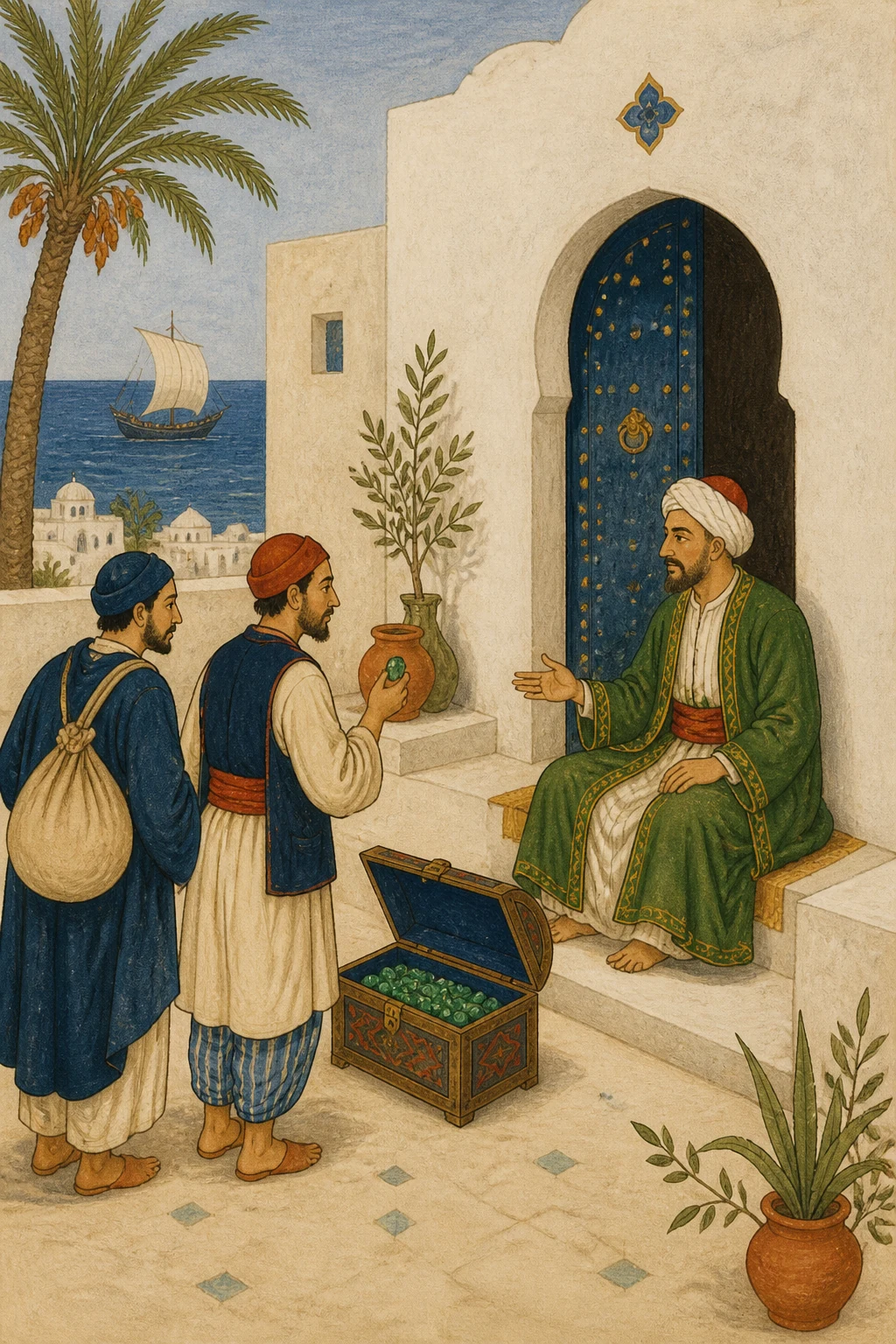
There was once a Muslim man who, when the pilgrimage season came round, felt a longing to go to Mecca. He was well-to-do and owned two jars full of mahboub gold coins. He began wondering where he could hide them. He had a friend who was a Jewish tailor. “I’ll hide them with the Jew,” he said to himself.
He filled the necks of the jars with clarified butter, thinking, “Jews don’t eat clarified butter, so if I leave these with him, he won’t steal anything from them.” He left the jars with the Jew and set off on the pilgrimage. One day, while the Jew’s wife was busy about the house, she accidentally knocked against one of the jars and broke it. The gold coins spilled out and scattered everywhere. She gathered them up, called her husband, and said, “Come and look!”
He came and saw the gold. He searched the other jar and found that it too was full of coins. He took the two jars, breaking the other one as well, put the gold in a chest, and went out to buy two jars of clarified butter. These he kept in his house until the pilgrim returned. After spending two or three days at home, the pilgrim went to the Jew. “Give me back what I left in your keeping,” he said.
The Jew brought him two jars of clarified butter. He picked them up and carried them home. He looked into the first jar and pushed his hand down through its neck, but found no gold at the bottom. He went back to the Jew, distressed and burning with anger. “Where are the two jars I brought you?” he demanded.
The Jew looked at him and said, “Those are the ones you brought me. That’s how I found them.” “My jars were full of gold! There was clarified butter on top and gold underneath.” “Then your jars must have been transformed,” said the Jew. The pilgrim was furious. They began quarrelling and went before Rashid. “May the Prophet intercede for you!” the pilgrim said. “I gave this Jew two jars of gold for safekeeping while I went on the pilgrimage. When I came back, I found them full of clarified butter.” “Perhaps they were transformed,” said the Jew. “God, glory be to Him, has power over all things!” said Rashid. “Go along, my son. You have no claim.” The poor pilgrim went home, weighed down with grief at the loss of his money, for money is like a piece of one’s own liver. As he was walking along, he met Ba Nwas. “What’s the matter with you, my friend?” Ba Nwas asked.
“The Jew has swallowed up everything I own,” he replied. “Strike a bargain with me,” said Ba Nwas, “and I’ll recover your money.” “I’ll give you two hundred mahboubs.” “Good.” Now Ba Nwas had a Christian friend, an image-maker who made likenesses of people from moulds. He went to him and said, “Make me an image just like the Jewish tailor.” “Take me to him and show him to me,” his friend replied. So he took him there. The Christian studied the Jew, quickly took a mould of his face, and went home to make a large image of him, his very likeness, with nothing added or left out. He sent word to Ba Nwas: “The Jew’s image is ready.” Ba Nwas sent for the pilgrim, brought out the image, and asked, “Do you like it?” “I do, but what good will it do me? Where’s the money?” Ba Nwas looked at him. “Wait and see! Go and buy me a monkey.” The man went and bought a monkey. Ba Nwas took it, set the image in front of it, picked up a stick, and began beating it. Whenever the blows hurt, the monkey would turn, see the image, and run behind it. As soon as it hid behind the image, Ba Nwas stopped beating it and left it alone. In time the monkey learned:
whenever Ba Nwas was about to strike it, it should run behind the image. Then Ba Nwas turned to the pilgrim and said, “Now go to the Jew, make friends with him again, and don’t bring up the money. When he isn’t looking, steal his son and bring him here. You’ll get your money back.” “Very well,” said the pilgrim. He went to the Jew and began sitting with him and drinking coffee beside him as he had always done. One day the Jew had an errand to run. Before leaving, he turned to the pilgrim and said, “Keep an eye on the little boy there.” The Jew went out. The pilgrim watched him until he was well away, then tucked the boy under his cloak and left. He took him to Ba Nwas, who gave him the monkey in exchange and said, “Go back to the shop and put the monkey where the boy was sitting. Buy half a loaf of bread and an ounce of clarified butter, but don’t finish eating before the Jew comes back. When he asks, ‘Where’s my son?’ tell him, ‘There’s your son!’ When he says, ‘What’s happened to him? He’s turned into a monkey!’ tell him, ‘When I began eating the bread and clarified butter, he ate with me
and was transformed, because clarified butter is forbidden in your religion: you eat only fresh butter.’” The pilgrim went back to his place, brought some bread and clarified butter, and sat down to eat while he waited for the Jew. When the Jew returned, he looked around and found that his son was nowhere to be seen. He turned to the pilgrim. “Where’s my son?” “There’s your son!”
“O Adonai! What’s happened to him? My son has turned into a monkey! What is this?” “Well, my Jewish friend, he came and ate bread and clarified butter with me. Since clarified butter is forbidden in your religion, he was transformed.” The Jew began shouting and went to lodge a complaint with Rashid. Ba Nwas was at court. The Jew complained to the king, saying, “My lord, I left my son in my shop with this pilgrim, and when I returned I found him turned into a monkey!” Rashid looked at the pilgrim. “And what have you to say?” “My lord, it’s quite true that he left his son with me. I went to buy some bread and an ounce of clarified butter. I began eating, and the boy came and ate with me. I couldn’t very well tell him not to eat. He took one mouthful with me, then a second,
and his shape changed: he turned into a monkey.” “My lord,” said the Jew, “since our lord Jesus came down to earth, such transformations have ceased.” Rashid looked at him. “Indeed they have, my son.”
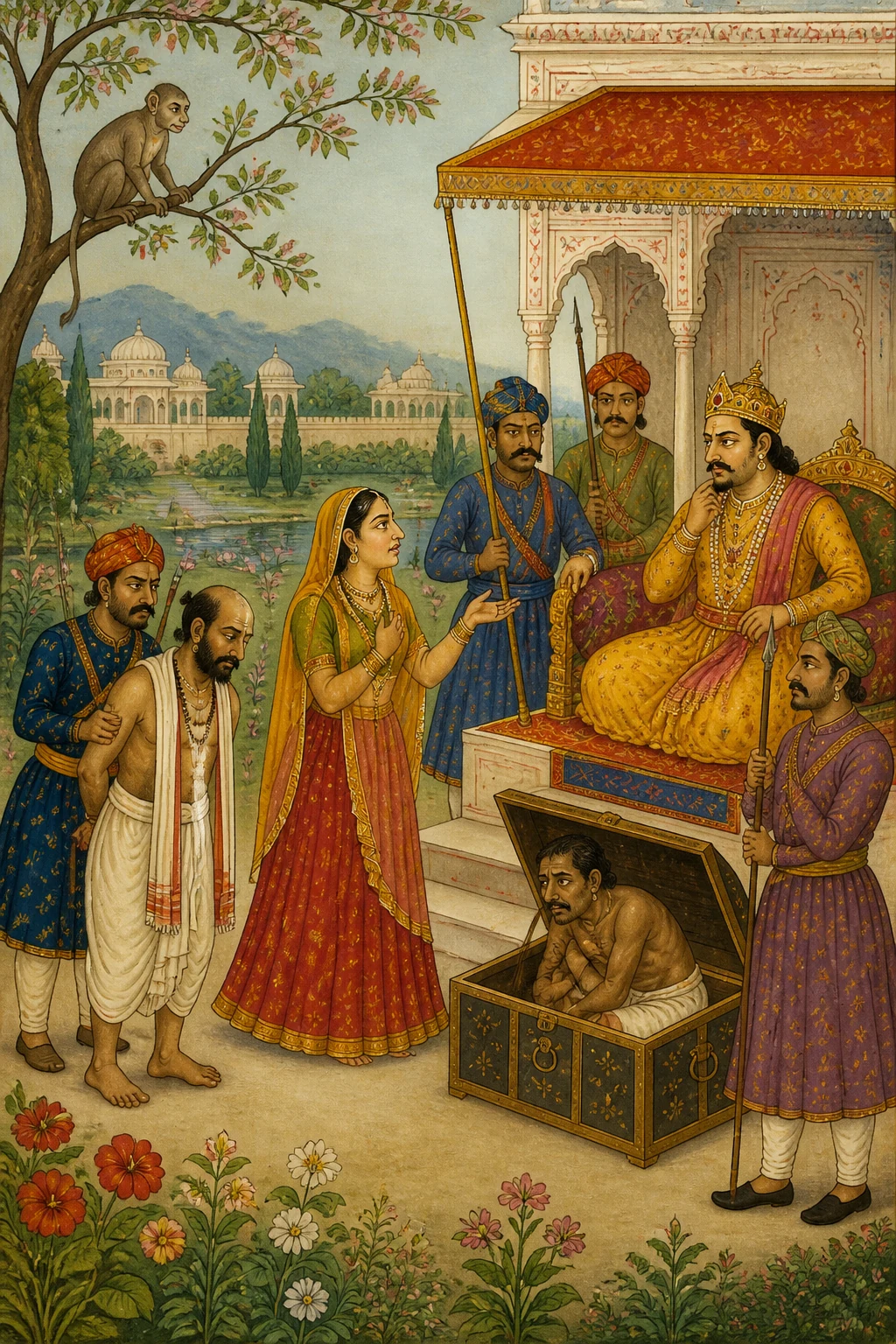
Then Ba Nwas turned to Rashid. “My lord, let us bring in the monkey. If it recognises him, leaps upon him, and embraces him, then it is his son. If it doesn’t leap upon him and doesn’t recognise him, then it is not his son.” They went and fetched the monkey and set it down in the court, before Rashid and his courtiers. Ba Nwas said, “Let everyone stand where he is. Whichever man the monkey goes to must be its father.” Everyone stood up, each in his place. Ba Nwas fixed the monkey with a fierce look, as though he were about to beat it. The monkey leapt up, threw itself round the Jew’s neck, and clung to him.
The Jew tried to pull the monkey away, but it went on hugging him and would not let go. “Come now,” said Rashid, “take your son and go.” The Jew looked at Rashid. “My lord, such transformations no longer happen!” Ba Nwas turned to the Jew. “So now you question transformations! You yourself said that the gold was transformed into clarified butter. The God who transformed gold into clarified butter can transform a human being into a monkey.” Rashid turned to the Jew. “Indeed, He who can transform gold can transform a human being. Go on, take your son and go home.” The Jew took the monkey and left. The pilgrim caught up with him on the road and said, “Look after that monkey. Your son is with me, and I’ve put him in a dungeon. Every day I’ll give him five hundred lashes and torment him. Unless you return my two jars of gold, with not so much as a dirham missing, I’ll begin cutting flesh from your son, roasting it, and feeding it to him.” The Jew could not bear the thought of what would happen to his own flesh and blood. He went and returned the pilgrim’s gold, and the pilgrim gave him back his son.