Prevod
Great-grandfather was such a dear, wise, good man; we all looked up to him. For as far back as I could remember, he had actually been called Grandfather, by his sons’ and daughters’ children alike, but when my brother Frederik’s little son joined the family, he was promoted to Great-grandfather; he could not hope to rise any higher in his lifetime! He was so fond of us all, but he did not seem very fond of the age we lived in. “The old days were good days!” he said. “Steady and sound they were! Now everything goes at a gallop, and everything is turned upside down. Young people do all the talking, and speak of kings themselves as though they were their equals. Anyone off the street can dip his rag in foul water and wring it out over an honourable man’s head!”
When Great-grandfather spoke like this, his face grew quite red; but a little later his kindly smile returned, and with it the words: “Well, well! Perhaps I am somewhat mistaken! I stand in the old days and cannot quite find my footing in the new. May the Lord guide and lead them!”
When Great-grandfather spoke of the old days, it was as though they came back to me. In my imagination I rode in a golden coach with liveried attendants, watched the guilds carry their signs in procession with music and banners, and joined in the merry Christmas parties with forfeits and dressing-up. Of course, there had also been much that was dreadful and terrible in those days—gibbets, breaking wheels, and bloodshed—but all those horrors had something alluring and stirring about them. I heard of the Danish noblemen who set the peasants free, and of Denmark’s crown prince, who abolished the slave trade.
It was delightful to hear Great-grandfather tell these stories, to hear about the days of his youth; yet the time before that was the most glorious of all, so mighty and grand.
“It was barbarous!” said my brother Frederik. “Thank God we have left it behind!” And he said it straight to Great-grandfather’s face. That was not proper, and yet I had great respect for Frederik; he was my eldest brother, and old enough to be my father, he said. He said so many funny things. He had passed his school-leaving examination with the highest marks, and was so capable in Father’s office that he would soon be able to join the business. He was the one Great-grandfather talked with most, but they always ended up arguing. Those two did not understand each other and never would, the whole family said; but young as I was, I soon noticed that neither could do without the other.
Great-grandfather listened with shining eyes when Frederik talked or read aloud about advances in science, discoveries of the forces of nature, and all the marvels of our age.
“People are growing cleverer, but not better!” Great-grandfather would say. “They invent the most dreadful weapons to destroy one another!” “Then the war is over all the sooner!” said Frederik. “One need not wait seven years for the blessing of peace! The world is full-blooded; it must be bled now and then. It is necessary!”
One day Frederik told him something that had actually happened in our own time, in a small country. The mayor’s clock, the great clock on the town hall, gave the time to the town and its inhabitants. It did not keep quite the right time, but the whole town went by it all the same. Now railways came to that country too, and since they connect with those of all the other countries, one must know the exact time, or there will be collisions. The railway had its own clock, set by the sun; it kept the right time, but the mayor’s did not, and now everyone in town went by the railway clock.
I laughed and thought it an amusing story, but Great-grandfather did not laugh; he grew quite serious. “There is a good deal in what you have just told me!” he said. “And I understand what you mean by telling it to me. There is a lesson in your clockwork. It makes me think of another clock, my parents’ old, plain Bornholm clock with its lead weights; it measured the hours of their lives and of my childhood. It may not have kept perfectly accurate time, but it went, and we looked at the hand, trusted it, and never thought about the wheels inside. The machinery of state was like that in those days too: one looked at it with confidence and believed in the hand. Now the machinery of state has become a clock of glass, where one can look straight into the works and see the wheels turning and whirring; one grows quite anxious about this pivot, that wheel! What will become of the timekeeping, I wonder, and I no longer have my childhood faith. That is the weakness of the present age!”
And so Great-grandfather talked himself into quite a temper. He and Frederik could not get along together, but neither could they part, “just like the old age and the new!” Both of them, and the whole family, came to feel this when Frederik had to travel far away, to America. The journey had to be made on the firm’s business. It was a painful parting for Great-grandfather, and the journey was so long, right across the ocean to another part of the globe.
“You shall have a letter from me every fortnight!” said Frederik. “And faster than any letter, you will hear from me along the telegraph wire; days will become hours, and hours minutes!”
A greeting came along the telegraph wire when Frederik went aboard ship in England. Sooner than any letter, even if the flying clouds had carried the mail, a greeting came from America, where Frederik had landed only a few hours before.
“It is indeed a thought of God’s that has been granted to our age!” said Great-grandfather. “A blessing for mankind!” “And it was in our country that those forces of nature were first understood and explained, Frederik has told me.”
“Yes,” said Great-grandfather, and kissed me. “Yes, and I have looked into the two gentle eyes that first saw and understood this force of nature; they were childlike eyes, like yours! And I have clasped his hand!” And then he kissed me again.
More than a month had passed when a letter from Frederik brought the news that he had become engaged to a lovely young girl whom the whole family was sure to like. Her photograph was sent and examined both with the naked eye and through a magnifying glass, for that is the wonderful thing about such pictures: they bear inspection under the strongest lenses, and indeed the likeness becomes even clearer. No painter has ever achieved that, not even the greatest of the old masters.
“If only that invention had been known in those days!” said Great-grandfather. “Then we could have looked the world’s benefactors and great men in the face! How gentle and good this young girl looks!” he said, gazing through the glass. “I shall know her when she walks through the door!”
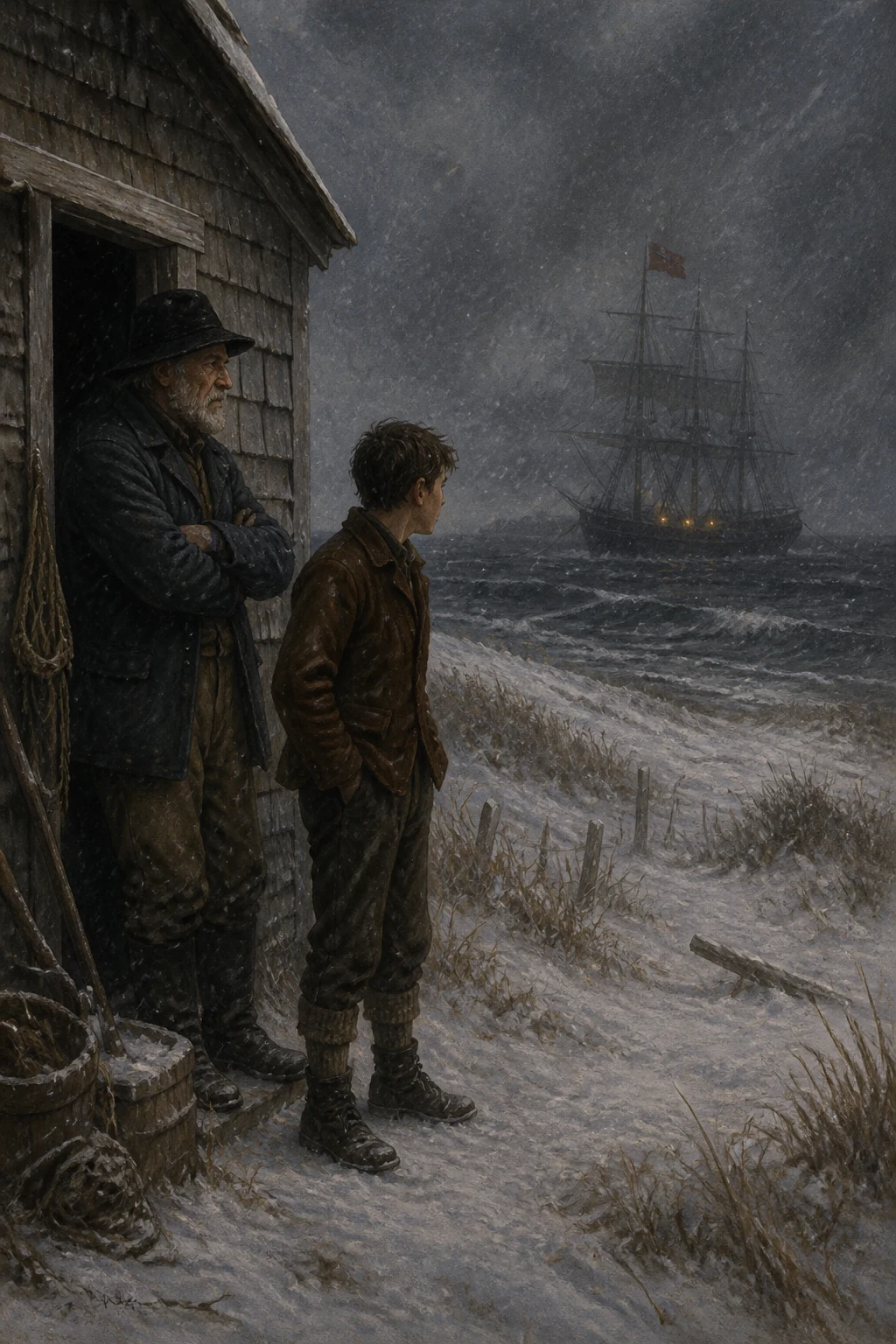
But that very nearly never happened; fortunately, we at home did not learn the full extent of the danger until it was past. The young newlyweds reached England happy and well, and from there they were to take a steamship to Copenhagen. They sighted the Danish coast, the white sand dunes of western Jutland; then a storm arose, the ship struck one of the sandbars and ran aground. The seas rose high and threatened to break the vessel apart; no lifeboat could come to their aid. Night fell, but in the midst of the darkness a bright rocket shot from the shore across the stranded ship. The rocket cast its rope over the vessel, a link was made between those out at sea and those on land, and soon, through the heavy, rolling waves, a beautiful young woman was drawn ashore in the rescue basket, alive and well. And she was overjoyed when her young husband soon stood beside her on dry land. Everyone aboard was saved; morning had not yet dawned.
We lay sweetly asleep in Copenhagen, thinking neither of sorrow nor of danger. When we gathered round the table for our morning coffee, a report arrived by telegram that an English steamship had been wrecked on the west coast. Our hearts filled with dread, but within the same hour a telegram came from our dear ones, safely rescued and back in their own country: Frederik and his young wife, who would soon be with us.
They all wept; I wept too, and Great-grandfather wept, folded his hands, and—I am sure of it—blessed the new age. That day Great-grandfather gave two hundred rigsdalers towards the monument to Hans Christian Ørsted.
When Frederik came home with his young wife and heard about it, he said: “That was right, Great-grandfather! Now I shall read you what Ørsted wrote many years ago about the old days and our own!”
“I suppose he shared your opinion?” said Great-grandfather. “Yes, you may be sure of that!” said Frederik. “And you are on our side too—you have contributed to his monument!”