O besedilu
Pokol snubcev
- Vir
- Odiseja
- Avtor
- Homer
- Jezik branja
- English
- Jezik izvirnika
- Ancient Greek
- Čas branja
- 24 min branja
- Obseg
- 19 strani
- Naslov izvirnika
- The Slaughter of the Suitors
O izvirniku
Odiseja
Dolga vrnitev domov čez morja, otoke, preizkušnje in prepoznavanja. Bralni jezik je English, izvirnik pa prihaja iz vira Odiseja v jeziku Ancient Greek.
Besedilo
Pokol snubcev
Then resourceful Odysseus stripped off his rags and sprang onto the great threshold, holding his bow and a quiver full of arrows. He poured the swift shafts out before his feet and spoke to the suitors: “This harmless contest is over. Now I shall try another target, one no man has ever struck, and see if I can hit it. May Apollo grant me glory!”
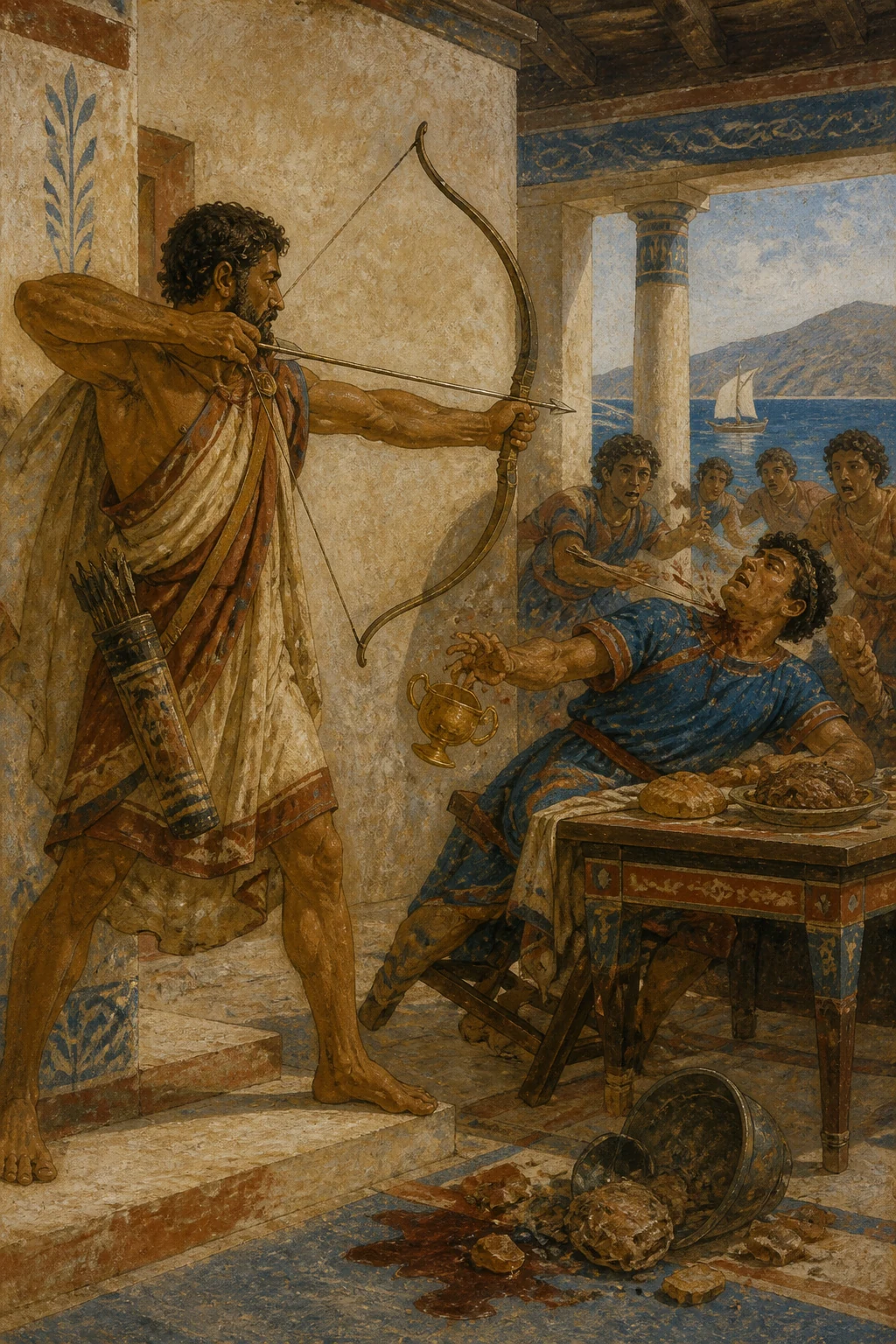
With that he aimed a bitter arrow at Antinous. Antinous was just about to lift a lovely golden cup with two handles; already he was turning it in his hands to drink the wine. No thought of death troubled his heart. Who would imagine that one man among so many feasting guests, however strong he might be, would bring him an evil death and black destruction?
Odysseus took aim and shot him in the throat, and the point passed straight through his tender neck. He sagged to one side, and the cup fell from his stricken hand. At once a thick jet of blood surged from his nostrils. His foot lashed out and thrust the table away, spilling the food to the ground, where bread and roasted meat lay fouled. The suitors raised an uproar through the hall when they saw the man fall. In turmoil they sprang from their seats and peered in every direction along the well-built walls. But nowhere was there a shield or a stout spear to seize.
They assailed Odysseus with angry words: “Stranger, you will pay for shooting at men! You will enter no more contests. Your own sheer destruction is certain now. You have killed the finest young man in Ithaca. The vultures will eat you here!”
So each man spoke, for they thought he had killed the man unwillingly. Fools, they did not understand that the cords of destruction had already been fastened upon them all. Resourceful Odysseus glared at them and said: “You dogs! You thought I would never come home again from the land of Troy, and so you ravaged my house, forced my serving women to lie with you, and courted my wife while I was still alive. You feared neither the gods who hold the broad heavens nor the indignation of men in days to come. Now the cords of destruction are fastened upon you all.”
At his words, pale terror seized them all, and each man looked about for a way to escape sheer destruction. Eurymachus alone answered him: “If you are indeed Odysseus of Ithaca, come home at last, you are right to speak of all the Achaeans have done, their many reckless deeds within your halls and out upon your lands.
“But the man who caused it all lies dead already—Antinous. He drove us to these deeds, not so much because he longed or cared for marriage, but because he had other things in mind, which the son of Cronus never brought to pass: he meant to make himself king over the people of well-built Ithaca and kill your son in an ambush.
“Now he has met his destined death. Spare your own people. Afterward we will make amends, collecting throughout the land the value of all that has been eaten and drunk in your halls. Each of us will bring payment worth twenty oxen, and we will give you bronze and gold until your heart is soothed. Till then, no one can blame your anger.”
Resourceful Odysseus glared at him and answered: “Eurymachus, even if you gave me all your inheritance, everything you now possess, and added whatever else you could obtain, not even then would I keep my hands from killing until the suitors had paid for all their insolence.
“Now the choice lies before you: fight me face to face, or flee, if any of you can escape death and doom. But I think not one will escape sheer destruction.” So he spoke, and their knees and hearts gave way.
Then Eurymachus addressed them once again: “Friends, this man will not restrain his invincible hands. Now that he has the polished bow and quiver, he will shoot from the smooth threshold until he has killed us all. Come, let us turn our minds to battle!
“Draw your swords and hold the tables before you against his deadly arrows. Let us all rush him together and see if we can drive him from the threshold and the doors. Then we can get out into the town and raise the alarm at once. This man would soon have shot his last!”
With that he drew his sharp bronze sword, edged on both sides, and sprang at Odysseus with a dreadful shout. At the same moment noble Odysseus loosed an arrow. It struck his chest beside the nipple and drove its swift point into his liver. His sword dropped from his hand to the ground, and he doubled over a table and fell across it, spilling the food and the two-handled cup to the floor. In his agony he battered the earth with his forehead and kicked with both feet, shaking his chair. Darkness poured over his eyes.
Amphinomus rushed straight at glorious Odysseus, his sharp sword drawn, hoping to force him back from the doors. But Telemachus struck first, driving his bronze-tipped spear into his back between the shoulders and clean through his chest. He fell with a crash and struck the ground full on his forehead.
Telemachus sprang away, leaving the long-shadowed spear in Amphinomus. He feared that, as he drew it out, one of the Achaeans might rush him with a sword and strike him, or stab him as he bent forward.
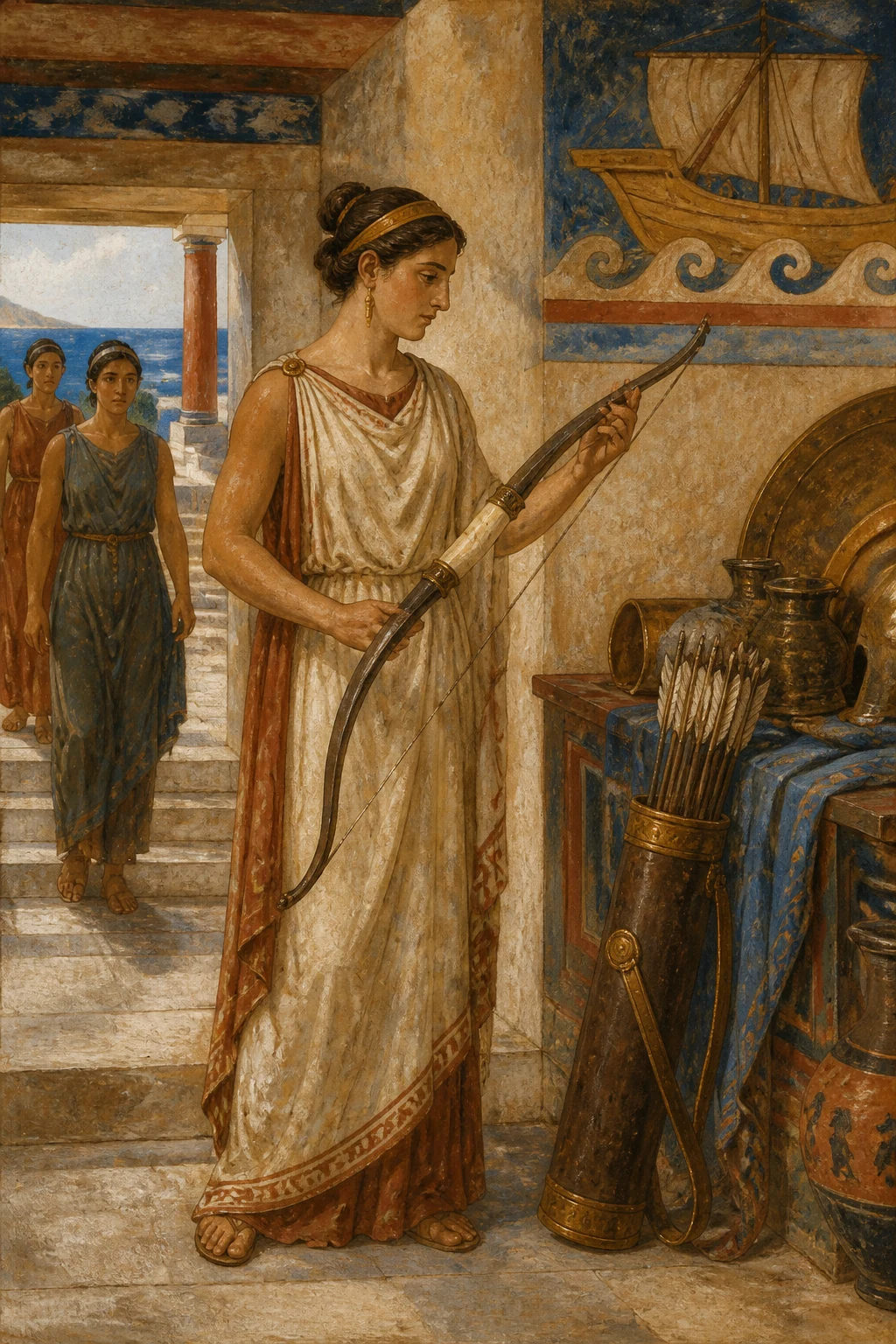
He ran and quickly reached his dear father. Standing close beside him, he spoke winged words: “Father, I will fetch you a shield, two spears, and a helmet of solid bronze that fits close at the temples. I will arm myself as well, and bring armor for the swineherd and the cowherd. It is better to be armed.”
Resourceful Odysseus answered him: “Run and fetch them while I still have arrows to defend myself, or they may drive me from the doors while I stand here alone.” So he spoke, and Telemachus obeyed his dear father and went to the storeroom where his splendid weapons lay.
From there he took four shields, eight spears, and four bronze helmets crested thickly with horsehair. He carried them back and quickly reached his dear father. First he clothed himself in bronze, and the two servants likewise put on the fine armor. Then they took their stand beside brave Odysseus, master of many wiles.
As long as he had arrows to defend himself, Odysseus kept aiming and striking down one suitor after another in his own house, and they fell close together. But when the arrows failed the shooting king, he set the bow upright against a pillar of the well-built hall, beside the gleaming wall. Then he slung a four-layered shield over his shoulder, set a well-made helmet on his mighty head, its horsehair crest nodding fearfully above him, and took up two strong spears tipped with bronze.
There was a raised side door in the well-built wall, and beside the far end of the hall’s threshold a passage led into an alley, closed by tightly fitted doors. Odysseus ordered the noble swineherd to stand close by and guard it, for it offered only a single way of attack.
Agelaus spoke out for all to hear: “Friends, could not someone climb up through that side door and tell the people, so that the alarm could be raised at once? This man would soon have shot his last!”
But Melanthius the goatherd answered him: “That cannot be, Agelaus, favored of Zeus. The fine courtyard doors are dangerously close, and the mouth of the passage is narrow. One brave man could hold us all back.
“Instead, let me bring you weapons from the storeroom so that you can arm yourselves. It is there, I think, and nowhere else, that Odysseus and his glorious son have put the weapons.” With that, Melanthius the goatherd climbed through the passages of the hall to Odysseus’ storerooms.
He took twelve shields from there, as many spears, and as many bronze helmets crested thickly with horsehair. He hurried back and gave them to the suitors. Then Odysseus’ knees and heart gave way when he saw them putting on armor and brandishing long spears in their hands. The task before him seemed formidable.
At once he spoke winged words to Telemachus: “Telemachus, surely one of the women in the hall is stirring up this deadly battle against us—or else Melanthius.” Thoughtful Telemachus answered him: “Father, the fault was mine, and no one else is to blame. I left the closely fitted storeroom door standing open. Their lookout was more alert than I was.
“Go now, good Eumaeus, shut the storeroom door and find out whether one of the women is doing this, or Melanthius, Dolius’ son, as I suspect.” While they were speaking together, Melanthius the goatherd went back to the storeroom to fetch more fine armor. The noble swineherd saw him and at once spoke to Odysseus, who stood nearby: “Son of Laertes, sprung from Zeus, Odysseus of many devices, there goes that villain again, the very man we suspected, making for the storeroom. Tell me plainly: shall I kill him, if I can overpower him, or bring him here to you, to pay for all the outrages he has devised in your house?”
Resourceful Odysseus answered him: “Telemachus and I will hold the proud suitors here inside the hall, however fiercely they press us. You two must twist his feet and hands behind his back and throw him into the storeroom, then fasten the doors behind you. Tie a plaited rope about him, haul him up the tall pillar, and bring him close beneath the beams, so that he may live a long while and suffer bitter pain.” So he spoke, and they listened closely and obeyed. They went to the storeroom, unseen by the man within.
He was searching for weapons in the depths of the room, while they stood waiting on either side of the doorposts. As Melanthius the goatherd crossed the threshold, carrying a fine helmet in one hand and in the other a broad, ancient shield, coated with mold—the shield the hero Laertes had carried in his youth, long since laid aside, its leather stitching coming loose—the two sprang upon him. They seized him by the hair and dragged him inside, threw him to the floor in anguish, and twisted his hands and feet far back, binding them tightly in cruel bonds, as Laertes’ son, much-enduring noble Odysseus, had commanded. Then they fastened a plaited rope about him, hauled him up the tall pillar, and brought him close beneath the beams.
Then you mocked him, Eumaeus the swineherd: “Now, Melanthius, you will certainly keep watch all night, lying in a soft bed, as you deserve. Nor will early-born Dawn on her golden throne escape your notice when she comes from Ocean’s streams, at the hour when you drive the goats to the house to provide the suitors’ feast.”
So he was left there, stretched in his deadly bonds. The two put on their armor, shut the shining door, and went back to brave Odysseus, master of many wiles. There they stood breathing battle, four men on the threshold, while within the hall their enemies were many and strong.
Then Athena, daughter of Zeus, came close to them, like Mentor in both form and voice. Odysseus rejoiced at the sight of her and said: “Mentor, ward off destruction! Remember your dear companion, all the kindness I have shown you. We are of an age.”
So he spoke, suspecting that this was Athena, rallier of armies. Across the hall the suitors shouted threats. Agelaus, son of Damastor, was the first to rebuke her: “Mentor, do not let Odysseus talk you into fighting the suitors and coming to his aid.
“For I think our purpose will be accomplished in this way: when we have killed these two, father and son, you will die with them for the deeds you mean to do here in the hall. You will pay with your own head.
“And when our bronze has stripped you of your strength, we will mingle all your possessions, within your house and outside it, with those of Odysseus. Nor will we allow your sons or daughters to live in your halls, or your faithful wife to walk through the town of Ithaca.”
So he spoke, and Athena’s anger burned still hotter in her heart. She rebuked Odysseus with angry words: “Odysseus, you no longer have the steadfast strength and courage you possessed when, for the sake of white-armed Helen of noble birth, you fought the Trojans without respite for nine years. You killed many men in dreadful battle, and through your counsel Priam’s city of broad streets was taken.
“How is it that now, when you have reached your own house and possessions, you shrink from showing your strength against the suitors? Come here, my friend, stand beside me and watch what I do, so that you may learn how Mentor, son of Alcimus, repays your kindness among your enemies.”
So she spoke, but she did not yet give him a victory wholly his own. She was still testing the strength and courage of Odysseus and his glorious son. She herself darted up to a roof beam of the smoke-darkened hall and perched there in the likeness of a swallow.
Agelaus, son of Damastor, urged on the suitors, with Eurynomus, Amphimedon, Demoptolemus, Peisander son of Polyctor, and brave Polybus. These were by far the best in valor of the suitors who still lived and fought for their lives. The rest the bow and its shower of arrows had already laid low.
Agelaus spoke out for all to hear: “Friends, this man will soon have to check his invincible hands. Mentor has gone, after uttering empty boasts, and they are left alone at the entrance.
“So do not all throw your long spears at once. Let the six of us cast first, and see whether Zeus will grant that Odysseus be struck and the glory be ours. The others will be no trouble once he has fallen.”
So he spoke, and eagerly they all cast their spears as he commanded. But Athena made every throw go wide. One struck a pillar of the well-built hall, another the closely fitted door, and another bronze-weighted ash spear crashed against the wall.
When they had escaped the suitors’ spears, much-enduring noble Odysseus spoke first: “Friends, now I would say it is our turn to cast into the press of suitors, who long to kill us and add that to their former crimes.”
So he spoke, and they all took straight aim and hurled their sharp spears. Odysseus struck Demoptolemus, Telemachus Euryades, the swineherd Elatus, and the keeper of the cattle killed Peisander.
All four fell together and bit the broad earth. The suitors drew back into the depths of the hall, while the others rushed forward and pulled their spears from the dead. Again the suitors eagerly cast their sharp spears, but Athena made most of them go wide.
One struck a pillar of the well-built hall, another the closely fitted door, and another bronze-weighted ash spear crashed against the wall. Amphimedon struck Telemachus a glancing blow on the wrist, but the bronze only grazed the skin.
Ctesippus’ long spear scraped Eumaeus’ shoulder above his shield, then flew past and fell to the ground. Once more the men around brave Odysseus, master of many wiles, cast their sharp spears into the press of suitors.
Then Odysseus, sacker of cities, struck Eurydamas, Telemachus struck Amphimedon, and the swineherd Polybus. The keeper of the cattle struck Ctesippus in the chest and exulted over him: “Son of Polytherses, lover of mockery, never again give way to folly and speak so proudly. Leave the word to the gods, for they are far stronger than you.
“Here is a guest-gift in return for that hoof you once gave godlike Odysseus as he wandered begging through his house.” So spoke the keeper of the crumple-horned cattle. Meanwhile Odysseus struck Damastor’s son at close quarters with his long spear.
Telemachus stabbed Leocritus, son of Evenor, in the middle of the flank and drove the bronze clean through. He fell forward and struck the ground full on his forehead. Then Athena raised the aegis that destroys mortals, high above them from the roof, and their hearts were struck with terror.
They fled through the hall like cattle in a herd, driven wild by the darting gadfly when it attacks in springtime, as the days grow long. And the others were like vultures with hooked talons and crooked beaks that swoop from the mountains upon birds: the birds scatter over the plain, cowering beneath the clouds, but the vultures pounce and kill them, and there is no defense or escape, while men rejoice in the hunt. So they rushed upon the suitors through the house and struck them on every side. Hideous groans rose as heads were battered, and the whole floor seethed with blood.
Leiodes rushed to Odysseus and clasped his knees. Begging him, he spoke winged words: “I am at your knees, Odysseus. Respect my plea and pity me. I swear I never said or did anything outrageous to any woman in these halls. I even tried to restrain the other suitors whenever they behaved that way.
“But they would not listen when I told them to keep their hands from evil. And so their recklessness has brought them a shameful death. Yet I, their diviner, who have done no wrong, shall lie among them. There is no gratitude afterward for good deeds.” Resourceful Odysseus glared at him and said: “If you claim to have been their diviner, you must often have prayed in this house that the day of my sweet return should remain far off, and that my dear wife should follow you and bear you children. So you shall not escape a grievous death.”
With that he took in his strong hand a sword lying there, which Agelaus had dropped to the ground as he was killed. With it he struck Leiodes through the neck. His head fell in the dust while he was still speaking.
The singer Phemius, son of Terpius, who had sung among the suitors under compulsion, was still trying to escape black death. He stood near the side door with his clear-toned lyre in his hands, turning over two courses in his mind: should he slip out of the hall and sit at the altar built to mighty Zeus, guardian of the courtyard, where Laertes and Odysseus had burned so many thighs of oxen, or should he rush to Odysseus and clasp his knees in supplication?
As he considered, it seemed wiser to clasp the knees of Odysseus, son of Laertes. He set his hollow lyre on the ground between the mixing bowl and a silver-studded chair, then rushed to Odysseus and clasped his knees. Begging him, he spoke winged words: “I am at your knees, Odysseus. Respect my plea and pity me. You yourself will grieve hereafter if you kill a singer who sings for gods and men.
“I am self-taught, and a god has planted in my heart the paths of every kind of song. I could sing beside you as before a god. Do not be eager, then, to cut my throat. Your dear son Telemachus can tell you that I never came to your house willingly or of my own desire to sing among the suitors at their feasts. They were far more numerous and stronger, and brought me here by force.”
So he spoke, and the noble Telemachus heard him. At once he addressed his father, who stood nearby: “Hold back! Do not strike this innocent man with your bronze. And let us save the herald Medon, too, who always cared for me in our house when I was a child—unless Philoetius or the swineherd has already killed him, or he met you as you stormed through the hall.”
So he spoke, and wise Medon heard him. He lay cowering beneath a chair, wrapped in the freshly flayed hide of an ox, trying to escape black death. At once he sprang from beneath the chair and quickly threw off the hide. Then he rushed to Telemachus and clasped his knees, begging him with winged words: “Dear friend, here I am! Hold back, and tell your father not to use his great strength to kill me with his sharp bronze in his anger at the suitors, who devoured his wealth in the halls and, fools that they were, showed you no respect.”
Resourceful Odysseus smiled at him and said: “Take courage. This man has protected you and saved your life, so that you may know in your heart, and tell others too, how much better kindness is than wrongdoing.
“But leave the hall, you and the famous singer, and sit outside in the courtyard, away from the slaughter, while I attend to what must be done in the house.” So he spoke, and the two went out of the hall and sat by the altar of mighty Zeus, peering about in every direction, still expecting death.
Odysseus searched his house to see whether any man still hid alive, trying to escape black death. But he saw them all lying in their blood and dust, a multitude like fish that fishermen have drawn from the gray sea in a net of many meshes and tipped onto the curving shore. They lie heaped upon the sand, longing for the sea’s waves, while the blazing sun takes away their lives. So the suitors lay heaped upon one another.
Then resourceful Odysseus said to Telemachus: “Telemachus, come, call the nurse Eurycleia here, so that I may tell her what is in my mind.” So he spoke, and Telemachus obeyed his dear father. He moved the door aside and called to the nurse Eurycleia: “Come, rise, old mother, you who oversee the serving women in our house. Come here. My father is calling you; he has something to tell you.”
So he spoke, and his words needed no repeating. She opened the doors of the well-appointed hall and came out, while Telemachus led the way. There she found Odysseus among the slain, spattered with blood and gore like a lion returning from devouring an ox in the fields. Its whole chest and both cheeks are bloody, and it is terrible to look upon. So Odysseus was spattered from his feet to his hands above.
When she saw the bodies and the boundless blood, she was about to raise a cry of triumph at the mighty deed before her. But Odysseus checked her and restrained her eagerness, speaking winged words: “Rejoice in your heart, old mother, but restrain yourself and do not cry aloud. It is unholy to exult over slain men.
“The fate ordained by the gods and their own wicked deeds brought these men down. They respected no one on earth who came among them, neither lowborn nor noble. And so their recklessness has brought them a shameful death.
“Now tell me which women in the house have dishonored me, and which are innocent.” His dear nurse Eurycleia answered him: “Then I will tell you the truth, my child.
“You have fifty serving women in the house, whom we have taught to do their work, to card wool and endure their servitude. Of these, twelve in all have taken the path of shamelessness, respecting neither me nor Penelope herself.
“Telemachus was only just growing up, and his mother would not allow him to give orders to the serving women. But let me go upstairs to the bright upper rooms and tell your wife, upon whom some god has cast a sleep.”
Resourceful Odysseus answered her: “Do not wake her yet. Tell the women who have behaved so shamefully to come here.” So he spoke, and the old woman went through the hall to give the women his message and hurry them along.
Then he called Telemachus, the cowherd, and the swineherd to him and spoke winged words: “Begin carrying out the dead, and order the women to help. Then have them clean the beautiful chairs and tables with water and porous sponges.
“When you have put the whole house in order, take the serving women out of the well-built hall into the space between the round storehouse and the courtyard’s stout wall. Strike them with your long-edged swords until you have taken the life from every one of them and they have forgotten the pleasures of Aphrodite that they enjoyed with the suitors in their secret embraces.”
So he spoke, and the women all came together, wailing bitterly and shedding floods of tears. First they carried out the bodies of the dead and laid them beneath the portico of the well-walled courtyard, propping them against one another. Odysseus himself directed them and drove them on, and under compulsion they carried them out.
Then they cleaned the beautiful chairs and tables with water and porous sponges. Telemachus, the cowherd, and the swineherd scraped the floor of the solidly built house with shovels, while the serving women carried the scrapings outside.
When they had put the whole hall in order, they led the serving women out of the well-built hall and penned them in the narrow space between the round storehouse and the courtyard’s stout wall, where there was no way of escape.
Then thoughtful Telemachus began to speak: “I will not take the lives of these women by a clean death. They poured abuse upon my head and upon my mother, and slept beside the suitors.”
With that he fastened a cable from a dark-prowed ship to a tall pillar and cast it around the round storehouse, stretching it high so that none could touch the ground with her feet. As when thrushes or long-winged doves strike a net set in a thicket as they make for their roost, and a hateful bed receives them, so the women’s heads hung in a row, with nooses around all their necks, so that they might die most miserably.
Their feet struggled a little while, but not for long. Then they brought Melanthius out through the porch into the courtyard. With pitiless bronze they cut off his nose and ears, tore out his genitals for the dogs to eat raw, and in their fury chopped off his hands and feet.
After washing their hands and feet, they went back into the house to Odysseus. Their work was done. He spoke to his dear nurse Eurycleia: “Bring sulfur, old mother, to cleanse pollution, and bring me fire, so that I may purify the hall. Tell Penelope to come here with her attendants, and bid all the serving women come through the house.”
His dear nurse Eurycleia answered him: “Yes, my child, all you have said is right. But let me bring you a cloak and tunic to wear. Do not stand here in your halls with your broad shoulders covered in rags. It would be unseemly.”
Resourceful Odysseus answered her: “First let me have a fire here in the hall.” So he spoke, and his dear nurse Eurycleia obeyed. She brought fire and sulfur, and Odysseus thoroughly purified the hall, the house, and the courtyard.
The old woman went once more through Odysseus’ lovely house to tell the women and urge them to come. They came from their quarters with torches in their hands, crowded about Odysseus, and welcomed him, lovingly kissing his head and shoulders and clasping his hands. A sweet longing for tears and lamentation seized him, for in his heart he knew them all.
Izvirnik
The Slaughter of the Suitors
Naslednje strani prikazujejo izvirno besedilo za primerjavo.
αὐτὰρ ὁ γυμνώθη ῥακέων πολύμητις Ὀδυσσεύς, ἆλτο δʼ ἐπὶ μέγαν οὐδόν, ἔχων βιὸν ἠδὲ φαρέτρην ἰῶν ἐμπλείην, ταχέας δʼ ἐκχεύατʼ ὀϊστοὺς αὐτοῦ πρόσθε ποδῶν, μετὰ δὲ μνηστῆρσιν ἔειπεν· οὗτος μὲν δὴ ἄεθλος ἀάατος ἐκτετέλεσται· νῦν αὖτε σκοπὸν ἄλλον, ὃν οὔ πώ τις βάλεν ἀνήρ, εἴσομαι, αἴ κε τύχωμι, πόρῃ δέ μοι εὖχος Ἀπόλλων. ἦ καὶ ἐπʼ Ἀντινόῳ ἰθύνετο πικρὸν ὀϊστόν. ἦ τοι ὁ καλὸν ἄλεισον ἀναιρήσεσθαι ἔμελλε, χρύσεον ἄμφωτον, καὶ δὴ μετὰ χερσὶν ἐνώμα, ὄφρα πίοι οἴνοιο· φόνος δέ οἱ οὐκ ἐνὶ θυμῷ μέμβλετο· τίς κʼ οἴοιτο μετʼ ἀνδράσι δαιτυμόνεσσι
μοῦνον ἐνὶ πλεόνεσσι, καὶ εἰ μάλα καρτερὸς εἴη, οἷ τεύξειν θάνατόν τε κακὸν καὶ κῆρα μέλαιναν; τὸν δʼ Ὀδυσεὺς κατὰ λαιμὸν ἐπισχόμενος βάλεν ἰῷ, ἀντικρὺ δʼ ἁπαλοῖο διʼ αὐχένος ἤλυθʼ ἀκωκή. ἐκλίνθη δʼ ἑτέρωσε, δέπας δέ οἱ ἔκπεσε χειρὸς βλημένου, αὐτίκα δʼ αὐλὸς ἀνὰ ῥῖνας παχὺς ἦλθεν αἵματος ἀνδρομέοιο· θοῶς δʼ ἀπὸ εἷο τράπεζαν ὦσε ποδὶ πλήξας, ἀπὸ δʼ εἴδατα χεῦεν ἔραζε· σῖτός τε κρέα τʼ ὀπτὰ φορύνετο. τοὶ δʼ ὁμάδησαν μνηστῆρες κατὰ δώμαθʼ, ὅπως ἴδον ἄνδρα πεσόντα, ἐκ δὲ θρόνων ἀνόρουσαν ὀρινθέντες κατὰ δῶμα, πάντοσε παπταίνοντες ἐϋδμήτους ποτὶ τοίχους·
οὐδέ πη ἀσπὶς ἔην οὐδʼ ἄλκιμον ἔγχος ἑλέσθαι. νείκειον δʼ Ὀδυσῆα χολωτοῖσιν ἐπέεσσι· ξεῖνε, κακῶς ἀνδρῶν τοξάζεαι· οὐκέτʼ ἀέθλων ἄλλων ἀντιάσεις· νῦν τοι σῶς αἰπὺς ὄλεθρος. καὶ γὰρ δὴ νῦν φῶτα κατέκτανες ὃς μέγʼ ἄριστος κούρων εἰν Ἰθάκῃ· τῷ σʼ ἐνθάδε γῦπες ἔδονται. ἴσκεν ἕκαστος ἀνήρ, ἐπεὶ ἦ φάσαν οὐκ ἐθέλοντα ἄνδρα κατακτεῖναι· τὸ δὲ νήπιοι οὐκ ἐνόησαν, ὡς δή σφιν καὶ πᾶσιν ὀλέθρου πείρατʼ ἐφῆπτο.
τοὺς δʼ ἄρʼ ὑπόδρα ἰδὼν προσέφη πολύμητις Ὀδυσσεύς· ὦ κύνες, οὔ μʼ ἔτʼ ἐφάσκεθʼ ὑπότροπον οἴκαδʼ ἱκέσθαι δήμου ἄπο Τρώων, ὅτι μοι κατεκείρετε οἶκον, δμῳῇσιν δὲ γυναιξὶ παρευνάζεσθε βιαίως, αὐτοῦ τε ζώοντος ὑπεμνάασθε γυναῖκα, οὔτε θεοὺς δείσαντες, οἳ οὐρανὸν εὐρὺν ἔχουσιν, οὔτε τινʼ ἀνθρώπων νέμεσιν κατόπισθεν ἔσεσθαι· νῦν ὑμῖν καὶ πᾶσιν ὀλέθρου πείρατʼ ἐφῆπται. ὣς φάτο, τοὺς δʼ ἄρα πάντας ὑπὸ χλωρὸν δέος εἷλεν· πάπτηνεν δὲ ἕκαστος ὅπη φύγοι αἰπὺν ὄλεθρον.
Εὐρύμαχος δέ μιν οἶος ἀμειβόμενος προσέειπεν· εἰ μὲν δὴ Ὀδυσεὺς Ἰθακήσιος εἰλήλουθας, ταῦτα μὲν αἴσιμα εἶπας, ὅσα ῥέζεσκον Ἀχαιοί, πολλὰ μὲν ἐν μεγάροισιν ἀτάσθαλα, πολλὰ δʼ ἐπʼ ἀγροῦ. ἀλλʼ ὁ μὲν ἤδη κεῖται ὃς αἴτιος ἔπλετο πάντων, Ἀντίνοος· οὗτος γὰρ ἐπίηλεν τάδε ἔργα, οὔ τι γάμου τόσσον κεχρημένος οὐδὲ χατίζων, ἀλλʼ ἄλλα φρονέων, τά οἱ οὐκ ἐτέλεσσε Κρονίων, ὄφρʼ Ἰθάκης κατὰ δῆμον ἐϋκτιμένης βασιλεύοι αὐτός, ἀτὰρ σὸν παῖδα κατακτείνειε λοχήσας.
νῦν δʼ ὁ μὲν ἐν μοίρῃ πέφαται, σὺ δὲ φείδεο λαῶν σῶν· ἀτὰρ ἄμμες ὄπισθεν ἀρεσσάμενοι κατὰ δῆμον, ὅσσα τοι ἐκπέποται καὶ ἐδήδοται ἐν μεγάροισι, τιμὴν ἀμφὶς ἄγοντες ἐεικοσάβοιον ἕκαστος, χαλκόν τε χρυσόν τʼ ἀποδώσομεν, εἰς ὅ κε σὸν κῆρ ἰανθῇ· πρὶν δʼ οὔ τι νεμεσσητὸν κεχολῶσθαι. τὸν δʼ ἄρʼ ὑπόδρα ἰδὼν προσέφη πολύμητις Ὀδυσσεύς· Εὐρύμαχʼ, οὐδʼ εἴ μοι πατρώϊα πάντʼ ἀποδοῖτε, ὅσσα τε νῦν ὔμμʼ ἐστὶ καὶ εἴ ποθεν ἄλλʼ ἐπιθεῖτε, οὐδέ κεν ὣς ἔτι χεῖρας ἐμὰς λήξαιμι φόνοιο πρὶν πᾶσαν μνηστῆρας ὑπερβασίην ἀποτῖσαι.
νῦν ὑμῖν παράκειται ἐναντίον ἠὲ μάχεσθαι ἢ φεύγειν, ὅς κεν θάνατον καὶ κῆρας ἀλύξῃ· ἀλλά τινʼ οὐ φεύξεσθαι ὀΐομαι αἰπὺν ὄλεθρον. ὣς φάτο, τῶν δʼ αὐτοῦ λύτο γούνατα καὶ φίλον ἦτορ. τοῖσιν δʼ Εὐρύμαχος προσεφώνεε δεύτερον αὖτις· ὦ φίλοι, οὐ γὰρ σχήσει ἀνὴρ ὅδε χεῖρας ἀάπτους, ἀλλʼ ἐπεὶ ἔλλαβε τόξον ἐΰξοον ἠδὲ φαρέτρην, οὐδοῦ ἄπο ξεστοῦ τοξάσσεται, εἰς ὅ κε πάντας ἄμμε κατακτείνῃ· ἀλλὰ μνησώμεθα χάρμης.
φάσγανά τε σπάσσασθε καὶ ἀντίσχεσθε τραπέζας ἰῶν ὠκυμόρων· ἐπὶ δʼ αὐτῷ πάντες ἔχωμεν ἀθρόοι, εἴ κέ μιν οὐδοῦ ἀπώσομεν ἠδὲ θυράων, ἔλθωμεν δʼ ἀνὰ ἄστυ, βοὴ δʼ ὤκιστα γένοιτο· τῷ κε τάχʼ οὗτος ἀνὴρ νῦν ὕστατα τοξάσσαιτο. ὣς ἄρα φωνήσας εἰρύσσατο φάσγανον ὀξὺ χάλκεον, ἀμφοτέρωθεν ἀκαχμένον, ἆλτο δʼ ἐπʼ αὐτῷ σμερδαλέα ἰάχων· ὁ δʼ ἁμαρτῆ δῖος Ὀδυσσεὺς ἰὸν ἀποπροίει, βάλε δὲ στῆθος παρὰ μαζόν, ἐν δέ οἱ ἥπατι πῆξε θοὸν βέλος· ἐκ δʼ ἄρα χειρὸς φάσγανον ἧκε χαμᾶζε, περιρρηδὴς δὲ τραπέζῃ κάππεσεν ἰδνωθείς, ἀπὸ δʼ εἴδατα χεῦεν ἔραζε
καὶ δέπας ἀμφικύπελλον· ὁ δὲ χθόνα τύπτε μετώπῳ θυμῷ ἀνιάζων, ποσὶ δὲ θρόνον ἀμφοτέροισι λακτίζων ἐτίνασσε· κατʼ ὀφθαλμῶν δʼ ἔχυτʼ ἀχλύς. Ἀμφίνομος δʼ Ὀδυσῆος ἐείσατο κυδαλίμοιο ἀντίος ἀΐξας, εἴρυτο δὲ φάσγανον ὀξύ, εἴ πώς οἱ εἴξειε θυράων. ἀλλʼ ἄρα μιν φθῆ Τηλέμαχος κατόπισθε βαλὼν χαλκήρεϊ δουρὶ ὤμων μεσσηγύς, διὰ δὲ στήθεσφιν ἔλασσεν· δούπησεν δὲ πεσών, χθόνα δʼ ἤλασε παντὶ μετώπῳ.
Τηλέμαχος δʼ ἀπόρουσε, λιπὼν δολιχόσκιον ἔγχος αὐτοῦ ἐν Ἀμφινόμῳ· περὶ γὰρ δίε μή τις Ἀχαιῶν ἔγχος ἀνελκόμενον δολιχόσκιον ἢ ἐλάσειε φασγάνῳ ἀΐξας ἠὲ προπρηνέα τύψας. βῆ δὲ θέειν, μάλα δʼ ὦκα φίλον πατέρʼ εἰσαφίκανεν, ἀγχοῦ δʼ ἱστάμενος ἔπεα πτερόεντα προσηύδα· ὦ πάτερ, ἤδη τοι σάκος οἴσω καὶ δύο δοῦρε καὶ κυνέην πάγχαλκον, ἐπὶ κροτάφοις ἀραρυῖαν αὐτός τʼ ἀμφιβαλεῦμαι ἰών, δώσω δὲ συβώτῃ καὶ τῷ βουκόλῳ ἄλλα· τετευχῆσθαι γὰρ ἄμεινον.
τὸν δʼ ἀπαμειβόμενος προσέφη πολύμητις Ὀδυσσεύς· οἶσε θέων, ἧός μοι ἀμύνεσθαι πάρʼ ὀϊστοί, μή μʼ ἀποκινήσωσι θυράων μοῦνον ἐόντα. ὣς φάτο, Τηλέμαχος δὲ φίλῳ ἐπεπείθετο πατρί, βῆ δʼ ἴμεναι θάλαμόνδʼ, ὅθι οἱ κλυτὰ τεύχεα κεῖτο. ἔνθεν τέσσαρα μὲν σάκεʼ ἔξελε, δούρατα δʼ ὀκτὼ καὶ πίσυρας κυνέας χαλκήρεας ἱπποδασείας· βῆ δὲ φέρων, μάλα δʼ ὦκα φίλον πατέρʼ εἰσαφίκανεν, αὐτὸς δὲ πρώτιστα περὶ χροῒ δύσετο χαλκόν· ὣς δʼ αὔτως τὼ δμῶε δυέσθην τεύχεα καλά, ἔσταν δʼ ἀμφʼ Ὀδυσῆα δαΐφρονα ποικιλομήτην.
αὐτὰρ ὅ γʼ, ὄφρα μὲν αὐτῷ ἀμύνεσθαι ἔσαν ἰοί. τόφρα μνηστήρων ἕνα γʼ αἰεὶ ᾧ ἐνὶ οἴκῳ βάλλε τιτυσκόμενος· τοὶ δʼ ἀγχιστῖνοι ἔπιπτον. αὐτὰρ ἐπεὶ λίπον ἰοὶ ὀϊστεύοντα ἄνακτα, τόξον μὲν πρὸς σταθμὸν ἐϋσταθέος μεγάροιο ἔκλινʼ ἑστάμεναι, πρὸς ἐνώπια παμφανόωντα, αὐτὸς δʼ ἀμφʼ ὤμοισι σάκος θέτο τετραθέλυμνον, κρατὶ δʼ ἐπʼ ἰφθίμῳ κυνέην εὔτυκτον ἔθηκεν, ἵππουριν, δεινὸν δὲ λόφος καθύπερθεν ἔνευεν· εἵλετο δʼ ἄλκιμα δοῦρε δύω κεκορυθμένα χαλκῷ.
ὀρσοθύρη δέ τις ἔσκεν ἐϋδμήτῳ ἐνὶ τοίχῳ, ἀκρότατον δὲ παρʼ οὐδὸν ἐϋσταθέος μεγάροιο ἦν ὁδὸς ἐς λαύρην, σανίδες δʼ ἔχον εὖ ἀραρυῖαι. τὴν δʼ Ὀδυσεὺς φράζεσθαι ἀνώγει δῖον ὑφορβὸν ἑσταότʼ ἄγχʼ αὐτῆς· μία δʼ οἴη γίγνετʼ ἐφορμή. τοῖς δʼ Ἀγέλεως μετέειπεν, ἔπος πάντεσσι πιφαύσκων· ὦ φίλοι, οὐκ ἂν δή τις ἀνʼ ὀρσοθύρην ἀναβαίη καὶ εἴποι λαοῖσι, βοὴ δʼ ὤκιστα γένοιτο; τῷ κε τάχʼ οὗτος ἀνὴρ νῦν ὕστατα τοξάσσαιτο.
τὸν δʼ αὖτε προσέειπε Μελάνθιος, αἰπόλος αἰγῶν· οὔ πως ἔστʼ, Ἀγέλαε διοτρεφές· ἄγχι γὰρ αἰνῶς αὐλῆς καλὰ θύρετρα καὶ ἀργαλέον στόμα λαύρης· καί χʼ εἷς πάντας ἐρύκοι ἀνήρ, ὅς τʼ ἄλκιμος εἴη. ἀλλʼ ἄγεθʼ, ὑμῖν τεύχεʼ ἐνείκω θωρηχθῆναι ἐκ θαλάμου· ἔνδον γάρ, ὀΐομαι, οὐδέ πη ἄλλῃ τεύχεα κατθέσθην Ὀδυσεὺς καὶ φαίδιμος υἱός. ὣς εἰπὼν ἀνέβαινε Μελάνθιος, αἰπόλος αἰγῶν, εἰς θαλάμους Ὀδυσῆος ἀνὰ ῥῶγας μεγάροιο.
ἔνθεν δώδεκα μὲν σάκεʼ ἔξελε, τόσσα δὲ δοῦρα καὶ τόσσας κυνέας χαλκήρεας ἱπποδασείας· βῆ δʼ ἴμεναι, μάλα δʼ ὦκα φέρων μνηστῆρσιν ἔδωκεν. καὶ τότʼ Ὀδυσσῆος λύτο γούνατα καὶ φίλον ἦτορ, ὡς περιβαλλομένους ἴδε τεύχεα χερσί τε δοῦρα μακρὰ τινάσσοντας· μέγα δʼ αὐτῷ φαίνετο ἔργον. αἶψα δὲ Τηλέμαχον ἔπεα πτερόεντα προσηύδα· Τηλέμαχʼ, ἦ μάλα δή τις ἐνὶ μεγάροισι γυναικῶν νῶϊν ἐποτρύνει πόλεμον κακὸν ἠὲ Μελανθεύς.
τὸν δʼ αὖ Τηλέμαχος πεπνυμένος ἀντίον ηὔδα· ὦ πάτερ, αὐτὸς ἐγὼ τόδε γʼ ἤμβροτον—οὐδέ τις ἄλλος αἴτιος—ὃς θαλάμοιο θύρην πυκινῶς ἀραρυῖαν κάλλιπον ἀγκλίνας· τῶν δὲ σκοπὸς ἦεν ἀμείνων. ἀλλʼ ἴθι, δῖʼ Εὔμαιε, θύρην ἐπίθες θαλάμοιο καὶ φράσαι ἤ τις ἄρʼ ἐστὶ γυναικῶν ἣ τάδε ῥέζει, ἢ υἱὸς Δολίοιο, Μελανθεύς, τόν περ ὀΐω. ὣς οἱ μὲν τοιαῦτα πρὸς ἀλλήλους ἀγόρευον, βῆ δʼ αὖτις θάλαμόνδε Μελάνθιος, αἰπόλος αἰγῶν, οἴσων τεύχεα καλά. νόησε δὲ δῖος ὑφορβός, αἶψα δʼ Ὀδυσσῆα προσεφώνεεν ἐγγὺς ἐόντα· διογενὲς Λαερτιάδη, πολυμήχανʼ Ὀδυσσεῦ,
κεῖνος δʼ αὖτʼ ἀΐδηλος ἀνήρ, ὃν ὀϊόμεθʼ αὐτοί, ἔρχεται ἐς θάλαμον· σὺ δέ μοι νημερτὲς ἐνίσπες, ἤ μιν ἀποκτείνω, αἴ κε κρείσσων γε γένωμαι, ἦε σοὶ ἐνθάδʼ ἄγω, ἵνʼ ὑπερβασίας ἀποτίσῃ πολλάς, ὅσσας οὗτος ἐμήσατο σῷ ἐνὶ οἴκῳ. τὸν δʼ ἀπαμειβόμενος προσέφη πολύμητις Ὀδυσσεύς· ἦ τοι ἐγὼ καὶ Τηλέμαχος μνηστῆρας ἀγαυοὺς σχήσομεν ἔντοσθεν μεγάρων, μάλα περ μεμαῶτας. σφῶϊ δʼ ἀποστρέψαντε πόδας καὶ χεῖρας ὕπερθεν ἐς θάλαμον βαλέειν, σανίδας δʼ ἐκδῆσαι ὄπισθε, σειρὴν δὲ πλεκτὴν ἐξ αὐτοῦ πειρήναντε κίονʼ ἀνʼ ὑψηλὴν ἐρύσαι πελάσαι τε δοκοῖσιν,
ὥς κεν δηθὰ ζωὸς ἐὼν χαλέπʼ ἄλγεα πάσχῃ· ὣς ἔφαθʼ, οἱ δʼ ἄρα τοῦ μάλα μὲν κλύον ἠδʼ ἐπίθοντο, βὰν δʼ ἴμεν ἐς θάλαμον, λαθέτην δέ μιν ἔνδον ἐόντα. ἦ τοι ὁ μὲν θαλάμοιο μυχὸν κάτα τεύχεʼ ἐρεύνα, τὼ δʼ ἔσταν ἑκάτερθε παρὰ σταθμοῖσι μένοντε. εὖθʼ ὑπὲρ οὐδὸν ἔβαινε Μελάνθιος, αἰπόλος αἰγῶν, τῇ ἑτέρῃ μὲν χειρὶ φέρων καλὴν τρυφάλειαν, τῇ δʼ ἑτέρῃ σάκος εὐρὺ γέρον, πεπαλαγμένον ἄζῃ, Λαέρτεω ἥρωος, ὃ κουρίζων φορέεσκε· δὴ τότε γʼ ἤδη κεῖτο, ῥαφαὶ δὲ λέλυντο ἱμάντων· τὼ δʼ ἄρʼ ἐπαΐξανθʼ ἑλέτην ἔρυσάν τέ μιν εἴσω κουρίξ, ἐν δαπέδῳ δὲ χαμαὶ βάλον ἀχνύμενον κῆρ,
σὺν δὲ πόδας χεῖράς τε δέον θυμαλγέϊ δεσμῷ εὖ μάλʼ ἀποστρέψαντε διαμπερές, ὡς ἐκέλευσεν υἱὸς Λαέρταο, πολύτλας δῖος Ὀδυσσεύς· σειρὴν δὲ πλεκτὴν ἐξ αὐτοῦ πειρήναντε κίονʼ ἀνʼ ὑψηλὴν ἔρυσαν πέλασάν τε δοκοῖσι. τὸν δʼ ἐπικερτομέων προσέφης, Εὔμαιε συβῶτα· νῦν μὲν δὴ μάλα πάγχυ, Μελάνθιε, νύκτα φυλάξεις, εὐνῇ ἔνι μαλακῇ καταλέγμενος, ὥς σε ἔοικεν· οὐδέ σέ γʼ ἠριγένεια παρʼ Ὠκεανοῖο ῥοάων λήσει ἐπερχομένη χρυσόθρονος, ἡνίκʼ ἀγινεῖς αἶγας μνηστήρεσσι δόμον κάτα δαῖτα πένεσθαι.
ὣς ὁ μὲν αὖθι λέλειπτο, ταθεὶς ὀλοῷ ἐνὶ δεσμῷ· τὼ δʼ ἐς τεύχεα δύντε, θύρην ἐπιθέντε φαεινήν, βήτην εἰς Ὀδυσῆα δαΐφρονα, ποικιλομήτην. ἔνθα μένος πνείοντες ἐφέστασαν, οἱ μὲν ἐπʼ οὐδοῦ τέσσαρες, οἱ δʼ ἔντοσθε δόμων πολέες τε καὶ ἐσθλοί. τοῖσι δʼ ἐπʼ ἀγχίμολον θυγάτηρ Διὸς ἦλθεν Ἀθήνη, Μέντορι εἰδομένη ἠμὲν δέμας ἠδὲ καὶ αὐδήν. τὴν δʼ Ὀδυσεὺς γήθησεν ἰδὼν καὶ μῦθον ἔειπε· Μέντορ, ἄμυνον ἀρήν, μνῆσαι δʼ ἑτάροιο φίλοιο, ὅς σʼ ἀγαθὰ ῥέζεσκον· ὁμηλικίην δέ μοί ἐσσι.
ὣς φάτʼ, ὀϊόμενος λαοσσόον ἔμμεν Ἀθήνην. μνηστῆρες δʼ ἑτέρωθεν ὁμόκλεον ἐν μεγάροισι· πρῶτος τήν γʼ ἐνένιπε Δαμαστορίδης Ἀγέλαος· Μέντορ, μή σʼ ἐπέεσσι παραιπεπίθῃσιν Ὀδυσσεὺς μνηστήρεσσι μάχεσθαι, ἀμυνέμεναι δέ οἱ αὐτῷ. ὧδε γὰρ ἡμέτερόν γε νόον τελέεσθαι ὀΐω· ὁππότε κεν τούτους κτέωμεν, πατέρʼ ἠδὲ καὶ υἱόν, ἐν δὲ σὺ τοῖσιν ἔπειτα πεφήσεαι, οἷα μενοινᾷς ἔρδειν ἐν μεγάροις· σῷ δʼ αὐτοῦ κράατι τίσεις.
αὐτὰρ ἐπὴν ὑμέων γε βίας ἀφελώμεθα χαλκῷ, κτήμαθʼ ὁπόσσα τοί ἐστι, τά τʼ ἔνδοθι καὶ τὰ θύρηφι, τοῖσιν Ὀδυσσῆος μεταμίξομεν· οὐδέ τοι υἷας ζώειν ἐν μεγάροισιν ἐάσομεν, οὐδέ θύγατρας οὐδʼ ἄλοχον κεδνὴν Ἰθάκης κατὰ ἄστυ πολεύειν. ὣς φάτʼ, Ἀθηναίη δὲ χολώσατο κηρόθι μᾶλλον, νείκεσσεν δʼ Ὀδυσῆα χολωτοῖσιν ἐπέεσσιν· οὐκέτι σοί γʼ, Ὀδυσεῦ, μένος ἔμπεδον οὐδέ τις ἀλκή οἵη ὅτʼ ἀμφʼ Ἑλένῃ λευκωλένῳ εὐπατερείῃ, εἰνάετες Τρώεσσιν ἐμάρναο νωλεμὲς αἰεί, πολλοὺς δʼ ἄνδρας ἔπεφνες ἐν αἰνῇ δηϊοτῆτι, σῇ δʼ ἥλω βουλῇ Πριάμου πόλις εὐρυάγυια.
πῶς δὴ νῦν, ὅτε σόν τε δόμον καὶ κτήμαθʼ ἱκάνεις, ἄντα μνηστήρων ὀλοφύρεαι ἄλκιμος εἶναι; ἀλλʼ ἄγε δεῦρο, πέπον, παρʼ ἔμʼ ἵστασο καὶ ἴδε ἔργον, ὄφρʼ εἰδῇς οἷός τοι ἐν ἀνδράσι δυσμενέεσσιν Μέντωρ Ἀλκιμίδης εὐεργεσίας ἀποτίνειν. ἦ ῥα, καὶ οὔ πω πάγχυ δίδου ἑτεραλκέα νίκην, ἀλλʼ ἔτʼ ἄρα σθένεός τε καὶ ἀλκῆς πειρήτιζεν ἠμὲν Ὀδυσσῆος ἠδʼ υἱοῦ κυδαλίμοιο. αὐτὴ δʼ αἰθαλόεντος ἀνὰ μεγάροιο μέλαθρον ἕζετʼ ἀναΐξασα, χελιδόνι εἰκέλη ἄντην.
μνηστῆρας δʼ ὤτρυνε Δαμαστορίδης Ἀγέλαος, Εὐρύνομός τε καὶ Ἀμφιμέδων Δημοπτόλεμός τε, Πείσανδρός τε Πολυκτορίδης Πόλυβός τε δαΐφρων· οἱ γὰρ μνηστήρων ἀρετῇ ἔσαν ἔξοχʼ ἄριστοι, ὅσσοι ἔτʼ ἔζωον περί τε ψυχέων ἐμάχοντο· τοὺς δʼ ἤδη ἐδάμασσε βιὸς καὶ ταρφέες ἰοί. τοῖς δʼ Ἀγέλεως μετέειπεν, ἔπος πάντεσσι πιφαύσκων· ὦ φίλοι, ἤδη σχήσει ἀνὴρ ὅδε χεῖρας ἀάπτους· καὶ δή οἱ Μέντωρ μὲν ἔβη κενὰ εὔγματα εἰπών, οἱ δʼ οἶοι λείπονται ἐπὶ πρώτῃσι θύρῃσι.
τῷ νῦν μὴ ἅμα πάντες ἐφίετε δούρατα μακρά, ἀλλʼ ἄγεθʼ οἱ ἓξ πρῶτον ἀκοντίσατʼ, αἴ κέ ποθι Ζεὺς δώῃ Ὀδυσσῆα βλῆσθαι καὶ κῦδος ἀρέσθαι. τῶν δʼ ἄλλων οὐ κῆδος, ἐπὴν οὗτός γε πέσῃσιν. ὣς ἔφαθʼ, οἱ δʼ ἄρα πάντες ἀκόντισαν ὡς ἐκέλευεν, ἱέμενοι· τὰ δὲ πάντα ἐτώσια θῆκεν Ἀθήνη, τῶν ἄλλος μὲν σταθμὸν ἐϋσταθέος μεγάροιο βεβλήκει, ἄλλος δὲ θύρην πυκινῶς ἀραρυῖαν· ἄλλου δʼ ἐν τοίχῳ μελίη πέσε χαλκοβάρεια.
αὐτὰρ ἐπεὶ δὴ δούρατʼ ἀλεύαντο μνηστήρων, τοῖς δʼ ἄρα μύθων ἦρχε πολύτλας δῖος Ὀδυσσεύς· ὦ φίλοι, ἤδη μέν κεν ἐγὼν εἴποιμι καὶ ἄμμι μνηστήρων ἐς ὅμιλον ἀκοντίσαι, οἳ μεμάασιν ἡμέας ἐξεναρίξαι ἐπὶ προτέροισι κακοῖσιν. ὣς ἔφαθʼ, οἱ δʼ ἄρα πάντες ἀκόντισαν ὀξέα δοῦρα ἄντα τιτυσκόμενοι· Δημοπτόλεμον μὲν Ὀδυσσεύς, Εὐρυάδην δʼ ἄρα Τηλέμαχος, Ἔλατον δὲ συβώτης, Πείσανδρον δʼ ἄρʼ ἔπεφνε βοῶν ἐπιβουκόλος ἀνήρ.
οἱ μὲν ἔπειθʼ ἅμα πάντες ὀδὰξ ἕλον ἄσπετον οὖδας, μνηστῆρες δʼ ἀνεχώρησαν μεγάροιο μυχόνδε· τοὶ δʼ ἄρʼ ἐπήϊξαν, νεκύων δʼ ἐξ ἔγχεʼ ἕλοντο. αὖτις δὲ μνηστῆρες ἀκόντισαν ὀξέα δοῦρα ἱέμενοι· τὰ δὲ πολλὰ ἐτώσια θῆκεν Ἀθήνη. τῶν ἄλλος μὲν σταθμὸν ἐϋσταθέος μεγάροιο βεβλήκειν, ἄλλος δὲ θύρην πυκινῶς ἀραρυῖαν· ἄλλου δʼ ἐν τοίχῳ μελίη πέσε χαλκοβάρεια. Ἀμφιμέδων δʼ ἄρα Τηλέμαχον βάλε χεῖρʼ ἐπὶ καρπῷ λίγδην, ἄκρον δὲ ῥινὸν δηλήσατο χαλκός.
Κτήσιππος δʼ Εὔμαιον ὑπὲρ σάκος ἔγχεϊ μακρῷ ὦμον ἐπέγραψεν· τὸ δʼ ὑπέρπτατο, πῖπτε δʼ ἔραζε. τοὶ δʼ αὖτʼ ἀμφʼ Ὀδυσῆα δαΐφρονα ποικιλομήτην, μνηστήρων ἐς ὅμιλον ἀκόντισαν ὀξέα δοῦρα. ἔνθʼ αὖτʼ Εὐρυδάμαντα βάλε πτολίπορθος Ὀδυσσεύς, Ἀμφιμέδοντα δὲ Τηλέμαχος, Πόλυβον δὲ συβώτης· Κτήσιππον δʼ ἄρʼ ἔπειτα βοῶν ἐπιβουκόλος ἀνὴρ βεβλήκει πρὸς στῆθος, ἐπευχόμενος δὲ προσηύδα· ὦ Πολυθερσεΐδη φιλοκέρτομε, μή ποτε πάμπαν εἴκων ἀφραδίῃς μέγα εἰπεῖν, ἀλλὰ θεοῖσιν μῦθον ἐπιτρέψαι, ἐπεὶ ἦ πολὺ φέρτεροί εἰσι.
τοῦτό τοι ἀντὶ ποδὸς ξεινήϊον, ὅν ποτʼ ἔδωκας ἀντιθέῳ Ὀδυσῆϊ δόμον κάτʼ ἀλητεύοντι. ἦ ῥα βοῶν ἑλίκων ἐπιβουκόλος· αὐτὰρ Ὀδυσσεὺς οὖτα Δαμαστορίδην αὐτοσχεδὸν ἔγχεϊ μακρῷ. Τηλέμαχος δʼ Εὐηνορίδην Λειώκριτον οὖτα δουρὶ μέσον κενεῶνα, διαπρὸ δὲ χαλκὸν ἔλασσεν· ἤριπε δὲ πρηνής, χθόνα δʼ ἤλασε παντὶ μετώπῳ. δὴ τότʼ Ἀθηναίη φθισίμβροτον αἰγίδʼ ἀνέσχεν ὑψόθεν ἐξ ὀροφῆς· τῶν δὲ φρένες ἐπτοίηθεν.
οἱ δʼ ἐφέβοντο κατὰ μέγαρον βόες ὣς ἀγελαῖαι· τὰς μέν τʼ αἰόλος οἶστρος ἐφορμηθεὶς ἐδόνησεν ὥρῃ ἐν εἰαρινῇ, ὅτε τʼ ἤματα μακρὰ πέλονται. οἱ δʼ ὥς τʼ αἰγυπιοὶ γαμψώνυχες ἀγκυλοχεῖλαι, ἐξ ὀρέων ἐλθόντες ἐπʼ ὀρνίθεσσι θόρωσι· ταὶ μέν τʼ ἐν πεδίῳ νέφεα πτώσσουσαι ἵενται, οἱ δέ τε τὰς ὀλέκουσιν ἐπάλμενοι, οὐδέ τις ἀλκὴ γίγνεται οὐδὲ φυγή· χαίρουσι δέ τʼ ἀνέρες ἄγρῃ· ὣς ἄρα τοὶ μνηστῆρας ἐπεσσύμενοι κατὰ δῶμα τύπτον ἐπιστροφάδην· τῶν δὲ στόνος ὤρνυτʼ ἀεικὴς κράτων τυπτομένων, δάπεδον δʼ ἅπαν αἵματι θῦε.
Λειώδης δʼ Ὀδυσῆος ἐπεσσύμενος λάβε γούνων, καί μιν λισσόμενος ἔπεα πτερόεντα προσηύδα· γουνοῦμαί σʼ, Ὀδυσεῦ· σὺ δέ μʼ αἴδεο καί μʼ ἐλέησον· οὐ γάρ πώ τινά φημι γυναικῶν ἐν μεγάροισιν εἰπεῖν οὐδέ τι ῥέξαι ἀτάσθαλον· ἀλλὰ καὶ ἄλλους παύεσκον μνηστῆρας, ὅτις τοιαῦτά γε ῥέζοι. ἀλλά μοι οὐ πείθοντο κακῶν ἄπο χεῖρας ἔχεσθαι· τῷ καὶ ἀτασθαλίῃσιν ἀεικέα πότμον ἐπέσπον. αὐτὰρ ἐγὼ μετὰ τοῖσι θυοσκόος οὐδὲν ἐοργὼς κείσομαι, ὡς οὐκ ἔστι χάρις μετόπισθʼ εὐεργέων· τὸν δʼ ἄρʼ ὑπόδρα ἰδὼν προσέφη πολύμητις Ὀδυσσεύς· εἰ μὲν δὴ μετὰ τοῖσι θυοσκόος εὔχεαι εἶναι,
πολλάκι που μέλλεις ἀρήμεναι ἐν μεγάροισι τηλοῦ ἐμοὶ νόστοιο τέλος γλυκεροῖο γενέσθαι, σοὶ δʼ ἄλοχόν τε φίλην σπέσθαι καὶ τέκνα τεκέσθαι· τῷ οὐκ ἂν θάνατόν γε δυσηλεγέα προφύγοισθα. ὣς ἄρα φωνήσας ξίφος εἵλετο χειρὶ παχείῃ κείμενον, ὅ ῥʼ Ἀγέλαος ἀποπροέηκε χαμᾶζε κτεινόμενος· τῷ τόν γε κατʼ αὐχένα μέσσον ἔλασσε. φθεγγομένου δʼ ἄρα τοῦ γε κάρη κονίῃσιν ἐμίχθη. Τερπιάδης δʼ ἔτʼ ἀοιδὸς ἀλύσκανε κῆρα μέλαιναν, Φήμιος, ὅς ῥʼ ἤειδε μετὰ μνηστῆρσιν ἀνάγκῃ.
ἔστη δʼ ἐν χείρεσσίν ἔχων φόρμιγγα λίγειαν ἄγχι παρʼ ὀρσοθύρην· δίχα δὲ φρεσὶ μερμήριζεν, ἢ ἐκδὺς μεγάροιο Διὸς μεγάλου ποτὶ βωμὸν ἑρκείου ἵζοιτο τετυγμένον, ἔνθʼ ἄρα πολλὰ Λαέρτης Ὀδυσεύς τε βοῶν ἐπὶ μηρίʼ ἔκηαν, ἦ γούνων λίσσοιτο προσαΐξας Ὀδυσῆα. ὧδε δέ οἱ φρονέοντι δοάσσατο κέρδιον εἶναι, γούνων ἅψασθαι Λαερτιάδεω Ὀδυσῆος. ἦ τοι ὁ φόρμιγγα γλαφυρὴν κατέθηκε χαμᾶζε μεσσηγὺς κρητῆρος ἰδὲ θρόνου ἀργυροήλου, αὐτὸς δʼ αὖτʼ Ὀδυσῆα προσαΐξας λάβε γούνων, καί μιν λισσόμενος ἔπεα πτερόεντα προσηύδα·
γουνοῦμαί σʼ, Ὀδυσεῦ· σὺ δέ μʼ αἴδεο καί μʼ ἐλέησον· αὐτῷ τοι μετόπισθʼ ἄχος ἔσσεται, εἴ κεν ἀοιδὸν πέφνῃς, ὅς τε θεοῖσι καὶ ἀνθρώποισιν ἀείδω. αὐτοδίδακτος δʼ εἰμί, θεὸς δέ μοι ἐν φρεσὶν οἴμας παντοίας ἐνέφυσεν· ἔοικα δέ τοι παραείδειν ὥς τε θεῷ· τῷ μή με λιλαίεο δειροτομῆσαι. καί κεν Τηλέμαχος τάδε γʼ εἴποι, σὸς φίλος υἱός, ὡς ἐγὼ οὔ τι ἑκὼν ἐς σὸν δόμον οὐδὲ χατίζων πωλεύμην μνηστῆρσιν ἀεισόμενος μετὰ δαῖτας, ἀλλὰ πολὺ πλέονες καὶ κρείσσονες ἦγον ἀνάγκῃ.
ὣς φάτο, τοῦ δʼ ἤκουσʼ ἱερὴ ἲς Τηλεμάχοιο, αἶψα δʼ ἑὸν πατέρα προσεφώνεεν ἐγγὺς ἐόντα· ἴσχεο μηδέ τι τοῦτον ἀναίτιον οὔταε χαλκῷ· καὶ κήρυκα Μέδοντα σαώσομεν, ὅς τέ μευ αἰεὶ οἴκῳ ἐν ἡμετέρῳ κηδέσκετο παιδὸς ἐόντος, εἰ δὴ μή μιν ἔπεφνε Φιλοίτιος ἠὲ συβώτης, ἠὲ σοὶ ἀντεβόλησεν ὀρινομένῳ κατὰ δῶμα. ὣς φάτο, τοῦ δʼ ἤκουσε Μέδων πεπνυμένα εἰδώς· πεπτηὼς γὰρ ἔκειτο ὑπὸ θρόνον, ἀμφὶ δὲ δέρμα ἕστο βοὸς νεόδαρτον, ἀλύσκων κῆρα μέλαιναν.
αἶψα δʼ ἀπὸ θρόνου ὦρτο, θοῶς δʼ ἀπέδυνε βοείην Τηλέμαχον δʼ ἄρʼ ἔπειτα προσαΐξας λάβε γούνων, καί μιν λισσόμενος ἔπεα πτερόεντα προσηύδα· ὦ φίλʼ, ἐγὼ μὲν ὅδʼ εἰμί, σὺ δʼ ἴσχεο εἰπὲ δὲ πατρὶ μή με περισθενέων δηλήσεται ὀξέϊ χαλκῷ, ἀνδρῶν μνηστήρων κεχολωμένος, οἵ οἱ ἔκειρον κτήματʼ ἐνὶ μεγάροις, σὲ δὲ νήπιοι οὐδὲν ἔτιον. τὸν δʼ ἐπιμειδήσας προσέφη πολύμητις Ὀδυσσεύς· θάρσει, ἐπεὶ δή σʼ οὗτος ἐρύσσατο καὶ ἐσάωσεν, ὄφρα γνῷς κατὰ θυμόν, ἀτὰρ εἴπῃσθα καὶ ἄλλῳ, ὡς κακοεργίης εὐεργεσίη μέγʼ ἀμείνων.
ἀλλʼ ἐξελθόντες μεγάρων ἕζεσθε θύραζε ἐκ φόνου εἰς αὐλήν, σύ τε καὶ πολύφημος ἀοιδός, ὄφρʼ ἂν ἐγὼ κατὰ δῶμα πονήσομαι ὅττεό με χρή. ὣς φάτο, τὼ δʼ ἔξω βήτην μεγάροιο κιόντε, ἑζέσθην δʼ ἄρα τώ γε Διὸς μεγάλου ποτὶ βωμόν, πάντοσε παπταίνοντε, φόνον ποτιδεγμένω αἰεί. πάπτηνεν δʼ Ὀδυσεὺς καθʼ ἑὸν δόμον, εἴ τις ἔτʼ ἀνδρῶν ζωὸς ὑποκλοπέοιτο, ἀλύσκων κῆρα μέλαιναν. τοὺς δὲ ἴδεν μάλα πάντας ἐν αἵματι καὶ κονίῃσι πεπτεῶτας πολλούς, ὥστʼ ἰχθύας, οὕς θʼ ἁλιῆες κοῖλον ἐς αἰγιαλὸν πολιῆς ἔκτοσθε θαλάσσης δικτύῳ ἐξέρυσαν πολυωπῷ· οἱ δέ τε πάντες
κύμαθʼ ἁλὸς ποθέοντες ἐπὶ ψαμάθοισι κέχυνται· τῶν μέν τʼ Ἠέλιος φαέθων ἐξείλετο θυμόν· ὣς τότʼ ἄρα μνηστῆρες ἐπʼ ἀλλήλοισι κέχυντο. δὴ τότε Τηλέμαχον προσέφη πολύμητις Ὀδυσσεύς· Τηλέμαχʼ, εἰ δʼ ἄγε μοι κάλεσον τροφὸν Εὐρύκλειαν, ὄφρα ἔπος εἴπωμι τό μοι καταθύμιόν ἐστιν. ὣς φάτο, Τηλέμαχος δὲ φίλῳ ἐπεπείθετο πατρί, κινήσας δὲ θύρην προσέφη τροφὸν Εὐρύκλειαν· δεῦρο δὴ ὄρσο, γρηῢ παλαιγενές, ἥ τε γυναικῶν δμῳάων σκοπός ἐσσι κατὰ μέγαρʼ ἡμετεράων· ἔρχεο· κικλήσκει σε πατὴρ ἐμός, ὄφρα τι εἴπῃ.
ὣς ἄρʼ ἐφώνησεν, τῇ δʼ ἄπτερος ἔπλετο μῦθος, ὤϊξεν δὲ θύρας μεγάρων εὖ ναιεταόντων, βῆ δʼ ἴμεν· αὐτὰρ Τηλέμαχος πρόσθʼ ἡγεμόνευεν. εὗρεν ἔπειτʼ Ὀδυσῆα μετὰ κταμένοισι νέκυσσιν, αἵματι καὶ λύθρῳ πεπαλαγμένον ὥστε λέοντα, ὅς ῥά τε βεβρωκὼς βοὸς ἔρχεται ἀγραύλοιο· πᾶν δʼ ἄρα οἱ στῆθός τε παρήϊά τʼ ἀμφοτέρωθεν αἱματόεντα πέλει, δεινὸς δʼ εἰς ὦπα ἰδέσθαι· ὣς Ὀδυσεὺς πεπάλακτο πόδας καὶ χεῖρας ὕπερθεν.
ἡ δʼ ὡς οὖν νέκυάς τε καὶ ἄσπετον εἴσιδεν αἷμα, ἴθυσέν ῥʼ ὀλολύξαι, ἐπεὶ μέγα εἴσιδεν ἔργον· ἀλλʼ Ὀδυσεὺς κατέρυκε καὶ ἔσχεθεν ἱεμένην περ, καί μιν φωνήσας ἔπεα πτερόεντα προσηύδα· ἐν θυμῷ, γρηῦ, χαῖρε καὶ ἴσχεο μηδʼ ὀλόλυζε· οὐχ ὁσίη κταμένοισιν ἐπʼ ἀνδράσιν εὐχετάασθαι. τούσδε δὲ μοῖρʼ ἐδάμασσε θεῶν καὶ σχέτλια ἔργα· οὔ τινα γὰρ τίεσκον ἐπιχθονίων ἀνθρώπων, οὐ κακὸν οὐδὲ μὲν ἐσθλόν, ὅτις σφέας εἰσαφίκοιτο· τῷ καὶ ἀτασθαλίῃσιν ἀεικέα πότμον ἐπέσπον.
ἀλλʼ ἄγε μοι σὺ γυναῖκας ἐνὶ μεγάροις κατάλεξον, αἵ τέ μʼ ἀτιμάζουσι καὶ αἳ νηλείτιδές εἰσιν. τὸν δʼ αὖτε προσέειπε φίλη τροφὸς Εὐρύκλεια· τοιγὰρ ἐγώ τοι, τέκνον, ἀληθείην καταλέξω. πεντήκοντά τοί εἰσιν ἐνὶ μεγάροισι γυναῖκες δμῳαί, τὰς μέν τʼ ἔργα διδάξαμεν ἐργάζεσθαι, εἴριά τε ξαίνειν καὶ δουλοσύνην ἀνέχεσθαι· τάων δώδεκα πᾶσαι ἀναιδείης ἐπέβησαν, οὔτʼ ἐμὲ τίουσαι οὔτʼ αὐτὴν Πηνελόπειαν.
Τηλέμαχος δὲ νέον μὲν ἀέξετο, οὐδέ ἑ μήτηρ σημαίνειν εἴασκεν ἐπὶ δμῳῇσι γυναιξίν. ἀλλʼ ἄγʼ ἐγὼν ἀναβᾶσʼ ὑπερώϊα σιγαλόεντα εἴπω σῇ ἀλόχῳ, τῇ τις θεὸς ὕπνον ἐπῶρσε. τὴν δʼ ἀπαμειβόμενος προσέφη πολύμητις Ὀδυσσεύς μή πω τήνδʼ ἐπέγειρε· σὺ δʼ ἐνθάδε εἰπὲ γυναιξὶν ἐλθέμεν, αἵ περ πρόσθεν ἀεικέα μηχανόωντο. ὣς ἄρʼ ἔφη, γρηῢς δὲ διὲκ μεγάροιο βεβήκει ἀγγελέουσα γυναιξὶ καὶ ὀτρυνέουσα νέεσθαι.
αὐτὰρ ὁ Τηλέμαχον καὶ βουκόλον ἠδὲ συβώτην εἰς ἓ καλεσσάμενος ἔπεα πτερόεντα προσηύδα· ἄρχετε νῦν νέκυας φορέειν καὶ ἄνωχθε γυναῖκας· αὐτὰρ ἔπειτα θρόνους περικαλλέας ἠδὲ τραπέζας ὕδατι καὶ σπόγγοισι πολυτρήτοισι καθαίρειν. αὐτὰρ ἐπὴν δὴ πάντα δόμον κατακοσμήσησθε, δμῳὰς ἐξαγαγόντες ἐϋσταθέος μεγάροιο, μεσσηγύς τε θόλου καὶ ἀμύμονος ἕρκεος αὐλῆς, θεινέμεναι ξίφεσιν τανυήκεσιν, εἰς ὅ κε πασέων ψυχὰς ἐξαφέλησθε καὶ ἐκλελάθωντʼ Ἀφροδίτης, τὴν ἄρʼ ὑπὸ μνηστῆρσιν ἔχον μίσγοντό τε λάθρη.
ὣς ἔφαθʼ, αἱ δὲ γυναῖκες ἀολλέες ἦλθον ἅπασαι, αἴνʼ ὀλοφυρόμεναι, θαλερὸν κατὰ δάκρυ χέουσαι. πρῶτα μὲν οὖν νέκυας φόρεον κατατεθνηῶτας, κὰδ δʼ ἄρʼ ὑπʼ αἰθούσῃ τίθεσαν εὐερκέος αὐλῆς, ἀλλήλοισιν ἐρείδουσαι· σήμαινε δʼ Ὀδυσσεὺς αὐτὸς ἐπισπέρχων· ταὶ δʼ ἐκφόρεον καὶ ἀνάγκῃ. αὐτὰρ ἔπειτα θρόνους περικαλλέας ἠδὲ τραπέζας ὕδατι καὶ σπόγγοισι πολυτρήτοισι κάθαιρον. αὐτὰρ Τηλέμαχος καὶ βουκόλος ἠδὲ συβώτης λίστροισιν δάπεδον πύκα ποιητοῖο δόμοιο ξῦον· ταὶ δʼ ἐφόρεον δμῳαί, τίθεσαν δὲ θύραζε.
αὐτὰρ ἐπειδὴ πᾶν μέγαρον διεκοσμήσαντο, δμῳὰς δʼ ἐξαγαγόντες ἐϋσταθέος μεγάροιο, μεσσηγύς τε θόλου καὶ ἀμύμονος ἕρκεος αὐλῆς, εἴλεον ἐν στείνει, ὅθεν οὔ πως ἦεν ἀλύξαι. τοῖσι δὲ Τηλέμαχος πεπνυμένος ἦρχʼ ἀγορεύειν· μὴ μὲν δὴ καθαρῷ θανάτῳ ἀπὸ θυμὸν ἑλοίμην τάων, αἳ δὴ ἐμῇ κεφαλῇ κατʼ ὀνείδεα χεῦαν μητέρι θʼ ἡμετέρῃ παρά τε μνηστῆρσιν ἴαυον. ὣς ἄρʼ ἔφη, καὶ πεῖσμα νεὸς κυανοπρῴροιο κίονος ἐξάψας μεγάλης περίβαλλε θόλοιο, ὑψόσʼ ἐπεντανύσας, μή τις ποσὶν οὖδας ἵκοιτο.
ὡς δʼ ὅτʼ ἂν ἢ κίχλαι τανυσίπτεροι ἠὲ πέλειαι ἕρκει ἐνιπλήξωσι, τό θʼ ἑστήκῃ ἐνὶ θάμνῳ, αὖλιν ἐσιέμεναι, στυγερὸς δʼ ὑπεδέξατο κοῖτος, ὣς αἵ γʼ ἑξείης κεφαλὰς ἔχον, ἀμφὶ δὲ πάσαις δειρῇσι βρόχοι ἦσαν, ὅπως οἴκτιστα θάνοιεν. ἤσπαιρον δὲ πόδεσσι μίνυνθά περ οὔ τι μάλα δήν. ἐκ δὲ Μελάνθιον ἦγον ἀνὰ πρόθυρόν τε καὶ αὐλήν· τοῦ δʼ ἀπὸ μὲν ῥῖνάς τε καὶ οὔατα νηλέϊ χαλκῷ τάμνον, μήδεά τʼ ἐξέρυσαν, κυσὶν ὠμὰ δάσασθαι, χεῖράς τʼ ἠδὲ πόδας κόπτον κεκοτηότι θυμῷ.
οἱ μὲν ἔπειτʼ ἀπονιψάμενοι χεῖράς τε πόδας τε εἰς Ὀδυσῆα δόμονδε κίον, τετέλεστο δὲ ἔργον· αὐτὰρ ὅ γε προσέειπε φίλην τροφὸν Εὐρύκλειαν· οἶσε θέειον, γρηΰ, κακῶν ἄκος, οἶσε δέ μοι πῦρ, ὄφρα θεειώσω μέγαρον· σὺ δὲ Πηνελόπειαν ἐλθεῖν ἐνθάδʼ ἄνωχθι σὺν ἀμφιπόλοισι γυναιξί· πάσας δʼ ὄτρυνον δμῳὰς κατὰ δῶμα νέεσθαι. τὸν δʼ αὖτε προσέειπε φίλη τροφὸς Εὐρύκλεια· ναὶ δὴ ταῦτά γε, τέκνον ἐμόν, κατὰ μοῖραν ἔειπες.
ἀλλʼ ἄγε τοι χλαῖνάν τε χιτῶνά τε εἵματʼ ἐνείκω, μηδʼ οὕτω ῥάκεσιν πεπυκασμένος εὐρέας ὤμους ἕσταθʼ ἐνὶ μεγάροισι· νεμεσσητὸν δέ κεν εἴη. τὴν δʼ ἀπαμειβόμενος προσέφη πολύμητις Ὀδυσσεύς· πῦρ νῦν μοι πρώτιστον ἐνὶ μεγάροισι γενέσθω. ὣς ἔφατʼ, οὐδʼ ἀπίθησε φίλη τροφὸς Εὐρύκλεια, ἤνεικεν δʼ ἄρα πῦρ καὶ θήϊον· αὐτὰρ Ὀδυσσεὺς εὖ διεθείωσεν μέγαρον καὶ δῶμα καὶ αὐλήν. γρηῢς δʼ αὖτʼ ἀπέβη διὰ δώματα κάλʼ Ὀδυσῆος ἀγγελέουσα γυναιξὶ καὶ ὀτρυνέουσα νέεσθαι· αἱ δʼ ἴσαν ἐκ μεγάροιο δάος μετὰ χερσὶν ἔχουσαι.
αἱ μὲν ἄρʼ ἀμφεχέοντο καὶ ἠσπάζοντʼ Ὀδυσῆα, καὶ κύνεον ἀγαπαζόμεναι κεφαλήν τε καὶ ὤμους χεῖράς τʼ αἰνύμεναι· τὸν δὲ γλυκὺς ἵμερος ᾕρει κλαυθμοῦ καὶ στοναχῆς, γίγνωσκε δʼ ἄρα φρεσὶ πάσας.
Nadaljuj z branjem