O besedilu
Laert in mir na Itaki
- Vir
- Odiseja
- Avtor
- Homer
- Jezik branja
- English
- Jezik izvirnika
- Ancient Greek
- Čas branja
- 26 min branja
- Obseg
- 21 strani
- Naslov izvirnika
- Laertes and the Peace of Ithaca
O izvirniku
Odiseja
Dolga vrnitev domov čez morja, otoke, preizkušnje in prepoznavanja. Bralni jezik je English, izvirnik pa prihaja iz vira Odiseja v jeziku Ancient Greek.
Besedilo
Laert in mir na Itaki
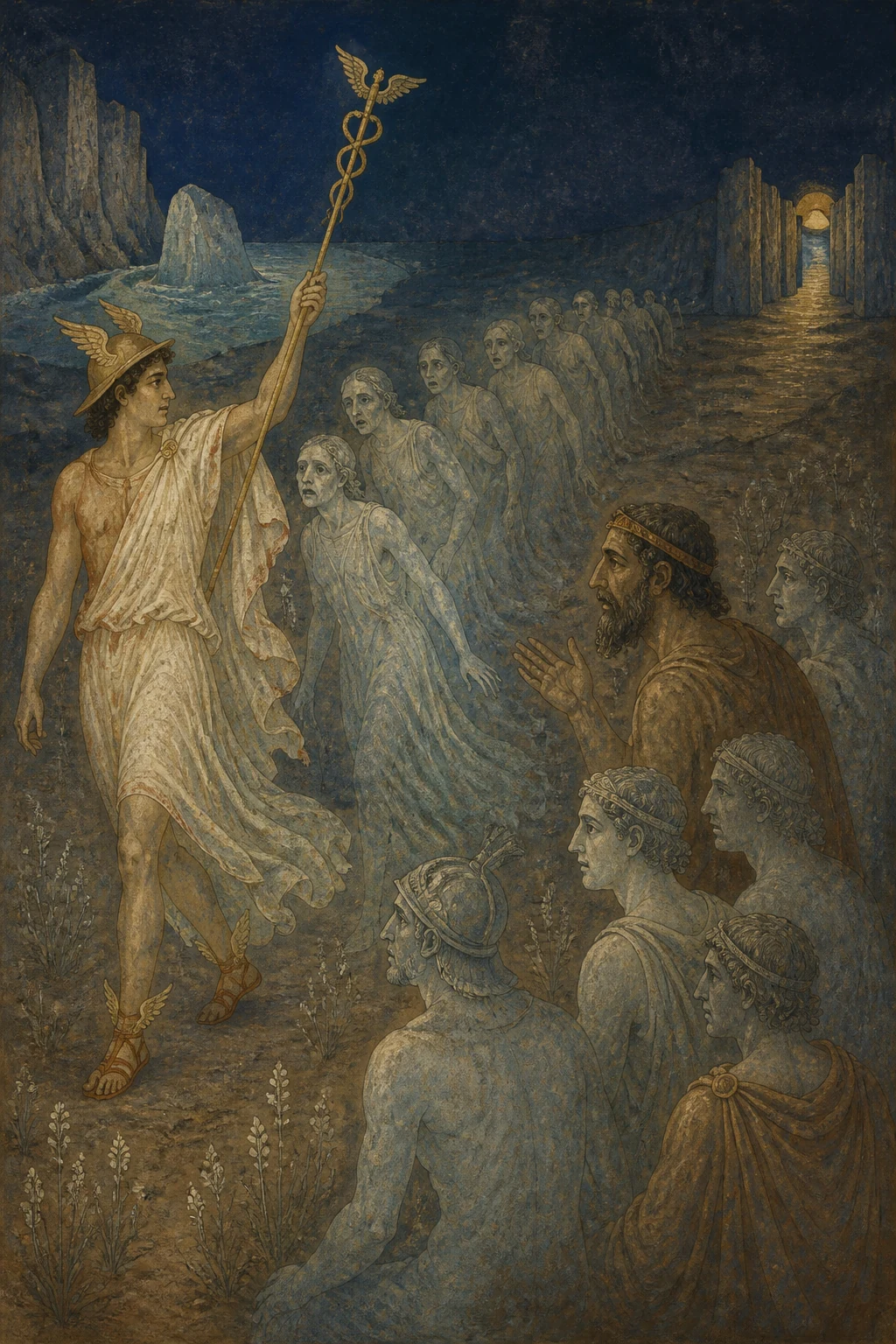
Meanwhile Hermes of Cyllene was summoning the souls of the suitors. In his hands he held his beautiful golden wand, with which he charms the eyes of those he chooses and wakes others from their sleep. With a wave of it he led them on, and they followed, gibbering.
As bats flit squeaking in the depths of a vast cavern when one falls from the cluster hanging on the rock, where they cling to one another, so the souls went together, gibbering; and gentle Hermes led them down the dank paths.
They passed the streams of Ocean and the White Rock, passed the gates of the Sun and the land of dreams, and soon reached the meadow of asphodel, where the souls dwell, the phantoms of the dead.
There they found the soul of Achilles, son of Peleus, and those of Patroclus, noble Antilochus, and Ajax, who in beauty and stature surpassed all the other Danaans except the peerless son of Peleus.
These were gathered about Achilles when the soul of Agamemnon, son of Atreus, drew near in sorrow. Around him were assembled the souls of all who had died with him in the house of Aegisthus and met their doom.
The soul of Peleus’ son was the first to address him: “Son of Atreus, we used to say that of all the warrior heroes you were ever dearest to Zeus who delights in thunder, because you ruled over so many mighty men in the land of the Trojans, where we Achaeans suffered such hardships.
“Yet even you were destined to meet destructive fate before your time—that fate which no man born can escape. Would that you had died and met your doom in the land of the Trojans, enjoying the royal honor that was yours! Then all the Achaeans would have raised a burial mound for you, and you would have won great glory for your son in days to come. Instead, you were doomed to perish by a most pitiful death.”
The soul of Atreus’ son answered him: “Fortunate son of Peleus, Achilles, peer of the gods! You died at Troy, far from Argos, and around you the best of the Trojan and Achaean warriors fell, fighting over your body. In a whirl of dust you lay, great in your fallen greatness, all your chariot fighting forgotten.
“We fought the whole day through, and would never have ceased from battle had Zeus not stopped us with a storm. When we had carried you out of the fighting to the ships, we washed your fair body with warm water and anointed it with oil, then laid you on a bier. Around you the Danaans shed many hot tears and cut their hair.
“Your mother came out of the sea with the immortal sea-nymphs when she heard the news. An unearthly cry arose over the water, and trembling seized all the Achaeans. They would have sprung up and fled to the hollow ships had not a man restrained them, one versed in the wisdom of many former days—Nestor, whose counsel had always proved the best. With their welfare at heart he addressed them: ‘Stand firm, Argives! Do not flee, young men of Achaea. This is his mother coming from the sea with the immortal sea-nymphs to mourn her dead son.’
“So he spoke, and the great-hearted Achaeans checked their flight. The daughters of the Old Man of the Sea stood around you, lamenting piteously, and clothed you in immortal garments. All nine Muses sang your dirge in turn with their lovely voices. Not one Argive could you have seen without tears, so moving was the clear-voiced Muse’s song.
“For seventeen days and nights we mourned you, immortal gods and mortal men together. On the eighteenth we gave you to the fire, slaughtering many fat sheep and shambling cattle around you.
“You burned in the garments of the gods, with abundant oil and sweet honey. Many Achaean warriors marched in armor around your blazing pyre, on foot and in chariots, and a great clamor arose. When the flame of Hephaestus had consumed you, at dawn we gathered your white bones, Achilles, in unmixed wine and oil. Your mother gave us a golden two-handled jar, saying it was a gift from Dionysus, the work of renowned Hephaestus.
“In it lie your white bones, glorious Achilles, mingled with those of the dead Patroclus, son of Menoetius. Apart lie the bones of Antilochus, whom you honored above all your other companions after Patroclus died.
“Over them we raised a great and splendid mound, we, the sacred host of Argive spearmen, on a jutting headland beside the broad Hellespont, so that men at sea might see it from afar, both those alive today and those yet to come.
“Your mother asked the gods for prizes of surpassing beauty and set them out in the arena for the finest of the Achaeans. You have attended the funerals of many heroes, when a king has died and young men gird themselves for the games and prizes are prepared. But those prizes above all would have filled your heart with wonder, had you seen them, so beautiful were the rewards that the goddess, silver-footed Thetis, set out in your honor. Truly you were dear to the gods.
“Thus even in death you have not lost your name: your noble fame shall live forever among all mankind, Achilles. But what pleasure is left for me, now that I have wound up the skein of war?
“For on my return Zeus devised a wretched death for me at the hands of Aegisthus and my accursed wife.” So they spoke to one another. Then Hermes the guide, the slayer of Argus, drew near, leading down the souls of the suitors whom Odysseus had slain. The two gazed at them in wonder and went straight toward them.
The soul of Agamemnon, son of Atreus, recognized renowned Amphimedon, the dear son of Melaneus, who had entertained him in his home in Ithaca. The soul of Atreus’ son was the first to speak: “Amphimedon, what befell you that you have all come down beneath the dark earth, all choice men of the same age? A man could not have gathered a finer company had he gone through a city picking its best.
“Did Poseidon overwhelm you in your ships, rousing cruel winds and towering waves? Or did hostile men destroy you on land as you drove off their cattle and fine flocks of sheep, or as you fought for their city and their women?
“Tell me, since I ask: I claim to be your guest-friend. Do you not remember when I came to your house with godlike Menelaus, to urge Odysseus to follow us to Ilium in our well-benched ships?
“A whole month passed before we crossed the broad sea, so hard was it to persuade Odysseus, sacker of cities.” The soul of Amphimedon answered him: “Most glorious son of Atreus, Agamemnon, king of men, I remember all you say, lord cherished by Zeus. And I shall tell you everything fully and truly, how the dreadful end that brought our deaths came about.
“We were courting the wife of Odysseus, who had long been absent. She would neither refuse the marriage she detested nor bring it to fulfillment, but plotted death and dark destruction for us. And she devised this further trick: she set up a great loom in her hall and began to weave a web, fine and very broad. Then she said to us: ‘Young men, my suitors, now that noble Odysseus is dead, eager though you are for my marriage, wait until I finish this cloth, so that my threads may not be wasted—a burial shroud for the hero Laertes, against the day when the fatal doom of grievous death strikes him down. I would not have any Achaean woman in the land reproach me if he who gained such wealth should lie without a winding-sheet.’
“So she spoke, and our proud hearts were persuaded. By day she would weave the great web, but at night, when she had torches set beside her, she would unravel it. For three years she deceived the Achaeans with this trick and won them over. But when the fourth year came, as the seasons rolled round, the months waned, and many days passed, one of her women who knew the truth told us, and we caught her unraveling the splendid web.
“So she finished it, unwillingly and under compulsion. When she had woven the great web, washed the shroud, and displayed it, shining like the sun or moon, then some malicious god brought Odysseus from somewhere to the outlying farm where the swineherd lived.
“There the dear son of noble Odysseus came, returning from sandy Pylos in his black ship. The two laid their plans for the suitors’ cruel death and came to the famous town. Odysseus came later, while Telemachus went ahead.
“The swineherd brought him in, dressed in miserable clothes, looking like a wretched old beggar leaning on a staff; foul rags covered his body. None of us could recognize him when he suddenly appeared, not even the older men among us. Instead, we abused him with insults and pelted him with missiles.
“For a while he endured the blows and insults in his own hall with a steadfast heart. But when the will of Zeus who bears the aegis roused him, he and Telemachus carried away the beautiful weapons, stored them in a chamber, and shot the bolts. Then, with great cunning, he prompted his wife to set the bow and the gray iron before the suitors as a contest for us doomed men—and the beginning of our slaughter.
“Not one of us could string the powerful bow; our strength fell far short. But when the great bow came into Odysseus’ hands, we all shouted that it must not be given to him, however much he pleaded. Telemachus alone urged them on and ordered it.
“Then noble, long-enduring Odysseus took it in his hand, strung the bow with ease, and shot through the iron. He went and stood on the threshold, poured out the swift arrows, glared about him fiercely, and struck down lord Antinous.
“Then he sent his deadly shafts at the others, aiming straight at them, and they fell thick and fast. It was clear that one of the gods was helping them, for at once they charged through the hall in their fury, killing on every side. Hideous groans arose as heads were struck, and the whole floor seethed with blood.
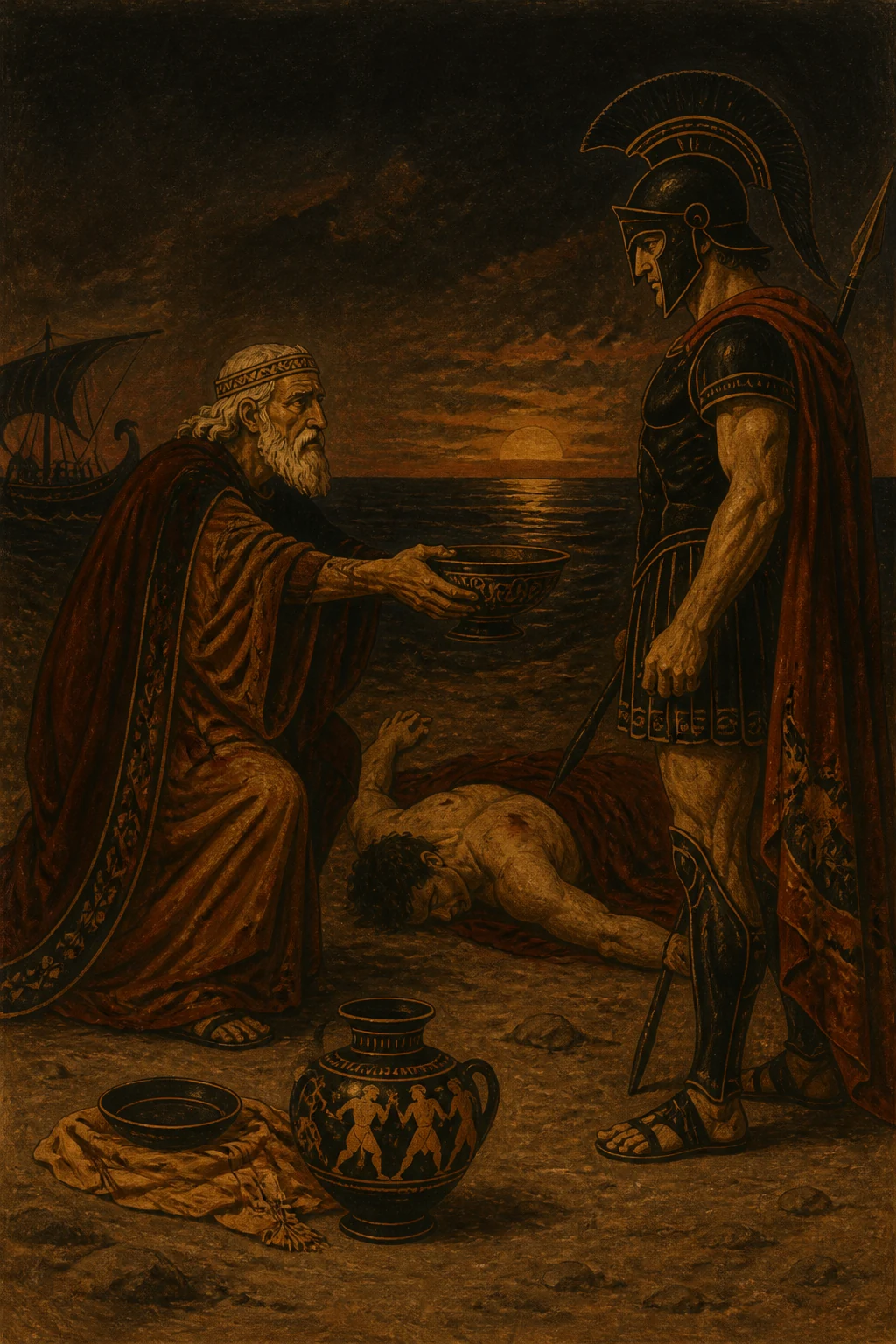
“That is how we died, Agamemnon. Even now our bodies lie uncared for in Odysseus’ hall, for our families in their homes do not yet know. They would wash the dark blood from our wounds, lay us out, and mourn us, for that is the honor owed the dead.”
The soul of Atreus’ son answered him: “Fortunate son of Laertes, Odysseus of many devices! Truly you won a wife of great virtue. How noble was the heart of faultless Penelope, Icarius’ daughter! How faithfully she remembered Odysseus, the husband of her youth! The fame of her virtue shall never perish: the immortals will fashion a lovely song for mortals in praise of steadfast Penelope. Not so the daughter of Tyndareus, who plotted evil deeds and killed the husband of her youth. A hateful song of her shall spread among mankind, and she will bring disgrace upon all women, even those who do good.”
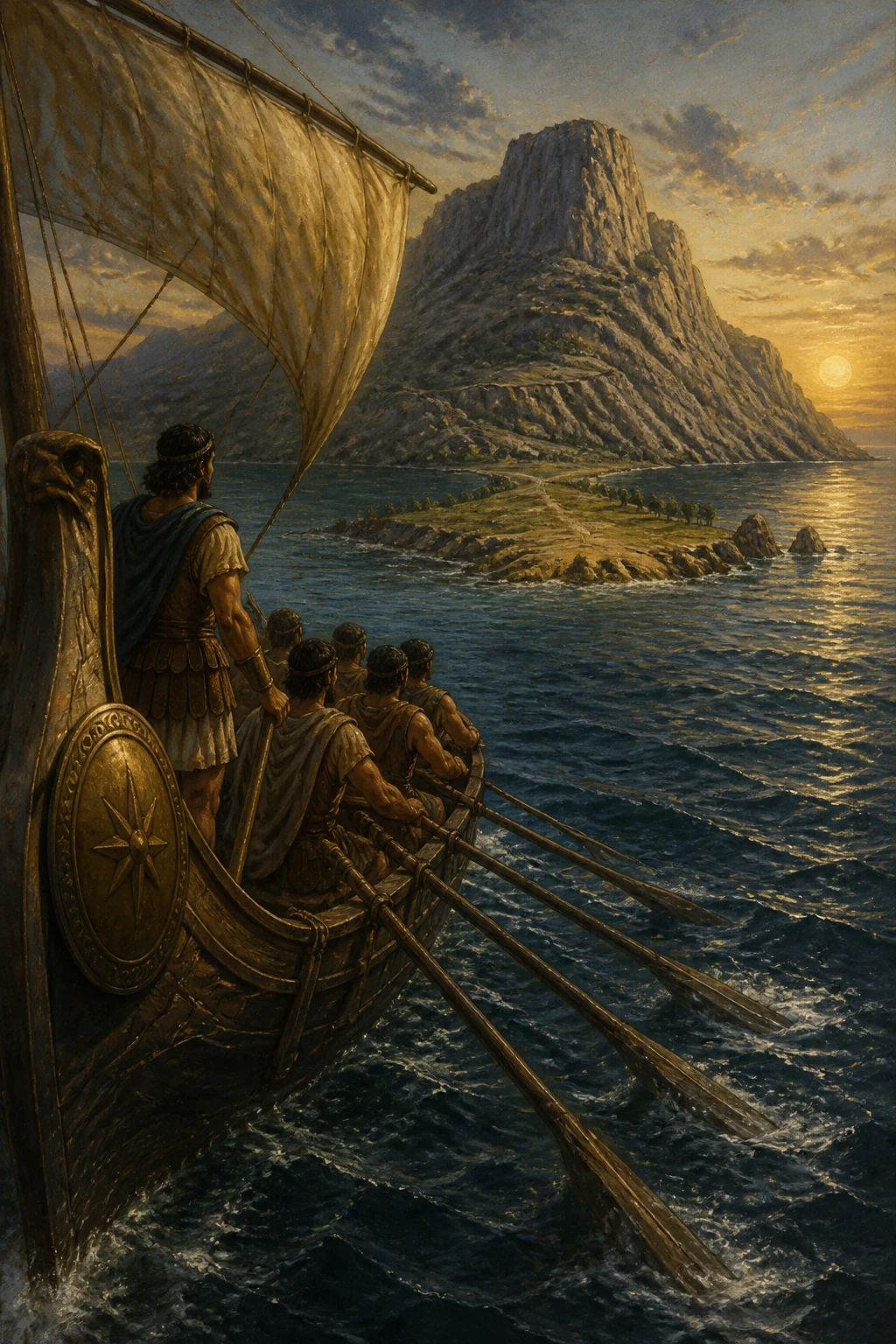
So they spoke to one another as they stood in the halls of Hades, deep beneath the earth. Meanwhile Odysseus and his companions had left the town and soon reached the fair, well-tended farm of Laertes, which he himself had acquired long ago after much toil.
There stood his house, with outbuildings running all around it, where the slaves who labored for him ate, sat, and slept. An old Sicilian woman lived there too, tending the old man devotedly on his farm, far from the town.
There Odysseus said to the servants and his son: “Go into the well-built house now, and quickly slaughter the best of the pigs for dinner. I shall put my father to the test, to see whether he will know me and recognize me with his own eyes, or fail to recognize me after so long an absence.”
With these words he gave his weapons of war to the servants. They went quickly into the house, while Odysseus drew near the fruitful orchard to make his trial. As he went down into the great orchard, he found neither Dolius nor any of the servants or his sons. They had gone to gather stones for a wall around the orchard, and the old man Dolius had led them there.
He found his father alone in the well-tended orchard, hoeing around a tree. He wore a dirty tunic, patched and shabby, and had bound stitched leather gaiters around his legs to guard against scratches, with gloves on his hands against the brambles. On his head he wore a goatskin cap, deepening his look of sorrow.
When noble, long-enduring Odysseus saw him worn down by age and burdened with deep grief, he stood beneath a tall pear tree and shed tears. Then he pondered in his heart whether to kiss and embrace his father and tell him everything—how he had come back to his native land—or first to question him and test him thoroughly.
As he thought it over, it seemed better to test him first with probing words. With this in mind, noble Odysseus went straight toward him. His father, head bent low, was digging around the tree. His glorious son stood beside him and said: “Old man, you show no lack of skill in tending an orchard. Everything is well cared for: not a plant, not a fig tree, vine, olive, pear tree, or garden bed is neglected anywhere.
“But I will tell you something else—do not take offense. You yourself are not well cared for. Besides grievous old age, you suffer from filthy neglect and wear shabby clothes. Surely it is not for idleness that your master neglects you, nor is there anything of the slave in your looks or stature. You have the bearing of a king.
“You look like one who, having bathed and eaten, should sleep at ease, as is the right of old men. But come, tell me truly: whose slave are you? Whose orchard do you tend?
“And tell me this truthfully, so that I may know for certain: have I really come to Ithaca, as a man I met just now on my way here told me? He was not very sensible, for he would not explain things or listen to my question when I asked about a guest-friend of mine, whether he is still alive somewhere or has already died and gone to the halls of Hades.
“I will tell you about him; listen and take heed. Once, in my own dear country, I entertained a man who came to our house, and no stranger from far away was ever dearer to me among all who entered my home. He said that he came from Ithaca and that his father was Laertes, son of Arceisius.
“I brought him to my house and entertained him generously, welcoming him with all my heart, for I had great wealth at home. And I gave him gifts befitting a guest: seven talents of wrought gold, a mixing-bowl of solid silver patterned with flowers, twelve single cloaks, as many rugs, as many fine mantles, and tunics to match. Besides these, I gave him four beautiful women skilled in excellent handiwork, whom he chose for himself.”
Then his father answered him, shedding tears: “Stranger, you have indeed come to the land you seek, but violent and reckless men possess it. In vain you bestowed those countless gifts. Had you found him alive in the land of Ithaca, he would have sent you on your way with generous gifts in return and a kindly welcome, as is right when another has shown kindness first.
“But come, tell me truly: how many years have passed since you entertained that man, your unfortunate guest, my son—if ever I had a son—ill-fated man! Far from his friends and native land, the fishes have perhaps devoured him in the sea, or on land he has fallen prey to beasts and birds. His mother and I, who gave him life, never wrapped him in his shroud and mourned him. Nor did his richly dowered wife, steadfast Penelope, lament her husband on his bier and close his eyes, as was fitting, for that is the honor owed the dead.
“And tell me this truthfully, so that I may know: who are you, and where are you from? Where are your city and your parents? Where is the swift ship that brought you here with your gallant companions? Or did you come as a passenger on another man’s ship, and have they put you ashore and sailed away?”
Resourceful Odysseus answered him: “I shall tell you everything quite truly. I come from Alybas, where I live in a splendid house. I am the son of lord Apheidas, son of Polypemon, and my name is Eperitus. But some god drove me off my course from Sicania and brought me here against my will. My ship lies over there, off the open country, far from town.
“As for Odysseus, this is now the fifth year since he left that place and departed from my country, poor man. Yet the birds were favorable when he set out, flying on his right. Rejoicing in them, I sent him on his way, and he rejoiced as he departed. Our hearts still hoped that we would meet again as guest-friends and exchange splendid gifts.”
So he spoke, and a black cloud of grief enveloped Laertes. With both hands he scooped up the sooty dust and poured it over his gray head, groaning bitterly. Odysseus’ heart was stirred; as he looked at his dear father, a sharp pang of feeling stung his nostrils.
He sprang forward, threw his arms around him, and kissed him, saying: “Father, I am the very man you ask about. I have come back to my native land in the twentieth year. But cease your weeping and tearful lamentation.
“For I must tell you—and we must make haste—I have killed the suitors in our house, avenging their bitter insults and their wicked deeds.” Laertes answered him: “If you are indeed my son Odysseus, returned to this place, give me now some clear token, so that I may be sure.”
Resourceful Odysseus replied: “First look at this scar, where a boar struck me with its white tusk when I went to Parnassus. You and my honored mother sent me to Autolycus, my mother’s dear father, to receive the gifts he had promised me when he came here.
“Come, I will also tell you the trees you once gave me in this well-tended orchard. I was a little boy, following you through the garden and asking you for each one. We walked among them, and you told me the name of every tree.
“You gave me thirteen pear trees, ten apple trees, and forty fig trees. And you promised to give me fifty rows of vines, each bearing fruit in its own season. Grapes of every kind grow there, whenever the seasons of Zeus weigh down the branches from above.”
So he spoke, and his father’s knees and heart gave way as he recognized the sure tokens Odysseus had given him. He threw his arms around his dear son, and noble, long-enduring Odysseus drew him close as he fainted.
When he had recovered his breath and his senses returned, he spoke again: “Father Zeus, surely you gods still dwell on high Olympus, if the suitors have truly paid for their reckless insolence!
“But now I am terribly afraid that all the men of Ithaca will soon attack us here, and send messengers to rouse the cities of the Cephallenians on every side.” Resourceful Odysseus answered him: “Take courage, and do not let such things trouble your heart.
“Let us go to the house near the orchard. I sent Telemachus ahead with the cowherd and the swineherd, to prepare our dinner as quickly as they could.” With these words the two went toward the handsome house.
When they reached the comfortable house, they found Telemachus, the cowherd, and the swineherd carving abundant meat and mixing the gleaming wine. Meanwhile, in his own house, the Sicilian maidservant bathed great-hearted Laertes, anointed him with oil, and wrapped a fine cloak around him. Athena stood beside the shepherd of the people and filled out his limbs, making him seem taller and sturdier than before.
He stepped from the bath, and his dear son marveled to see him face to face, looking like the immortal gods. He spoke to him in winged words: “Father, surely one of the everlasting gods has made you handsomer and taller to behold.”
Wise Laertes answered him: “If only, Father Zeus, Athena, and Apollo, I had been yesterday in our house as I was when, ruling over the Cephallenians, I took Nericus, that well-built fortress on the mainland coast! If I had stood beside you with armor on my shoulders and fought off the suitors, I would have brought many of them to their knees in our hall, and your heart would have rejoiced.”
So they spoke to one another. When the others had finished their work and prepared the feast, they sat in order on chairs and seats. They were beginning their dinner when old Dolius arrived with his sons, weary from their labors. Their mother, the old Sicilian woman, had gone out to call them, she who had brought them up and who tended the old man Laertes devotedly now that age had overtaken him.
When they saw Odysseus and knew him in their hearts, they stood in the hall in amazement. But Odysseus gently chided them: “Old man, sit down to dinner, and all of you put aside your wonder. We have long been waiting here in the hall, eager to begin our meal, but always expecting you.”
So he spoke, and Dolius went straight toward him with both hands outstretched. He took Odysseus’ hand and kissed it at the wrist, then spoke to him in winged words: “Dear master, you have returned to us who longed for you so deeply, though we had ceased to hope. The gods themselves have brought you back. Welcome, a thousand welcomes, and may the gods grant you happiness!
“And tell me this truthfully, so that I may know: does wise Penelope already know for certain that you have returned, or shall we send a messenger?” Resourceful Odysseus answered him: “Old man, she knows already. Why should you trouble yourself about that?”
So he spoke, and Dolius sat down again on a polished stool. His sons likewise gathered around renowned Odysseus, greeting him warmly and clasping his hands. Then they sat in order beside Dolius, their father.
While they attended to their dinner in the hall, Rumor the messenger sped swiftly through the town, proclaiming the suitors’ dreadful death and doom. At the news, people came from every direction, gathering with cries and groans before Odysseus’ house. They carried the dead out of the house and buried their own. Those from other cities they placed aboard swift ships and entrusted to fishermen to take home. Then, grieving at heart, they went together to the assembly.
When they were gathered, Eupeithes rose to address them. Unrelenting grief lay in his heart for his son Antinous, the first man noble Odysseus had killed. Shedding tears for him, he spoke: “Friends, this man has devised a monstrous deed against the Achaeans. First he took many brave men away in his ships, lost his hollow ships, and lost his people. Now he has come back and killed the very best of the Cephallenians. Come, before he can hurry away to Pylos or holy Elis, where the Epeians rule, let us go against him. Otherwise we shall hang our heads forever. It will be a disgrace for generations to hear of, if we do not avenge ourselves on the murderers of our sons and brothers. For my part, life would hold no pleasure. I would rather die at once and join the dead.
“Come, let us go, before they cross the sea and escape us.” So he spoke in tears, and pity seized all the Achaeans. Then Medon and the inspired bard came up from Odysseus’ house, for sleep had released them. They stood in the midst of the assembly, and astonishment seized every man.
Medon, a man of sound judgment, addressed them: “Listen to me now, men of Ithaca. It was not against the will of the immortal gods that Odysseus accomplished these deeds. I myself saw an undying god standing close beside Odysseus, exactly like Mentor in appearance.
“At one moment the immortal god would appear before Odysseus, encouraging him; at another he would rush through the hall, throwing the suitors into confusion, and they fell thick and fast.” So he spoke, and pale fear seized them all.
Then the old hero Halitherses, son of Mastor, addressed them, for he alone could see both before and after. With their welfare at heart, he said: “Listen now, men of Ithaca, to what I have to say. Friends, it is through your own wickedness that these things have happened. You would not listen to me, nor to Mentor, shepherd of the people, and restrain your sons from their folly. In their wicked recklessness they committed terrible deeds, wasting the possessions and dishonoring the wife of a prince whom they said would never return.
“Now let this be the course we take. Listen to what I tell you: let us not march against him, lest someone bring disaster on himself.” So he spoke, and more than half sprang up with loud cries and left. The rest remained together where they were. His words had not pleased their hearts; they sided with Eupeithes, and at once rushed to fetch their armor.
When they had clothed themselves in gleaming bronze, they gathered before the spacious town. Eupeithes led them in his folly, thinking to avenge his son’s murder. Yet he was never to return: there he would meet his doom.
Meanwhile Athena addressed Zeus, son of Cronus: “Our Father, son of Cronus, highest of rulers, tell me what purpose you hold hidden in your heart. Will you prolong this cruel war and dreadful strife, or establish friendship between the two sides?”
Zeus the cloud-gatherer answered her: “My child, why do you question me about these things? Was it not you yourself who devised this plan, that Odysseus should return and take vengeance on those men?
“Do as you wish; but I will tell you what is fitting. Now that noble Odysseus has avenged himself on the suitors, let them swear solemn oaths, and let him remain their king for all his days. We in turn shall put the killing of their sons and brothers from their minds. Let them love one another as before, and let peace and prosperity abound.”
With these words he urged on Athena, who was already eager, and she darted down from the peaks of Olympus. Meanwhile, when the men had satisfied their desire for the pleasant food, noble, long-enduring Odysseus was the first to speak: “Let someone go outside and see whether they are already coming near.”
So he spoke, and a son of Dolius went out at his command. He stepped onto the threshold and saw them all close by. At once he spoke winged words to Odysseus: “Here they are, close upon us! Let us arm ourselves at once.”
So he spoke, and they sprang up and put on their armor, the four about Odysseus and the six sons of Dolius. Laertes and Dolius armed themselves as well, gray-haired though they were, warriors now by necessity.
When they had clothed themselves in gleaming bronze, they opened the doors and went out, Odysseus leading. Athena, daughter of Zeus, came near them in the likeness of Mentor, both in form and voice.
Noble, long-enduring Odysseus rejoiced at the sight of her, and at once addressed his dear son Telemachus: “Telemachus, now that you enter the place where men do battle and the best are proved, you will learn for yourself not to disgrace the line of your fathers. In strength and courage we have always excelled throughout the earth.”
Wise Telemachus answered him: “Dear father, if you wish, you shall see that with the spirit I have in me I will bring no disgrace upon your line, as you say.” So he spoke, and Laertes rejoiced: “What a day this is for me, dear gods! How glad I am! My son and grandson are vying with each other in valor.”
Bright-eyed Athena stood beside him and said: “Son of Arceisius, dearest by far of all my companions, pray to the bright-eyed maiden and to Father Zeus, then raise your long-shadowed spear and hurl it at once.”
So she spoke, and Pallas Athena breathed great strength into him. He prayed to the daughter of mighty Zeus, then raised his long-shadowed spear and hurled it at once, striking Eupeithes through his bronze-cheeked helmet.
But the shield did not stop the spear: the bronze point drove clean through. He fell with a thud, and his armor clattered about him. Odysseus and his glorious son charged into the front ranks, striking with swords and double-pointed spears.
And now they would have killed them all, leaving none to return home, had not Athena, daughter of Zeus who bears the aegis, cried aloud and checked the whole host: “Men of Ithaca, cease this bitter fighting, so that you may part at once without bloodshed!”
So Athena spoke, and pale terror seized them. In their fear, their weapons flew from their hands and fell to the ground at the sound of the goddess’s voice. They turned toward the city, desperate to save their lives.
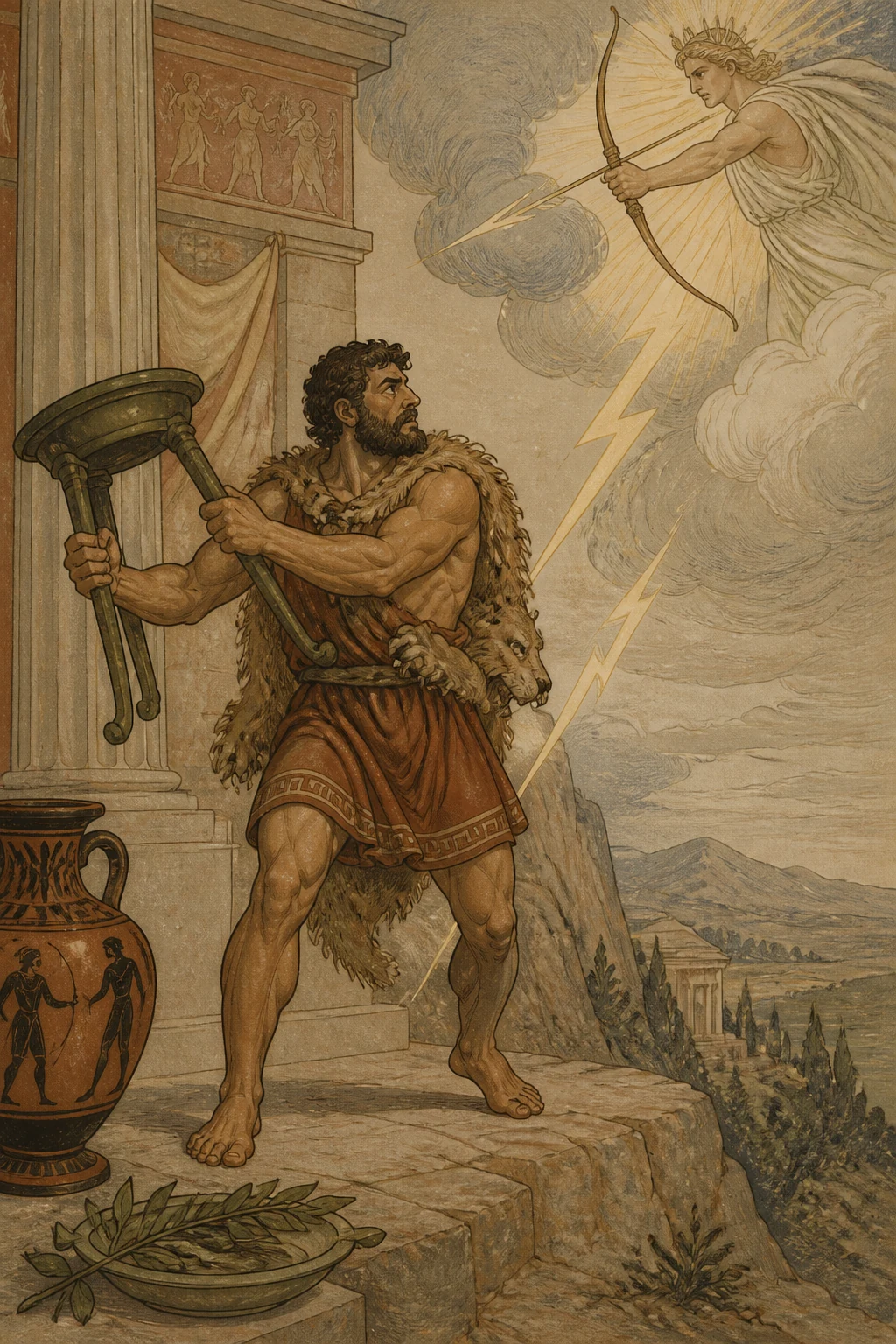
Then much-enduring, noble Odysseus gave a terrible shout, gathered himself, and swooped like a high-flying eagle. But at that moment the son of Cronus hurled a smoking thunderbolt, which fell before the bright-eyed daughter of the mighty father.
Then bright-eyed Athena spoke to Odysseus: “Son of Laertes, sprung from Zeus, resourceful Odysseus, hold back! End this strife of war that spares neither side, lest the son of Cronus, far-seeing Zeus, grow angry with you.”
So Athena spoke, and he obeyed, glad at heart. Then Pallas Athena, daughter of Zeus who bears the aegis, established a sworn peace between the two sides, taking Mentor’s likeness in both form and voice.
Izvirnik
Laertes and the Peace of Ithaca
Naslednje strani prikazujejo izvirno besedilo za primerjavo.
Ἑρμῆς δὲ ψυχὰς Κυλλήνιος ἐξεκαλεῖτο ἀνδρῶν μνηστήρων· ἔχε δὲ ῥάβδον μετὰ χερσὶν καλὴν χρυσείην, τῇ τʼ ἀνδρῶν ὄμματα θέλγει ὧν ἐθέλει, τοὺς δʼ αὖτε καὶ ὑπνώοντας ἐγείρει· τῇ ῥʼ ἄγε κινήσας, ταὶ δὲ τρίζουσαι ἕποντο. ὡς δʼ ὅτε νυκτερίδες μυχῷ ἄντρου θεσπεσίοιο τρίζουσαι ποτέονται, ἐπεί κέ τις ἀποπέσῃσιν ὁρμαθοῦ ἐκ πέτρης, ἀνά τʼ ἀλλήλῃσιν ἔχονται, ὣς αἱ τετριγυῖαι ἅμʼ ἤϊσαν· ἦρχε δʼ ἄρα σφιν Ἑρμείας ἀκάκητα κατʼ εὐρώεντα κέλευθα.
πὰρ δʼ ἴσαν Ὠκεανοῦ τε ῥοὰς καὶ Λευκάδα πέτρην, ἠδὲ παρʼ Ἠελίοιο πύλας καὶ δῆμον ὀνείρων ἤϊσαν· αἶψα δʼ ἵκοντο κατʼ ἀσφοδελὸν λειμῶνα, ἔνθα τε ναίουσι ψυχαί, εἴδωλα καμόντων. εὗρον δὲ ψυχὴν Πηληϊάδεω Ἀχιλῆος καὶ Πατροκλῆος καὶ ἀμύμονος Ἀντιλόχοιο Αἴαντός θʼ, ὃς ἄριστος ἔην εἶδός τε δέμας τε τῶν ἄλλων Δαναῶν μετʼ ἀμύμονα Πηλεΐωνα. ὣς οἱ μὲν περὶ κεῖνον ὁμίλεον· ἀγχίμολον δὲ ἤλυθʼ ἔπι ψυχὴ Ἀγαμέμνονος Ἀτρεΐδαο ἀχνυμένη· περὶ δʼ ἄλλαι ἀγηγέραθʼ, ὅσσαι ἅμʼ αὐτῷ οἴκῳ ἐν Αἰγίσθοιο θάνον καὶ πότμον ἐπέσπον.
τὸν προτέρη ψυχὴ προσεφώνεε Πηλεΐωνος· Ἀτρεΐδη, περὶ μέν σʼ ἔφαμεν Διὶ τερπικεραύνῳ ἀνδρῶν ἡρώων φίλον ἔμμεναι ἤματα πάντα, οὕνεκα πολλοῖσίν τε καὶ ἰφθίμοισιν ἄνασσες δήμῳ ἔνι Τρώων, ὅθι πάσχομεν ἄλγεʼ Ἀχαιοί. ἦ τʼ ἄρα καὶ σοὶ πρῶϊ παραστήσεσθαι ἔμελλεν μοῖρʼ ὀλοή, τὴν οὔ τις ἀλεύεται ὅς κε γένηται. ὡς ὄφελες τιμῆς ἀπονήμενος, ἧς περ ἄνασσες, δήμῳ ἔνι Τρώων θάνατον καὶ πότμον ἐπισπεῖν· τῷ κέν τοι τύμβον μὲν ἐποίησαν Παναχαιοί, ἠδέ κε καὶ σῷ παιδὶ μέγα κλέος ἤραʼ ὀπίσσω· νῦν δʼ ἄρα σʼ οἰκτίστῳ θανάτῳ εἵμαρτο ἁλῶναι.
τὸν δʼ αὖτε ψυχὴ προσεφώνεεν Ἀτρείδαο· ὄλβιε Πηλέος υἱέ, θεοῖς ἐπιείκελʼ Ἀχιλλεῦ, ὃς θάνες ἐν Τροίῃ ἑκὰς Ἄργεος· ἀμφὶ δέ σʼ ἄλλοι κτείνοντο Τρώων καὶ Ἀχαιῶν υἷες ἄριστοι, μαρνάμενοι περὶ σεῖο· σὺ δʼ ἐν στροφάλιγγι κονίης κεῖσο μέγας μεγαλωστί, λελασμένος ἱπποσυνάων. ἡμεῖς δὲ πρόπαν ἦμαρ ἐμαρνάμεθʼ· οὐδέ κε πάμπαν παυσάμεθα πτολέμου, εἰ μὴ Ζεὺς λαίλαπι παῦσεν. αὐτὰρ ἐπεί σʼ ἐπὶ νῆας ἐνείκαμεν ἐκ πολέμοιο, κάτθεμεν ἐν λεχέεσσι, καθήραντες χρόα καλὸν ὕδατί τε λιαρῷ καὶ ἀλείφατι· πολλὰ δέ σʼ ἀμφὶ δάκρυα θερμὰ χέον Δαναοὶ κείροντό τε χαίτας.
μήτηρ δʼ ἐξ ἁλὸς ἦλθε σὺν ἀθανάτῃς ἁλίῃσιν ἀγγελίης ἀΐουσα· βοὴ δʼ ἐπὶ πόντον ὀρώρει θεσπεσίη, ὑπὸ δὲ τρόμος ἔλλαβε πάντας Ἀχαιούς· καί νύ κʼ ἀναΐξαντες ἔβαν κοίλας ἐπὶ νῆας, εἰ μὴ ἀνὴρ κατέρυκε παλαιά τε πολλά τε εἰδώς, Νέστωρ, οὗ καὶ πρόσθεν ἀρίστη φαίνετο βουλή· ὅ σφιν ἐϋφρονέων ἀγορήσατο καὶ μετέειπεν· ἴσχεσθʼ, Ἀργεῖοι, μὴ φεύγετε, κοῦροι Ἀχαιῶν· μήτηρ ἐξ ἁλὸς ἥδε σὺν ἀθανάτῃς ἁλίῃσιν ἔρχεται, οὗ παιδὸς τεθνηότος ἀντιόωσα.
ὣς ἔφαθʼ, οἱ δʼ ἔσχοντο φόβου μεγάθυμοι Ἀχαιοί· ἀμφὶ δέ σʼ ἔστησαν κοῦραι ἁλίοιο γέροντος οἴκτρʼ ὀλοφυρόμεναι, περὶ δʼ ἄμβροτα εἵματα ἕσσαν. Μοῦσαι δʼ ἐννέα πᾶσαι ἀμειβόμεναι ὀπὶ καλῇ θρήνεον· ἔνθα κεν οὔ τινʼ ἀδάκρυτόν γʼ ἐνόησας Ἀργείων· τοῖον γὰρ ὑπώρορε Μοῦσα λίγεια. ἑπτὰ δὲ καὶ δέκα μέν σε ὁμῶς νύκτας τε καὶ ἦμαρ κλαίομεν ἀθάνατοί τε θεοὶ θνητοί τʼ ἄνθρωποι· ὀκτωκαιδεκάτῃ δʼ ἔδομεν πυρί, πολλὰ δέ σʼ ἀμφὶ μῆλα κατεκτάνομεν μάλα πίονα καὶ ἕλικας βοῦς.
καίεο δʼ ἔν τʼ ἐσθῆτι θεῶν καὶ ἀλείφατι πολλῷ καὶ μέλιτι γλυκερῷ· πολλοὶ δʼ ἥρωες Ἀχαιοὶ τεύχεσιν ἐρρώσαντο πυρὴν πέρι καιομένοιο, πεζοί θʼ ἱππῆές τε· πολὺς δʼ ὀρυμαγδὸς ὀρώρει αὐτὰρ ἐπεὶ δή σε φλὸξ ἤνυσεν Ἡφαίστοιο, ἠῶθεν δή τοι λέγομεν λεύκʼ ὀστέʼ, Ἀχιλλεῦ, οἴνῳ ἐν ἀκρήτῳ καὶ ἀλείφατι· δῶκε δὲ μήτηρ χρύσεον ἀμφιφορῆα· Διωνύσοιο δὲ δῶρον φάσκʼ ἔμεναι, ἔργον δὲ περικλυτοῦ Ἡφαίστοιο.
ἐν τῷ τοι κεῖται λεύκʼ ὀστέα, φαίδιμʼ Ἀχιλλεῦ, μίγδα δὲ Πατρόκλοιο Μενοιτιάδαο θανόντος, χωρὶς δʼ Ἀντιλόχοιο, τὸν ἔξοχα τῖες ἁπάντων τῶν ἄλλων ἑτάρων, μετὰ Πάτροκλόν γε θανόντα. ἀμφʼ αὐτοῖσι δʼ ἔπειτα μέγαν καὶ ἀμύμονα τύμβον χεύαμεν Ἀργείων ἱερὸς στρατὸς αἰχμητάων ἀκτῇ ἔπι προὐχούσῃ, ἐπὶ πλατεῖ Ἑλλησπόντῳ, ὥς κεν τηλεφανὴς ἐκ ποντόφιν ἀνδράσιν εἴη τοῖς οἳ νῦν γεγάασι καὶ οἳ μετόπισθεν ἔσονται.
μήτηρ δʼ αἰτήσασα θεοὺς περικαλλέʼ ἄεθλα θῆκε μέσῳ ἐν ἀγῶνι ἀριστήεσσιν Ἀχαιῶν. ἤδη μὲν πολέων τάφῳ ἀνδρῶν ἀντεβόλησας ἡρώων, ὅτε κέν ποτʼ ἀποφθιμένου βασιλῆος ζώννυνταί τε νέοι καὶ ἐπεντύνονται ἄεθλα· ἀλλά κε κεῖνα μάλιστα ἰδὼν θηήσαο θυμῷ, οἷʼ ἐπὶ σοὶ κατέθηκε θεὰ περικαλλέʼ ἄεθλα, ἀργυρόπεζα Θέτις· μάλα γὰρ φίλος ἦσθα θεοῖσιν. ὣς σὺ μὲν οὐδὲ θανὼν ὄνομʼ ὤλεσας, ἀλλά τοι αἰεὶ πάντας ἐπʼ ἀνθρώπους κλέος ἔσσεται ἐσθλόν, Ἀχιλλεῦ, αὐτὰρ ἐμοὶ τί τόδʼ ἦδος, ἐπεὶ πόλεμον τολύπευσα; ἐν νόστῳ γάρ μοι Ζεὺς μήσατο λυγρὸν ὄλεθρον
Αἰγίσθου ὑπὸ χερσὶ καὶ οὐλομένης ἀλόχοιο. ὣς οἱ μὲν τοιαῦτα πρὸς ἀλλήλους ἀγόρευον, ἀγχίμολον δέ σφʼ ἦλθε διάκτορος ἀργεϊφόντης, ψυχὰς μνηστήρων κατάγων Ὀδυσῆϊ δαμέντων, τὼ δʼ ἄρα θαμβήσαντʼ ἰθὺς κίον, ὡς ἐσιδέσθην. ἔγνω δὲ ψυχὴ Ἀγαμέμνονος Ἀτρεΐδαο παῖδα φίλον Μελανῆος, ἀγακλυτὸν Ἀμφιμέδοντα· ξεῖνος γάρ οἱ ἔην Ἰθάκῃ ἔνι οἰκία ναίων. τὸν προτέρη ψυχὴ προσεφώνεεν Ἀτρεΐδαο· Ἀμφίμεδον, τί παθόντες ἐρεμνὴν γαῖαν ἔδυτε πάντες κεκριμένοι καὶ ὁμήλικες; οὐδέ κεν ἄλλως κρινάμενος λέξαιτο κατὰ πτόλιν ἄνδρας ἀρίστους.
ἦ ὔμμʼ ἐν νήεσσι Ποσειδάων ἐδάμασσεν, ὄρσας ἀργαλέους ἀνέμους καὶ κύματα μακρά; ἦ που ἀνάρσιοι ἄνδρες ἐδηλήσαντʼ ἐπὶ χέρσου βοῦς περιταμνομένους ἠδʼ οἰῶν πώεα καλά, ἠὲ περὶ πτόλιος μαχεούμενοι ἠδὲ γυναικῶν; εἰπέ μοι εἰρομένῳ· ξεῖνος δέ τοι εὔχομαι εἶναι. ἦ οὐ μέμνῃ ὅτε κεῖσε κατήλυθον ὑμέτερον δῶ, ὀτρυνέων Ὀδυσῆα σὺν ἀντιθέῳ Μενελάῳ Ἴλιον εἰς ἅμʼ ἕπεσθαι ἐϋσσέλμων ἐπὶ νηῶν; μηνὶ δʼ ἄρʼ οὔλῳ πάντα περήσαμεν εὐρέα πόντον, σπουδῇ παρπεπιθόντες Ὀδυσσῆα πτολίπορθον.
τὸν δʼ αὖτε ψυχὴ προσεφώνεεν Ἀμφιμέδοντος· Ἀτρεΐδη κύδιστε, ἄναξ ἀνδρῶν Ἀγάμεμνον, μέμνημαι τάδε πάντα, διοτρεφές, ὡς ἀγορεύεις· σοὶ δʼ ἐγὼ εὖ μάλα πάντα καὶ ἀτρεκέως καταλέξω, ἡμετέρου θανάτοιο κακὸν τέλος, οἷον ἐτύχθη. μνώμεθʼ Ὀδυσσῆος δὴν οἰχομένοιο δάμαρτα· ἡ δʼ οὔτʼ ἠρνεῖτο στυγερὸν γάμον οὔτʼ ἐτελεύτα, ἡμῖν φραζομένη θάνατον καὶ κῆρα μέλαιναν, ἀλλὰ δόλον τόνδʼ ἄλλον ἐνὶ φρεσὶ μερμήριξε· στησαμένη μέγαν ἱστὸν ἐνὶ μεγάροισιν ὕφαινε, λεπτὸν καὶ περίμετρον· ἄφαρ δʼ ἡμῖν μετέειπε· κοῦροι ἐμοὶ μνηστῆρες, ἐπεὶ θάνε δῖος Ὀδυσσεύς,
μίμνετʼ ἐπειγόμενοι τὸν ἐμὸν γάμον, εἰς ὅ κε φᾶρος ἐκτελέσω, μή μοι μεταμώνια νήματʼ ὄληται, Λαέρτῃ ἥρωϊ ταφήϊον, εἰς ὅτε κέν μιν μοῖρʼ ὀλοὴ καθέλῃσι τανηλεγέος θανάτοιο, μή τίς μοι κατὰ δῆμον Ἀχαιϊάδων νεμεσήσῃ, αἴ κεν ἄτερ σπείρου κεῖται πολλὰ κτεατίσσας. ὣς ἔφαθʼ, ἡμῖν δʼ αὖτʼ ἐπεπείθετο θυμὸς ἀγήνωρ. ἔνθα καὶ ἠματίη μὲν ὑφαίνεσκεν μέγαν ἱστόν, νύκτας δʼ ἀλλύεσκεν, ἐπεὶ δαΐδας παραθεῖτο.
ὣς τρίετες μὲν ἔληθε δόλῳ καὶ ἔπειθεν Ἀχαιούς· ἀλλʼ ὅτε τέτρατον ἦλθεν ἔτος καὶ ἐπήλυθον ὧραι, μηνῶν φθινόντων, περὶ δʼ ἤματα πόλλʼ ἐτελέσθη, καὶ τότε δή τις ἔειπε γυναικῶν, ἣ σάφα ᾔδη, καὶ τήν γʼ ἀλλύουσαν ἐφεύρομεν ἀγλαὸν ἱστόν. ὣς τὸ μὲν ἐξετέλεσσε καὶ οὐκ ἐθέλουσʼ, ὑπʼ ἀνάγκης. εὖθʼ ἡ φᾶρος ἔδειξεν, ὑφήνασα μέγαν ἱστόν, πλύνασʼ, ἠελίῳ ἐναλίγκιον ἠὲ σελήνῃ, καὶ τότε δή ῥʼ Ὀδυσῆα κακός ποθεν ἤγαγε δαίμων ἀγροῦ ἐπʼ ἐσχατιήν, ὅθι δώματα ναῖε συβώτης.
ἔνθʼ ἦλθεν φίλος υἱὸς Ὀδυσσῆος θείοιο, ἐκ Πύλου ἠμαθόεντος ἰὼν σὺν νηῒ μελαίνῃ· τὼ δὲ μνηστῆρσιν θάνατον κακὸν ἀρτύναντε ἵκοντο προτὶ ἄστυ περικλυτόν, ἦ τοι Ὀδυσσεὺς ὕστερος, αὐτὰρ Τηλέμαχος πρόσθʼ ἡγεμόνευε. τὸν δὲ συβώτης ἦγε κακὰ χροῒ εἵματʼ ἔχοντα, πτωχῷ λευγαλέῳ ἐναλίγκιον ἠδὲ γέροντι σκηπτόμενον· τὰ δὲ λυγρὰ περὶ χροῒ εἵματα ἕστο· οὐδέ τις ἡμείων δύνατο γνῶναι τὸν ἐόντα ἐξαπίνης προφανέντʼ, οὐδʼ οἳ προγενέστεροι ἦσαν, ἀλλʼ ἔπεσίν τε κακοῖσιν ἐνίσσομεν ἠδὲ βολῇσιν.
αὐτὰρ ὁ τῆος ἐτόλμα ἐνὶ μεγάροισιν ἑοῖσι βαλλόμενος καὶ ἐνισσόμενος τετληότι θυμῷ· ἀλλʼ ὅτε δή μιν ἔγειρε Διὸς νοός αἰγιόχοιο, σὺν μὲν Τηλεμάχῳ περικαλλέα τεύχεʼ ἀείρας ἐς θάλαμον κατέθηκε καὶ ἐκλήϊσεν ὀχῆας, αὐτὰρ ὁ ἣν ἄλοχον πολυκερδείῃσιν ἄνωγε τόξον μνηστήρεσσι θέμεν πολιόν τε σίδηρον, ἡμῖν αἰνομόροισιν ἀέθλια καὶ φόνου ἀρχήν. οὐδέ τις ἡμείων δύνατο κρατεροῖο βιοῖο νευρὴν ἐντανύσαι, πολλὸν δʼ ἐπιδευέες ἦμεν.
ἀλλʼ ὅτε χεῖρας ἵκανεν Ὀδυσσῆος μέγα τόξον, ἔνθʼ ἡμεῖς μὲν πάντες ὁμοκλέομεν ἐπέεσσι τόξον μὴ δόμεναι, μηδʼ εἰ μάλα πολλʼ ἀγορεύοι· Τηλέμαχος δέ μιν οἶος ἐποτρύνων ἐκέλευσεν. αὐτὰρ ὁ δέξατο χειρὶ πολύτλας δῖος Ὀδυσσεύς, ῥηϊδίως δʼ ἐτάνυσσε βιόν, διὰ δʼ ἧκε σιδήρου, στῆ δʼ ἄρʼ ἐπʼ οὐδὸν ἰών, ταχέας δʼ ἐκχεύατʼ ὀϊστοὺς δεινὸν παπταίνων, βάλε δʼ Ἀντίνοον βασιλῆα. αὐτὰρ ἔπειτʼ ἄλλοις ἐφίει βέλεα στονόεντα, ἄντα τιτυσκόμενος· τοὶ δʼ ἀγχιστῖνοι ἔπιπτον.
γνωτὸν δʼ ἦν ὅ ῥά τίς σφι θεῶν ἐπιτάρροθος ἦεν· αὐτίκα γὰρ κατὰ δώματʼ ἐπισπόμενοι μένεϊ σφῷ κτεῖνον ἐπιστροφάδην, τῶν δὲ στόνος ὤρνυτʼ ἀεικὴς κράτων τυπτομένων, δάπεδον δʼ ἅπαν αἵματι θῦεν. ὣς ἡμεῖς, Ἀγάμεμνον, ἀπωλόμεθʼ, ὧν ἔτι καὶ νῦν σώματʼ ἀκηδέα κεῖται ἐνὶ μεγάροις Ὀδυσῆος· οὐ γάρ πω ἴσασι φίλοι κατὰ δώμαθʼ ἑκάστου, οἵ κʼ ἀπονίψαντες μέλανα βρότον ἐξ ὠτειλέων κατθέμενοι γοάοιεν· ὃ γὰρ γέρας ἐστὶ θανόντων.
τὸν δʼ αὖτε ψυχὴ προσεφώνεεν Ἀτρεΐδαο· ὄλβιε Λαέρταο πάϊ, πολυμήχανʼ Ὀδυσσεῦ, ἦ ἄρα σὺν μεγάλῃ ἀρετῇ ἐκτήσω ἄκοιτιν. ὡς ἀγαθαὶ φρένες ἦσαν ἀμύμονι Πηνελοπείῃ, κούρῃ Ἰκαρίου· ὡς εὖ μέμνητʼ Ὀδυσῆος, ἀνδρὸς κουριδίου· τῷ οἱ κλέος οὔ ποτʼ ὀλεῖται ἧς ἀρετῆς, τεύξουσι δʼ ἐπιχθονίοισιν ἀοιδὴν ἀθάνατοι χαρίεσσαν ἐχέφρονι Πηνελοπείῃ, οὐχ ὡς Τυνδαρέου κούρη κακὰ μήσατο ἔργα, κουρίδιον κτείνασα πόσιν, στυγερὴ δέ τʼ ἀοιδὴ ἔσσετʼ ἐπʼ ἀνθρώπους, χαλεπὴν δέ τε φῆμιν ὀπάσσει θηλυτέρῃσι γυναιξί, καὶ ἥ κʼ εὐεργὸς ἔῃσιν.
ὣς οἱ μὲν τοιαῦτα πρὸς ἀλλήλους ἀγόρευον, ἑσταότʼ εἰν Ἀΐδαο δόμοις, ὑπὸ κεύθεσι γαίης· οἱ δʼ ἐπεὶ ἐκ πόλιος κατέβαν, τάχα δʼ ἀγρὸν ἵκοντο καλὸν Λαέρταο τετυγμένον, ὅν ῥά ποτʼ αὐτὸς Λαέρτης κτεάτισσεν, ἐπεὶ μάλα πόλλʼ ἐμόγησεν. ἔνθα οἱ οἶκος ἔην, περὶ δὲ κλίσιον θέε πάντη, ἐν τῷ σιτέσκοντο καὶ ἵζανον ἠδὲ ἴαυον δμῶες ἀναγκαῖοι, τοί οἱ φίλα ἐργάζοντο. ἐν δὲ γυνὴ Σικελὴ γρηῢς πέλεν, ἥ ῥα γέροντα ἐνδυκέως κομέεσκεν ἐπʼ ἀγροῦ, νόσφι πόληος.
ἔνθʼ Ὀδυσεὺς δμώεσσι καὶ υἱέϊ μῦθον ἔειπεν· ὑμεῖς μὲν νῦν ἔλθετʼ ἐϋκτίμενον δόμον εἴσω, δεῖπνον δʼ αἶψα συῶν ἱερεύσατε ὅς τις ἄριστος· αὐτὰρ ἐγὼ πατρὸς πειρήσομαι ἡμετέροιο, αἴ κέ μʼ ἐπιγνώῃ καὶ φράσσεται ὀφθαλμοῖσιν, ἦέ κεν ἀγνοιῇσι, πολὺν χρόνον ἀμφὶς ἐόντα. ὣς εἰπὼν δμώεσσιν ἀρήϊα τεύχεʼ ἔδωκεν. οἱ μὲν ἔπειτα δόμονδε θοῶς κίον, αὐτὰρ Ὀδυσσεὺς ἆσσον ἴεν πολυκάρπου ἀλωῆς πειρητίζων.
οὐδʼ εὗρεν Δολίον, μέγαν ὄρχατον ἐσκαταβαίνων, οὐδέ τινα δμώων οὐδʼ υἱῶν· ἀλλʼ ἄρα τοί γε αἱμασιὰς λέξοντες ἀλωῆς ἔμμεναι ἕρκος ᾤχοντʼ, αὐτὰρ ὁ τοῖσι γέρων ὁδὸν ἡγεμόνευε. τὸν δʼ οἶον πατέρʼ εὗρεν ἐϋκτιμένῃ ἐν ἀλωῇ, λιστρεύοντα φυτόν· ῥυπόωντα δὲ ἕστο χιτῶνα ῥαπτὸν ἀεικέλιον, περὶ δὲ κνήμῃσι βοείας κνημῖδας ῥαπτὰς δέδετο, γραπτῦς ἀλεείνων, χειρῖδάς τʼ ἐπὶ χερσὶ βάτων ἕνεκʼ· αὐτὰρ ὕπερθεν αἰγείην κυνέην κεφαλῇ ἔχε, πένθος ἀέξων.
τὸν δʼ ὡς οὖν ἐνόησε πολύτλας δῖος Ὀδυσσεὺς γήραϊ τειρόμενον, μέγα δὲ φρεσὶ πένθος ἔχοντα, στὰς ἄρʼ ὑπὸ βλωθρὴν ὄγχνην κατὰ δάκρυον εἶβε. μερμήριξε δʼ ἔπειτα κατὰ φρένα καὶ κατὰ θυμὸν κύσσαι καὶ περιφῦναι ἑὸν πατέρʼ, ἠδὲ ἕκαστα εἰπεῖν, ὡς ἔλθοι καὶ ἵκοιτʼ ἐς πατρίδα γαῖαν, ἦ πρῶτʼ ἐξερέοιτο ἕκαστά τε πειρήσαιτο. ὧδε δέ οἱ φρονέοντι δοάσσατο κέρδιον εἶναι, πρῶτον κερτομίοις ἐπέεσσιν πειρηθῆναι.
τὰ φρονέων ἰθὺς κίεν αὐτοῦ δῖος Ὀδυσσεύς. ἦ τοι ὁ μὲν κατέχων κεφαλὴν φυτὸν ἀμφελάχαινε· τὸν δὲ παριστάμενος προσεφώνεε φαίδιμος υἱός· ὦ γέρον, οὐκ ἀδαημονίη σʼ ἔχει ἀμφιπολεύειν ὄρχατον, ἀλλʼ εὖ τοι κομιδὴ ἔχει, οὐδέ τι πάμπαν, οὐ φυτόν, οὐ συκέη, οὐκ ἄμπελος, οὐ μὲν ἐλαίη, οὐκ ὄγχνη, οὐ πρασιή τοι ἄνευ κομιδῆς κατὰ κῆπον. ἄλλο δέ τοι ἐρέω, σὺ δὲ μὴ χόλον ἔνθεο θυμῷ αὐτόν σʼ οὐκ ἀγαθὴ κομιδὴ ἔχει, ἀλλʼ ἅμα γῆρας λυγρὸν ἔχεις αὐχμεῖς τε κακῶς καὶ ἀεικέα ἕσσαι.
οὐ μὲν ἀεργίης γε ἄναξ ἕνεκʼ οὔ σε κομίζει, οὐδέ τί τοι δούλειον ἐπιπρέπει εἰσοράασθαι εἶδος καὶ μέγεθος· βασιλῆϊ γὰρ ἀνδρὶ ἔοικας. τοιούτῳ δὲ ἔοικας, ἐπεὶ λούσαιτο φάγοι τε, εὑδέμεναι μαλακῶς· ἡ γὰρ δίκη ἐστὶ γερόντων. ἀλλʼ ἄγε μοι τόδε εἰπὲ καὶ ἀτρεκέως κατάλεξον, τεῦ δμὼς εἶς ἀνδρῶν; τεῦ δʼ ὄρχατον ἀμφιπολεύεις; καὶ μοι τοῦτʼ ἀγόρευσον ἐτήτυμον, ὄφρʼ ἐῢ εἰδῶ, εἰ ἐτεόν γʼ Ἰθάκην τήνδʼ ἱκόμεθʼ, ὥς μοι ἔειπεν οὗτος ἀνὴρ νῦν δὴ ξυμβλήμενος ἐνθάδʼ ἰόντι, οὔ τι μάλʼ ἀρτίφρων, ἐπεὶ οὐ τόλμησεν ἕκαστα εἰπεῖν ἠδʼ ἐπακοῦσαι ἐμὸν ἔπος, ὡς ἐρέεινον
ἀμφὶ ξείνῳ ἐμῷ, ἤ που ζώει τε καὶ ἔστιν ἦ ἤδη τέθνηκε καὶ εἰν Ἀΐδαο δόμοισιν. ἐκ γάρ τοι ἐρέω, σὺ δὲ σύνθεο καί μευ ἄκουσον· ἄνδρα ποτʼ ἐξείνισσα φίλῃ ἐνὶ πατρίδι γαίῃ ἡμέτερόνδʼ ἐλθόντα, καὶ οὔ πω τις βροτὸς ἄλλος ξείνων τηλεδαπῶν φιλίων ἐμὸν ἵκετο δῶμα· εὔχετο δʼ ἐξ Ἰθάκης γένος ἔμμεναι, αὐτὰρ ἔφασκε Λαέρτην Ἀρκεισιάδην πατέρʼ ἔμμεναι αὐτῷ. τὸν μὲν ἐγὼ πρὸς δώματʼ ἄγων ἐῢ ἐξείνισσα, ἐνδυκέως φιλέων, πολλῶν κατὰ οἶκον ἐόντων, καί οἱ δῶρα πόρον ξεινήϊα, οἷα ἐῴκει.
χρυσοῦ μέν οἱ δῶκʼ εὐεργέος ἑπτὰ τάλαντα, δῶκα δέ οἱ κρητῆρα πανάργυρον ἀνθεμόεντα, δώδεκα δʼ ἁπλοΐδας χλαίνας, τόσσους δὲ τάπητας, τόσσα δὲ φάρεα καλά, τόσους δʼ ἐπὶ τοῖσι χιτῶνας, χωρὶς δʼ αὖτε γυναῖκας, ἀμύμονα ἔργα ἰδυίας, τέσσαρας εἰδαλίμας, ἃς ἤθελεν αὐτὸς ἑλέσθαι. τὸν δʼ ἠμείβετʼ ἔπειτα πατὴρ κατὰ δάκρυον εἴβων· ξεῖνʼ, ἦ τοι μὲν γαῖαν ἱκάνεις, ἣν ἐρεείνεις, ὑβρισταὶ δʼ αὐτὴν καὶ ἀτάσθαλοι ἄνδρες ἔχουσιν· δῶρα δʼ ἐτώσια ταῦτα χαρίζεο, μυρίʼ ὀπάζων· εἰ γάρ μιν ζωόν γʼ ἐκίχεις Ἰθάκης ἐνὶ δήμῳ, τῷ κέν σʼ εὖ δώροισιν ἀμειψάμενος ἀπέπεμψε
καὶ ξενίῃ ἀγαθῇ ἡ γὰρ θέμις, ὅς τις ὑπάρξῃ. ἀλλʼ ἄγε μοι τόδε εἰπὲ καὶ ἀτρεκέως κατάλεξον, πόστον δὴ ἔτος ἐστίν, ὅτε ξείνισσας ἐκεῖνον σὸν ξεῖνον δύστηνον, ἐμὸν παῖδʼ, εἴ ποτʼ ἔην γε, δύσμορον; ὅν που τῆλε φίλων καὶ πατρίδος αἴης ἠέ που ἐν πόντῳ φάγον ἰχθύες, ἢ ἐπὶ χέρσου θηρσὶ καὶ οἰωνοῖσιν ἕλωρ γένετʼ· οὐδέ ἑ μήτηρ κλαῦσε περιστείλασα πατήρ θʼ, οἵ μιν τεκόμεσθα· οὐδʼ ἄλοχος πολύδωρος, ἐχέφρων Πηνελόπεια, κώκυσʼ ἐν λεχέεσσιν ἑὸν πόσιν, ὡς ἐπεῴκει, ὀφθαλμοὺς καθελοῦσα· τὸ γὰρ γέρας ἐστὶ θανόντων.
καί μοι τοῦτʼ ἀγόρευσον ἐτήτυμον, ὄφρʼ ἐῢ εἰδῶ· τίς πόθεν εἶς ἀνδρῶν; πόθι τοι πόλις ἠδὲ τοκῆες; ποῦ δὲ νηῦς ἕστηκε θοή, ἥ σʼ ἤγαγε δεῦρο ἀντιθέους θʼ ἑτάρους; ἦ ἔμπορος εἰλήλουθας νηὸς ἐπʼ ἀλλοτρίης, οἱ δʼ ἐκβήσαντες ἔβησαν; τὸν δʼ ἀπαμειβόμενος προσέφη πολύμητις Ὀδυσσεύς· τοιγὰρ ἐγώ τοι πάντα μάλʼ ἀτρεκέως καταλέξω. εἰμὶ μὲν ἐξ Ἀλύβαντος, ὅθι κλυτὰ δώματα ναίω, υἱὸς Ἀφείδαντος Πολυπημονίδαο ἄνακτος· αὐτὰρ ἐμοί γʼ ὄνομʼ ἐστὶν Ἐπήριτος· ἀλλά με δαίμων πλάγξʼ ἀπὸ Σικανίης δεῦρʼ ἐλθέμεν οὐκ ἐθέλοντα· νηῦς δέ μοι ἥδʼ ἕστηκεν ἐπʼ ἀγροῦ νόσφι πόληος.
αὐτὰρ Ὀδυσσῆϊ τόδε δὴ πέμπτον ἔτος ἐστίν, ἐξ οὗ κεῖθεν ἔβη καὶ ἐμῆς ἀπελήλυθε πάτρης, δύσμορος· ἦ τέ οἱ ἐσθλοὶ ἔσαν ὄρνιθες ἰόντι, δεξιοί, οἷς χαίρων μὲν ἐγὼν ἀπέπεμπον ἐκεῖνον, χαῖρε δὲ κεῖνος ἰών· θυμὸς δʼ ἔτι νῶϊν ἐώλπει μίξεσθαι ξενίῃ ἠδʼ ἀγλαὰ δῶρα διδώσειν. ὣς φάτο, τὸν δʼ ἄχεος νεφέλη ἐκάλυψε μέλαινα· ἀμφοτέρῃσι δὲ χερσὶν ἑλὼν κόνιν αἰθαλόεσσαν χεύατο κὰκ κεφαλῆς πολιῆς, ἁδινὰ στεναχίζων.
τοῦ δʼ ὠρίνετο θυμός, ἀνὰ ῥῖνας δέ οἱ ἤδη δριμὺ μένος προὔτυψε φίλον πατέρʼ εἰσορόωντι. κύσσε δέ μιν περιφὺς ἐπιάλμενος, ἠδὲ προσηύδα· κεῖνος μέν τοι ὅδʼ αὐτὸς ἐγώ, πάτερ, ὃν σὺ μεταλλᾷς, ἤλυθον εἰκοστῷ ἔτεϊ ἐς πατρίδα γαῖαν. ἀλλʼ ἴσχεο κλαυθμοῖο γόοιό τε δακρυόεντος. ἐκ γάρ τοι ἐρέω· μάλα δὲ χρὴ σπευδέμεν ἔμπης· μνηστῆρας κατέπεφνον ἐν ἡμετέροισι δόμοισι, λώβην τινύμενος θυμαλγέα καὶ κακὰ ἔργα.
τὸν δʼ αὖ Λαέρτης ἀπαμείβετο φώνησέν τε· εἰ μὲν δὴ Ὀδυσεύς γε ἐμὸς πάϊς ἐνθάδʼ ἱκάνεις, σῆμά τί μοι νῦν εἰπὲ ἀριφραδές, ὄφρα πεποίθω. τὸν δʼ ἀπαμειβόμενος προσέφη πολύμητις Ὀδυσσεύς· οὐλὴν μὲν πρῶτον τήνδε φράσαι ὀφθαλμοῖσι, τὴν ἐν Παρνησῷ μʼ ἔλασεν σῦς λευκῷ ὀδόντι οἰχόμενον· σὺ δέ με προΐεις καὶ πότνια μήτηρ ἐς πατέρʼ Αὐτόλυκον μητρὸς φίλον, ὄφρʼ ἂν ἑλοίμην δῶρα, τὰ δεῦρο μολών μοι ὑπέσχετο καὶ κατένευσεν.
εἰ δʼ ἄγε τοι καὶ δένδρεʼ ἐϋκτιμένην κατʼ ἀλωὴν εἴπω, ἅ μοί ποτʼ ἔδωκας, ἐγὼ δʼ ᾔτεόν σε ἕκαστα παιδνὸς ἐών, κατὰ κῆπον ἐπισπόμενος· διὰ δʼ αὐτῶν ἱκνεύμεσθα, σὺ δʼ ὠνόμασας καὶ ἔειπες ἕκαστα. ὄγχνας μοι δῶκας τρισκαίδεκα καὶ δέκα μηλέας, συκέας τεσσαράκοντʼ· ὄρχους δέ μοι ὧδʼ ὀνόμηνας δώσειν πεντήκοντα, διατρύγιος δὲ ἕκαστος ἤην· ἔνθα δʼ ἀνὰ σταφυλαὶ παντοῖαι ἔασιν— ὁππότε δὴ Διὸς ὧραι ἐπιβρίσειαν ὕπερθεν.
ὣς φάτο, τοῦ δʼ αὐτοῦ λύτο γούνατα καὶ φίλον ἦτορ, σήματʼ ἀναγνόντος τά οἱ ἔμπεδα πέφραδʼ Ὀδυσσεύς. ἀμφὶ δὲ παιδὶ φίλῳ βάλε πήχεε· τὸν δὲ ποτὶ οἷ εἷλεν ἀποψύχοντα πολύτλας δῖος Ὀδυσσεύς. αὐτὰρ ἐπεί ῥʼ ἄμπνυτο καὶ ἐς φρένα θυμὸς ἀγέρθη, ἐξαῦτις μύθοισιν ἀμειβόμενος προσέειπε· Ζεῦ πάτερ, ἦ ῥα ἔτʼ ἔστε θεοὶ κατὰ μακρὸν Ὄλυμπον, εἰ ἐτεὸν μνηστῆρες ἀτάσθαλον ὕβριν ἔτισαν.
νῦν δʼ αἰνῶς δείδοικα κατὰ φρένα μὴ τάχα πάντες ἐνθάδʼ ἐπέλθωσιν Ἰθακήσιοι, ἀγγελίας δὲ πάντη ἐποτρύνωσι Κεφαλλήνων πολίεσσι. τὸν δʼ ἀπαμειβόμενος προσέφη πολύμητις Ὀδυσσεύς· θάρσει, μή τοι ταῦτα μετὰ φρεσὶ σῇσι μελόντων. ἀλλʼ ἴομεν προτὶ οἶκον, ὃς ὀρχάτου ἐγγύθι κεῖται· ἔνθα δὲ Τηλέμαχον καὶ βουκόλον ἠδὲ συβώτην προὔπεμψʼ, ὡς ἂν δεῖπνον ἐφοπλίσσωσι τάχιστα. ὣς ἄρα φωνήσαντε βάτην πρὸς δώματα καλά.
οἱ δʼ ὅτε δή ῥʼ ἵκοντο δόμους εὖ ναιετάοντας, εὗρον Τηλέμαχον καὶ βουκόλον ἠδὲ συβώτην ταμνομένους κρέα πολλὰ κερῶντάς τʼ αἴθοπα οἶνον. τόφρα δὲ Λαέρτην μεγαλήτορα ᾧ ἐνὶ οἴκῳ ἀμφίπολος Σικελὴ λοῦσεν καὶ χρῖσεν ἐλαίῳ, ἀμφὶ δʼ ἄρα χλαῖναν καλὴν βάλεν· αὐτὰρ Ἀθήνη ἄγχι παρισταμένη μέλεʼ ἤλδανε ποιμένι λαῶν, μείζονα δʼ ἠὲ πάρος καὶ πάσσονα θῆκεν ἰδέσθαι. ἐκ δʼ ἀσαμίνθου βῆ· θαύμαζε δέ μιν φίλος υἱός, ὡς ἴδεν ἀθανάτοισι θεοῖς ἐναλίγκιον ἄντην· καί μιν φωνήσας ἔπεα πτερόεντα προσηύδα· ὦ πάτερ, ἦ μάλα τίς σε θεῶν αἰειγενετάων
εἶδός τε μέγεθός τε ἀμείνονα θῆκεν ἰδέσθαι. τὸν δʼ αὖ Λαέρτης πεπνυμένος ἀντίον ηὔδα· αἲ γάρ, Ζεῦ τε πάτερ καὶ Ἀθηναίη καὶ Ἄπολλον, οἷος Νήρικον εἷλον, ἐϋκτίμενον πτολίεθρον, ἀκτὴν ἠπείροιο, Κεφαλλήνεσσιν ἀνάσσων, τοῖος ἐών τοι χθιζὸς ἐν ἡμετέροισι δόμοισιν, τεύχεʼ ἔχων ὤμοισιν, ἐφεστάμεναι καὶ ἀμύνειν ἄνδρας μνηστῆρας· τῷ κε σφέων γούνατʼ ἔλυσα πολλῶν ἐν μεγάροισι, σὺ δὲ φρένας ἔνδον ἐγήθεις.
ὣς οἱ μὲν τοιαῦτα πρὸς ἀλλήλους ἀγόρευον. οἱ δʼ ἐπεὶ οὖν παύσαντο πόνου τετύκοντό τε δαῖτα, ἑξείης ἕζοντο κατὰ κλισμούς τε θρόνους τε· ἔνθʼ οἱ μὲν δείπνῳ ἐπεχείρεον, ἀγχίμολον δὲ ἦλθʼ ὁ γέρων Δολίος, σὺν δʼ υἱεῖς τοῖο γέροντος, ἐξ ἔργων μογέοντες, ἐπεὶ προμολοῦσα κάλεσσεν μήτηρ γρηῦς Σικελή, ἥ σφεας τρέφε καί ῥα γέροντα ἐνδυκέως κομέεσκεν, ἐπεὶ κατὰ γῆρας ἔμαρψεν. οἱ δʼ ὡς οὖν Ὀδυσῆα ἴδον φράσσαντό τε θυμῷ, ἔσταν ἐνὶ μεγάροισι τεθηπότες· αὐτὰρ Ὀδυσσεὺς μειλιχίοις ἐπέεσσι καθαπτόμενος προσέειπεν· ὦ γέρον, ἵζʼ ἐπὶ δεῖπνον, ἀπεκλελάθεσθε δὲ θάμβευς·
δηρὸν γὰρ σίτῳ ἐπιχειρήσειν μεμαῶτες μίμνομεν ἐν μεγάροις, ὑμέας ποτιδέγμενοι αἰεί. ὣς ἄρ ἔφη, Δολίος δʼ ἰθὺς κίε χεῖρε πετάσσας ἀμφοτέρας, Ὀδυσεῦς δὲ λαβὼν κύσε χεῖρʼ ἐπὶ καρπῷ, καί μιν φωνήσας ἔπεα πτερόεντα προσηύδα· ὦ φίλʼ, ἐπεὶ νόστησας ἐελδομένοισι μάλʼ ἡμῖν οὐδʼ ἔτʼ ὀϊομένοισι, θεοὶ δέ σʼ ἀνήγαγον αὐτοί, οὖλέ τε καὶ μάλα χαῖρε, θεοὶ δέ τοι ὄλβια δοῖεν. καί μοι τοῦτʼ ἀγόρευσον ἐτήτυμον, ὄφρʼ ἐῢ εἰδῶ, ἢ ἤδη σάφα οἶδε περίφρων Πηνελόπεια νοστήσαντά σε δεῦρʼ, ἦ ἄγγελον ὀτρύνωμεν.
τὸν δʼ ἀπαμειβόμενος προσέφη πολύμητις Ὀδυσσεύς ὦ γέρον, ἤδη οἶδε· τί σε χρὴ ταῦτα πένεσθαι; ὣς φάθʼ, ὁ δʼ αὖτις ἄρʼ ἕζετʼ ἐϋξέστου ἐπὶ δίφρου. ὣς δʼ αὔτως παῖδες Δολίου κλυτὸν ἀμφʼ Ὀδυσῆα δεικανόωντʼ ἐπέεσσι καὶ ἐν χείρεσσι φύοντο, ἑξείης δʼ ἕζοντο παραὶ Δολίον, πατέρα σφόν. ὣς οἱ μὲν περὶ δεῖπνον ἐνὶ μεγάροισι πένοντο· Ὄσσα δʼ ἄρʼ ἄγγελος ὦκα κατὰ πτόλιν ᾤχετο πάντη, μνηστήρων στυγερὸν θάνατον καὶ κῆρʼ ἐνέπουσα.
οἱ δʼ ἄρʼ ὁμῶς ἀΐοντες ἐφοίτων ἄλλοθεν ἄλλος μυχμῷ τε στοναχῇ τε δόμων προπάροιθʼ Ὀδυσῆος, ἐκ δὲ νέκυς οἴκων φόρεον καὶ θάπτον ἕκαστοι, τοὺς δʼ ἐξ ἀλλάων πολίων οἶκόνδε ἕκαστον πέμπον ἄγειν ἁλιεῦσι θοῇς ἐπὶ νηυσὶ τιθέντες· αὐτοὶ δʼ εἰς ἀγορὴν κίον ἀθρόοι, ἀχνύμενοι κῆρ. αὐτὰρ ἐπεί ῥʼ ἤγερθεν ὁμηγερέες τʼ ἐγένοντο, τοῖσιν δʼ Εὐπείθης ἀνά θʼ ἵστατο καὶ μετέειπε· παιδὸς γάρ οἱ ἄλαστον ἐνὶ φρεσὶ πένθος ἔκειτο, Ἀντινόου, τὸν πρῶτον ἐνήρατο δῖος Ὀδυσσεύς· τοῦ ὅ γε δάκρυ χέων ἀγορήσατο καὶ μετέειπεν· ὦ φίλοι, ἦ μέγα ἔργον ἀνὴρ ὅδʼ ἐμήσατʼ Ἀχαιούς·
τοὺς μὲν σὺν νήεσσιν ἄγων πολέας τε καὶ ἐσθλοὺς ὤλεσε μὲν νῆας γλαφυράς, ἀπὸ δʼ ὤλεσε λαούς· τοὺς δʼ ἐλθὼν ἔκτεινε Κεφαλλήνων ὄχʼ ἀρίστους, ἀλλʼ ἄγετε, πρὶν τοῦτον ἢ ἐς Πύλον ὦκα ἱκέσθαι ἢ καὶ ἐς Ἤλιδα δῖαν, ὅθι κρατέουσιν Ἐπειοί, ἴομεν· ἦ καὶ ἔπειτα κατηφέες ἐσσόμεθʼ αἰεί· λώβη γὰρ τάδε γʼ ἐστὶ καὶ ἐσσομένοισι πυθέσθαι, εἰ δὴ μὴ παίδων τε κασιγνήτων τε φονῆας τισόμεθʼ. οὐκ ἂν ἐμοί γε μετὰ φρεσὶν ἡδὺ γένοιτο ζωέμεν, ἀλλὰ τάχιστα θανὼν φθιμένοισι μετείην.
ἀλλʼ ἴομεν, μὴ φθέωσι περαιωθέντες ἐκεῖνοι. ὣς φάτο δάκρυ χέων, οἶκτος δʼ ἕλε πάντας Ἀχαιούς. ἀγχίμολον δέ σφʼ ἦλθε Μέδων καὶ θεῖος ἀοιδὸς ἐκ μεγάρων Ὀδυσῆος, ἐπεί σφεας ὕπνος ἀνῆκεν, ἔσταν δʼ ἐν μέσσοισι· τάφος δʼ ἕλεν ἄνδρα ἕκαστον. τοῖσι δὲ καὶ μετέειπε Μέδων πεπνυμένα εἰδώς· κέκλυτε δὴ νῦν μευ, Ἰθακήσιοι· οὐ γὰρ Ὀδυσσεὺς ἀθανάτων ἀέκητι θεῶν τάδʼ ἐμήσατο ἔργα· αὐτὸς ἐγὼν εἶδον θεὸν ἄμβροτον, ὅς ῥʼ Ὀδυσῆϊ ἐγγύθεν ἑστήκει καὶ Μέντορι πάντα ἐῴκει.
ἀθάνατος δὲ θεὸς τοτὲ μὲν προπάροιθʼ Ὀδυσῆος φαίνετο θαρσύνων, τοτὲ δὲ μνηστῆρας ὀρίνων θῦνε κατὰ μέγαρον· τοὶ δʼ ἀγχιστῖνοι ἔπιπτον. ὣς φάτο, τοὺς δʼ ἄρα πάντας ὑπὸ χλωρὸν δέος ᾕρει. τοῖσι δὲ καὶ μετέειπε γέρων ἥρως Ἁλιθέρσης Μαστορίδης· ὁ γὰρ οἶος ὅρα πρόσσω καὶ ὀπίσσω· ὅ σφιν ἐϋφρονέων ἀγορήσατο καὶ μετέειπε· κέκλυτε δὴ νῦν μευ, Ἰθακήσιοι, ὅττι κεν εἴπω· ὑμετέρῃ κακότητι, φίλοι, τάδε ἔργα γένοντο· οὐ γὰρ ἐμοὶ πείθεσθʼ, οὐ Μέντορι ποιμένι λαῶν, ὑμετέρους παῖδας καταπαυέμεν ἀφροσυνάων, οἳ μέγα ἔργον ἔρεξαν ἀτασθαλίῃσι κακῇσι,
κτήματα κείροντες καὶ ἀτιμάζοντες ἄκοιτιν ἀνδρὸς ἀριστῆος· τὸν δʼ οὐκέτι φάντο νέεσθαι. καὶ νῦν ὧδε γένοιτο. πίθεσθέ μοι ὡς ἀγορεύω· μὴ ἴομεν, μή πού τις ἐπίσπαστον κακὸν εὕρῃ. ὣς ἔφαθʼ, οἱ δʼ ἄρʼ ἀνήϊξαν μεγάλῳ ἀλαλητῷ ἡμίσεων πλείους· τοὶ δʼ ἀθρόοι αὐτόθι μίμνον· οὐ γάρ σφιν ἅδε μῦθος ἐνὶ φρεσίν, ἀλλʼ Εὐπείθει πείθοντʼ· αἶψα δʼ ἔπειτʼ ἐπὶ τεύχεα ἐσσεύοντο. αὐτὰρ ἐπεί ῥʼ ἕσσαντο περὶ χροῒ νώροπα χαλκόν, ἀθρόοι ἠγερέθοντο πρὸ ἄστεος εὐρυχόροιο.
τοῖσιν δʼ Εὐπείθης ἡγήσατο νηπιέῃσι· φῆ δʼ ὅ γε τίσεσθαι παιδὸς φόνον, οὐδʼ ἄρʼ ἔμελλεν ἂψ ἀπονοστήσειν, ἀλλʼ αὐτοῦ πότμον ἐφέψειν. αὐτὰρ Ἀθηναίη Ζῆνα Κρονίωνα προσηύδα· ὦ πάτερ ἡμέτερε, Κρονίδη, ὕπατε κρειόντων, εἰπέ μοι εἰρομένῃ, τί νύ τοι νόος ἔνδοθι κεύθει; ἢ προτέρω πόλεμόν τε κακὸν καὶ φύλοπιν αἰνὴν τεύξεις, ἦ φιλότητα μετʼ ἀμφοτέροισι τίθησθα; τὴν δʼ ἀπαμειβόμενος προσέφη νεφεληγερέτα Ζεύς· τέκνον ἐμόν, τί με ταῦτα διείρεαι ἠδὲ μεταλλᾷς; οὐ γὰρ δὴ τοῦτον μὲν ἐβούλευσας νόον αὐτή, ὡς ἦ τοι κείνους Ὀδυσεὺς ἀποτίσεται ἐλθών;
ἔρξον ὅπως ἐθέλεις· ἐρέω τέ τοι ὡς ἐπέοικεν. ἐπεὶ δὴ μνηστῆρας ἐτίσατο δῖος Ὀδυσσεύς, ὅρκια πιστὰ ταμόντες ὁ μὲν βασιλευέτω αἰεί, ἡμεῖς δʼ αὖ παίδων τε κασιγνήτων τε φόνοιο ἔκλησιν θέωμεν· τοὶ δʼ ἀλλήλους φιλεόντων ὡς τὸ πάρος, πλοῦτος δὲ καὶ εἰρήνη ἅλις ἔστω. ὣς εἰπὼν ὤτρυνε πάρος μεμαυῖαν Ἀθήνην, βῆ δὲ κατʼ Οὐλύμποιο καρήνων ἀΐξασα. οἱ δʼ ἐπεὶ οὖν σίτοιο μελίφρονος ἐξ ἔρον ἕντο, τοῖς δʼ ἄρα μύθων ἦρχε πολύτλας δῖος Ὀδυσσεύς· ἐξελθών τις ἴδοι μὴ δὴ σχεδὸν ὦσι κιόντες.
ὣς ἔφατʼ· ἐκ δʼ υἱὸς Δολίου κίεν, ὡς ἐκέλευεν· στῆ δʼ ἄρʼ ἐπʼ οὐδὸν ἰών, τοὺς δὲ σχεδὸν εἴσιδε πάντας· αἶψα δʼ Ὀδυσσῆα ἔπεα πτερόεντα προσηύδα· οἵδε δὴ ἐγγὺς ἔασʼ· ἀλλʼ ὁπλιζώμεθα θᾶσσον. ὣς ἔφαθʼ, οἱ δʼ ὤρνυντο καὶ ἐν τεύχεσσι δύοντο, τέσσαρες ἀμφʼ Ὀδυσῆʼ, ἓξ δʼ υἱεῖς οἱ Δολίοιο· ἐν δʼ ἄρα Λαέρτης Δολίος τʼ ἐς τεύχεʼ ἔδυνον, καὶ πολιοί περ ἐόντες, ἀναγκαῖοι πολεμισταί.
αὐτὰρ ἐπεί ῥʼ ἕσσαντο περὶ χροῒ νώροπα χαλκόν, ὤϊξάν ῥα θύρας, ἐκ δʼ ἤϊον, ἦρχε δʼ Ὀδυσσεύς. τοῖσι δʼ ἐπʼ ἀγχίμολον θυγάτηρ Διὸς ἦλθεν Ἀθήνη Μέντορι εἰδομένη ἠμὲν δέμας ἠδὲ καὶ αὐδήν. τὴν μὲν ἰδὼν γήθησε πολύτλας δῖος Ὀδυσσεύς· αἶψα δὲ Τηλέμαχον προσεφώνεεν ὃν φίλον υἱόν· Τηλέμαχʼ, ἤδη μὲν τόδε γʼ εἴσεαι αὐτὸς ἐπελθών, ἀνδρῶν μαρναμένων ἵνα τε κρίνονται ἄριστοι, μή τι καταισχύνειν πατέρων γένος, οἳ τὸ πάρος περ ἀλκῇ τʼ ἠνορέῃ τε κεκάσμεθα πᾶσαν ἐπʼ αἶαν.
τὸν δʼ αὖ Τηλέμαχος πεπνυμένος ἀντίον ηὔδα· ὄψεαι, αἴ κʼ ἐθέλῃσθα, πάτερ φίλε, τῷδʼ ἐπὶ θυμῷ οὔ τι καταισχύνοντα τεὸν γένος, ὡς ἀγορεύεις. ὣς φάτο, Λαέρτης δʼ ἐχάρη καὶ μῦθον ἔειπε· τίς νύ μοι ἡμέρη ἥδε, θεοὶ φίλοι; ἦ μάλα χαίρω· υἱός θʼ υἱωνός τʼ ἀρετῆς πέρι δῆριν ἔχουσιν. τὸν δὲ παρισταμένη προσέφη γλαυκῶπις Ἀθήνη· ὦ Ἀρκεισιάδη, πάντων πολὺ φίλταθʼ ἑταίρων, εὐξάμενος κούρῃ γλαυκώπιδι καὶ Διὶ πατρί, αἶψα μαλʼ ἀμπεπαλὼν προΐει δολιχόσκιον ἔγχος.
ὣς φάτο, καί ῥʼ ἔμπνευσε μένος μέγα Παλλὰς Ἀθήνη εὐξάμενος δʼ ἄρʼ ἔπειτα Διὸς κούρῃ μεγάλοιο, αἶψα μάλʼ ἀμπεπαλὼν προΐει δολιχόσκιον ἔγχος, καὶ βάλεν Εὐπείθεα κόρυθος διὰ χαλκοπαρῄου. ἡ δʼ οὐκ ἔγχος ἔρυτο, διαπρὸ δὲ εἴσατο χαλκός, δούπησεν δὲ πεσών, ἀράβησε δὲ τεύχεʼ ἐπʼ αὐτῷ. ἐν δʼ ἔπεσον προμάχοις Ὀδυσεὺς καὶ φαίδιμος υἱός, τύπτον δὲ ξίφεσίν τε καὶ ἔγχεσιν ἀμφιγύοισι.
καί νύ κε δὴ πάντας ὄλεσαν καὶ ἔθηκαν ἀνόστους, εἰ μὴ Ἀθηναίη, κούρη Διὸς αἰγιόχοιο, ἤϋσεν φωνῇ, κατὰ δʼ ἔσχεθε λαὸν ἅπαντα. ἴσχεσθε πτολέμου, Ἰθακήσιοι, ἀργαλέοιο, ὥς κεν ἀναιμωτί γε διακρινθῆτε τάχιστα. ὣς φάτʼ Ἀθηναίη, τοὺς δὲ χλωρὸν δέος εἷλεν· τῶν δʼ ἄρα δεισάντων ἐκ χειρῶν ἔπτατο τεύχεα, πάντα δʼ ἐπὶ χθονὶ πῖπτε, θεᾶς ὄπα φωνησάσης· πρὸς δὲ πόλιν τρωπῶντο λιλαιόμενοι βιότοιο.
σμερδαλέον δʼ ἐβόησε πολύτλας δῖος Ὀδυσσεύς, οἴμησεν δὲ ἀλεὶς ὥς τʼ αἰετὸς ὑψιπετήεις. καὶ τότε δὴ Κρονίδης ἀφίει ψολόεντα κεραυνόν, κὰδ δʼ ἔπεσε πρόσθε γλαυκώπιδος ὀβριμοπάτρης. δὴ τότʼ Ὀδυσσῆα προσέφη γλαυκῶπις Ἀθήνη· διογενὲς Λαερτιάδη, πολυμήχανʼ Ὀδυσσεῦ, ἴσχεο, παῦε δὲ νεῖκος ὁμοιΐου πολέμοιο, μή πως τοι Κρονίδης κεχολώσεται εὐρύοπα Ζεύς. ὣς φάτʼ Ἀθηναίη, ὁ δʼ ἐπείθετο, χαῖρε δὲ θυμῷ.
ὅρκια δʼ αὖ κατόπισθε μετʼ ἀμφοτέροισιν ἔθηκεν Παλλὰς Ἀθηναίη, κούρη Διὸς αἰγιόχοιο, Μέντορι εἰδομένη ἠμὲν δέμας ἠδὲ καὶ αὐδήν.
Nadaljuj z branjem