Prevod
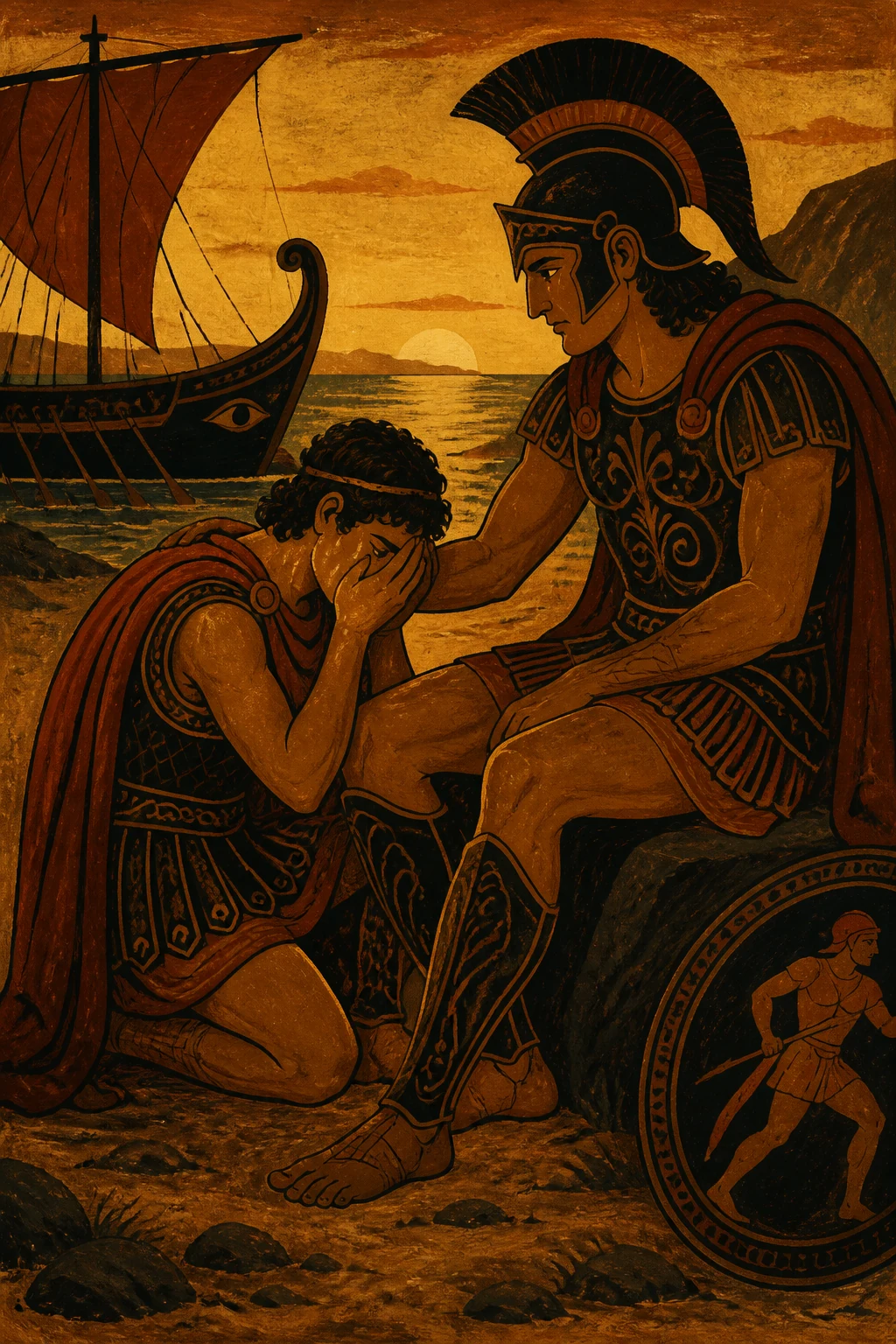
So they mourned throughout the city. But when the Achaeans reached their ships and the Hellespont, they scattered, each to his own ship. Achilles, however, would not let the Myrmidons disperse, but addressed his battle-loving companions: “Myrmidons, riders of swift horses, my loyal comrades, let us not yet unyoke our single-hoofed horses from the chariots. Let us draw near with horses and chariots alike and mourn Patroclus, for that is the honor due the dead.
“Then, when we have taken our fill of bitter lamentation, we shall unyoke the horses and all feast here.” So he spoke, and they raised one united cry, Achilles leading their grief. Three times they drove their flowing-maned horses round the body, weeping, and Thetis stirred in them a longing to lament.
The sands were drenched, and the warriors’ armor was drenched with tears: such was the master of battle they had lost. The son of Peleus led their passionate lament, laying his man-slaying hands upon his companion’s breast: “Hail, Patroclus, even in the house of Hades! Now I am fulfilling all that I promised you before: to drag Hector here and give him to the dogs to tear and eat raw, and to cut the throats of twelve glorious sons of Troy before your pyre, in anger at your death.”
So he spoke, devising shameful treatment for noble Hector, whom he stretched face down in the dust beside the bier of Menoetius’ son. The men stripped off their glittering bronze armor and unyoked their high-necked horses, then sat down in their thousands beside the ship of the swift-footed grandson of Aeacus. And Achilles gave them a lavish funeral feast.
Many white cattle bellowed as they were slaughtered beneath the knife, and many sheep and bleating goats. Many white-tusked swine, rich in fat, were stretched out to singe in the flame of Hephaestus. Everywhere about the corpse the blood ran so thick that cups could have dipped it up.
But the Achaean kings led their lord, the swift-footed son of Peleus, to noble Agamemnon, persuading him with difficulty, for his heart was bitter with grief for his companion. When they reached Agamemnon’s hut, they at once ordered the clear-voiced heralds to set a great cauldron over the fire, hoping to persuade the son of Peleus to wash the bloody gore from his body.
But he firmly refused, and swore an oath: “No, by Zeus, highest and best of gods! It is not right that water should touch my head until I have laid Patroclus on the fire, heaped up his burial mound, and cut my hair. Never again, while I remain among the living, will grief like this come upon my heart.
“But now let us submit to this hateful meal. At dawn, Agamemnon, lord of men, order wood to be brought and everything made ready that befits a dead man on his journey down into the misty darkness, so that the tireless fire may burn him swiftly from our sight and the men may turn again to their tasks.”
So he spoke, and they listened closely and obeyed. Each hurried to prepare his supper, and they feasted; no heart lacked its fair share of the meal.
When they had satisfied their desire for food and drink, each went to his own hut to sleep. But the son of Peleus lay groaning heavily among his many Myrmidons beside the loud-resounding sea, in an open space where the waves washed upon the shore. There sweet sleep took hold of him, pouring round him and easing the cares of his heart, for his splendid limbs were utterly weary from chasing Hector toward windy Ilios. Then the spirit of unhappy Patroclus came to him, like the living man in every way—in stature, in his lovely eyes, and in his voice—and wearing the same clothes upon his body. He stood above Achilles’ head and spoke: “You sleep, Achilles, and have forgotten me.
“You never neglected me while I lived, but now that I am dead you do. Bury me as quickly as you can, so that I may pass through the gates of Hades. The spirits keep me far away, the shadows of the dead; they will not yet allow me to join them beyond the river, and I wander aimlessly about the wide-gated house of Hades.
“Give me your hand, I beg you, for never again shall I return from Hades once you have given me my share of fire. Never again in life shall we sit apart from our dear companions and take counsel together. Hateful death has swallowed me, the fate allotted to me at my birth. And you too, godlike Achilles, are destined to perish beneath the walls of the wealthy Trojans.
“One thing more I will say and charge you to do, if you will listen. Do not lay my bones apart from yours, Achilles, but together, just as we were brought up together in your house, when Menoetius brought me as a little boy from Opus to your home because of a grievous killing. That was the day I killed Amphidamas’ son, a foolish child, not meaning to, in anger over a game of knucklebones. Then Peleus the horseman welcomed me into his house, brought me up with loving care, and named me your attendant. So let one vessel hold both our bones, the golden two-handled urn your honored mother gave you.”
Swift-footed Achilles answered him: “Why have you come here, dear friend, to lay all these commands upon me? I will certainly fulfill them all and do as you ask.
“But come closer to me. Let us clasp each other, if only for a little while, and take our fill of bitter lamentation.” With these words he reached out his loving arms, but caught nothing. The spirit vanished beneath the earth like smoke, with a thin, shrill cry. Achilles sprang up in amazement, struck his hands together, and spoke in sorrow: “Ah, then even in the house of Hades there is a spirit, a phantom, though no living mind remains in it at all! All night the spirit of unhappy Patroclus stood beside me, weeping and lamenting, and laid his commands upon me, wonderfully like the man himself.”
So he spoke, and stirred in them all a longing to lament. Rosy-fingered Dawn appeared while they were weeping round the pitiful corpse. Then lord Agamemnon sent men and mules from all the huts to fetch wood, with a worthy man to oversee them: Meriones, attendant of noble Idomeneus.
They went with woodcutters’ axes in their hands and stoutly plaited ropes, while the mules went on before them. Up and down they traveled, across slopes and over winding paths. When they reached the foothills of Ida with its many springs, they hurried to fell the high-crowned oaks with long-edged bronze, and the trees came crashing down. The Achaeans split them, then bound the logs to the mules, which tore up the earth with their hooves as they strained through the thick brush toward the plain.
All the woodcutters carried logs, for so Meriones, attendant of noble Idomeneus, had ordered. They threw them down in rows along the shore, where Achilles had marked out a great burial mound for Patroclus and himself.
When they had laid down the vast store of wood on every side, they sat together there and waited. Achilles at once ordered the battle-loving Myrmidons to put on their bronze armor and each to yoke his horses to his chariot. They rose and armed themselves, and fighting men and charioteers mounted their chariots. The chariots led the way, and behind them came a cloud of foot soldiers, thousands strong. In their midst his companions carried Patroclus.
They covered the whole body with locks of hair they cut from their heads and cast upon him. Behind them noble Achilles held his head, grieving, for he was sending his blameless companion down to Hades. When they reached the place Achilles had appointed, they laid him down and swiftly piled up abundant wood for him.
Then swift-footed noble Achilles thought of something else. Standing apart from the pyre, he cut off the golden lock he had kept growing for the river Spercheius. Deeply troubled, he looked out over the wine-dark sea and said: “Spercheius, in vain did my father Peleus vow that when I returned to my dear native land I would cut my hair for you and offer a sacred hecatomb, and sacrifice fifty uncastrated rams beside your waters, at your springs, where your holy precinct lies and your fragrant altar.
“Such was the old man’s prayer, but you have not fulfilled his wish. Now, since I shall not return to my dear native land, let me give this lock to the hero Patroclus to take with him.” So saying, he placed the hair in his dear companion’s hands, and stirred in them all a longing to lament.
And the sunlight would have faded while they mourned, had Achilles not quickly come to Agamemnon’s side and said: “Son of Atreus, it is your words above all that the Achaean army will obey. Even of grief there can be a surfeit. Now send the men away from the pyre and tell them to prepare their meal. We who are closest to the dead will attend to these things; and let the leaders remain here with us.”
When Agamemnon, lord of men, heard this, he at once dismissed the army to the trim ships. But the mourners stayed and piled up the wood. They built a pyre a hundred feet in length and breadth, and with grieving hearts laid the body on its top.
Before the pyre they skinned and dressed many sturdy sheep and shambling, curving-horned cattle. Great-hearted Achilles took the fat from all of them and covered the dead man with it from head to foot, then piled the flayed carcasses around him.
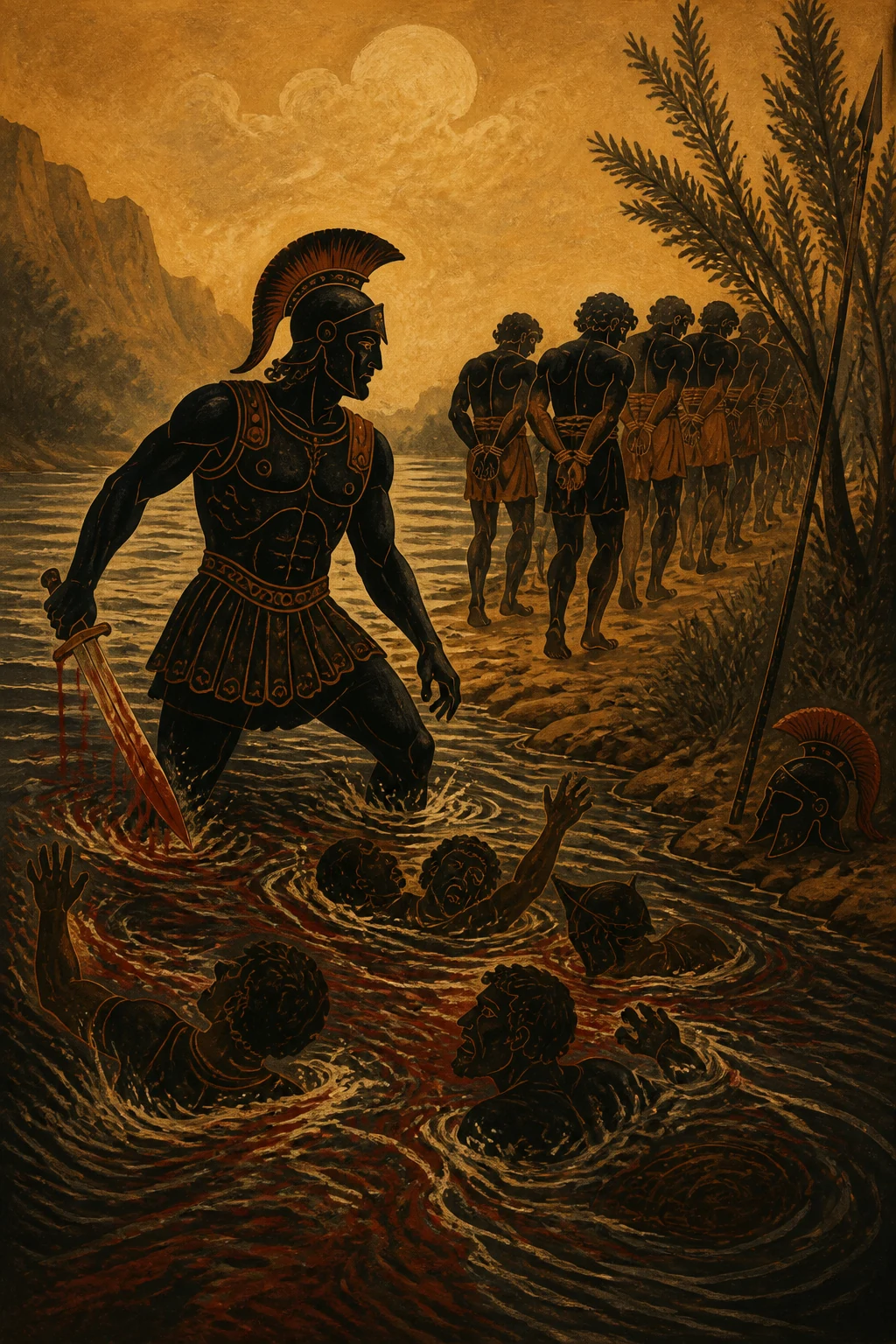
He set jars of honey and oil upon the pyre, leaning them against the bier. Four proud-necked horses he swiftly threw upon it, groaning aloud. The dead lord had owned nine dogs fed at his table; Achilles cut the throats of two and cast them on the pyre, and with his bronze blade slaughtered twelve noble sons of the high-hearted Trojans. Evil were the deeds he planned in his heart. Then he let loose the iron fury of fire to feed upon them.
He cried aloud and called his dear companion by name: “Hail, Patroclus, even in the house of Hades! Now I am fulfilling all that I promised you before. Twelve noble sons of the high-hearted Trojans—the fire is devouring them all along with you. But Hector, Priam’s son, I will not give to the fire to consume, but to the dogs.”
So he spoke in menace. Yet the dogs did not touch Hector, for Aphrodite, daughter of Zeus, kept them away by day and night, and anointed him with immortal, rose-scented oil, so that Achilles would not tear his flesh as he dragged him.
And Phoebus Apollo brought a dark cloud down from heaven to the plain and covered the whole space where the body lay, lest the sun’s fierce heat should shrivel the flesh about his sinews and limbs.
But the pyre of dead Patroclus would not burn. Then swift-footed noble Achilles thought of something else. Standing apart from the pyre, he prayed to the two winds, Boreas and Zephyrus, and promised splendid offerings. Pouring many libations from a golden cup, he begged them to come, so that the bodies might swiftly blaze in the fire and the wood be kindled. Iris heard his prayers and sped away with his message to the winds.
They were gathered in the house of blustering Zephyrus, feasting together. Iris came running and stood on the stone threshold. At the sight of her they all sprang up, each calling her to sit beside him. But she refused to sit and said: “No seat for me. I am going back to the streams of Ocean, to the land of the Ethiopians, where they are offering hecatombs to the immortals, so that I too may share the sacred feast.
“But Achilles prays that Boreas and loud-roaring Zephyrus will come, and promises splendid offerings, so that you may rouse the pyre to burn where Patroclus lies, for whom all the Achaeans mourn.”
With these words she departed, and the two winds rose with a tremendous roar, driving the clouds before them. Soon they reached the sea and blew across it, and the waves rose beneath their shrill blast. They came to fertile Troy and fell upon the pyre, and the mighty, heaven-kindled fire roared aloud.
All night long they struck the flames of the pyre together, blowing fiercely. And all night swift Achilles took his two-handled cup, drew wine from a golden mixing bowl, and poured it on the ground, drenching the earth as he called upon the spirit of unhappy Patroclus.
As a father mourns while burning the bones of his son, a bridegroom whose death has brought grief to his wretched parents, so Achilles mourned as he burned his companion’s bones, creeping beside the pyre and groaning bitterly.
At the hour when the morning star comes forth to herald light upon the earth, and saffron-robed Dawn spreads after it across the sea, the pyre began to die down and the flame ceased. The winds turned back toward their home across the Thracian sea, which groaned beneath its surging swell.
The son of Peleus moved away from the pyre, lay down exhausted, and sweet sleep swept over him. But the men gathered about the son of Atreus and came together toward Achilles. Their approaching voices and footfalls woke him, and he sat upright and spoke: “Son of Atreus, and you other chiefs of all the Achaeans, first quench the whole pyre with gleaming wine, wherever the fire’s fury has spread. Then let us gather the bones of Patroclus, son of Menoetius, carefully distinguishing them. They are easy to recognize, for he lay in the middle of the pyre, while the others, horses and men together, burned apart at its edges.
“Let us lay his bones in a golden vessel, wrapped in a double layer of fat, until I too am hidden in Hades. I ask you not to labor over a very great mound, but only one of fitting size. Later, you Achaeans who remain behind me beside the many-benched ships can raise it broad and high.”
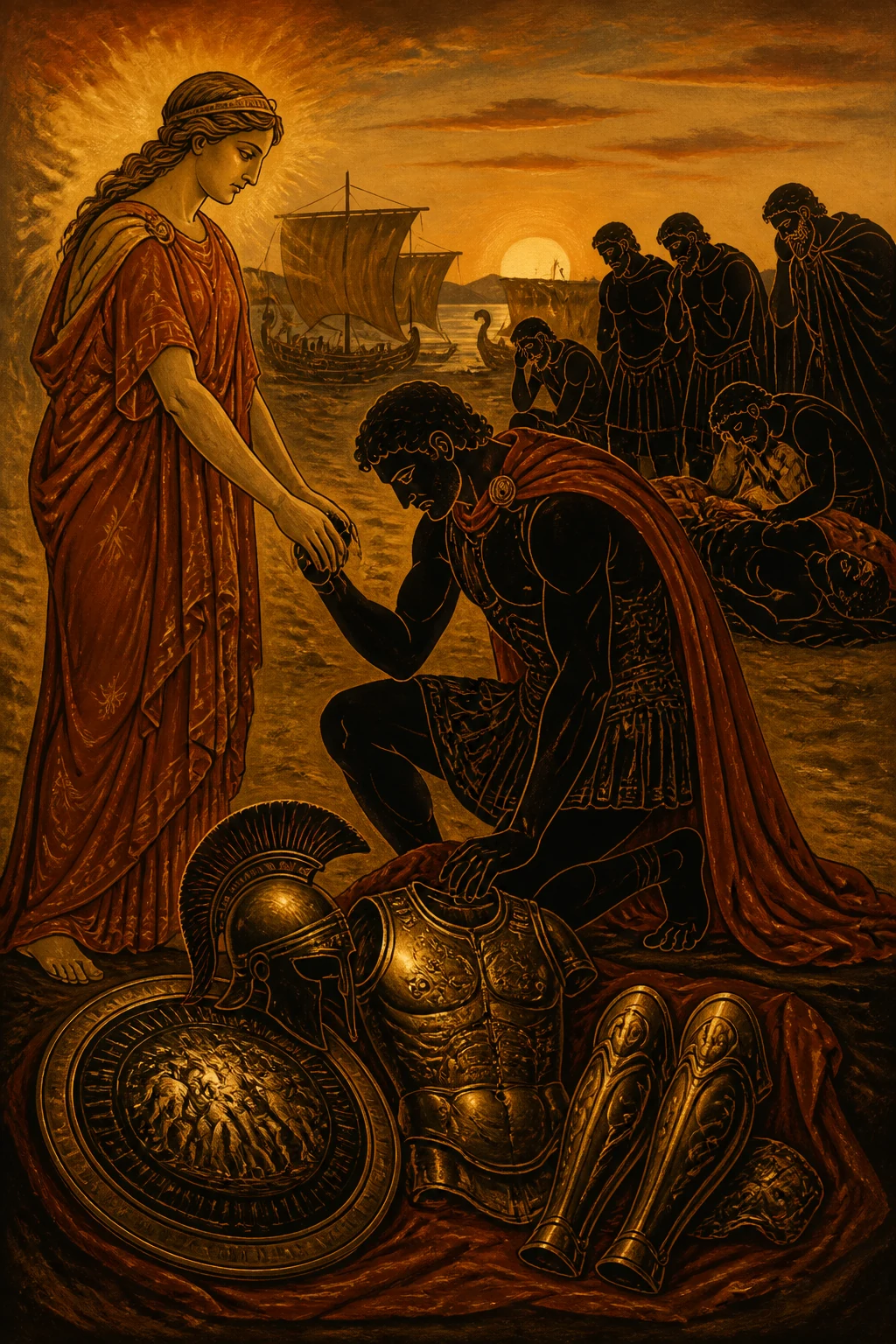
So he spoke, and they obeyed the swift-footed son of Peleus. First they quenched with gleaming wine all the pyre over which the flames had spread, and the ashes settled deep. Weeping, they gathered their gentle companion’s white bones into a golden vessel, wrapped in a double layer of fat, and carried it to the hut, where they covered it with a soft linen cloth. They marked a circle for the mound and laid its foundations round the pyre, then quickly heaped the loose earth over it. When they had raised the mound, they turned to leave, but Achilles kept the army there and seated them in a broad assembly. From the ships he brought prizes: cauldrons and tripods, horses and mules, sturdy cattle, women with lovely girdles, and gray iron.
First he set out splendid prizes for the swift chariot racers: for the winner, a woman skilled in faultless handiwork and a handled tripod holding twenty-two measures; for the second, a six-year-old unbroken mare, pregnant with a mule foal; for the third, a beautiful cauldron holding four measures, still bright and untouched by fire; for the fourth, two talents of gold; and for the fifth, a two-handled bowl, also untouched by fire.
He rose and addressed the Argives: “Son of Atreus, and you other well-greaved Achaeans, these prizes lie here in the assembly awaiting the chariot racers. If we Achaeans were holding games in honor of anyone else, I would certainly win the first prize and carry it to my hut.
“You know how far my horses surpass all others in excellence. They are immortal: Poseidon gave them to my father Peleus, and he in turn entrusted them to me. But I shall stand aside, and my single-hoofed horses too, for they have lost the glorious and gentle charioteer who so often poured flowing oil over their manes after bathing them in clear water.
“They stand mourning for him, their manes trailing on the ground, their hearts full of sorrow. But let the rest of you throughout the camp make ready, whoever among the Achaeans trusts in his horses and his well-built chariot.”
So spoke the son of Peleus, and the swift chariot racers gathered. Far the first to rise was Eumelus, lord of men, the dear son of Admetus, who excelled in horsemanship. Next rose mighty Diomedes, son of Tydeus, and yoked the Trojan horses he had once taken from Aeneas, though Apollo had rescued Aeneas himself.
After him rose fair-haired Menelaus, Zeus-born son of Atreus. He yoked his swift horses, Agamemnon’s mare Aethe and his own Podargus. Echepolus, son of Anchises, had given the mare to Agamemnon as a gift, so that he need not follow him to windy Ilios but could stay at home and enjoy himself; for Zeus had given him great wealth, and he lived in spacious Sicyon. Menelaus yoked her now, eager as she was for the race.
Fourth, Antilochus harnessed his flowing-maned horses, the glorious son of Nestor, the high-hearted king, son of Neleus. Swift-footed horses bred at Pylos drew his chariot. His father stood close beside him and, with kindly intent, gave advice to one who already had good sense: “Antilochus, young though you are, Zeus and Poseidon have loved you and taught you every skill of horsemanship. There is little need to instruct you, for you know well how to wheel around the turning post. But your horses are the slowest in the race, and I fear that will cost you dearly.
“The others have faster horses, but their drivers have no more cunning than you. Come then, dear son, turn every kind of skill over in your mind, so that the prizes do not slip away from you.
“It is skill, far more than strength, that makes a good woodcutter. It is skill that lets the helmsman steer a swift ship on the wine-dark sea when the winds buffet her. And it is skill that lets one charioteer outstrip another.
“The man who trusts in his horses and chariot alone will carelessly wheel wide this way and that; his horses wander over the course, and he cannot hold them in. But the cunning driver, even with poorer horses, keeps his eye always on the turning post and rounds it close. He never forgets how to judge the first pull on the oxhide reins, but holds his team steady and watches the man ahead.
“I will tell you of a landmark so clear that you cannot miss it. A dead stump, oak or pine, stands a fathom above the ground, not yet rotted by the rain. Two white stones are set against it, one on either side, where the road narrows; the racing ground is smooth all round. It may be the tomb of a man long dead, or perhaps men of an earlier time set it there as a turning post. Now swift-footed noble Achilles has made it the mark for the race.
“Drive your horses and chariot close against it, and lean a little to the left in the well-woven car. Shout at the right-hand horse and goad him on, giving him rein with your hands.
“Let your left-hand horse graze the turning post, so that the hub of your well-made wheel seems almost to touch it. But take care not to strike the stone, or you may wound your horses and smash your chariot. That would delight the others and bring you shame. Be thoughtful, dear son, and keep watch.
“For if you can overtake the others at the turning post, no one will catch you with a sudden rush or pass you—not even if he drove noble Arion behind you, Adrastus’ swift horse of divine descent, or the fine horses of Laomedon, bred here in Troy.”
With these words Nestor, son of Neleus, sat down again in his place, having told his son the essential points of every maneuver. Fifth, Meriones harnessed his flowing-maned horses. They mounted their chariots and cast their lots. Achilles shook them, and the lot of Antilochus, Nestor’s son, leaped out first. After him lord Eumelus drew his place, then Menelaus, son of Atreus, famed for his spear; after him Meriones was allotted his position. Last of all, though far the best, the son of Tydeus drew his place to drive.
They stood in a line, and Achilles pointed out the turning post far away on the level plain. Beside it he stationed godlike Phoenix, his father’s attendant, as a judge, to observe the race and report the truth.
All together they raised their whips above the horses, struck them with the lashes, and shouted urgent encouragement. The horses sped swiftly across the plain, away from the ships. Beneath their breasts the dust rose in clouds like a storm, and their manes streamed in the wind.
The chariots now skimmed the earth that feeds so many, now bounded high into the air. The drivers stood in their cars, and each man’s heart pounded in his longing for victory. Each called to his horses, and they flew on, raising dust across the plain.
But when the swift horses were running the final stretch back toward the gray sea, then each team’s true worth began to show, and their pace grew strained. Soon the swift mares of Pheres’ grandson drew ahead.
Close behind them came Diomedes’ Trojan stallions, not far away at all but hard upon them. They seemed always about to mount Eumelus’ chariot, and their breath warmed his back and broad shoulders, for they flew along with their heads stretched over him.
And Diomedes would have passed him or made the outcome doubtful, had Phoebus Apollo not grown angry with the son of Tydeus and struck the gleaming whip from his hand. Tears of anger streamed from his eyes as he saw the mares pulling farther and farther ahead, while his own horses lost speed, running without the goad.
But Athena did not fail to notice Apollo’s trick against the son of Tydeus. She sped after the shepherd of the people, gave him back his whip, and put fresh strength into his horses. Then in anger she went after the son of Admetus and broke his horses’ yoke. The mares swerved to either side of the road, and the pole fell loose to the ground.
Eumelus himself tumbled from the chariot beside the wheel. His elbows, mouth, and nostrils were scraped raw, and his forehead was bruised above his brows. His eyes filled with tears, and his strong voice failed him.
The son of Tydeus turned his single-hoofed horses aside and drove past, leaping far ahead of the others, for Athena had put strength into his horses and granted glory to him. Behind him came fair-haired Menelaus, son of Atreus.
Antilochus called to his father’s horses: “On with you both! Stretch out as fast as you can! I do not ask you to compete with the horses of warlike Diomedes, to whom Athena has now granted speed and given their driver glory. But catch the horses of Atreus’ son, and do not fall behind! Quickly, before Aethe puts you to shame—a mere mare! Why are you falling back, my fine pair?
“I tell you this, and it will surely come to pass: no more care and feeding from Nestor, shepherd of the people! He will kill you on the spot with the sharp bronze if through your slackness we carry off a lesser prize.
“So press on after them and hurry as fast as you can. I myself will think of a way to slip past where the road narrows; I shall not miss my chance.” So he spoke, and the horses, frightened by their master’s shout, ran faster for a little while. Soon steadfast Antilochus saw a narrow place in the sunken road.
There was a break in the earth, where winter rainwater had gathered and torn away part of the road, hollowing out the whole place. Menelaus was driving through it, keeping clear of a collision with another chariot. But Antilochus turned his single-hoofed horses off the road and, swerving a little, raced beside him.
The son of Atreus grew afraid and shouted to Antilochus: “Antilochus, you are driving recklessly! Hold in your horses! The road is narrow here; soon it will be wider, and you can pass. Do not crash into my chariot and ruin us both!”
So he spoke, but Antilochus drove harder still, plying his goad as though he had not heard. They raced on for the distance a strong young man throws a discus from the shoulder when testing his strength. Then the mares of Atreus’ son fell back, for Menelaus deliberately eased his driving, lest the single-hoofed horses collide on the road and overturn the well-woven chariots, throwing the drivers into the dust in their eagerness for victory.
Fair-haired Menelaus rebuked him: “Antilochus, no mortal is more reckless than you! Away with you! We Achaeans were wrong to call you sensible. But even so, you will not carry off the prize without swearing an oath.”
Then he called to his horses: “Do not hold back; do not stand there with grieving hearts. Their feet and knees will tire before yours do, for neither of them is young.”
So he spoke, and the horses, frightened by their master’s shout, ran faster and soon drew close to the others. The Argives sat in the assembly watching the horses as they flew across the plain in clouds of dust.
Idomeneus, leader of the Cretans, was the first to make out the horses, for he sat apart from the assembly on a high lookout. He heard and recognized the driver’s shouting from far away, and saw a conspicuous horse in the lead, chestnut all over except for a white mark on its forehead, round like the moon.
He rose and spoke among the Argives: “Friends, leaders and rulers of the Argives, am I alone in seeing the horses, or can you see them too? It seems to me that another team is now in front, and another driver is coming into view. The mares that led on the outward course must have come to grief somewhere on the plain. I saw them first as they rounded the turning post, but now I cannot find them anywhere, though my eyes search all across the Trojan plain. Did their driver lose his grip on the reins and fail to hold them well around the post, missing the turn? I think he must have fallen there and smashed his chariot, and the mares bolted when panic seized their hearts.
“But stand up and look for yourselves. I cannot make him out clearly, but I think the man is an Aetolian by birth, who rules among the Argives: mighty Diomedes, son of horse-taming Tydeus.”
Swift Ajax, son of Oileus, answered him with insulting words: “Idomeneus, why are you always so quick to bluster? The high-stepping mares are still racing far away over the broad plain. You are hardly the youngest among the Argives, nor are the eyes in your head the keenest. Yet you are always blustering! You should not be so loud-mouthed; there are better men than you here.
“The same mares are in front as before, Eumelus’ mares, and he himself stands in the chariot holding the reins.” The leader of the Cretans answered angrily: “Ajax, master of abuse, empty-headed man! In everything else you fall behind the Argives, for your mind is stubborn and harsh.
“Come then, let us wager a tripod or a cauldron, and let us both appoint Agamemnon, son of Atreus, as judge of which horses lead. You will learn when you have to pay.” So he spoke, and swift Ajax, son of Oileus, sprang up in anger to answer him with harsh words. Their quarrel would have gone further still, had Achilles himself not risen and said: “Ajax and Idomeneus, no more exchanging these harsh, bitter words. It is not fitting.
“You would both be angry with another man who behaved like this. Sit here in the assembly and watch the horses. In their eagerness for victory they will soon be here themselves, and then each of you will recognize the Argives’ horses, those behind and those in front.”
So he spoke, and the son of Tydeus came driving very close, striking his horses continually with sweeping strokes of the whip. They bounded high and swiftly covered the course. Dust spattered the driver without ceasing, and the chariot, adorned with gold and tin, raced behind the swift-footed horses. Its wheel rims scarcely left a track in the fine dust, so swiftly did the pair fly on.
He halted in the middle of the assembly, and sweat streamed from the horses’ necks and chests to the ground. Diomedes leaped down from the gleaming chariot and leaned his whip against the yoke. Nor did mighty Sthenelus delay: he quickly claimed the prize and gave the woman to his high-hearted companions to lead away, and the handled tripod to carry. He himself unyoked the horses.
Next Antilochus, of Neleus’ line, drove in his horses, having passed Menelaus by cunning, not by speed. Yet even so Menelaus kept his swift horses close behind.
As close as a horse runs to the wheel when it strains across the plain, drawing its master in his chariot—the tips of its tail hairs brush the rim, and the wheel runs close behind, with little space between as it courses over the broad plain—so far Menelaus finished behind blameless Antilochus. At first he had been a discus throw behind, but he had quickly caught him, for Agamemnon’s lovely-maned mare Aethe was gaining strength. Had the course stretched farther for them both, Menelaus would have passed him and left no doubt about the outcome.
But Meriones, the brave attendant of Idomeneus, came in a spear’s cast behind glorious Menelaus. His sleek-maned horses were the slowest, and he himself the least skilled at driving a chariot in the race.
Last of all came the son of Admetus, driving his horses before him and dragging his splendid chariot. When swift-footed, godlike Achilles saw him, he pitied him, and stood among the Argives to address them with winged words: “The best man comes in last with his single-hoofed horses. Come, let us give him the second prize, as is fitting; but let the son of Tydeus take the first.”
So he spoke, and all applauded his proposal. Indeed, he would have given him the mare, since the Achaeans approved, had not Antilochus, son of great-hearted Nestor, risen to answer Achilles, son of Peleus, and plead his claim: “Achilles, I shall be very angry with you if you carry out those words. You mean to take away my prize, because you remember how his chariot and swift horses came to grief, though he himself is a fine charioteer. But he should have prayed to the immortals; then he would not have come in last of all.
“If you pity him and he is dear to your heart, you have plenty of gold in your hut, and bronze, and flocks; you have slave women and single-hoofed horses. Take something from these and give him an even greater prize, now, this very moment, if you wish, so that the Achaeans may praise you.
“But the mare I will not give up. Let any man who wants her try to fight me for her with his hands.” So he spoke, and swift-footed, godlike Achilles smiled, pleased with Antilochus, who was his dear companion. He answered him with winged words: “Antilochus, if you ask me to give Eumelus something else from my own possessions, I will gladly do so.
“I shall give him the bronze breastplate I stripped from Asteropaeus, with a band of gleaming tin running all around it. It will be worth much to him.” So he spoke, and told his dear companion Automedon to fetch it from his hut. He went and brought it, and placed it in Eumelus’ hands; and Eumelus received it gladly.
Then Menelaus too rose among them, grieved at heart and bitterly angry with Antilochus. A herald put the staff in his hand and called for silence among the Argives. Then the godlike warrior addressed them: “Antilochus, you who were sensible before, what have you done?
“You have disgraced my skill and hampered my horses by thrusting yours ahead of them, though yours were far inferior. Come, leaders and rulers of the Argives, judge fairly between us, showing neither man favor, lest some bronze-clad Achaean should say: ‘Menelaus has used lies to overpower Antilochus and gone off with the mare, because his horses were much worse, though he himself was greater in rank and strength.’
“Or come, I will give judgment myself, and I think no other Danaan will find fault with me, for it will be just. Antilochus, cherished by Zeus, come here and do what custom requires: stand before your horses and chariot, holding in your hands the supple whip with which you drove before, lay your hand upon the horses, and swear by the Earthholder, the Earthshaker, that you did not deliberately obstruct my chariot by deceit.”
Then wise Antilochus answered him: “Be patient now, lord Menelaus. I am much younger than you, and you are my elder and my better. You know the faults of a young man: his mind is quick, but his judgment slight.
“So let your heart be forbearing. I will give you the mare I won, of my own accord. And if you should ask for some greater thing from my own possessions, I would gladly give it to you at once rather than fall forever from your favor, cherished of Zeus, and stand guilty before the gods.”
So spoke the son of great-hearted Nestor, and led the mare over and put her reins in Menelaus’ hands. His heart grew warm, as when dew settles about the ears of ripening grain and the fields bristle with the crop: so, Menelaus, did your heart grow warm within your breast.
He addressed Antilochus with winged words: “Now I will yield to you, Antilochus, angry though I am, since before this you were neither reckless nor foolish. This time your youth has overcome your judgment.
“Take care not to deceive your betters again. No other Achaean could so easily have persuaded me. But you have suffered much and endured much for my sake, as have your noble father and your brother. Therefore I shall listen to your plea, and give you the mare, though she is mine, so that these men too may know that my heart is never overbearing or unrelenting.”
So he spoke, and gave the mare to Noemon, Antilochus’ companion, to lead away; then he took the shining cauldron. Meriones carried off the two talents of gold, coming fourth as he had in the race. The fifth prize remained, a two-handled bowl. Achilles carried it through the assembly of the Argives and gave it to Nestor. Standing beside him, he said: “Take this now, old sir, and let it be a treasure for you, a memorial of Patroclus’ funeral, for you will never see him among the Argives again. I give you this prize without a contest, since you will not fight with your fists or wrestle, nor enter the javelin contest, nor race on foot; harsh old age already weighs upon you.”
With these words he put it in his hands, and Nestor received it gladly and answered him with winged words: “Yes, my child, all you have said is right. My limbs are no longer firm beneath me, nor my feet; my arms no longer swing lightly from either shoulder.
“If only I were young and my strength as steady as when the Epeians buried lord Amarynceus at Buprasium, and the king’s sons offered prizes! Then no man could match me, neither among the Epeians, nor the Pylians themselves, nor the great-hearted Aetolians.
“In boxing I defeated Clytomedes, son of Enops, and in wrestling Ancaeus of Pleuron, who stood up against me. I outran Iphiclus, swift though he was, and outthrew Phyleus and Polydorus with the spear.
“Only in the chariot race did the sons of Actor beat me, using their numbers to press ahead, begrudging me the victory, for the greatest prizes still lay there for that event. They were twins: one drove steadily, steadily held the reins, while the other urged the horses with the whip.
“Such was I once. Now let younger men take part in contests like these. I must bow to grievous old age, though then I stood out among the heroes. But go, and honor your companion’s funeral with the games.
“I accept this gift with a willing heart, and rejoice that you always remember my kindness and never forget me, or the honor I ought to receive among the Achaeans. May the gods reward you for this with a blessing to delight your heart.”
So he spoke, and the son of Peleus went through the great throng of Achaeans, after hearing all the praise of Neleus’ son. Then he set out prizes for the painful boxing match. He brought a hardworking mule and tethered her in the arena, six years old and unbroken—the hardest age at which to break one in. For the defeated man he set out a two-handled cup.
He stood upright and addressed the Argives: “Son of Atreus, and you other well-greaved Achaeans, we invite two men, the best among you, to raise their fists and fight for these prizes. Whichever man Apollo grants endurance, and all the Achaeans acknowledge as victor, shall lead the hardworking mule back to his hut; the defeated man shall carry off the two-handled cup.”
So he spoke, and at once a brave, powerful man arose, skilled in boxing: Epeius, son of Panopeus. He laid his hand upon the hardworking mule and said: “Let whoever is to carry off the two-handled cup come forward. No other Achaean, I declare, will win the mule by beating me with his fists, for I claim to be the best.
“Is it not enough that I fall short in battle? No man can be a master of every task. I tell you this, and it will surely come to pass: I shall tear my opponent’s flesh and shatter his bones.
“Let his friends stay here together, ready to carry him away when my hands have beaten him down.” So he spoke, and all fell silent. Only Euryalus stood up to face him, a godlike man, son of lord Mecisteus, Talaus’ son, who once went to Thebes for the funeral of the fallen Oedipus and defeated all the Cadmeans there.
The son of Tydeus, famed for his spear, busied himself about Euryalus, encouraging him with words and longing for his victory. First he put a loincloth around him, then gave him well-cut thongs of hide from a field-grazing ox.
When both had girded themselves, they stepped into the middle of the arena, raised their sturdy fists against each other, and fell to, their heavy hands meeting in blows. There was a terrible crunching of jaws, and sweat ran from every limb. Then noble Epeius rushed in and struck his opponent on the cheek as he looked for an opening. He did not stand long: his splendid limbs gave way beneath him.
As a fish leaps in the weed-strewn shallows under a gust of the North Wind, and the dark wave covers it, so he leapt beneath the blow. But great-hearted Epeius caught him in his hands and raised him up. His dear companions gathered around and led him through the assembly, his feet dragging, spitting thick blood, his head lolling to one side. They brought him over and sat him down among them, dazed; then they went back themselves and fetched the two-handled cup.
At once the son of Peleus set out other prizes, for the third event, displaying them to the Danaans for the strenuous wrestling match. For the winner there was a great tripod to stand over a fire, which the Achaeans valued among themselves at twelve oxen. For the defeated man he brought into their midst a woman skilled in many kinds of work, whom they valued at four oxen.
He stood upright and addressed the Argives: “Rise, you two who will try your strength for this prize.” So he spoke, and great Ajax, son of Telamon, rose, and resourceful Odysseus, master of cunning, stood up too.
When they had girded themselves, the two stepped into the middle of the arena and gripped each other with their sturdy arms, like rafters joined by a skilled carpenter in the roof of a lofty house to withstand the force of the winds.
Their backs creaked beneath the bold hands that strained hard at them; sweat streamed down, and close-set welts, red with blood, rose along their ribs and shoulders. Still they strove fiercely for victory and the well-wrought tripod. Neither could Odysseus trip Ajax and bring him to the ground, nor could Ajax throw him, for Odysseus’ strength held firm.
But when they were beginning to weary the well-greaved Achaeans, great Ajax, son of Telamon, said to him: “Son of Laertes, sprung from Zeus, Odysseus of many devices, lift me, or let me lift you. All the rest shall be in Zeus’ hands.”
With these words he lifted him; but Odysseus did not forget his cunning. He struck behind Ajax’s knee, making his legs give way, and threw him backward. Odysseus fell upon his chest, and the people gazed in wonder.
Next the much-enduring, godlike Odysseus tried to lift him. He moved him a little from the ground, but could lift him no farther; he hooked his knee, and both fell to the earth beside each other and were covered in dust.
They would have sprung up and wrestled a third time, had not Achilles himself risen and held them back: “Strain no more, and do not wear yourselves out with suffering. Victory belongs to you both. Take equal prizes and leave the arena, so that other Achaeans may compete.”
So he spoke, and they readily listened and obeyed. They wiped off the dust and put on their tunics. Then the son of Peleus set out prizes for swiftness of foot: a wrought silver mixing bowl that held six measures, and far surpassed every other on earth in beauty, for skilled Sidonian craftsmen had fashioned it with care. Phoenician men had carried it across the misty sea and, putting into harbor, had given it to Thoas as a gift. Euneus, son of Jason, had given it to the warrior Patroclus as the price of Lycaon, Priam’s son.
Achilles now offered it in honor of his companion as a prize for whoever should prove lightest on his swift feet. For second place he set out a great ox, rich in fat, and for the last prize half a talent of gold.
He stood upright and addressed the Argives: “Rise, you who will try for this prize.” So he spoke, and at once swift Ajax, son of Oileus, rose, and resourceful Odysseus, and then Antilochus, Nestor’s son, who surpassed all the young men in speed.
They stood side by side, and Achilles marked the finish. Their course stretched away from the starting line. At once the son of Oileus took the lead, and noble Odysseus sped close behind him, as close as the weaving rod is to the breast of a well-girdled woman when she draws it deftly toward her, pulling the weft through the warp and holding the rod near her breast. So close behind him ran Odysseus, his feet striking Ajax’s footprints before the dust could settle over them. As he ran swiftly on, noble Odysseus breathed down upon his head. All the Achaeans shouted for him as he strove for victory, urging him on in his eager race.
But as they ran the final stretch, Odysseus prayed in his heart to bright-eyed Athena: “Hear me, goddess, and come in kindness to help my feet.” So he prayed, and Pallas Athena heard him. She made his limbs light, his feet and his arms above.
But just as they were about to dash for the prize, Ajax slipped as he ran, for Athena tripped him where dung lay spilled from the loud-bellowing cattle that swift-footed Achilles had slaughtered in honor of Patroclus. His mouth and nostrils filled with cattle dung. Much-enduring, godlike Odysseus lifted the mixing bowl, having come in first, while glorious Ajax took the ox.
He stood holding the horn of the field-grazing ox, spitting out dung, and said among the Argives: “Curse it! The goddess tripped my feet—she who always stands beside Odysseus like a mother and helps him.”
So he spoke, and they all laughed heartily at him. Antilochus carried off the last prize with a smile and addressed the Argives: “Friends, I will tell you what you all know already: even now the immortals honor older men.
“Ajax is only a little older than I am, but this man belongs to an earlier generation, to the men of former days. They call him a vigorous old man, and it is hard for any Achaean to race him on foot—except Achilles.”
So he spoke, paying honor to the swift-footed son of Peleus. Achilles answered him: “Antilochus, your praise shall not go unrewarded. I shall add another half-talent of gold to your prize.”
With these words he put it in his hands, and Antilochus received it gladly. Then the son of Peleus brought into the arena and set down a long-shadowed spear, a shield, and a helmet—the armor of Sarpedon, which Patroclus had stripped from him.
He stood upright and addressed the Argives: “We invite two men, the best among you, to put on armor, take up flesh-cutting bronze, and test each other before the throng for these prizes.
“Whichever is first to reach the other’s fair flesh, piercing through the armor to touch the inward parts and draw dark blood, to him I shall give this fine Thracian sword with silver studs, which I stripped from Asteropaeus. The two shall share this armor between them, and we shall set a good feast before them in our huts.”
So he spoke, and great Ajax, son of Telamon, rose, and the son of Tydeus, mighty Diomedes, stood up too. When they had armed themselves on either side of the throng, they met in the middle, eager to fight, with terrible looks. All the Achaeans were seized with awe.
When they had drawn near in their advance against each other, three times they charged, three times they closed. Then Ajax thrust through the round shield, but did not reach the flesh, for the breastplate beneath protected it. But the son of Tydeus kept aiming the point of his shining spear at Ajax’s neck above the great shield.
Then the Achaeans, fearing for Ajax, called on them to stop and take equal prizes. But the hero Achilles gave the great sword to the son of Tydeus, bringing it to him with its sheath and well-cut belt.
Then the son of Peleus set out a lump of rough-cast iron, which mighty Eetion had once used to throw. Swift-footed, godlike Achilles had killed him and carried it away in his ships with the rest of his possessions.
He stood upright and addressed the Argives: “Rise, you who will try for this prize. Even if the winner’s fertile fields lie far away, he will have enough iron to use for five full years. Neither his shepherd nor his plowman will need to go to town for want of iron: this will supply them.”
So he spoke, and Polypoetes, steadfast in battle, rose, and mighty, godlike Leonteus, and Ajax, son of Telamon, and noble Epeius. They stood in order, and noble Epeius took the iron, swung it around, and hurled it. All the Achaeans laughed at his throw.
Next Leonteus, scion of Ares, made his cast. Third, great Ajax, son of Telamon, hurled it from his sturdy hand and threw beyond all their marks. But when Polypoetes, steadfast in battle, took the iron, he threw it farther than all the others by the distance a herdsman throws his staff, which flies whirling through the herd. They shouted aloud.
The companions of mighty Polypoetes rose and carried their king’s prize to the hollow ships. Then Achilles set out dark iron for the archers: ten double axes and ten single axes. Far off on the sands he set up the mast of a dark-prowed ship, and tied a trembling dove to it by the foot with a slender cord, bidding them shoot at her. “Whoever hits the trembling dove shall take up all the double axes and carry them home. Whoever hits the cord but misses the bird shall take the single axes, for his is the lesser shot.”
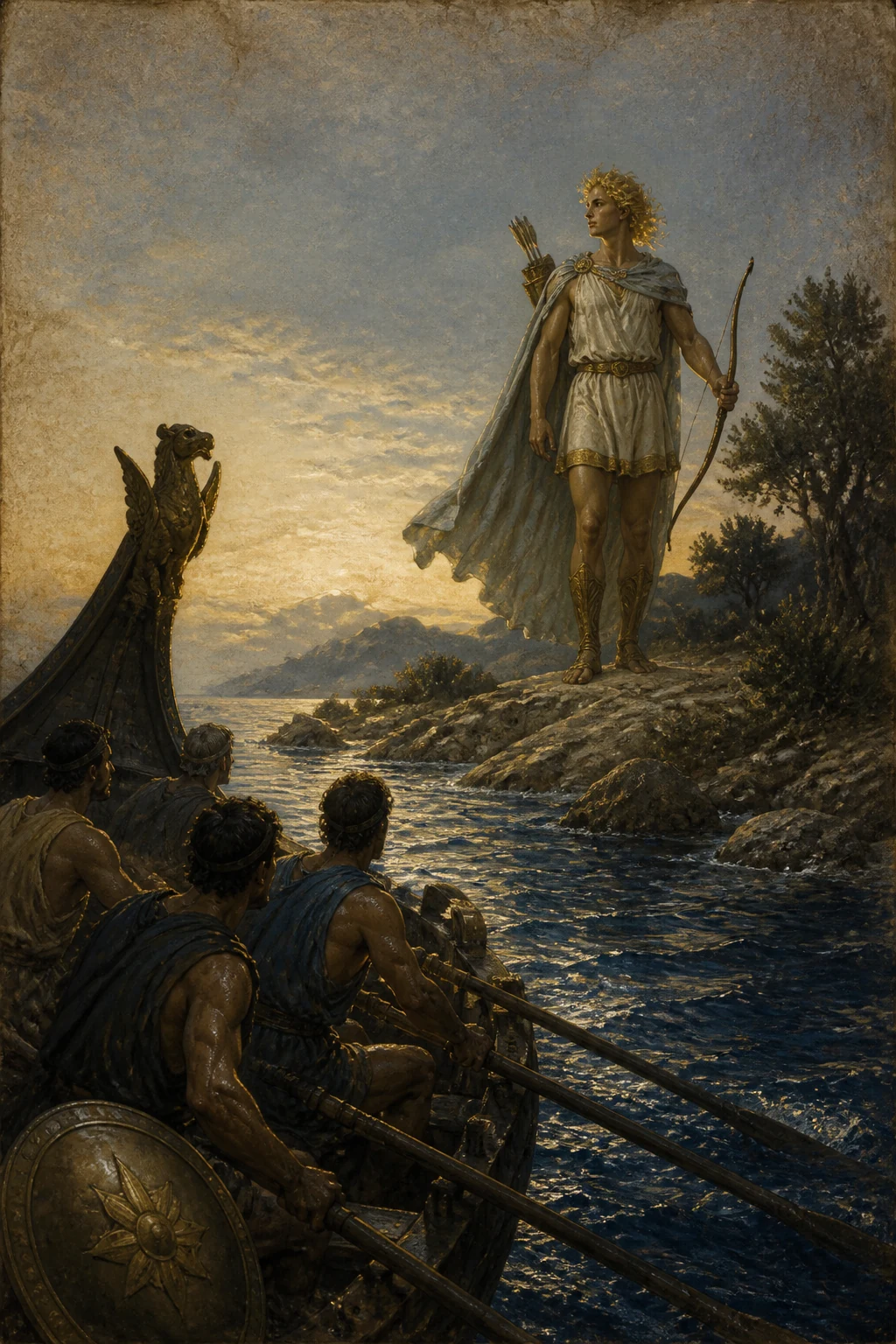
So he spoke, and mighty lord Teucer rose, and Meriones, the brave attendant of Idomeneus, stood up too. They took lots and shook them in a bronze helmet. Teucer won the first shot. At once he loosed an arrow with force, but did not promise the lord Apollo a splendid sacrifice of a hundred firstborn lambs.
He missed the bird, for Apollo denied him that, but struck the cord beside the foot by which the bird was tied. The sharp arrow cut straight through the cord.
The dove darted toward the sky, while the cord dropped loose to the ground, and the Achaeans shouted. Meriones hurriedly snatched the bow from Teucer’s hand; he had long been holding an arrow ready as Teucer took aim.
At once he promised Apollo the Far-shooter a splendid sacrifice of a hundred firstborn lambs. High beneath the clouds he caught sight of the trembling dove, and as she wheeled he struck her in the middle beneath the wing. The arrow passed clean through and fell back to earth, fixing itself in the ground before Meriones’ foot. The bird settled on the mast of the dark-prowed ship, her neck drooping and her thick feathers sagging.
Swiftly the life flew from her limbs, and she fell far from the mast. The people gazed in wonder. Meriones took up all ten double axes, while Teucer carried the single axes to the hollow ships.
Then the son of Peleus brought into the arena a long-shadowed spear and a flower-patterned cauldron, untouched by fire and worth an ox, and set them down. The javelin throwers rose: Agamemnon, son of Atreus, ruler of wide lands, and Meriones, the brave attendant of Idomeneus.
Swift-footed, godlike Achilles addressed them: “Son of Atreus, we know how far you surpass all others, how you are best in strength and in casting the spear. Take this prize and go back to the hollow ships; let us give the spear to the warrior Meriones, if that is your wish. It is what I propose.”
So he spoke, and Agamemnon, lord of men, did not refuse. He gave the bronze-tipped spear to Meriones, and entrusted the splendid prize to the herald Talthybius.