Waltey
Požrešni rdeči lisjak
094 THE GREEDY RED FOX
Živalske zgodbe Clare Dillingham Pierson · Clara Dillingham PiersonO besedilu
Požrešni rdeči lisjak
- Vir
- Živalske zgodbe Clare Dillingham Pierson
- Avtor
- Clara Dillingham Pierson
- Jezik branja
- Slovenščina
- Jezik izvirnika
- English
- Čas branja
- 13 min branja
- Obseg
- 11 strani
- Naslov izvirnika
- 094 THE GREEDY RED FOX
O izvirniku
Živalske zgodbe Clare Dillingham Pierson
Devetindevetdeset avtorskih zgodb o živalih na kmetiji, travniku, v gozdu, ob ribniku in ponoči. Bralni jezik je Slovenščina, izvirnik pa prihaja iz vira Živalske zgodbe Clare Dillingham Pierson v jeziku English.
Besedilo
Požrešni rdeči lisjak
Rdeči lisjak je bil lepo vzgojen. Njegova mati je bila nadvse previdna in vsa predana svojim otrokom. Kadar je ušpičil kaj napačnega, se nikoli ni mogel izgovarjati, da ni vedel, kaj je prav. Morda je bil tako lahkomiseln po očetu, vendar mu nobeden od njegovih dveh bratov in treh sester ni bil podoben. Očeta se niso spominjali. Pravzaprav ga niso nikoli videli in mati je le redko govorila o njem.
Mati je sama skrbela za vseh šest otrok. Ko so se skotili, si je celo populila dlako s trebuha, da jim je mehko postlala gnezdo. Tako nebogljeni mladički so bili. Oči in ušesa so imeli še nekaj časa zaprta in vse, kar so znali, je bilo, da so se prevračali drug čez drugega in pili toplo mleko, ki ga je imela mati zanje.
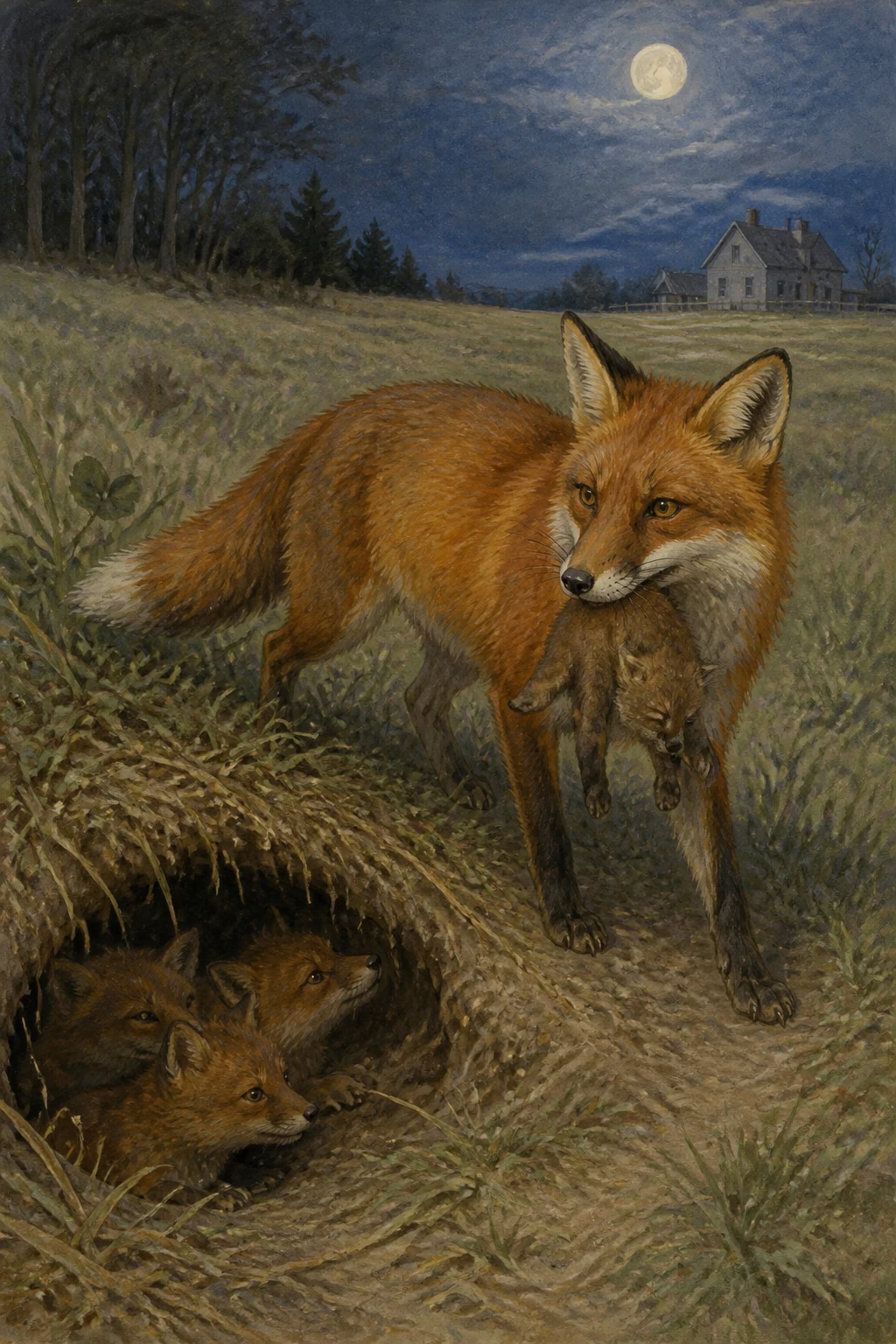
Za dom so imeli tri brloge, vse na odprtem polju med gozdom in kmetijo. Včasih so živeli v prvem, včasih v drugem, včasih pa v tretjem. Neke noči, ko se je mati odpravila na lov, je povohala tla v bližini brloga in se nato vrnila. »Tod blizu je bil človek,« je rekla, »zato vas bom odnesla drugam.«
Lisičke je to silno vznemirilo in vsaka je hotela prva na pot, toda mati jih je utišala in rekla, da jih utegne kak človek ujeti, še preden se preselijo, če bodo tako glasne, in potem —. Ničesar več ni rekla, a po tem, kako je zamahnila z repom, so vedele, da bi bilo strašno, če bi jih ujel človek.
Medtem ko jih je enega za drugim nosila v drug brlog, so se tisti, ki so še ostali, pogovarjali o ljudeh. »Ko bi le vedel, zakaj so ljudje tako strašni,« je rekel prvi. »Gotovo zato, ker imajo velikanske gobce in ostre zobe.«
»Le kakšne barve je njihov kožuh?« se je vprašal drugi. Te mlade lisičke namreč niso videle še nikogar razen svoje matere. Če jim ne bi povedala, da imajo različne živali različno obarvane kožuhe, bi mislile, da so vsi natanko takšni kot ona: z dolgo rdečkasto rumeno dlako, po zadnjem delu hrbta precej prepredeno s sivino, z belim grlom, trebuhom in konico repa ter črnimi uhlji po zunanji strani. Vendar so bile trdno prepričane, da nobena druga žival nima tako čudovitega repa kakor ona, saj se je vsaka dolga rdečkasta dlaka končevala s črno konico, na koncu repa pa se je bohotil prelep, povsem bel čop. To jim je pravzaprav povedala sama.
Ko se je mati naslednjič vrnila, so štirje otroci, ki so še čakali, zavpili: »Prosim, povej nam, kakšne barve je človekov kožuh!« Bila je razumna in preudarna lisica in je vedela, da je mnogo pomembneje obvarovati otroke, da jih kdo ne ujame, kakor pa takoj odgovoriti na vsa njihova vprašanja. Poleg tega je imela, ko so izrekli vprašanje do konca, enega mladička že v gobcu in ga ni hotela odložiti samo zato, da bi govorila. In tudi to je bilo prav, veste, kajti govoriš lahko kadar koli, delo pa je treba opraviti takrat, ko je čas zanj.
Ko so bili varno in udobno nameščeni v drugem brlogu, je legla, da bi jih podojila, in medtem ko so pili mleko, jim je pripovedovala o ljudeh. »Ljudje,« je rekla, »so najstrašnejše živali na svetu. Druge živali vas bodo pustile pri miru, če niso lačne, človek pa vas bo preganjal tudi s polnim trebuhom. Seveda imajo štiri noge — saj jih imajo vse živali —, a hodijo samo po dveh. S prednjima nogama prenašajo stvari. Mi jih nosimo v gobcu, vendar je bila edina reč, ki sem jo kdaj videla človeku v gobcu, kratka rjava paličica, ki je na enem koncu gorela. To se mi je zdelo silno neumno, saj je moral hočeš nočeš vdihavati dim, pustil pa je tudi, da je paličica dogorela, in nato ogenj vrgel proč. Sicer pa so ljudje neznansko neumne živali.«
Eden od malih rdečih lisjačkov je za hip nehal piti in rekel: »Nisi nam povedala, kakšne barve je njihov kožuh.« »Edino dlako, ki jo imajo,« je rekla mati lisica, »imajo na glavi. Navadno jim raste po vrhu glave in zadaj, nekaterim pa tudi malo po spodnjem delu obraza. Lahko je črna, rdeča, rjava, siva ali bela. Lisasta pa ni nikoli.«
Otroci bi radi vprašali še marsikaj, toda mati lisica ni jedla že od prejšnjega večera in mudilo se ji je na lov.
Nikoli ne bi mogli povedati vsega, kar se je pripetilo malim rdečim lisičkam. Velikokrat so se preselile iz enega brloga v drugega; naučile so se jesti meso, ki jim ga je prinašala mati, namesto da bi pile mleko iz njenega telesa, se skupaj podile pred vhodom v svoj dom, mati pa jih je medtem opazovala z gozdnega roba, pripravljena, da jih opozori, če bi zagledala prihajati ljudi ali pse.
Brloge je skopala sredi polja zato, ker se jim tam ljudje ali psi niso mogli neopazno prikrasti, kakor bi se lahko v gozdu, vendar jo je skrbelo, da se bodo otroci tako zatopili v igro, da bodo pozabili paziti. Večino dneva so prespali, ponoči pa so bili vedno budni. Ko so dovolj odrasli, so začeli sami hoditi na lov. Mati lisica jim je dala obilo dobrih nasvetov, potem pa se ni več menila zanje. Odtlej je dremala na prisojnem pobočju, zvita v prelepo mehko rdečkasto rumeno kepo, s košatim repom ovitim okoli telesa, da ji je grel tačke in senčil oči pred svetlobo.
Šest bratov in sester se je potem le redko videlo. Lisicam gre v življenju bolje, če živijo same, in seveda so si želele, da bi jim šlo dobro. Najstarejši brat je bil tisti lahkomiselni. Mati je zanj storila vse, kar je mogla, pa je bil še zmeraj lahkomiseln. Na pamet je znal vsa pravila, ki ga jih je naučila, a se jih ni držal. Pravila so bila takšna:
»Kadar le moreš, teci po trdih, suhih tleh. Na mehkih, mokrih tleh tvoje tačke pustijo več vonja in psi tam laže sledijo tvoji sledi.
»Nikoli ne pojdi nikamor, če nisi prepričan, da lahko prideš tudi ven. »Pazi, da bo tvoj rep suh. Lisjak z mokrim repom ne more dobro teči. »Če te preganjajo psi, skoči na leseno ograjo in teci po njej ali pa zabredi v potok in hodi po njem.
»Za hrano se bodi vedno pripravljen potruditi. Kar najdeš že pripravljeno in te kar čaka, utegne biti vaba v pasti. »Na lovu vedno hodi. Lisjak, ki teče v drncu, gre mimo tistega, kar bi moral najti.«
Nekaj časa si jih je vsak večer ponavljal, ko se je odpravljal na pot. Potem je tu in tam kak večer izpustil. Nato jih je ponavljal samo še takrat, kadar se je prejšnji dan česa prestrašil. Nazadnje jih je povsem nehal ponavljati. »Zdaj sem že odrasel lisjak,« si je rekel, »in takšne reči so dobre samo za otroke. Saj menda znam poskrbeti zase.«
Pogosto je hodil iskat hrano proti kmetiji, včasih grozdje, včasih zelenjavo, včasih pa kaj izdatnejšega. Collie ga je že večkrat pregnal, toda Collie se je staral in redil in med tekom mu je moral jezik viseti iz gobca, zato se je Rdečemu lisjaku vse skupaj zdelo le zabavno. V mesečini je lahkotno tekel, njegovo vitko telo je skoraj lebdelo nad tlemi, prelepi rep pa je držal iztegnjen naravnost za seboj. Kratke, vitke noge so bile močne in se niso zlahka utrudile, in dokler je imel suh rep, je brez težav ušel Collieju. Včasih si je nabral veliko prednost, nato pa sedel in ga počakal. Zasoplemu psu je zatem klical predrznosti in se pognal naprej šele, ko se ga je Colliejev smrček že skoraj dotaknil.
»Lep večer!« mu je nekoč rekel. »Upam, da ti nos služi bolje kakor noge.« To je bilo grdo od njega, veste, toda Collie je vedno ohranil mirno kri in je odvrnil samo: »Prav lepo se poti, hvala.« Tako je odgovoril zato, ker prav vlaga na pasjem smrčku omogoča psu, da voha in sledi vonjavam, za katere bitja s suhim nosom sploh ne vedo.
Nato je lisjak naredil dolg, lahkoten skok in spet odbrzel, Collie pa je moral leči, da bi prišel do sape. »Mislim,« je rekel, »da mi gre čuvanje ovac bolje od preganjanja lisjakov — in tudi precej lažje je.« Vendar Collie ni rad izgubljal in preostanek noči je prebedel ob misli, kako lepo bi bilo ujeti tega lisjaka. Vsake toliko je zaslišal Rdečega lisjaka lajati tam zunaj na polju in ob tem je od nestrpnosti trznil z repom.
Rdeči lisjak pa se je zdaj previdno bližal kmetiji in snoval, kako bi ujel purico. Vse popoldne je s svojega ležišča na pobočju opazoval jate puranov. Vsakič, ko je med dremežem odprl oči, jih je gledal, kako so hodili sem in tja po poljih, se oglašali drug drugemu z blagimi, tožečimi glasovi in pri vsakem koraku pozibavali glave naprej in nazaj. Če ne bi imel tako polnega trebuha, bi že takrat poskusil katerega ujeti. Sklenil je, da bo poskusil tisto noč, in odločil se je, da bi raje dobil tolsto svetlo purico kakor katero od njenih temnejših sester. Na to, da bi ujel starega purana, ni niti pomislil, saj je bil tako velik in močan in je bil videti tako srdit. Šele pred kratkim se je spet začel sprehajati s puranjimi materami in mladiči. Poleti niso imeli nič opraviti drug z drugim.
Ko je Rdeči lisjak prispel na kmečko dvorišče, jih je našel na prenočišču na spodnjih vejah jablane. Ob deblo je bila prislonjena dolga deska, da so se kokoši lahko povzpele nanjo. Kokoši so bile zdaj v kokošnjaku, deska pa je še vedno stala tam. Rdeči lisjak se je ozrl na vse strani. Noč je bila zvezdnata. Kmečka hiša je bila temna in tiha. Collieja ni bilo nikjer videti. Enkrat je zaslišal konja, ki je v spanju udaril s kopitom ob tla. Nato je spet vse utihnilo.
Rdeči lisjak se je tiho povzpel po poševni deski. Puran se je zganil. Rdeči lisjak je obstal z eno tačko v zraku. Ko je presodil, da puran trdno spi, je šel naprej. Puran se je spet zganil, drugi pa tudi. Rdeči lisjak je planil po tolsti svetli purici. Tudi ona je odskočila in z drugimi vred odletela visoko na vrh skednja. Rdeči lisjak je stekel po deski navzdol s petimi svetlorjavimi repnimi peresi v gobcu. Bil je silno jezen nase. »Če ne bi izgubljal časa z izbiranjem prav nje,« je rekel, »bi prav zlahka ujel katero od drugih.«
Plazil se je po sencah in preverjal, ali je hrup, ki so ga zagnali purani, prebudil kmeta ali Collieja. Hiša je bila tiha in temna. Collieja ni bilo doma. »Pogledal bom še h kokošnjaku,« je rekel Rdeči lisjak.
Počasi in previdno je stopal proti kokošnjaku. Velika vrata so bila zaprta in zapahnjena. Obšel ga je in stopil na perutninsko dvorišče. Tam je bila majhna odprtina, skozi katero je perutnina lahko hodila ven in noter. Rdečemu lisjaku se je uspelo splaziti skoznjo, vendar ne zlahka. Stiskala mu je telo in mečkala kožuh. Z zadnjima nogama se je moral zelo močno odrivati, da je sploh prišel skozi. Ko je bil notri, je potreboval nekaj časa, da je prišel do sape. »Še nikoli se nisem tlačil skozi kaj tako tesnega,« je tiho rekel, »ampak od nekdaj sem se znal splaziti skozi zelo majhno luknjo.«
Ugotovil je, da vsa perutnina prenočuje previsoko zanj. Morda bi lahko skočil in katero ujel, če bi bil kokošnjak večji, toda za enega njegovih imenitnih skokov ni bilo dovolj prostora. Šel je h gnezdom in tam našel veliko jajc. Strl jih je in pojedel. Iz kotičkov gobca so mu tekla v rumenih potočkih in mu vso dolgo dlako zlepila v lepljive pramene. Lahko si mislite, kako težko je jesti surova jajca iz lupine, če jih lahko držiš samo s tacami.
Eno jajce je bilo lahko in gladko. Močno je ugriznil vanj, da bi ga strl, in ko je počilo, je bilo votlo. V njem ni bilo niti kapljice česa užitnega, povrhu pa si je še malo porezal ustnico, tako da ga je bolelo, če je poskušal še kaj pojesti. Ko se je porezal, je poskočil in nekaj vzkliknil. Šanghajski petelin, ki ga je hrup prebudil, je rekel, da je zaklel: »Trnje in pasti!« Morda pa le ni bilo kaj tako grdega. Upajmo, da ne.
Šanghajski petelin je prebudil vso drugo perutnino. »Ne letajte s prečk!« je zaklical. »Ostanite, kjer ste! Ostanite, kjer ste! OSTANITE, KJER STE!« Drugi petelini so ponavljali »Kru-u-u-u«, kakor se oglašajo, kadar so v bližini jastrebi. Kokoši pa so kokodakale in kokodakale in kokodakale, dokler jim ni zmanjkalo sape. Ko so spet prišle do sape, so kokodakale naprej.
Rdeči lisjak je vedel, da je čas za odhod. Kmet bo gotovo slišal hrup. Skozi luknjo, po kateri je prišel noter, je pomolil glavo, se z zadnjima nogama odrival na vso moč in s prednjima grebel po tleh. Kožuh mu je mečkalo huje kot prej in tako tesno ga je stiskalo, da je komaj dihal. Saj je že noter komaj zlezel skozi luknjo, zdaj pa je imel v želodcu devet jajc, če ne štejemo tistega, kar mu je steklo iz kotičkov gobca, in je bil predebel, da bi se stlačil skoznjo.
Perutnina je videla, kaj se je zgodilo, in šlo ji je na smeh. Vse skupaj se ji je zdelo silno smešno, pa vendar bi ji bilo toliko ljubše, čim prej bi odšel. Rdeči lisjak je imel glavo zunaj in je videl, kako je v kmetovi sobi zasvetila luč. Nato je zaslišal odpiranje vrat in kmet je s svetilko v roki prišel proti kokošnjaku. Collie je pritekel izza hišnega vogala. Rdeči lisjak se je še zadnjič obupano napel, nato pa negibno obležal.
Ko ga je kmet prijel in mu okoli vratu zavezal vrv, ga je moral najprej potegniti nazaj v kokošnjak. Rdeči lisjak je bil čisto miren in krotek, kakršni so pripadniki njegovega rodu vselej, kadar jih ujamejo. Collie je poskakoval po zadnjih nogah in lajal na vse grlo. Perutnina je v svetlobi svetilke mežikala z okroglimi rumenimi očmi, kmetov hlapec pa je stekel po prazno kletko za piščance, da bi vanjo zaprli Rdečega lisjaka. Collie je bil navadno zelo vljuden, a ni pozabil, kako nesramen je bil Rdeči lisjak do njega, in zdaj se mu je ponudila imenitna priložnost, da mu vrne milo za drago.
»Dober večer!« je zalajal. »O, dober večer! Vesel sem, da si prišel. Nikar ne misli, da moraš že iti. Oprosti, ampak gobec ti je služil bolje kakor noge, kajne?«
Rdeči lisjak je zaprl oči in se delal, da ne sliši. Umazanija s tal kokošnjaka se mu je prilepila na z jajci zamazani kožuh in bil je videti prav klavrno. Zaprli so ga v kletko za piščance z lesenim dnom, da se ne bi mogel izkopati ven, on pa se je zvil v majhno kepo in si z repom zakril obraz. Collie se je še nekaj časa motal tam okoli, nato pa odšel spat. Ko ga ni bilo več, si je Rdeči lisjak očistil kožuh. »Tokrat so me ujeli,« je rekel, »a to se ne bo več ponovilo. Zdaj moram prežati na priložnost za pobeg. Gotovo bo prišla.«
In res je prišla. A to je že druga zgodba.
Izvirnik
094 THE GREEDY RED FOX
Naslednje strani prikazujejo izvirno besedilo za primerjavo.
The Red Fox had been well brought up. His mother was a most cautious person and devoted to her children. When he did things which were wrong, he could never excuse himself by saying that he did not know better. Of course it is possible that he was like his father in being so reckless, yet none of his two brothers and three sisters were like him. They did not remember their father. In fact, they had never seen him, and their mother seldom spoke of him.
His mother had taken all the care of her six children, even pulling fur from her own belly to make a soft nest covering for them when they were first born. They were such helpless babies. Their eyes and ears were closed for some time, and all they could do was to tumble each other around and drink the warm milk that their mother had for them.
They had three burrows to live in, all of them in an open field between the forest and the farmhouse. Sometimes they lived in the first, sometimes in the second, and sometimes in the third. One night when their mother went out to hunt, she smelled along the ground near the burrow and then came back. "There has been a man near here," she said, "and I shall take you away."
That excited the little Foxes very much, and each wanted to be the first to go, but she hushed them up, and said that if they talked so loudly as that some man might catch them before they moved, and then--. She said nothing more, yet they knew from the way she moved her tail that it would be dreadful to have a man catch them.
While she was carrying them to another burrow one at a time, those who were left behind talked about men. "I wish I knew why men are so dreadful," said the first. "It must be because they have very big mouths and sharp teeth."
"I wonder what color their fur is," said another.
Now these young Foxes had seen nobody but their mother. If she had not told them that different animals wore different colored furs, they would have thought that everybody looked just like her, with long reddish-yellow fur and that on the hinder part of the back quite grizzled; throat, belly, and the tip of the tail white, and the outside of the ears black. They were very sure, however, that no other animal had such a wonderful tail as she, with each of its long, reddish hairs tipped with black and the beautiful brush of pure white at the end. In fact, she had told them so.
The next time their mother came back, the four children who were still there cried out, "Please tell us, what color is a man's fur?"
She was a sensible and prudent Fox, and knew it was much more important to keep her children from being caught than it was to answer all their questions at once. Besides, she already had one child in her mouth when they finished their question, and she would not put him down for the sake of talking. And that also was right, you know, for one can talk at any time, but the time to do work is just when it needs to be done.
After they were snugly settled in the other burrow, she lay down to feed them, and while they were drinking their milk she told them about men. "Men," she said, "are the most dreadful animals there are. Other animals will not trouble you unless they are hungry, but a man will chase you even when his stomach is full. They have four legs, of course,--all animals have,--but they use only two to walk upon. Their front legs they use for carrying things. We carry with our mouths, yet the only thing I ever saw a man have in his mouth was a short brown stick that was afire at one end. I thought it very silly, for he couldn't help breathing some of the smoke, and he let the stick burn up and then threw the fire away. However, men are exceedingly silly animals."
One of the little Red Foxes stopped drinking long enough to say, "You didn't tell us what color their fur is."
"The only fur they have," said Mother Fox, "is on their heads. They usually have fur on the top and back parts of their heads, and some of them have a little on the lower part of their faces. They may have black, red, brown, gray, or white fur. It is never spotted."
The children would have liked to ask more questions, but Mother Fox had eaten nothing since the night before, and was in a hurry to begin her hunt.
One could never tell all that happened to the little Red Foxes. They moved from burrow to burrow many times; they learned to eat meat which their mother brought them instead of drinking milk from her body, they frolicked together near the doorway of their home, and while they did this their mother watched from the edge of the forest, ready to warn them if she saw men or dogs coming.
She had chosen to dig her burrows in the middle of a field, because then there was no chance for men or Dogs to sneak up to them unseen, as there would have been in the forest, yet she feared that her children would be playing so hard that they might forget to watch. They slept most of the day, and at night they were always awake. When they were old enough, they began to hunt for themselves. Mother Fox gave them a great deal of good advice and then paid no more attention to them. After that, she took her naps on a sunny hillside, lying in a beautiful soft reddish-yellow bunch, with her bushy tail curled around to keep her feet warm and shade her eyes from the light.
The six brothers and sisters seldom saw each other after this. Foxes succeed better in life if they live alone, and of course they wanted to succeed. The eldest brother was the reckless one. His mother had done her best by him, and still he was reckless. He knew by heart all the rules that she had taught him, but he did not keep them. These were the rules:
"Always run on hard, dry things when you can. Soft, wet places take more scent from your feet, and Dogs can follow your trail better on them.
"Never go into any place unless you are sure you can get out.
"Keep your tail dry. A Fox with a wet tail cannot run well.
"If Dogs are chasing you, jump on to a rail fence and run along the top of it or walk in a brook.
"Always be willing to work for your food. That which you find all ready and waiting for you may be the bait of a trap.
"Always walk when you are hunting. The Fox who trots will pass by that which he should find."
For a while he said them over to himself every night when he started out. Then he began to skip a night once in a while. Next he got to saying them only when he had been frightened the day before. After that he stopped saying them altogether. "I am a full-grown Fox now," he said to himself, "and such things are only good for children. I guess I know how to take care of myself."
He often went toward the farmhouse to hunt, sometimes for grapes, sometimes for vegetables, and sometimes for heartier food. Collie had chased him away, but Collie was growing old and fat and had to hang his tongue out when he ran, so the Red Fox thought it only fun. He trotted along in the moonlight, his light, slender body seeming to almost float over the ground, and his beautiful tail held straight out behind. His short, slender legs were strong and did not tire easily, and as long as he could keep his tall dry he outran Collie easily. Sometimes he would get far ahead and sit down to wait for him. Then he would call out saucy things to the panting Dog, and only start on when Collie's nose had almost touched him.
"Fine evening!" he once said. "Hope your nose works better than your legs do."
That was a mean thing to say, you know, but Collie always keeps his temper and only answered, "It's sweating finely, thank you." He answered that way because it is the sweat on a Dog's nose which makes it possible for him to smell and follow scents which dry-nosed people do not even know about.
Then the Fox gave a long, light leap, and was off again, and Collie had to lie down to breathe. "I think," said he, "that I can tend Sheep better than I can chase Foxes--and it is a good deal easier." Still, Collie didn't like to be beaten and he lay awake the rest of the night thinking how he would enjoy catching that Fox. Every little while he heard the Red Fox barking off in the fields, and it made him twitch his tail with impatience.
Now the Red Fox was walking carefully toward the farmhouse and planning to catch a Turkey. He had watched the flocks of Turkeys all afternoon from his sleeping-place on the hillside. Every time he opened his eyes between naps he had looked at them as they walked to and fro in the fields, talking to each other in their gentle, complaining voices and moving their heads back and forth at every step. If his stomach had not been so full he would have tried to catch one then. He made up his mind to try it that night, and decided that he would rather have the plump, light-colored one than any of her darker sisters. He did not even think of catching the old Gobbler, for he was so big and strong and fierce-looking. He had just begun to walk with the Turkey mothers and children. During the summer they had had nothing to do with each other.
When the Red Fox reached the farmyard, he found them roosting on the low branches of an apple-tree. A long board had been placed against it to let the Chickens walk up. Now the Chickens were in the Hen-house, but the board was still there. The Red Fox looked all around. It was a starlight night. The farmhouse was dark and quiet. Collie was nowhere to be seen. Once he heard a Horse stamp in his sleep. Then all was still again.
The Red Fox walked softly up the slanting board. The Gobbler stirred. The Red Fox stopped with one foot in the air. When he thought him fast asleep he went on. The Gobbler stirred again and so did the others. The Red Fox sprang for the plump, light-colored one. She jumped also, and with the others flew far up to the top of the barn. The Red Fox ran down the board with five buff tail-feathers in his mouth. He was much out of patience with himself. "If I hadn't stopped to pick for her," he said, "I could have caught one of the others easily enough."
He sneaked around in the shadows to see if the noise made by the turkeys had awakened the farmer or Collie. The farmhouse was still and dark. Collie was not at home. "I will look at the Hen-house," said the Red Fox.
He walked slowly and carefully to the Hen-house. The big door was closed and bolted. He walked all around and into the poultry yard. There was a small opening through which the fowls could pass in and out. The Red Fox managed to crawl though, but it was not easy. It squeezed his body and crushed his fur. He had to push very hard with his hind feet to get through at all. When he was inside it took him some time to get his breath. "That's the tightest place I ever was in," said he softly, "but I always could crawl through a very small hole."
He found the fowls all roosting too high for him. Perhaps if the Hen-house had been larger, he might have leaped and caught one, but there was not room for one of his finest springs. He went to the nests and found many eggs there. These he broke and ate. They ran down in yellow streams from the corners of his mouth and made his long fur very sticky. You can just imagine how hard it would be to eat raw eggs from the shell with only your paws in which to hold them.
One egg was light and slippery. He bit hard to break that one, and when it broke it was hollow. Not a drop of anything to eat in it, and then it cut his lip a little, too, so that he could not eat more without its hurting. He jumped and said something when he was cut. The Shanghai Cock, who was awakened by the noise, said that he exclaimed, "Brambles and traps!" but it may not have been anything so bad as that. We will hope it was not.
The Shanghai Cock awakened all the other fowls. "Don't fly off your perch!" he cried. "Stay where you are! Stay where where you are! STAY WHERE YOU ARE!" The other Cocks kept saying "Eru-u-u-u," as they do when Hawks are near. The Hens squawked and squawked and squawked, until they were out of breath. When they got their breath they squawked some more.
The Red Fox knew that it was time for him to go. The farmer would be sure to hear the noise. He put his head out of the hole through which he had come in, and he pushed as hard as he could with his hind feet and scrambled with his fore feet. His fur was crushed worse than ever, and he was squeezed so tightly that he could hardly breathe. You see it had been all he could do to get in through the hole, and now he had nine eggs in his stomach (excepting what had run down at the corners of his mouth), and he was too large to pass through.
The fowls saw what was the matter, and wanted to laugh. They thought it very funny, and yet the sooner he could get away the better they would like it. The Red Fox had his head outside and saw a light flash in the farmer's room. Then he heard doors open, and the farmer came toward the Hen-house with a lantern in his hand. Collie came trotting around the corner of the house. The Red Fox made one last desperate struggle and then lay still.
When the farmer picked him up and tied a rope around his neck, he had to pull him backward into the Hen-house to do it. The Red Fox was very quiet and gentle, as people of his family always are when caught. Collie pranced around on two legs and barked as loudly as he could. The fowls blinked their round yellow eyes in the lantern light, and the farmer's man ran out for an empty Chicken-coop into which to put the Red Fox. Collie was usually quite polite, but he had not forgotten how rude the Red Fox had been to him, and it was a fine chance to get even.
"Good evening!" he barked. "Oh, good evening! I'm glad you came. Don't think you must be going. Excuse me, but your mouth worked better than your legs, didn't it?"
The Red Fox shut his eyes and pretended not to hear. The dirt from the floor of the Hen-house had stuck to his egg-covered fur, and he looked very badly. They put him in a Chicken-coop with a board floor, so that he couldn't burrow out, and he curled down in a little heap and hid his face with his tail. Collie hung around for a while and then went off to sleep. After he was gone, the Red Fox cleaned his fur. "I got caught this time," he said, "but it won't happen again. Now I must watch for a chance to get away. It will surely come."
It did come. But that is another story.
Nadaljuj z branjem