Waltey
Pastir in tat
Tisoč in ena noč · arabska pripovedna tradicijaO besedilu
Pastir in tat
- Vir
- Tisoč in ena noč
- Avtor
- arabska pripovedna tradicija
- Jezik branja
- English
- Jezik izvirnika
- Arabic
- Čas branja
- 56 min branja
- Obseg
- 45 strani
- Naslov izvirnika
- حكاية الراعي واللص - الليالي ٩٢١ إلى ٩٣٠
O izvirniku
Tisoč in ena noč
Zgodbe v zgodbah, polne trgovcev, dvorov, preoblek in nočnih zapletov. Bralni jezik je English, izvirnik pa prihaja iz vira Tisoč in ena noč v jeziku Arabic.
Besedilo
Pastir in tat
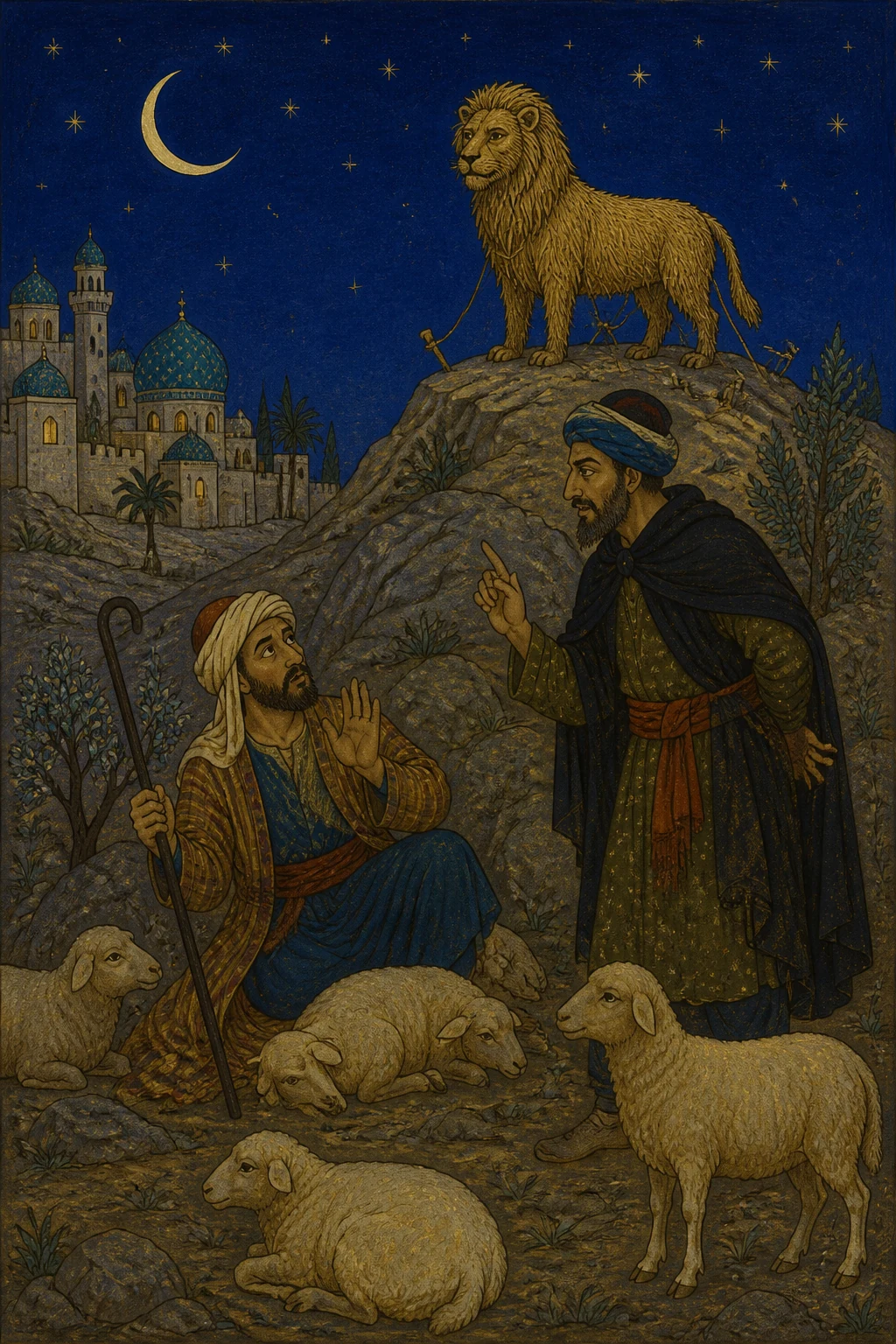
She said: They relate that there was once a shepherd who watched over his sheep with great care. One night a thief came, intending to steal some of his flock, but found him so vigilant that he neither slept by night nor relaxed his watch by day. All night long the thief tried to outwit him, but gained nothing. When all his tricks had failed, he went out into the wilderness, caught a lion, skinned it, and stuffed its hide with straw. He then brought it and set it on a high spot in the wilderness, where the shepherd would plainly see it. The thief approached the shepherd and said, “This lion has sent me to ask you for his supper from these sheep.” “Where is the lion?” asked the shepherd. “Look up,” said the thief. “There he stands.” The shepherd raised his head and saw the figure of the lion. Taking it for a living beast, he was seized with terrible fright. But morning overtook Shahrazad, and she fell silent, leaving her tale untold.
When it was the nine hundred and twenty-second night,
She said: It has reached me, O fortunate King, that when the shepherd saw the figure of the lion, he took it for a living beast and was seized with terrible fright. Trembling with fear, he said to the thief, “Brother, take whatever you please. I shall not stand in your way.” So the thief took as many sheep as he wanted, and the shepherd’s great terror made him all the greedier. Every little while he would come back to frighten him, saying, “The lion needs such and such, and intends to do this and that,” and then take as many sheep as he wished. He kept treating the shepherd in this fashion until he had carried off most of the flock. “I have told you this, O King, lest these great men of your realm be emboldened by your forbearance and gentleness and grow greedy at your expense. The wisest course is to put them to death before they can do the same to you.” The king accepted her words and said, “I accept this counsel of yours. I shall neither heed their advice nor go out to meet them.”
When morning came, the viziers, the great officers of state, and the leading citizens assembled. Each brought his weapons, and they made for the king’s house, intending to storm it, kill him, and set another on the throne. On reaching the house, they asked the doorkeeper to open the gate, but he refused. So they sent for fire to burn down the gates and force their way in. Hearing this, the doorkeeper hurried to the king and told him that the people had gathered at the gate. “They asked me to open it,” he said, “and I refused, so they have sent for fire to burn down the gates. Then they mean to enter and kill you. What are your commands?” The king said to himself, “I have fallen into terrible peril.” Then he sent for the woman, and when she came he said, “Everything Shamas told me has proved true. High and low alike have gathered here, intending to kill me and all of you. When the doorkeeper would not admit them, they sent for fire to burn down the gates, and the house will burn with us inside. What do you advise?” “Have no fear,” she answered, “and do not let their actions dismay you. These are times when fools rise against their kings.” “What, then, do you advise me to do?” asked the king. “How are we to meet this danger?” She replied, “My advice is that you bind your head with a cloth and pretend to be ill. Then send for the vizier Shamas, so that he may come and see your condition. When he arrives, say to him, ‘I wished to go out to the people today, but this illness has prevented me. Go to them and tell them how I am. Tell them that tomorrow I shall come out, attend to their needs, and look into their affairs.’ This will reassure them and calm their anger. When morning comes, summon ten of your father’s slaves, men of courage and strength whom you can trust with your life, who will heed your words, obey your commands, keep your secrets, and remain loyal to you. Station them beside you and order them to let no one enter your presence except one at a time. Whenever a man enters, say to them, ‘Seize him and kill him.’ Once they have agreed to this, set up your throne in your audience hall in the morning and open your gate. When the people see it open, their minds will be at ease, and they will come to you with innocent hearts and ask leave to enter. Admit them one by one, as I have told you, and do with them as you please. But you must begin by killing the elder Shamas, for he is the chief vizier and holds the reins of power. Kill him first, then all the rest, one after another. Spare none whom you know might break faith with you, nor any whose might you fear. Once you have done this, they will have no strength left to oppose you, and you will be rid of them altogether. Your kingdom will be yours alone, and you may do as you please. Know that no other plan will serve you better.” The king said to her, “Your advice is sound, and your judgment wise. I shall certainly do as you have said.”
Then he called for a cloth, bound it round his head, feigned weakness, and sent for Shamas. When the vizier appeared before him, he said, “Shamas, you know that I love you and follow your advice, and that above all other men you are to me both brother and father. You know that I accept all you urge upon me. You advised me to go out to my subjects and sit in judgment over their affairs, and I understood that you spoke for my good. Yesterday I wished to go out to them, but this illness came upon me, and I cannot sit upright. I have heard that the people of the kingdom are distressed because I have not appeared before them, and that in their wickedness they have contemplated doing me an unseemly injury, for they do not know how ill I am. Go out to them, explain my condition, and make my excuses. I shall comply with their wishes and do what they desire. Set this matter right and give them your assurance on my behalf. You have been a faithful counsellor to me, as you were to my father before me, and it has always been your way to reconcile people. God Most High willing, I shall go out to them tomorrow. Perhaps this illness will leave me tonight through the blessing of my good intentions and the kindness I cherish towards them in my heart.” Shamas prostrated himself before God, prayed for the king, and kissed his hands, rejoicing at what he had heard. He went out to the people, told them what the king had said, and dissuaded them from their purpose. He explained the king’s excuse and the reason he had not appeared, and told them that he had promised to come out the next day and do as they wished. At this they dispersed to their homes. But morning overtook Shahrazad, and she fell silent, leaving her tale untold.
When it was the nine hundred and twenty-third night,
She said: It has reached me, O fortunate King, that Shamas went out to the officers of state and said, “Tomorrow the king will come out to you and do as you wish.” So they returned to their homes. Such was their case. As for the king, he sent for the ten mighty slaves he had chosen from among his father’s strongest men, men of unshakable resolve and formidable courage. He said to them, “You know the favour you enjoyed with my father, the high rank he gave you, and the benefits he bestowed upon you, besides his kindness and generosity. Now that he is gone, I shall raise you to an even higher place in my service. I shall tell you why, and you have my pledge, before God, that you are safe with me. But first I must ask you this: will you stand by me in a certain matter, obey what I tell you, and keep my secret from everyone? If you carry out my orders, I shall reward you beyond your desires.” The ten answered with one voice, “Whatever you command, our lord, we shall do. We shall never depart from your instructions, for you are our master.” “May God reward you,” he said. “Now I shall tell you why I have singled you out for greater honour. You know how generously my father treated the people of his kingdom, what pledge he took from them concerning me, and how they swore that they would neither break faith with me nor disobey my commands. Yet you saw what they did yesterday, when they all gathered round me, intending to kill me. I mean to take action against them. Having considered what they did yesterday, I see that nothing but punishment will deter them from doing the same again. I must therefore entrust you with secretly killing those whom I designate, so that by putting their great men and leaders to death I may ward off evil and calamity from my country. This is how it shall be done: tomorrow I shall sit in this place, in this chamber, and admit them to my presence one at a time. They will enter by one door and leave by another. Stand before me, all ten of you, and watch for my signal. Whenever a man enters, seize him, take him into this room, kill him, and conceal his body.” “We hear and obey,” they answered. Then he rewarded them, dismissed them, and passed the night.
In the morning he summoned them and ordered his throne to be set up. He put on his royal robes, took the book of judgments in his hand, and commanded that the gate be opened. When it was opened, he stationed the ten slaves before him, and a herald proclaimed, “Whoever has a suit to bring, let him come before the king.” The viziers, commanders, and chamberlains arrived, and each took his appointed place. Then the king ordered them to enter one at a time. Shamas the vizier entered first, as was customary for the chief minister. He had barely taken his place before the king when the ten slaves surrounded him, seized him, took him into the room, and killed him. Next they dealt with the remaining viziers, then the learned men, then the righteous, killing them one by one until they had finished them all. After that the king summoned the executioners and ordered them to put to the sword any men of courage and might who remained. They left alive none whom they knew to possess spirit or valour, sparing only the lowest and most worthless of the people. These they drove away, and each returned to his family. Thereafter the king withdrew into his pleasures and indulged every appetite, pursuing oppression, tyranny, and injustice until he surpassed all the evildoers who had gone before him. His lands were rich in gold, silver, rubies, and precious stones, and all the kings around him envied his kingdom and awaited his downfall. One of the neighbouring kings said to himself, “Now I have the opportunity I wanted to wrest this kingdom from that ignorant boy. He has killed his chief officers and all the men of courage and valour in his land. This is the moment to seize what he holds, for he is young, knows nothing of war, and has no judgment. No one remains to guide or support him. Today I shall begin hostilities by writing him a letter in which I mock him and rebuke him for what he has done. Then I shall see how he answers.”
So he wrote him a letter as follows: “In the name of God, the Compassionate, the Merciful. To proceed: I have heard what you have done to your viziers, your learned men, and your mighty warriors, and of the calamity you have brought upon yourself. Through your tyranny and corruption you have left yourself neither strength nor power to repel an attacker. God has granted me victory over you and delivered you into my hands. Therefore heed my words and obey my command: build me an impregnable palace in the midst of the sea. If you cannot do so, leave your country and save yourself, for I shall send against you from the farthest reaches of India twelve divisions, each of twelve thousand fighting men. They will invade your lands, plunder your wealth, kill your men, and carry your women into captivity. I shall appoint my vizier Badi to command them and order him to maintain the siege until he has taken your kingdom. I have instructed the young man bearing this letter not to remain with you longer than three days. If you obey my command, you will be safe; otherwise I shall send against you all that I have described.” Then he sealed the letter and gave it to the messenger, who travelled until he reached the city, entered the king’s presence, and handed it to him. When the king read it, his strength failed him, his heart grew heavy, and his thoughts fell into confusion. He felt certain that he was doomed, and could find no one to consult, no one to help him, and no one to come to his rescue. He rose and went in to his wife, his face drained of colour. “What is the matter, O King?” she asked. “Today I am no king,” he replied, “but a king’s slave.” Then he opened the letter and read it to her. When she heard it, she began to weep and wail and tore her clothes. The king asked her, “Have you any counsel or stratagem to meet this dreadful difficulty?” “What do women know of stratagems in war?” she answered. “Women have neither strength nor judgment in such matters. Strength and resourcefulness in affairs like these belong to men.” When the king heard her words, he was overcome with remorse, sorrow, and grief for what he had done to his followers and the leaders of his state. But morning overtook Shahrazad, and she fell silent, leaving her tale untold.
When it was the nine hundred and twenty-fourth night,
She said: It has reached me, O fortunate King, that when the king heard these words from his wife, he was overcome with remorse and sorrow for having killed his viziers and the noblest of his subjects. He wished he had died before such dreadful news could reach him. Then he said to his women, “You have brought upon me what the tortoises brought upon the francolin.” “How was that?” they asked. The king replied, “They relate that some tortoises once lived on an island full of trees, fruit, and streams. One day a francolin happened to fly over it, weary and afflicted by the heat. When his suffering grew too great, he alighted on the island where the tortoises lived. Seeing them, he sought refuge in their dwelling. The tortoises used to graze about the island and then return to their home. When they came back from their grazing grounds, they found the francolin there. His appearance delighted them, and God made him beautiful in their eyes. They praised their Creator, grew very fond of the bird, and rejoiced in his company. ‘Surely,’ they said to one another, ‘this is the loveliest of birds.’ They all began to caress him and show him affection. Seeing their love, he in turn grew fond of them and felt at ease in their company. He would fly wherever he pleased, returning in the evening to spend the night with them, and in the morning he would fly off again wherever he wished. This became his habit, and he continued in this way for some time. But the tortoises found his absence lonely. They realised that they saw him only at night, and that at dawn he would hasten away before they were even aware of it; meanwhile their love for him kept growing. So they said to one another, ‘We have come to love this francolin, and he has become our friend. We can no longer bear to be parted from him. How can we contrive to keep him with us always? When he flies away, he is gone all day, and we see him only at night.’ One of them offered this counsel: ‘Set your minds at rest, my sisters. I shall make him stay with us and never leave us for so much as the blink of an eye.’ ‘If you do that,’ they all replied, ‘we shall be your slaves.’
“When the francolin returned from his wanderings and settled among them, the cunning tortoise approached him, blessed him, and congratulated him on his safe return. ‘My lord,’ she said, ‘know that God has granted you our love, just as He has placed love for us in your heart. You have become our companion in this wilderness. The happiest hours of those who love are spent together, while distance and separation are the greatest affliction. Yet you leave us at daybreak and do not return until sunset, and we feel terribly lonely. This has been very hard on us, and we suffer greatly because of it.’ The francolin answered, ‘Yes, I love you and long for you even more than you do for me. Parting from you is no easy thing, but I cannot help it, for I am a winged bird and cannot remain with you always. It is not in my nature. A bird with wings settles only at night, to sleep; in the morning he flies off and roams wherever he pleases.’ ‘True,’ replied the tortoise, ‘but a winged creature seldom knows repose, for the good he gains does not amount to a quarter of the hardship he endures. The chief object of every creature is ease and comfort. God has established love and affection between us, and we fear that some enemy may catch and kill you, leaving us deprived of the sight of your face.’ ‘You speak truly,’ said the francolin. ‘But what counsel or plan have you for me?’ She replied, ‘My advice is that you pluck out the flight feathers that carry you so swiftly through the air, and remain here with us at your ease. Eat what we eat and drink what we drink in this grove, with its many trees and ripening fruits. We shall live together in this fertile place and enjoy one another’s company.’ The francolin inclined to her words and longed for repose. Approving of the tortoise’s advice, he plucked out his feathers one by one, settled among them, and lived with them, content with a little pleasure and a fleeting delight.
“While they were living thus, a weasel passed by. He fixed his eyes on the francolin and examined him, and saw that his wings were shorn and that he could not take flight. Delighted by the sight, he said to himself, ‘This francolin has plenty of flesh and few feathers.’ Then the weasel approached and fell upon him. The francolin cried out and begged the tortoises for help, but instead of coming to his rescue they drew away and huddled together when they saw him in the weasel’s grasp. At the sight of his torment, they were choked with tears. ‘Have you nothing to offer but weeping?’ the francolin asked them. ‘Brother,’ they replied, ‘we have neither the strength nor the power nor any means to deal with the weasel.’ At this the francolin grieved and abandoned all hope of life. He said to them, ‘You are not to blame. The fault is mine, for I obeyed you and plucked out the wings with which I flew. I deserve to perish for having listened to you, and I blame you for nothing.’ And now, women, I do not blame you either, but myself, and it is myself I must chastise. I failed to remember that you were the cause of our father Adam’s transgression, for which he was driven out of Paradise. I forgot that you are the root of every evil. In my ignorance, mistaken judgment, and folly, I obeyed you and killed my viziers and the governors of my kingdom, who counselled me faithfully in all things and were my honour and my strength in every matter that troubled me. Now I can find no one to replace them, nor anyone to fill their place, and I have fallen into terrible peril.” But morning overtook Shahrazad, and she fell silent, leaving her tale untold.
When it was the nine hundred and twenty-fifth night,
She said: It has reached me, O fortunate King, that the king reproached himself, saying, “In my ignorance I obeyed you and killed my viziers, and I can find no one to replace them or fill their place. Unless God sends me someone of sound judgment to guide me towards deliverance, I shall meet with utter ruin.” Then he rose and went into his bedchamber, lamenting the viziers and sages. “Would that I had those lions beside me now,” he said, “if only for a single hour, so that I might beg their pardon, look upon them, and tell them of my plight and all that has befallen me since they died.” All day he remained submerged in a sea of sorrow, neither eating nor drinking. When night fell, he rose, changed his clothes, put on shabby garments, and went out in disguise to wander through the city, hoping to hear someone say a word that would bring him comfort. As he walked through the streets, he came upon two boys sitting alone beside a wall. They were of the same age, each twelve years old. Hearing them talking together, the king drew close enough to hear and understand their words. One of them was saying to the other, “Listen, brother, to what my father told me last night about his crops, which have withered before their time because of the lack of rain and the many afflictions that have beset this city.” The other asked, “Do you know the cause of these afflictions?” “No,” he answered. “If you know, tell me.” “Yes, I know,” replied the other, “and I shall tell you. One of my father’s friends told me that our king has killed his viziers and the great men of his realm, though they had committed no crime. He did it only because of his love for women and his devotion to them. The viziers warned him against this, but he would not stop, and at his women’s bidding he ordered them put to death. He even killed my father Shamas, his own vizier and his father’s vizier before him, who had been his trusted counsellor. But you shall see what God will do to him for his sins: He will avenge them upon him.” “What can God do to him now that they are dead?” the boy asked. His companion replied, “The king of the farthest reaches of India has treated our king with contempt and sent him a letter rebuking him. In it he says, ‘Build me a palace in the midst of the sea. If you do not, I shall send against you twelve divisions, each containing a hundred thousand fighting men. I shall appoint my vizier Badi to command these armies, and he will seize your kingdom, kill your men, and carry you and your women into captivity.’ When the messenger from the king of farthest India brought this letter, he allowed him three days. Know, brother, that this king is a stubborn tyrant of great strength and formidable might, and his kingdom is densely peopled. Unless our king devises some means of holding him off, he will perish. And once our king is destroyed, this king will seize our livelihoods, kill our men, and carry our women into captivity.”
When the king heard these words, his agitation increased, and he drew towards them, saying to himself, “This boy is truly wise, for he has spoken of something he has not learned from me. The letter from the king of farthest India is in my keeping, and I alone hold its secret. No one but me has learned this news. How, then, did the boy discover it? Still, I shall turn to him and speak with him, and pray that God may place our deliverance in his hands.” The king approached the boy gently and said, “Dear child, what is this you have been saying about our king? He did a very wicked thing in killing his viziers and the great men of his realm, though in truth it is himself and his subjects he has injured. You spoke truly. But tell me, child, how did you learn that the king of farthest India wrote to our king, rebuking him and addressing him in the harsh terms you have repeated?” The boy replied, “I learned it from the saying of the ancients: ‘Nothing is hidden from God.’ And among the children of Adam are those endowed with a spiritual insight that reveals hidden secrets to them.” “You speak truly, my son,” said the king. “But is there any stratagem or plan by which our king may ward off this terrible calamity from himself and his kingdom?” “Yes,” answered the boy. “If the king sends for me and asks what he should do to repel his enemy and escape his designs, I shall tell him how he may be saved, by the power of God Most High.” “Who will tell the king of this,” asked the king, “so that he may send for you and summon you?” The boy replied, “I have heard that he is searching for people of experience and sound judgment. If he sends for me, I shall go with his messengers and explain what will set his affairs right and ward off disaster. But if he neglects this grave matter and occupies himself with pleasures among his women, and I go to him unbidden, wishing to tell him how he may be saved, he will order me killed like those viziers. My acquaintance with him would then cause my destruction, and people would despise me and think little of my judgment. I should fall under the saying: ‘When a man’s learning exceeds his judgment, that learned man perishes through his ignorance.’”
When the king heard the boy’s words, he recognised his wisdom, saw his excellence, and became certain that both he and his subjects would be saved through him. He spoke to the boy again, asking, “Where are you from? Where is your home?” “This wall leads to our house,” the boy answered. The king carefully marked the place, then bade the boy farewell and returned joyfully to his palace. Once inside, he put on his own clothes, called for food and drink, and forbade the women to approach him. He ate and drank, thanked God Most High, and begged Him for deliverance and aid, and for pardon and forgiveness for what he had done to the learned men and leaders of his realm. Then he repented sincerely before God and bound himself by a vow to much fasting and prayer. He summoned one of his personal servants, described where the boy lived, and ordered him to go there and bring him gently into his presence. The slave went to the boy and said, “The king summons you, intending to bestow his favour upon you. He will ask you a question, and then you shall return home safe and well.” “What business does the king have with me,” the boy asked, “that he has sent for me?” The servant replied, “My master has summoned you for a question and an answer.” “A thousand times I hear and obey the king’s command,” said the boy. Then he went with him until they reached the king. On coming before him, he greeted him, prostrated himself before God, and prayed for the king. The king returned his greeting and bade him sit, and he sat down. But morning overtook Shahrazad, and she fell silent, leaving her tale untold.
When it was the nine hundred and twenty-sixth night,
She said: It has reached me, O fortunate King, that when the boy came to the king and greeted him, the king bade him sit, and he sat down. Then the king asked, “Do you know who spoke with you yesterday?” “Yes,” said the boy. “Where is he, then?” “He is the man speaking to me now,” the boy replied. “You are right, dear child,” said the king. Then he ordered a chair to be placed beside his own, seated the boy upon it, and called for food and drink. They fell into conversation, until at last the king said, “Vizier, yesterday you spoke to me and said that you had a plan by which you could shield us from the designs of the king of India. What is this plan? How are we to ward off his evil? Tell me, and I shall make you my foremost counsellor in affairs of state and choose you as my vizier. I shall follow your judgment in everything you advise and grant you a splendid reward.” The boy replied, “Keep your reward, O King. Seek counsel and plans from your women, who advised you to kill my father Shamas along with the other viziers.” When the king heard this, he was ashamed. He sighed and said, “Dear child, was Shamas truly your father, as you say?” “Shamas was indeed my father,” the boy answered, “and I am truly his son.” At this the king humbled himself, his eyes filled with tears, and he begged God’s forgiveness. “Boy,” he said, “I did this in my ignorance, through the women’s evil counsel, and great is their cunning. But I ask you to forgive me. I shall put you in your father’s place and raise you to an even higher rank. Once this calamity has passed, I shall put a collar of gold about your neck, mount you on the finest of steeds, and order a herald to go before you, proclaiming, ‘This honoured youth holds the seat second only to the king.’ As for what you have said about the women, I have resolved to take vengeance upon them, and have left its hour to God Most High. Now tell me your plan, that my heart may be at ease.” The boy replied, “Give me your pledge that you will not oppose the advice I give you, and that I shall be safe from what I fear.” The king said, “Let God’s covenant stand between us: I shall not depart from your words. You shall be my counsellor, and whatever you command, I shall do. God Most High is witness between us to what I say.”
At this the boy’s heart opened, and he felt free to speak. “O King,” he said, “this is my plan and stratagem. Wait until the messenger comes to ask for an answer at the end of the respite you have granted him. When he appears before you and asks for it, put him off and bid him wait until another day. He will protest that his king has allowed him a fixed number of days, and will argue with you. Dismiss him and put him off until another day, without saying which day it will be. He will leave you in anger, go into the middle of the city, and speak aloud among the people, saying, ‘People of this city, I am the messenger of the king of farthest India, a man of formidable might and a resolve that bends iron. He sent me with a letter to the king of this city and set me a term, saying, “If you do not return when the days I have appointed are over, my punishment will fall upon you.” I came to the king of this city and gave him the letter. When he had read it, he asked me to wait three days, after which he would give me his reply. Out of kindness and consideration for him, I agreed. Now the three days have passed, and I have come to ask for his answer, but he has put me off until another day. I can wait no longer. I am returning to my master, the king of farthest India, to tell him what has happened to me. You people are witnesses between us.’ When word of this reaches you, send for him and have him brought before you. Speak gently to him and say, ‘Messenger bent on your own destruction, what led you to reproach us among our subjects? You have deserved immediate death at our hands, but the ancients have said, “Forgiveness is a mark of the noble.” Know that our delay in answering you is not due to any inability on our part. It is only that we have much business and little leisure to write to your king.’ Then call for the letter and read it again. When you have finished, laugh heartily and ask him, ‘Have you another letter with you, so that we may answer that as well?’ He will say, ‘I have no letter but this one.’ Ask him again, and he will answer, ‘I have no other at all.’ Then say, ‘This king of yours has no sense, to write such words in this letter. He can only mean to rouse our spirits, so that we march against him with our armies, invade his country, and seize his kingdom. But this time we shall not hold him to account for the insolence of his letter, for he is deficient in reason and wanting in resolution. It befits our power to give him warning first, and caution him against repeating such ravings. If he hazards his life by doing so again, he will deserve swift calamity. I think the king who sent you is an ignorant fool who gives no thought to consequences, and has no wise vizier of sound judgment to consult. Had he any sense, he would have consulted a vizier before sending us such ridiculous words. Nevertheless, I have an answer worthy of his letter, and more besides. I shall hand it to one of the schoolboys to reply.’ Then send for me and summon me. When I appear before you, give me leave to read the letter and write its answer.”
At this the king’s heart grew light. He approved of the boy’s counsel and admired his stratagem, bestowed gifts upon him, granted him his father’s rank, and sent him away rejoicing. When the three days granted to the messenger had passed, the messenger came before the king and asked for his answer. The king put him off until another day. The messenger withdrew to the edge of the royal carpet and uttered insolent words, just as the boy had foretold. Then he went out into the marketplace and said, “People of this city, I am the envoy of the king of farthest India to your king. I brought him a message, but he keeps delaying his answer. The time our king allowed me has expired, and your king has no excuse left. You shall bear witness to this.” When these words reached the king, he sent for the messenger and had him brought before him. “Messenger bent on your own destruction,” he said, “are you not carrying a letter from one king to another, containing secrets between them? How, then, can you go out among the people and reveal the secrets of kings to the common crowd? You have deserved punishment at our hands, but we shall overlook this so that you may take back our answer to that foolish king. Indeed, it is fitting that none but the least of the schoolboys should reply to him on our behalf.” Then he summoned the boy, who came. On entering the king’s presence while the messenger stood there, he prostrated himself before God and prayed that the king might enjoy enduring glory and long life. The king tossed him the letter and said, “Read this letter and write its answer at once.” The boy took it, read it, smiled, and laughed. “Was it to answer this letter that you sent for me?” he asked the king. “Yes,” he replied. “Most readily I hear and obey,” said the boy. He took out an inkwell and paper and wrote… But morning overtook Shahrazad, and she fell silent, leaving her tale untold.
When it was the nine hundred and twenty-seventh night,
She said: It has reached me, O fortunate King, that when the boy took the letter and read it, he at once brought out an inkwell and a sheet of paper and wrote: “In the name of God, the Compassionate, the Merciful. Peace be upon those who have won safety, and the mercy of the Compassionate One. To proceed: Know, you who are called a great king in name but not in deed, that your letter has reached us. We have read it and understood the absurdities and strange ravings it contains, and have thereby become certain of your ignorance and your aggression against us. You have stretched out your hands toward what lies beyond your power. Were we not moved by compassion for God’s creatures and our subjects, we would not have delayed in coming against you. As for your messenger, he went into the marketplace and spread the contents of your letter among high and low, and so deserved punishment at our hands. Yet we spared him out of mercy, since his service to you affords him an excuse; it was not out of respect for you that we refrained from punishing him. As for your mention in your letter of my killing my viziers, my learned men, and the grandees of my kingdom, that is true, but I had reasons of my own. I have not slain a single learned man without having a thousand of his kind more learned, more discerning, and wiser than he. There is not a child in my kingdom who is not filled with knowledge, and for every man put to death I have so many excellent men of his calling to replace him that I cannot count them. Every soldier in my army can withstand a whole division of yours. As for wealth, I have workshops for producing gold and silver, and precious ores are as common with me as pieces of stone. As for the people of my kingdom, I cannot describe to you their beauty, their comeliness, and their riches. How, then, did you dare address us, saying, ‘Build me a palace in the midst of the sea’? This is a strange demand indeed, and must spring from the feebleness of your understanding. Had you any sense, you would first have inquired into the surging of the waves and the movements of the winds while I built your palace. As for your claim that you will overcome me, God forbid! How could such a man as you assail us and conquer our kingdom? Rather, Almighty God has given me victory over you, for you have trespassed and attacked me without right. Know that you have deserved punishment both from God and from me. Yet I fear God in my dealings with you and your subjects, and will not march against you without warning. If you fear God, hasten to send me this year’s tribute. Otherwise, I shall not turn back from marching against you with eleven hundred thousand fighting men, all mighty warriors mounted on elephants. I shall array them around our vizier and order him to besiege you for three years, in return for the three days you allowed your envoy. I shall take possession of your kingdom, killing no one in it but you and carrying off no captives but the women of your household.” Then the boy drew his own likeness in the letter and wrote beside it: “This reply was written by the youngest child in the school.” He then sealed it and handed it to the king, who gave it to the messenger. The messenger took it, kissed the king’s hands, and departed, thanking Almighty God and the king for the forbearance shown him, and marveling as he went at the boy’s skill.
When he reached his own king, it was the third day after the three days allotted him. The king was then holding court on account of the messenger’s delay beyond the appointed time. The messenger entered, prostrated himself before him, and handed him the letter. The king took it and questioned him about the reason for his delay and about King Wardkhan’s affairs. He related the whole story, telling him everything he had seen with his own eyes and heard with his own ears. The king was bewildered and said to the messenger, “Woe to you! What are these tales you tell me of such a king?” The messenger answered, “O mighty King, here I stand before you. Open the letter and read it, and you will see what is true and what is false.” The king opened the letter and read it, and when he saw in it the likeness of the boy who had written it, he became certain that his kingdom was lost and was at a loss what to do. He turned to his viziers and the great officers of his realm, told them what had happened, and read them the letter. They were aghast and terribly afraid, and began trying to calm the king with words that came only from their lips, while their hearts were torn with fear. Then Badi, the chief vizier, said, “Know, O King, that there is no profit in what my fellow viziers are saying. My advice is that you write this king a letter of apology, saying: ‘I am your friend, as I was your father’s before you. We sent you the messenger with that letter only to put you to the test, that we might discover your resolution, your courage, your learning and understanding of hidden mysteries, and all the virtues you possess. We ask Almighty God to bless your kingdom, strengthen the fortifications of your city, and increase your power, so long as you take care to preserve yourself, that the affairs of your subjects may prosper.’ Send it to him with another messenger.” The king said, “By Almighty God, this is a great marvel! How can he be a mighty king, prepared for war, after killing the learned men of his kingdom, his counselors, and the commanders of his troops? How can his kingdom still flourish and bring forth such immense strength? Stranger still, the little children in its schools can make such a reply on their king’s behalf! But through my wicked greed I have kindled this fire against myself and the people of my kingdom, and I know of nothing that can quench it except this counsel of my vizier.”
He then made ready a precious gift, with many servants and attendants, and wrote a letter as follows: “In the name of God, the Compassionate, the Merciful. To proceed: O mighty King Wardkhan, son of my dear brother Jili‘ad—may God have mercy upon him and preserve you—your answer to our letter has reached us. We have read it and understood its contents, and found in it what gladdens us. This is all that we have asked of God for you. We pray that He may exalt your station, strengthen the foundations of your kingdom, and grant you victory over the enemies who wish you harm. Know, O King, that your father was a brother to me, and throughout his life there were covenants and solemn pledges between us. He experienced nothing but kindness from us, and we likewise experienced nothing but kindness from him. When he died and you ascended the throne of his kingdom, we rejoiced exceedingly. But when we heard what you had done to your viziers and the great men of your state, we feared that news of it might reach some other king, who would covet your realm. We supposed that you were neglecting your own interests and the defense of your fortresses, and paying no heed to the affairs of your kingdom. We therefore wrote to you in such terms as would rouse you. Now that we have seen you return us such an answer, our hearts are reassured on your account. May God grant you long enjoyment of your kingdom and aid you in your affairs. Peace.” He then made the gift ready and sent it with a hundred horsemen. And dawn overtook Shahrazad, and she fell silent, leaving her tale untold.
When it was the nine hundred and twenty-eighth night
She said: It has reached me, O fortunate King, that when the King of Farthest India had prepared his gift for King Wardkhan, he sent it with a hundred horsemen. They journeyed on until they came before King Wardkhan and saluted him. They gave him the letter, which he read and understood. He lodged the captain of the hundred horsemen in a place befitting him, treated him honorably, and accepted the gift, news of which spread among the people. The king was exceedingly pleased. He sent for the boy, the son of Shimas, brought him into his presence, and honored him. Then he summoned the captain of the hundred horsemen, called for the letter he had brought from his king, and handed it to the boy, who opened it and read it. The king was greatly delighted, and began reproaching the captain, who kissed his hands, offered his apologies, and prayed that his life and blessings might endure forever. The king thanked him, treated him with still greater honor, and bestowed fitting gifts upon him and all his companions. He also prepared presents for them to take back, and ordered the boy to write a reply. The boy wrote in gracious terms, briefly treating the matter of peace and praising the courtesy of the envoy and the horsemen with him. When he had finished the letter, he presented it to the king, who said, “Read it, dear boy, so that we may know what is written in it.” The boy read it in the presence of the hundred horsemen, and its composition and meaning won the admiration of the king and all who were there. The king then sealed it, handed it to the captain of the hundred horsemen, and dismissed him, sending a company of his own soldiers to escort them to the borders of their country.
Such was the case with the king and the boy. As for the captain of the hundred horsemen, he was astonished at what he had witnessed of the boy’s abilities and knowledge, and thanked Almighty God that his business had been so swiftly accomplished and peace accepted. He traveled on until he reached the King of Farthest India, to whom he presented the gifts and rarities, delivering the presents and handing him the letter, and told him all he had seen. The king rejoiced exceedingly and thanked Almighty God. He honored the captain of the hundred horsemen, praised the zeal he had shown in his task, and raised his rank. From that time forward, he lived in safety and security, with a tranquil heart and ever-increasing contentment.
Such was the case with the King of Farthest India. As for King Wardkhan, he set himself right with God, abandoned his evil ways, and sincerely repented to God of his former conduct. He gave up women altogether and devoted himself wholly to setting his kingdom in order and watching over his subjects in the fear of God. He appointed the son of Shimas vizier in his father’s place, making him his foremost counselor in the kingdom and the keeper of his secrets. He ordered his city, and all the other cities as well, to be decorated for seven days. The people rejoiced; fear and terror left them, and they welcomed the prospect of justice and fair dealing. They prayed fervently for the king and for the vizier who had delivered both him and them from this distress. Afterward, the king said to the vizier, “What is your counsel for putting the kingdom in order, improving the condition of the people, and restoring it to its former state, with leaders and administrators to govern it?” The vizier replied, “O King of exalted rank, my counsel is that before all else you begin by rooting sin out of your heart, abandoning your former diversions, your oppression, and your preoccupation with women. For if you return to the root of sin, your second lapse will be worse than the first.” The king asked, “What is this root of sin that I must tear out?” The vizier, young in years but great in understanding, answered, “O great King, know that the root of sin is to follow the desires of women, incline toward them, and accept their opinions and counsels. Love of them alters sound minds and corrupts wholesome dispositions. There are clear proofs to support what I say. If you were to reflect on them and examine their circumstances closely, you would find a counselor within yourself and have no need of my words at all. Do not occupy your heart with thoughts of women, and erase their images from your mind. Almighty God commanded through His prophet Moses that men should not multiply wives, and one of the wise kings said to his son, ‘My son, when you are established upon the throne after me, do not take many women, lest your heart go astray and your judgment be utterly corrupted.’ For having many women leads to love of them, and love of them leads to the corruption of judgment. Proof of this lies in what befell our lord Solomon son of David, peace be upon them both, whom God singled out for knowledge, wisdom, and mighty sovereignty, giving him what He had given none of the kings before him; yet women were the cause of his father’s lapse. There are many such examples, O King. I have mentioned Solomon only so that you may know that no one could possess a dominion like his, for all the kings of the earth obeyed him. Know, O King, that love of women is the root of every evil, and not one of them has sound judgment. A man should therefore content himself with no more of them than necessity requires, and not incline toward them altogether, for that will cast him into corruption and destruction. If you obey my words, O King, all your affairs will be set right; if you disregard them, you will repent when repentance can no longer avail you.” The king answered, “I have renounced my former excessive devotion to them.” And dawn overtook Shahrazad, and she fell silent, leaving her tale untold.
When it was the nine hundred and twenty-ninth night
She said: It has reached me, O fortunate King, that King Wardkhan said to his vizier, “I have renounced my former devotion to women and turned away from all preoccupation with them. But what shall I do to them in requital for what they have done? For it was through their scheming that your father Shimas was killed. That was never my intention, nor do I know what happened to my reason that I should have agreed with them to put him to death.” Then he sighed and cried, “Alas for the loss of my vizier, his sound judgment, and his wise governance! Alas for the loss of his fellow viziers, the leaders of the kingdom, and their prudent counsel!” The vizier answered, “Know, O King, that the blame does not rest with women alone. They are like attractive merchandise that arouses the desires of those who look upon it. Whoever covets it and wishes to buy, they sell it to him; whoever does not buy is not forced by anyone to do so. The blame rests with the buyer, especially if he knows the harm that merchandise will do him. I warned you, and my father before me warned you, but you would not accept his advice.” The king replied, “I acknowledge my guilt, as you have said, O Vizier. I have no excuse except divine decree.” The vizier said, “Know, O King, that Almighty God created us and gave us the power to act, together with will and choice. If we wish, we act, and if we wish, we refrain. God has not commanded us to do harm, thereby burdening us with sin and calling us to account for doing what would then be right. In all circumstances He commands us only to do good and forbids us to do evil. It is by our own will that we do whatever we do, whether right or wrong.” The king said, “You speak truly. My fault arose from my own inclination toward desire. I warned myself against it many times, and your father Shimas warned me many times, yet my passions overcame my reason. Have you anything that will keep me from committing this fault, so that my reason may prevail over the desires of my soul?” The vizier answered, “Yes. I see a way to keep you from committing it: cast off the garment of ignorance and put on the garment of justice; disobey your passions and obey your Lord. Return to the ways of your father, the just king, and fulfill your duties toward Almighty God and your subjects. Safeguard your faith and your people, discipline yourself, and refrain from killing your subjects. Consider the consequences of your deeds, renounce oppression, injustice, aggression, and corruption, and practice justice, fairness, and humility. Obey the commands of Almighty God and show unfailing compassion to His creatures, over whom He has appointed you His deputy. Persevere in whatever will earn their prayers for you. If you remain steadfast in this, your days will be serene, and God in His mercy will pardon you and make all who see you hold you in awe. Your enemies will dwindle away, Almighty God will rout their armies, and you will be acceptable to God and held in awe and loved by His creatures.”
The king said to him, “With your sweet words you have revived my spirit and filled my heart with light. You have cleared the eye of my understanding after its blindness. With the help of Almighty God, I am resolved to do everything you have told me, to abandon my former oppression and indulgence in desire, and to bring myself out of distress into ease and out of fear into safety. You should rejoice and be glad at this, for old as I am, I have become your son, and young as you are, you have become a beloved father to me. It is now my duty to strive to carry out whatever you command. I give thanks for the bounty of Almighty God and for your kindness. Through you, Almighty God has bestowed upon me blessings, good guidance, and sound judgment that dispel my anxiety and sorrow. By your noble knowledge and wise management, my subjects have been delivered to safety. You are now the ruler of my kingdom; I shall hold no distinction above you save that of sitting upon the throne. Whatever you do shall have my sanction, and no one shall gainsay your word. Though you are young in years, you are great in understanding and rich in knowledge. I thank God, who has brought you to me, that you might guide me to the path of righteousness after I had strayed toward destruction.”
The vizier said, “O fortunate King, know that I claim no merit for offering you counsel. What I have said is only part of my duty, for I am a sapling nurtured by your bounty. Nor am I alone in this: my father before me was overwhelmed by your generous favors. We all acknowledge your kindness and beneficence. How could we fail to do so, O King, when you are our shepherd and ruler, who fights our enemies for us, undertakes our protection, watches over us, and exerts himself for our safety? Even if we gave our lives in your service, we could not render the thanks we owe you. We can only beseech Almighty God, who has set you over us and given you authority to rule us, and ask Him to grant you long life and success in all your undertakings; to spare you affliction throughout your days; to fulfill your desires and preserve your majesty until your death; to strengthen your arms through His bounty, that you may lead every people and subdue every adversary; to bring forth through you every learned and valiant man in your kingdom, and remove from it every ignorant man and coward; to lift scarcity and calamity from your subjects, and sow harmony and love among them; and to grant you prosperity in this world and blessedness in the next, through His grace, His generosity, and His hidden kindness. Amen. He has power over all things, and nothing is difficult for Him. To Him is the return and the final destination.” When the king heard this prayer, he rejoiced exceedingly and felt the deepest affection for him. He said, “Know, O Vizier, that you now stand with me in the place of both brother and son, and nothing but death shall part us. Everything my hand possesses is yours to dispose of. If I have no heir, you shall sit upon my throne in my stead, for you are more worthy of it than anyone else in my kingdom. In the presence of the great men of my realm, I shall invest you with my sovereignty and appoint you my heir after me, if Almighty God wills.” And dawn overtook Shahrazad, and she fell silent, leaving her tale untold.
When it was the nine hundred and thirtieth night
She said: It has reached me, O fortunate King, that King Wardkhan said to the vizier, the son of Shimas, “I shall appoint you my successor and make you my heir after me, calling the great men of my kingdom to witness it, with the help of Almighty God.” Then he summoned his scribe, who came before him, and ordered him to write to all the grandees of his state, bidding them attend him. He had a proclamation cried aloud throughout his city to all who were there, high and low, and ordered the emirs, commanders, chamberlains, and all the officers of his service, as well as the learned men and sages, to gather in his presence. The king held a magnificent court and spread a banquet such as had never been seen, inviting everyone, high and low. They all assembled and spent a month in pleasure, eating and drinking. Afterward, he bestowed clothing upon all his courtiers and the poor of his kingdom, and gave rich gifts to the learned men. With the advice of the son of Shimas, he chose a number of scholars and sages and had them brought before him. He ordered the boy to select seven from among them to serve as viziers under his authority, with him at their head. The boy, the son of Shimas, chose those who were most advanced in age, soundest in understanding, widest in knowledge, and quickest to remember. Finding six men who possessed these qualities, he presented them to the king, who clothed them in the robes of viziers and said, “You shall be my viziers, under the authority of the son of Shimas. Whatever this vizier of mine, the son of Shimas, tells you or commands you to do, you must never depart from it. Though he is the youngest of you, he is the greatest in understanding.” The king then seated them upon embroidered chairs, as was customary for viziers, and assigned them provisions and allowances. He ordered them to select, from among the great men of the state who had assembled at his feast, those soldiers who were fit to serve the kingdom, appointing them commanders of thousands, hundreds, and tens. He fixed their salaries and assigned them provisions according to the custom for men of high rank. They accomplished this without delay. He also ordered them to bestow generous gifts upon all the others who had attended, and to send each man home with honor and respect. He commanded his governors to deal justly with the people and enjoined them to show compassion to poor and rich alike. He ordered grants from the treasury to be made to them according to their ranks. The viziers prayed that his glory and life might endure, and he ordered the city to be decorated for three days in thanksgiving to Almighty God for the success He had granted him.
Such was the case with the king and his vizier, the son of Shimas, in their ordering of the kingdom, its emirs, and its governors. As for the favored women, concubines and others, whose tricks and deceit had caused the viziers’ deaths and the ruin of the kingdom, when all who had attended the court from town and countryside had returned to their homes and their affairs had been set in order, the king commanded the vizier, young in years but great in understanding, the son of Shimas, to summon the other viziers. When they were all assembled before him, the king withdrew with them in private and said, “Know, O Viziers, that I had strayed from the straight path and was sunk in ignorance, rejecting counsel, breaking covenants and pledges, and opposing those who advised me well. The cause of all this was the playfulness of these women, their deception of me, their gilded words and falsehoods, and my acceptance of them. Because their words were sweet and gentle, I imagined them to be good counsel, when in truth they were deadly poison. Now I am certain that they intended nothing but my ruin and destruction. They have therefore justly deserved punishment and requital at my hands, that I may make them an example to all who will take warning. But what is the wisest means of putting them to death?” The vizier, the son of Shimas, answered, “O King of exalted rank, I told you before that the fault does not belong to women alone, but is shared between them and the men who obey them. Nevertheless, these women deserve punishment on two grounds: first, that your word must be carried out, since you are the supreme king; and second, that they dared to deceive you and meddle in matters that did not concern them and on which they were unfit to speak. Thus they have earned destruction. Yet what has already befallen them is punishment enough. From now on, reduce them to the station of servants. The decision in this, as in all else, is yours.”
One of the viziers counseled the king to follow the advice of the son of Shimas. Another came forward, prostrated himself before the king, and said, “May God prolong the king’s days! If you must take some action to bring about their destruction, do as I advise.” The king asked, “What do you advise me?” He replied, “Order one of your favored women to take those women who deceived you into the chamber where the viziers and sages were killed, and imprison them there. Command that they be given only a little food and drink, just enough to sustain their bodies, and never be allowed to leave that place. Whenever one of them dies a natural death, let her remain among the others as she is, until every last one of them has died. This is the least they deserve, for they caused this great upheaval—indeed, they were the root of all the calamities and troubles that befell us in those days. The saying truly applies to them: ‘He who digs a pit for his brother will fall into it himself, however long he may remain unharmed.’” The king accepted his counsel and did as he advised. He sent for four formidable women from among his favorites and handed the others over to them, commanding them to take them to the place where the men had been slain and imprison them there. He allotted them scant portions of wretched food and foul drink. They were overcome with grief, repented of what they had done, and bitterly lamented it. God rewarded them with disgrace in this world and prepared torment for them in the next. They remained in that dark and stinking place, and each day some of them died, until all had perished. News of this event spread through every land and region. Such was the end of the affair of the king, his viziers, and his subjects. Praise be to God, who brings nations to an end and gives life to moldering bones, who is forever worthy of glory, exaltation, and reverence.
Izvirnik
حكاية الراعي واللص - الليالي ٩٢١ إلى ٩٣٠
Naslednje strani prikazujejo izvirno besedilo za primerjavo.
فلما كانت الليلة ٩٢١
قالت: زعموا أنه كان رجل راعي غنم، وكان محافِظًا على رعايتها، فأتاه لص ذات ليلة يريد أن يسرق من غنمه شيئًا، فرآه محافظًا عليها لا ينام ليلًا ولا يغفل نهارًا، فصار يحاوله طول ليله فلم يظفر منه بشيء، فلما أعْيَتْه الحيلة انطلَقَ إلى البرية واصطاد أسدًا وسلخ جلده وحشاه تِبْنًا، ثم أتى به ونصبه على محلٍّ عالٍ في البرية، بحيث يراه الراعي ويتحقَّقه، ثم أقبَلَ اللص على الراعي وقال له: إن هذا الأسد قد أرسلني إليك يطلب عشاءً من هذا الغنم. فقال له الراعي: وأين الأسد؟ فقال له اللص: ارفعْ بصرك ها هو واقف. فرفع الراعي رأسه فرأى صورة الأسد، فلما رآها ظنَّ أنها أسد حقيقة، ففزع منها فزعًا شديدًا. وأدرك شهرزاد الصباح، فسكتَتْ عن الكلام المباح.
فلما كانت الليلة ٩٢٢
قالت: بلغني أيها الملك السعيد، أن الراعي لما رأى صورة الأسد ظنَّ أنها أسد حقيقة، ففزع منها فزعًا شديدًا، وأخذه الرعب وقال للص: يا أخي، خُذْ ما شئتَ ليس عندي مخالَفة، فأخذ اللص من الغنم حاجته وازداد طمعه في الراعي بسبب شدة خوفه، فصار كلَّ قليلٍ يأتي إليه ويرعبه ويقول له: إن الأسد يحتاج إلى كذا وقصده أن يفعل كذا. ثم يأخذ من الغنم كفايته، ولم يزل اللص مع الراعي على هذه الحالة حتى أفنى غالب الغنم. وإنما قلتُ لك هذا الكلام أيها الملك لئلا يغترَّ كبراءُ دولتك هؤلاء بحِلْمك ولِين جانِبك، فيطمعوا فيك، والرأي السديد أن يكون موتهم أقرب ممَّا يفعلونه بك. فقبل الملك قولها وقال: إني قبلتُ منك هذه النصيحة، ولستُ مطيعًا لمشورتهم ولا خارجًا إليهم.
فلما أصبح الصباح اجتمَعَ الوزراء وأكابر الدولة ووجهاء الناس، وحمل كلُّ واحدٍ منهم سلاحَه معه وتوجَّهوا إلى بيت الملك ليهجموا عليه ويقتلوه ويولُّوا غيره، فلما وصلوا إلى بيت الملك سألوا البوَّاب أن يفتح لهم الباب، فلم يفتح لهم، فأرسلوا ليحضروا نارًا فيحرقوا بها الأبواب ثم يدخلوا، فسمع البوَّاب منهم هذا الكلام، فانطلق بسرعة وأعلم الملك أن الخلق مجتمعون على الباب، وقال له: إنهم سألوني أن أفتح لهم فأبَيْتُ، فأرسلوا ليُحضِروا نارًا فيُحرِقوا بها الأبواب، ثم يدخلوا عليك ويقتلوك، فماذا تأمرني؟ فقال الملك في نفسه: إني وقعتُ في الهَلَكة العظيمة. ثم أرسَلَ خلف المرأة فحضرَتْ، فقال: إن شماسًا لم يخبرني بشيء إلا وقد وجدتُه صحيحًا، وقد حضر الخاص والعام من الناس يريدون قتلي وقتلكم، ولمَّا لم يفتح لهم البوَّابُ أرسلوا ليُحضِروا النار يحرقون الأبواب فيحترق البيت ونحن داخله، فماذا تُشِيرين علينا؟ فقالت له المرأة: لا بأس عليك ولا يهولنك أمرهم، فإن هذا الزمان يقوم فيه السفهاء على ملوكهم. فقال لها الملك: فما تُشِيرين به عليَّ لأفعله؟ وما الحيلة في هذا الأمر؟ فقالت: الرأي عندي أنك تعصب رأسَك بعصابة وتظهر أنك مريض، ثم ترسل إلى الوزير شماس فيحضر إليك ويرى حالك الذي أنت فيه، فإذا حضر فقُلْ له: قد أردتُ الخروجَ إلى الناس في هذا اليوم، فمنعني هذا المرض، فاخرجْ إلى الناس وأخبرهم بما أنا فيه، وأخبرهم أني في غدٍ أخرج إليهم وأقضي حوائجهم وأنظر في أحوالهم ليطمئنوا ويسكن غيظهم، وإذا أصبحتَ فاستدْعِ بعشرة من عبيد أبيك، يكونون من أهل البأس والقوة، وتكون آمِنًا على نفسك منهم، ويكونون سامعين لقولك طائعين لأمرك كاتمين لسرك حافظين لودِّكَ، ثم أَوقِفْهم على رأسك وَأْمرهم ألَّا يمكِّنوا أحدًا من الدخول عليك إلا واحدًا بعد واحدٍ، فإذا دخل واحد فقُلْ لهم: خذوه واقتلوه. وإذا اتفقوا معك على ذلك، فأصبحْ ناصبًا كرسيك في ديوانك وافتح بابك، فإنهم إذا رأوك فتحتَ الباب طابَتْ نفوسهم، وأتوا لك بقلبٍ سليمٍ واستأذنوا في الدخول عليك، فَأْذن لهم في الدخول واحدًا بعد واحد كما قلتُ لكَ، وافعل بهم مرادك، ولكن ينبغي أن تبدأ بقتل شماس الكبير أولهم، فإنه هو الوزير الأعظم، وهو صاحب الأمر، فاقتله أولًا، ثم بعد ذلك اقتل الجميع واحدًا بعد واحد، ولا تُبْقِ منهم مَن تعرف أنه ينكث لكَ عهدًا، وكذلك كل مَن تخاف صولته؛ فإنك إذا فعلتَ بهم ذلك، فإنهم لا يبقى لهم قوة عليك، وتستريح منهم الراحة الكلية، ويصفو لك المُلْك وتعمل ما تحب، واعلم أنه لا حيلةَ لكَ أنفع من هذه الحيلة. فقال لها الملك: إن رأيك هذا سديد، وأمرك فيه رشيد، فلا بد أن أعمل ما ذكرتِ.
ثم أمر بعِصابة فشدَّ بها رأسه وتضاعَفَ وأرسل إلى شماس، فلما حضر بين يدَيْه قال له: يا شماس، قد علمتَ أني لك مُحِبٌّ ولرأيك مطيع، وأنت لي كالأخ والوالد دون كلِّ أحد، وتعرف أني أقبل منك جميع ما أمرتني به، وقد كنتَ أمرتني بالخروج إلى الرعية والجلوس لأحكامهم، وتحقَّقت أنها نصيحة منك لنا، وقد أردتُ الخروجَ إليهم بالأمس فعرض لي هذا المرض، ولستُ أستطيع الجلوس، وقد بلغني أن أهل المملكة متنغِّصون من عدم خروجي إليهم، وهموا أن يفعلوا بي ما لا يليق من شرِّهم، فإنهم غير عالمين بما أنا فيه من المرض، فاخرج إليهم وأعلمهم بحالي وما أنا فيه، واعتذر إليهم عني، فإني تابع لما يقولون وفاعل ما يحبون، فأصلِحْ هذا الأمر واضمن لهم عني ذلك، فإنك نصيح لي ولوالدي من قبلي، وعادتك الإصلاح بين الناس، وإن شاء الله تعالى في غدٍ أخرج إليهم، ولعلَّ مرضي أن يزول عني في هذه الليلة ببركة صالح نيتي، وما أضمرتُه لهم من الخير في سريرتي. فسجد شماس لله ودعا للملك وقبَّلَ يدَيْه وفرح بذلك، وخرج إلى الناس وأخبرهم بما سمعه من الملك ونهاهم عمَّا أرادوه، وأعلَمَهم بالعُذْر وسبب امتناع الملك عن الخروج، وأخبرهم أنه وعده في غدٍ بالخروج إليهم، وأنه يصنع لهم ما يحبون، فانصرفوا عند ذلك إلى منازلهم. وأدرك شهرزاد الصباح، فسكتَتْ عن الكلام المباح.
فلما كانت الليلة ٩٢٣
قالت: بلغني أيها الملك السعيد، أن شماسًا خرج إلى الدولة وقال لهم: إن الملك في غدٍ يخرج إليكم ويصنع لكم ما تحبون. فانصرفوا إلى منازلهم. هذا ما كان من أمرهم، وأما ما كان من أمر الملك، فإنه بعث إلى العشرة عبيد الجبابرة الذين اختارهم من جبابرة أبيه، وكانوا ذوي عزمٍ جليد وبأسٍ شديد، وقال لهم: قد علمتم ما كان لكم عند والدي من الحظوة ورفعة الشأن والإحسان إليكم، مع لطفه بكم وإكرامه إياكم، فأنا أنزلكم بعده عندي في درجةٍ أرفع من تلك الدرجة، وسأعرِّفكم سببَ ذلك وأنتم في أمان الله مني، ولكن أسألكم عن مسألةٍ، هل تكونون معي فيها طائعين لأمري فيما أقوله لكم، كاتمين لسري عن جميع الناس، ولكم مني الإحسانُ فوق ما تريدون حيث امتثلتم أمري؟ فأجابه العشرة من فمٍ واحدٍ وكلام متوارد قائلين: جميع ما تأمرنا به يا سيدنا نحن به عاملون، ولا نخرج عمَّا تشير به علينا مطلقًا، وأنت وليُّ أمرنا. فقال لهم: أحسَنَ الله لكم، فأنا الآن أعرِّفكم سببَ اختصاصكم بمزيد الإكرام عندي؛ هو أنكم قد علمتم ما كان يفعله أبي بأهل مملكته من الإكرام، وما عاهَدَهم عليه من أمري وإقرارهم له بأنهم لا ينكثون لي عهدًا ولا يخالفون أمري، وقد نظرتم ما كان منهم بالأمس حيث اجتمعوا جميعًا حولي يريدون قتلي، وأنا أريد أن أصنع بهم أمرًا؛ وذلك أني نظرت ما كان منهم بالأمس، فرأيتُ أنه لا يزجرهم عن مثله إلا نكالهم، فلا بد أن أوكلكم بقتل مَن أشير لكم بقتله سرًّا حتى أدفع الشر والبلاء عن بلادي بقتل أكابرهم ورؤسائهم، وطريقة ذلك أني أقعد في هذا المقعد في هذه المقصورة في غدٍ، وآذن لهم بالدخول عليَّ واحدًا بعد واحد، وأن يدخلوا من بابٍ ويخرجوا من آخَر، فقفوا أنتم العشرة بين يدَيْ فاهمين لإشارتي، وكلما يدخل واحد فخذوه وادخلوا به هذا البيت واقتلوه وأَخْفوا جثته. فقالوا: سمعًا لقولك وطاعة لأمرك. فعند ذلك أحسَنَ إليهم وصرفهم وبات.
فلما أصبح طلَبَهم، وأمر بنصب السرير، ثم لبس ثياب الملك وأخذ في يده كتابَ القضاء وأمر بفتح الباب ففُتِح، وأوقف العشرة عبيد بين يدَيْه، ونادى المنادي: مَن كان له حكومة فَلْيحضر إلى بساط الملك. فأتى الوزراء والقوَّاد والحجَّاب ووقف كلُّ واحدٍ في مرتبته، ثم أمر بالدخول واحدًا بعد واحدٍ، فدخل شماس الوزير أولًا كما هي عادة الوزير الأكبر، فلما دخل واستقَرَّ قدام الملك لم يشعر إلا والعشرة عبيد محتاطون به وأخذوه وأدخلوه البيت وقتلوه، وأقبلوا على باقي الوزراء، ثم العلماء، ثم الصلحاء، فصاروا يقتلونهم واحدًا بعد واحد حتى فرغوا من الجميع، ثم دعا بالجلادين وأمرهم بحطِّ السيف فيمَن بقي منهم من أهل الشجاعة وقوة البأس، فلم يتركوا أحدًا ممَّن يعرفون أن له شهامةً إلا قتلوه، ولم يتركوا إلا سَفَلةَ الناس ورعاعهم، ثم طردوهم ولحق كلُّ واحد منهم بأهله، ثم بعد ذلك اختلى الملك بلذاته وأعطى نفسه شهواتها، واتَّبَع البَغْي والجَوْر والظلم حتى سبق مَن تقدَّمه من أهل الشر، وكانت بلاد هذا الملك معدن الذهب والفضة والياقوت والجواهر، وجميع مَن حوله من الملوك يحسدونه على هذه المملكة ويتوقَّعون له البلاء، فقال في نفسه بعضُ الملوك المجاورين له: إني ظفرتُ بما كنتُ أريد من أخذ هذه المملكة من يد هذا الولد الجاهل، بسبب ما حصل من قَتْله لأكابر دولته وأهل الشجاعة والنجدة الذين كانوا في أرضه، فهذا هو وقت الفرصة وانتزاع ما في يده لكونه صغيرًا، ولا درايةَ له بالحرب ولا رأي له، ولم يَبْقَ عنده مَن يرشده ولا يُعضِّده، فأنا اليوم أفتح معه باب الشرِّ، وهو أني أكتب له كتابًا وأعبث به فيه، وأبكِّتُه على ما حصل منه، وأنظر ما يكون من جوابه.
فكتب له مكتوبًا مضمونه: «بسم الله الرحمن الرحيم، أما بعد، فقد بلغني ما فعلتَ بوزرائك وعلمائك وجبابرتك، وما أوقعتَ نفسك فيه من البلاء حتى لم يَبْقَ لكَ طاقة ولا قوة على دَفْع مَن يصول عليك حين طغيتَ وأفسدت، وإن الله قد أعطاني النصرَ عليك وظفرني بك، فاسمع كلامي وامتثِلْ أمري وابْنِ لي قصرًا منيعًا في وسط البحر، وإن لم تقدر على ذلك فاخرجْ من بلادك وفُزْ بنفسك، فإني باعث إليك من أقصى الهند اثني عشر كردوسًا، كل كردوس اثنا عشر ألف مقاتل، فيدخلون بلادك، وينهبون أموالك، ويقتلون رجالك، ويَسْبون حريمك، وأجعل قائدهم بديعًا وزيري وآمُره أن يرسخ عليها محاصِرًا إلى أن يملكها، وقد أمرتُ هذا الغلام المرسَل إليك أنه لا يقيم عندك غير ثلاثة أيام، فإنِ امتثلتَ أمري نجوتَ، وإلا أرسلتُ إليك ما ذكرتُه لك.» ثم ختم الكتاب وأعطاه للرسول، فسار به حتى وصل إلى تلك المدينة ودخل على الملك وأعطاه الكتاب، فلما قرأه الملك ضعُفَتْ قوته وضاق صدره، والتبس عليه أمره وتحقَّق الهلاك، ولم يجد مَن يستشيره ولا مَن يستعين به ولا مَن ينجده، فقام ودخل على زوجته وهو متغيِّر اللون، فقالت له: ما شأنك أيها الملِك؟ فقال لها: لستُ اليومَ بملِكٍ ولكني عبدٌ للملِك. ثم فتَحَ الكتاب وقرأه عليها، فلما سمعته أخذتْ في البكاء والنحيب وشقَّتْ ثيابها، فقال لها الملك: هل عندك شيء من الرأي والحيلة في هذا الأمر العسير؟ فقالت له: وما عند النساء من الحيلة في الحروب؟ والنساء لا قوةَ لهن ولا رأيَ لهن، وإنما القوة والحيلة للرجال في مثل هذا الأمر. فلما سمع الملك منها ذلك الكلام حصل له غاية الندم والتأسُّف والكآبة على ما فرط منه في حقِّ جماعته ورؤساء دولته. وأدرك شهرزاد الصباح، فسكتَتْ عن الكلام المباح.
فلما كانت الليلة ٩٢٤
قالت: بلغني أيها الملك السعيد، أن الملك لما سمع من زوجته ذلك الكلام حصل له غاية الندم والتأسُّف على ما فرط منه من قتل وزرائه وأشراف رعيته، وتمنَّى الموت لنفسه قبل أن يَرِدَ عليه مثلُ هذا الخبر الفظيع، ثم قال لنسائه: لقد وقع لي منكن ما وقع للدُّرَّاج مع السلاحف. فقلن له: وكيف كان ذلك؟ فقال الملك: زعموا أن سلاحف كانت في جزيرة من الجزائر، وكانت تلك الجزيرة ذات أشجار وأثمار وأنهار، فاتفق أن دُرَّاجًا اجتازَ بها يومًا، وقد أصابه الحر والتعب، فلما أضرَّ به ذلك حطَّ من طيرانه في تلك الجزيرة التي بها تلك السلاحف، فلما رأى السلاحف التجَأَ إليها ونزل عندها، وكانت السلاحف ترعى في جهات الجزيرة، ثم ترجع إلى مكانها، فلما رجعتْ من مسارحها إلى مكانها رأت الدُّرَّاج فيه، فلما رأته أعجَبَها وزيَّنه الله لها، فسبَّحَتْ خالقها وأحَبَّتْ هذا الدُّرَّاج حبًّا شديدًا وفرحت به، ثم قال بعضها لبعض: لا شكَّ أن هذا أحسن الطيور. فصارت كلها تلاطفه وتجنح إليه، فلما رأى منها عين المحبة مالَ إليها واستأنَسَ بها، وصار يطير إلى أي جهة أراد وعند المساء يرجع إلى المبيت عندها، فإذا أصبَحَ الصباح يطير إلى حيث أراد، وصارت هذه عادته واستمرَّ على هذا الحال مدةً من الزمان، فلما رأت السلاحف أن غيابه عنها يوحشها وتحقَّقَتْ أنها لا تراه إلا في الليل، وإذا أصبح طار مبادرًا ولا تشعر به مع زيادة حبِّها له، قال بعضها لبعض: إن هذا الدُّرَّاج قد أحببناه وصار لنا صديقًا، وما بقي لنا قدرة على فراقه، فما يكون من الحيلة الموصلة إلى إقامته عندنا دائمًا؛ لأنه إذا طار يغيب عنَّا النهار كله ولا نراه إلا في الليل؟ فأشارَتْ عليها واحدة قائلة: استريحوا يا أخواتي وأنا أجعله لا يفارقنا طرفةَ عين. فقال لها الجميع: إن فعلتِ ذلك صرنا لكِ كلنا عبيدًا.
فلما حضر الدُّرَّاج من مسرحه وجلس بينهم، تقرَّبَتْ منه السلحفاة المحتالة ودعَتْ له وهنَّأته بالسلامة، وقالت له: يا سيدي، اعلم أن الله قد رزقك منَّا المحبةَ، وكذلك أودع قلبك محبتنا، وصرتَ لنا في هذا القفر أنيسًا، وأحسن أوقات المحبين إذا كانوا مجتمعين، والبلاء العظيم في البُعْد والفراق، ولكنك تتركنا عند طلوع الفجر ولا تعود إلينا إلا عند الغروب، فيصير عندنا وحشة زائدة، وقد شقَّ علينا ذلك كثيرًا ونحن في وَجْدٍ عظيم لهذا السبب. فقال لها الدُّرَّاج: نعم، أنا عندي محبة لكنَّ، واشتياق عظيم إليكن، زيادة على ما عندكن، وفراقُكن ليس سهلًا عندي، ولكنْ ما بيدي حيلة في ذلك لكوني طيرًا بأجنحة، فلا يمكنني المقام معكن دائمًا؛ لأن هذا ليس من طبعي، فإن الطير ذا الأجنحة ليس له مستقرٌّ إلا في الليل لأجل النوم، وإذا أصبح طار وسرح في أي موضع أعجبه. فقالت له السلحفاة: صدقتَ، ولكنْ ذو الأجنحة في غالب الأوقات لا راحةَ له، لكونه لا يناله من الخير ربع ما يحصل له من المشقة، وغاية المقصود للشخص الرفاهية والراحة، ونحن قد جعل الله بيننا وبينك المحبةَ والألفة، ونخشى عليك ممَّن يصطادك من أعدائك فتهلك ونُحرَم من رؤية وجهك. فأجابها الدُّرَّاج قائلًا: صدقتِ، ولكن ما عندك من الرأي والحيلة في أمري؟ فقالت له: الرأي عندي أن تنتف سواعدك التي تسرع بطيرانك، وتقعد عندنا مستريحًا، وتأكل من أكلنا وتشرب من شربنا في هذه السرحة الكثيرة الأشجار اليانعة الأثمار، ونقيم نحن وأنت في هذا الموضع المُخصِب، ويتمتَّع كلٌّ منَّا بصاحبه. فمال الدُّرَّاج إلى قولها وقصد الراحة، ثم نتف ريشه واحدة بعد واحدة حكم ما استحسنه من رأي السلحفاة، واستقر عندهن عائشًا معهن، ورضي باللذة اليسيرة والطرب الزائل.
فبينما هم على تلك الحالة، وإذا بابن عرس قد مرَّ عليه، فرمقه بعينه وتأمَّله، فرآه مقصوص الجناح لا يستطيع النهوض، فلما رآه على تلك الحالة فَرِحَ به فرحًا شديدًا وقال في نفسه: إن هذا الدُّرَّاج سمين اللحم قليل الريش. ثم دنا منه ابن عرس وافترسه، فصاح الدُّرَّاج وطلب النجدة من السلاحف، فلم يَنجدْنَه بل تباعدْنَ عنه وانكمشْنَ في بعضهن لمَّا رأيْنَ ابن عرس قابضًا عليه، وحيث رأيْنَ ابن عرس يعذِّبه خنقهنَّ البكاء عليه، فقال لهن الدُّرَّاج: هل عندكن شيء غير البكاء؟ فقلن له: يا أخانا، ليس لنا قوة ولا طاقة ولا حيلة في أمر ابن عرس. فحزن الدُّرَّاج عند ذلك وقطع الرجاء من حياة نفسه، وقال لهن: ليس لكنَّ ذنب، إنما الذنب لي حيث أطعتكنَّ ونتفتُ أجنحتي التي أطيرُ بها، فأنا أستحق الهلاكَ لمطاوعتي لكنَّ، ولا ألومكنَّ في شيءٍ. وأنا الآن لا ألومكنَّ أيتها النساء بل ألوم نفسي وأؤدِّبها؛ حيث لم أتذكَّر أنكن سبب الهفوة التي حصلَتْ من أبينا آدم، ولأجلها خرج من الجنة، ونسيت أنكنَّ أصلُ كل شرٍّ، فأطعتكنَّ بجهلي وخطأ رأيي وسوء تدبيري، وقتلتُ وزرائي وحكَّام مملكتي الذين كانوا إليَّ نصحاء في كلِّ الأمور، وكانوا عزَّتي وقوَّتي على كلِّ أمرٍ أهمني، فأنا الآن لم أجد عوضًا عنهم، ولا أرى أحدًا يقوم مقامهم، وقد وقعتُ في الهلاك العظيم. وأدرك شهرزاد الصباح، فسكتَتْ عن الكلام المباح.
فلما كانت الليلة ٩٢٥
قالت: بلغني أيها الملك السعيد، أن الملك لامَ نفسه وقال: أنا الذي أطعتكنَّ بجهلي، وقتلتُ وزرائي ولم أجد عوضًا عنهم يقوم مقامهم، وإنْ لم يفتح الله عليَّ بمَن له رأي سديد يرشدني إلى ما فيه خلاصي وقعتُ في الهَلَكة العظيمة. ثم إنه قام ودخل مرقده بعد أن نعى الوزراء والحكماء قائلًا: يا ليت هؤلاء الأُسُود عندي في هذا الوقت ولو ساعة واحدة، حتى أعتذر إليهم وأنظرهم وأشكو إليهم أمري وما حصل بي بعدهم. ولم يزل غريقًا في بحر الهمِّ طولَ نهاره ولا يأكل ولا يشرب، فلما جنَّ الليل قام وغيَّرَ لباسه ولبس ثيابًا رديئة، وتنكَّرَ وخرج يسوح في المدينة لعله يسمع من أحدٍ كلمةً يرتاح بها، فبينما هو يطوف في الشوارع، وإذا هو بغلامين مختليَيْن بأنفسهما، جالسين بجانب حائطٍ وهما مستويان في السن، عمر كل واحد منهما اثنتا عشرة سنة، فسمعهما يتحدثان مع بعضهما، فدنا منهما الملك بحيث يسمع كلامهما ويفهمه، فسمع واحد منهما يقول للآخَر: اسمع يا أخي ما حكاه لي والدي ليلةَ أمسِ من أجل ما وقع له في زرعه ويبسه قبل أوانه بسبب عدم المطر وكثرة البلاء الحاصل في هذه المدينة. فقال له الآخر: أتعرف ما سبب هذا البلاء؟ قال له: لا، فإن كنتَ تعرفه أنت فاذكره لي. فأجابه قائلًا: نعم، أعرفه وأخبرك به؛ اعلم أنَّ أحد أصحاب والدي قال لي: إن ملكنا قد قتَلَ وزراءه وعظماء دولته من غير ذنب جنَوْه، بل من أجل حبِّه للنساء وميله إليهن، وإن الوزراء نهَوْه عن ذلك فلم ينتهِ وأمر بقتلهم طاعةً لنسائه، حتى إنه قتل شماسًا والدي وزيره ووزير والده من قبله، وكان صاحب مشورته، ولكن سوف تنظر ما يفعل الله به بسبب ذنوبه فسينتقم لهم منه. فقال الغلام: وما عسى أن يفعل الله به بعد هلاكهم؟ قال له: اعلم أن ملك الهند الأقصى قد استخَفَّ بمَلِكنا وبعث إليه كتابًا يوبِّخه فيه ويقول له: ابنِ لي قصرًا في وسط البحر، وإن لم تفعل ذلك فأنا أُرسِلُ إليك اثني عشر كردوسًا، كل كردوس فيه مائة ألف مقاتل، وأجعل قائد هذه العساكر بديعًا وزيري فيأخذ مُلْكك ويقتل رجالك ويسبيك مع حريمك. فلما جاء رسول ملك الهند الأقصى بهذا الكتاب أمهَلَه ثلاثة أيام، واعلم يا أخي أن ذلك الملِك جبَّار عنيد ذو قوةٍ وبأسٍ شديد، وفي مملكته خلق كثير، وإن لم يحتَلْ ملِكُنا فيما يمنعه منه وقع في الهَلَكة، وبعد هلاك مَلِكنا يأخذ هذا المَلِك أرزاقنا ويقتل رجالنا ويسبي حريمنا.
فلما سمع الملك منهما هذا الكلام زاد اضطرابًا ومال إليهما وقال في نفسه: إن هذا الغلام لَحكيم لكونه أخبر عن شيء لم يبلغه مني، فإن الكتاب الذي جاء من ملك أقصى الهند عندي، والسر معي ولم يطَّلِع أحدٌ على هذا الخبر غيري، فكيف علِمَ هذا الغلام به؟ ولكن أنا ألتجئ إليه وأكلِّمه وأسأل الله أن يكون خلاصنا لديه. ثم إن الملك دَنَا من الغلام بلطفٍ وقال له: أيها الولد الحبيب، ما هذا الذي ذكرتَه من أجل مَلِكنا؟ فإنه قد أساء كلَّ الإساءة في قتل وزرائه وكبراء دولته، لكنه في الحقيقة قد أساء إلى نفسه ورعيته، وأنت صدقتَ فيما قلتَه، ولكن عرِّفني أيها الولد من أين عرفتَ أن ملك الهند الأقصى كتب إلى ملكنا كتابًا ووبَّخه فيه، وقال له هذا الكلام الصعب الذي قلتَه؟ قال له الغلام: قد علمت هذا من قول القدماء: إنه ليس يخفى على الله خافية، والخلق من بني آدم فيهم روحانية تُظهِر لهم الأسرارَ الخفية. فقال له: صدقتَ يا ولدي، لكن هل لمَلِكنا حيلةٌ أو تدبير يدفع به عن نفسه وعن مملكته هذا البلاء العظيم؟ فأجاب الغلام قائلًا: نعم، إذا أرسَلَ الملِك إليَّ وسألني ماذا يصنعه ليدفع به عدوَّه وينجو من كيده، أخبرته بما فيه نجاته بقوة الله تعالى. قال له الملِك: ومَن يُعلِم الملِكَ بذلك حتى يُرسِلَ إليك ويدعوك؟ فأجابه قائلًا: إني سمعتُ عنه أنه يفتِّش على أهل الخبرة والرأي الرشيد، وإذا أرسَلَ إليَّ سرتُ معهم إليه وعرَّفْتُه بما فيه صلاحه ودفع البلاء عنه، وإنْ أهمَلَ هذا الأمرَ العسيرَ واشتغل بلهوه مع نسائه، وأردتُ أني أُعلِمه بما فيه نجاته وتوجَّهت إليه من تلقاء نفسي، فإنه يأمر بقتلي مثل أولئك الوزراء، وتكون معرفتي به سببًا لهلاكي، وتستقل الناس بي ويستنقصون عقلي، وأكون من مضمون قول مَن قال: مَن كان علمه أكثر من عقله هلَكَ ذلك العالم بجهله.
فلما سمع الملك كلام الغلام تحقَّقَ حكمته وتبيَّن فضيلته وتيقَّنَ أن النجاة تحصل له ولرعيته على يدَيْه، فعند ذلك أعاد الملِك الكلام على الغلام وقال له: من أين أنت؟ وأين بيتك؟ فقال له الغلام: إن هذه الحائط توصل إلى بيتنا. فتعهَّدَ الملك ذلك المكان، ثم إنه ودَّعَ الغلام ورجع إلى مملكته مسرورًا، فلما استقَرَّ في بيته لبس ثيابه ودعا بالطعام والشراب، ومنع عنه النساء وأكل وشرب وشكر الله تعالى وطلب منه النجاة والمعونة والمغفرة والعفو عمَّا فعل بعلماء دولته ورؤسائهم، ثم تاب إلى الله توبةً خالصةً، وافترض على نفسه الصومَ والصلاةَ الكثيرة بالنذر، ودعا بأحد غلمانه الخواص ووصف له مكان الغلام، وأمره أن ينطلق إليه ويُحضِره بين يدَيْه برفقٍ، فمضى ذلك العبد إلى الغلام وقال له: الملِك يدعوك لخيرٍ يصل إليك من قِبَله، ويسألك سؤالًا ثم تعود في خيرٍ إلى منزلك. فأجاب الغلام قائلًا: وما حاجة الملك التي دعاني من أجلها؟ قال له الخادم: إن حاجة مولاي التي دعاك من أجلها هي سؤال وجواب. فقال له الغلام: ألف سمع وألف طاعة لأمر الملك. ثم سار معه حتى وصل إلى الملك، فلما صار بين يدَيْه سجد لله ودعا للملك بعد أن سلَّمَ عليه، فردَّ الملك عليه السلام وأمره بالجلوس فجلس. وأدرك شهرزاد الصباح، فسكتَتْ عن الكلام المباح.
فلما كانت الليلة ٩٢٦
قالت: بلغني أيها الملك السعيد، أن الغلام لما جاء إلى الملك وسلَّمَ عليه أمره بالجلوس فجلس، فقال له: هل تعرف مَن تكلَّمَ معك بالأمس؟ قال الغلام: نعم. قال له: فأين هو؟ فأجابه بقوله: هو الذي يكلِّمني في هذا الوقت. فقال له الملك: لقد صدقتَ أيها الحبيب. ثم أمر الملك بوضع كرسي بجانب كرسيه وأجلسه عليه وأمر بإحضار أكل وشرب، ثم امتزجَا في الحديث إلى أن قال الملك للغلام: إنك أيها الوزير حدَّثْتَني بالأمس حديثًا وذكرتَ فيه أن معك حيلةً تدفع بها عنَّا كيدَ ملك الهند، فما هي الحيلة؟ وكيف التدبير في دفع شَرِّه عنَّا؟ فأخبرني لكي أجعلك أولَّ مَن يتكلَّم معي في المُلْك وأصطفيك وزيرًا لي، وأكون تابعًا لرأيك في كلِّ ما أشرتَ به عليَّ، وأجيزك جائزة سنية. فقال له الغلام: جائزتك لك أيها الملك، والمشورة والتدبير عند نسائك اللاتي أشرْنَ عليك بقتل والدي شماس مع بقية الوزراء. فلما سمع الملك منه ذلك خجل وتنهَّدَ وقال: أيها الولد الحبيب، وهل شماس والدك كما ذكرتَ؟ فأجابه الغلام قائلًا: إن شماسًا والدي حقًّا، وأنا ولده صدقًا. فعند ذلك خشع الملك ودمعت عيناه واستغفر الله وقال: أيها الغلام، إني فعلتُ ذلك بجهلي وسوء تدبير النساء وكيدهن عظيم، ولكن أسألك أن تكون مسامِحًا لي، وإني جاعلك في موضع أبيك وأعلى مقامًا من مقامه، وإذا زالت هذه النقمة النازلة بنا طوَّقتك بطوق الذهب، وأركبتُكَ أعزَّ مركوبٍ، وأمرتُ المنادي أن ينادي قدامك قائلًا: هذا الولد العزيز صاحب الكرسي الثاني بعد الملك. وأما ما ذكرتَ من أمر النساء، فإني أضمرتُ الانتقامَ منهن وجعلته في الوقت الذي يريده الله تعالى، فأخبِرْني بما عندك من التدبير ليطمئن قلبي. فأجابه الغلام قائلًا: أعطِني عهدًا أنك لا تخالِف رأيي فيما أذكره لك، وأن أكون ممَّا أخشاه في أمان. فقال له الملك: هذا عهد الله بيني وبينك، إني لا أخرج عن كلامك وإنك عندي صاحب المشورة، ومهما أمرتَني به فعلتُه، والشاهد بيني وبينك على ما أقول هو الله تعالى.
فعند ذلك انشرَحَ صدر الغلام واتسع عنده مجال الكلام فقال: أيها الملك، إن التدبيرَ والحيلةَ عندي أنك تنظر الوقت الذي يحضر لك فيه الساعي طالب الجواب بعد المهلة التي أمهلته إياها، فإذا حضر بين يدَيْكَ وطلب الجواب، فادفعه عنك وأمهله إلى يوم آخَر، فعند ذلك يعتذر إليك أن ملكه حدَّدَ عليه أيامًا معلومة ويراجعك في كلامك، فاطرحه وأمْهِلْه إلى يومٍ آخَر ولا تعيِّن له ذلك اليوم؛ فيخرج من عندك غضبانًا ويتوجَّه إلى وسط المدينة ويتكلَّم جهرًا بين الناس ويقول: يا أهل المدينة، إني ساعي ملك الهند الأقصى، وهو صاحب بأسٍ شديدٍ وعزمٍ يلين الحديد، قد أرسلني بكتابٍ إلى ملك هذه المدينة وحدَّدَ لي أيامًا وقال: إنْ لم تحضر عقبَ الأيام التي حدَّدْتُها لكَ حلَّتْ بك نقمتي، وها أنا جئتُ إلى ملِك هذه المدينة وأعطيتُه الكتابَ، فلما قرأه أمهلني ثلاثة أيام، ثم يعطيني جوابَ ذلك الكتاب، فأجبتُه إلى ذلك لطفًا به ورعاية لخاطره، وقد مضَتِ الثلاثة أيام وأتيتُ أطلب منه الجواب، فأمهلني إلى يوم آخَر، وأنا ليس عندي صبر، فها أنا منطلق إلى سيدي ملك الهند الأقصى وأخبره بما وقع لي، وأنتم أيها القوم شاهِدون بيني وبينه. فعند ذلك يبلغك كلامه فأرسِلْ إليه وأحضِرْه بين يدَيْكَ وكلِّمه بلطفٍ وقُلْ له: أيها الساعي لإتلاف نفسه، ما الذي حملك على ملامتنا بين رعيتنا؟ لقد استحقَقْتَ منَّا التلفَ عاجلًا، ولكن قالت القدماء: العفو من شِيَم الكرام. واعلم أن تأخيرَ الجواب عنك ليس عجزًا منَّا، وإنما هو لزيادة أشغالنا وقلة تفرُّغنا لكتابة جواب ملِكِكم. ثم اطلب الكتابَ واقرأه ثانيًا، وبعد أن تفرغ من قراءته أكثِرْ من الضحك وقُلْ له: هل معك كتاب غير هذا الكتاب فنكتب جوابًا له أيضًا؟ فيقول لك: ليس معي كتاب غير هذا الكتاب. فأَعِدْ عليه القولَ ثانيًا، فيقول لك: ليس معي غيره أصلًا. فقُلْ له: إن ملِكَكم هذا معدوم العقل حيث ذكر في هذا الكتاب كلامًا ما يريد به تقويم نفوسنا لأجل أن نتوجَّهَ بعسكرنا إليه فنغزو بلاده ونأخذ مملكته، ولكن لا نؤاخذه في هذه المرة على إساءة أدبه بهذا المكتوب؛ لأنه قاصِر العقل ضعيف الحزم، فالمناسب لمقدرتنا أننا ننذره أولًا ونحذِّره من أن يعود لمثل هذه الهذيانات، فإن خاطَرَ بنفسه وعاد إلى مثلها استحَقَّ البلاءَ عاجلًا، وأظنُّ أن الملِك الذي أرسَلَكَ جاهلٌ أحمق غير مفكِّر في العواقب، وليس له وزير عاقل سديد الرأي يستشيره، ولو كان عاقلًا لاستشارَ وزيرًا قبل أن يرسل إلينا مثل هذا الكلام السخرية، ولكن له عندي جواب مثل كتابه وأزيد، وأنا أدفع كتابه لبعض صبيان المكتب ليُجِيبه. ثم أرسِلْ إليَّ واطلبني، فإذا حضرتُ بين يدَيْكَ فَأْذَنْ لي بقراءة الكتاب وردِّ جوابه.
فعند ذلك انشرَحَ صدر الملك واستحسن رأي الغلام، وأعجبته حيلته، فأنعَمَ عليه وخوَّلَه رتبة والده وصرفه مسرورًا، فلما انقضَتِ الثلاثة أيام التي جعلها مهلةً للساعي، جاء الساعي ودخل على الملك وطلب الجواب، فأمهله الملك إلى يوم آخَر، فخرج الساعي إلى آخِر البساط وتكلَّمَ بكلامٍ غير لائق مثلما قال الغلام، ثم خرج إلى السوق وقال: يا أهل هذه المدينة، إني رسول ملك الهند الأقصى إلى ملِكِكم، جئْتُه برسالةٍ وهو يماطلني في جوابها، وقد انقضَتِ المدة التي حدَّدَها لي ملِكُنا، ولم يَبْقَ لملِكِكم عذرٌ، فأنتم تكونون شهداء على ذلك. فلما بلغ الملك هذا الكلام أرسَلَ إلى ذلك الساعي وأحضَرَه بين يدَيْه وقال له: أيها الساعي في إتلاف نفسه، ألستَ ناقلًا كتابًا من ملك إلى ملك وبينهما أسرار، فكيف تخرج بين الناس وتُظهِر أسرارَ الملوك على العامة؟! لقد استحقَقْتَ منَّا القصاص، ولكن نحن نتحمَّل ذلك لأجل عود جوابك لهذا الملك الأحمق، والأنسب ألَّا يردَّ له جوابًا عنَّا إلا أقل صبيان المكتب. ودعا بحضور ذلك الغلام فحضر، ولما دخل على الملك والساعي حاضِر، سجَدَ لله ودعا للملك بدوام العز والبقاء، فعند ذلك رمى الملك الكتابَ للغلام وقال له: اقرأ هذا الكتاب واكتب جوابه بسرعةٍ. فأخذ الغلام الكتابَ وقرأه وتبسَّمَ بالضحك وقال للملك: هل إرسالك خلفي لأجل جواب هذا الكتاب؟ فقال له: نعم. فأجاب: بمزيد السمع والطاعة. وأخرج الدواةَ والقرطاسَ وكتب … وأدرك شهرزاد الصباح، فسكتَتْ عن الكلام المباح.
فلما كانت الليلة ٩٢٧
قالت: بلغني أيها الملك السعيد، أن الغلام لما أخَذَ الكتابَ وقرأه، أخرَجَ في الوقت دواةً وقرطاسًا، وكتب: «بسم الله الرحمن الرحيم، السلام على مَن فاز بالأمان ورحمة الرحمن. أما بعدُ، فإني أُعلِمُكَ أيها المدعوُّ ملِكًا كبيرًا اسمًا لا رسمًا، أنه قد وصل إلينا كتابُكَ وقرأناه وفهمنا ما فيه من الخرافات وغريب الهذيانات، فتحقَّقْنا جهلك وبغيك علينا، وقد مددتَ يدَيْكَ إلى ما لا تقدر عليه، ولولا أن الرأفة أخذتنا على خلق الله والرعية لما تأخَّرْنا عنكَ، وأمَّا رسولك فإنه خرج إلى السوق ونشر أخبار كتابك على الخاص والعام فاستحقَّ منَّا القصاص، ولكن أبقيناه رحمةً منَّا له لكونه معذورًا معك، ولم نترك قصاصه وقارًا لك، فأما ما ذكرتَه في كتابِكَ من قتلي لوزرائي وعلمائي وكبراء مملكتي فإن ذلك حقٌّ، ولكن لسببٍ قام عندي، وما قتلتُ من العلماء واحدًا إلا وعندي من جنسه ألفٌ أعلم منه وأفهم وأعقل، وليس عندي طفل إلا وهو ممتلئ من العلوم، وعندي عوضًا عن كلِّ واحد من المقتولين من فضلاء نوعه ما لا أقدر أن أحصيه، وكل واحد من عسكري يقاوِم كردوسًا من عسكرك؛ وأما من جهة المال، فإن عندي معمل الذهب والفضة، وأما المعادن فإنها عندي كقِطَع الحجارة، وأما أهل مملكتي فإني لا أقدر أن أصف لك حسنهم وجمالهم وغناهم، فكيف تجاسَرْتَ علينا وقلتَ لنا: ابْنِ لي قصرًا في وسط البحر؟ فإن هذا أمر عجيب، ولعله ناشئ عن سخافة عقلك؛ لأنه لو كان لك عقل لَكنتَ فحصْتَ عن دفعات الأمواج وحركات الرياح وأنا أبني لك القصر؛ وأمَّا زعمك أنك تظفر بي، فحاشا لله من ذلك، كيف يبغي علينا مثلك ويظفر بملكنا؟ بل إن الله تعالى أظفرني بك لكونك متعدِّيًا وباغيًا عليَّ بغير حقٍّ، فاعلم أنك قد استوجبْتَ العذاب من الله ومني، ولكن أنا أخاف الله فيك وفي رعيتك، ولا أركب عليك إلا بعد النذارة، فإن كنتَ تخشى الله فعجِّلْ لي بإرسال خراج هذه السنة، وإلا لَأرجع عن الركوب عليك ومعي ألف ألف ومائة ألف مقاتل كلهم جبابرة بأفيالٍ فأسردهم حول وزيرنا وآمره أن يقيم على محاصرتك ثلاثَ سنوات نظير الثلاثة أيام التي أمهلتها لقاصدك، وأتملك مملكتك بحيث لا أقتل منها أحدًا غير نفسك، ولا أسبي منها غير حريمك.» ثم صوَّرَ الغلامُ في المكتوب صورتَه وكتب بجانبها: «إن هذا الجواب كتَبَه أصغر أولاد الكتَّاب.» ثم ختمه وسلَّمَه إلى الملك، فأعطاه الملك للساعي، فأخذه الساعي وقبَّلَ يدَيِ الملك ومضى من عنده شاكرًا لله تعالى وللملك على حِلْمه عليه، وانطلق وهو يتعجَّبُ مما رأى من حذق الغلام.
فلما وصل إلى ملِكه وكان دخوله عليه في اليوم الثالث بعد الثلاثة أيام المحدودة له، وكان الملك في ذلك الوقت ناصِب الديوان بسبب تأخير الساعي عن المدة المحدودة له، فلما دخل عليه سجَدَ بين يدَيْه، ثم أعطاه الكتابَ، فأخذه وسأل الساعي عن سببِ إبطائه، وعن أحوال الملك وردخان، فقَصَّ عليه القصةَ وحكى له جميعَ ما نظره بعينه وسمعه بأذنه، فاندهَشَ عقل الملك وقال للساعي: ويحك! ما هذه الأخبار التي تخبرني بها عن مثل هذا الملك؟ فأجابه الساعي قائلًا: أيها الملك العزيز، ها أنا بين يدَيْكَ فافتح الكتاب واقرأه يظهر لك الصدق من الكذب. فعند ذلك فتح الملك الكتابَ وقرأه ونظَرَ فيه صورةَ الغلام الذي كتبه، فأيقَنَ بزوال مُلْكِه وتحيَّرَ فيما يكون من أمره، ثم التفَتَ إلى وزرائه وعظماء دولته وأخبرهم بما جرى وقرأ عليهم الكتابَ، فارتاعوا لذلك وارتعبوا رعبًا عظيمًا، وصاروا يسكِّنون روعَ الملك بكلامٍ من ظاهر اللسان وقلوبهم تتمزَّقُ من الخفقان، ثم إن بديعًا الوزير الكبير قال: اعلم أيها الملك أن الذي يقوله إخوتي من الوزراء لا فائدةَ فيه، والرأي عندي أنك تكتب لهذا الملك كتابًا وتعتذر إليه فيه، وتقول له: «أنا مُحِبٌّ لك ولوالدك من قبلك، وما أرسلنا إليك الساعي بهذا الكتاب إلا على طريقِ الامتحان لكَ لننظر عزائمك وما عندك من الشجاعة والأمور العلمية والرموز الخفية، وما أنت منطوٍ عليه من الكمالات الكلية، ونسأل الله تعالى أن يبارِكَ لكَ في مملكتك، ويشيد حصونَ مدينتك، ويزيد في سلطانك حيثما كنتَ حافظًا لنفسك، فتتمُّ أمور رعيتك.» وأرْسِلْه له مع ساعٍ آخَر. فقال الملك: والله العظيم إنَّ في هذا لَعجبًا عظيمًا، كيف يكون هذا ملِكًا عظيمًا معتدًّا للحرب بعد قتله لعلماء مملكته وأصحاب رأيه ورؤساء جنده، وتكون مملكته عامرة بعد ذلك، ويخرج منها هذه القوة العظيمة؟! وأعجب من هذا أن صغار مكاتبها يردُّون عن ملكها مثل هذا الجواب! لكن أنا بسوء طمعي أشعلتُ هذه النار عليَّ وعلى أهل مملكتي، ولا أدري ما يُطفِئها إلا رأي وزيري هذا.
ثم إنه جهَّزَ هديةً ثمينةً وخَدَمًا وحشمًا كثيرة، وكتب كتابًا مضمونه: «بسم الله الرحمن الرحيم، أما بعد، أيها الملك العزيز وردخان ولد الأخ العزيز جليعاد رحمه الله وأبقاك، لقد حضر لنا جوابُ كتابنا، فقرأناه وفهمنا ما فيه، فرأينا فيه ما يسرنا وهذا غاية طلبنا لك من الله، ونسأله أن يُعلِي شأنك ويشيد أركان مملكتك، وينصرك على أعدائك الذين يريدون بك السوء، واعلم أيها الملك أن أباك كان لي أخًا، وبيني وبينه عهود ومواثيق مدة حياته، وما كان يرى منَّا إلا خيرًا، وكنَّا نحن كذلك لا نرى منه إلا خيرًا، ولمَّا تُوفِّي وجلستَ أنت على كرسي مملكته، حصل عندنا غاية الفرح والسرور، ولمَّا بلغنا ما فعلتَ بوزرائك وأكابر دولتك، خشينا أن يصل خبر ذلك إلى ملِكٍ غيرنا فيطمع فيك، وكنَّا نظن أنك في غفلةٍ عن مصالحك وحفظ حصونك، مُهمِلًا لأمور مملكتك، فكاتَبْناك بما ننبِّهك به، فلما رأيناك قد رددتَ لنا مثل هذا الجواب، اطمأن قلبنا عليك، متَّعَكَ الله بمملكتك، وجعلك معانًا على شأنك والسلام.» ثم جهَّزَ له الهدية وأرسلها إليه مع مائة فارس. وأدرك شهرزاد الصباح، فسكتَتْ عن الكلام المباح.
فلما كانت الليلة ٩٢٨
قالت: بلغني أيها الملك السعيد، أن ملك الهند الأقصى لما جهَّزَ الهديةَ إلى الملك وردخان أرسَلَها له مع مائة فارسٍ، فساروا إلى أن أقبلوا على الملك وردخان وسلَّموا عليه، ثم أعطوه الكتابَ فقرأه وفهم معناه، ثم أنزل رئيسَ المائة فارس في محلٍّ يصلح له وأكرَمَه، وقبِلَ الهديةَ منه وشاع خبرها عند الناس، وفرح الملك بذلك فرحًا شديدًا، ثم أرسَلَ إلى الغلام ابن شماس وأحضره بين يدَيْه وأكرمه، وأرسل إلى رئيس المائة فارس، ثم طلب الكتاب الذي أحضَرَه من ملكه وأعطاه للغلام، ففتحه وقرأه فسُرَّ الملك بذلك سرورًا كبيرًا، وصار يعاتِبُ رئيسَ المائة فارسٍ وهو يقبِّل يدَيْه ويعتذر إليه ويدعو له بدوام البقاء وخلود النِّعَم عليه، فشكره الملك على ذلك وأكرمه إكرامًا زائدًا، وأعطاه وأعطى جميعَ مَن معه ما يليق بهم، وجهَّزَ معهم هدايا، وأمر الغلام أن يكتب ردَّ الجواب، فعند ذلك كتب الغلام الجوابَ وأحْسَنَ الخطابَ وأوجَزَ في باب الصلح، وذكر أدبَ الرسولِ ومَن معه من الفرسان، فلما تمَّمَ الكتابَ عرضه على الملك، فقال له الملك: اقرأه أيها الولد العزيز لكي نعرف ما كُتِب فيه. فعند ذلك قرأ الغلام بحضرة المائة فارس، فأعجب الملِكَ هو وكل مَن حضَرَ نظامُه ومعناه، ثم ختمه الملك وسلَّمَه إلى رئيس المائة فارس وصرفه، وأرسَلَ معه من عسكره طائفةً توصلهم إلى أطراف بلادهم.
هذا ما كان من أمر الملك والغلام، وأما ما كان من أمر رئيس المائة فارس، فإنه اندهَشَ عقله ممَّا رآه من أمر الغلام ومعرفته، وشكر الله تعالى على قضاء مصلحته بسرعةٍ وعلى قبول الصلح، ثم إنه سار إلى أن وصل إلى ملك أقصى الهند وقدَّمَ إليه الهدايا والتحف، وأوصل إليه العطايا وناوَلَه الكتابَ وأخبره بما نظر، ففرح الملك بذلك فرحًا شديدًا، وشكر الله تعالى وأكرَمَ رئيسَ المائة فارس، وشكَرَ همَّتَه على فعله، ورفع درجته، وصار من ذلك الوقت في أمنٍ وأمانٍ وطمأنينةٍ وزيادة انشراح.
هذا ما كان من أمر ملك أقصى الهند، وأما ما كان من أمر الملك وردخان، فإنه استقام مع الله ورجع عن طريقته الرديئة، وتاب إلى الله توبةً خالصةً عمَّا كان فيه، وترك النساء جملةً ومالَ بكليته إلى صلاحِ مملكته والنظر بخوف الله إلى رعيته، وجعل ولد شماس وزيرًا عوضًا عن والده، وصاحِبَ الرأي المقدَّم عنده في المملكة، وكاتمًا لسرِّه، وأمر بزينة مدينته سبعة أيام وكذلك بقية المدائن، ففرحت الرعية بذلك وزال الخوف والرعب عنهم، واستبشروا بالعدل والإنصاف، وابتهلوا بالدعاء للملك والوزير الذي أزالَ عنه وعنهم هذا الغمَّ، وبعد ذلك قال الملك للوزير: ما الرأي عندك في إتقان المملكة وإصلاح الرعية ورجوعها إلى ما كانت عليه أولًا من وجود الرؤساء والمدبرين؟ فعند ذلك أجابه الوزير قائلًا: أيها الملك العزيز الشأن، الرأي عندي أنك قبل كل شيء تبتدئ بقَطْع أمر المعاصي من قلبك، وتترك ما كنتَ فيه من اللهو والعسف والاشتغال بالنساء؛ لأنك إنْ رجعتَ إلى أصل المعاصي تكون الضلالةُ الثانية أشدَّ من الأولى. فقال الملك: وما هي أصل المعاصي التي ينبغي أن أقلع عنها؟ فأجابه ذلك الوزير الصغير السن الكبير العقل قائلًا: أيها الملك الكبير، اعلم أن أصل المعصية اتِّبَاع هوى النساء، والميل إليهن وقبول رأيهن وتدبيرهن؛ لأن محبتهن تغيِّر العقولَ الصافية وتفسد الطباع السليمة، والشاهد على قولي من دلائل واضحة لو تفكَّرْتَ فيها وتتَّبَعْتَ وقائعها بإمعانِ النظر، لَوجدتَ لك ناصحًا من نفسك واستغنيتَ عن قولي جملةً، فلا تشغل قلبَك بذِكْرهن واقطع من ذهنك رسمهن؛ لأن الله تعالى أمَرَ بعدم الإكثار منهن على يد نبيه موسى، حتى قال أحد الملوك الحكماء لولده: يا ولدي، إذا استقمتَ في الملك من بعدي، فلا تستكثر من النساء لئلا يضلَّ قلبك ويفسد رأيك بالجملة، فالاستكثار منهن يُفضِي إلى حبِّهن، وحبُّهن يُفضِي إلى فساد الرأي، والبرهان على ذلك ما جرى لسيدنا سليمان بن داود عليهما السلام، الذي خصَّه الله بالعلم والحكمة والمُلْك العظيم، ولم يُعْطِ أحدًا من الملوك التي تقدَّمت مثل ما أعطاه، فكانت النساء سببًا لهفوة والده، ومثل هذا كثير أيها الملك، وإنما ذكرتُ لك سليمان لتعرف أنه ليس لأحد أن يملك مثل ما ملك حتى أطاعه جميع ملوك الأرض. واعلم أيها الملك أن محبة النساء أصل كلِّ شر، وليس لإحداهن رأي، فينبغي للإنسان أن يقتصر منهن على قدر الضرورة، ولا يميل إليهن كلَّ الميل، فإن ذلك يُوقِعه في الفساد والهَلَكة، فإن أطعتَ قولي أيها الملك استقامَتْ لك جميع أمورك، وإن تركته ندمتَ حيث لا ينفعك الندم. فأجابه الملك قائلًا: لقد تركتُ ما كنتُ فيه من فرط الميل إليهن. وأدرك شهرزاد الصباح، فسكتَتْ عن الكلام المباح.
فلما كانت الليلة ٩٢٩
قالت: بلغني أيها الملك السعيد، أن الملك وردخان لما قال لوزيره: إني قد تركتُ ما كنتُ فيه من الميل إليهن، وأعرضتُ عن الاشتغال بالنساء جميعًا، ولكن ماذا أصنع فيهن جزاءً على ما فعلن؟ لأن قتْلَ شماس والدك كان من كيدهن، ولم يكن ذلك مرادي، ولا عرفت كيف جرى لي في عقلي حتى وافقتهن على قتله. ثم تأوَّهَ وصاح قائلًا: وا أسفاه على فقْدِ وزيري وسداد رأيه وحسن تدبيره، وعلى فقد نظرائه من الوزراء ورؤساء المملكة وحُسْن آرائهم الرشيدة. فأجابه الوزير قائلًا: اعلم أيها الملك أن الذنبَ ليس للنساء وحدهن؛ لأنهن مثل بضاعة مستحسنة تميل إليها شهوات الناظرين، فمَن اشتهى واشترى باعوه، ومَن لم يشترِ لم يجبره أحدٌ على الشراء، ولكنَّ الذنبَ لمَن اشترى، وخصوصًا إذا كان عرفًا بمضرَّة تلك البضاعة، وقد حذَّرتك ووالدي من قبلي كان يحذِّرك ولم تقبل منه نصيحةً. فأجابه الملك: إنني أوجبتُ على نفسي الذنبَ كما قلت أيها الوزير، ولا عذر لي إلا التقادير الإلهية. فقال الوزير: اعلم أيها الملك أن الله تعالى خلقنا وخلق لنا استطاعةً، وجعل لنا إرادةً واختيارًا، فإنْ شئنا فعلنا وإنْ شئنا لم نفعل، ولم يأمرنا الله بفعل ضررٍ لئلا يلزمنا ذنبٌ، فيجب علينا حساب فيما يكون فعله صوابًا؛ لأنه تعالى لا يأمرنا إلا بالخير على سائر الأحوال، وإنما ينهانا عن الشر، ولكن نحن بإرادتنا نفعل ما نفعله، صوابًا كان أو خطأً. فقال له الملك: صدقتَ، وإنما كان خطئي مني لميلي إلى الشهوات، وقد حذَّرتُ نفسي من ذلك مرارًا، وحذَّرني والدك شماس مرارًا، فغلبَتْ نفسي على عقلي، فهل عندك شيء يمنعني عن ارتكابِ هذا الخطأ حتى يكون عقلي غالبًا على شهوات نفسي؟ فأجاب الوزير: نعم، إني أرى شيئًا يمنعك من ارتكاب هذا الخطأ، وهو أنك تنزع عنك ثوبَ الجهل وتلبس ثوب العدل، وتعصي هواك وتطيع مولاك، وترجع إلى سيرة الملك العادل أبيكَ، وتعمل ما يجب عليك من حقوق الله تعالى وحقوق رعيتك، وتحافظ على دينك وعلى رعيتك وعلى سياسة نفسك وعلى عدم قتل رعيتك، وتنظر في عواقب الأمور، وتنزل عن الظلم والجور والبغي والفساد، وتستعمل العدلَ والإنصافَ والخضوع، وتمتثل أوامرَ الله تعالى وتلازِمُ الشفقةَ على خليقته الذين استخلفك عليهم، وتواظِب على ما يُوجِب دعاءَهم لك؛ لأنك إذا دامَ لك ذلك صفَا وقتك وعفَا الله برحمته عنك، وجعلك مُهابًا عند كلِّ مَن يراك، وتتلاشى أعداؤك ويهزم الله تعالى جيوشهم، وتصير عند الله مقبولًا، وعند خلقه مُهابًا محبوبًا.
فقال له الملك: لقد أحييتَ فؤادي ونوَّرْتَ قلبي بكلامك الحلو، وجليتَ عين بصيرتي بعد العمى، وأنا عازم على أن أفعل جميعَ ما ذكرتَه لي بمعونة الله تعالى، وأترك ما كنتُ عليه من البغي والشهوات، وأُخرِج نفسي من الضِّيق إلى السعة، ومن الخوف إلى الأمن، وينبغي أن تكون بذلك فَرِحًا مسرورًا؛ لأني صرتُ لك ابنًا مع كبر سني، وصرتَ أنت لي والدًا حبيبًا على صِغَر سنِّكَ، وصار من الواجب عليَّ بذْلُ المجهود فيما تأمرني به، وأنا أشكر فضْلَ الله تعالى وفضلك، فإن الله تعالى أولاني بك من النِّعَم وحُسْن الهداية وسداد الرأي ما يدفع همي وغمي، وقد حصلَتْ سلامة رعيتي على يدَيْك بشرف معرفتك وحسن تدبيرك، فأنت الآن مدبِّر لملكي، لا أتشرف عليك بسوى الجلوس على الكرسي، وكل ما تفعله جائزٌ عليَّ ولا رادَّ لكلمتك وإنْ كنتَ صغيرَ السن؛ لأنك كبير العقل كثير المعرفة، فأشكر الله الذي يسَّرَكَ لي حتى هديتني إلى سبيل الاستقامة بعد الاعوجاج المهلك.
قال الوزير: أيها الملك السعيد، اعلم أنه لا فضلَ لي عليك في بذل النصيحة لك؛ لأن قولي من بعض ما يلزمني حيث كنتُ غريسَ نعمتك، وليس هكذا أنا وحدي، بل والدي من قبلي مغمورٌ بجزيل نعمتك، فنحن الجميع مُقِرُّون بجميلك وفضلك، فكيف لا نقر بذلك وأنت أيها الملك راعينا وحاكمنا ومحارِبٌ عنَّا أعداءَنا، ومتولٍ حفْظَنا وحارِسنا وباذِل جهدك في سلامتنا؟ وإننا لو بذلنا أرواحَنا في طاعتك لم نقم بواجب شكرك، ولكن نتضرَّع إلى الله تعالى الذي ولَّاك علينا وحكَّمك فينا، ونسأله أن يهِبَ لك العمرَ الطويل، ويمنحك النجاحَ في جميع أعمالك، ولا يمتحنك بمحنةٍ في زمانك، ويبلغك مرادك ويجعلك مُهابًا إلى حين مماتك، ويبسط بالكرم سواعدك حتى تقود كل عالم وتقهر كل معاند، ويوجد بك في مملكتك كل عالم وشجاع، وينزع منها كلَّ جاهل وجبان، ويرفع عن رعيتك الغلاء والبلاء، ويزرع بينهم الألفة والمحبة، ويمتِّعك من الدنيا بفَلَاحها، ومن الآخرة بصلاحها، بمَنِّه وكرمه وخفِيِّ لُطْفِه، آمين؛ إنه على كل شيء قدير، وليس عليه أمر عسير، وإليه المرجع والمصير. فلما سمع الملك منه هذا الدعاء، حصل عنده غاية الفرح ومال إليه كلَّ الميل، وقال له: اعلم أيها الوزير أنك صرتَ عندي في مقام الأخ والولد، وليس يفصلني عنك إلا الموت، وجميع ما تملكه يدي لك التصرُّف فيه، وإن لم يكن لي خَلَفٌ تجلس على تختي عوضًا عني، فأنت أولى من جميع أهل مملكتي، فأولِّيك مُلْكي بحضرة أكابر مملكتي، وأجعلك وليَ عهدي من بعدي إن شاء الله تعالى. وأدرك شهرزاد الصباح، فسكتَتْ عن الكلام المباح.
فلما كانت الليلة ٩٣٠
قالت: بلغني أيها الملك السعيد، أن الملك وردخان قال لابن شماس الوزير: سوف أستخلفك عني وأجعلك ولي عهدي من بعدي، وأُشهِد على ذلك أكابرَ مملكتي بعون الله تعالى. ثم بعد ذلك دعَا بكاتبه فحضر بين يدَيْه، فأمره أن يكتب إلى سائر كبراء دولته بالحضور إليه، وأجهر بالنداء في مدينته للحاضرين الخاص والعام، وأمر أن يجتمع الأمراء والقوَّاد والحجَّاب وسائر أرباب الخدم إلى حضرة الملك، وكذلك العلماء والحكماء، وعمل الملك ديوانًا عظيمًا وسماطًا لم يُعمَل مثله قطُّ، وعزم جميع الناس من الخاص والعام، فاجتمع الجميع على حظٍّ وأكلٍ وشربٍ مدة شهر، وبعد ذلك كسَا جميعَ حاشيته وفقراء مملكته، وأعطى العلماء عطايا وافرة، فاختار جملةً من العلماء والحكماء بمعرفة ابن شماس وأدخَلَهم عليه، وأمره أن ينتخب منهم سبعةً ليجعلهم وزراء من تحت كلمته، ويكون هو الرئيس عليهم؛ فعند ذلك اختار الغلام ابن شماس منهم أكبرهم سنًّا وأكملهم عقلًا وأكثرهم درايةً وأسرعهم حفظًا، ورأى مَن بهذه الصفات ستة أشخاص، فقدَّمَهم إلى الملك وألبسهم ثياب الوزراء وكلَّمَهم قائلًا: أنتم تكونون وزرائي تحت طاعة ابن شماس، وجميع ما يقوله لكم أو يأمركم به وزيري هذا ابن شماس لا تخرجوا عنه أبدًا، ولو كان هو أصغركم سنًّا لأنه أكبركم عقلًا. ثم إن الملك أجلَسَهم على كراسي مزركشة على عادة الوزراء، وأجرى إليهم الأرزاقَ والنفقاتَ، ثم أمرهم أن ينتخبوا من أكابر الدولة الذين اجتمعوا عنده في الوليمة مَن يصلح لخدمة المملكة من الأجناد، ليجعل منهم رؤساء ألوف ورؤساء مئين ورؤساء عشرات، ورتَّبَ لهم المرتبات وأجرى إليهم الأرزاق على عادة الكبراء، ففعلوا ذلك في أسرع وقت، وأمرهم أيضًا أن يُنعِموا على بقية مَن حضر بالإنعامات الجزيلة، وأن يصرفوا كلَّ واحد إلى أرضه بعزٍّ وإكرام، وأمر عمَّاله بالعدل في الرعية وأوصاهم بالشفقة على الفقراء والأغنياء، وأمر بإسعافهم من الخزنة على قدر درجاتهم، فدعَا له الوزراء بدوام العزِّ والبقاء، ثم إنه أمر بزينة المدينة ثلاثةَ أيام شكرًا لله تعالى على ما حصل له من التوفيق.
هذا ما كان من أمر الملك ووزيره ابن شماس في ترتيب المملكة وأمرائها وعمَّالها، وأما ما كان من أمر النساء المحظيات من السراري وغيرهن، اللاتي كنَّ سببًا لقتل الوزراء وفساد المملكة بحِيَلهن وخداعهن، فإنه لما انصرف جميع مَن كان في الديوان من المدينة والقرى إلى محله واستقامت أمورهم، أمر الملك الوزير الصغير السن الكبير العقل الذي هو ابن شماس أن يحضر بقية الوزراء، فلما حضروا جميعًا بين يدَيِ الملك اختلى بهم وقال لهم: اعلموا أيها الوزراء أني كنتُ حائدًا عن الطريق المستقيم، مستغرِقًا في الجهل، مُعرِضًا عن النصيحة، ناقضًا للعهود والمواثيق، مخالفًا لأهل النصح، وسبب ذلك كله ملاعَبة هؤلاء النساء وخداعهن إياي، وزخرفة كلامهن وباطلهن لي وقبولي لذلك؛ لأني كنتُ أظن أن كلامهن نصح بسبب عذوبته ولينه، فإذا هو سمٌّ قاتل، والآن قد تقرَّرَ عندي أنهن لم يُرِدْنَ لي إلا الهلاك والتلف، فقد استحقَقْنَ العقوبةَ والجزاءَ مني على جهة العدل، حتى أجعلهن عبرةً لمَن اعتبَرَ، لكن فما الرأي السديد في إهلاكهن؟ فأجابه الوزير ابن شماس قائلًا: أيها الملك العظيم الشأن، إنني قلتُ لك أولًا أن الذنب ليس مختصًّا بالنساء وحدهن، بل هو مشترك بينهن وبين الرجال الذين يطيعونهن، لكن النساء يستوجبن الجزاءَ على كلِّ حالٍ لأمرين: الأول تنفيذ قولك لكونك الملك الأعظم، والثاني لتجاسرهنَّ عليك وخداعهن لك، ودخولهن فيما لا يعنيهن وما لا يصلحن للتكلُّم فيه، فهن أحقُّ بالهلاك، ولكن كفاهن ما هو نازل بهن، ومن الآن اجعلهن بمنزلة الخَدَم، والأمر إليك في ذلك وغيره.
ثم إن أحد الوزراء أشار على الملك بما قاله ابن شماس، وأحد الوزراء تقدَّمَ إلى الملك وسجد له وقال: أدام الله أيام الملك، إنْ كان لا بد أن تفعل بهن فعلةً لهلاكهن، فافعل ما أقوله لك. فقال الملك: ما الذي تقوله لي؟ فقال له: أن تأمر إحدى محاظيك بأن تأخذ النساء اللاتي خدعنك وتُدخِلهن البيتَ الذي حصل فيه قتل الوزراء والحكماء، وتسجنهن هناك، وتأمر أن يُعطَى لهنَّ قليلٌ من الطعام والشراب قدر ما يمسك أبدانهن، ولا يُؤذَن إليهن في الخروج من ذلك الموضع أصلًا، وكلُّ مَن ماتت بنفسها تبقى بينهن على حالها إلى أن يَمُتْنَ عن آخِرهن، وهذا أقل جزائهن؛ لأنهن كُنَّ سببًا لهذه الفتنة العظيمة، بل وأصل جميع البلايا والفتن التي وقعت في الزمان، وصدق عليهن قولُ القائل: إنَّ مَن حفر بئرًا لأخيه وقع فيها، ولو طالَتْ سلامته. فقبِلَ الملك رأيه وفعل كما قال له، وأرسل خلف أربع محظيات جبَّارات وسلَّمَ إليهن النساء، وأمرهن أن يُدخِلنهن محلَّ القتلى ويسجنهن فيه، وأجرى لهن طعامًا دنيئًا قليلًا وشرابًا رديئًا، فكان من أمرهن أنهن حزنَّ حزنًا عظيمًا، وندمن على ما فرط منهن، وتأسَّفْنَ تأسُّفًا كثيرًا، وأعطاهن الله جزاءَهن في الدنيا من الخزي، وأعَدَّ لهن العذابَ في الآخرة، ولم يزلْنَ في ذلك الموضع المظلم المنتن الرائحة، وفي كل يوم تموت ناس منهن حتى هلكن عن آخِرهن، وشاع خبر هذه الواقعة في جميع البلاد والأقطار، وهذا ما انتهى إليه أمر الملك ووزرائه ورعيته، والحمد لله مُفنِي الأمم ومحيي الرمم، المستحق للتجليل والإعظام والتقديس على الدوام.
Nadaljuj z branjem