Prevod
One day a farmer took his hornbeam stick from the corner and said to his wife, “Trine, I am going out into the country, and I shan’t be back for three days. If the cattle dealer calls while I’m away and wants to buy our three cows, you may sell them, but only for two hundred thalers, not a penny less, do you hear?” “Go in God’s name,” answered his wife. “I’ll see to it.” “Yes, you!” said her husband. “You fell on your head once when you were a little child, and you’ve never got over it to this day. But I tell you this: if you do anything foolish, I’ll paint your back blue, and without any paint, just with this stick I have in my hand. And you can be sure the colour will last a whole year.” With that, the man went on his way.
The next morning the cattle dealer came, and the woman had little need to bargain with him. When he had looked over the cows and heard the price, he said, “I’ll gladly give you that. It’s a fair price between friends. I’ll take the animals away at once.” He unchained them and drove them out of the cowshed. Just as he was about to pass through the farmyard gate, the woman caught him by the sleeve and said, “You must give me the two hundred thalers first, or I can’t let you go.” “Quite right,” answered the man. “I simply forgot to buckle on my money belt. But don’t worry, you shall have security until I pay. I’ll take two cows with me and leave you the third, so you’ll have a good pledge.” This made sense to the woman. She let the man go off with his cows and thought, “How pleased Hans will be when he sees how cleverly I’ve managed!” On the third day the farmer came home, as he had said he would, and asked at once whether the cows had been sold. “Of course, dear Hans,” answered his wife, “and for two hundred thalers, just as you said. They’re scarcely worth that much, but the man took them without a word of protest.” “Where’s the money?” asked the farmer. “The money? I haven’t got that,” answered his wife. “He’d forgotten his money belt, but he’ll bring it soon. He left me a good pledge.” “What sort of pledge?” asked the man. “One of the three cows. He won’t get her until he’s paid for the others. I managed it cleverly: I kept the smallest, because she eats the least.” The man flew into a rage, raised his stick, and was about to give her the coat of paint he had promised. Suddenly he lowered it and said, “You are the stupidest goose that ever waddled over God’s earth, but I pity you. I’ll go out onto the highway and spend three days looking for someone even more foolish than you. If I succeed, you shall go free; but if I don’t, you shall have every bit of the reward you deserve.”
He went out onto the highway, sat down on a stone, and waited to see what would happen. Presently he saw a farm wagon approaching, with a woman standing in the middle of it instead of sitting on the bundle of straw beside her or walking alongside the oxen to guide them. “This may be the sort you’re looking for,” the man thought. He sprang up and ran back and forth in front of the wagon like someone not quite right in the head. “What do you want, my good fellow?” the woman asked him. “I don’t know you. Where have you come from?” “I’ve fallen out of heaven,” answered the man, “and I don’t know how to get back. Couldn’t you drive me up there?” “No,” said the woman, “I don’t know the way. But if you come from heaven, perhaps you can tell me how my husband is getting on. He’s been there these three years. Surely you’ve seen him?” “Oh, I’ve seen him, but not everyone can have an easy life. He tends the sheep, and the poor creatures give him a great deal of trouble. They leap up the mountains and stray into the wilderness, and he has to run after them and round them up again. He’s all in rags, too, and his clothes will soon be falling off his back. There are no tailors there: Saint Peter won’t let any in, as you know from the tale.” “Who would ever have thought it!” cried the woman. “Do you know what? I’ll fetch his Sunday coat, which is still hanging in the cupboard at home. He can wear that there and look respectable. Be so kind as to take it with you.” “That won’t do,” answered the farmer. “You aren’t allowed to bring clothes into heaven. They take them away from you at the gate.” “Listen,” said the woman, “yesterday I sold my fine wheat and got a tidy sum for it. I’ll send him that. If you put the purse in your pocket, no one will notice.” “If nothing else will do,” replied the farmer, “I’ll gladly oblige you.” “Just stay sitting there,” she said. “I’ll drive home and fetch the purse. I’ll soon be back. I don’t sit on the bundle of straw, you see, but stand in the wagon, to make it easier for the animals.” She urged her oxen on, and the farmer thought, “She certainly has a gift for foolishness. If she really brings the money, my wife may count herself lucky, for she’ll get no beating.” Before long the woman came running back, brought the money, and put it into his pocket herself. Before she left, she thanked him a thousand times for his kindness.
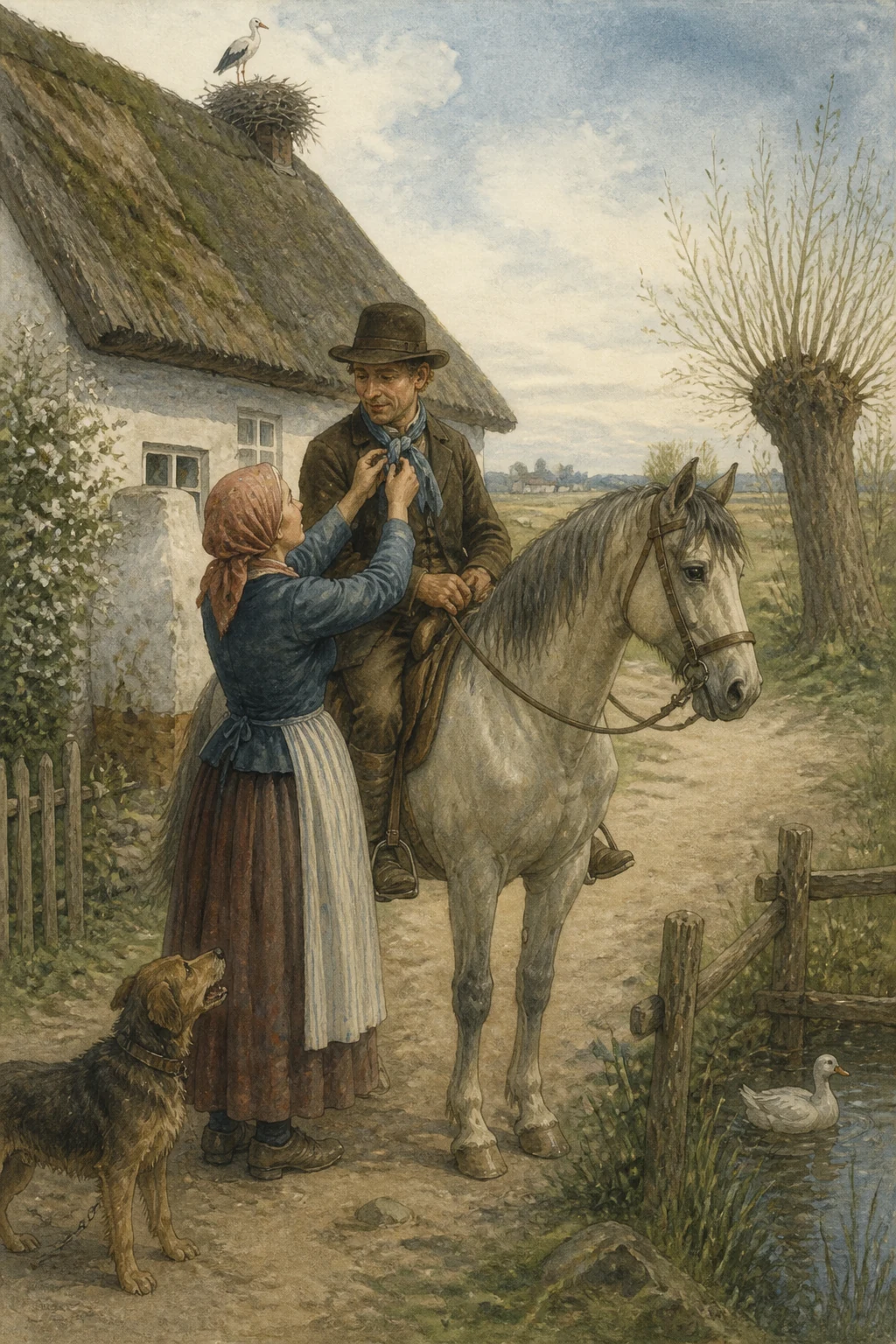
When the woman reached home again, she found her son, who had returned from the fields. She told him the astonishing things she had heard, then added, “I’m so glad I’ve had a chance to send something to my poor husband. Who would ever have imagined he could want for anything in heaven?” Her son was utterly amazed. “Mother,” he said, “a man doesn’t come down from heaven every day. I’ll go straight out and see if I can still find him. He must tell me what it’s like up there and how they go about their work.” He saddled the horse and rode off in great haste. He found the farmer sitting under a willow tree, about to count the money in the purse. “Have you seen the man who came from heaven?” the young fellow called to him. “Yes,” answered the farmer. “He’s set off on his way back and gone up that mountain over there, where it’s a little nearer. You can still catch him if you ride hard.” “Oh,” said the young fellow, “I’ve worn myself out working all day, and the ride here has quite finished me off. You know the man. Be so kind as to get on my horse and persuade him to come here.” “Aha,” thought the farmer, “here’s another with no wick in his lamp.” “Why shouldn’t I do you that favour?” he said, mounted the horse, and rode off at a brisk trot. The young fellow sat waiting until nightfall, but the farmer did not return. “No doubt,” he thought, “the man from heaven was in a great hurry and didn’t want to turn back, and the farmer gave him the horse to take to my father.” He went home and told his mother what had happened: he had sent his father the horse so that he would not always have to run about on foot. “You did well,” she answered. “Your legs are still young, and you can walk.”
When the farmer reached home, he put the horse in the stable beside the cow that had been left as a pledge, then went to his wife and said, “Trine, you’ve been lucky. I found two fools even more simple-minded than you. This time you’ll escape a beating. I’ll save it for another occasion.” Then he lit his pipe, sat down in the grandfather chair, and said, “That was a good bargain: a sleek horse and a great purse full of money for two scrawny cows. If foolishness always brought in so much, I’d gladly hold it in honour.” So thought the farmer, but I am sure you like the simple folk better.