O besedilu
Orfej in Evridika
- Vir
- Ovidove preobrazbe
- Avtor
- Ovid
- Jezik branja
- English
- Jezik izvirnika
- Latin
- Čas branja
- 5 min branja
- Obseg
- 4 strani
- Naslov izvirnika
- Orpheus and Eurydice
O izvirniku
Ovidove preobrazbe
Pesniški tok antičnih preobrazb, kjer bogovi, ljudje in narava stalno menjavajo obliko. Bralni jezik je English, izvirnik pa prihaja iz vira Ovidove preobrazbe v jeziku Latin.
Besedilo
Orfej in Evridika
From there, wrapped in a saffron cloak, Hymenaeus departed through the boundless sky toward the shores of the Cicones, summoned, all in vain, by the voice of Orpheus. He came indeed, but brought neither the solemn words nor a joyful face nor any happy omen. Even the torch he held kept sputtering with smoke that drew tears, and no amount of shaking coaxed a flame. The outcome was worse than the omen: for as the new bride wandered through the grass, accompanied by a band of naiads, she died from a serpent’s bite in her ankle.
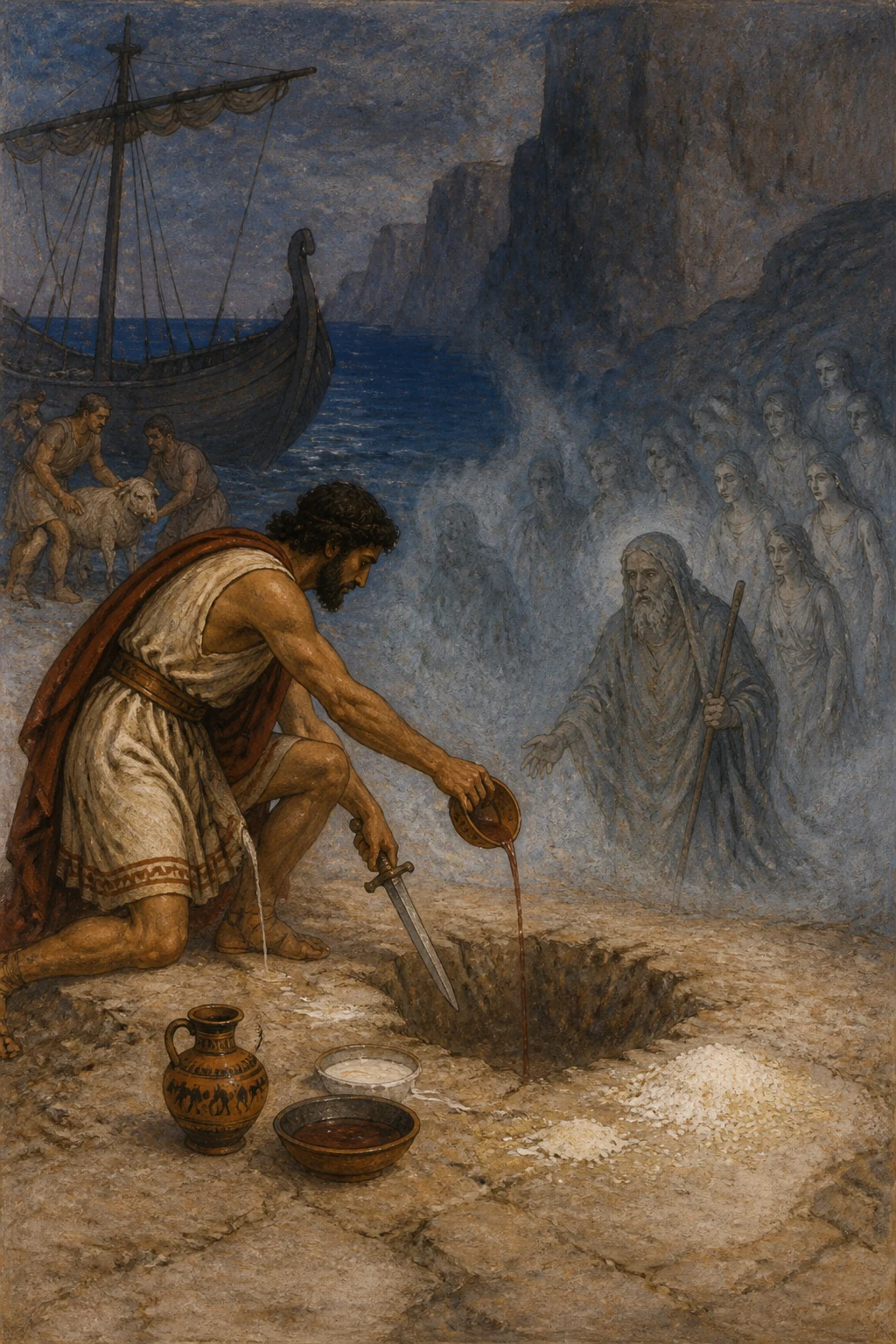
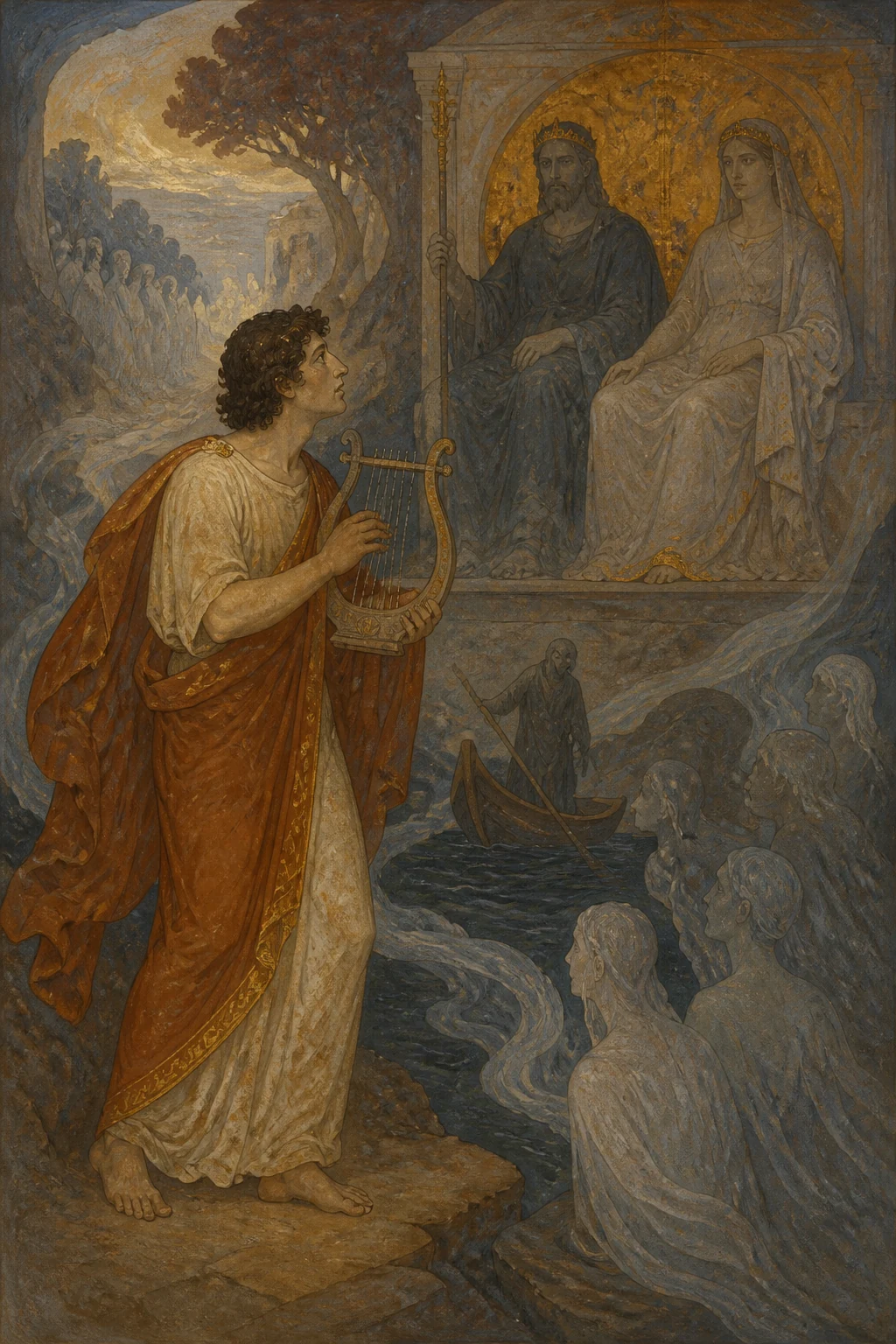
When the bard of Rhodope had mourned her long enough in the upper air, determined to try the shades as well, he dared descend to the Styx through the gate of Taenarus. Through the weightless throngs, the phantoms of the buried dead, he approached Persephone and the lord of the shades, who rules that joyless kingdom. Striking his lyre to accompany his song, he spoke: “O powers of the world that lies beneath the earth, to which all of us born mortal must return, if I may, and if you will allow me to set aside the evasions of a lying tongue and speak the truth, I have not come to gaze upon dark Tartarus, nor to bind the three throats, bristling with snakes, of the monster sprung from Medusa.
My wife is the reason for my journey: a viper she trod on poured its poison into her and stole her years of promise. I wished to find the strength to bear it; I will not deny I tried. Love conquered me. This god is well known in the world above; whether he is known here too, I cannot say. Yet I believe he is; and if the story of that ancient abduction is no lie, Love joined you too. By these places full of terror, by this vast chaos and the silence of your boundless realm, I beg you: unweave Eurydice’s fate, too swiftly spun.
We are all owed to you, and after a brief delay, sooner or later, we hasten to this one abode. We all journey here; this is our final home, and yours is the longest reign over the human race. She too, when she has lived her rightful span of years, will be yours: I ask not for a gift, but for a loan. But if the Fates deny this mercy to my wife, I am resolved not to return: rejoice in the death of two.”
As he spoke, moving the strings in time with his words, the bloodless spirits wept. Tantalus no longer reached for the retreating water, and Ixion’s wheel stood still; the birds ceased tearing at the liver, the daughters of Belus left their urns, and you, Sisyphus, sat upon your stone. Then for the first time, they say, the cheeks of the Furies grew wet with tears, overcome by his song. Neither the royal consort nor the ruler of the depths could bear to refuse his plea, and they called Eurydice. She was among the newly arrived shades, and walked slowly because of her wound.
Orpheus of Rhodope received her, and with her this condition: he must not turn his eyes behind him until he had left the valleys of Avernus, or the gift would be revoked. They took an upward path through the hushed silence, steep, dark, and thick with murky mist. They were not far from the edge of the upper world when, fearing she might falter and longing to see her, the lover turned his eyes, and at once she slipped back.
He stretched out his arms, struggling to hold her and be held, but, wretched, caught nothing but the yielding air. And now, dying a second time, she made no complaint against her husband: what could she complain of but being loved? She spoke a last “farewell,” which he could scarcely hear, and fell back once more to the place she had left. Orpheus was as stunned by his wife’s second death as the terrified man who saw the hound’s three necks, the middle one bearing chains, and whose terror did not leave him until his former nature left him too, as stone spread through his body; or Olenus, who took another’s guilt upon himself and wished to be thought the guilty one, and you, unhappy
Lethaea, who trusted in your beauty: once two hearts most closely joined, now stones upon moist Ida. The ferryman drove him back as he pleaded in vain to cross once more. Yet for seven days he sat unkempt upon the bank, without the gift of Ceres; anguish, grief, and tears were all his nourishment. Lamenting the cruelty of the gods of Erebus, he withdrew to lofty Rhodope and Haemus, lashed by the north winds.
For the third time the sun had ended the year in the sign of the watery Fishes, and Orpheus had shunned all love of women, whether because it had ended unhappily for him or because he had pledged his faith. Yet many women burned to join themselves to the bard, and many grieved at his rejection. He it was who taught the peoples of Thrace to turn their love to tender boys, and, before manhood came, to pluck the brief springtime of their years and its earliest flowers.
Izvirnik
Orpheus and Eurydice
Naslednje strani prikazujejo izvirno besedilo za primerjavo.
Source ID: ovid_metamorphoses_story_067 Citation: Ovid, Metamorphoses 10.1-10.85 Original language: Latin Source: PerseusDL canonical-latinLit Source URL: https://github.com/PerseusDL/canonical-latinLit/blob/master/data/phi0959/phi006/phi0959.phi006.perseus-lat2.xml Segmentation certainty: medium 1: Inde per inmensum croceo velatus amictu 2: aethera digreditur Ciconumque Hymenaeus ad oras 3: tendit et Orphea nequiquam voce vocatur.
4: Adfuit ille quidem, sed nec sollemnia verba 5: nec laetos vultus nec felix attulit omen. 6: Fax quoque, quam tenuit, lacrimoso stridula fumo 7: usque fuit nullosque invenit motibus ignes. 8: Exitus auspicio gravior: nam nupta per herbas 9: dum nova naiadum turba comitata vagatur, 10: occidit in talum serpentis dente recepto. 11: Quam satis ad superas postquam Rhodopeius auras 12: deflevit vates, ne non temptaret et umbras, 13: ad Styga Taenaria est ausus descendere porta; 14: perque leves populos simulacraque functa sepulcro 15: Persephonen adiit inamoenaque regna tenentem
16: umbrarum dominum. Pulsisque ad carmina nervis 17: sic ait: “O positi sub terra numina mundi, 18: in quem reccidimus, quidquid mortale creamur, 19: si licet et falsi positis ambagibus oris 20: vera loqui sinitis, non huc, ut opaca viderem 21: Tartara, descendi, nec uti villosa colubris 22: terna Medusaei vincirem guttura monstri: 23: causa viae est coniunx, in quam calcata venenum 24: vipera diffudit crescentesque abstulit annos.
25: Posse pati volui nec me temptasse negabo: 26: vicit Amor. Supera deus hic bene notus in ora est, 27: an sit et hic, dubito. Sed et hic tamen auguror esse; 28: famaque si veteris non est mentita rapinae, 29: vos quoque iunxit Amor. Per ego haec loca plena timoris, 30: per chaos hoc ingens vastique silentia regni, 31: Eurydices, oro, properata retexite fata. 32: Omnia debemur vobis, paulumque morati 33: serius aut citius sedem properamus ad unam.
34: Tendimus huc omnes, haec est domus ultima, vosque 35: humani generis longissima regna tenetis. 36: Haec quoque, cum iustos matura peregerit annos, 37: iuris erit vestri: pro munere poscimus usum. 38: Quod si fata negant veniam pro coniuge, certum est 39: nolle redire mihi: leto gaudete duorum.” 40: Talia dicentem nervosque ad verba moventem 41: exsangues flebant animae: nec Tantalus undam 42: captavit refugam, stupuitque Ixionis orbis, 43: nec carpsere iecur volucres, urnisque vacarunt 44: Belides, inque tuo sedisti, Sisyphe, saxo.
45: Tunc primum lacrimis victarum carmine fama est 46: Eumenidum maduisse genas. Nec regia coniunx 47: sustinet oranti nec qui regit ima negare, 48: Eurydicenque vocant. Umbras erat illa recentes 49: inter et incessit passu de vulnere tardo. 50: Hanc simul et legem Rhodopeius accipit Orpheus, 51: ne flectat retro sua lumina, donec Avernas 52: exierit valles: aut inrita dona futura.
53: Carpitur acclivis per muta silentia trames, 54: arduus, obscurus, caligine densus opaca. 55: Nec procul afuerunt telluris margine summae: 56: hic, ne deficeret, metuens avidusque videndi 57: flexit amans oculos; et protinus illa relapsa est, 58: bracchiaque intendens prendique et prendere certans 59: nil nisi cedentes infelix arripit auras. 60: Iamque iterum moriens non est de coniuge quicquam 61: questa suo: quid enim nisi se quereretur amatam?
62: Supremumque “vale,” quod iam vix auribus ille 63: acciperet, dixit revolutaque rursus eodem est. 64: Non aliter stupuit gemina nece coniugis Orpheus, 65: quam tria qui timidus, medio portante catenas, 66: colla canis vidit, quem non pavor ante reliquit, 67: quam natura prior, saxo per corpus oborto; 68: quique in se crimen traxit voluitque videri 69: Olenos esse nocens, tuque, o confisa figurae, 70: infelix Lethaea, tuae, iunctissima quondam 71: pectora, nunc lapides, quos umida sustinet Ide.
72: Orantem frustraque iterum transire volentem 73: portitor arcuerat. Septem tamen ille diebus 74: squalidus in ripa Cereris sine munere sedit: 75: cura dolorque animi lacrimaeque alimenta fuere. 76: Esse deos Erebi crudeles questus, in altam 77: se recipit Rhodopen pulsumque aquilonibus Haemum. 78: Tertius aequoreis inclusum piscibus annum 79: finierat Titan, omnemque refugerat Orpheus 80: femineam venerem, seu quod male cesserat illi, 81: sive fidem dederat. Multas tamen ardor habebat 82: iungere se vati, multae doluere repulsae.
83: Ille etiam Thracum populis fuit auctor amorem 84: in teneros transferre mares citraque iuventam 85: aetatis breve ver et primos carpere flores.
Nadaljuj z branjem