O besedilu
Odisej v podzemlju
- Vir
- Odiseja
- Avtor
- Homer
- Jezik branja
- English
- Jezik izvirnika
- Ancient Greek
- Čas branja
- 31 min branja
- Obseg
- 25 strani
- Naslov izvirnika
- Odysseus in the Underworld
O izvirniku
Odiseja
Dolga vrnitev domov čez morja, otoke, preizkušnje in prepoznavanja. Bralni jezik je English, izvirnik pa prihaja iz vira Odiseja v jeziku Ancient Greek.
Besedilo
Odisej v podzemlju
When we had gone down to the ship and the sea, we first dragged the ship into the sacred water, then set the mast and sails aboard the black hull. We took the sheep and put them aboard, and embarked ourselves, grieving and shedding bitter tears.
Behind our dark-prowed ship, Circe of the lovely braids, the dread goddess with a mortal’s voice, sent a following wind to fill our sails, a faithful companion. When we had attended to all the ship’s gear, we sat down, and the wind and helmsman steered her.
All day her sails stood taut as she crossed the sea. The sun went down, and all the ways grew dark. She reached the boundaries of deep-flowing Ocean, where the Cimmerian people have their land and city, shrouded in mist and cloud. Never does the shining sun look down on them with his rays, whether he climbs toward the starry heavens or turns back from heaven toward the earth. Instead, deadly night lies spread over those unhappy mortals.
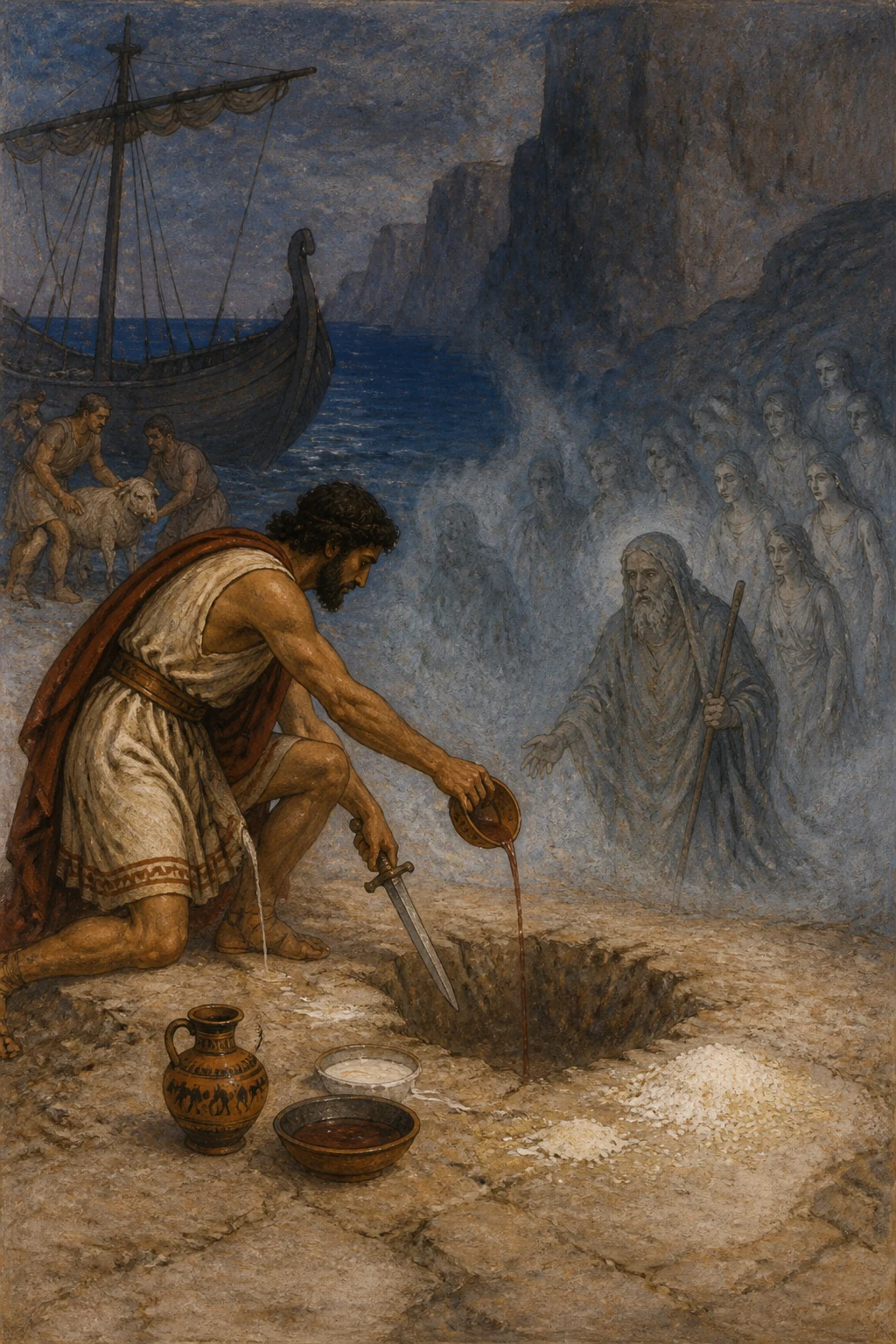
There we beached the ship and took out the sheep. Then we walked beside the stream of Ocean until we reached the place Circe had described. Perimedes and Eurylochus held the victims, while I drew the sharp sword from beside my thigh and dug a pit, a cubit each way. Around it I poured a libation for all the dead, first of milk and honey, then of sweet wine, and third of water; over it I sprinkled white barley meal.
Earnestly I prayed to the powerless shades of the dead, promising that when I came to Ithaca I would sacrifice in my halls the finest barren cow I owned, and heap the pyre with precious offerings. To Tiresias alone I would sacrifice a ram, wholly black, the finest in our flocks.
When I had entreated the tribes of the dead with vows and prayers, I took the sheep and cut their throats over the pit, and the dark blood flowed. Then out of Erebus gathered the souls of the dead and gone.
Brides and unmarried youths, old men who had endured much, tender maidens with hearts newly stricken by grief, and many men wounded by bronze-tipped spears, slain in battle, still wearing their bloodstained armor: from every side they thronged about the pit with unearthly cries, and pale terror seized me.
Then I urged my companions to skin and burn the sheep that lay slaughtered by the pitiless bronze, and to pray to the gods, to mighty Hades and dread Persephone. I myself drew the sharp sword from beside my thigh and sat there, keeping the powerless shades of the dead from approaching the blood until I had questioned Tiresias.
The first soul to come was that of my companion Elpenor. He had not yet been buried beneath the broad-wayed earth, for we had left his body in Circe’s house, unwept and unburied, since another task pressed upon us.
At the sight of him I wept, and my heart was filled with pity. I spoke to him with winged words: “Elpenor, how did you come beneath this misty darkness? You have reached here on foot before I could in my black ship.”
So I spoke, and with a groan he answered: “Son of Laertes, sprung from Zeus, resourceful Odysseus, an evil fate from a god and too much wine were my ruin. I had lain down to sleep in Circe’s house, and forgot to go back to the long ladder and climb down. Instead I fell headlong from the roof. My neck broke at the spine, and my soul went down to Hades.
“Now I beg you by those we have left behind, who are not here with us—by your wife, by the father who reared you as a little child, and by Telemachus, the only son you left in your halls. For I know that when you leave this house of Hades, you will bring your well-built ship to the island of Aeaea. There, my lord, I ask you to remember me.
“Do not sail away and leave me behind, unwept and unburied, lest I bring the gods’ wrath upon you. Burn me with whatever armor I possess, and raise a mound for me on the shore of the gray sea, so that men yet to come may hear of an unhappy man.
“Do this for me, and plant upon my grave the oar I used to row with when I was alive among my companions.” So he spoke, and I answered him: “All this, unhappy man, I will perform and carry out for you.”
So we sat exchanging sorrowful words, I on one side holding my sword above the blood, and the phantom of my companion on the other, speaking at length. Then came the soul of my dead mother, Anticleia, daughter of great-hearted Autolycus, whom I had left alive when I set out for sacred Ilium.
At the sight of her I wept, and my heart was filled with pity. Yet even in my bitter grief I would not let her approach the blood before I had questioned Tiresias. Then came the soul of Tiresias of Thebes, bearing a golden scepter. He knew me and said: “Son of Laertes, sprung from Zeus, resourceful Odysseus, why, unhappy man, have you left the sunlight and come here to see the dead and this joyless place?
“Stand back from the pit and hold away your sharp sword, so that I may drink the blood and tell you the truth.” So he spoke. I stepped back and thrust my silver-studded sword into its sheath. When he had drunk the dark blood, the noble prophet addressed me: “You seek a homecoming sweet as honey, glorious Odysseus, but a god will make it hard for you. I do not think you will escape the notice of the Earth-shaker, who has laid up anger against you in his heart, enraged because you blinded his dear son.
“Even so, despite your sufferings, you may yet come home, if you are willing to curb your own desires and those of your companions when first you bring your well-built ship to the island of Thrinacia, escaping the violet sea, and find grazing there the cattle and sturdy sheep of the Sun, who sees and hears all things.
“If you leave them unharmed and keep your mind upon your homecoming, you may yet reach Ithaca, though you suffer much. But if you harm them, I foretell destruction for your ship and your companions. Even if you yourself escape, you will come home late and in misery, having lost all your companions, aboard another man’s ship. And in your house you will find trouble: insolent men devouring your wealth, courting your godlike wife and offering marriage gifts.
“But when you come, you will indeed make them pay for their violence. Once you have killed the suitors in your halls, whether by cunning or openly with the sharp bronze, you must set out with a well-shaped oar and travel until you reach men who know nothing of the sea, who eat no food seasoned with salt. They know nothing of crimson-prowed ships, nor of the well-shaped oars that serve as ships’ wings.
“I will give you a clear sign that you cannot mistake. When another traveler meets you and says that you carry a winnowing fan upon your sturdy shoulder, then plant your well-shaped oar in the earth and offer rich sacrifices to lord Poseidon—a ram, a bull, and a boar that mounts the sows. Then return home and offer sacred hecatombs to the immortal gods who hold the wide heavens, to each of them in turn. And death will come to you from the sea, a death so gentle that it will take you when you are worn with prosperous old age; around you your people will flourish. All that I tell you is true.”
So he spoke, and I answered him: “Tiresias, surely the gods themselves have spun this fate. But come, tell me this, and tell me truly. I see here the soul of my dead mother. She sits in silence beside the blood, and has not brought herself to look her own son in the face or speak to him.
“Tell me, my lord, how can she recognize me for who I am?” So I spoke, and he answered at once: “A simple thing I will tell you, and impress upon your mind. Whichever of the dead you allow to approach the blood will speak the truth to you; whoever you refuse will turn and go away.”
With these words the soul of lord Tiresias went back into the house of Hades, having delivered his prophecies. I remained steadfast where I was until my mother came forward and drank the dark blood. At once she knew me, and lamenting, spoke to me with winged words: “My child, how have you come alive beneath this misty darkness? It is hard for the living to look upon these places.
“Between us lie great rivers and fearful streams—first of all Ocean, which no one can cross on foot, but only in a well-built ship. Have you come here now from Troy, wandering all this time with your ship and companions? Have you not yet reached Ithaca, nor seen your wife in your own halls?”
So she spoke, and I answered her: “Mother, necessity brought me down to Hades, to seek counsel from the soul of Tiresias of Thebes. I have not yet come near Achaea, nor set foot in our own land, but have wandered always in misery since the day I first followed noble Agamemnon to Ilium, famed for its horses, to fight the Trojans.
“But come, tell me this, and tell me truly. What doom of grievous death overcame you? Was it a long illness, or did Artemis, who showers arrows, come and strike you with her gentle shafts?
“Tell me of my father and the son I left behind. Does my royal honor still rest with them, or does some other man now hold it, while they say I shall never return? Tell me, too, the thoughts and intentions of my wedded wife. Does she remain with our son and faithfully guard all we possess, or has the noblest of the Achaeans already married her?”
So I spoke, and my honored mother answered at once: “Indeed she remains in your halls with an enduring heart. In sorrow her nights and days pass away, as she sheds tears.
“No one yet possesses your royal honor. Telemachus holds your estates undisturbed, and feasts at the shared banquets that a man who gives judgment should attend, for everyone invites him. Your father stays there in the country and never comes down to the city. He has no bedstead for his bed, no cloaks or shining coverlets. In winter he sleeps in the house where the servants sleep, in the ashes beside the fire, and wears poor clothes upon his body. But when summer comes, and fruitful autumn, beds of fallen leaves lie scattered on the ground for him all over the slopes of his vineyard.
“There he lies in sorrow, nursing a great grief in his heart as he longs for your return, and harsh old age comes upon him. So it was that I too perished and met my fate. The keen-eyed archer goddess did not come into our halls and kill me with her gentle shafts, nor did any illness fall upon me to waste me cruelly and draw the life from my limbs. No, it was longing for you, glorious Odysseus, for your wisdom and your gentleness, that robbed me of my honey-sweet life.”
So she spoke, and I longed in my heart to embrace the soul of my dead mother. Three times I sprang toward her, my heart urging me to clasp her, and three times she flitted from my arms like a shadow or a dream. A sharper anguish rose within my heart, and I spoke to her with winged words: “Mother, why will you not stay for me, when I long to hold you, so that even in Hades we may throw our loving arms around each other and find comfort in bitter weeping?
“Or is this some phantom that august Persephone has sent to make me grieve and groan still more?” So I spoke, and my honored mother answered at once: “Ah, my child, most ill-fated of all men! Persephone, daughter of Zeus, is not deceiving you. This is the lot of mortals when they die. Sinews no longer bind flesh and bones together; the fierce strength of blazing fire consumes them as soon as life has left the white bones, and the soul flies off and hovers like a dream.
“But strive to return to the light as quickly as you can, and remember all these things, so that afterward you may tell your wife.” So we exchanged words, and the women came, sent by august Persephone, all those who had been wives and daughters of noble men.
They gathered in a throng around the dark blood, while I considered how to question each of them. This seemed to me the best plan: I drew the long, sharp sword from beside my sturdy thigh and would not let them all drink the dark blood at once.
They came forward one by one, and each declared her lineage, while I questioned them all. The first I saw was highborn Tyro, who told me she was the daughter of noble Salmoneus and the wife of Cretheus, son of Aeolus. She fell in love with the divine river Enipeus, by far the loveliest river that flows upon the earth, and would often walk beside his beautiful streams.
Taking his form, the Earth-holder, the Earth-shaker, lay beside her at the mouth of the swirling river. A dark wave rose around them, arching high as a mountain, and hid the god and the mortal woman.
He loosened her maiden’s girdle and poured sleep over her. When the god had fulfilled the works of love, he took her by the hand and said: “Rejoice, woman, in our love. When the year has run its course, you will bear glorious children, for the embraces of immortals are never fruitless. Tend them and rear them well.
“Now go home, and keep silent: tell no one. I am Poseidon, the Earth-shaker.” With these words he plunged beneath the surging sea. She conceived and bore Pelias and Neleus, who both became mighty servants of great Zeus. Pelias, rich in flocks, lived in spacious Iolcus, and Neleus in sandy Pylos.
Other sons this queen among women bore to Cretheus: Aeson, Pheres, and Amythaon, who delighted in chariot fighting. After her I saw Antiope, daughter of Asopus, who claimed to have slept in the arms of Zeus himself. She bore two sons, Amphion and Zethus, who first founded seven-gated Thebes and built its walls, for strong though they were, they could not dwell in spacious Thebes without walls.
After her I saw Alcmene, wife of Amphitryon, who lay in the arms of great Zeus and bore bold Heracles, lionhearted in battle. I saw Megara too, daughter of proud Creon, whom the son of Amphitryon, tireless in strength, took to wife.
I saw the mother of Oedipus, beautiful Epicaste, who in the ignorance of her heart committed a dreadful deed by marrying her own son. He had killed his father and married her, but the gods soon made it known among men.
Through the gods’ deadly designs he remained in lovely Thebes, ruling the Cadmeans in anguish. But she went down to the house of Hades, the mighty keeper of the gates, fastening a deadly noose to a high roof beam, overcome by grief. To him she left behind all the many sufferings a mother’s Furies bring to pass.
I saw lovely Chloris, whom Neleus once married for her beauty, giving countless marriage gifts. She was the youngest daughter of Amphion, son of Iasus, who once ruled mightily in Minyan Orchomenus. She was queen of Pylos and bore him glorious children: Nestor, Chromius, and lordly Periclymenus.
Besides these she bore noble Pero, a wonder among mortals, whom all the neighboring men sought to marry. But Neleus would give her only to the man who could drive from Phylace the broad-browed, curving-horned cattle of mighty Iphiclus, a difficult task. Only a noble seer undertook to drive them away; but a god’s harsh decree ensnared him, with cruel bonds and the herdsmen of the fields.
Yet when the months and days were fulfilled, as the year revolved and the seasons returned, mighty Iphiclus released him, after he had declared all the prophecies. So the will of Zeus was accomplished.
I saw Leda, wife of Tyndareus, who bore him two stouthearted sons, Castor the horse-tamer and Polydeuces the skilled boxer. Both are held alive by the life-giving earth. Even beneath the ground they receive honor from Zeus: on alternate days they live and then are dead, and they have been granted honor equal to the gods.
After her I saw Iphimedeia, wife of Aloeus, who said that she had lain with Poseidon. She bore two sons, though their lives were short: godlike Otus and far-famed Ephialtes, the tallest men the grain-giving earth ever reared, and by far the handsomest after glorious Orion. At nine years old they were nine cubits broad and nine fathoms tall.
They even threatened the immortals on Olympus with the tumult of furious war. They longed to pile Ossa upon Olympus, and upon Ossa leafy Pelion, so that they might climb into heaven.
And they would have done it, had they reached full manhood. But the son of Zeus whom lovely-haired Leto bore killed them both before the down had blossomed beneath their temples and covered their cheeks with its first bloom.
I saw Phaedra and Procris, and beautiful Ariadne, daughter of Minos of the deadly mind. Theseus once took her from Crete toward the hill of sacred Athens, but had no joy of her: before that, Artemis killed her on sea-girt Dia, on the testimony of Dionysus.
I saw Maera and Clymene, and hateful Eriphyle, who accepted precious gold in exchange for her own husband. But I could not tell or name all the wives and daughters of heroes I saw: the immortal night would end before I finished. And now it is time to sleep, whether I go to my swift ship and my companions or remain here. My passage home will be the care of the gods and of you.”
So he spoke, and all fell still and silent, held spellbound throughout the shadowy hall. Then white-armed Arete spoke: “Phaeacians, what do you think of this man, his looks, his stature, and the balanced mind within him?
“He is my guest, though each of you shares in the honor. Do not hurry to send him away, nor stint your gifts to one in such need. By the gods’ favor, many possessions lie stored in your halls.”
Then the aged hero Echeneus, the eldest of the Phaeacians, spoke among them: “Friends, our wise queen’s words do not miss the mark or fall short of our judgment. Listen to her.
“But word and deed now rest with Alcinous.” Alcinous answered him: “So it shall indeed be, as surely as I live and rule the oar-loving Phaeacians. Yet our guest, however much he longs for home, must bear to stay until tomorrow, so that I may complete all our gifts. His passage will concern us all, and me above all, for the authority in this land is mine.”
Resourceful Odysseus answered him: “Lord Alcinous, most renowned of all your people, even if you asked me to remain here for a year while you arranged my passage and gave me splendid gifts, I would willingly do so. It would be far better to return to my dear native land with fuller hands. All those who saw me come home to Ithaca would honor and welcome me the more.”
Alcinous answered him: “Odysseus, when we look at you, we do not take you for a cheat or a deceiver, like the many men the dark earth nourishes, scattered far and wide, who fashion lies about things no one could ever witness. Your words have grace, and your mind is noble.
“You have told your tale with a singer’s skill, the bitter sorrows of all the Argives and your own. But come, tell me this, and tell me truly: did you see any of your godlike companions who followed you to Ilium and met their fate there?
“This night is long, immeasurably long; it is not yet time to sleep in the hall. Tell me of these wondrous deeds. I could endure until bright dawn, if you could bear to tell me here of your sufferings.”
Resourceful Odysseus answered him: “Lord Alcinous, most renowned of all your people, there is a time for many tales, and a time for sleep. But if you still long to listen, I would not begrudge you other stories, more pitiful still: the sufferings of my companions who perished afterward, who escaped the Trojans’ grievous battle cries only to die on their return through an evil woman’s will.
“When holy Persephone had scattered the souls of the women this way and that, the sorrowing soul of Agamemnon, son of Atreus, came forward. Around him gathered the souls of all who had died beside him in the house of Aegisthus and met their fate.
“As soon as he had drunk the dark blood, he knew me. He wept aloud, shedding abundant tears, and spread his hands toward me, longing to reach me. But he no longer had the steadfast strength and vigor that once had filled his supple limbs.
“At the sight of him I wept, and my heart was filled with pity. I spoke to him with winged words: ‘Most glorious son of Atreus, Agamemnon, lord of men, what doom of grievous death overcame you?
“‘Did Poseidon destroy you aboard your ships, raising a furious blast of cruel winds? Or did hostile men strike you down on land while you were driving off cattle and fine flocks of sheep, or fighting for a city and its women?’
“So I spoke, and he answered at once: ‘Son of Laertes, sprung from Zeus, resourceful Odysseus, Poseidon did not destroy me aboard my ships by raising a furious blast of cruel winds, nor did hostile men strike me down on land. Aegisthus plotted my death and doom, and killed me with the help of my accursed wife. He invited me into his house, gave me a feast, and slaughtered me as one slaughters an ox at its manger.
“‘So I died a most pitiful death. Around me my companions were slaughtered relentlessly, like white-tusked pigs killed in the house of a rich and powerful man for a wedding, a shared banquet, or a flourishing feast.
“‘You have witnessed the killing of many men, slain singly and in the thick of battle. But this sight would have wrung your heart above all: how we lay in the hall around the mixing bowl and the laden tables, while the whole floor seethed with blood.
“‘Most pitiful of all was the cry I heard from Priam’s daughter Cassandra, whom treacherous Clytemnestra killed beside me. Dying upon the sword, I lifted my hands and let them fall to the ground. But that shameless woman turned away, and would not even bring herself to close my eyes with her hands or shut my mouth as I went down to Hades.
“‘There is nothing more dreadful or shameless than a woman who can harbor such deeds in her heart, as she conceived that monstrous act and contrived the murder of her wedded husband. I had thought I would come home to a glad welcome from my children and my servants. But she, supreme in her knowledge of wickedness, poured shame upon herself and upon all women yet to come, even those who do good.’
“So he spoke, and I answered him: ‘Ah, how terribly far-seeing Zeus has hated the line of Atreus from the beginning, through the counsels of women! For Helen’s sake many of us perished, and while you were far away, Clytemnestra was preparing your betrayal.’
“So I spoke, and he answered at once: ‘Therefore never be too trusting, even with your wife. Do not reveal to her everything you know. Tell her some things, but keep others hidden.
“‘Yet death will not come to you from your wife, Odysseus. Icarius’ daughter, wise Penelope, is too prudent and too sound in judgment. We left her a young bride when we set out for war, with an infant son at her breast. He must now be numbered among the men—a fortunate son, for his dear father will see him on his return, and he will embrace his father, as is right.
“‘But my wife did not even let me feast my eyes upon my son; she killed me first. And I will tell you another thing: lay it to heart. Bring your ship to your dear native land secretly, not openly, for there is no longer any trusting women.
“‘But come, tell me this, and tell me truly: do you hear that my son is still alive, perhaps in Orchomenus or sandy Pylos, or with Menelaus in spacious Sparta? Surely noble Orestes is not yet dead upon the earth.’
“So he spoke, and I answered him: ‘Son of Atreus, why do you ask me this? I do not know whether he lives or is dead, and it is wrong to speak empty words.’ So we stood exchanging sorrowful words, grieving and shedding bitter tears. Then came the souls of Achilles, son of Peleus, of Patroclus, of noble Antilochus, and of Ajax, who in looks and stature surpassed all the other Danaans after the noble son of Peleus.
“The soul of the swift-footed grandson of Aeacus knew me and lamenting, spoke to me with winged words: ‘Son of Laertes, sprung from Zeus, resourceful Odysseus, daring man, what greater deed can you devise in your heart?
“‘How did you dare come down to Hades, where the senseless dead dwell, the phantoms of mortals whose toil is over?’ So he spoke, and I answered him: ‘Achilles, son of Peleus, by far the greatest of the Achaeans, I came in need of Tiresias, to see if he could give me counsel on how to reach rugged Ithaca. I have not yet come near Achaea, nor set foot in our own land, but suffering is always with me. Yet no man, Achilles, was ever more blessed than you, nor ever will be.
“‘While you lived, we Argives honored you like a god, and now that you are here you rule mightily among the dead. So do not grieve at death, Achilles.’ So I spoke, and he answered at once: ‘Do not try to comfort me for death, glorious Odysseus.
“‘I would rather work the soil as another man’s hired hand, for a landless man with little to live on, than rule over all the dead who have perished. But come, tell me of my noble son. Did he follow you to war and become a champion, or not?
“‘Tell me, too, if you have heard anything of noble Peleus. Does he still hold honor among the many Myrmidons, or do men throughout Hellas and Phthia dishonor him because old age has bound his hands and feet?
“‘For I am no longer beneath the sunlight to help him, strong as I was when on the broad plains of Troy I killed the best of their warriors, defending the Argives. If I could come to my father’s house like that, even for a moment, I would make those who oppress him and rob him of honor shudder at my strength and my invincible hands.’
“So he spoke, and I answered him: ‘Of noble Peleus I have heard nothing. But of your dear son Neoptolemus I will tell you the whole truth, as you ask. I myself brought him from Scyros in my hollow, well-balanced ship to join the well-greaved Achaeans.
“‘Whenever we took counsel before the city of Troy, he was always first to speak, and his words never missed the mark. Only godlike Nestor and I surpassed him. And whenever we fought the Trojans with bronze on the plain, he never stayed among the mass of men or in the crowd, but ran far ahead, yielding to no one in courage. Many men he killed in terrible battle.
“‘I could not tell or name all the warriors he killed in defense of the Argives. But what a man he slew with his bronze blade—the hero Eurypylus, son of Telephus! Around him many of his Ceteian companions were killed, all because of gifts offered to a woman.
“‘He was the handsomest man I saw after noble Memnon. And when we, the best of the Argives, climbed into the horse Epeius built, I was entrusted with everything, both opening and closing our close-packed hiding place. There the other Danaan leaders and rulers wiped away tears, and every man’s limbs trembled. But never once did I see your son’s fair complexion pale, nor did I see him wipe a tear from his cheeks. Instead he begged me again and again to let him out of the horse, and kept feeling for his sword hilt and his bronze-weighted spear, eager to bring destruction upon the Trojans.
“But when we had sacked Priam’s steep-walled city, he boarded his ship with his share of the spoils and a splendid prize of honor, unharmed: neither struck by sharp bronze nor wounded in close combat, as so often happens in war, where Ares rages without distinction.”
So I spoke, and the spirit of the swift-footed son of Aeacus went striding away across the meadow of asphodel, rejoicing that I had spoken of his son’s renown. The other spirits of the dead stood sorrowfully about me, each asking after those dear to them.
Only the spirit of Ajax, son of Telamon, stood apart, still angry over the victory I had won against him when judgment was given beside the ships concerning the armor of Achilles. His noble mother had offered it as a prize.
The sons of the Trojans and Pallas Athena had judged the contest. How I wish I had never won such a prize! For because of that armor the earth had closed over so great a man as Ajax, who surpassed all the other Danaans in stature and in deeds, save only the noble son of Peleus.
I spoke to him with gentle words: “Ajax, son of noble Telamon, were you never to forget your anger against me, even in death, over that accursed armor? The gods made it a scourge to the Argives, for in losing you they lost their tower of strength. We Achaeans mourn your death unceasingly, no less than we mourn Achilles, son of Peleus. No one else is to blame but Zeus, who bitterly hated the host of Danaan spearmen and laid this doom upon you.
“Come nearer, my lord, and hear what I have to say. Subdue your anger and your proud spirit.” So I spoke, but he made no answer and went away into Erebus among the other spirits of the dead.
Even then, for all his anger, he might have spoken to me, or I to him; but my heart was eager to see the spirits of the other dead. There I saw Minos, the glorious son of Zeus, holding a golden scepter and sitting in judgment over the dead. Around him they sat or stood in the wide-gated house of Hades, seeking rulings from their king.
After him I saw mighty Orion driving wild beasts together across the meadow of asphodel, the very beasts he had slain on the lonely mountains. In his hands he held a club of solid bronze, forever unbroken.
I also saw Tityus, son of glorious Earth, stretched upon the ground. He lay across nine hundred feet, and two vultures, one on either side, tore at his liver, plunging their beaks into his body; he could not fend them off with his hands. For he had assaulted Leto, the glorious consort of Zeus, as she traveled toward Pytho through Panopeus with its lovely dancing grounds.
Then I saw Tantalus in grievous torment, standing in a pool whose waters reached his chin. He strained in his thirst, yet could get nothing to drink. Whenever the old man stooped, eager to drink, the water vanished, swallowed into the earth, and the dark ground appeared about his feet: some divine power dried it up.
Tall, leafy trees hung their fruit above his head: pear trees and pomegranates, apple trees with shining fruit, sweet figs and flourishing olives. But whenever the old man reached out to grasp them, the wind tossed the branches up toward the shadowy clouds.
Then I saw Sisyphus in grievous torment, struggling with an enormous stone in both his hands. Bracing himself with hands and feet, he would thrust the stone uphill; but whenever he was about to push it over the crest, its weight would turn it back, and down to the plain the pitiless stone would roll again.
Then he would strain once more to push it upward. Sweat poured from his limbs, and dust rose about his head. After him I saw mighty Heracles—his phantom, for he himself delights in feasts among the immortal gods, with lovely-ankled Hebe as his wife, the daughter of great Zeus and golden-sandaled Hera.
Around him the dead clamored like birds, scattering in terror in every direction. He stood like the black night, his bow unsheathed and an arrow on the string, glaring fiercely about him, as though always on the point of shooting.
A fearsome golden belt crossed his breast, a sword-belt on which marvelous scenes had been wrought: bears, wild boars, and glaring lions; struggles and battles, slaughter and the killing of men.
May the craftsman who brought all his skill to that belt never have made, nor ever make, another! Heracles knew me at once when his eyes fell on me, and in pity he spoke these winged words: “Son of Laertes, sprung from Zeus, resourceful Odysseus! Ah, poor man, are you too pursuing some wretched fate like the one I bore beneath the sunlight?
“I was the son of Zeus, the son of Cronus, yet my suffering knew no end. I was made subject to a man far inferior to myself, and he imposed harsh labors on me. Once he even sent me here to bring back the hound, for he could think of no other labor harder than this. Yet I brought it up and led it out of Hades; Hermes and bright-eyed Athena guided me.”
With these words he went back into the house of Hades, while I stayed firmly where I was, hoping that some other hero of those who died long ago might yet appear. And I might have seen those men of an earlier age whom I longed to see, Theseus and Peirithous, glorious sons of gods. But before they came, countless throngs of the dead gathered with an unearthly clamor, and pale fear seized me, lest august Persephone should send up from Hades the head of the Gorgon, that dreadful monster.
At once I went to the ship and ordered my companions to embark and loosen the mooring ropes. They quickly went aboard and took their places at the oars. The current bore the ship down the river Ocean, first with our rowing, and afterward with a fair wind.
Izvirnik
Odysseus in the Underworld
Naslednje strani prikazujejo izvirno besedilo za primerjavo.
αὐτὰρ ἐπεί ῥʼ ἐπὶ νῆα κατήλθομεν ἠδὲ θάλασσαν, νῆα μὲν ἂρ πάμπρωτον ἐρύσσαμεν εἰς ἅλα δῖαν, ἐν δʼ ἱστὸν τιθέμεσθα καὶ ἱστία νηὶ μελαίνῃ, ἐν δὲ τὰ μῆλα λαβόντες ἐβήσαμεν, ἂν δὲ καὶ αὐτοὶ βαίνομεν ἀχνύμενοι θαλερὸν κατὰ δάκρυ χέοντες. ἡμῖν δʼ αὖ κατόπισθε νεὸς κυανοπρῴροιο ἴκμενον οὖρον ἵει πλησίστιον, ἐσθλὸν ἑταῖρον, Κίρκη εὐπλόκαμος, δεινὴ θεὸς αὐδήεσσα. ἡμεῖς δʼ ὅπλα ἕκαστα πονησάμενοι κατὰ νῆα ἥμεθα· τὴν δʼ ἄνεμός τε κυβερνήτης τʼ ἴθυνε.
τῆς δὲ πανημερίης τέταθʼ ἱστία ποντοπορούσης· δύσετό τʼ ἠέλιος σκιόωντό τε πᾶσαι ἀγυιαί. ἡ δʼ ἐς πείραθʼ ἵκανε βαθυρρόου Ὠκεανοῖο. ἔνθα δὲ Κιμμερίων ἀνδρῶν δῆμός τε πόλις τε, ἠέρι καὶ νεφέλῃ κεκαλυμμένοι· οὐδέ ποτʼ αὐτοὺς ἠέλιος φαέθων καταδέρκεται ἀκτίνεσσιν, οὔθʼ ὁπότʼ ἂν στείχῃσι πρὸς οὐρανὸν ἀστερόεντα, οὔθʼ ὅτʼ ἂν ἂψ ἐπὶ γαῖαν ἀπʼ οὐρανόθεν προτράπηται, ἀλλʼ ἐπὶ νὺξ ὀλοὴ τέταται δειλοῖσι βροτοῖσι.
νῆα μὲν ἔνθʼ ἐλθόντες ἐκέλσαμεν, ἐκ δὲ τὰ μῆλα εἱλόμεθʼ· αὐτοὶ δʼ αὖτε παρὰ ῥόον Ὠκεανοῖο ᾔομεν, ὄφρʼ ἐς χῶρον ἀφικόμεθʼ, ὃν φράσε Κίρκη. ἔνθʼ ἱερήια μὲν Περιμήδης Εὐρύλοχός τε ἔσχον· ἐγὼ δʼ ἄορ ὀξὺ ἐρυσσάμενος παρὰ μηροῦ βόθρον ὄρυξʼ ὅσσον τε πυγούσιον ἔνθα καὶ ἔνθα, ἀμφʼ αὐτῷ δὲ χοὴν χεόμην πᾶσιν νεκύεσσι, πρῶτα μελικρήτῳ, μετέπειτα δὲ ἡδέι οἴνῳ, τὸ τρίτον αὖθʼ ὕδατι· ἐπὶ δʼ ἄλφιτα λευκὰ πάλυνον.
πολλὰ δὲ γουνούμην νεκύων ἀμενηνὰ κάρηνα, ἐλθὼν εἰς Ἰθάκην στεῖραν βοῦν, ἥ τις ἀρίστη, ῥέξειν ἐν μεγάροισι πυρήν τʼ ἐμπλησέμεν ἐσθλῶν, Τειρεσίῃ δʼ ἀπάνευθεν ὄιν ἱερευσέμεν οἴῳ παμμέλανʼ, ὃς μήλοισι μεταπρέπει ἡμετέροισι. τοὺς δʼ ἐπεὶ εὐχωλῇσι λιτῇσί τε, ἔθνεα νεκρῶν, ἐλλισάμην, τὰ δὲ μῆλα λαβὼν ἀπεδειροτόμησα ἐς βόθρον, ῥέε δʼ αἷμα κελαινεφές· αἱ δʼ ἀγέροντο ψυχαὶ ὑπὲξ Ἐρέβευς νεκύων κατατεθνηώτων.
νύμφαι τʼ ἠίθεοί τε πολύτλητοί τε γέροντες παρθενικαί τʼ ἀταλαὶ νεοπενθέα θυμὸν ἔχουσαι, πολλοὶ δʼ οὐτάμενοι χαλκήρεσιν ἐγχείῃσιν, ἄνδρες ἀρηίφατοι βεβροτωμένα τεύχεʼ ἔχοντες· οἳ πολλοὶ περὶ βόθρον ἐφοίτων ἄλλοθεν ἄλλος θεσπεσίῃ ἰαχῇ· ἐμὲ δὲ χλωρὸν δέος ᾕρει. δὴ τότʼ ἔπειθʼ ἑτάροισιν ἐποτρύνας ἐκέλευσα μῆλα, τὰ δὴ κατέκειτʼ ἐσφαγμένα νηλέι χαλκῷ, δείραντας κατακῆαι, ἐπεύξασθαι δὲ θεοῖσιν, ἰφθίμῳ τʼ Ἀΐδῃ καὶ ἐπαινῇ Περσεφονείῃ· αὐτὸς δὲ ξίφος ὀξὺ ἐρυσσάμενος παρὰ μηροῦ ἥμην, οὐδʼ εἴων νεκύων ἀμενηνὰ κάρηνα
αἵματος ἆσσον ἴμεν, πρὶν Τειρεσίαο πυθέσθαι. πρώτη δὲ ψυχὴ Ἐλπήνορος ἦλθεν ἑταίρου· οὐ γάρ πω ἐτέθαπτο ὑπὸ χθονὸς εὐρυοδείης· σῶμα γὰρ ἐν Κίρκης μεγάρῳ κατελείπομεν ἡμεῖς ἄκλαυτον καὶ ἄθαπτον, ἐπεὶ πόνος ἄλλος ἔπειγε. τὸν μὲν ἐγὼ δάκρυσα ἰδὼν ἐλέησά τε θυμῷ, καί μιν φωνήσας ἔπεα πτερόεντα προσηύδων· Ἐλπῆνορ, πῶς ἦλθες ὑπὸ ζόφον ἠερόεντα; ἔφθης πεζὸς ἰὼν ἢ ἐγὼ σὺν νηὶ μελαίνῃ.
ὣς ἐφάμην, ὁ δέ μʼ οἰμώξας ἠμείβετο μύθῳ· διογενὲς Λαερτιάδη, πολυμήχανʼ Ὀδυσσεῦ, ἆσέ με δαίμονος αἶσα κακὴ καὶ ἀθέσφατος οἶνος. Κίρκης δʼ ἐν μεγάρῳ καταλέγμενος οὐκ ἐνόησα ἄψορρον καταβῆναι ἰὼν ἐς κλίμακα μακρήν, ἀλλὰ καταντικρὺ τέγεος πέσον· ἐκ δέ μοι αὐχὴν ἀστραγάλων ἐάγη, ψυχὴ δʼ Ἄϊδόσδε κατῆλθε. νῦν δέ σε τῶν ὄπιθεν γουνάζομαι, οὐ παρεόντων, πρός τʼ ἀλόχου καὶ πατρός, ὅ σʼ ἔτρεφε τυτθὸν ἐόντα, Τηλεμάχου θʼ, ὃν μοῦνον ἐνὶ μεγάροισιν ἔλειπες· οἶδα γὰρ ὡς ἐνθένδε κιὼν δόμου ἐξ Ἀίδαο νῆσον ἐς Αἰαίην σχήσεις ἐυεργέα νῆα·
ἔνθα σʼ ἔπειτα, ἄναξ, κέλομαι μνήσασθαι ἐμεῖο. μή μʼ ἄκλαυτον ἄθαπτον ἰὼν ὄπιθεν καταλείπειν νοσφισθείς, μή τοί τι θεῶν μήνιμα γένωμαι, ἀλλά με κακκῆαι σὺν τεύχεσιν, ἅσσα μοι ἔστιν, σῆμά τέ μοι χεῦαι πολιῆς ἐπὶ θινὶ θαλάσσης, ἀνδρὸς δυστήνοιο καὶ ἐσσομένοισι πυθέσθαι. ταῦτά τέ μοι τελέσαι πῆξαί τʼ ἐπὶ τύμβῳ ἐρετμόν, τῷ καὶ ζωὸς ἔρεσσον ἐὼν μετʼ ἐμοῖς ἑτάροισιν. ὣς ἔφατʼ, αὐτὰρ ἐγώ μιν ἀμειβόμενος προσέειπον· ταῦτά τοι, ὦ δύστηνε, τελευτήσω τε καὶ ἔρξω.
νῶι μὲν ὣς ἐπέεσσιν ἀμειβομένω στυγεροῖσιν ἥμεθʼ, ἐγὼ μὲν ἄνευθεν ἐφʼ αἵματι φάσγανον ἴσχων, εἴδωλον δʼ ἑτέρωθεν ἑταίρου πόλλʼ ἀγόρευεν· ἦλθε δʼ ἐπὶ ψυχὴ μητρὸς κατατεθνηυίης, Αὐτολύκου θυγάτηρ μεγαλήτορος Ἀντίκλεια, τὴν ζωὴν κατέλειπον ἰὼν εἰς Ἴλιον ἱρήν. τὴν μὲν ἐγὼ δάκρυσα ἰδὼν ἐλέησά τε θυμῷ· ἀλλʼ οὐδʼ ὣς εἴων προτέρην, πυκινόν περ ἀχεύων, αἵματος ἆσσον ἴμεν, πρὶν Τειρεσίαο πυθέσθαι.
ἦλθε δʼ ἐπὶ ψυχὴ Θηβαίου Τειρεσίαο χρύσεον σκῆπτρον ἔχων, ἐμὲ δʼ ἔγνω καὶ προσέειπεν· διογενὲς Λαερτιάδη, πολυμήχανʼ Ὀδυσσεῦ, τίπτʼ αὖτʼ, ὦ δύστηνε, λιπὼν φάος ἠελίοιο ἤλυθες, ὄφρα ἴδῃ νέκυας καὶ ἀτερπέα χῶρον; ἀλλʼ ἀποχάζεο βόθρου, ἄπισχε δὲ φάσγανον ὀξύ, αἵματος ὄφρα πίω καί τοι νημερτέα εἴπω. ὣς φάτʼ, ἐγὼ δʼ ἀναχασσάμενος ξίφος ἀργυρόηλον κουλεῷ ἐγκατέπηξʼ. ὁ δʼ ἐπεὶ πίεν αἷμα κελαινόν, καὶ τότε δή μʼ ἐπέεσσι προσηύδα μάντις ἀμύμων· νόστον δίζηαι μελιηδέα, φαίδιμʼ Ὀδυσσεῦ· τὸν δέ τοι ἀργαλέον θήσει θεός· οὐ γὰρ ὀίω
λήσειν ἐννοσίγαιον, ὅ τοι κότον ἔνθετο θυμῷ χωόμενος ὅτι οἱ υἱὸν φίλον ἐξαλάωσας. ἀλλʼ ἔτι μέν κε καὶ ὣς κακά περ πάσχοντες ἵκοισθε, αἴ κʼ ἐθέλῃς σὸν θυμὸν ἐρυκακέειν καὶ ἑταίρων, ὁππότε κε πρῶτον πελάσῃς ἐυεργέα νῆα Θρινακίῃ νήσῳ, προφυγὼν ἰοειδέα πόντον, βοσκομένας δʼ εὕρητε βόας καὶ ἴφια μῆλα Ἠελίου, ὃς πάντʼ ἐφορᾷ καὶ πάντʼ ἐπακούει. τὰς εἰ μέν κʼ ἀσινέας ἐάᾳς νόστου τε μέδηαι, καί κεν ἔτʼ εἰς Ἰθάκην κακά περ πάσχοντες ἵκοισθε· εἰ δέ κε σίνηαι, τότε τοι τεκμαίρομʼ ὄλεθρον, νηί τε καὶ ἑτάροις. αὐτὸς δʼ εἴ πέρ κεν ἀλύξῃς,
ὀψὲ κακῶς νεῖαι, ὀλέσας ἄπο πάντας ἑταίρους, νηὸς ἐπʼ ἀλλοτρίης· δήεις δʼ ἐν πήματα οἴκῳ, ἄνδρας ὑπερφιάλους, οἵ τοι βίοτον κατέδουσι μνώμενοι ἀντιθέην ἄλοχον καὶ ἕδνα διδόντες. ἀλλʼ ἦ τοι κείνων γε βίας ἀποτίσεαι ἐλθών· αὐτὰρ ἐπὴν μνηστῆρας ἐνὶ μεγάροισι τεοῖσι κτείνῃς ἠὲ δόλῳ ἢ ἀμφαδὸν ὀξέι χαλκῷ, ἔρχεσθαι δὴ ἔπειτα λαβὼν ἐυῆρες ἐρετμόν, εἰς ὅ κε τοὺς ἀφίκηαι οἳ οὐκ ἴσασι θάλασσαν ἀνέρες, οὐδέ θʼ ἅλεσσι μεμιγμένον εἶδαρ ἔδουσιν· οὐδʼ ἄρα τοί γʼ ἴσασι νέας φοινικοπαρῄους οὐδʼ ἐυήρεʼ ἐρετμά, τά τε πτερὰ νηυσὶ πέλονται.
σῆμα δέ τοι ἐρέω μάλʼ ἀριφραδές, οὐδέ σε λήσει· ὁππότε κεν δή τοι συμβλήμενος ἄλλος ὁδίτης φήῃ ἀθηρηλοιγὸν ἔχειν ἀνὰ φαιδίμῳ ὤμῳ, καὶ τότε δὴ γαίῃ πήξας ἐυῆρες ἐρετμόν, ῥέξας ἱερὰ καλὰ Ποσειδάωνι ἄνακτι, ἀρνειὸν ταῦρόν τε συῶν τʼ ἐπιβήτορα κάπρον, οἴκαδʼ ἀποστείχειν ἔρδειν θʼ ἱερᾶς ἑκατόμβας ἀθανάτοισι θεοῖσι, τοὶ οὐρανὸν εὐρὺν ἔχουσι, πᾶσι μάλʼ ἑξείης. θάνατος δέ τοι ἐξ ἁλὸς αὐτῷ ἀβληχρὸς μάλα τοῖος ἐλεύσεται, ὅς κέ σε πέφνῃ γήραι ὕπο λιπαρῷ ἀρημένον· ἀμφὶ δὲ λαοὶ ὄλβιοι ἔσσονται. τὰ δέ τοι νημερτέα εἴρω.
ὣς ἔφατʼ, αὐτὰρ ἐγώ μιν ἀμειβόμενος προσέειπον· Τειρεσίη, τὰ μὲν ἄρ που ἐπέκλωσαν θεοὶ αὐτοί. ἀλλʼ ἄγε μοι τόδε εἰπὲ καὶ ἀτρεκέως κατάλεξον· μητρὸς τήνδʼ ὁρόω ψυχὴν κατατεθνηυίης· ἡ δʼ ἀκέουσʼ ἧσται σχεδὸν αἵματος, οὐδʼ ἑὸν υἱὸν ἔτλη ἐσάντα ἰδεῖν οὐδὲ προτιμυθήσασθαι. εἰπέ, ἄναξ, πῶς κέν με ἀναγνοίη τὸν ἐόντα; ὣς ἐφάμην, ὁ δέ μʼ αὐτίκʼ ἀμειβόμενος προσέειπεν· ῥηΐδιόν τοι ἔπος ἐρέω καὶ ἐπὶ φρεσὶ θήσω.
ὅν τινα μέν κεν ἐᾷς νεκύων κατατεθνηώτων αἵματος ἆσσον ἴμεν, ὁ δέ τοι νημερτὲς ἐνίψει· ᾧ δέ κʼ ἐπιφθονέῃς, ὁ δέ τοι πάλιν εἶσιν ὀπίσσω. ὣς φαμένη ψυχὴ μὲν ἔβη δόμον Ἄϊδος εἴσω Τειρεσίαο ἄνακτος, ἐπεὶ κατὰ θέσφατʼ ἔλεξεν· αὐτὰρ ἐγὼν αὐτοῦ μένον ἔμπεδον, ὄφρʼ ἐπὶ μήτηρ ἤλυθε καὶ πίεν αἷμα κελαινεφές· αὐτίκα δʼ ἔγνω, καί μʼ ὀλοφυρομένη ἔπεα πτερόεντα προσηύδα· τέκνον ἐμόν, πῶς ἦλθες ὑπὸ ζόφον ἠερόεντα ζωὸς ἐών; χαλεπὸν δὲ τάδε ζωοῖσιν ὁρᾶσθαι.
μέσσῳ γὰρ μεγάλοι ποταμοὶ καὶ δεινὰ ῥέεθρα, Ὠκεανὸς μὲν πρῶτα, τὸν οὔ πως ἔστι περῆσαι πεζὸν ἐόντʼ, ἢν μή τις ἔχῃ ἐυεργέα νῆα. ἦ νῦν δὴ Τροίηθεν ἀλώμενος ἐνθάδʼ ἱκάνεις νηί τε καὶ ἑτάροισι πολὺν χρόνον; οὐδέ πω ἦλθες εἰς Ἰθάκην, οὐδʼ εἶδες ἐνὶ μεγάροισι γυναῖκα; ὣς ἔφατʼ, αὐτὰρ ἐγώ μιν ἀμειβόμενος προσέειπον· μῆτερ ἐμή, χρειώ με κατήγαγεν εἰς Ἀίδαο ψυχῇ χρησόμενον Θηβαίου Τειρεσίαο· οὐ γάρ πω σχεδὸν ἦλθον Ἀχαιΐδος, οὐδέ πω ἁμῆς γῆς ἐπέβην, ἀλλʼ αἰὲν ἔχων ἀλάλημαι ὀιζύν, ἐξ οὗ τὰ πρώτισθʼ ἑπόμην Ἀγαμέμνονι δίῳ
Ἴλιον εἰς ἐύπωλον, ἵνα Τρώεσσι μαχοίμην. ἀλλʼ ἄγε μοι τόδε εἰπὲ καὶ ἀτρεκέως κατάλεξον· τίς νύ σε κὴρ ἐδάμασσε τανηλεγέος θανάτοιο; ἦ δολιχὴ νοῦσος, ἦ Ἄρτεμις ἰοχέαιρα οἷς ἀγανοῖς βελέεσσιν ἐποιχομένη κατέπεφνεν; εἰπὲ δέ μοι πατρός τε καὶ υἱέος, ὃν κατέλειπον, ἢ ἔτι πὰρ κείνοισιν ἐμὸν γέρας, ἦέ τις ἤδη ἀνδρῶν ἄλλος ἔχει, ἐμὲ δʼ οὐκέτι φασὶ νέεσθαι. εἰπὲ δέ μοι μνηστῆς ἀλόχου βουλήν τε νόον τε, ἠὲ μένει παρὰ παιδὶ καὶ ἔμπεδα πάντα φυλάσσει ἦ ἤδη μιν ἔγημεν Ἀχαιῶν ὅς τις ἄριστος.
ὣς ἐφάμην, ἡ δʼ αὐτίκʼ ἀμείβετο πότνια μήτηρ· καὶ λίην κείνη γε μένει τετληότι θυμῷ σοῖσιν ἐνὶ μεγάροισιν· ὀιζυραὶ δέ οἱ αἰεὶ φθίνουσιν νύκτες τε καὶ ἤματα δάκρυ χεούσῃ. σὸν δʼ οὔ πώ τις ἔχει καλὸν γέρας, ἀλλὰ ἕκηλος Τηλέμαχος τεμένεα νέμεται καὶ δαῖτας ἐίσας δαίνυται, ἃς ἐπέοικε δικασπόλον ἄνδρʼ ἀλεγύνειν· πάντες γὰρ καλέουσι. πατὴρ δὲ σὸς αὐτόθι μίμνει ἀγρῷ, οὐδὲ πόλινδε κατέρχεται. οὐδέ οἱ εὐναὶ δέμνια καὶ χλαῖναι καὶ ῥήγεα σιγαλόεντα, ἀλλʼ ὅ γε χεῖμα μὲν εὕδει ὅθι δμῶες ἐνὶ οἴκῳ, ἐν κόνι ἄγχι πυρός, κακὰ δὲ χροῒ εἵματα εἷται·
αὐτὰρ ἐπὴν ἔλθῃσι θέρος τεθαλυῖά τʼ ὀπώρη, πάντῃ οἱ κατὰ γουνὸν ἀλωῆς οἰνοπέδοιο φύλλων κεκλιμένων χθαμαλαὶ βεβλήαται εὐναί. ἔνθʼ ὅ γε κεῖτʼ ἀχέων, μέγα δὲ φρεσὶ πένθος ἀέξει σὸν νόστον ποθέων, χαλεπὸν δʼ ἐπὶ γῆρας ἱκάνει. οὕτω γὰρ καὶ ἐγὼν ὀλόμην καὶ πότμον ἐπέσπον· οὔτʼ ἐμέ γʼ ἐν μεγάροισιν ἐύσκοπος ἰοχέαιρα οἷς ἀγανοῖς βελέεσσιν ἐποιχομένη κατέπεφνεν, οὔτε τις οὖν μοι νοῦσος ἐπήλυθεν, ἥ τε μάλιστα τηκεδόνι στυγερῇ μελέων ἐξείλετο θυμόν· ἀλλά με σός τε πόθος σά τε μήδεα, φαίδιμʼ Ὀδυσσεῦ, σή τʼ ἀγανοφροσύνη μελιηδέα θυμὸν ἀπηύρα.
ὣς ἔφατʼ, αὐτὰρ ἐγώ γʼ ἔθελον φρεσὶ μερμηρίξας μητρὸς ἐμῆς ψυχὴν ἑλέειν κατατεθνηυίης. τρὶς μὲν ἐφωρμήθην, ἑλέειν τέ με θυμὸς ἀνώγει, τρὶς δέ μοι ἐκ χειρῶν σκιῇ εἴκελον ἢ καὶ ὀνείρῳ ἔπτατʼ. ἐμοὶ δʼ ἄχος ὀξὺ γενέσκετο κηρόθι μᾶλλον, καί μιν φωνήσας ἔπεα πτερόεντα προσηύδων· μῆτερ ἐμή, τί νύ μʼ οὐ μίμνεις ἑλέειν μεμαῶτα, ὄφρα καὶ εἰν Ἀίδαο φίλας περὶ χεῖρε βαλόντε ἀμφοτέρω κρυεροῖο τεταρπώμεσθα γόοιο; ἦ τί μοι εἴδωλον τόδʼ ἀγαυὴ Περσεφόνεια ὤτρυνʼ, ὄφρʼ ἔτι μᾶλλον ὀδυρόμενος στεναχίζω; ὣς ἐφάμην, ἡ δʼ αὐτίκʼ ἀμείβετο πότνια μήτηρ·
ὤ μοι, τέκνον ἐμόν, περὶ πάντων κάμμορε φωτῶν, οὔ τί σε Περσεφόνεια Διὸς θυγάτηρ ἀπαφίσκει, ἀλλʼ αὕτη δίκη ἐστὶ βροτῶν, ὅτε τίς κε θάνῃσιν· οὐ γὰρ ἔτι σάρκας τε καὶ ὀστέα ἶνες ἔχουσιν, ἀλλὰ τὰ μέν τε πυρὸς κρατερὸν μένος αἰθομένοιο δαμνᾷ, ἐπεί κε πρῶτα λίπῃ λεύκʼ ὀστέα θυμός, ψυχὴ δʼ ἠύτʼ ὄνειρος ἀποπταμένη πεπότηται. ἀλλὰ φόωσδε τάχιστα λιλαίεο· ταῦτα δὲ πάντα ἴσθʼ, ἵνα καὶ μετόπισθε τεῇ εἴπῃσθα γυναικί.
νῶι μὲν ὣς ἐπέεσσιν ἀμειβόμεθʼ, αἱ δὲ γυναῖκες ἤλυθον, ὤτρυνεν γὰρ ἀγαυὴ Περσεφόνεια, ὅσσαι ἀριστήων ἄλοχοι ἔσαν ἠδὲ θύγατρες. αἱ δʼ ἀμφʼ αἷμα κελαινὸν ἀολλέες ἠγερέθοντο, αὐτὰρ ἐγὼ βούλευον ὅπως ἐρέοιμι ἑκάστην. ἥδε δέ μοι κατὰ θυμὸν ἀρίστη φαίνετο βουλή· σπασσάμενος τανύηκες ἄορ παχέος παρὰ μηροῦ οὐκ εἴων πίνειν ἅμα πάσας αἷμα κελαινόν. αἱ δὲ προμνηστῖναι ἐπήισαν, ἠδὲ ἑκάστη ὃν γόνον ἐξαγόρευεν· ἐγὼ δʼ ἐρέεινον ἁπάσας.
ἔνθʼ ἦ τοι πρώτην Τυρὼ ἴδον εὐπατέρειαν, ἣ φάτο Σαλμωνῆος ἀμύμονος ἔκγονος εἶναι, φῆ δὲ Κρηθῆος γυνὴ ἔμμεναι Αἰολίδαο· ἣ ποταμοῦ ἠράσσατʼ Ἐνιπῆος θείοιο, ὃς πολὺ κάλλιστος ποταμῶν ἐπὶ γαῖαν ἵησι, καί ῥʼ ἐπʼ Ἐνιπῆος πωλέσκετο καλὰ ῥέεθρα. τῷ δʼ ἄρα εἰσάμενος γαιήοχος ἐννοσίγαιος ἐν προχοῇς ποταμοῦ παρελέξατο δινήεντος· πορφύρεον δʼ ἄρα κῦμα περιστάθη, οὔρεϊ ἶσον, κυρτωθέν, κρύψεν δὲ θεὸν θνητήν τε γυναῖκα.
λῦσε δὲ παρθενίην ζώνην, κατὰ δʼ ὕπνον ἔχευεν. αὐτὰρ ἐπεί ῥʼ ἐτέλεσσε θεὸς φιλοτήσια ἔργα, ἔν τʼ ἄρα οἱ φῦ χειρί, ἔπος τʼ ἔφατʼ ἔκ τʼ ὀνόμαζε· χαῖρε, γύναι, φιλότητι· περιπλομένου δʼ ἐνιαυτοῦ τέξεις ἀγλαὰ τέκνα, ἐπεὶ οὐκ ἀποφώλιοι εὐναὶ ἀθανάτων· σὺ δὲ τοὺς κομέειν ἀτιταλλέμεναί τε. νῦν δʼ ἔρχευ πρὸς δῶμα, καὶ ἴσχεο μηδʼ ὀνομήνῃς· αὐτὰρ ἐγώ τοί εἰμι Ποσειδάων ἐνοσίχθων.
ὣς εἰπὼν ὑπὸ πόντον ἐδύσετο κυμαίνοντα. ἡ δʼ ὑποκυσαμένη Πελίην τέκε καὶ Νηλῆα, τὼ κρατερὼ θεράποντε Διὸς μεγάλοιο γενέσθην ἀμφοτέρω· Πελίης μὲν ἐν εὐρυχόρῳ Ἰαωλκῷ ναῖε πολύρρηνος, ὁ δʼ ἄρʼ ἐν Πύλῳ ἠμαθόεντι. τοὺς δʼ ἑτέρους Κρηθῆι τέκεν βασίλεια γυναικῶν, Αἴσονά τʼ ἠδὲ Φέρητʼ Ἀμυθάονά θʼ ἱππιοχάρμην. τὴν δὲ μετʼ Ἀντιόπην ἴδον, Ἀσωποῖο θύγατρα, ἣ δὴ καὶ Διὸς εὔχετʼ ἐν ἀγκοίνῃσιν ἰαῦσαι, καί ῥʼ ἔτεκεν δύο παῖδʼ, Ἀμφίονά τε Ζῆθόν τε, οἳ πρῶτοι Θήβης ἕδος ἔκτισαν ἑπταπύλοιο, πύργωσάν τʼ, ἐπεὶ οὐ μὲν ἀπύργωτόν γʼ ἐδύναντο
ναιέμεν εὐρύχορον Θήβην, κρατερώ περ ἐόντε. τὴν δὲ μετʼ Ἀλκμήνην ἴδον, Ἀμφιτρύωνος ἄκοιτιν, ἥ ῥʼ Ἡρακλῆα θρασυμέμνονα θυμολέοντα γείνατʼ ἐν ἀγκοίνῃσι Διὸς μεγάλοιο μιγεῖσα· καὶ Μεγάρην, Κρείοντος ὑπερθύμοιο θύγατρα, τὴν ἔχεν Ἀμφιτρύωνος υἱὸς μένος αἰὲν ἀτειρής. μητέρα τʼ Οἰδιπόδαο ἴδον, καλὴν Ἐπικάστην, ἣ μέγα ἔργον ἔρεξεν ἀιδρείῃσι νόοιο γημαμένη ᾧ υἷι· ὁ δʼ ὃν πατέρʼ ἐξεναρίξας γῆμεν· ἄφαρ δʼ ἀνάπυστα θεοὶ θέσαν ἀνθρώποισιν.
ἀλλʼ ὁ μὲν ἐν Θήβῃ πολυηράτῳ ἄλγεα πάσχων Καδμείων ἤνασσε θεῶν ὀλοὰς διὰ βουλάς· ἡ δʼ ἔβη εἰς Ἀίδαο πυλάρταο κρατεροῖο, ἁψαμένη βρόχον αἰπὺν ἀφʼ ὑψηλοῖο μελάθρου, ᾧ ἄχεϊ σχομένη· τῷ δʼ ἄλγεα κάλλιπʼ ὀπίσσω πολλὰ μάλʼ, ὅσσα τε μητρὸς Ἐρινύες ἐκτελέουσιν. καὶ Χλῶριν εἶδον περικαλλέα, τήν ποτε Νηλεὺς γῆμεν ἑὸν διὰ κάλλος, ἐπεὶ πόρε μυρία ἕδνα, ὁπλοτάτην κούρην Ἀμφίονος Ἰασίδαο, ὅς ποτʼ ἐν Ὀρχομενῷ Μινυείῳ ἶφι ἄνασσεν· ἡ δὲ Πύλου βασίλευε, τέκεν δέ οἱ ἀγλαὰ τέκνα, Νέστορά τε Χρόμιον τε Περικλύμενόν τʼ ἀγέρωχον.
τοῖσι δʼ ἐπʼ ἰφθίμην Πηρὼ τέκε, θαῦμα βροτοῖσι, τὴν πάντες μνώοντο περικτίται· οὐδʼ ἄρα Νηλεὺς τῷ ἐδίδου ὃς μὴ ἕλικας βόας εὐρυμετώπους ἐκ Φυλάκης ἐλάσειε βίης Ἰφικληείης ἀργαλέας· τὰς δʼ οἶος ὑπέσχετο μάντις ἀμύμων ἐξελάαν· χαλεπὴ δὲ θεοῦ κατὰ μοῖρα πέδησε, δεσμοί τʼ ἀργαλέοι καὶ βουκόλοι ἀγροιῶται. ἀλλʼ ὅτε δὴ μῆνές τε καὶ ἡμέραι ἐξετελεῦντο ἂψ περιτελλομένου ἔτεος καὶ ἐπήλυθον ὧραι, καὶ τότε δή μιν ἔλυσε βίη Ἰφικληείη, θέσφατα πάντʼ εἰπόντα· Διὸς δʼ ἐτελείετο βουλή.
καὶ Λήδην εἶδον, τὴν Τυνδαρέου παράκοιτιν, ἥ ῥʼ ὑπὸ Τυνδαρέῳ κρατερόφρονε γείνατο παῖδε, Κάστορά θʼ ἱππόδαμον καὶ πὺξ ἀγαθὸν Πολυδεύκεα, τοὺς ἄμφω ζωοὺς κατέχει φυσίζοος αἶα· οἳ καὶ νέρθεν γῆς τιμὴν πρὸς Ζηνὸς ἔχοντες ἄλλοτε μὲν ζώουσʼ ἑτερήμεροι, ἄλλοτε δʼ αὖτε τεθνᾶσιν· τιμὴν δὲ λελόγχασιν ἶσα θεοῖσι. τὴν δὲ μετʼ Ἰφιμέδειαν, Ἀλωῆος παράκοιτιν εἴσιδον, ἣ δὴ φάσκε Ποσειδάωνι μιγῆναι, καί ῥʼ ἔτεκεν δύο παῖδε, μινυνθαδίω δʼ ἐγενέσθην, Ὦτόν τʼ ἀντίθεον τηλεκλειτόν τʼ Ἐφιάλτην, οὓς δὴ μηκίστους θρέψε ζείδωρος ἄρουρα
καὶ πολὺ καλλίστους μετά γε κλυτὸν Ὠρίωνα· ἐννέωροι γὰρ τοί γε καὶ ἐννεαπήχεες ἦσαν εὖρος, ἀτὰρ μῆκός γε γενέσθην ἐννεόργυιοι. οἵ ῥα καὶ ἀθανάτοισιν ἀπειλήτην ἐν Ὀλύμπῳ φυλόπιδα στήσειν πολυάικος πολέμοιο. Ὄσσαν ἐπʼ Οὐλύμπῳ μέμασαν θέμεν, αὐτὰρ ἐπʼ Ὄσσῃ Πήλιον εἰνοσίφυλλον, ἵνʼ οὐρανὸς ἀμβατὸς εἴη. καί νύ κεν ἐξετέλεσσαν, εἰ ἥβης μέτρον ἵκοντο· ἀλλʼ ὄλεσεν Διὸς υἱός, ὃν ἠύκομος τέκε Λητώ, ἀμφοτέρω, πρίν σφωιν ὑπὸ κροτάφοισιν ἰούλους ἀνθῆσαι πυκάσαι τε γένυς ἐυανθέι λάχνῃ.
Φαίδρην τε Πρόκριν τε ἴδον καλήν τʼ Ἀριάδνην, κούρην Μίνωος ὀλοόφρονος, ἥν ποτε Θησεὺς ἐκ Κρήτης ἐς γουνὸν Ἀθηνάων ἱεράων ἦγε μέν, οὐδʼ ἀπόνητο· πάρος δέ μιν Ἄρτεμις ἔκτα Δίῃ ἐν ἀμφιρύτῃ Διονύσου μαρτυρίῃσιν. Μαῖράν τε Κλυμένην τε ἴδον στυγερήν τʼ Ἐριφύλην, ἣ χρυσὸν φίλου ἀνδρὸς ἐδέξατο τιμήεντα. πάσας δʼ οὐκ ἂν ἐγὼ μυθήσομαι οὐδʼ ὀνομήνω, ὅσσας ἡρώων ἀλόχους ἴδον ἠδὲ θύγατρας· πρὶν γάρ κεν καὶ νὺξ φθῖτʼ ἄμβροτος. ἀλλὰ καὶ ὥρη εὕδειν, ἢ ἐπὶ νῆα θοὴν ἐλθόντʼ ἐς ἑταίρους ἢ αὐτοῦ· πομπὴ δὲ θεοῖς ὑμῖν τε μελήσει.
ὣς ἔφαθʼ, οἱ δʼ ἄρα πάντες ἀκὴν ἐγένοντο σιωπῇ, κηληθμῷ δʼ ἔσχοντο κατὰ μέγαρα σκιόεντα. τοῖσιν δʼ Ἀρήτη λευκώλενος ἤρχετο μύθων. Φαίηκες, πῶς ὔμμιν ἀνὴρ ὅδε φαίνεται εἶναι εἶδός τε μέγεθός τε ἰδὲ φρένας ἔνδον ἐίσας; ξεῖνος δʼ αὖτʼ ἐμός ἐστιν, ἕκαστος δʼ ἔμμορε τιμῆς· τῷ μὴ ἐπειγόμενοι ἀποπέμπετε, μηδὲ τὰ δῶρα οὕτω χρηίζοντι κολούετε· πολλὰ γὰρ ὑμῖν κτήματʼ ἐνὶ μεγάροισι θεῶν ἰότητι κέονται.
τοῖσι δὲ καὶ μετέειπε γέρων ἥρως Ἐχένηος, ὃς δὴ Φαιήκων ἀνδρῶν προγενέστερος ἦεν· ὦ φίλοι, οὐ μὰν ἧμιν ἀπὸ σκοποῦ οὐδʼ ἀπὸ δόξης μυθεῖται βασίλεια περίφρων· ἀλλὰ πίθεσθε. Ἀλκινόου δʼ ἐκ τοῦδʼ ἔχεται ἔργον τε ἔπος τε. τὸν δʼ αὖτʼ Ἀλκίνοος ἀπαμείβετο φώνησέν τε· τοῦτο μὲν οὕτω δὴ ἔσται ἔπος, αἴ κεν ἐγώ γε ζωὸς Φαιήκεσσι φιληρέτμοισιν ἀνάσσω· ξεῖνος δὲ τλήτω μάλα περ νόστοιο χατίζων ἔμπης οὖν ἐπιμεῖναι ἐς αὔριον, εἰς ὅ κε πᾶσαν δωτίνην τελέσω· πομπὴ δʼ ἄνδρεσσι μελήσει πᾶσι, μάλιστα δʼ ἐμοί· τοῦ γὰρ κράτος ἔστʼ ἐνὶ δήμῳ.
τὸν δʼ ἀπαμειβόμενος προσέφη πολύμητις Ὀδυσσεύς· Ἀλκίνοε κρεῖον, πάντων ἀριδείκετε λαῶν, εἴ με καὶ εἰς ἐνιαυτὸν ἀνώγοιτʼ αὐτόθι μίμνειν, πομπὴν δʼ ὀτρύνοιτε καὶ ἀγλαὰ δῶρα διδοῖτε, καί κε τὸ βουλοίμην, καί κεν πολὺ κέρδιον εἴη, πλειοτέρῃ σὺν χειρὶ φίλην ἐς πατρίδʼ ἱκέσθαι· καί κʼ αἰδοιότερος καὶ φίλτερος ἀνδράσιν εἴην πᾶσιν, ὅσοι μʼ Ἰθάκηνδε ἰδοίατο νοστήσαντα. τὸν δʼ αὖτʼ Ἀλκίνοος ἀπαμείβετο φώνησέν τε· ὦ Ὀδυσεῦ, τὸ μὲν οὔ τί σʼ ἐίσκομεν εἰσορόωντες, ἠπεροπῆά τʼ ἔμεν καὶ ἐπίκλοπον, οἷά τε πολλοὺς βόσκει γαῖα μέλαινα πολυσπερέας ἀνθρώπους,
ψεύδεά τʼ ἀρτύνοντας ὅθεν κέ τις οὐδὲ ἴδοιτο· σοὶ δʼ ἔπι μὲν μορφὴ ἐπέων, ἔνι δὲ φρένες ἐσθλαί. μῦθον δʼ ὡς ὅτʼ ἀοιδὸς ἐπισταμένως κατέλεξας, πάντων τʼ Ἀργείων σέο τʼ αὐτοῦ κήδεα λυγρά. ἀλλʼ ἄγε μοι τόδε εἰπὲ καὶ ἀτρεκέως κατάλεξον, εἴ τινας ἀντιθέων ἑτάρων ἴδες, οἵ τοι ἅμʼ αὐτῷ Ἴλιον εἰς ἅμʼ ἕποντο καὶ αὐτοῦ πότμον ἐπέσπον. νὺξ δʼ ἥδε μάλα μακρή, ἀθέσφατος· οὐδέ πω ὥρη εὕδειν ἐν μεγάρῳ, σὺ δέ μοι λέγε θέσκελα ἔργα.
καί κεν ἐς ἠῶ δῖαν ἀνασχοίμην, ὅτε μοι σὺ τλαίης ἐν μεγάρῳ τὰ σὰ κήδεα μυθήσασθαι. τὸν δʼ ἀπαμειβόμενος προσέφη πολύμητις Ὀδυσσεύς· Ἀλκίνοε κρεῖον, πάντων ἀριδείκετε λαῶν, ὥρη μὲν πολέων μύθων, ὥρη δὲ καὶ ὕπνου· εἰ δʼ ἔτʼ ἀκουέμεναί γε λιλαίεαι, οὐκ ἂν ἐγώ γε τούτων σοι φθονέοιμι καὶ οἰκτρότερʼ ἄλλʼ ἀγορεύειν, κήδεʼ ἐμῶν ἑτάρων, οἳ δὴ μετόπισθεν ὄλοντο, οἳ Τρώων μὲν ὑπεξέφυγον στονόεσσαν ἀυτήν, ἐν νόστῳ δʼ ἀπόλοντο κακῆς ἰότητι γυναικός.
αὐτὰρ ἐπεὶ ψυχὰς μὲν ἀπεσκέδασʼ ἄλλυδις ἄλλῃ ἁγνὴ Περσεφόνεια γυναικῶν θηλυτεράων, ἦλθε δʼ ἐπὶ ψυχὴ Ἀγαμέμνονος Ἀτρεΐδαο ἀχνυμένη· περὶ δʼ ἄλλαι ἀγηγέραθʼ, ὅσσοι ἅμʼ αὐτῷ οἴκῳ ἐν Αἰγίσθοιο θάνον καὶ πότμον ἐπέσπον. ἔγνω δʼ αἶψʼ ἔμʼ ἐκεῖνος, ἐπεὶ πίεν αἷμα κελαινόν· κλαῖε δʼ ὅ γε λιγέως, θαλερὸν κατὰ δάκρυον εἴβων, πιτνὰς εἰς ἐμὲ χεῖρας, ὀρέξασθαι μενεαίνων· ἀλλʼ οὐ γάρ οἱ ἔτʼ ἦν ἲς ἔμπεδος οὐδέ τι κῖκυς, οἵη περ πάρος ἔσκεν ἐνὶ γναμπτοῖσι μέλεσσι.
τὸν μὲν ἐγὼ δάκρυσα ἰδὼν ἐλέησά τε θυμῷ, καί μιν φωνήσας ἔπεα πτερόεντα προσηύδων· Ἀτρεΐδη κύδιστε, ἄναξ ἀνδρῶν Ἀγάμεμνον, τίς νύ σε κὴρ ἐδάμασσε τανηλεγέος θανάτοιο; ἦε σέ γʼ ἐν νήεσσι Ποσειδάων ἐδάμασσεν ὄρσας ἀργαλέων ἀνέμων ἀμέγαρτον ἀυτμήν; ἦέ σʼ ἀνάρσιοι ἄνδρες ἐδηλήσαντʼ ἐπὶ χέρσου βοῦς περιταμνόμενον ἠδʼ οἰῶν πώεα καλά, ἠὲ περὶ πτόλιος μαχεούμενον ἠδὲ γυναικῶν; ὣς ἐφάμην, ὁ δέ μʼ αὐτίκʼ ἀμειβόμενος προσέειπε· διογενὲς Λαερτιάδη, πολυμήχανʼ Ὀδυσσεῦ, οὔτʼ ἐμέ γʼ ἐν νήεσσι Ποσειδάων ἐδάμασσεν
ὄρσας ἀργαλέων ἀνέμων ἀμέγαρτον ἀυτμήν, οὔτε μʼ ἀνάρσιοι ἄνδρες ἐδηλήσαντʼ ἐπὶ χέρσου, ἀλλά μοι Αἴγισθος τεύξας θάνατόν τε μόρον τε ἔκτα σὺν οὐλομένῃ ἀλόχῳ, οἶκόνδε καλέσσας, δειπνίσσας, ὥς τίς τε κατέκτανε βοῦν ἐπὶ φάτνῃ. ὣς θάνον οἰκτίστῳ θανάτῳ· περὶ δʼ ἄλλοι ἑταῖροι νωλεμέως κτείνοντο σύες ὣς ἀργιόδοντες, οἵ ῥά τʼ ἐν ἀφνειοῦ ἀνδρὸς μέγα δυναμένοιο ἢ γάμῳ ἢ ἐράνῳ ἢ εἰλαπίνῃ τεθαλυίῃ.
ἤδη μὲν πολέων φόνῳ ἀνδρῶν ἀντεβόλησας, μουνὰξ κτεινομένων καὶ ἐνὶ κρατερῇ ὑσμίνῃ· ἀλλά κε κεῖνα μάλιστα ἰδὼν ὀλοφύραο θυμῷ, ὡς ἀμφὶ κρητῆρα τραπέζας τε πληθούσας κείμεθʼ ἐνὶ μεγάρῳ, δάπεδον δʼ ἅπαν αἵματι θῦεν. οἰκτροτάτην δʼ ἤκουσα ὄπα Πριάμοιο θυγατρός, Κασσάνδρης, τὴν κτεῖνε Κλυταιμνήστρη δολόμητις ἀμφʼ ἐμοί, αὐτὰρ ἐγὼ ποτὶ γαίῃ χεῖρας ἀείρων βάλλον ἀποθνήσκων περὶ φασγάνῳ· ἡ δὲ κυνῶπις νοσφίσατʼ, οὐδέ μοι ἔτλη ἰόντι περ εἰς Ἀίδαο χερσὶ κατʼ ὀφθαλμοὺς ἑλέειν σύν τε στόμʼ ἐρεῖσαι.
ὣς οὐκ αἰνότερον καὶ κύντερον ἄλλο γυναικός, ἥ τις δὴ τοιαῦτα μετὰ φρεσὶν ἔργα βάληται· οἷον δὴ καὶ κείνη ἐμήσατο ἔργον ἀεικές, κουριδίῳ τεύξασα πόσει φόνον. ἦ τοι ἔφην γε ἀσπάσιος παίδεσσιν ἰδὲ δμώεσσιν ἐμοῖσιν οἴκαδʼ ἐλεύσεσθαι· ἡ δʼ ἔξοχα λυγρὰ ἰδυῖα οἷ τε κατʼ αἶσχος ἔχευε καὶ ἐσσομένῃσιν ὀπίσσω θηλυτέρῃσι γυναιξί, καὶ ἥ κʼ ἐυεργὸς ἔῃσιν. ὣς ἔφατʼ, αὐτὰρ ἐγώ μιν ἀμειβόμενος προσέειπον· ὢ πόποι, ἦ μάλα δὴ γόνον Ἀτρέος εὐρύοπα Ζεὺς ἐκπάγλως ἤχθηρε γυναικείας διὰ βουλὰς ἐξ ἀρχῆς· Ἑλένης μὲν ἀπωλόμεθʼ εἵνεκα πολλοί,
σοὶ δὲ Κλυταιμνήστρη δόλον ἤρτυε τηλόθʼ ἐόντι. ὣς ἐφάμην, ὁ δέ μʼ αὐτίκʼ ἀμειβόμενος προσέειπε· τῷ νῦν μή ποτε καὶ σὺ γυναικί περ ἤπιος εἶναι· μή οἱ μῦθον ἅπαντα πιφαυσκέμεν, ὅν κʼ ἐὺ εἰδῇς, ἀλλὰ τὸ μὲν φάσθαι, τὸ δὲ καὶ κεκρυμμένον εἶναι. ἀλλʼ οὐ σοί γʼ, Ὀδυσεῦ, φόνος ἔσσεται ἔκ γε γυναικός· λίην γὰρ πινυτή τε καὶ εὖ φρεσὶ μήδεα οἶδε κούρη Ἰκαρίοιο, περίφρων Πηνελόπεια.
ἦ μέν μιν νύμφην γε νέην κατελείπομεν ἡμεῖς ἐρχόμενοι πόλεμόνδε· πάϊς δέ οἱ ἦν ἐπὶ μαζῷ νήπιος, ὅς που νῦν γε μετʼ ἀνδρῶν ἵζει ἀριθμῷ, ὄλβιος· ἦ γὰρ τόν γε πατὴρ φίλος ὄψεται ἐλθών, καὶ κεῖνος πατέρα προσπτύξεται, ἣ θέμις ἐστίν. ἡ δʼ ἐμὴ οὐδέ περ υἷος ἐνιπλησθῆναι ἄκοιτις ὀφθαλμοῖσιν ἔασε· πάρος δέ με πέφνε καὶ αὐτόν. ἄλλο δέ τοι ἐρέω, σὺ δʼ ἐνὶ φρεσὶ βάλλεο σῇσιν· κρύβδην, μηδʼ ἀναφανδά, φίλην ἐς πατρίδα γαῖαν νῆα κατισχέμεναι· ἐπεὶ οὐκέτι πιστὰ γυναιξίν.
ἀλλʼ ἄγε μοι τόδε εἰπὲ καὶ ἀτρεκέως κατάλεξον, εἴ που ἔτι ζώοντος ἀκούετε παιδὸς ἐμοῖο, ἤ που ἐν Ὀρχομενῷ ἢ ἐν Πύλῳ ἠμαθόεντι, ἤ που πὰρ Μενελάῳ ἐνὶ Σπάρτῃ εὐρείῃ· οὐ γάρ πω τέθνηκεν ἐπὶ χθονὶ δῖος Ὀρέστης. ὣς ἔφατʼ, αὐτὰρ ἐγώ μιν ἀμειβόμενος προσέειπον· Ἀτρεΐδη, τί με ταῦτα διείρεαι; οὐδέ τι οἶδα, ζώει ὅ γʼ ἦ τέθνηκε· κακὸν δʼ ἀνεμώλια βάζειν. νῶι μὲν ὣς ἐπέεσσιν ἀμειβομένω στυγεροῖσιν ἕσταμεν ἀχνύμενοι θαλερὸν κατὰ δάκρυ χέοντες· ἦλθε δʼ ἐπὶ ψυχὴ Πηληϊάδεω Ἀχιλῆος καὶ Πατροκλῆος καὶ ἀμύμονος Ἀντιλόχοιο
Αἴαντός θʼ, ὃς ἄριστος ἔην εἶδός τε δέμας τε τῶν ἄλλων Δαναῶν μετʼ ἀμύμονα Πηλεΐωνα. ἔγνω δὲ ψυχή με ποδώκεος Αἰακίδαο καί ῥʼ ὀλοφυρομένη ἔπεα πτερόεντα προσηύδα· διογενὲς Λαερτιάδη, πολυμήχανʼ Ὀδυσσεῦ, σχέτλιε, τίπτʼ ἔτι μεῖζον ἐνὶ φρεσὶ μήσεαι ἔργον; πῶς ἔτλης Ἄϊδόσδε κατελθέμεν, ἔνθα τε νεκροὶ ἀφραδέες ναίουσι, βροτῶν εἴδωλα καμόντων; ὣς ἔφατʼ, αὐτὰρ ἐγώ μιν ἀμειβόμενος προσέειπον· ὦ Ἀχιλεῦ Πηλῆος υἱέ, μέγα φέρτατʼ Ἀχαιῶν, ἦλθον Τειρεσίαο κατὰ χρέος, εἴ τινα βουλὴν εἴποι, ὅπως Ἰθάκην ἐς παιπαλόεσσαν ἱκοίμην·
οὐ γάρ πω σχεδὸν ἦλθον Ἀχαιΐδος, οὐδέ πω ἁμῆς γῆς ἐπέβην, ἀλλʼ αἰὲν ἔχω κακά. σεῖο δʼ, Ἀχιλλεῦ, οὔ τις ἀνὴρ προπάροιθε μακάρτατος οὔτʼ ἄρʼ ὀπίσσω. πρὶν μὲν γάρ σε ζωὸν ἐτίομεν ἶσα θεοῖσιν Ἀργεῖοι, νῦν αὖτε μέγα κρατέεις νεκύεσσιν ἐνθάδʼ ἐών· τῷ μή τι θανὼν ἀκαχίζευ, Ἀχιλλεῦ. ὣς ἐφάμην, ὁ δέ μʼ αὐτίκʼ ἀμειβόμενος προσέειπε· μὴ δή μοι θάνατόν γε παραύδα, φαίδιμʼ Ὀδυσσεῦ.
βουλοίμην κʼ ἐπάρουρος ἐὼν θητευέμεν ἄλλῳ, ἀνδρὶ παρʼ ἀκλήρῳ, ᾧ μὴ βίοτος πολὺς εἴη, ἢ πᾶσιν νεκύεσσι καταφθιμένοισιν ἀνάσσειν. ἀλλʼ ἄγε μοι τοῦ παιδὸς ἀγαυοῦ μῦθον ἐνίσπες, ἢ ἕπετʼ ἐς πόλεμον πρόμος ἔμμεναι, ἦε καὶ οὐκί. εἰπὲ δέ μοι Πηλῆος ἀμύμονος, εἴ τι πέπυσσαι, ἢ ἔτʼ ἔχει τιμὴν πολέσιν μετὰ Μυρμιδόνεσσιν, ἦ μιν ἀτιμάζουσιν ἀνʼ Ἑλλάδα τε Φθίην τε, οὕνεκά μιν κατὰ γῆρας ἔχει χεῖράς τε πόδας τε.
οὐ γὰρ ἐγὼν ἐπαρωγὸς ὑπʼ αὐγὰς ἠελίοιο, τοῖος ἐών, οἷός ποτʼ ἐνὶ Τροίῃ εὐρείῃ πέφνον λαὸν ἄριστον, ἀμύνων Ἀργείοισιν· εἰ τοιόσδʼ ἔλθοιμι μίνυνθά περ ἐς πατέρος δῶ· τῷ κέ τεῳ στύξαιμι μένος καὶ χεῖρας ἀάπτους, οἳ κεῖνον βιόωνται ἐέργουσίν τʼ ἀπὸ τιμῆς. ὣς ἔφατʼ, αὐτὰρ ἐγώ μιν ἀμειβόμενος προσέειπον· ἦ τοι μὲν Πηλῆος ἀμύμονος οὔ τι πέπυσμαι, αὐτάρ τοι παιδός γε Νεοπτολέμοιο φίλοιο πᾶσαν ἀληθείην μυθήσομαι, ὥς με κελεύεις· αὐτὸς γάρ μιν ἐγὼ κοίλης ἐπὶ νηὸς ἐίσης ἤγαγον ἐκ Σκύρου μετʼ ἐυκνήμιδας Ἀχαιούς.
ἦ τοι ὅτʼ ἀμφὶ πόλιν Τροίην φραζοίμεθα βουλάς, αἰεὶ πρῶτος ἔβαζε καὶ οὐχ ἡμάρτανε μύθων· Νέστωρ ἀντίθεος καὶ ἐγὼ νικάσκομεν οἴω. αὐτὰρ ὅτʼ ἐν πεδίῳ Τρώων μαρναίμεθα χαλκῷ, οὔ ποτʼ ἐνὶ πληθυῖ μένεν ἀνδρῶν οὐδʼ ἐν ὁμίλῳ, ἀλλὰ πολὺ προθέεσκε τὸ ὃν μένος οὐδενὶ εἴκων, πολλοὺς δʼ ἄνδρας ἔπεφνεν ἐν αἰνῇ δηιοτῆτι. πάντας δʼ οὐκ ἂν ἐγὼ μυθήσομαι οὐδʼ ὀνομήνω, ὅσσον λαὸν ἔπεφνεν ἀμύνων Ἀργείοισιν, ἀλλʼ οἷον τὸν Τηλεφίδην κατενήρατο χαλκῷ, ἥρωʼ Εὐρύπυλον, πολλοὶ δʼ ἀμφʼ αὐτὸν ἑταῖροι Κήτειοι κτείνοντο γυναίων εἵνεκα δώρων.
κεῖνον δὴ κάλλιστον ἴδον μετὰ Μέμνονα δῖον. αὐτὰρ ὅτʼ εἰς ἵππον κατεβαίνομεν, ὃν κάμʼ Ἐπειός, Ἀργείων οἱ ἄριστοι, ἐμοὶ δʼ ἐπὶ πάντα τέταλτο, ἠμὲν ἀνακλῖναι πυκινὸν λόχον ἠδʼ ἐπιθεῖναι, ἔνθʼ ἄλλοι Δαναῶν ἡγήτορες ἠδὲ μέδοντες δάκρυά τʼ ὠμόργνυντο τρέμον θʼ ὑπὸ γυῖα ἑκάστου· κεῖνον δʼ οὔ ποτε πάμπαν ἐγὼν ἴδον ὀφθαλμοῖσιν οὔτʼ ὠχρήσαντα χρόα κάλλιμον οὔτε παρειῶν δάκρυ ὀμορξάμενον· ὁ δέ γε μάλα πόλλʼ ἱκέτευεν ἱππόθεν ἐξέμεναι, ξίφεος δʼ ἐπεμαίετο κώπην καὶ δόρυ χαλκοβαρές, κακὰ δὲ Τρώεσσι μενοίνα.
ἀλλʼ ὅτε δὴ Πριάμοιο πόλιν διεπέρσαμεν αἰπήν, μοῖραν καὶ γέρας ἐσθλὸν ἔχων ἐπὶ νηὸς ἔβαινεν ἀσκηθής, οὔτʼ ἂρ βεβλημένος ὀξέι χαλκῷ οὔτʼ αὐτοσχεδίην οὐτασμένος, οἷά τε πολλὰ γίγνεται ἐν πολέμῳ· ἐπιμὶξ δέ τε μαίνεται Ἄρης. ὣς ἐφάμην, ψυχὴ δὲ ποδώκεος Αἰακίδαο φοίτα μακρὰ βιβᾶσα κατʼ ἀσφοδελὸν λειμῶνα, γηθοσύνη ὅ οἱ υἱὸν ἔφην ἀριδείκετον εἶναι. αἱ δʼ ἄλλαι ψυχαὶ νεκύων κατατεθνηώτων ἕστασαν ἀχνύμεναι, εἴροντο δὲ κήδεʼ ἑκάστη.
οἴη δʼ Αἴαντος ψυχὴ Τελαμωνιάδαο νόσφιν ἀφεστήκει, κεχολωμένη εἵνεκα νίκης, τήν μιν ἐγὼ νίκησα δικαζόμενος παρὰ νηυσὶ τεύχεσιν ἀμφʼ Ἀχιλῆος· ἔθηκε δὲ πότνια μήτηρ. παῖδες δὲ Τρώων δίκασαν καὶ Παλλὰς Ἀθήνη. ὡς δὴ μὴ ὄφελον νικᾶν τοιῷδʼ ἐπʼ ἀέθλῳ· τοίην γὰρ κεφαλὴν ἕνεκʼ αὐτῶν γαῖα κατέσχεν, Αἴανθʼ, ὃς πέρι μὲν εἶδος, πέρι δʼ ἔργα τέτυκτο τῶν ἄλλων Δαναῶν μετʼ ἀμύμονα Πηλεΐωνα.
τὸν μὲν ἐγὼν ἐπέεσσι προσηύδων μειλιχίοισιν· Αἶαν, παῖ Τελαμῶνος ἀμύμονος, οὐκ ἄρʼ ἔμελλες οὐδὲ θανὼν λήσεσθαι ἐμοὶ χόλου εἵνεκα τευχέων οὐλομένων; τὰ δὲ πῆμα θεοὶ θέσαν Ἀργείοισι, τοῖος γάρ σφιν πύργος ἀπώλεο· σεῖο δʼ Ἀχαιοὶ ἶσον Ἀχιλλῆος κεφαλῇ Πηληϊάδαο ἀχνύμεθα φθιμένοιο διαμπερές· οὐδέ τις ἄλλος αἴτιος, ἀλλὰ Ζεὺς Δαναῶν στρατὸν αἰχμητάων ἐκπάγλως ἤχθηρε, τεῒν δʼ ἐπὶ μοῖραν ἔθηκεν.
ἀλλʼ ἄγε δεῦρο, ἄναξ, ἵνʼ ἔπος καὶ μῦθον ἀκούσῃς ἡμέτερον· δάμασον δὲ μένος καὶ ἀγήνορα θυμόν. ὣς ἐφάμην, ὁ δέ μʼ οὐδὲν ἀμείβετο, βῆ δὲ μετʼ ἄλλας ψυχὰς εἰς Ἔρεβος νεκύων κατατεθνηώτων. ἔνθα χʼ ὅμως προσέφη κεχολωμένος, ἤ κεν ἐγὼ τόν· ἀλλά μοι ἤθελε θυμὸς ἐνὶ στήθεσσι φίλοισι τῶν ἄλλων ψυχὰς ἰδέειν κατατεθνηώτων. ἔνθʼ ἦ τοι Μίνωα ἴδον, Διὸς ἀγλαὸν υἱόν, χρύσεον σκῆπτρον ἔχοντα, θεμιστεύοντα νέκυσσιν, ἥμενον, οἱ δέ μιν ἀμφὶ δίκας εἴροντο ἄνακτα, ἥμενοι ἑσταότες τε κατʼ εὐρυπυλὲς Ἄϊδος δῶ.
τὸν δὲ μετʼ Ὠρίωνα πελώριον εἰσενόησα θῆρας ὁμοῦ εἰλεῦντα κατʼ ἀσφοδελὸν λειμῶνα, τοὺς αὐτὸς κατέπεφνεν ἐν οἰοπόλοισιν ὄρεσσι χερσὶν ἔχων ῥόπαλον παγχάλκεον, αἰὲν ἀαγές. καὶ Τιτυὸν εἶδον, Γαίης ἐρικυδέος υἱόν, κείμενον ἐν δαπέδῳ· ὁ δʼ ἐπʼ ἐννέα κεῖτο πέλεθρα, γῦπε δέ μιν ἑκάτερθε παρημένω ἧπαρ ἔκειρον, δέρτρον ἔσω δύνοντες, ὁ δʼ οὐκ ἀπαμύνετο χερσί· Λητὼ γὰρ ἕλκησε, Διὸς κυδρὴν παράκοιτιν, Πυθώδʼ ἐρχομένην διὰ καλλιχόρου Πανοπῆος.
καὶ μὴν Τάνταλον εἰσεῖδον κρατέρʼ ἄλγεʼ ἔχοντα ἑστεῶτʼ ἐν λίμνῃ· ἡ δὲ προσέπλαζε γενείῳ· στεῦτο δὲ διψάων, πιέειν δʼ οὐκ εἶχεν ἑλέσθαι· ὁσσάκι γὰρ κύψειʼ ὁ γέρων πιέειν μενεαίνων, τοσσάχʼ ὕδωρ ἀπολέσκετʼ ἀναβροχέν, ἀμφὶ δὲ ποσσὶ γαῖα μέλαινα φάνεσκε, καταζήνασκε δὲ δαίμων. δένδρεα δʼ ὑψιπέτηλα κατὰ κρῆθεν χέε καρπόν, ὄγχναι καὶ ῥοιαὶ καὶ μηλέαι ἀγλαόκαρποι συκέαι τε γλυκεραὶ καὶ ἐλαῖαι τηλεθόωσαι· τῶν ὁπότʼ ἰθύσειʼ ὁ γέρων ἐπὶ χερσὶ μάσασθαι, τὰς δʼ ἄνεμος ῥίπτασκε ποτὶ νέφεα σκιόεντα.
καὶ μὴν Σίσυφον εἰσεῖδον κρατέρʼ ἄλγεʼ ἔχοντα λᾶαν βαστάζοντα πελώριον ἀμφοτέρῃσιν. ἦ τοι ὁ μὲν σκηριπτόμενος χερσίν τε ποσίν τε λᾶαν ἄνω ὤθεσκε ποτὶ λόφον· ἀλλʼ ὅτε μέλλοι ἄκρον ὑπερβαλέειν, τότʼ ἀποστρέψασκε κραταιίς· αὖτις ἔπειτα πέδονδε κυλίνδετο λᾶας ἀναιδής. αὐτὰρ ὅ γʼ ἂψ ὤσασκε τιταινόμενος, κατὰ δʼ ἱδρὼς ἔρρεεν ἐκ μελέων, κονίη δʼ ἐκ κρατὸς ὀρώρει. τὸν δὲ μετʼ εἰσενόησα βίην Ἡρακληείην, εἴδωλον· αὐτὸς δὲ μετʼ ἀθανάτοισι θεοῖσι τέρπεται ἐν θαλίῃς καὶ ἔχει καλλίσφυρον Ἥβην, παῖδα Διὸς μεγάλοιο καὶ Ἥρης χρυσοπεδίλου.
ἀμφὶ δέ μιν κλαγγὴ νεκύων ἦν οἰωνῶν ὥς, πάντοσʼ ἀτυζομένων· ὁ δʼ ἐρεμνῇ νυκτὶ ἐοικώς, γυμνὸν τόξον ἔχων καὶ ἐπὶ νευρῆφιν ὀιστόν, δεινὸν παπταίνων, αἰεὶ βαλέοντι ἐοικώς. σμερδαλέος δέ οἱ ἀμφὶ περὶ στήθεσσιν ἀορτὴρ χρύσεος ἦν τελαμών, ἵνα θέσκελα ἔργα τέτυκτο, ἄρκτοι τʼ ἀγρότεροί τε σύες χαροποί τε λέοντες, ὑσμῖναί τε μάχαι τε φόνοι τʼ ἀνδροκτασίαι τε. μὴ τεχνησάμενος μηδʼ ἄλλο τι τεχνήσαιτο, ὃς κεῖνον τελαμῶνα ἑῇ ἐγκάτθετο τέχνῃ.
ἔγνω δʼ αὖτʼ ἔμʼ ἐκεῖνος, ἐπεὶ ἴδεν ὀφθαλμοῖσιν, καί μʼ ὀλοφυρόμενος ἔπεα πτερόεντα προσηύδα· διογενὲς Λαερτιάδη, πολυμήχανʼ Ὀδυσσεῦ, ἆ δείλʼ, ἦ τινὰ καὶ σὺ κακὸν μόρον ἡγηλάζεις, ὅν περ ἐγὼν ὀχέεσκον ὑπʼ αὐγὰς ἠελίοιο. Ζηνὸς μὲν πάϊς ἦα Κρονίονος, αὐτὰρ ὀιζὺν εἶχον ἀπειρεσίην· μάλα γὰρ πολὺ χείρονι φωτὶ δεδμήμην, ὁ δέ μοι χαλεποὺς ἐπετέλλετʼ ἀέθλους. καί ποτέ μʼ ἐνθάδʼ ἔπεμψε κύνʼ ἄξοντʼ· οὐ γὰρ ἔτʼ ἄλλον φράζετο τοῦδέ γέ μοι κρατερώτερον εἶναι ἄεθλον· τὸν μὲν ἐγὼν ἀνένεικα καὶ ἤγαγον ἐξ Ἀίδαο· Ἑρμείας δέ μʼ ἔπεμψεν ἰδὲ γλαυκῶπις Ἀθήνη.
ὣς εἰπὼν ὁ μὲν αὖτις ἔβη δόμον Ἄϊδος εἴσω, αὐτὰρ ἐγὼν αὐτοῦ μένον ἔμπεδον, εἴ τις ἔτʼ ἔλθοι ἀνδρῶν ἡρώων, οἳ δὴ τὸ πρόσθεν ὄλοντο. καί νύ κʼ ἔτι προτέρους ἴδον ἀνέρας, οὓς ἔθελόν περ, Θησέα Πειρίθοόν τε, θεῶν ἐρικυδέα τέκνα· ἀλλὰ πρὶν ἐπὶ ἔθνεʼ ἀγείρετο μυρία νεκρῶν ἠχῇ θεσπεσίῃ· ἐμὲ δὲ χλωρὸν δέος ᾕρει, μή μοι Γοργείην κεφαλὴν δεινοῖο πελώρου ἐξ Ἀίδεω πέμψειεν ἀγαυὴ Περσεφόνεια.
αὐτίκʼ ἔπειτʼ ἐπὶ νῆα κιὼν ἐκέλευον ἑταίρους αὐτούς τʼ ἀμβαίνειν ἀνά τε πρυμνήσια λῦσαι. οἱ δʼ αἶψʼ εἴσβαινον καὶ ἐπὶ κληῖσι καθῖζον. τὴν δὲ κατʼ Ὠκεανὸν ποταμὸν φέρε κῦμα ῥόοιο, πρῶτα μὲν εἰρεσίῃ, μετέπειτα δὲ κάλλιμος οὖρος.
Nadaljuj z branjem