Prevod
So noble, long-enduring Odysseus prayed there, while the strong mules carried the girl toward the city. When she reached her father’s renowned palace, she halted at the gateway. Her brothers, looking like immortal gods, gathered round her, unyoked the mules from the wagon, and carried the clothes indoors.
She herself went to her chamber, where an old woman from Apeira, her attendant Eurymedusa, lit a fire for her. Curved ships had once brought Eurymedusa from Apeira, and she had been chosen as a prize of honor for Alcinous, because he ruled over all the Phaeacians, and the people obeyed him as a god. She had brought up white-armed Nausicaa in the palace.
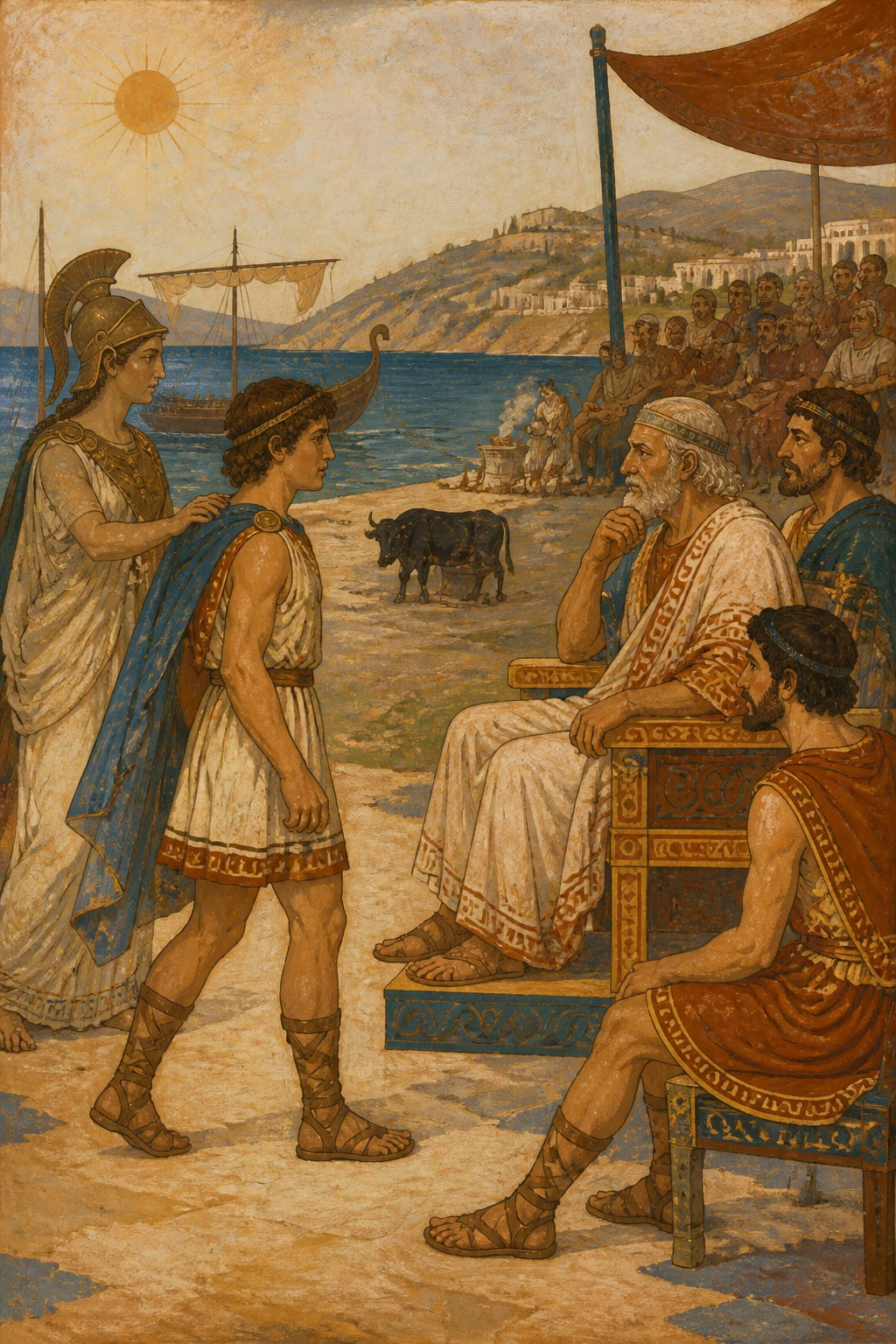
Now she kindled the fire for her and prepared her supper in the chamber. Meanwhile Odysseus rose to go to the city. Athena, watching over him with kindly thoughts, poured a thick mist around him, so that no proud Phaeacian meeting him would taunt him or question who he was.
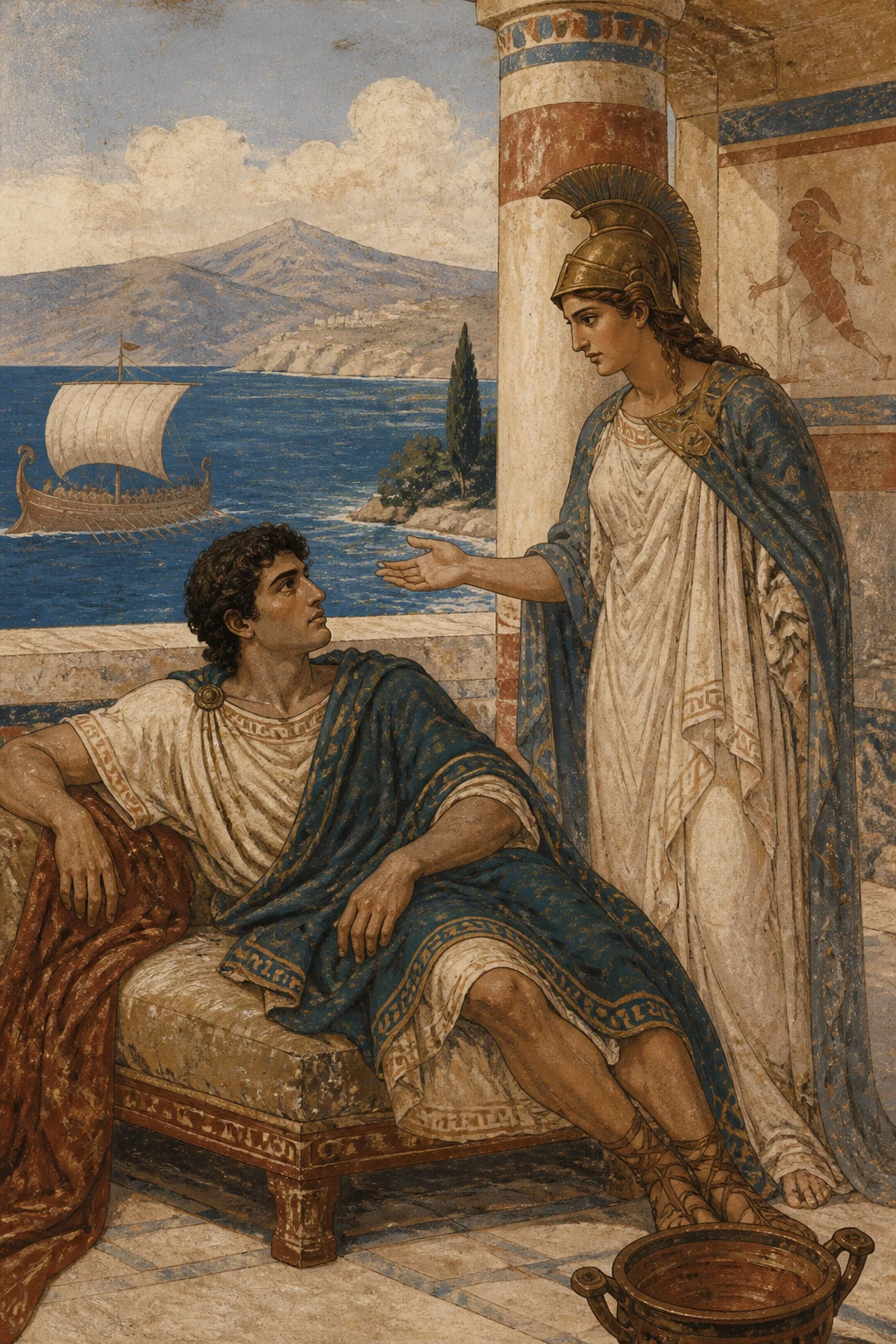
Just as he was about to enter the lovely city, the goddess, gray-eyed Athena, met him in the likeness of a young girl carrying a pitcher. She stood before him, and noble Odysseus asked her, “My child, could you guide me to the house of Alcinous, who rules among these people?
“I have come here a stranger, worn by suffering, from a distant land, and I know none of the people who inhabit this city and country.” Then the goddess, gray-eyed Athena, answered him, “Indeed, good stranger, I will show you the house you ask for, since he lives close to my noble father’s home.
“Only walk quietly, and I will lead the way. Do not look at anyone or ask them questions. These people have little patience with strangers, and do not welcome or show affection to those who come from elsewhere.
“Trusting in their swift ships, they cross the great gulf of the sea, for the Earth-shaker has granted them this gift. Their ships are swift as a wing or a thought.” With these words Pallas Athena led briskly on, and he followed in the goddess’s footsteps.
The Phaeacians, famed for their ships, did not notice him as he passed among them through the city. Fair-haired Athena, the dread goddess, would not allow it: in her kindness toward him she had poured a wondrous mist about him.
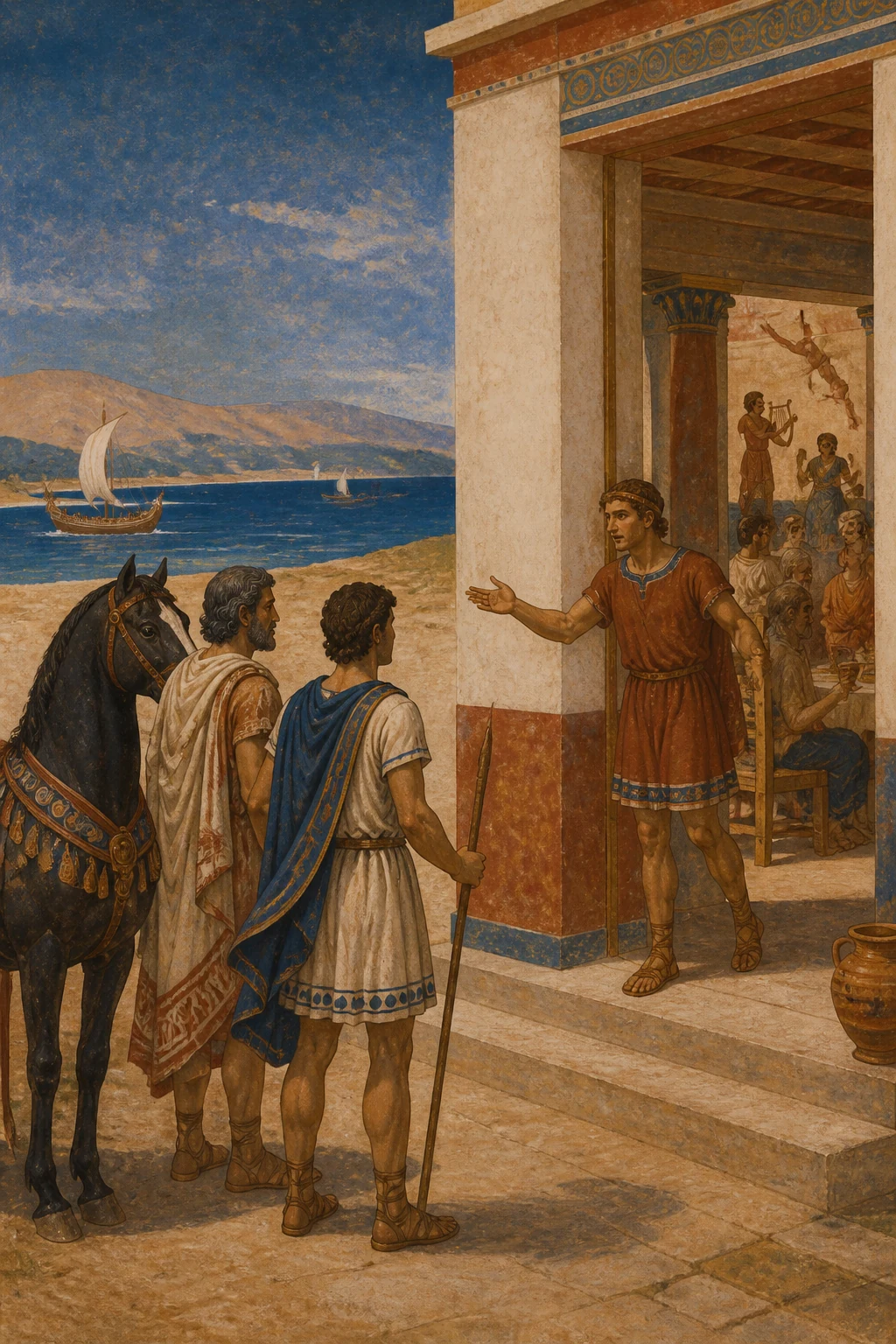
Odysseus marveled at the harbors and the shapely ships, the meeting places of the heroes themselves, and the long, high walls crowned with stakes—a wonder to behold. When they reached the king’s renowned palace, the goddess, gray-eyed Athena, began to speak: “Here, good stranger, is the house you asked me to show you. You will find the kings, cherished by Zeus, feasting inside. Go in, and let no fear trouble your heart. A bold man fares better in all he undertakes, even when he comes from a foreign land.
“The mistress of the house is the first person you will come upon in the hall. Arete is the name she is known by, and she comes of the same lineage that bore King Alcinous. First, Poseidon the Earth-shaker and Periboea, loveliest of women, had a son, Nausithous. Periboea was the youngest daughter of great-hearted Eurymedon, who once ruled over the overbearing Giants.
“But he brought destruction on his reckless people and perished himself. Poseidon lay with his daughter, and she bore him a son, great-hearted Nausithous, who ruled among the Phaeacians. Nausithous fathered Rhexenor and Alcinous.
“Rhexenor, still a young husband in his house and without a son, was struck down by Apollo of the silver bow. He left only one daughter, Arete, whom Alcinous made his wife, honoring her as no other woman on earth is honored among all those who now keep house with their husbands.
“Such heartfelt honor she has always received, and receives still, from her dear children, from Alcinous himself, and from the people, who look upon her as a goddess and greet her with words of reverence as she walks through the city.
“She herself is by no means lacking in sound judgment, and for those she favors she settles quarrels even among men. If she is kindly disposed toward you in her heart, then you may hope to see your loved ones again and return to your high-roofed house and your native land.”
With these words gray-eyed Athena departed over the barren sea. Leaving lovely Scheria, she came to Marathon and broad-streeted Athens, and entered the strong-built house of Erechtheus. But Odysseus approached the renowned palace of Alcinous. He stood there, his heart turning over many thoughts, before he crossed the bronze threshold.
For a radiance like that of the sun or moon shone through the high-roofed house of great-hearted Alcinous. Walls of bronze ran on either side from the threshold to the farthest recess, with a frieze of dark blue above them. Golden doors enclosed the strong-built house; silver doorposts stood upon the bronze threshold, with a silver lintel above them and a golden door ring.
On either side stood dogs of gold and silver, which Hephaestus had fashioned with his knowing skill to guard the house of great-hearted Alcinous, deathless and ageless for all time.
Inside, seats lined the walls on either side, all the way from the threshold to the innermost recess. Over them lay fine, closely woven coverings, the work of women. There the leaders of the Phaeacians would sit eating and drinking, for they had plentiful provision all year round.
Golden youths stood on well-built pedestals, holding blazing torches in their hands to light the hall at night for the banqueters. Fifty serving women worked throughout the house: some ground the golden grain at the mills, while others wove at the looms or turned their spindles, sitting close as the leaves of a tall poplar. From the tightly woven linen, liquid oil seemed to drip.
As the Phaeacians surpass all other men in driving a swift ship over the sea, so their women are skilled at the loom, for Athena has granted them surpassing knowledge of beautiful handiwork and sound understanding.
Outside the courtyard, close to the gates, lay a great orchard of four acres, enclosed by a fence on every side. There tall, flourishing trees grew: pear and pomegranate, apple trees laden with shining fruit, sweet figs, and luxuriant olives.
Their fruit never perishes or fails, winter or summer, but lasts throughout the year. Always the west wind blows, bringing some fruit to birth and ripening others. Pear follows pear to ripeness, apple follows apple, cluster follows cluster of grapes, and fig follows fig.
There too his fruitful vineyard was planted. One part, on a level patch of ground, lay drying in the sun; elsewhere they were gathering grapes, and elsewhere treading them. In the foremost rows were unripe grapes just shedding their blossoms, while others were beginning to darken.
Beyond the last row, neatly ordered beds grew with every kind of plant, green and flourishing all year round. There were two springs: one spread its streams throughout the garden, while the other flowed from the opposite side beneath the courtyard threshold toward the lofty house, and from it the townspeople drew their water.
Such were the splendid gifts the gods had bestowed on Alcinous. Noble, long-enduring Odysseus stood there gazing. When he had gazed to his heart’s content, he stepped quickly over the threshold into the house.
He found the leaders and rulers of the Phaeacians pouring libations from their cups to the keen-eyed Slayer of Argus, to whom they made their last offering whenever they thought of sleep. Noble, long-enduring Odysseus walked through the hall, still wrapped in the thick mist Athena had poured around him, until he reached Arete and King Alcinous.
Odysseus clasped his hands about Arete’s knees, and at once the wondrous mist fell away from him. The people were struck speechless at the sight of a man in the hall, and stared in amazement. Then Odysseus made his plea: “Arete, daughter of godlike Rhexenor, after much suffering I come to your knees, to your husband, and to these guests. May the gods grant them prosperity throughout their lives, and may each hand down to his children the possessions in his house and whatever honors the people have bestowed on him. But hasten my passage home, so that I may reach my native land soon, for I have long suffered misery far from those I love.”
With these words he sat down in the ashes of the hearth beside the fire, and all remained hushed and silent. At last the old hero Echeneus spoke. He was the eldest of the Phaeacians, distinguished in speech and versed in the lore of long ago. With goodwill toward them all, he addressed them: “Alcinous, it is neither honorable nor fitting that a stranger should sit on the ground in the ashes of the hearth. These men hold back, waiting for your word.
“Come, raise the stranger and seat him on a silver-studded chair, and bid the heralds mix the wine, so that we may pour a libation to Zeus who delights in thunder, who attends upon suppliants worthy of reverence. And let the housekeeper give the stranger supper from the stores within.”
When the mighty, revered Alcinous heard this, he took wise, resourceful Odysseus by the hand, raised him from the hearth, and seated him on a gleaming chair. To make room, he asked his gallant son Laodamas to rise, who sat beside him and was his best-loved son.
A maid brought water in a beautiful golden pitcher and poured it over a silver basin for him to wash his hands, then drew a polished table beside him. The worthy housekeeper brought bread and set it before him, adding many dishes, giving generously of what she had.
Then noble, long-enduring Odysseus ate and drank. And mighty Alcinous addressed the herald: “Pontonous, mix a bowl of wine and serve everyone throughout the hall, so that we may pour a libation to Zeus who delights in thunder, who attends upon suppliants worthy of reverence.”
So he spoke, and Pontonous mixed the honey-sweet wine and served it to everyone, pouring the first drops into each cup for the offering. When they had poured their libations and drunk as much as their hearts desired, Alcinous addressed them: “Listen, leaders and rulers of the Phaeacians, while I tell you what the heart within my breast urges me to say.
“Now that you have feasted, go home and sleep. At dawn we will summon more of the elders, entertain our guest in the palace, and offer splendid sacrifices to the gods. Then we will consider his passage, so that under our escort the stranger may reach his native land swiftly and gladly, without hardship or distress, however far away it lies. Let him suffer no harm or sorrow on the way before he sets foot in his own country. Once there, he must endure whatever Destiny and the stern Spinners spun into his thread at birth, when his mother bore him.
“But if he is one of the immortals come down from heaven, then the gods are devising something new. Until now they have always appeared openly to us when we offer glorious sacrifices, and they sit beside us and feast in our company.
“Even if one of us meets them while traveling alone, they do not hide themselves, for we are close kin to them, like the Cyclopes and the savage tribes of Giants.” Resourceful Odysseus answered him: “Alcinous, put that thought from your mind. In neither stature nor appearance am I like the immortals who inhabit the broad heavens, but like mortal men.
“Whoever you may know among men who have borne the greatest misery, with them I could match my sorrows. Indeed, I could tell of even greater suffering—all that I have endured by the will of the gods.
“But let me eat, for all my grief. Nothing is more shameless than the hateful belly, which forces a man to remember its demands even when he is worn with suffering and carries sorrow in his heart. So it is with me: my heart is full of sorrow, yet my belly keeps urging me to eat and drink, making me forget all I have suffered and commanding me to fill it.
“But at the first light of dawn, make haste to set me, wretched as I am, upon my native shore after all my suffering. Let life leave me, if only I may once more see my possessions, my servants, and my great high-roofed house.”
So he spoke, and all approved and urged that the stranger be sent on his way, since he had spoken fittingly. When they had poured libations and drunk as much as their hearts desired, each went home to sleep. But noble Odysseus remained in the hall, with Arete and godlike Alcinous sitting beside him, while the maids cleared away the dishes of the feast.
White-armed Arete was the first to speak, for she recognized the fine cloak and tunic he wore, which she herself had made with her serving women. She addressed him with winged words: “Stranger, this is the first thing I shall ask you myself: who are you, and where do you come from? Who gave you these clothes?
“Did you not say that you came here after wandering over the sea?” Resourceful Odysseus answered her: “Queen, it would be hard to recount all my troubles from beginning to end, for the gods who dwell in heaven have given me many. But I will answer what you ask and wish to know.
“There is an island called Ogygia, far out at sea. There lives Atlas’s daughter, the guileful, fair-haired Calypso, a dread goddess. No one, either god or mortal man, has dealings with her.
“But some power brought me, wretched and alone, to her hearth, after Zeus had struck my swift ship with a blazing thunderbolt and shattered it in the midst of the wine-dark sea. There all my brave companions perished, while I clasped in my arms the keel of the curved ship and drifted for nine days. On the tenth dark night the gods brought me to the island of Ogygia, where fair-haired Calypso lives, a dread goddess. She took me in, cared for me tenderly, and nourished me, and promised to make me deathless and ageless for all time. But she could never persuade the heart within my breast.
“There I stayed for seven long years, always wetting with my tears the immortal clothes Calypso gave me. But when the eighth year came round, she urged me to depart, whether because of a message from Zeus or because her own mind had changed.
“She sent me off on a raft bound firmly together, gave me plentiful bread and sweet wine, clothed me in immortal garments, and sent a gentle, kindly wind to carry me. For seventeen days I sailed across the sea, and on the eighteenth the shadowy mountains of your land came into view. My heart rejoiced—unhappy man that I was, for I was destined to encounter still more misery, which Poseidon the Earth-shaker raised against me. He roused the winds and barred my way, stirring up a boundless sea, and the waves would not let me stay aboard my raft, though I groaned in anguish.
“Then the storm scattered it, but I swam across this gulf until wind and water carried me to your shore. There, as I tried to land, a wave would have dashed me against the great rocks on that forbidding coast. But I drew back and swam on until I reached a river, where the place seemed best to me, free of rocks and sheltered from the wind.
“I staggered ashore, gathering what strength I had, and immortal night came on. I went some distance from the heaven-fed river, lay down among the bushes, and heaped leaves over myself. Then a god poured measureless sleep upon me.
“There among the leaves I slept, my heart worn out with grief, through all the night, through dawn, and past midday. The sun was declining when sweet sleep released me. On the shore I saw your daughter’s maids at play, and she herself was among them, lovely as a goddess. I made my plea to her, and she showed excellent judgment—more than one would expect from anyone so young, for the young are always heedless.
“She gave me plentiful bread and gleaming wine, had me washed in the river, and gave me these clothes. Grieved as I am, I have told you the truth.” Then Alcinous answered him: “Stranger, in this at least my daughter failed to judge rightly: she did not bring you to our house with her serving women, though she was the first to whom you made your plea.”
Resourceful Odysseus answered him: “My lord, do not blame your blameless daughter on that account. She did tell me to follow with the maids, but I would not, from fear and a sense of shame, lest your heart should be angered at the sight. We men upon the earth are quick to jealousy.”
Then Alcinous answered him: “Stranger, the heart within my breast is not such as to take offense without cause. Due measure is best in everything. Father Zeus, Athena, and Apollo, if only a man such as you, with a mind so like my own, would take my daughter and be called my son-in-law, remaining here! I would give you a house and possessions, if you chose to stay. But no Phaeacian will detain you against your will. May Father Zeus never approve of that.
“As for your passage, I appoint tomorrow, so that you may know it for certain. Then you shall lie overcome by sleep, while they row over a calm sea until you reach your country and your home, or wherever else you wish, even if it lies much farther than Euboea. Those of our people who saw it say it is the most distant of all lands: they went there when they carried fair-haired Rhadamanthus to visit Tityus, the son of Earth.
“They reached it and completed their journey without effort, and returned home that very same day. You too will learn for yourself how excellent my ships are, and how well my young men toss the sea with their oars.”
So he spoke, and noble, long-enduring Odysseus rejoiced. He raised his voice in prayer: “Father Zeus, may Alcinous fulfill all that he has said! Then his glory would never fade across the grain-giving earth, and I would reach my native land.”
While they spoke together in this way, white-armed Arete ordered the maids to set a bed beneath the portico, lay fine purple blankets upon it, spread coverlets above them, and provide thick cloaks for him to wrap himself in.
The maids went out from the hall with torches in their hands. When they had busily made the sturdy bed, they came and stood beside Odysseus, urging him: “Rise, stranger, and come to rest. Your bed is ready.”
So they spoke, and the thought of sleep was welcome to him. There noble, long-enduring Odysseus slept on a carved bed beneath the echoing portico, while Alcinous lay in the inner chamber of the lofty house, and beside him his wife, the queen, prepared their bed and bedding.