Waltey
Nanizajte se, biseri
Legende sau basmele românilor · Petre IspirescuO besedilu
Nanizajte se, biseri
- Vir
- Legende sau basmele românilor
- Avtor
- Petre Ispirescu
- Jezik branja
- English
- Jezik izvirnika
- Română
- Čas branja
- 16 min branja
- Obseg
- 13 strani
- Naslov izvirnika
- 006 Înșiră-te, mărgărite
O izvirniku
Legende sau basmele românilor
Romunske ljudske pravljice o začaranih kraljestvih, preizkušnjah in junakih, zapisane iz ustnega izročila. Bralni jezik je English, izvirnik pa prihaja iz vira Legende sau basmele românilor v jeziku Română.
Besedilo
Nanizajte se, biseri
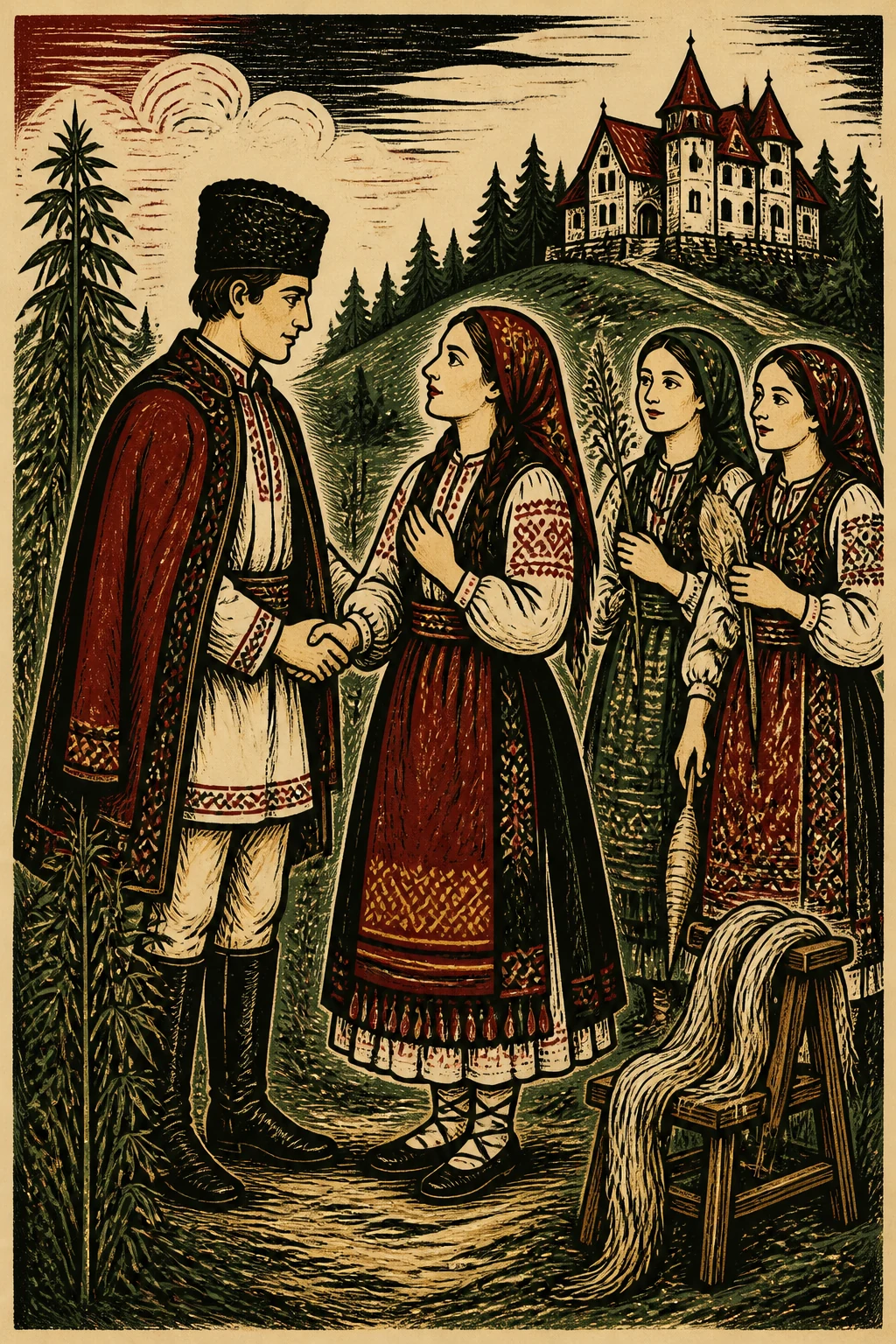
Once upon a time, as never before, and so on. Once there was a great boyar’s son who, after wandering through many lands and exploring every corner of them, was returning to his estate. As he passed through a hemp field, he saw three girls working among the hemp. He went on his way, minding his own business, without paying any heed to what the girls were saying. But when certain words reached his ears, they roused him from his thoughts. He turned towards the girls and asked, “What did you say, girls?” “If that boyar’s son passing this way were to marry me, I would clothe his whole household with a single spindle,” said the eldest girl. “If that boyar’s son passing this way were to marry me, I would feed his whole household with a single loaf,” said the middle girl. “If that boyar’s son passing this way were to marry me, I would bear him two princely children, golden through and through,” said the youngest girl. When the girls had repeated what they had said, he stood pondering. “Well now, what can this mean?” Then, after thinking it over a little longer, he said to the youngest, “My girl, I like your words better than your sisters’. If you will come with me, I will take you for my wife, only you must keep your promise.” And how could the girl have refused? For he was a fine young fellow, tall as a fir tree, handsome and charming beyond measure. The girl blushed as red as a peony; then, after a little more thought, she held out her hand and said:
“Well, may good come of it. If you are meant for me, neither shall I escape you nor you escape me, no matter who may try to stand in our way.” The boyar’s son took the girl and brought her to his estates. There he had a palace the like of which she had never seen. They were married, and held a wedding whose fame spread through many lands, and did all that was fitting to establish their married household. Before long, the girl found herself with child, as women do. When the boyar’s son heard the news, he could scarcely contain his joy, and at once ordered a cradle made entirely of silk in which to lay the children. When he had first brought his wife home, he had given her a maid, the daughter of an old Gypsy woman who eked out a living about the boyar’s courtyard on whatever the household would spare her. No sooner did that accursed crow set eyes on the girl than she conceived an evil design against her. When the time came for the birth, the boyar’s son was away on business. The mistress of the house sent the Gypsy maid to fetch a midwife. She brought her own mother. As soon as the old woman arrived, she said, “Our gracious lady, bless your dear eyes! Hereabouts it is the custom for ladies about to give birth to climb into the loft, while the midwife stands at the hatch with a sieve to catch the children.” The lady answered, “Very well, Granny. If that is the custom here, let us do so.” Poor innocent that she was, it never crossed her mind that this concealed the foulest of tricks. She knew her own heart was pure. She had done good to everyone. She therefore never imagined that anyone could harbour so much as the shadow of an evil thought against her. She believed the old woman. And, climbing into the loft, she gave birth, just as she had promised, to two princely children, golden through and through, into the sieve the Gypsy woman held beneath the hatch. When the viper of a crow saw such beautiful babies, what did she do to disgrace her mistress? She hurried away and buried the children in the dung heap beside the stable, then took two puppies from a dog that had lately whelped and showed them to her mistress, saying, “There, my lady, see what you have brought into the world.” “How can such a thing be?” the lady answered. And the filthy crow began to quarrel with her mistress. One said it was so; the other said it could not be. Meanwhile, the boyar’s son came home. The Gypsy woman went out to meet him and, showing him the sieve with the puppies, said, “Look what a fine gift your chosen wife has given you! Thank goodness God put it into your head to bring her a faithful servant like me to stay beside her. Otherwise, who knows how she might have hoodwinked you and made a laughingstock of you?” The boyar’s son flew into a rage at such a disgrace, and to punish his wife he married the Gypsy woman and made his former wife a servant. The poor woman saw plainly the injustice done to her, but, having no one to turn to, she held her tongue and endured, trusting that God would shed His mercy upon her and one day bring her innocence to light. Some time passed, and lo and behold, two apple trees sprang from the dung heap where the children had been buried. Their bark was overlaid with gold, and shone like daylight when the night was pitch-dark. They grew in a day as other trees grow in a year, and before long they were tall. The Gypsy woman, who knew the wickedness she had committed, took fright at the beauty of the apple trees and said to her husband, the children’s father, “You know, I have a mind to ask you to cut down those apple trees growing beside the stable, and make two planks from them for our bed, since we are still a few planks short.” “Come now, woman,” answered the boyar’s son, “how can we cut down such splendid apple trees? Can’t you see they are the stuff of fairy tales? Who else has trees like these?” “Be that as it may, I have set my heart on your cutting them down. If you will not, I shall never again eat bread and salt from the same plate as you.” Unable to rid himself of her nagging, the boyar’s son had the apple trees cut down and made into planks, which were laid upon the bed, and they slept on them. During the night, the Gypsy woman heard the planks speaking. “Sister,” said one—for the children were a boy and a girl—“sister, is your burden heavy?” “Heavy indeed,” answered the girl, “for the Gypsy woman lies upon me. And is your burden heavy?” “Mine is not heavy,” said the boy, “for Father lies upon me.” When the Gypsy woman realized that the words of the planks would be her undoing if the boyar’s son heard them, not a wink of sleep touched her eyes until morning. “Husband,” said the accursed crow as soon as day broke, “cut up those planks you put on the bed yesterday, for I had dreadful dreams last night.” “Come now, woman,” he answered, “how can we cut up such beautiful planks?” “I neither know nor care. If you will not cut them up, I shall go and throw myself into a ravine.” To escape her clamour, the boyar’s son had the planks chopped into little splinters. Then the wicked woman stopped up every hole in the house and put the wood on the fire to burn. Nevertheless, two little sparks slipped up the chimney and fell into the garden. Where they fell, two stems of basil sprang up at once. The boyar had a little lamb that roamed about his courtyard. It strayed into the garden, ate the basil, and immediately its fleece turned to gold. So beautiful did the lamb become that nowhere in the world could another be found to equal it. The Gypsy woman nearly burst with spite when she saw it, for she understood that this boded her no good. After a little while, finding her husband in a pleasant mood, she said, “How I should relish a little meat from that lamb of ours!” “Do not even think of such a thing,” answered the boyar’s son, “for that lamb is dear to me.”
Seeing that this time her words had no effect, the Gypsy woman turned to trickery. She pretended to be ill. For a whole week she tormented her husband with her groans. One night she feigned a sudden start from sleep, and when her husband asked what had happened, she answered, “I dreamed that a wise woman came to me and told me that if I wished to recover, I must ask you to slaughter that lamb of ours, so that we might eat its pluck.” “Nonsense, wife!” he answered. “What are you saying? Where in all the world has anyone seen so beautiful a lamb? How could we slaughter it? Better to summon every healer in the land to give you medicines that will make you well.” “This is the only cure for me,” she told him. “If you will not slaughter the lamb, I can only think you wish me dead.” With no way out, the boyar’s son had the lamb slaughtered and sent to the kitchen to be cooked. The viper hurried straight to the kitchen and gave orders for what was to be done with the lamb, so that nothing of it should remain. She sent its entrails to the stream with a trusted servant to be washed, after counting even the smallest length of gut, and warned the woman that she would answer with her head if she lost so much as a scrap. While washing them in the stream, the servant somehow tore off a little piece. In her fear, she let it float away. Then she returned home, brought back all the entrails, and handed them over to be counted again. The next day, the boyar’s former wife went to the stream with her wooden pail to fetch water. Looking downstream, she saw two little children on a bank, playing with two golden apples that lit up the earth, and she stayed there until evening, gazing at them longingly, for the thought came to her that they might be her own children. When she returned home, the filthy crow began to beat her. But she said, “Do not beat me any more, mistress, for what my eyes have seen you could gaze at for a whole week and still not have your fill.” Hearing this, the crow went there herself, and indeed she too remained gazing at the children. How could she have remembered to go away, with such unheard-of beauty before her? The children played and tumbled about so merrily that it made one glad to be alive simply to watch them. The she-devil stood rooted to the spot, staring. Then the children’s mother came and roused her from her stupor. “You see, mistress, did I not tell you that you could never have your fill of such beauty, however long you looked?” The accursed woman conceived an evil design against them and kept plotting how she might destroy them. Meanwhile, crowds upon crowds came to look at the children. Among the onlookers was an old woman, wiser than most, who longed to have them for her own. She went home and brought back a little distaff and a small staff. With these she went to the water’s edge and, holding them out, called to the children in a sweet and tender voice. No sooner did the children see these things than they hurried towards them: the girl seized the distaff and the boy the staff. The old woman took them with her, dressed them in some rags, and brought them home. Not long afterwards, the boyar called a work gathering, inviting all the boys and girls in the village to string pearls. The old woman went too, with her children. The boyar’s son sat among the company, where everyone was talking of this and that, telling jokes and asking riddles. He happened to be in good spirits that day and said, “Do you know what, children? Instead of chattering away with jokes and all sorts of nonsense, each of you had better tell a tale.” Everyone agreed with one voice that the boyar’s idea was a good one. Some told one story, others another, until the turn came for the old woman’s children to tell theirs. But, shy as God had made them, they answered, “Well now, Master Boyar, what can we tell? We do not know a single tale.” “Come, do not be so coy. Tell us whatever you can.” Then the boy began: “Once upon a time there were three girls working in a hemp field—string yourselves, pearls! And a great boyar’s son passed that way—string yourselves, pearls! The eldest girl said, ‘If that boyar’s son were to marry me, I would clothe his whole household with a single spindle’—string yourselves, pearls! The middle girl said, ‘If that boyar’s son passing this way were to marry me, I would feed his whole household with a single loaf’—string yourselves, pearls! The youngest girl said, ‘If that boyar’s son were to marry me, I would bear him two princely children, golden through and through’—string yourselves, pearls! The boyar’s son married the youngest girl, and when he brought her home he gave her a Gypsy woman’s daughter to serve her.” As soon as the accursed Gypsy woman heard the beginning of such a tale, she began to say, “An ember, and a coal—hush, boy, tell no more.” But the boyar said, “A coal, and an ember—tell on, boy, tell on.” The boy began again: “Time passed, and the boyar’s wife found herself with child. When the hour of birth came, the boyar was not at home. His wife sent the Gypsy woman to fetch a midwife, and she brought her own mother—string yourselves, pearls! As soon as her old mother arrived, she said that thereabouts it was the custom for ladies giving birth to climb into the loft, while the midwife waited at the hatch with a sieve. The lady believed her. She climbed into the loft and bore two princely children, golden through and through—string yourselves, pearls! When the crow saw this marvel, she went and buried the children in the dung heap beside the stable, and put two newborn puppies in the sieve. These she showed the boyar, telling him that such were the offspring his wife had borne him—string yourselves, pearls! The boyar grew angry with his wife and punished her by making her the Gypsy woman’s servant, while he took the Gypsy woman for his wife. From the dung heap grew two apple trees with golden bark. As soon as the Gypsy woman saw them, she nagged the boyar until he cut them down and made them into bed planks. That night, when they lay down, the plank beneath the boyar said, ‘Sister, is your burden heavy?’ ‘Heavy indeed, for the Gypsy woman lies upon me. And is your burden heavy?’ ‘Mine is not heavy, for Father lies upon me’—string yourselves, pearls!” Again the Gypsy woman broke in: “An ember, and a coal—hush, boy, tell no more.” But the boyar spoke up too: “An ember, and a coal—tell on, boy, tell on.” The boy continued: “Then the wicked woman, who had heard what the planks were saying, pressed her husband until he had them chopped up. She broke them into splinters and put them on the fire. Two little sparks flew up the chimney and fell into the garden. From those sparks sprang two stems of basil. The boyar had a little lamb. It strayed into the garden and ate the basil. At once its fleece turned golden—string yourselves, pearls! When the crow saw this wonder, she pretended to be ill and asked her husband to slaughter the lamb, saying she would recover if she ate some of it. He refused. She persisted. And to escape her nagging, for her tongue would never be still, he had it slaughtered—string yourselves, pearls! The Gypsy woman sent a trusted servant to wash the lamb’s entrails in the river, and so that not the smallest length of gut should go missing, she counted them out to her. As the servant washed them, a little scrap broke off, and she let it float down the river. It came to rest on a gravel bank, and from it we emerged—string yourselves, pearls!” And, wonder of wonders, the pearls threaded themselves without the children so much as laying a hand on them. The accursed Gypsy woman kept saying, for she could see where all this was leading, “An ember, and a coal—hush, boy, tell no more.” But the boyar, whose heart seemed to find comfort in the boy’s words, urged him on, saying, “A coal, and an ember—tell on, boy, tell on.” “An old woman took us from there and brought us to her house, where she is raising us as her own children. The boyar, the master of this estate, held a gathering, and we came too. And here we are, just as our mother bore us—string yourselves, pearls!” All who were present stared wide-eyed at the child telling the tale, scarcely able to believe what their ears were hearing. Then the boy ended his story by saying, “And if you do not believe us, look and see for yourselves.” At once they stripped off their filthy rags and stood there shining so brightly that no one could bear to look at them. Their father sprang forward immediately and gathered them into his arms. He felt them nestle against his heart, and then he knew them for his own children. Their mother came too, weeping tears as big as fists, and embraced them. They wept for joy that God had brought them all together again, and rejoiced with the joy of angels. Then the boyar, bitterly grieved at the Gypsy woman’s deceit and treachery, ordered two unbroken stallions brought from the herd. He had the Gypsy woman tied to their tails, together with a sack of walnuts, and let the horses loose to run wherever they pleased. Wherever a walnut fell, a piece of her fell too, until not so much as a speck of dust remained of her. And I mounted a saddle, and so on.
Izvirnik
006 Înșiră-te, mărgărite
Naslednje strani prikazujejo izvirno besedilo za primerjavo.
fostil o data ca nici o data, etc. A fostil o data un feciorti de hoerfi mare, dupa ce cutreerase terile, resbatendif prin tote unghiurile, se intorcea la mo0a sa. Si trecende printr'o canepiste, vequ trel fete ce munceail la canepa. E1u isi cauta de drumfi in treha lui, lard sa is aminte la cele ce totil si,uneati fetele. Gaud a junse la urechile lui nisce vorhe trezi, cad era dusil pe gOnduri. Se IntOrse la fete le intreba Ce ati disc, fetelor ? De- m'arit lua pe mine feciorulii ela de boeru ce trece p'aci, efi imbraca curtea cu un fus, disc fata cea man mare. De m'arti lua pe mine feciorul ela de Boer ce trece p'aci, satura curtea cu o pita, Oise fata cea De m'arn lua pe mine feciorulii ela de boeru ce trece p'aci, face doi feti-logoferi cu totulti si cu totule de aura, dlise fata cea mica. Dura ce ii spusera fetele ce clisesera, elu statu de se socoti gbndinclu-se: me, ca ce sa fie asta Apoi dupa ce se man resgandi, Oise fetei celei midi : Fetico, mie Imi placu vorbele tale mai mutt de cat ale suroriloru tale. Daca vrei sa ntergi cu mine, ell to iau de sotie, numai sa-ti pi cuventuiu. Si cum sa nu fi voit fata ; caci era unit bradil de flecati, chipe0 §i dragala9, nu gluma. Fata ro,i la fala ca un bujoru ; apoi, dui a ce man statu nitelii la chibzuri, intinse maim si H disc : 5i ce-le 5i eu i-a5u eu l-a51 1 -art mijlocie.
Ai, sä fie de bine. Daca to vei fi orandulu ineu, nu scapii eu de tine, Inc! to de mine, macaru de s'aru pune nu sciii tine si cruci01 si curmecli01. Feciorulit de boerii lua fata 0 se duse cu densa la mo0ile lui. Acolo avea elu nisce palaturi cum nu mai vecluse ea. Se cununara, facendil o nunta de se dusese vestea 'elite taxi, si facura totil ce trebuia pentru rostulii casatoriel ion, Nu trecu multn si fata ratline grea Si ea ca tots lumea. Cand aucli feciorulii de hoer una Ca asta, nu mai putu de bucurie, si porunci numai de tabu sa-i faca unit loganu 11Urnai de matase, in care sail pue copii. Feciorulii de boerii, dud i0 aduse acasa nevasta, ii Bete, pentru trebuintele el, o fata a unel bahnite de tiganca ce-.0 tinea chicle prin curtea boerului cu ce se induraii staranii. Procleta de ciora cumii veclu fata, II puce gandil reu. Card :sosi cosulu nascerei, fiulti de boerii nu era acasa, ci dusii intr'ale sale. Deanna easel trimise pe tiganca sa aduca o mdse. Ea aduse pe muma-sa. Acosta, cum veni, II clise : Milostiva nostra Domna, mancati-a0 ochiFwil. La nol p'aci este obiceia ca Domnele cand are sa nasca, sä se sue in podia si mop sa stea cu ciurulu la 1,ia podului, sa faca. Domna ii respunse : Bine, bunico ; data aca ye este obiceiul p'aci, aca sa facemit Ea, biet, nevinovata 'An era, Did prin gandii nu-i plesnea ca intru acesta era o viclenie din cele mai spurcate. Ea se scia curata la inima. Facuse tutuloril bine. Nu se qtepta, deci, ca cine-va sä aiba nici macar o umbra de cugete pangarite pentru densa. Ea creclu. Si suindu-se in podii, facu, cum clisese, doi feti- Ingofeti cu totului totului de auril, in ciurulii pe care ilia tinea tiganca la gura rodului. Cum veciu copilasii ap de fru- -moGi, gnperita de ciora, cesa faca ca sa ponosesca pe Domna .sa ? se duse numai do dbu ci ingropa copilnii in baligarida in ci asa
de la grajda si luandil dot catei de la o catea ce falase de curand, ii arata clOnanei sale dicendu-i: Eta, stapana, ce facug Dumneata. Cum se pole una ca asta ? ii respunse dOmna. Si 'Angara de ciora incepu a se ciorovoi cu Deanna sa. Ba, c'o fi; ba, ca n'o fi. lntre acestea eta ca sosi §i fiulit de boerii. Tiganca ii esi lnainte, §i aratandu-I ciurula Cu cateii, ii ;Use : Eta ce pricopsela iti facu nevasta ce alesil. Bine ca dat Dumneclea in &Ida sa-i aduci o credinciosa ca mine, care sa fie pe langa dansa, del altminteri, tine scie cum era sa te imbrobodesca si salt ri4a de dumneta. Se manic fluid de boera sand veclu o ast-fel de batjocura si ca sa o pedepsesca, luta de- sotie pe tiganca; era pe fosta. lui nevasta o facu slujnica. Biata femee, v6;lu bine nedreptatea ce i se Wu ; dud n.eavenda Incotro, then si rabda cu nadejclea in Dumnedea ea-a va reversa mila luI asupra ei, §i va da, odata, °data, la ivela nevinovalla sa. Si mai trecenda cats -va vreme, eta mare, ca rasari, din baligarulu unde fusesera Ingropati copiii, doui meri. Coja acestora men era suflata cu aura, de lucea ca clioa, cand nOptea era intunerica besna. Ei cresceaa intr'o di ca inteunit anii, si dupa putinit se fa'cura marl Tiganca, care scia blestematia ce Meuse se temu, v6clenda frumusetea merilorii, si clise barbatului ei, tatala 1.441 de densa : Me, mie mi-a venita a§a sa te indemnit a taia merit eia ce crescil grajda, §i din ei sa fact, din dot', doe scanduri la patil, ca totil ne lipsesce cite -va scanduri. Bine, fa, respunse that de boera, cum sa taemii not a mandrete de meri ? Nu vecli, tu, ca sunt de poveste? Gine mai are asemenea meri? Fie ; mie mi-a venitit aga, ca sa-i tai; ca tu de nu-1vet taia, ea nu mat manancii paine si sane cu tine pe unit talent. ti-a copiilore, langA. 11-al
Si neputendu-se cortorosi de ddnsa, Fiulu de boerti puse de taie merii si fa'cu dinteensii scanduri, le puse la patu si se culcard pe densele. Peste nOpte tiganca audi cum vorbia scandurile. Dado, dicea una, cad' copii erau unit baiatii si o fata, dado, dise baiatul, greti ti-e tie? Greti, respunse fata, caci este 'Agana pe mine. Dara tie, greu 41 este ? Mie nu-ml este greu dise baiatulti, ca este tata pe mine. Cum pricepu tiganca ca vorbele scandurilorii o vora du ce la perdare, de le va audi Fiulti de boeril, nu mai dete nici picu de somnii in genele el' pang dimineta. Barbate, ii dise blesternata de cloroipina, cum se lumina de (Pa, sä tai scandurile alea ce pusti eri la patti ; cad amu visat.0 nisce vise unite asta nopte. Bine fa, II respunse elu, cumil sa taiemti ale scanduri asa de frumose? Eu nu sciti ; to data nu le ye! -Ulla, eti me dual si me dau de ripa. Ca sa scape de cara ei, Fiulif de boerti puse de taie scan durile, facendu-le tandari marunte. Eara spurcata astupa tote gaurelele "asei si puse scandurile pe focti de arser a Totusi doue scanteiore, se strecurara pe cos si picara in gradina. In loculu unde cadura aceste scantel, rasari indata doe steble de busuioc. Boierulu avea unu mieluselu ce crescea si eltt prin curtea lui ; acesta scapandtt in gradina, maraca busuioculti, si indata i se auri lana. Si asa de frumosii se fdcu mielulii, in catil nu se mai gasea pe lume unit altulii asa de frumosii ca acesta. Crapa fierea inteansa de necazti nand vedu_ cad tiganca pricepu ca acesta nu era lucru curate pentru (Masa. Si dupa ce ma! trecu catinica vrerne; dise barbatului ei, cand it vedu cu voe bung. Cum asi mai manta came din mielulti ela alu nostru Niel sa to gandescI la una ca asta, ca mie mi-este dragd ii respunse Fiulu de boeril. le-amii mielulti;
Vedu tiganca ca de astA data nu i se prinde vorba, o intOrse la vi clenie. Se facu bolnava. U septemana incheiata isT chinui barbatulil cu gemetele el. Inteo nopte se facu ca rasare din somnit ; si data o intreba barbatu-seu, ca ce i s'a intAmplatti, ea it respunse : Arai visatu ca unde venise o descantatoresca si uncle imi dicea ca data voil BA me facti sanatosa, sa ceru de la tine sa tai mielul6 ela alu nostru mancamit drobulu. Fugl d'acolo, lievasta.ii respunse ell ce stal tu de vorbesci Unde s'a mai vedutii pe lume unit mielu asa de frumosti. ? Cum sa -lit taemu ? Mai bine sä aducemu pe top vracii dea lecuri care sa te faca sanatosa. Leculti meu esta este, ii mai dise ea. Daca nu vei sa tai mielulu, intelegl ca tu vei sa moru ea. Si neavend6 incotro, Fiulii de boerii puse de taie mielulu dete la bucatorie gatesca. Gasperita se duse indata in bucatarie si puse la tale ce sa se faca cu mielulu, ca sa nu mai rarnae nimicu din ell. Trimise matele la pirau, cu o credinciosa d'ale el, sa le spele, dupa ce numera pins si cell mai mica matisoru, si-i spuse ca va plati cu capultt ei de va perde vr'unu crainpeitt din ele. CredinciOsa bahnitei spalandu-le la f irau, nu sciu cum facu, si rupse unil capataiii. De frica ilu dete pe garla. Dupd aceea se intorse acasa, aduse tote matele si le dete iarasi in numerii. A. doua di ducendu-se fosta sotie a boierului la pirau cu cofa aduca apa; se una la vale pe riu si vedu acolo pe unit dambil doT copilasi jucandu-ae cu doue mere de auru, de lucea pamentulA, si remase acolo pinA sera uitandu-se cu jindA la densii, caci el if da in gandu ca p6te sa fie copil d ensei. /ntorcandu-se acasa, o lua spurcata de cioroica la bataf Dal% ea clise : Nu mai me bate, stepana, ca ce-mi vedura oath., o septemand sa te totu uiti, si totu nu te indestulezi. Daca audi asa, se duse si cioreica, si in adever ca si si sa-i sa -ti sa si-la st-la
ea se uitase acolo privindil la copilni. Si cum .1-aru aduce arninte ore a se departa, rand venea aca frumusete ne mai audita ? Se jucau copii i se sbeguiaii, de-ti era draga lumea sa privesci la det*1. /ntepenise impelitata, sgaindu-se cu ochii acolo. Si venindu mama copiiloril §i tredind-o din biumacela in care caduse : Vedi, stapand, nu -ti spunearnu eu ca nu to poti indestula de o asa frumusete, de te-ai uita nu sciu catil? Procleia le puse gandu reit, totu planuia cum ar face ca sa-1 rdpue. Inteacestea venea lumea dupa lume de se luta la densii. Dintre toti privitoril o baba betrana, mai priceputd, dorindii si ea sa-1 alba de fetii ei, ducendu-se acasa, aduse cu (Musa o furca mica si unu toiagelu. Cu acestea se dnse in marginea riului si aratandu-le aceste unelte, ii strigard cu unu grain Cum v6dura copii aceste lucruri, °data se repedira la densele ; si fata puse mana pe lured, era bdiatulit pe toiagu. Litandu-I baba cu sine, ii imbraca cu nisce sdrente si ii duse acasa la (Musa. Nu trecu multi% dupa acesta, si boerulii facu claca, adunandti pe toti copiii §i fetele din satu ca sa insire margaritare. Se duse si baba cu copiii ei. Acolo, la sedatore, uncle se strauserd toti de vorbea la vercli §i uscate, spuindti la glume si la ghicitori, sta Fectorulti de boeru. Elti se intamplase in acea di sa fie cu voe bung, §i dise : Sciti ce ? copii ! De catu sa flecdriti la glume la eke nagode tote, mai bine spuneti-ve fie care basmulit seu. Tort intr'o glasuire, prilmira de buna cugetarea Boerului. Si spusera unii, una ; altil, alta ; pina ce veni si randulu babel, ca spue §i ei basmulu lout. Dara ei sfiiciog cum it lasase pe ei Dumnedeti, respunsera : Apoi de Boerule, not ce sa spunemu.? ca nu scimu n:ci unu basmu. si duiosu. si copiilora si sa -ti
De! nu ye mai fandositi acum. Spuneti si yoi, ia, ce y'ett pricepe. Atunci baiatuln incepu : A fostil o data trel fete cari munceati in cauepisce, insiete margaritari; si trecendit p'acolo un Fedora de boern mare, insiete margaritari. «Fata cea mai mare dise : De m'arn lua pe mine de sotie, Fec1orulti ela de boerii. en' 1-asn i nbraca curtea cu unit fusit, insri'te margaritari. «Fata cea mijlocie dise : De m'arn lua pe mine de sotie Fecioruld ela de boeru ce trece p'aci, eu i-asu satura curtea cu o pita. insirate margaritari. «Fata cea mai mica dise si ea : De m'aru lua pe mine de sotie Feciorulii eta de boerii, en i-asit face doi fete-log,ofet e CJ totuld si cu totultit de aura. insirate margaritari. «Fectoruln de boerti lua de sotie pe fata cea mai mica, si data o duse acasa, II dete spre slujba pe fata unei tigance.D Afurisita de tiganca cum audi inceputulit unui astii-felu de basmu, prinse a dice : Unit tdciune, $'unti carbune, Taci, Mete, nu mai spune. Eara boerulit dise si elu : Unit carbune, 5'untit taciune, Spune, Mete, spune. Baetul erasi incepu : «Mai trecu ce mai trecu si sotia boerului remase grea. Gaud fu la cesuld nascerii, boerulii nit era acasa. Sofia lui trimise pe ligancti sa-1 aduca o mose ; si ea aduse pe ma-sa Insiete margAritari. «Bahnita de ma-sa data veni dise ca pe la (Masa p'acolea este obiceiulit ca dOnmele cand nascit, sa se sue in podu si mOsa sa stea la urea podultd cu ciuruln. Domna credu. Se a
urca in polo §i nescu doi feti-logofetel cu totului, cu totulul aura. insiete margaritari. aCioroica cum veclu minunea asta, se duse de ingropa copilasii baligarulit de la grajdu, §i puse in ciurti doi cater tali de curandft, pe care ii areta boerului, spuindu-I ca astafela de odrasle I-a nascutti sotia. Insiete margaritari. aBoerulti se manie pe sotia sa, si o pedepsi, facend-o slujnica tigancei, era pe tiganca o lug de sotie. Din baligarti crescu doi meet cu coja de aura. Tiganca cum Ii veclu, se tinu de cara boerului ca tae §i faca scanduri de pat. Peste nepte cand se culcarg, scandura de sub boere clise : Dado, greti tie Greti, ca este Laguna pe mine ; darg tie greft ti-e ? Mie nu-mi este greft, ca este tata pe mine. In§irle marggritari.v Tiganca erg sari cu vorba : Unti taciune, S'unu cArbune, Tadi, Mete, nu mai spune. Darg si Doerulft sari, si clise si elu : Unit taciune, S'unft carbune, Spune, bgete, spune. Baiatulti incepu : a Atunci bahnita, care auclise ce vorbise scandurile, staru cu dinadinsul la barbatu-sea, ping ce taie scandurile. Ea le lacu tandari si le puse pe focti. Doe scanteiere sarira pe co§g Si caclura in grading. Din aceste scanteiere, rgsarirg doe steble de busuioc. Doerulti avea un mielqele ; elu scapg in grading §i manta din acest busuioc. IndatA i se auri lanai mgrgariitari. « Cum vec.lu cioropina acestg minune, se prefacu ca e bolnava si ceru de le barbatu-sea sa-i tae mielule, ca se va insanatqi de va manca din elu. Acesta se impotrivi. Ea sta.rui. Si ca sa scape de gara-mara, cg nu-I mai tacea fleenca, puse de-lii taie. mArgaritari. in fesa-1 sa-1 1.1-e ei Ineiete
Tiganca trimise pe o credinciosa `a el cu matele mielului sA le spele la rill; si ca SA nu lipsesca nici unit matisor, i le dete pe numer. Credinciosa spelendu-le, se rupse unu crampetasii si-1A dete pe riu. El se opri pe un prund, si not esirdmii de acolo. Insir'te margaritarLD Si, o minune ! Margaritarulu se insira de la sine, fall ca copiii se fi pus mana pe densulii. Afurisita de tiganca tote mereu le dicea, cat' vedea ea unde are sa ajunga treba : Un taciune S'un carbune Tad, baete, nu mat spune. Boerul Insa, caruia pare ca i se racorea inima &And audea spusele baetului, ii da ghies, clicendu'i : Un carbune S'un taciune, Spune, baete, spune. tt De acolo ne Ina o baba si ne duse la casa ei, unde ne cresce ca pe copiii el. Boerul i, stApanulit sacestei mosii, Neu o secletire, si veniraniit sl not, si eca-to -ne, refer' cum ne-a nascut maica. margaritarb. Toff ee' de far& ramasesera cu ochii bleojditi la copilulit care spunea basmulA, si pare-ca nu le venea a crede celora ce le au;lea urechile. Atunci bAetul Isi sfirsi basmulu clicend : cc Si data nu credeti, uitati-ve si ye IncredintarLD Si d'odatd se desbrAcara de strentele cele murdare, si remasera strAlucindit de nu putea, niminea sa tie °chit' la el. Taal lorii lush numai de catii se repecli, .si luandu-i In brate veclu case lipescil de inima lui, si atunci II cunoscu ca sunt fit al set. Si viindA si muma lor, care plansese de dAnsii ru lacramile catu pumnulii, iI imbrAtise si densa. Si planserA de bucurie CA ii mat aduna Dumnecleit Ia un locii pre to' si se veselira veselie IngerescA. '1i
Atunci boerulti, amarat de amagirea si inelAciunea tigancei, porunci si aduse din herghelie doi armasari neinvetati. Apoi legs pe tiganca de cOdele cailoril, impreunii cu mill sacti de nuel, si le dete drumulu sa se duca in lume, .i unde cadea nuca, cadea si bucafica, pind ce nu se mai alese nici prafubl de &um. Eara eu incalecaiii p'o ,ea, etc.
Nadaljuj z branjem