Prevod
Once upon a time there was a woman who was a witch through and through. She had two daughters: one was ugly and wicked, and she loved her because she was her own daughter; the other was beautiful and good, and she hated her because she was her stepdaughter.
One day the stepdaughter had a beautiful apron that pleased the other girl so much that she grew envious and told her mother she wanted it and must have it. "Hush, my child," said the old woman, "you shall have it. Your stepsister has long deserved to die. Tonight, when she is asleep, come to me, and I will chop off her head. Only make sure you lie at the back of the bed, and push her right to the front."
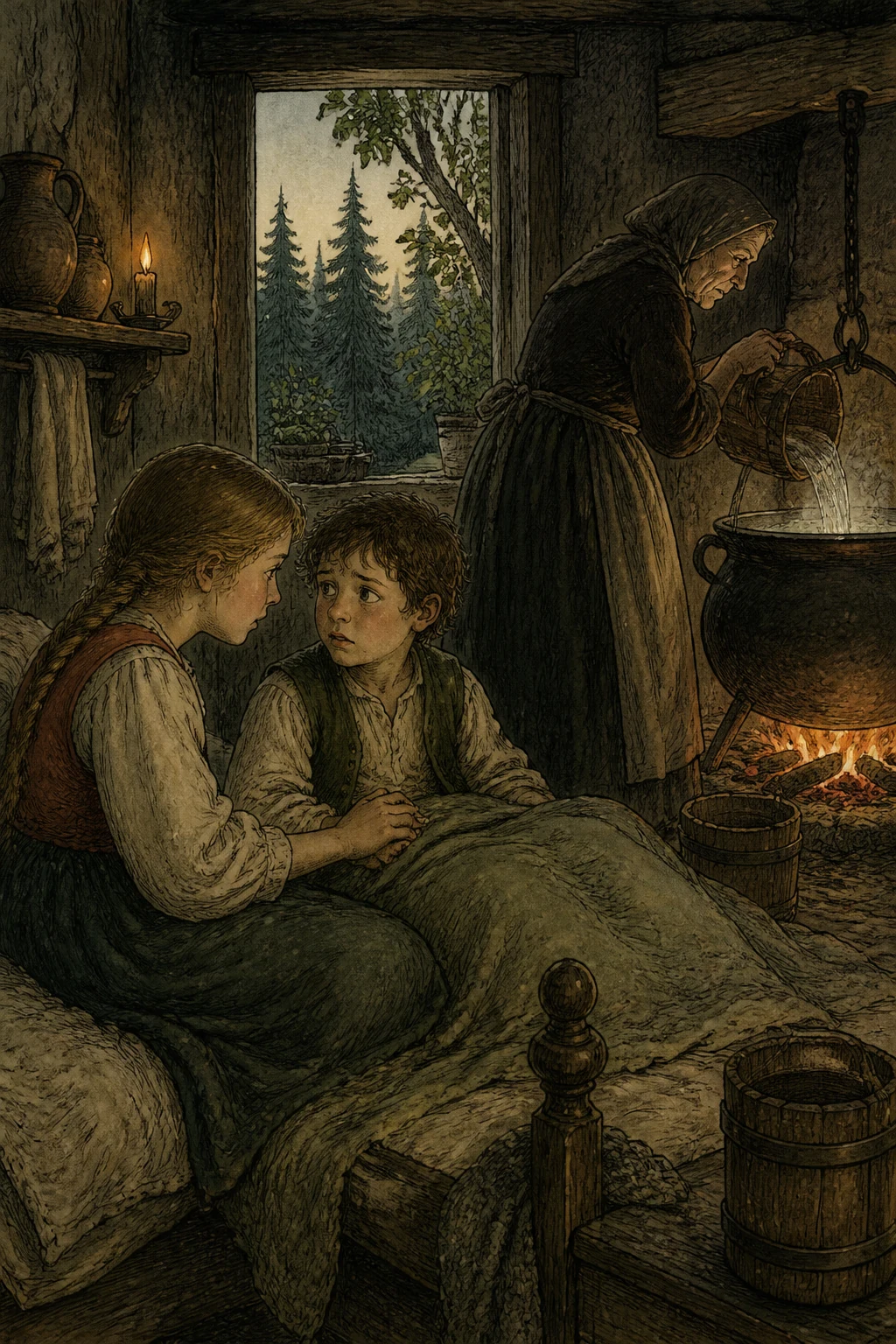
The poor girl would have been done for if she had not happened to be standing in a corner and overheard everything. All day she was not allowed to set foot outside the door, and when bedtime came, she had to get into bed first so that the other girl could lie at the back. But once her stepsister was asleep, she gently pushed her to the front and took the place at the back, against the wall. In the night the old woman came creeping in, holding an axe in her right hand. With her left she first felt to make sure someone was lying at the front, then gripped the axe with both hands and chopped and chopped until she had cut off her own child's head. When she had gone, the girl got up and went to her sweetheart, whose name was Roland, and knocked at his door. When he came out, she said, "Listen, dearest Roland, we must flee at once. My stepmother meant to kill me, but she struck her own child instead. When day comes and she sees what she has done, we shall be lost."
"But I advise you," said Roland, "to take her magic wand first, or we shall never escape if she comes after us." The girl fetched the magic wand, then took the severed head and let three drops of blood fall to the ground: one in front of the bed, one in the kitchen, and one on the stairs. Then she hurried away with her sweetheart.
When the old witch rose the next morning, she called her daughter, meaning to give her the apron, but the girl did not come. Then she called, "Where are you?"
"Why, here on the stairs, sweeping," answered one of the drops of blood. The old woman went out, but saw no one on the stairs, and called again, "Where are you?"
"Why, here in the kitchen, warming myself," cried the second drop of blood. She went into the kitchen, but found no one. Then she called once more, "Where are you?"
"Oh, here in bed, sleeping," cried the third drop of blood. She went into the bedroom and up to the bed. And what did she see? Her own child lying in a pool of blood, her head cut off by her own mother's hand.
The witch flew into a rage and rushed to the window. Since she could see far across the world, she caught sight of her stepdaughter hurrying away with her sweetheart Roland. "That will do you no good," she cried. "However far away you may be, you shall not escape me."
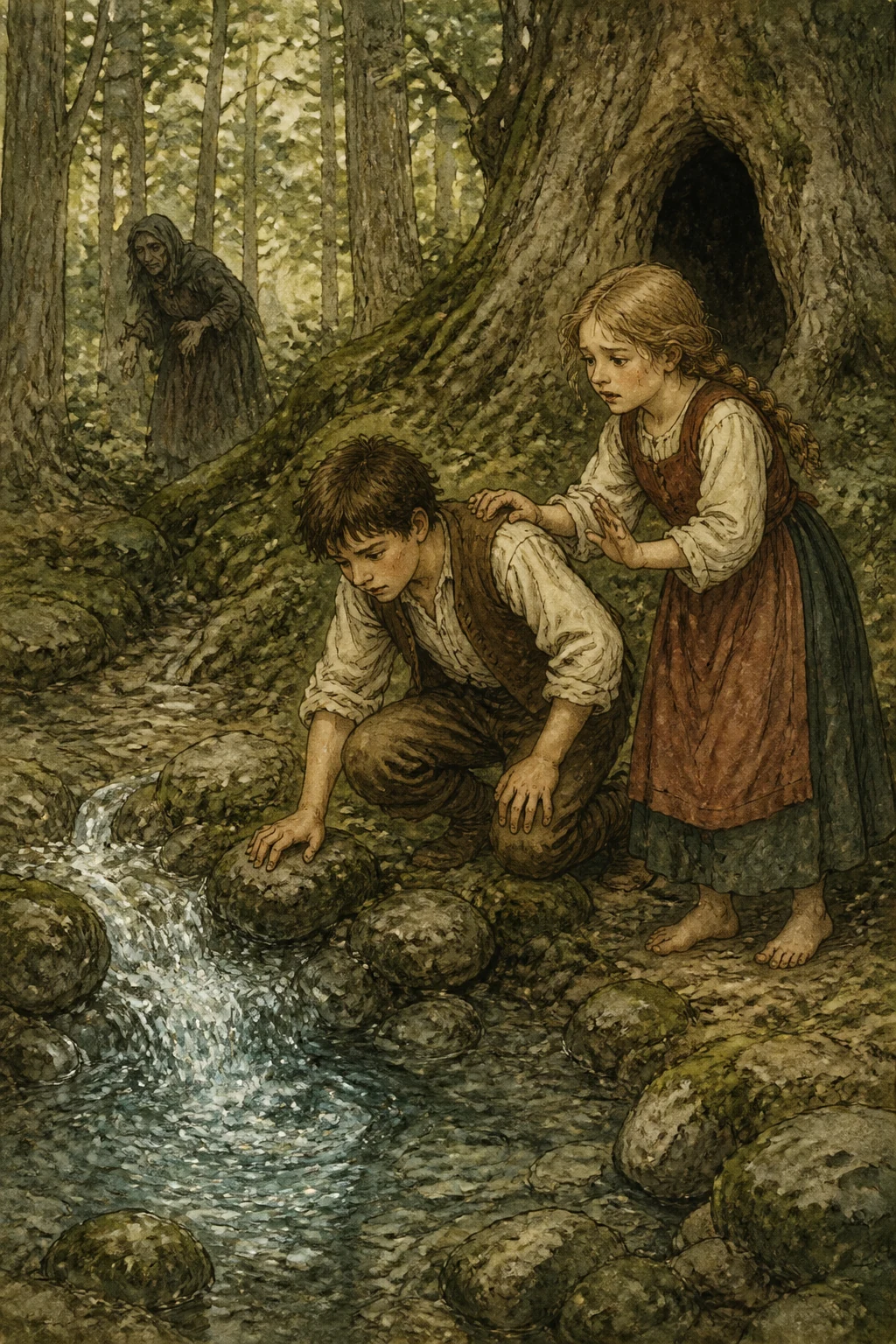
She pulled on her magic boots, which carried her an hour's journey at every stride, and before long she had caught up with them both. But when the girl saw the old woman striding towards them, she used the magic wand to turn her sweetheart Roland into a lake and herself into a duck swimming in the middle of it. The witch stood on the bank, threw crumbs of bread into the water, and did all she could to lure the duck to her. But the duck would not be lured, and that evening the old woman had to turn back without accomplishing anything.
Then the girl and her sweetheart Roland took their own shapes again and walked on through the night until daybreak. At dawn the girl turned herself into a beautiful flower growing in the middle of a thorn hedge, and her sweetheart Roland into a fiddler. Before long the witch came striding up and said to the musician, "Dear fiddler, may I pick that beautiful flower?" "Oh yes," he answered, "and I will play while you do." As she hastily crawled into the hedge to pick the flower, for she knew very well who the flower was, he began to play. Whether she wished it or not, she had to dance, for it was an enchanted tune. The faster he played, the wilder her leaps became, and the thorns tore the clothes from her body and pricked her until she was bloodied and sore. Since he would not stop, she had to dance until she fell down dead.
Now that they were free, Roland said, "I will go to my father and arrange the wedding." "Then I will stay here meanwhile," said the girl, "and wait for you. And so that no one recognizes me, I will turn myself into a red stone in the field." So Roland went away, and the girl stood as a red stone in the field, waiting for her sweetheart.
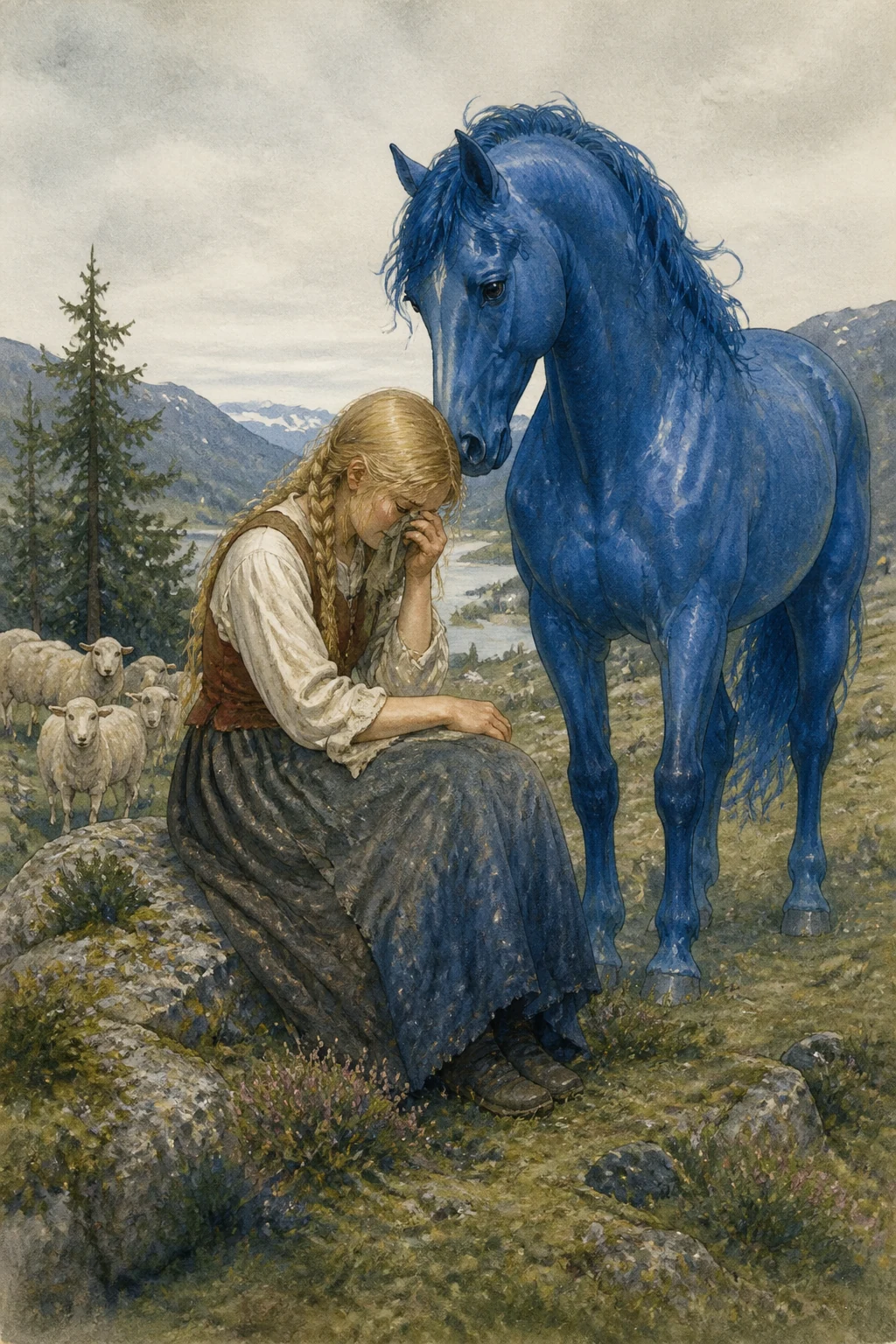
But when Roland reached home, he fell into the snares of another woman, who contrived to make him forget the girl. The poor girl waited a long time, but when at last he still did not return, she grew sad and turned herself into a flower, thinking, "Surely someone will come along and trample me underfoot."
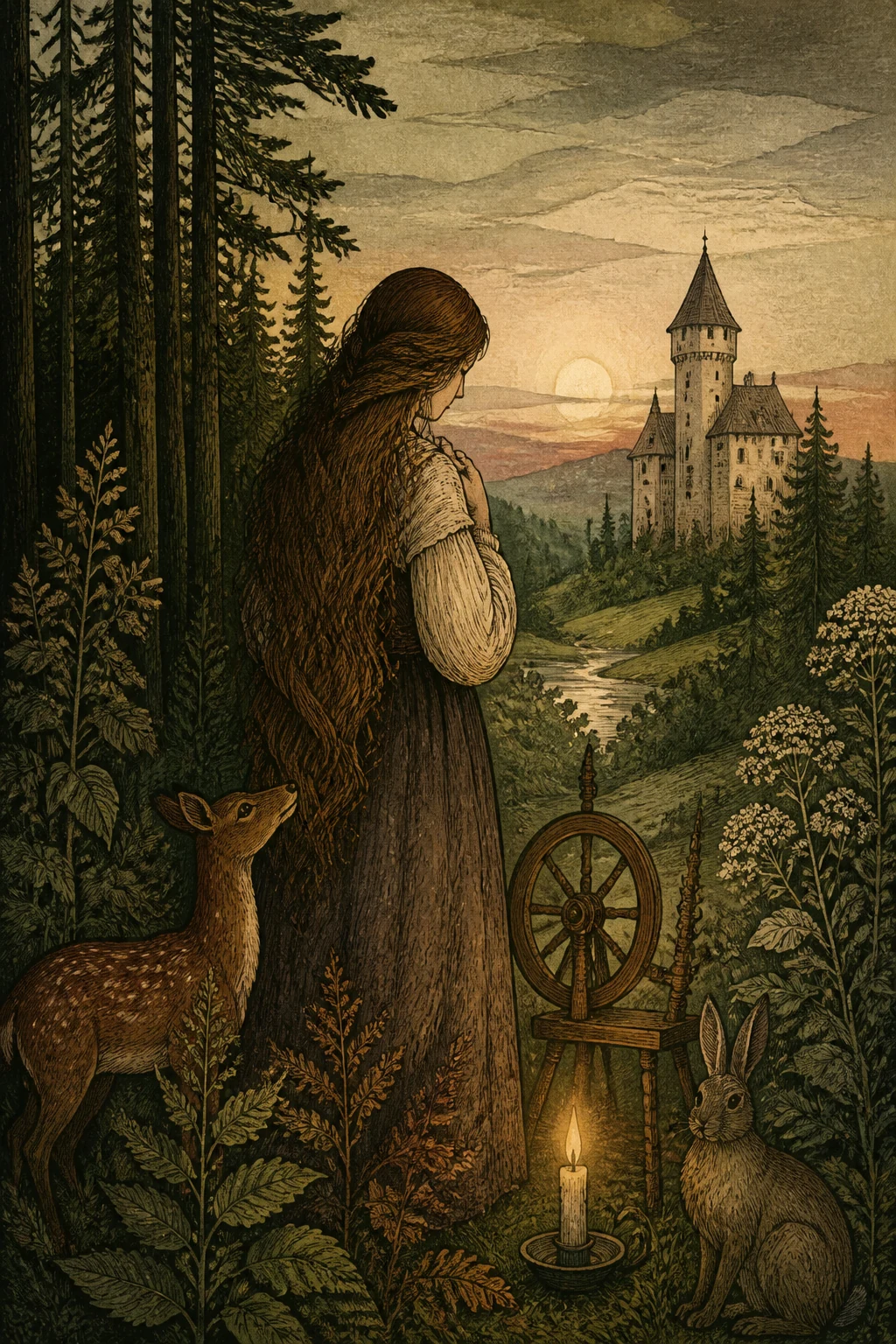
Now it happened that a shepherd was tending his sheep in the field and saw the flower. Because it was so beautiful, he picked it, took it home, and put it in his chest. From that time on, strange things happened in the shepherd's house. When he rose in the morning, all the work was already done: the room had been swept, the tables and benches wiped clean, a fire lit on the hearth, and water fetched. At noon, when he came home, the table was laid and a good meal was ready. He could not understand how this happened, for he never saw anyone in his house, and no one could have hidden in the little cottage. He was certainly pleased to be so well cared for, but at last he grew uneasy and went to a wise woman to ask her advice. The wise woman said, "There is magic at work here. Early one morning, watch carefully to see whether anything moves in the room. If you see anything, whatever it may be, quickly throw a white cloth over it, and the spell will be broken." The shepherd did as she had told him, and the next morning, just as day was breaking, he saw the chest open and the flower come out.
He quickly sprang forward and threw a white cloth over it. At once the enchantment ended, and a beautiful girl stood before him. She confessed that she had been the flower and had been keeping house for him all this time. She told him her story, and since he had grown fond of her, he asked whether she would marry him. But she answered, "No," for she meant to remain faithful to her sweetheart Roland, even though he had deserted her. She promised, however, that she would not leave, but would go on keeping house for him.
Now the time came for Roland to be married, and according to the old custom, it was announced throughout the land that all the girls were to gather and sing in honour of the bridal pair. When the faithful girl heard this, she grew so sorrowful that she thought her heart would burst, and she did not want to go. But the others came and brought her along. Whenever her turn to sing came, she hung back, until she was the only one left and could no longer avoid it.
But as soon as she began to sing and her song reached Roland's ears, he sprang up and cried, "I know that voice! This is my true bride, and I want no other." All that he had forgotten, all that had vanished from his mind, suddenly came home to his heart again. Then the faithful girl married her sweetheart Roland, and her sorrow ended and her joy began.