Prevod
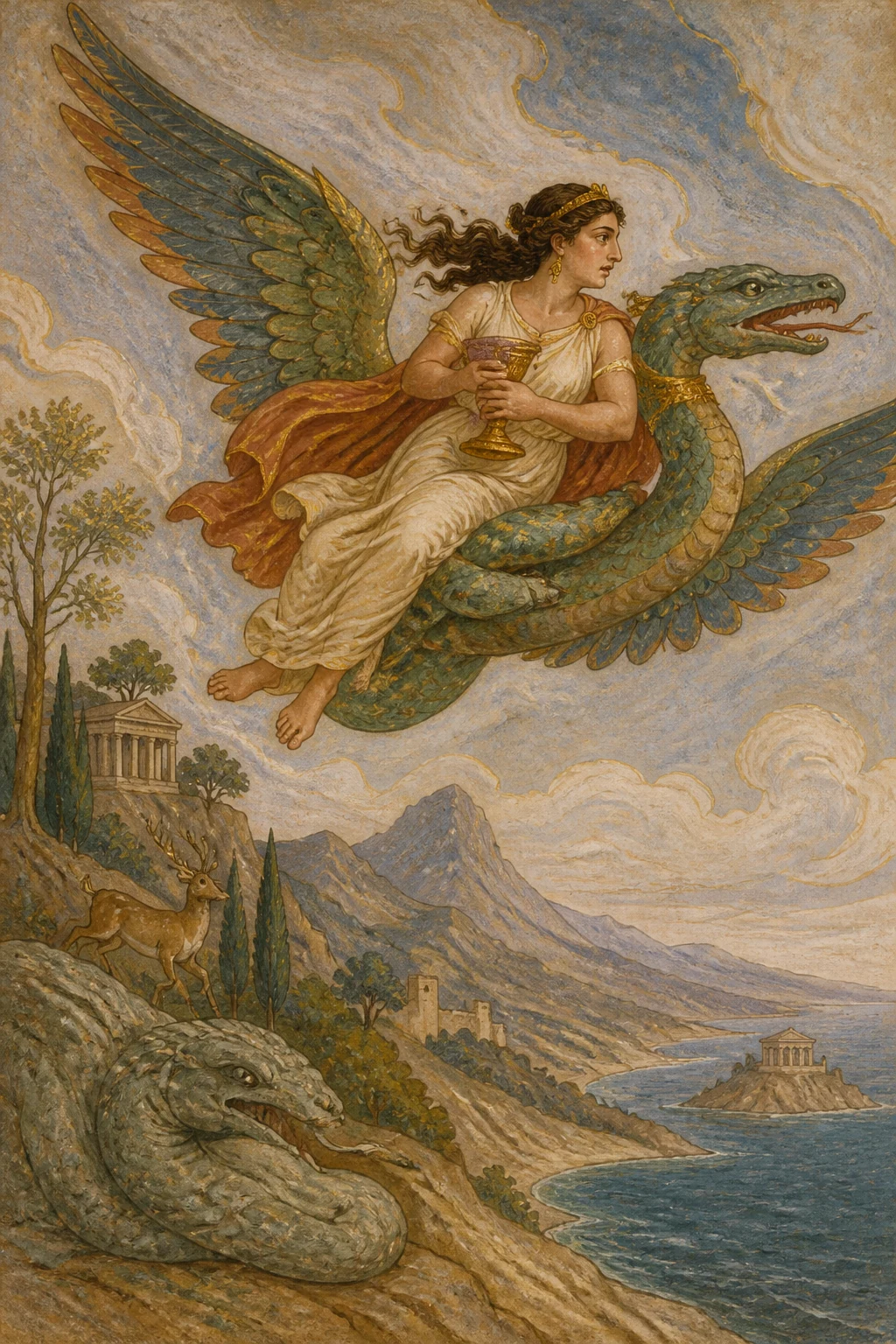
Until then Tritonia had kept her gold-born brother company; now, wrapped in a hollow cloud, she left Seriphos, leaving Cythnos and Gyaros on her right, and took what seemed the shortest path across the sea to Thebes and Helicon, home of the virgin Muses. Reaching that mountain, she alighted and addressed the learned sisters: “Word of a new spring has reached my ears, struck from the rock by the hard hoof of Medusa’s winged offspring.
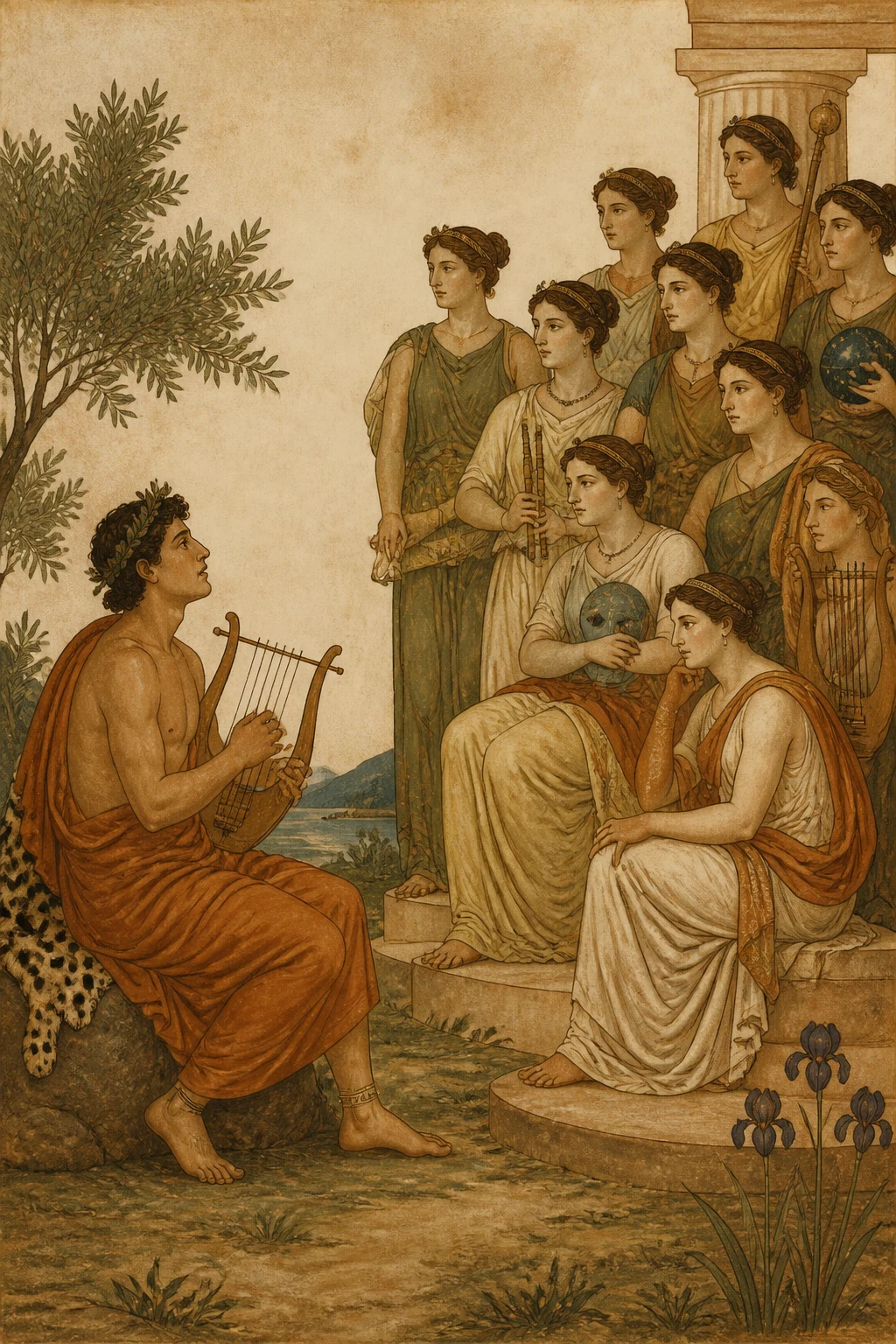
That has brought me here. I wished to see this marvel: I saw the creature himself born from his mother’s blood.” Urania answered: “Whatever brings you, goddess, to visit our home, you are most welcome to our hearts. The story is true: Pegasus is the source of this spring.” And she led Pallas down to the sacred waters. After long admiring the stream struck forth by his hoof, the goddess gazed around at the groves of ancient trees, the caves, and the grass embroidered with countless flowers, and called the daughters of Mnemosyne blessed alike in their pursuits and in their home. Then one of the sisters answered her: “Tritonia, had your courage not called you to greater deeds,
you would have joined our choir. You speak truly, and rightly praise our arts and our home; our lot is happy, if only we may be safe. But so little is forbidden to wickedness that everything alarms our maiden hearts. Dreadful Pyreneus still haunts my eyes, and I have not yet wholly recovered my peace of mind. With Thracian soldiers that savage man had seized Daulis and the lands of Phocis, and held them under his unlawful rule.
We were making for the shrines of Parnassus. He saw us passing and, pretending reverence for our divinity, said, ‘Daughters of Mnemosyne’—for he knew us—‘stop here, and do not hesitate, I beg you, to shelter beneath my roof from the threatening sky and rain’—for it was raining. ‘The gods have often entered humbler homes.’ Moved by his words and by the weather, we agreed and entered his entrance hall.
The rain had ceased; the north winds had conquered the south, and dark clouds fled from the clearing sky. We were eager to leave, but Pyreneus barred his doors and prepared to assault us. We took wing and escaped his violence. He stood high on his citadel, as though about to follow, and said, ‘Whatever path you take, I shall take too.’ Then, out of his mind, he flung himself from the top of the highest tower and fell face-first. The bones of his face were shattered, and as he died he beat the earth, stained with his wicked blood.”
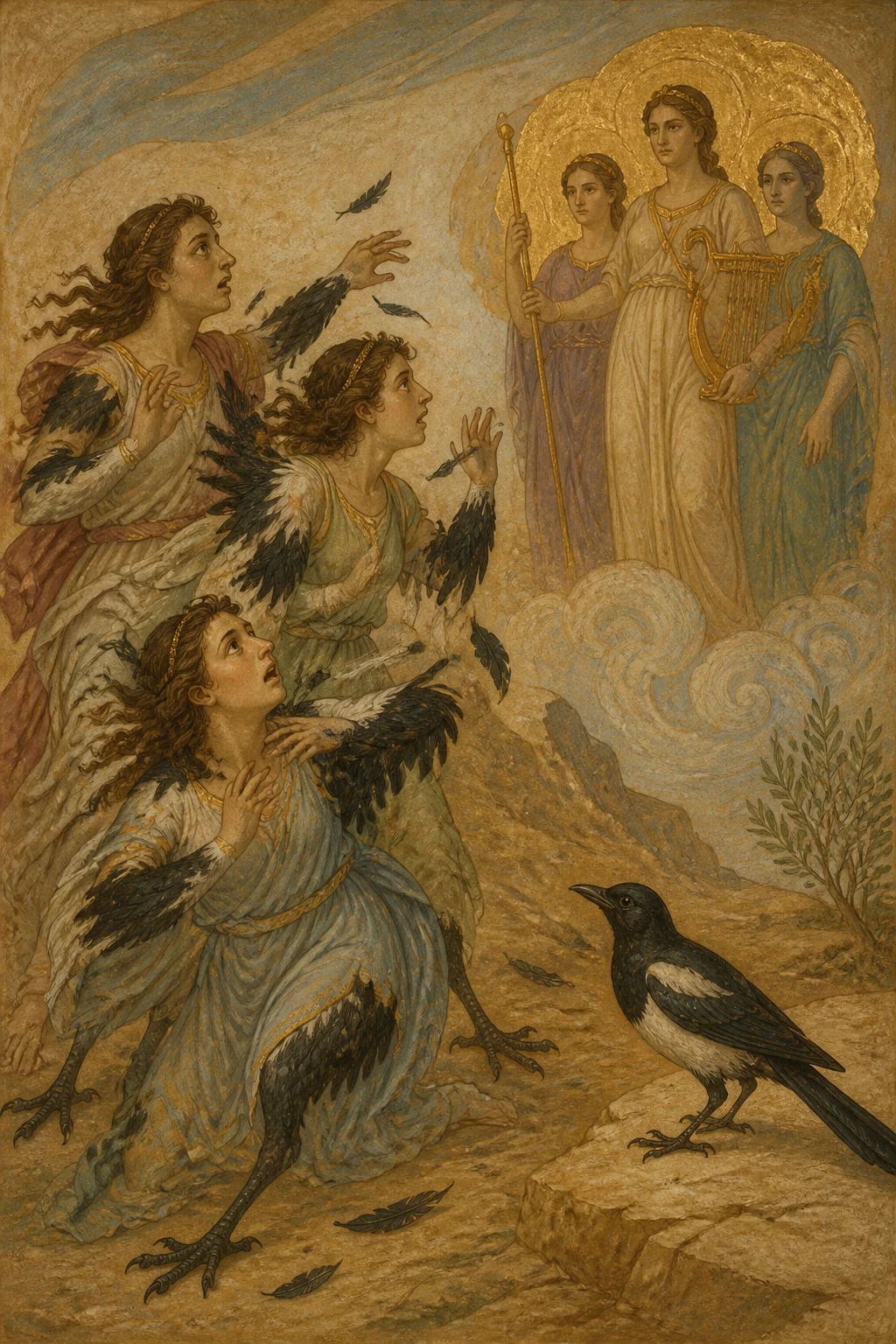
The Muse was still speaking when wings rustled through the air, and voices called greetings from the high branches. Jove’s daughter looked up, seeking the source of speech so clear, so sure in its words, and thought a human voice had spoken. But it was a bird: nine magpies, lamenting their fate, had settled on the branches, mimicking every sound. To the wondering goddess the Muse began: “These too have lately swelled the throng of birds, defeated in a contest.
Pierus, rich in the fields of Pella, was their father; Euippe of Paeonia was their mother. Nine times, as she was about to give birth, she called on mighty Lucina. Puffed up by their numbers, this troop of foolish sisters travelled through so many towns of Haemonia and Achaea and came here to challenge us with these words: ‘Stop deceiving the ignorant crowd with your empty sweetness.
If you have any confidence in yourselves, contend with us, goddesses of Thespiae. Neither in voice nor skill shall we be beaten, and our numbers match yours. Either yield, defeated, and leave Medusa’s spring and Hyantian Aganippe, or we shall yield the plains of Emathia, as far as snowy Paeonia, to you. Let the nymphs decide the contest.’ It was shameful to compete, but seemed more shameful still to yield. The chosen nymphs swore by their rivers and took their seats on benches formed of living rock.
Then, without drawing lots, the first sister to declare herself ready sang of the wars of the gods, falsely exalting the Giants and belittling the deeds of the mighty gods. She sang how Typhoeus, sent forth from earth’s deepest depths, had struck terror into the gods of heaven, and how they all turned and fled, until, exhausted, they found refuge in Egypt, where the Nile divides into seven mouths.
She told how earth-born Typhoeus came there too, and how the gods concealed themselves in borrowed shapes. ‘Jupiter,’ she said, ‘became the leader of a flock; hence Libyan Ammon is still portrayed with curving horns. The Delian god hid in a raven, Semele’s son in a goat, Phoebus’s sister in a cat, Saturn’s daughter in a snow-white cow, Venus in a fish, and the Cyllenian god in the wings of an ibis.’”