O besedilu
Medejin beg
- Vir
- Ovidove preobrazbe
- Avtor
- Ovid
- Jezik branja
- English
- Jezik izvirnika
- Latin
- Čas branja
- 4 min branja
- Obseg
- 4 strani
- Naslov izvirnika
- Medea's Flight
O izvirniku
Ovidove preobrazbe
Pesniški tok antičnih preobrazb, kjer bogovi, ljudje in narava stalno menjavajo obliko. Bralni jezik je English, izvirnik pa prihaja iz vira Ovidove preobrazbe v jeziku Latin.
Besedilo
Medejin beg
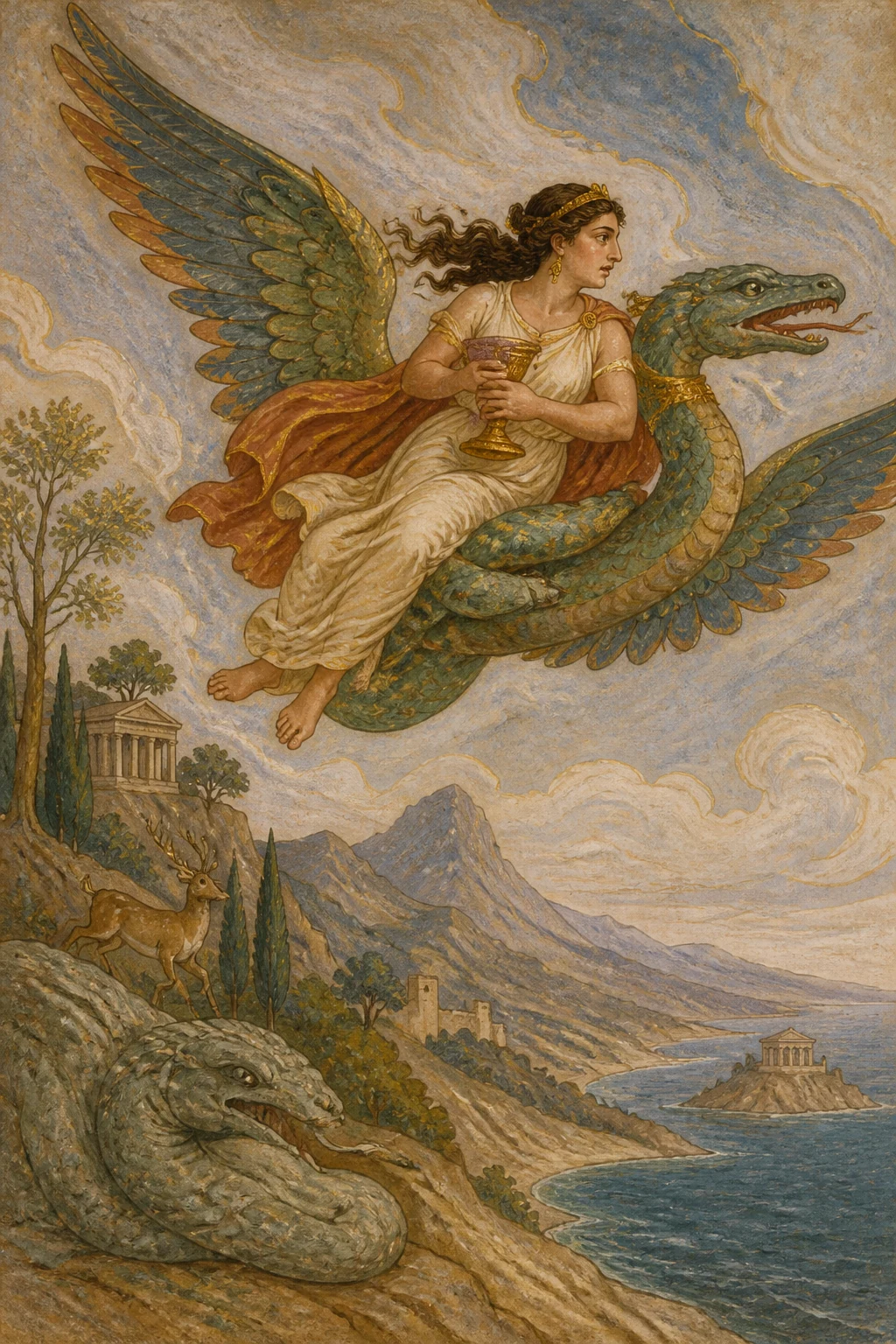
Had she not risen into the air on winged serpents, she would not have escaped punishment. High she flew, over shady Pelion, home of Philyra’s son, and over Othrys and the region famed for old Cerambus’s fate. Here, raised into the air on wings by the nymphs’ help, when the earth lay buried beneath the sea’s vast flood, he escaped Deucalion’s waters without being engulfed.
On her left she leaves Aeolian Pitane and the long serpent’s likeness fashioned out of stone, and Ida’s grove, where Bacchus concealed his son’s theft, a bullock, beneath the semblance of a deer; and the place where Corythus’s father lies beneath a little sand, and the fields that Maera terrified with her strange new barking, and Eurypylus’s city, where the women of Cos wore horns when Hercules and his company departed; and Rhodes, sacred to Phoebus, and the Telchines of Ialysus, whose eyes blighted all things merely by looking upon them, till Jupiter, loathing them, sank them beneath his brother’s waves.
She passes, too, the walls of Carthaea on ancient Ceos, where the father Alcidamas would one day marvel that a gentle dove could have sprung from his daughter’s body. Then she sees Hyrie’s lake and the valley of Cycnus, made famous by his sudden change into a swan. There Phyllius, at the boy’s command, had brought him birds and a savage lion, all tamed; ordered also to subdue a bull, he had subdued it, but, angered that his love had so often been scorned, refused the bull when the boy demanded this final prize.
Indignant, the boy said, “You will wish you had given it,” and leaped from a high cliff. All thought he had fallen to his death: but, changed into a swan, he hung in the air on snowy wings. His mother Hyrie, unaware that he was saved, melted away in tears and became the lake that bears her name. Nearby lies Pleuron, where Combe, daughter of Ophius, escaped her sons’ attacks on fluttering wings.
Then she beholds the fields of Calaurea, sacred to Leto, witness to a king’s transformation, with his wife, into birds. On her right is Cyllene, where Menephron would lie with his mother like a savage beast. Far from there she looks back at Cephisus, mourning his grandson’s fate, changed by Apollo into a bloated seal, and at the home of Eumelus, who mourned his son, now flying through the air.
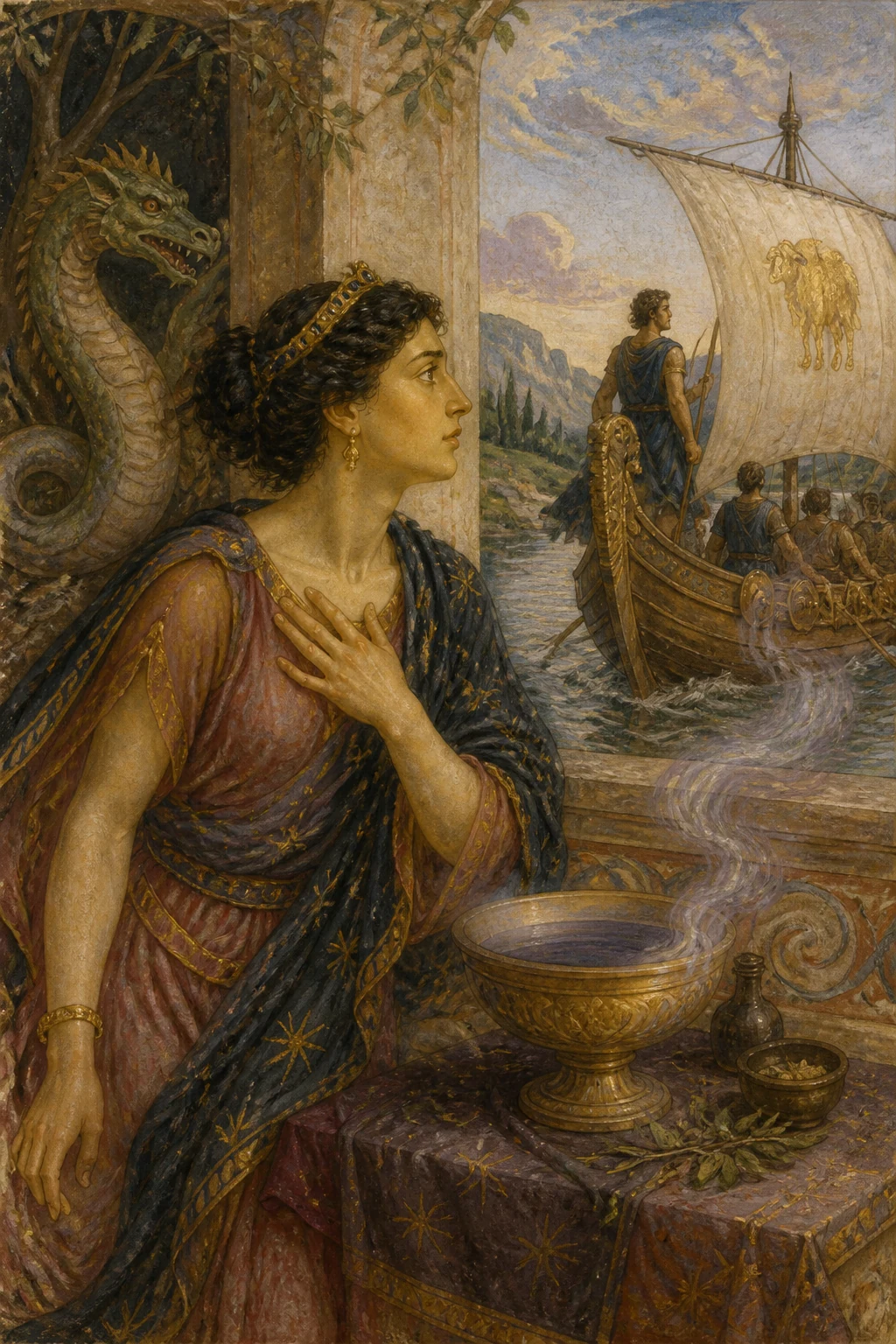
At last, on her serpents’ wings, she reached Ephyre, land of Pirene. Here, in the earliest age, ancient tradition tells, human bodies sprang from mushrooms born of rain. But after the new bride had burned through Colchian poison, and both seas had seen the king’s palace ablaze, her impious sword was drenched in her children’s blood; and the mother, having taken a wicked vengeance, escaped Jason’s weapons.
Carried away from there by the Titan’s dragons, she entered the citadel of Pallas, which had seen you, most righteous Phene, and you, aged Periphas, both flying through the air, and Polypemon’s granddaughter borne on newfound wings. Aegeus welcomed her, blameworthy in this one deed alone; nor was hospitality enough: he bound himself to her in marriage. Now Theseus had arrived, a son still unknown to his father, who by his valour had brought peace to the Isthmus between two seas.
To destroy him, Medea mixed the aconite she had once brought with her from the shores of Scythia. They say it sprang from the teeth of Echidna’s hound. There is a cave with a dark, gaping mouth, and a downward path by which the Tirynthian hero dragged Cerberus out, bound with chains of adamant, while he struggled and turned his eyes away from daylight and the glittering sunbeams. Roused to furious rage, he filled the air with barking from his three throats and spattered the green fields with white foam.
This, they believe, took root and, nourished by the rich and fertile soil, acquired its power to poison. Because these plants spring up and thrive on hard rock, country people call them aconite. Through his wife’s cunning, Aegeus himself offered it to his son as though to an enemy. Theseus had taken the offered cup in his unsuspecting hand, when his father recognized, on the sword’s ivory hilt, the emblems of his own house, and dashed the deadly cup from his lips.
She escaped death in clouds conjured by her spells.
Izvirnik
Medea's Flight
Naslednje strani prikazujejo izvirno besedilo za primerjavo.
Source ID: ovid_metamorphoses_story_048 Citation: Ovid, Metamorphoses 7.350-7.424 Original language: Latin Source: PerseusDL canonical-latinLit Source URL: https://github.com/PerseusDL/canonical-latinLit/blob/master/data/phi0959/phi006/phi0959.phi006.perseus-lat2.xml Segmentation certainty: medium 350: Quod nisi pennatis serpentibus isset in auras, 351: non exempta foret poenae. Fugit alta superque 352: Pelion umbrosum, Philyreia tecta, superque 353: Othryn et eventu veteris loca nota Cerambi.
354: Hic ope nympharum sublatus in aera pennis, 355: cum gravis infuso tellus foret obruta ponto, 356: Deucalioneas effugit inobrutus undas. 357: Aeoliam Pitanen a laeva parte relinquit 358: factaque de saxo longi simulacra draconis, 359: Idaeumque nemus, quo nati furta, iuvencum 360: occuluit Liber falsi sub imagine cervi, 361: quaque pater Corythi parva tumulatus harena est, 362: et quos Maera novo latratu terruit agros, 363: Eurypylique urbem, qua Coae cornua matres 364: gesserunt tum cum discederet Herculis agmen 365: Phoebeamque Rhodon et Ialysios Telchinas,
366: quorum oculos ipso vitiantes omnia visu 367: Iuppiter exosus fraternis subdidit undis. 368: Transit et antiquae Cartheia moenia Ceae, 369: qua pater Alcidamas placidam de corpore natae 370: miraturus erat nasci potuisse columbam. 371: Inde lacus Hyries videt et Cycneia tempe, 372: quae subitus celebravit olor. Nam Phyllius illic 373: imperio pueri volucresque ferumque leonem 374: tradiderat domitos; taurum quoque vincere iussus 375: vicerat, et spreto totiens iratus amore 376: praemia poscenti taurum suprema negabat.
377: Ille indignatus “cupies dare” dixit et alto 378: desiluit saxo. Cuncti cecidisse putabant: 379: factus olor niveis pendebat in aere pennis. 380: At genetrix Hyrie, servatum nescia, flendo 381: delicuit stagnumque suo de nomine fecit. 382: Adiacet his Pleuron, in qua trepidantibus alis 383: Ophias effugit natorum vulnera Combe. 384: Inde Calaureae Letoidos adspicit arva, 385: in volucrem versi cum coniuge conscia regis.
386: Dextera Cyllene est, in qua cum matre Menephron 387: concubiturus erat saevarum more ferarum 388: Cephison procul hinc deflentem fata nepotis 389: respicit, in tumidam phocen ab Apolline versi, 390: Eumelique domum lugentis in aere natum. 391: Tandem vipereis Ephyren Pirenida pennis 392: contigit. Hic aevo veteres mortalia primo 393: corpora vulgarunt pluvialibus edita fungis.
394: Sed postquam Colchis arsit nova nupta venenis, 395: flagrantemque domum regis mare vidit utrumque, 396: sanguine natorum perfunditur impius ensis, 397: ultaque se male mater Iasonis effugit arma. 398: Hinc Titaniacis ablata draconibus intrat 399: Palladias arces, quae te, iustissima Phene, 400: teque, senex Peripha, pariter videre volantes 401: innixamque novis neptem Polypemonis alis.
402: Excipit hanc Aegeus, facto dammandus in uno; 403: nec satis hospitium est: thalami quoque foedere iungit. 404: Iamque aderat Theseus, proles ignara parenti, 405: et virtute sua bimarem pacaverat Isthmon. 406: Huius in exitium miscet Medea quod olim 407: attulerat secum Scythicis aconiton ab oris. 408: Illud Echidneae memorant e dentibus ortum 409: esse canis. Specus est tenebroso caecus hiatu, 410: est via declivis, per quam Tirynthius heros 411: restantem contraque diem radiosque micantes 412: obliquantem oculos nexis adamante catenis 413: Cerberon abstraxit; rabida qui concitus ira
414: implevit pariter ternis latratibus auras 415: et sparsit virides spumis albentibus agros. 416: Has concresse putant nactasque alimenta feracis 417: fecundique soli vires cepisse nocendi. 418: Quae quia nascuntur dura vivacia caute, 419: agrestes aconita vocant. Ea coniugis astu 420: ipse parens Aegeus nato porrexit ut hosti. 421: Sumpserat ignara Theseus data pocula dextra, 422: cum pater in capulo gladii cognovit eburno 423: signa sui generis facinusque excussit ab ore.
424: Effugit illa necem nebulis per carmina motis.
Nadaljuj z branjem