Prevod
Once upon a time, as never before—for if it had never happened, it would never be told—when poplars bore pears and willows bore violets; when bears fought by striking their tails together; when wolves and lambs embraced and kissed like brothers; when a flea was shod on one foot with ninety-nine okas of iron and leapt into the highest heavens to bring us stories; when a fly would write upon the wall—a greater liar is he who doubts it all. There was once a great emperor and an empress, both young and beautiful, who longed to have children. Time and again they did all that was needful; they sought out healers and philosophers to read the stars and foretell whether they would ever have children, but all in vain. At last the emperor heard that in a nearby village there lived a wise old man, and sent for him. But the old man told the messengers that whoever had need of him must come to his house. So the emperor and empress set out, taking with them several great boyars, soldiers, and servants, and went to the old man’s home. As soon as he saw them in the distance, he came out to meet them and said, “Welcome, and may you be in good health! But you should know, Emperor, that the wish you cherish will bring you sorrow.” “I have not come to ask you about that,” said the emperor, “but if you have some remedy that will enable us to have children, give it to us.”
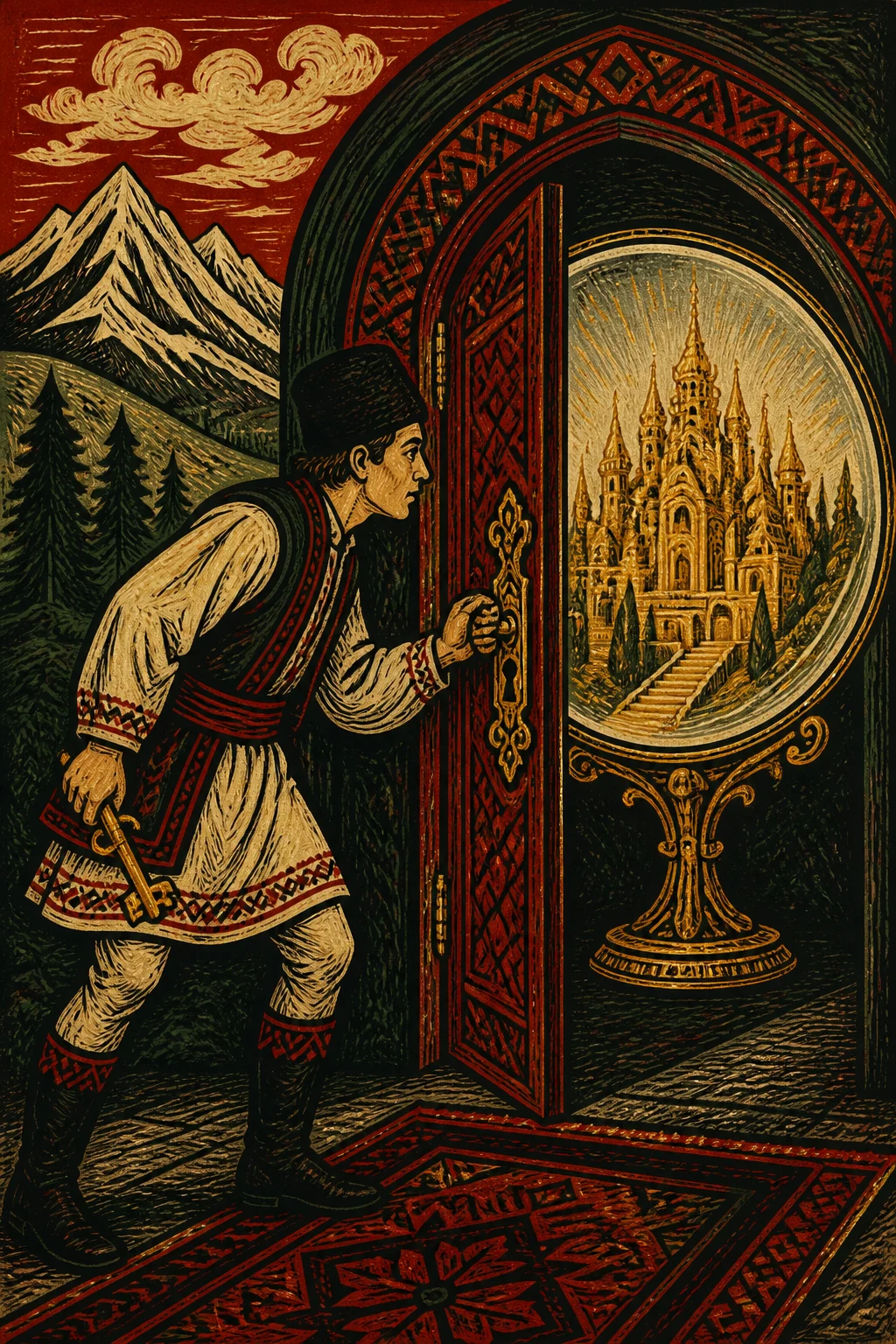
“I have,” replied the old man, “but you will have only one child. He will be a lovely Făt-Frumos, but you will have no share in his life.” The emperor and empress took the remedies and returned joyfully to the palace, and a few days later the empress found herself with child. The whole empire, the entire court, and all the servants rejoiced at the news. But before the hour of his birth arrived, the child began to cry, and no healer could soothe him. Then the emperor began promising him all the good things in the world, yet even this would not quiet him. “Hush, Father’s darling,” the emperor said, “and I shall give you this kingdom or that; hush, my son, and I shall give you this emperor’s daughter or that one for your wife,” and many more promises of the same kind. At last, seeing that nothing would do, he said, “Hush, my son, and I shall give you Youth Without Age and Life Without Death.” Then the child fell silent and was born. The servants beat their drums and sounded their trumpets, and there was great rejoicing throughout the empire for a whole week. The more the child grew, the cleverer and bolder he became. They sent him to schools and philosophers, and all that other children learned in a year he learned in a month, so that the emperor was beside himself with joy. The whole empire took pride in the thought that it would one day have an emperor as wise and learned as Solomon. After a time, however, something came over the boy: he was always wistful, sad, and lost in thought. One day, on his fifteenth birthday, while the emperor was feasting at table with all the boyars and officers of the realm, Făt-Frumos rose and said, “Father, the time has come for you to give me what you promised at my birth.” Hearing this, the emperor grew very sad and said, “But, my son, where could I find such a thing, a thing no one has ever heard of? If I promised it to you then, it was only to soothe you.” “If you cannot give it to me, Father, then I must wander the whole world until I find the promise for which I was born.” Then all the boyars and the emperor fell to their knees, begging him not to leave the empire. “Your father is growing old now,” the boyars said, “and we shall raise you to the throne and bring you the most beautiful empress under the sun for your wife.” But nothing could turn him from his purpose. He stood firm as a rock, and when his father saw that there was no help for it, he gave his consent and ordered provisions and everything else he would need to be made ready for the journey. Făt-Frumos then went to the imperial stables, where the finest stallions in the whole empire were kept, to choose himself a horse. But whenever he laid hold of one by the tail, he threw it to the ground, and so it went with every horse. At last, just as he was about to leave, he glanced once more around the stable and saw a scrawny, mangy, sore-covered horse in a corner. He went over to it, but when he took hold of its tail, the horse turned its head and said, “What is your command, Master? Thanks be to God, who has let me live to feel a brave man’s hand upon me once again!” And, planting its feet, it stood straight as a candle. Făt-Frumos told it what he meant to do, and the horse said, “To attain your wish, you must ask your father for the bow, the quiver of arrows, and the clothes he wore when he was a young man. As for me, you must tend me with your own hands for six weeks and feed me barley boiled in milk.” When Făt-Frumos asked the emperor for the things the horse had advised him to obtain, his father summoned the steward of the court and ordered him to open all the chests of clothing, so that his son could choose whatever pleased him. After rummaging for three days and three nights, Făt-Frumos at last found, at the bottom of an old chest, his father’s clothes and weapons from his youth, all badly rusted. He set about cleaning the rust away with his own hands, and after six weeks he had made the weapons shine like mirrors. All the while he tended the horse as it had instructed him. It was hard work, but he succeeded. When the horse heard from Făt-Frumos that the clothes and weapons were clean and ready, it gave itself a single shake, and all its sores and mange fell away. It stood there just as its mother had foaled it: a sleek, powerful horse with four wings. Seeing it thus, Făt-Frumos said, “Three days from now we leave.” “Long life to you, Master! I am ready this very day, if you command it,” replied the horse. On the morning of the third day, the whole court and the whole empire were filled with grief. Făt-Frumos, dressed as a warrior, sword in hand and mounted on the horse he had chosen, took his leave of the emperor, the empress, the boyars great and small, the soldiers, and all the servants of the court. With tears in their eyes, they begged him to give up the journey, lest he go to his doom. But he put spurs to his horse and swept out through the gate like the wind. Behind him came wagons laden with provisions and money, and some two hundred soldiers whom the emperor had appointed to accompany him. Once he had passed beyond his father’s empire and reached the wilderness, Făt-Frumos divided all his wealth among the soldiers, bade them farewell, and sent them home, keeping only as much food as his horse could carry. Then he took the road eastward and travelled on and on and on for three days and three nights, until he came to a broad plain strewn with human bones. As they stopped to rest, the horse said, “You must know, Master, that we are now on the lands of Gheonoaia, who is so wicked that no one sets foot upon her domain without being killed. She was once a woman like any other, but she disobeyed her parents and tormented them until their curse turned her into a monster. At this moment she is with her children, but tomorrow, in that forest you see, we shall meet her coming to destroy you. She is fearfully large, but do not be afraid. Have your bow ready to shoot her, and keep your sword and spear close at hand, to use them when the need arises.” They settled down to rest, taking turns to keep watch. The next day, as dawn was breaking, they made ready to cross the forest. Făt-Frumos saddled and bridled the horse, tightened the girth more than usual, and set out. Presently he heard a dreadful pounding. Then the horse said, “Be ready, Master! Hold fast, for here comes Gheonoaia.” She came hurtling towards them, knocking down trees in her haste, while the horse rose like the wind until it was just above her. Făt-Frumos shot off one of her legs with an arrow, and was about to strike her with a second when she cried, “Stop, Făt-Frumos! I shall do you no harm!” Seeing that he did not believe her, she gave him a pledge written in her own blood. “Long may your horse live, Făt-Frumos,” she added, “for he is a creature of magic. Had it not been for him, I would have eaten you roasted; as it is, you have had the better of me. Know that, until today, no mortal has dared cross my borders and come this far. The few madmen who ventured it barely reached the plain where you saw all those bones.” They went to her home, where Gheonoaia feasted Făt-Frumos and showed him all the hospitality due a traveller. But while they sat at table and made merry, Gheonoaia kept groaning with pain. All at once he took the leg he had kept in his bag and put it back in place, and she was healed at once. In her joy, Gheonoaia kept the feast going for three days and begged Făt-Frumos to choose one of her three daughters for his wife, for they were as beautiful as fairies. But he would not. Instead, he told her plainly what he was seeking, and she said, “With the horse you have and your own courage, I believe you will succeed.” After three days they made ready and set off. Făt-Frumos travelled on, and on again, along a road that seemed ever longer, until, beyond Gheonoaia’s borders, he came upon a lovely plain, one half bright with flowering grass and the other scorched. He asked the horse why the grass was burned, and the horse replied, “Here we are on the lands of Scorpia, Gheonoaia’s sister. They are so wicked that they cannot live together. Their parents’ curse fell upon them, and that is why they became the monsters you see. Their hatred is terrible beyond telling, and each is always trying to seize land from the other. When Scorpia is enraged, she pours out fire and pitch. It seems she has had a quarrel with her sister, and, coming to drive her off her lands, burned the grass wherever she passed. She is worse than her sister and has three heads. Let us rest a little, Master, and be ready early tomorrow morning.” The next day they made their preparations as they had done before meeting Gheonoaia, and set out. Presently they heard a howl and a rushing roar such as they had never heard before. “Be ready, Master! Here comes that fiend Scorpia.” With one jaw reaching to the heavens and the other to the earth, and spewing flames, Scorpia came upon them swift as the wind. But the horse rose like an arrow until it was just above her, then swooped at her from one side. Făt-Frumos shot an arrow and struck off one of her heads. As he was about to take another, Scorpia begged him in tears to spare her, promising to do him no harm; and to assure him of her word, she gave him a pledge written in her own blood. Scorpia entertained Făt-Frumos even more lavishly than Gheonoaia had done. He returned the head his arrow had struck off, and it joined itself to her body the moment he put it back in place. After three days they went on their way. Beyond Scorpia’s borders they travelled on and on, and on again, until they reached a meadow made all of flowers, where it was always spring. Every blossom was lovelier than the next, and their sweet scent was intoxicating. A light breeze barely stirred the air. Here they stopped to rest, and the horse said, “We have come this far as best we could, Master, but there is one more obstacle before us. We must face a great danger, and if God helps us escape this too, then we shall indeed have proved ourselves. Ahead lies the palace where Youth Without Age and Life Without Death dwell. This house is surrounded by a tall, dense forest, home to all the fiercest beasts in the world. They keep sleepless watch by day and night, and there are very many of them. There is no fighting them, and no passing through the forest. We must try, if we can, to leap over it.” After resting for some two days, they made ready once more. Then the horse drew a deep breath and said, “Master, tighten the girth as much as you can, and when you mount, hold fast to the stirrups and my mane. Keep your legs pressed close beneath my shoulders, so that you do not hinder me in flight.” He mounted, and the horse tried its wings; in a minute they were close to the forest. “Master,” the horse said again, “now is the hour when the beasts of the forest are fed, and they are all gathered in the courtyard. Let us cross.” “Let us cross,” replied Făt-Frumos, “and may God have mercy on us.” They rose into the air and saw the palace shining so brightly that one could look at the sun, but not at it. They passed over the forest, and just as they were about to descend before the palace steps, the horse’s foot barely brushed the top of a tree. At once the whole forest stirred, and the beasts raised such a clamour that it made one’s hair stand on end. They hurried down, and had the lady of the palace not been outside feeding her little ones—for so she called the beasts of the forest—they would surely have been destroyed. She saved them chiefly out of joy at their coming, for until then she had never seen a human soul in her realm. She checked the beasts, soothed them, and sent them back to their places. The lady was a tall, slender, graceful fairy of surpassing beauty. At the sight of her, Făt-Frumos stood spellbound. But she looked at him kindly and said, “Welcome, Făt-Frumos! What do you seek here?” “We seek,” he said, “Youth Without Age and Life Without Death.” “If that is what you seek, then here it is.” He dismounted and entered the palace. There he found two other women, just as young as the first; they were her elder sisters. He began thanking the fairy for saving him from danger, while the sisters joyfully prepared a delicious supper, served entirely on dishes of gold. The horse was set free to graze wherever it pleased. Afterwards, they were introduced to all the beasts, so that they could wander safely through the forest. The women begged him to live with them from that day forward, saying that they had grown weary of being always alone. He did not wait to be asked twice, but gladly accepted, for this was the very thing he had sought. Little by little they grew familiar with one another. He told them his story and all he had endured before reaching them, and before long he married the youngest sister. When they were wed, the ladies of the house gave him leave to roam wherever he wished in all the surrounding country, except for one valley, which they pointed out to him. There, they said, he must never go, for no good would come of it; and they told him that it was called the Valley of Tears. He lived there for an age beyond reckoning without knowing it, for he remained as young as on the day he had arrived. He wandered through the forest without so much as a headache to trouble him. He delighted in the golden palaces, lived in peace and quiet with his wife and her sisters, and enjoyed the beauty of the flowers and the sweetness and purity of the air, a happy man. He often went hunting. One day he gave chase to a hare, loosed one arrow and then another, but missed it both times. Annoyed, he pursued it and shot a third arrow, which found its mark. But in the heat of the chase, the unfortunate man had failed to notice that, in following the hare, he had entered the Valley of Tears. He picked up the hare and was returning home when, all at once, an aching longing for his father and mother seized him. He dared not tell the fairy women, but they guessed from the sadness and restlessness they saw in him. “Unhappy man, you have entered the Valley of Tears!” they said in alarm. “I have, my dear ones, though I never meant to do such a foolish thing. And now I am wasting away with longing for my parents. Yet I cannot bear to leave you either. I have spent many days with you, and have no unkindness to complain of. I shall go, then, to see my parents once more, and afterwards I shall return, never to leave again.” “Do not leave us, beloved! Your parents have been dead for hundreds of years, and if you go, we fear you will never return. Stay with us, for our hearts tell us that you will perish.”
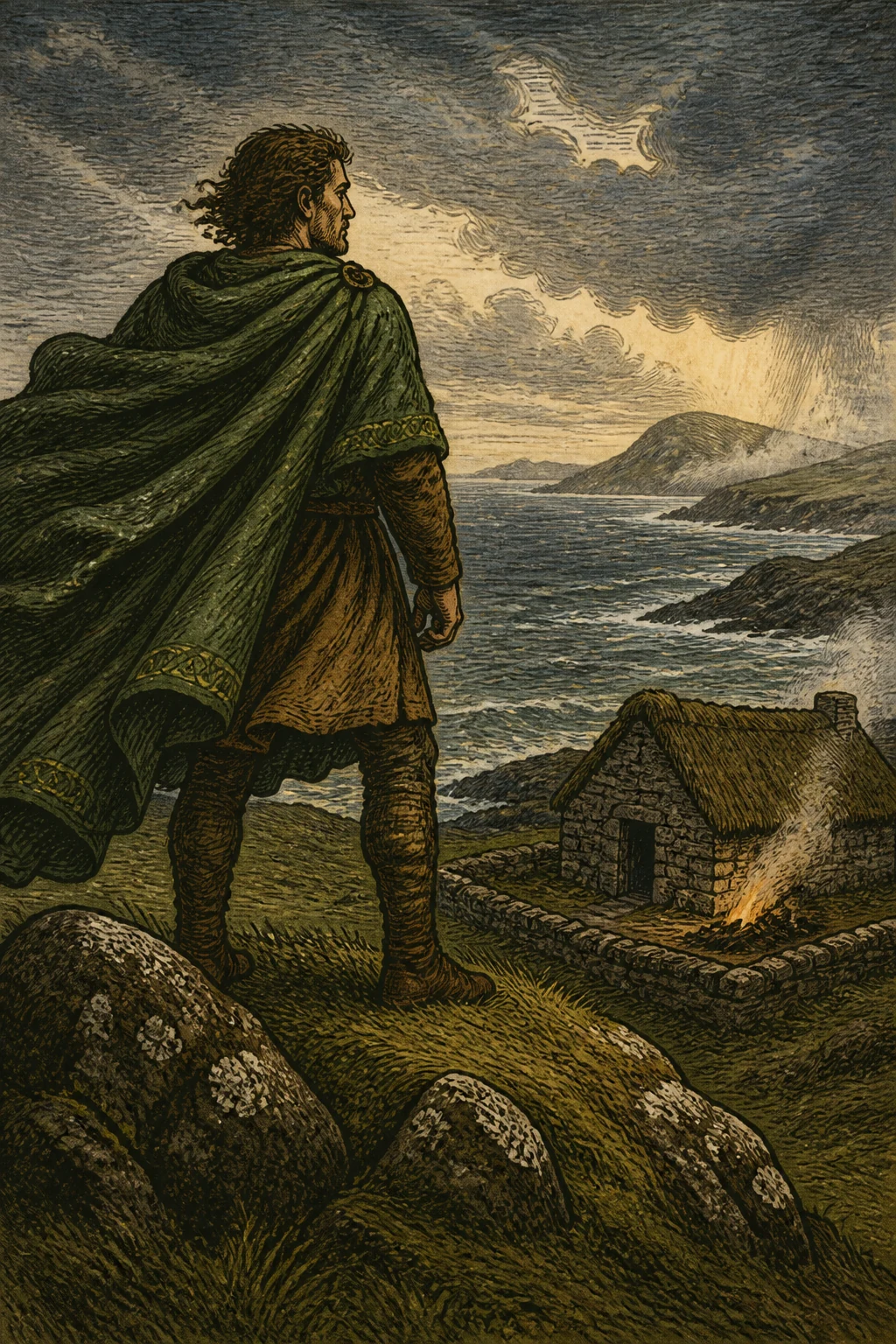
All the pleas of the three women, and of the horse as well, could not soothe his longing for his parents, which was consuming him entirely. At last the horse said, “If you will not listen to me, Master, then whatever befalls you, know that you alone are to blame. I shall make one condition, and if you agree to it, I will take you back.” “I agree most gladly,” he said. “Tell me what it is.” “As soon as we reach your father’s palace, I shall set you down and return here, if you choose to remain even for an hour.” “So be it,” he said. They made ready to depart. He embraced the women, and when they had said their farewells, he set out, leaving them sighing, with tears in their eyes. They reached the lands where Scorpia’s domain had once been, and found cities there; the forests had turned to fields. He asked one person after another about Scorpia and her dwelling, but they replied that their grandparents had heard such tales from their own forebears. “How can that be?” Făt-Frumos said. “I passed this way only the other day!” And he told them all he knew. The people laughed at him as though he were raving or dreaming with his eyes open. Distressed, he went on, never noticing that his hair and beard had turned white. When he reached Gheonoaia’s lands, he made the same inquiries as he had in Scorpia’s domain and received the same answers. He could not understand how the country had changed so much in so few days. Troubled once more, he continued on his way, his white beard now reaching to his waist, and his legs beginning to tremble, until he came to his father’s empire. Here there were different people and different cities, and the old places had changed beyond recognition. At last he reached the palace where he had been born. As soon as he dismounted, the horse kissed his hand and said, “Farewell, Master. I am going back to the place we left. If you wish to come too, mount at once, and let us be off.” “Farewell. I hope to return myself before long.” The horse flew away swift as an arrow. Seeing the ruined palaces overgrown with weeds, he sighed, and with tears in his eyes tried to remember how splendid they had once been, and how he had spent his childhood within them. He went round them two or three times, searching every room, every little corner that recalled the past, and the stable where he had found the horse. Then he went down into the cellar, whose entrance was choked with fallen rubble. Looking this way and that, his white beard now reaching to his knees, lifting his eyelids with his hands and scarcely able to walk, he found nothing but a battered old chest. He opened it, but there was nothing inside. Then he lifted the lid of its little inner compartment, and a feeble voice said, “Welcome! Had you delayed much longer, I too would have perished.” His own Death, which had shrivelled to a hook in that little compartment, struck him a blow. He fell dead and crumbled at once to dust. And I mounted a saddle and told you this tale.