Prevod
_The King of Rocc’Aspra wishes to marry his daughter. Through an old woman’s cunning, she changes herself into a she-bear and escapes his clutches. Falling into the hands of a prince, she is seen by him in her true form in a garden, where she is dressing her hair, and he falls in love with her. After various adventures, she is revealed as a woman and becomes his wife._ _Popa’s whole story made the women roar with laughter; but when it came to their wiles, enough to hoodwink a fox, they nearly split their sides. And truly, a woman has as many tricks as there are pomegranate seeds, strung a hundred to every hair on her head: fraud is her mother, falsehood her nurse, flattery her teacher, pretence her counsellor, and deceit her companion, with whose help she turns and twists a man however she pleases.
But to return to Antonella, who was itching to speak: after gathering herself a moment, as though mustering her thoughts, she began as follows._ That wise man spoke well who said that a command of gall cannot be obeyed with sugar. A man must give orders of just measure if he hopes to find obedience of proper weight; unreasonable commands breed irreconcilable resistance, as happened to the King of Rocc’Aspra, who, by demanding something unlawful of his daughter, gave her cause to flee, at the risk of losing both her honour and her life.
Now, they say there was once a King of Rocca Aspra whose wife was the mother of beauty itself. In the very prime of her years, she fell from the horse of health and broke her life. But before the candle of her days went out at the auction of the years, she called her husband and said, “I know you have always loved me with all your heart; therefore show me that the sickle which cuts short my years does not also behead your love. Promise me never to marry again unless you find another woman as beautiful as I have been; otherwise I shall leave you a curse wrung from my very breasts, and bear you hatred even in the next world.” The king, who loved her beyond all bounds, burst into tears on hearing this last wish, and for some time could not utter a single blessed word. At last, when he had wept himself out, he said, “May the gout strike me first, may I be reduced to a beggar like Starace, before I ever think of another wife! My darling, put it out of your mind; do not believe such dreams, that I could ever love another woman.
You were the first wearing of my affection, and you shall carry away the last rags of my desire.” While he spoke these words, the poor young woman, already rattling in her throat, rolled her eyes and stretched out her feet. The king, seeing his homeland laid waste, opened the taps of his eyes and made such a pounding and shrieking that the whole court came running. He called upon the name of that good soul, cursed the fortune that had snatched her away, and, tearing his beard, heaped filth upon the stars that had sent him this misfortune. But he chose to follow the saying: pain in the elbow and grief for a wife hurt sorely but do not last. Two women: one in the grave, another on the knee. Night had not yet come out upon heaven’s parade ground to muster the bats when he began counting on his fingers.
“Here is my wife dead and gone, and I am left a widower, plunged in mourning, with nothing to look forward to but the sight of this poor daughter she has left me. I must therefore find someone suitable to give me a son. But where shall I turn my beak? Where shall I find a woman who exactly matches my wife’s beauty, when every other looks like a hag beside her? There’s the rub! Where could you rake up another, where could you hunt one out with a bell, when nature made Nardella—may she rest in glory—and then broke the mould?
“Alas, what a labyrinth she has put me in! What a pickle, this promise I made her! But what am I doing? I have not even seen the wolf yet, and already I am running away. Let us search, look about, and make inquiries. Can there be no other she-ass for Nardella’s stall? Must the whole world be lost to me? Has there been a blight, a plague upon women, and has their seed died out?” So saying, he immediately had a proclamation issued by Master Chiommiento, commanding all the beautiful women in the world to come and submit their beauty to the touchstone, for he wished to marry the fairest and endow her with a kingdom. When the news had spread everywhere, there was not a woman in the universe who did not come to try her luck; not a hag, however misshapen, who failed to join the crowd. For whenever this string of beauty is plucked, no fright will admit defeat, no sea-monster yield the palm;
each stands upon her dignity, each insists she is the best; and if the mirror tells her the truth, she blames the glass for giving a false reflection, and the quicksilver for having been crookedly applied. Now, when the country was full of women, the king had them stand in a row and began walking up and down, like the Grand Turk entering his seraglio to choose the finest Genoese whetstone for sharpening his Damascus blade. Back and forth he went, like a monkey that can never keep still, examining and sizing up this one and that. One seemed crooked about the forehead, another too long in the nose; one too wide in the mouth, another too thick in the lips; this one a lanky beanpole, that one a stunted little thing; one too tightly buttoned up, another too freely on display. He disliked the Spanish woman for her sallow complexion; the Neapolitan did not take his fancy because of the stilts she walked on; the German seemed cold and icy; the Frenchwoman too flighty a scatterbrain; the Venetian a distaff of flax, with that whitish hair. In the end, for one reason or another, he sent them all away with one hand in front and the other behind. And seeing that all those lovely faces had come to nothing, he resolved to choke on his own folly and turned to his very own daughter, saying, “Why am I hunting for Mary all over Ravenna, when my daughter Preziosa was cast in the very same mould as her mother? I have this beautiful face at home, and go looking for it at the arse-end of the world!”
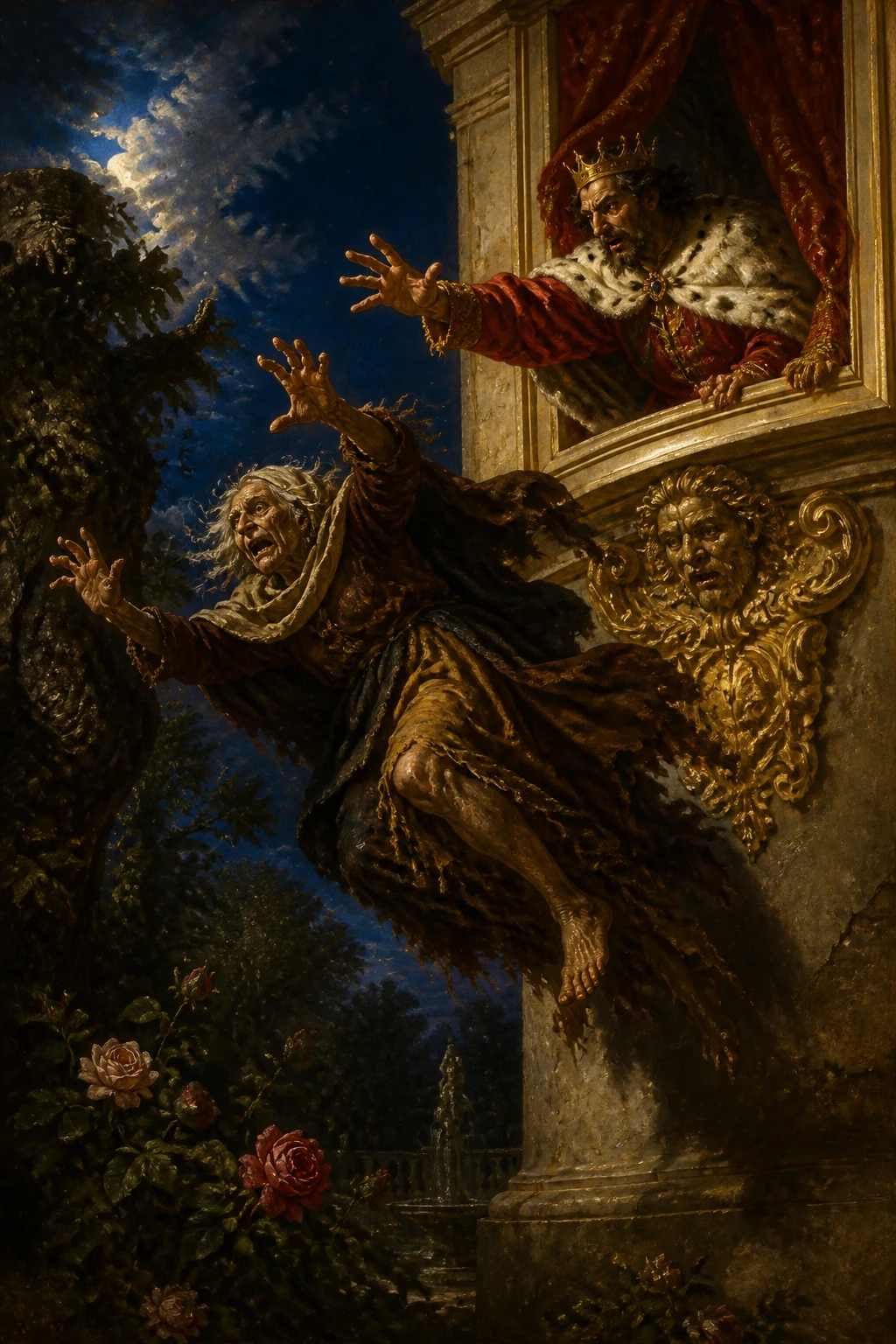
When he made his intentions known to his daughter, she gave him such a dressing-down and tongue-lashing that Heaven itself must tell you of it. The king, beside himself with rage, said, “Lower that voice and stick that tongue back where it belongs! Make up your mind to tie this marriage knot tonight, or your ear will be the largest piece left of you.” Hearing this resolve, Preziosa withdrew to her chamber, where, bewailing her wretched fate, she scarcely left a hair upon her head untorn. While she was holding this mournful wake, an old woman arrived who used to bring her cosmetics. Finding her more in the other world than in this, and learning the cause of her sorrow, she said, “Take heart, my child, and do not despair: there is a remedy for every evil except death. Now listen: tonight, when your father, ass that he is, wishes to play the stallion, put this little stick into your mouth, and at once you will become a she-bear. Then make your escape, for he will be so frightened that he will let you go. Head straight for the forest, where Heaven has kept your good fortune in store since the day you were born. And whenever you wish to appear as the woman you are, and always will be, take the stick out of your mouth, and you will return to your former shape.”
Preziosa embraced the old woman, had a generous apronful of flour, slices of ham, and bacon given to her, and sent her on her way. As the sun, like a bankrupt whore, began changing quarters, the king summoned the musicians and invited all his vassal lords to a splendid feast. After five or six hours of noisy merrymaking, they sat down to table and chewed beyond all measure. Then he went to bed and called for his bride to bring the ledger so that they could settle their accounts of love. She put the stick into her mouth, took the shape of a terrible she-bear, and went towards him. Terrified at this marvel, he rolled himself up in the mattresses and did not poke out his little skull even when morning came. Meanwhile, Preziosa escaped and made her way towards a forest where the shadows were conspiring to see what injury they could do the sun at nightfall. There she lived in the pleasant company of the other animals, until the son of the King of Acqua-Corrente came to those parts. At the sight of a she-bear he nearly died on the spot; but when he noticed how the creature frisked and wagged her tail like a little puppy as she circled him, he took courage. Stroking her and calling, “Here, here! Puss, puss! Chick, chick! Coo, coo! Pretty little thing! Come along, come along!” he took her home, ordering that she should be cared for as though she were his own person, and lodged in a garden beside the royal palace, so that he could see her from a window whenever he pleased. Now, one day when everyone in the household had gone out and the prince was alone, he leaned out to look at the she-bear and saw that Preziosa, having removed the stick from her mouth to dress her hair, was combing her golden tresses. At the sight of such surpassing beauty he was almost beside himself with wonder, and hurtled down the stairs to the garden. But Preziosa, noticing the commotion, thrust the stick into her mouth and became as she had been before. When the prince reached the garden and could not find what he had seen from above, he was so stunned with disappointment that he sank into a deep melancholy and within four days took to his bed, forever saying, “My she-bear! My she-bear!” His mother, hearing this lament, imagined that the bear had somehow hurt him and ordered her killed. But the servants, who had fallen in love with the bear’s gentle ways—for she could have made the very stones in the road love her—could not bear to turn her into butcher’s meat. They took her to the forest and told the queen that they had finished her off. When this reached the prince’s ears, he behaved in ways beyond belief. Rising from his bed, ill as he was, he threatened to make mincemeat of the servants; but on hearing from them how matters really stood, he mounted his horse, more dead than alive, and searched and wandered until he found the she-bear and brought her home again. Having put her in a chamber, he said, “O dainty morsel fit for a king, hidden away inside this skin! O candle of love, shut up in this hairy lantern! Why play these tricks upon me, to see me flounder and waste away hair by hair? I am dying, famished, worn out, and withered for the sake of this beauty; and you can see the proof plainly enough, for I have boiled down to a third, like cooked wine. I am nothing but skin and bone, and fever has stitched itself with double thread into these veins.
“So raise the curtain of that stinking hide, and let me see the splendour of your beauty! Take away the leaves covering this basket, and let me look upon those lovely fruits! Lift this hanging, and let these eyes enter to behold such a display of wonders! Who has imprisoned so smooth a work in a jail woven of hair? Who has locked so fair a treasure in a leather chest? Let me see this marvel of grace, and take all my desires in payment, my darling, for only this she-bear’s grease can ease the cramped sinews from which I suffer.” But after speaking and speaking, and finding that he was throwing his words away, he flung himself back into bed and suffered such a violent attack that the physicians gave a gloomy account of his prospects. His mother, who had no other treasure in the world, sat down beside his bed and said, “My son, what is the source of all this anguish?
“What melancholy humour has seized you? You are young, you are loved, you are great, you are rich: what do you lack, my son? Speak! A bashful beggar carries an empty bag. If you want a wife, you choose and I shall strike the bargain; you take her and I shall pay. Do you not see that your suffering is mine? Your pulse pounds, and my heart with it; fever burns in your blood, and distress in my brain, for I have no prop for my old age but you. So cheer up, and gladden this heart of mine, rather than see this kingdom plunged into mourning, this house laid waste, and your mother tearing out her hair.” Hearing these words, the prince said, “Nothing can comfort me but the sight of the she-bear. So, if you wish to see me well, let her stay in this room. I want no one else to tend me, make my bed, or cook my food but her alone. Surely, with this pleasure, I shall be well in four shakes.” His mother thought it absurd that a she-bear should act as cook and chambermaid, and feared her son was delirious; nevertheless, to please him, she had the bear brought in. Coming up to the prince’s bed, the creature raised her paw and felt the sick man’s pulse, which made the queen smile, though she expected at any moment to see her claw his nose off. But when the prince said to the bear, “My little imp, will you not cook for me, feed me, and look after me?” she bowed her head to show that she accepted the bargain.
At this, his mother had some chickens brought in, a fire lit in a hearth in the very same room, and water put on to boil. The bear took hold of a chicken, scalded it, deftly plucked and gutted it, then put part of it on a spit and made the rest into a fine gratin. The prince, who had been unable to stomach even sugar, licked his fingers over it. And when he had finished stuffing himself, she gave him a drink with such grace that the queen wanted to kiss her forehead. After this, when the prince had got out of bed to put the physicians’ judgement to the test, the bear promptly made his bed and ran into the garden. There she gathered an apronful of roses and orange blossoms and scattered them over it, so that the queen declared the bear was worth a treasure, and that her son had a hundredweight of reason to love her. But the prince, seeing these lovely services, only added fuel to his fire: where before he had wasted away by the dram, now he dwindled by the pound.
And he said to the queen, “My lady mother, unless I give this she-bear a kiss, I shall breathe my last.” The queen, seeing him grow faint, said, “Kiss him, kiss him, my lovely creature! Do not let this poor son of mine waste away before my eyes!”
The she-bear drew near, and the prince caught her in his arms and could not kiss her enough. While they were thus muzzle to muzzle, I know not how, the stick slipped from Preziosa’s mouth, and there in the prince’s arms stood the loveliest creature in the world. Clasping her in the loving pincers of his arms, he said, “I have caught you, little rascal! You shall not escape me again without good cause.” Preziosa, adding the blush of modesty to the picture of her natural beauty, said, “I am already in your hands. I entrust my honour to your keeping; cut and weigh, and turn me where you will.” And when the queen asked who this beautiful young woman was, and what had reduced her to this savage life,
she told the whole story of her misfortunes from beginning to end. The queen praised her as a good and honourable girl, and told her son that she gladly consented to his taking her as his wife. The prince, who desired nothing else in life, immediately pledged himself to her, and his mother, blessing them both together, celebrated this fine union with great festivities and illuminations. And Preziosa bore witness upon the scales of human judgement to the truth that _those who do good may always hope for good._