Prevod
Had she not risen into the air on winged serpents, she would not have escaped punishment. High she flew, over shady Pelion, home of Philyra’s son, and over Othrys and the region famed for old Cerambus’s fate. Here, raised into the air on wings by the nymphs’ help, when the earth lay buried beneath the sea’s vast flood, he escaped Deucalion’s waters without being engulfed.
On her left she leaves Aeolian Pitane and the long serpent’s likeness fashioned out of stone, and Ida’s grove, where Bacchus concealed his son’s theft, a bullock, beneath the semblance of a deer; and the place where Corythus’s father lies beneath a little sand, and the fields that Maera terrified with her strange new barking, and Eurypylus’s city, where the women of Cos wore horns when Hercules and his company departed; and Rhodes, sacred to Phoebus, and the Telchines of Ialysus, whose eyes blighted all things merely by looking upon them, till Jupiter, loathing them, sank them beneath his brother’s waves.
She passes, too, the walls of Carthaea on ancient Ceos, where the father Alcidamas would one day marvel that a gentle dove could have sprung from his daughter’s body. Then she sees Hyrie’s lake and the valley of Cycnus, made famous by his sudden change into a swan. There Phyllius, at the boy’s command, had brought him birds and a savage lion, all tamed; ordered also to subdue a bull, he had subdued it, but, angered that his love had so often been scorned, refused the bull when the boy demanded this final prize.
Indignant, the boy said, “You will wish you had given it,” and leaped from a high cliff. All thought he had fallen to his death: but, changed into a swan, he hung in the air on snowy wings. His mother Hyrie, unaware that he was saved, melted away in tears and became the lake that bears her name. Nearby lies Pleuron, where Combe, daughter of Ophius, escaped her sons’ attacks on fluttering wings.
Then she beholds the fields of Calaurea, sacred to Leto, witness to a king’s transformation, with his wife, into birds. On her right is Cyllene, where Menephron would lie with his mother like a savage beast. Far from there she looks back at Cephisus, mourning his grandson’s fate, changed by Apollo into a bloated seal, and at the home of Eumelus, who mourned his son, now flying through the air.
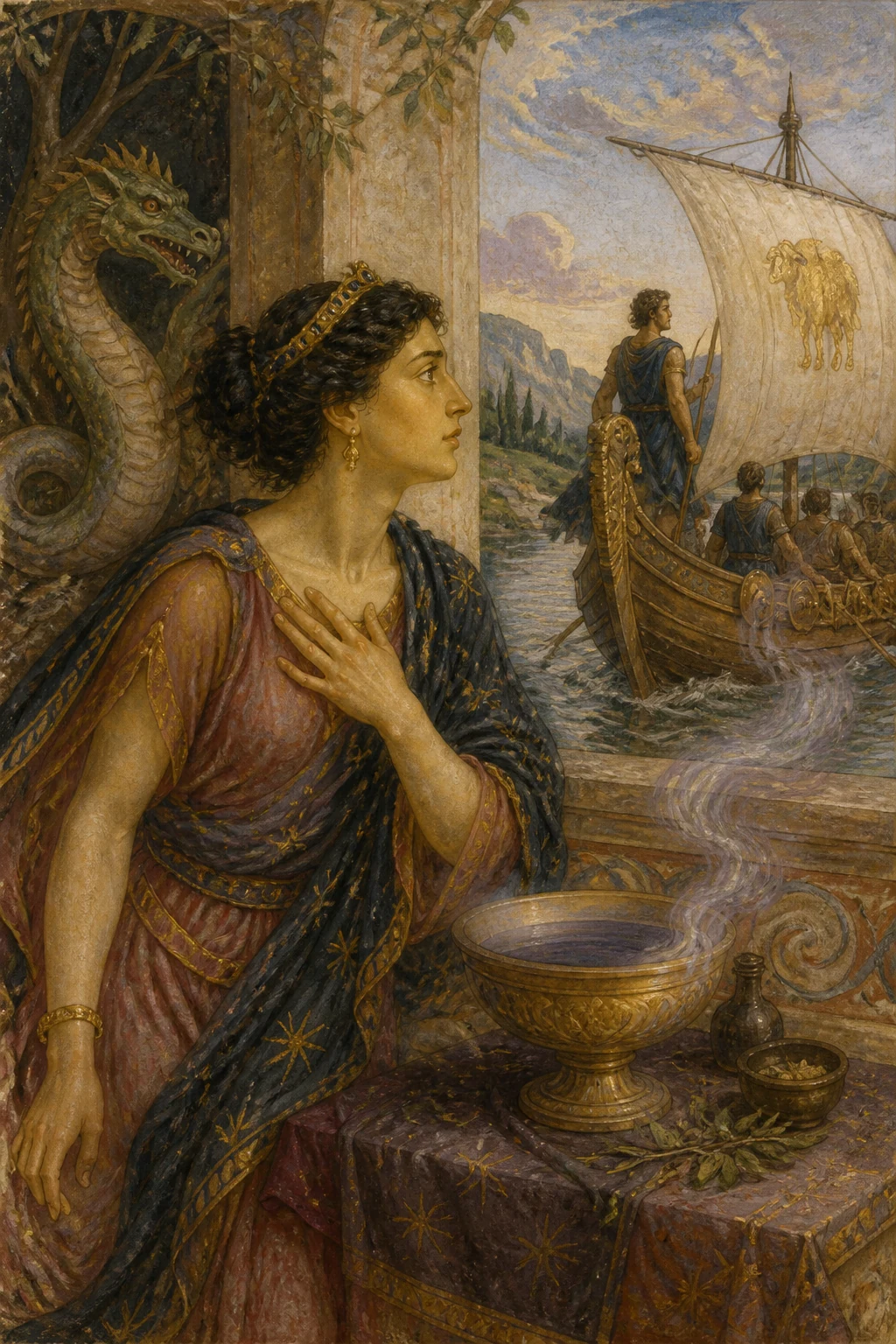
At last, on her serpents’ wings, she reached Ephyre, land of Pirene. Here, in the earliest age, ancient tradition tells, human bodies sprang from mushrooms born of rain. But after the new bride had burned through Colchian poison, and both seas had seen the king’s palace ablaze, her impious sword was drenched in her children’s blood; and the mother, having taken a wicked vengeance, escaped Jason’s weapons.
Carried away from there by the Titan’s dragons, she entered the citadel of Pallas, which had seen you, most righteous Phene, and you, aged Periphas, both flying through the air, and Polypemon’s granddaughter borne on newfound wings. Aegeus welcomed her, blameworthy in this one deed alone; nor was hospitality enough: he bound himself to her in marriage. Now Theseus had arrived, a son still unknown to his father, who by his valour had brought peace to the Isthmus between two seas.
To destroy him, Medea mixed the aconite she had once brought with her from the shores of Scythia. They say it sprang from the teeth of Echidna’s hound. There is a cave with a dark, gaping mouth, and a downward path by which the Tirynthian hero dragged Cerberus out, bound with chains of adamant, while he struggled and turned his eyes away from daylight and the glittering sunbeams. Roused to furious rage, he filled the air with barking from his three throats and spattered the green fields with white foam.
This, they believe, took root and, nourished by the rich and fertile soil, acquired its power to poison. Because these plants spring up and thrive on hard rock, country people call them aconite. Through his wife’s cunning, Aegeus himself offered it to his son as though to an enemy. Theseus had taken the offered cup in his unsuspecting hand, when his father recognized, on the sword’s ivory hilt, the emblems of his own house, and dashed the deadly cup from his lips.
She escaped death in clouds conjured by her spells.