Prevod
And now the land of Etna sheltered the weary Daedalus, and Cocalus, who had taken up arms for his suppliant, was praised for his kindness; now Athens had ceased to pay its mournful tribute, thanks to Theseus’ glorious deed. The temples were wreathed with garlands, and they invoked warlike Minerva with Jupiter and the other gods, honoring them with the blood of vowed sacrifices, gifts, and caskets of incense.
Wandering rumor had spread the name of Theseus through the cities of Argos, and the peoples who dwelt in wealthy Achaia implored his help in times of great peril. Calydon, though it had Meleager, also sought his aid with anxious, suppliant prayers. The reason for its plea was a boar, the servant and avenger of wrathful Diana. For Oeneus, they say, rejoicing in a year of plenty, had offered the firstfruits of his crops to Ceres, his wine to Lyaeus, and the oil of Pallas’ olive to golden-haired Minerva.
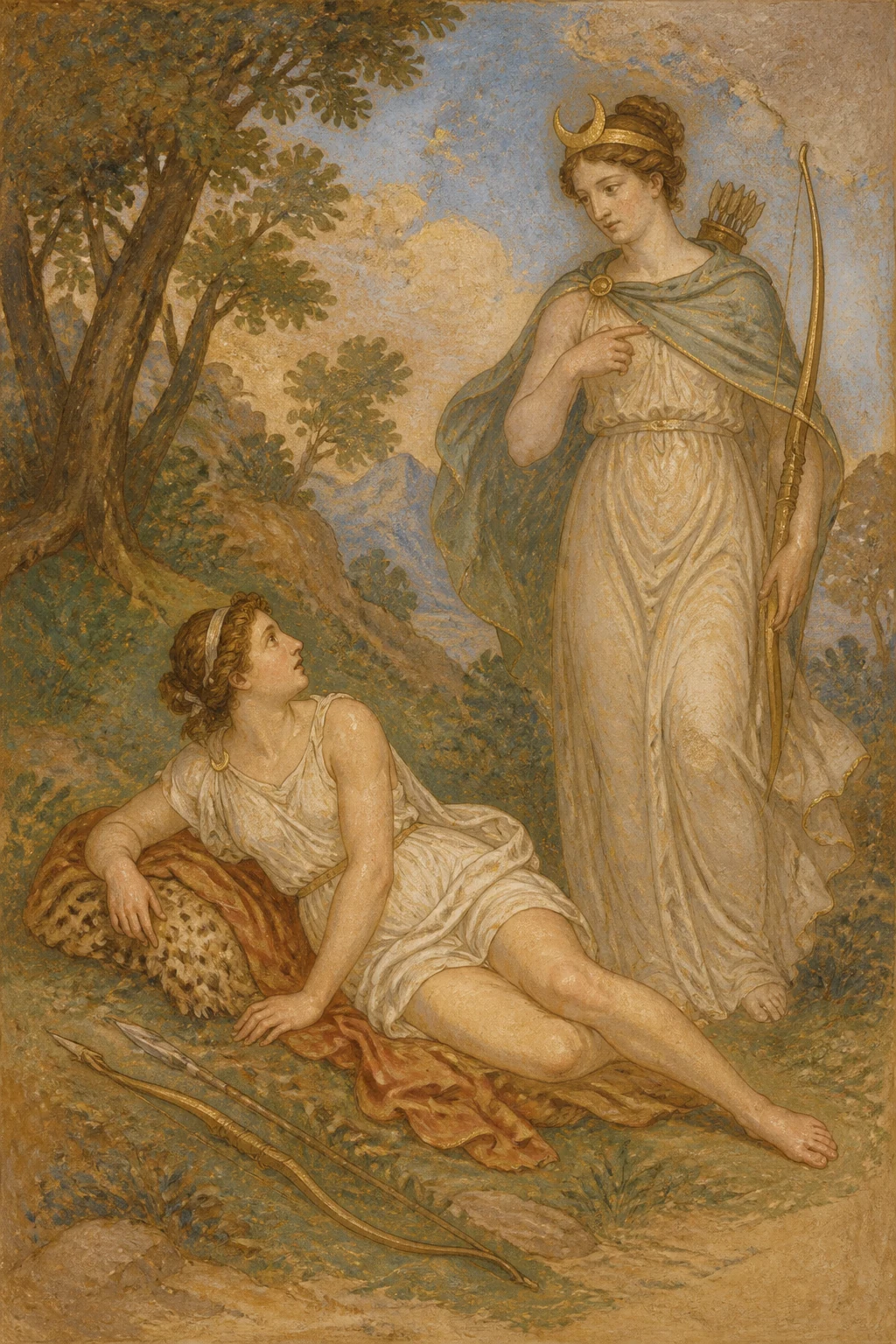
This zealous homage, begun by the farmers, reached all the gods above; only the altars of Latona’s daughter, they say, were passed over and left without incense. Anger touches even the gods. “We shall not endure this unpunished: though dishonored, we shall not be called unavenged,” she said, and, spurned, sent a boar to ravage Oeneus’ fields, a creature so huge that grassy Epirus breeds no greater bulls, while those of Sicily’s fields are smaller.
Its eyes flash with blood and fire; its shaggy neck bristles, and its hairs stand stiff as spear shafts, rising like a palisade, like tall shafts of spears. With a harsh hissing, seething foam pours down its broad shoulders; its tusks rival an Indian elephant’s. Lightning comes from its mouth; its breath sets leaves ablaze. Now it tramples the growing crops while still green, now it reaps the ripened hopes of farmers doomed to weep, destroying Ceres’ grain in the ear. In vain the threshing floor, in vain the granaries await the promised harvest.
Heavy clusters are strewn on the ground with the long vine shoots, and olives with the branches of the evergreen tree. It rages against the flocks as well: neither shepherd nor dog can protect them, nor fierce bulls defend the herds. The people scatter, believing themselves safe only within the city walls, until Meleager and with him a chosen band of young men gather, eager for glory: the twin sons of Tyndareus, one famed for boxing, the other for horsemanship; Jason, builder of the first ship; Theseus and Pirithous, happily united in friendship; the two sons of Thestius, and the sons of Aphareus, Lynceus and swift Idas; Caeneus, no longer a woman;
fierce Leucippus, and Acastus, renowned for his javelin; Hippothous and Dryas, and Phoenix, son of Amyntor; the matched sons of Actor, and Phyleus, sent from Elis. Nor were Telamon and the father of great Achilles absent, nor tireless Eurytion, with the son of Pheres and Iolaus of Hyantian Thebes; nor Echion, unbeaten in the race; nor Lelex of Naryx, Panopeus, Hyleus, fierce Hippasus, and Nestor, still in the first years of youth; nor those Hippocoon sent from ancient Amyclae; nor Penelope’s father-in-law, with Ancaeus of Parrhasia; nor the wise son of Ampycus, nor the son of Oecles, still safe from his wife; nor the Tegean girl, glory of Lycaeus’ woods.
A polished clasp fastened her garment at the neck; her hair was simply dressed, gathered in a single knot. From her left shoulder hung an ivory quiver, rattling with arrows, and her left hand held a bow. Such was her dress; her face was one you might truly call maidenly in a boy, boyish in a maiden. The Calydonian hero saw her and desired her in the same instant, though the god opposed his love, and drank in secret flames. “Happy the man,” he said, “whom she deigns to take as husband.” Time and modesty allowed no more: the greater task of the great contest pressed.
A forest thick with trees, which no age had ever felled, rose from the plain and overlooked the sloping fields. When the men reached it, some stretched out nets, some unleashed the hounds, and others followed the deep-pressed tracks, eager to find their peril. There was a hollow valley where streams of rainwater were accustomed to descend; the bottom of its pool was filled with pliant willow, slender sedges, marsh rushes, osiers, and short reeds beneath the taller canes.
Roused from this place, the boar charged fiercely into the midst of its foes, like lightning struck from clashing clouds. The woodland fell before its rush, and the trees it thrust aside crashed loudly. The young men shouted and held their weapons leveled in strong right hands, the broad iron blades quivering. It charged and scattered the dogs, striking at each that stood against its fury, sweeping the barking pack aside.
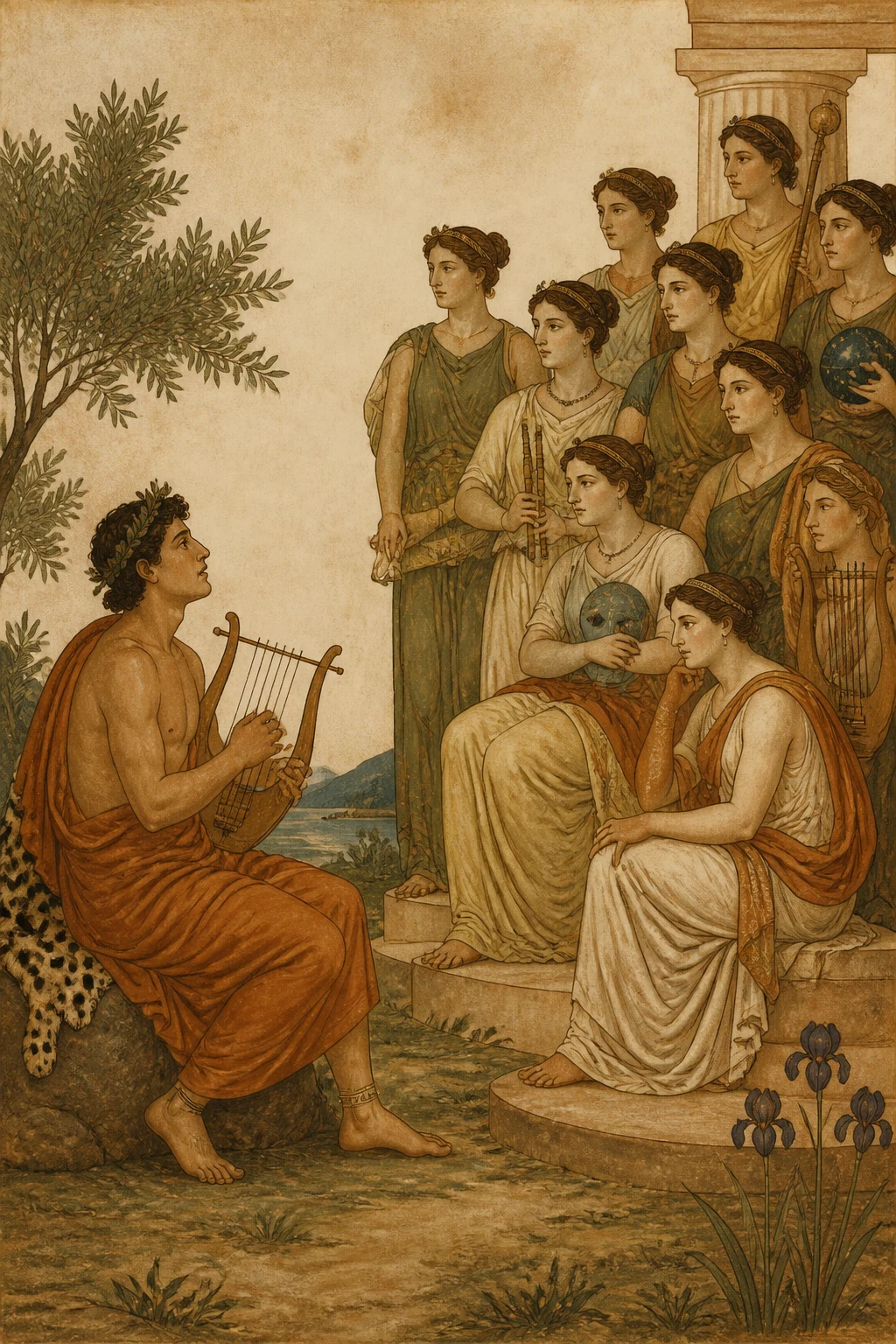
The first spear, hurled by Echion’s arm, missed and lightly wounded the trunk of a maple. The next seemed certain to lodge in the back it aimed at, had its thrower not put too much force behind it: it flew too far. Jason of Pagasae had cast that spear. “Phoebus,” said the son of Ampycus, “if I have worshipped you and worship you still, let my spear strike surely where I aim!”
The god granted the prayer as far as he could: the boar was struck, but not wounded, for Diana had stripped the iron from the flying javelin; the wood arrived without its point. The beast’s anger flared, burning no less fiercely than lightning: flame flashed from its eyes and breathed from its chest. As a heavy stone flies, hurled by a taut-drawn cord, when aimed at walls or towers crowded with soldiers, so the deadly boar charged straight and sure at the young men, laying low Hippalmus and Pelagon, who guarded the right flank; their comrades dragged them away.
But Enaesimus, Hippocoon’s son, did not escape the fatal blows: as he trembled and prepared to turn and flee, a slash behind the knee severed his sinews. The Pylian too might have died before the days of Troy, but, planting his spear, he vaulted with all his strength into the branches of a nearby tree and from that safe perch looked down on the foe he had escaped.
Fiercely whetting its tusks on the oak’s trunk, the beast threatened destruction; then, trusting its newly sharpened weapons, it ripped great Eurytus’ son in the thigh with its curving tusk. But the twin brothers, not yet stars in heaven, both splendid to behold, both riding horses whiter than snow, brandished through the air the quivering points of their spears. They would have wounded it, had the bristling beast not entered the dark woods, where neither javelin nor horse could follow.
Telamon pursued, and, heedless in his eagerness, caught his foot on a tree root and fell headlong. While Peleus helped him rise, the Tegean girl set a swift arrow to the string and sent it from her bending bow. The shaft lodged beneath the beast’s ear, grazing its skin and staining its bristles with a little blood. Yet she was no happier at her successful shot than Meleager. He is said to have been the first to see the blood, the first to point it out to his companions, and to say, “You shall receive the honor your courage deserves.”
The men blushed with shame, urging one another on, rousing their spirits with shouts and hurling their weapons in confusion: the crowded volleys spoiled their aim and thwarted their blows. Then the axe-bearing Arcadian, raging toward his doom, cried, “Learn, young men, how far a man’s weapons surpass a woman’s, and make way for my achievement! Though Latona’s daughter herself protect it with her weapons, my right hand shall kill it, despite Diana’s will.”
Such were the boasts he uttered with swelling pride; then, lifting his double-edged axe in both hands, he rose to his full height upon his toes. The beast struck before he could act, driving both tusks high into his groin, the shortest road to death. Ancaeus fell, and his entrails spilled in bloody coils and streamed from his body; the earth was soaked with gore. Pirithous, Ixion’s son, advanced against the foe, brandishing his hunting spears in his strong right hand.
But the son of Aegeus cried, “Keep your distance, dearer to me than myself, half of my soul! The brave may fight from afar: rash courage was Ancaeus’ ruin.” He spoke and hurled a heavy cornel spear tipped with bronze. Well aimed, it would have fulfilled his wish, but a leafy branch broken from a tree blocked its path. The son of Aeson also hurled a javelin, which chance turned from the boar to the doom of an innocent hound: it pierced the dog’s flanks and pinned it through them to the earth.
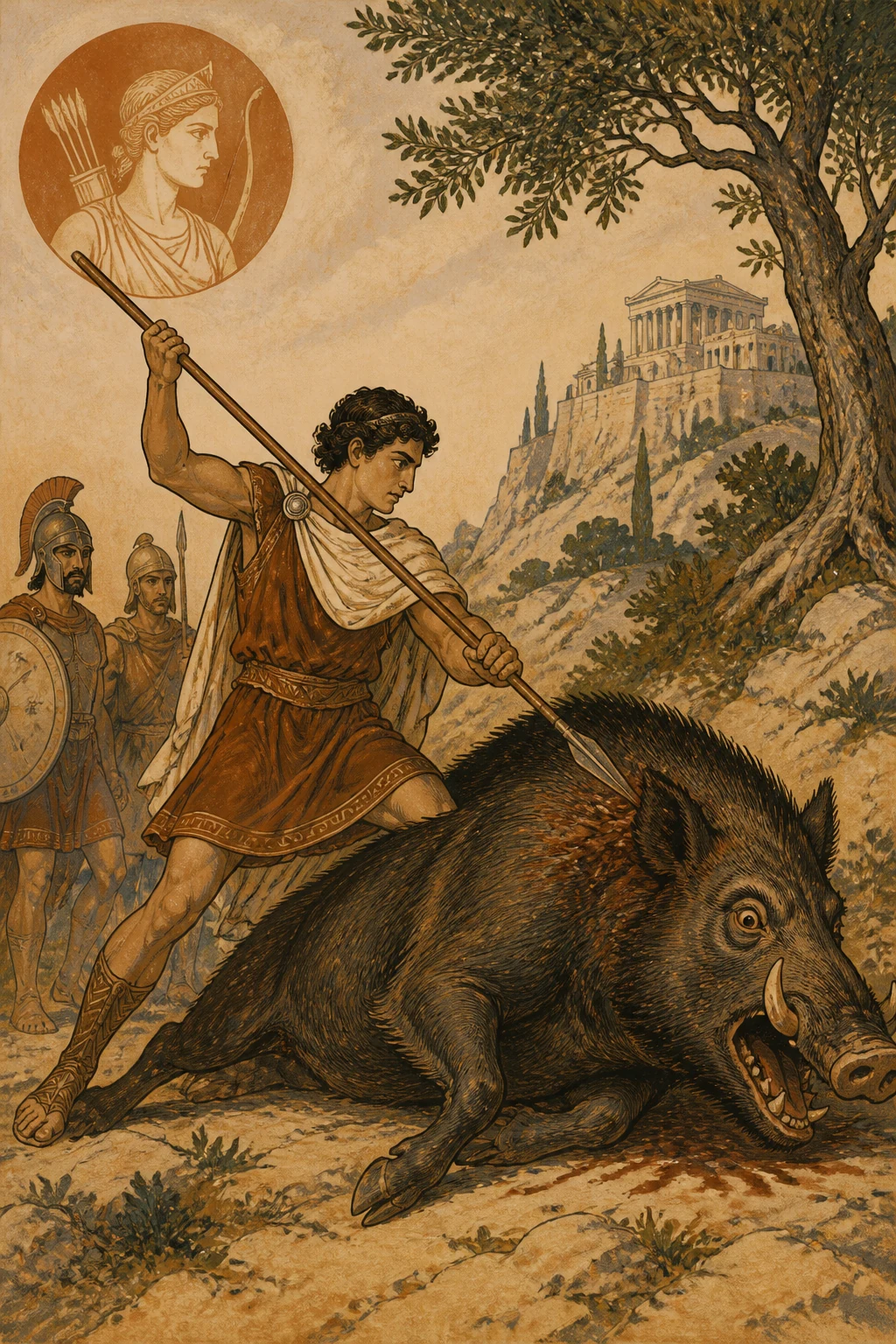
But Oeneus’ son had mixed fortune: of the two spears he threw, the first stuck in the ground, the second in the middle of the boar’s back. At once, as it raged and wheeled its body round, pouring out hissing foam mingled with fresh blood, the man who had wounded it came up, provoked its fury, and buried his gleaming hunting spear deep in its chest. His companions acclaimed their joy with shouts and eagerly clasped his victorious right hand in theirs.
They gazed in wonder at the monstrous beast, stretched over so much ground, and still thought it unsafe to touch; yet each dipped his weapon in its blood. The victor planted his foot upon the deadly head and said, “Take, maiden of Nonacris, the spoils that are mine to bestow, and let my glory be shared with you.” At once he gave her the hide, its back bristling with stiff hair, and the head with its mighty tusks.
She delighted in the gift and in the giver alike; the others envied her, and murmurs ran through the whole company. Among them the sons of Thestius stretched out their arms and shouted loudly, “Come, put them down, woman! Do not steal the honors that are ours. Do not let trust in your beauty deceive you, lest your lovesick champion be too far away to help.” They robbed her of the gift and him of the right to give it.
The son of Mars could not endure it. Gnashing his teeth in swelling anger, he cried, “Learn, you thieves of another’s honor, how far deeds differ from threats!” With impious steel he pierced Plexippus’ breast, which feared no such attack. Toxeus hesitated, uncertain what to do, longing to avenge his brother, yet fearing his brother’s fate. Meleager gave him little time to doubt, but warmed the weapon, still hot from the first murder, in the blood of the other brother.