Prevod
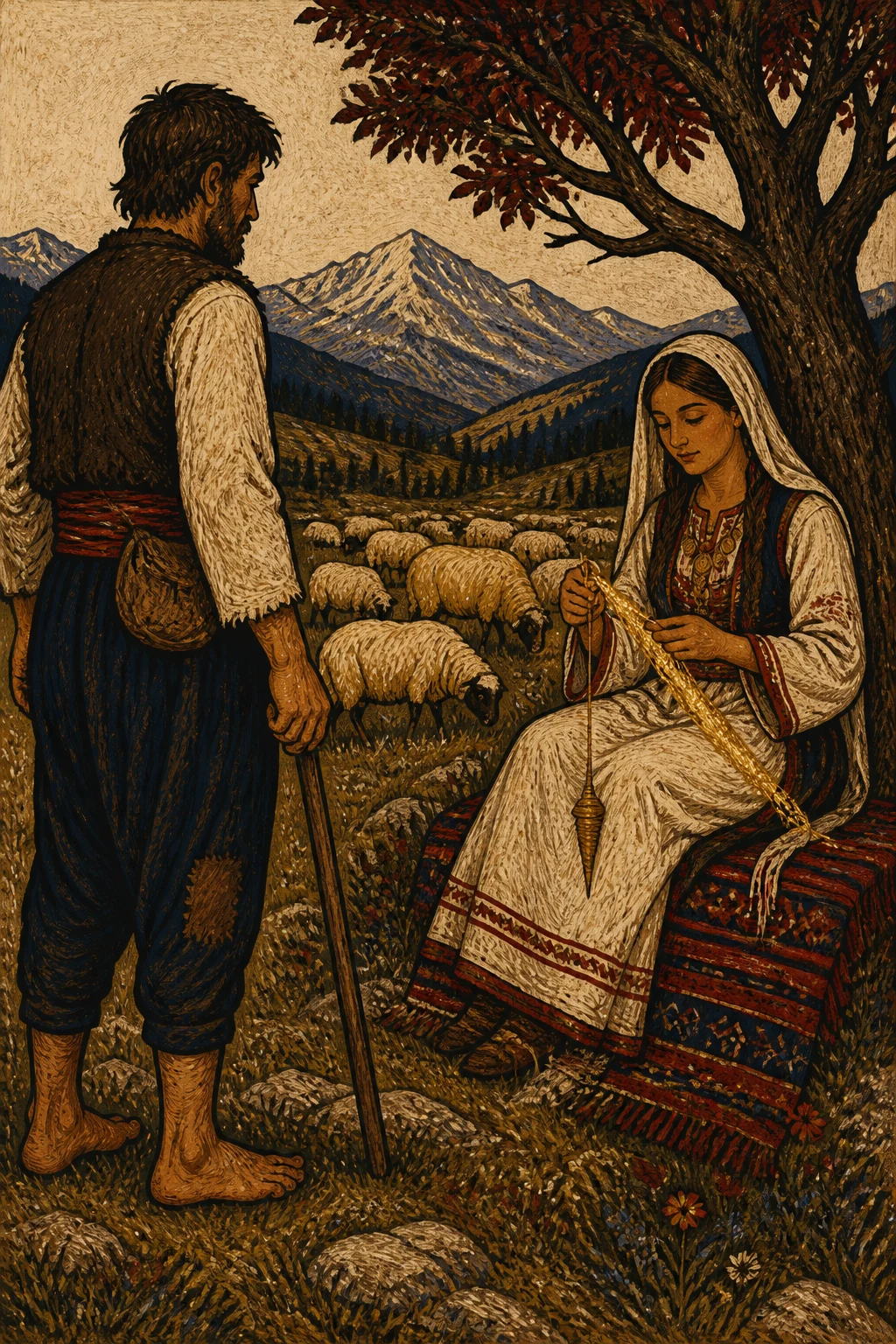
Once upon a time, as never before, and so on, there lived a Wallachian named Negoe. He was a strong, hardworking man. He cared nothing for who you were or whose son you might be. He minded his own little patch of work, paid his taxes, and kept on good terms with everyone in the village; and somehow, by one means or another, he managed his affairs so that the earnings of his labour would last him a good long while. In time he came to marrying age and, like any good Christian, did as people do. But what should happen? The very moment his wife came through the door, Poverty slipped into his house as well. She found an old chest, neglected and forgotten in a corner of Negoe’s cottage, which no one ever looked at, and there, without a sound, Poverty made herself a nest. She sat cross-legged on the chest all day long and all night through, and as for stirring from the spot—not she! The chest, it seems, was empty; nobody put anything into it any more, so old and rickety had it grown. Poor Negoe saw that he was beginning to fall behind. Things no longer went as smoothly as before, and he began to brood, for he knew he was working even harder than he used to; yet now he could scarcely make ends meet. The poor man wore himself to the bone with work, but as for putting anything by—not a chance, Heaven preserve us! Indeed, he was brought so low that wicked thoughts began tempting him to take his own life; for the devil, as you know, has nothing better to do—he does not build churches or dig wells at crossroads. The poor fellow struggled with mind and body, but it was as though a spell had been cast upon him: he went from loss to loss until he was utterly destitute. The whole village had noticed him, seeing him at work now for neighbour Burcilă, now for the village elders or the leading householders, now for the priest. He always found something to do; he worked for everyone, and everyone prospered by his labour. But whenever he worked for himself, his toil came to nothing. If the waters rose, it was his ploughed fields they flooded. If beasts or crows descended upon his neighbours’ crops, his own were destroyed altogether. If hail struck the grain, it pounded his into the earth until not a trace remained. One time the maize would be blighted, another there would be locusts or a flood: every misfortune fell upon his head. His fellow villagers and neighbours joined forces more than once to lend him a hand or give him a day’s labour, but all in vain; nothing turned out well for him. At last his neighbours and the whole village gave him up. Everyone thought good fortune was simply not his lot, and believed that some curse from God must have fallen upon him. The man came to loathe his very life. And so, one Sunday, as he sat with a bitter heart and his pipe in his mouth, wondering how to put an end to himself, for he was sick to death of poverty, his wife came and told him that before long he would be a father. Raising his eyes to her, he seemed to catch sight of a hideous creature sitting cross-legged, all hunched up, on the old, unused chest. He rubbed his eyes and looked again, and what should he see? A shrivelled hag, uglier than the plague, with a chin so hooked it seemed about to catch her nose, eyes sunk into hollow sockets, hair sticking up as though it had been piled on her head with a pitchfork, hands like winding-reels, and a back so humped and knotted that her like was nowhere to be found in all the world. When he saw such a foul monstrosity sitting like an evil omen in his house and on his chest, an icy shudder ran through him. But he kept his nerve, went straight up to her, and asked, “Who are you, and what are you doing here?” “I am Poverty,” she answered, “and I have come uninvited.” “Get out of my house!” “Oh, not so fast, my fine fellow,” Poverty replied, grinning mockingly at him. “To drive Poverty out of your house, you must have something to put in her place.” And, grinning once more, she showed him fangs that would have frightened the devil himself. The poor man held his tongue and swallowed the insult. The thought that he was to become a father, and her words about having something to put in Poverty’s place, set his mind working. He meant to drive Poverty from his house, for he could not stomach the affront she had offered him, nor could he bear to leave his offspring in her accursed hands. Once more he threw himself into work, toil fit for a galley slave. He strained this way and that, turned night into day, and worked hand and foot, as the saying goes, yet gained not so much as the black beneath a fingernail. Troubles beset him on every side, and he no longer knew what to do. Whenever he came into the house, that shrivelled Poverty grinned at him in mockery. Then one day his wife’s time came, and she gave birth to a plump little boy, healthy and strong like his father. What was he to do now? He had no money, and not enough food to blind a mouse; as for clothes or household comforts—not a thing! There was nothing, absolutely nothing, in his house for the eye to rest upon. How was he to manage? He would have liked to find a godfather of some standing to christen the child, and to give a christening feast himself. But with what? The poor man stood with folded arms, looking up to heaven and down at the earth, not knowing whom to turn to. Being an honest fellow by nature, he had no wish to deceive anyone with lies. He knew one thing, and held to it: when he said yes, it must be yes; when he said no, then no it was. For a long time he had known a prosperous shepherd, but the man was not in the village: he had his sheep up in the mountains. Then, as luck would have it, someone came and invited Negoe to share a drink. And whom should he find there but his friend! His delight was beyond telling. He asked the shepherd to become his child’s godfather, and the shepherd gladly agreed to christen the little one. May good fortune attend him! Everything was arranged as it should be. At the christening, the shepherd gave his godson a breeding ewe. That was all Negoe needed. When the time came to leave, the shepherd said, “My friend, you have nowhere to keep the little ewe. Leave her in my flock, and I shall look after her just as I do my own.” “Very well, my friend,” Negoe answered. “Let it be as you say.” He was only too glad to have the burden taken off his hands, for he scarcely had anything to eat himself, let alone anything to give a sheep. The shepherd went away with his flock. The man set to work again, but his labour brought him barely enough to keep body and soul together. You might say he was working for nothing. After some time, a hired man from the shepherd’s fold appeared at his door. “Master has sent me to you with this wool.” “Well, and what am I to do with it?” “You see, sir, master had his sheep shorn, and he had his godson’s ewe shorn too. This is her wool, and he has sent it to its rightful owner.” “Many thanks for his kindness. Give my friend our warmest wishes, and may we hear nothing but good news of him.” Taking the wool from the hired man, Negoe went into the house, walked straight up to Poverty, and said in a bold voice, “Move aside, Poverty. I am putting this wool there.” But Poverty, bless you, had no wish to leave the nest she had made for herself. She grinned again, but this time her grin cost her dear, for the sturdy fellow swung the wool at her and—thump!—caught her such a blow on the back of the neck that she almost bit through her tongue, and toppled her off the chest. Poverty stayed where she had fallen, in a sorry heap. His godson’s ewe had borne a lamb, and when it had grown a little, the shepherd sheared it along with the other lambs and sent its fleece home as well. The peasant, bolder now, entered the house and went straight up to Poverty again. “Move along, you grinning hag! I am putting this fleece there.” And since Poverty still dawdled, he struck her with the fleece so hard that it sent her head over heels, nearer the door. In autumn another hired man arrived, bringing him a leather bag full of cheese. “The head shepherd at the fold,” he said, “saved the milk from his godson’s ewe, made it into cheese, and sent me to bring it home.” “Tell my friend,” Negoe answered, “that his godson kisses his hands, and may we meet again in good health.” Then he hurried into the house, went up to Poverty, and said, “Move aside, Poverty. I am putting this bag in your place.” “But where am I to go now?” Poverty answered. “Out of doors, if there is no room for you! Go and lodge in the steel of some hunter’s gun—that is where you belong.” “Oh, is that what you think? You can whistle for it!” But he struck her on the head with the bag of cheese and knocked her into a crumpled heap behind the door. Poor Negoe was obliged to spend another whole winter with Poverty by his hearth. The following summer, the little ewe’s lamb was full-grown. This time they brought him two fleeces. The peasant came in with both in his hands and, thumping and belabouring Poverty, bade her leave without waiting for an invitation to dinner. When Poverty saw that he meant business, she bolted out through the door; and then you should have seen her go! Her heels fairly smoked as she ran, until she went off to hatch her eggs in the steel of hunters’ guns. And ever since then hunters have been poor, for they waste their time in the far corners of the woods and among the brambles, roaming about all day to shoot some wretched little bird or other. Negoe began to kick up his heels with joy at having rid himself of Poverty. Now whatever he put his hand to, God lent His blessing. Everything went well for him. He too began to put something by. His labour brought visible progress, and he enjoyed the fruits of
it. What more is there to tell? In a short time, through his diligence, he became one of the foremost men in the village, with livestock, a little plough, and all the belongings of a man favoured by God. You see, it takes livestock to drive Poverty out of the house.