Prevod
The well was deep, and so the rope was long; the windlass was hard to turn when the bucket of water had to be raised over the rim. The sun could never reach down far enough to see its reflection in the water, however clear it might be, but wherever its rays could reach, green things grew between the stones.
A family of toads lived there. They were newcomers, having arrived headlong with old Mother Toad, who was still alive. The green frogs, who had made their home there long before and swam about in the water, acknowledged the family connection and called them “the well-guests.” These guests certainly meant to stay; they lived very comfortably on dry land, as they called the wet stones.
Mother Frog had once been on a journey, riding up in the water bucket, but it grew too bright for her and she had to screw up her eyes. Luckily, she escaped from the bucket; she fell into the water with a tremendous splash and lay for three days afterwards with a bad back. She could not tell them much about the world above, but she knew, and they all knew, that the well was not the whole world. Mother Toad could surely have told them a thing or two, but she never answered when she was asked, and so they stopped asking.
“She’s fat and ugly, nasty and flabby!” said the young green frogs. “Her children will be just as nasty!” “Very likely!” said Mother Toad, “but one of them has a precious jewel in its head—or else I have it!”
The green frogs heard this and stared, and as they did not like it, they pulled faces and sank to the bottom. But the young toads stretched out their hind legs in sheer pride; every one of them believed it had the jewel. And so they held their heads quite still, until at last they asked what it was they were so proud of, and what a precious jewel really was.
“It is something so glorious and costly,” said Mother Toad, “that I cannot describe it! It is something you carry about for your own pleasure, while everyone else goes about envying you. But don’t ask me—I won’t answer!”
“Well, I haven’t got the jewel!” said the smallest toad, who was as ugly as ugly could be. “Why should I have anything so wonderful? And if it annoys other people, it cannot give me any pleasure! No, all I wish is that some day I might get up to the rim of the well and look out. It must be lovely there!”
“You had better stay where you are!” said the old toad. “You know this place; you know what it is like! Beware of the bucket—it will crush you. And even if you do get into it, you may fall out. Not everyone falls as luckily as I did, with all their limbs and all their eggs still whole!”
“Croak!” said the little one, and it was much as when we human beings say “Alas!” It longed so much to get up to the rim of the well and look out; it felt such a yearning for the green things above. And when, next morning, the bucket happened to be drawn up full of water, and for a moment stood still beside the stone where the toad was sitting, a tremor ran through the little creature. It jumped into the brimming bucket and sank to the bottom of the water, which was then drawn up and poured out.
“Ugh, what a horrible thing!” said the farmhand who caught sight of it. “That’s the nastiest creature I’ve ever seen!” And he kicked at the toad with his wooden shoe. It was nearly maimed, but managed to escape among the tall nettles. It saw stalk upon stalk, and it looked upwards too! The sun shone on the leaves, making them quite transparent; to the toad it was as it is to us when we suddenly enter a great forest where the sun shines through the branches and leaves.
“It is far lovelier here than down in the well! One could wish to stay here all one’s life!” said the little toad. It lay there for an hour; it lay there for two! “I wonder what there is outside? Now I’ve come so far, I must try to go farther!” And it crawled as fast as it could, coming out onto the road, where the sun shone upon it and the dust powdered it as it marched across the highway.
“Now this really is dry land!” said the toad. “I’m almost getting too much of a good thing—it makes me tingle!” It now reached the ditch, where forget-me-nots and meadowsweet grew. Close by was a hedge of elder and hawthorn, twined with “Mary’s white sleeves,” the bindweed flowers. There were colours here to look at, and a butterfly flew past. The toad thought it was a flower that had broken loose so that it could look about the world more easily, which seemed perfectly reasonable.
“If only I could dart about like that,” said the toad. “Croak! Ah, how lovely!” It stayed beside the ditch for eight nights and days, with no shortage of food. On the ninth day it thought, “Onward!” Yet what could there be more beautiful than this? Perhaps a little toad, or some green frogs. During the night, sounds had come on the wind as though there were “cousins” nearby. “How lovely it is to be alive! To get out of the well, lie among the nettles, crawl along the dusty road, and rest in the wet ditch! But onward! I must find some frogs or a little toad. One cannot do without them, after all; nature alone is not enough!” And so it set out on its travels again.
It came to a large pond in a field, with reeds all round it, and made its way inside. “Perhaps it’s too wet here for you?” said the frogs. “But you are very welcome! Are you a gentleman or a lady? It makes no difference—you are equally welcome!”
And so it was invited to a concert that evening, a family concert: great enthusiasm and thin voices—we know the sort. There were no refreshments, only free drinks, the whole pond, if they could manage it.
“Now I’m travelling on!” said the little toad; it always felt a longing for something better. It saw the stars twinkling, so large and clear; it saw the new moon shining; it saw the sun rise higher and higher.
“I must still be in the well, only a larger well. I must get higher up! I am so restless and full of longing!” And when the moon grew full and round, the poor creature thought, “Could that be the bucket being lowered, the one I must jump into to get higher up? Or is the sun the great bucket? How large it is, how radiant! It can hold us all! I must watch for my chance! Oh, how bright it is inside my head! I don’t believe the jewel could shine more brightly! But I haven’t got it, and I’m not crying over that. No, higher up, into radiance and joy! I feel so certain, and yet so afraid—it is a hard step to take! But take it one must! Onward! Straight along the highway!”
And it took such steps as a crawling creature can, until it reached the public road where people lived. There were flower gardens and kitchen gardens alike. It stopped to rest beside a cabbage patch.
“What a lot of different creatures there are that I have never known! And how great and blessed the world is! But one must look about in it, too, and not stay sitting in one place.” And so it hopped into the cabbage patch. “How green it is here! How pretty!”
“I know that well enough!” said the cabbage caterpillar on its leaf. “My leaf is the biggest in the whole patch! It hides half the world, but I can do without that half!” “Cluck! Cluck!” Some hens were coming, stepping briskly through the cabbage patch. The foremost hen was far-sighted; she saw the caterpillar on the crinkled leaf and pecked at it, sending it tumbling to the ground, where it twisted and wriggled. The hen looked first with one eye, then with the other, for she did not know what might come of all that wriggling.
“It isn’t doing that of its own free will!” thought the hen, raising her head to strike. The toad was so terrified that it crawled straight towards her.
“So it has reinforcements!” she said. “Just look at that crawling thing!” And the hen turned away. “I don’t care for that little green mouthful. It would only tickle my throat!” The other hens agreed, and off they went.
“I wriggled my way out of that!” said the caterpillar. “It is a good thing to have presence of mind. But the hardest part is still to come: getting back onto my cabbage leaf. Where is it?”
The little toad came over and expressed its sympathy. It was glad that its ugliness had frightened the hens away. “What do you mean by that?” asked the caterpillar. “I wriggled free of them myself. You are very unpleasant to look at! May I be left to myself? Now I can smell cabbage! Now I’m beside my leaf! There is nothing so lovely as one’s own home. But I must get higher up!”
“Yes, higher up!” said the little toad. “Higher up! It feels just as I do! But it is out of sorts today; that comes of its fright. We all want to get higher up!” And it looked as high as it could.
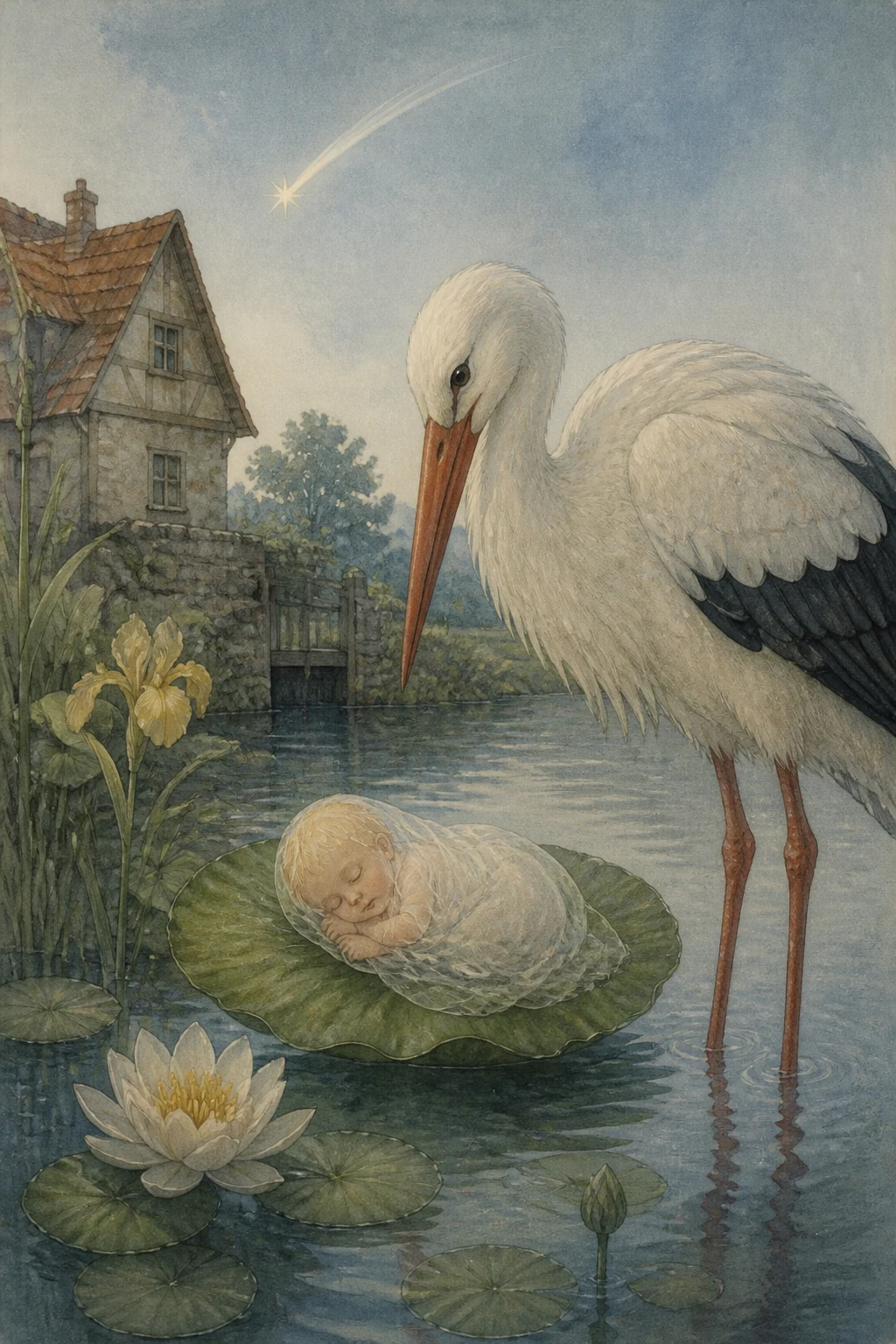
The stork sat in his nest on the farmer’s roof. He clattered his beak, and Mother Stork clattered hers. “How high up they live!” thought the toad. “If only I could get up there!”
Two young students were staying in the farmhouse: one was a poet, the other a naturalist. One sang and wrote joyfully of all that God had created, as it was reflected in his heart; he poured it out in brief, clear, richly ringing verse. The other took hold of the thing itself, indeed, cut it open when necessary. He treated the Lord’s handiwork as a great sum: he subtracted and multiplied, wishing to know it inside and out and to speak of it with understanding. And sound understanding it was; he spoke of it joyfully and wisely. They were good, happy people, both of them.
“There’s a fine specimen of a toad sitting there!” said the naturalist. “I must have it in spirits!” “You already have two others!” said the poet. “Leave it in peace to enjoy itself!”
“But it is so beautifully ugly!” said the other. “Well, if we could find the jewel in its head,” said the poet, “I would help you cut it open myself!”
“The jewel!” said the other. “You certainly know your natural history!” “But isn’t there something very beautiful in that folk belief that the toad, the ugliest of all creatures, often conceals the most precious jewel in its head? Isn’t it the same with human beings? What a jewel Aesop possessed—and Socrates, too!” The toad heard no more, and did not understand half of what it had heard. The two friends walked away, and it escaped being put in spirits.
“They were talking about the jewel too!” said the toad. “It’s a good thing I haven’t got it, or I would have been in trouble!” Just then a clattering came from the farmer’s roof. Father Stork was giving his family a lecture, and they were looking down askance at the two young men in the cabbage patch.
“Human beings are the most conceited creatures!” said the stork. “Listen to their tongues wagging! And yet they cannot make a proper clatter. They pride themselves on their gift of speech, their language! A fine sort of language it is: with every day’s journey we make, it becomes unintelligible to them; one cannot understand another. We can speak our language all over the world, in Denmark and Egypt alike. Human beings cannot fly, either! They get about by an invention they call ‘the railway,’ but they often break their necks on it. It sends a shiver through my beak to think of it! The world can get along without human beings. We can do without them! So long as we may keep the frogs and earthworms!”
“That was a mighty speech!” thought the little toad. “What a great man he is! And how high he sits—higher than I have ever seen anyone sit before! And how he can swim!” it exclaimed as the stork spread his wings and swept through the air.
And Mother Stork spoke in the nest, telling of the land of Egypt, of the waters of the Nile, and of all the matchless mud in that foreign country. It sounded quite new and delightful to the little toad.
“I must go to Egypt!” it said. “If only the stork would take me along, or one of his children. I would repay the favour on its wedding day. Yes, I shall get to Egypt, for I am so happy! All this longing and desire I feel is far better than having a jewel in my head!”
And yet that was the very jewel it possessed: the eternal longing and desire to rise, always higher! It shone within, it shone with joy, it sparkled with desire. Just then the stork came. He had seen the toad in the grass, swooped down, and took hold of the little creature none too gently. His beak pinched, the wind rushed past; it was not pleasant, but upwards it went, upwards towards Egypt, the toad knew. And so its eyes shone; it was as though a spark flew out of them:
“Croak! Ah!” The body was dead; the toad had been killed. But the spark from its eyes—what became of that? The sunbeam took it; the sunbeam carried away the jewel from the toad’s head. Where to?
You must not ask the naturalist; better ask the poet. He will tell you as a fairy tale, and the cabbage caterpillar will be in it, and the stork family too. Just think! The caterpillar is transformed and becomes a beautiful butterfly! The stork family flies over mountains and seas to distant Africa, and yet finds the shortest way home again to Denmark, to the very same place, the very same roof! Yes, it really is almost too much like a fairy tale, and yet it is true. You may ask the naturalist; he must admit it. And you know it yourself, too, for you have seen it.
But the jewel in the toad’s head? Seek it in the sun! Look at it if you can! The radiance there is too strong. We do not yet have eyes to look into all the glory God has created, but surely we shall have them, and that will be the loveliest fairy tale of all, for we ourselves shall be part of it!