Prevod
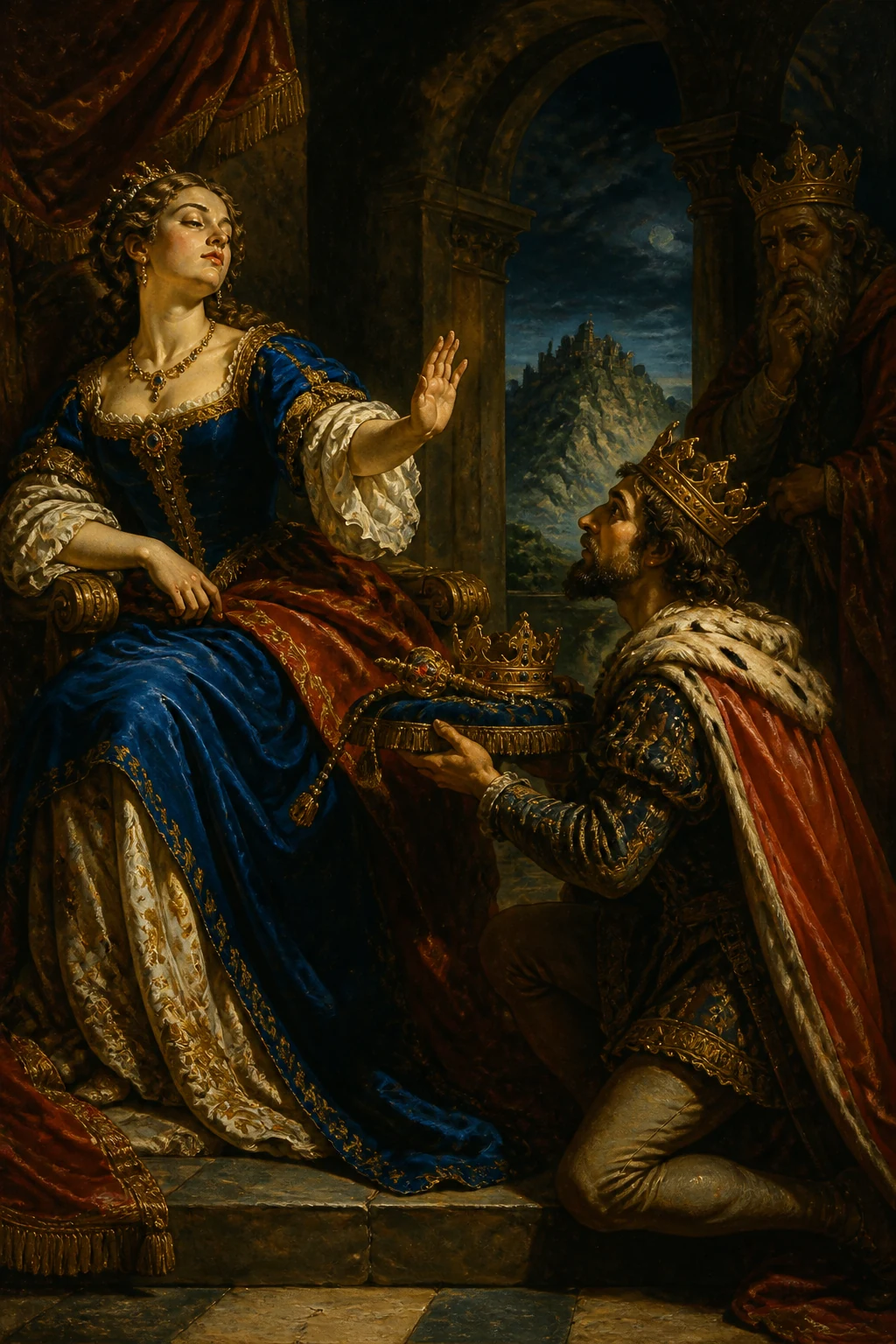
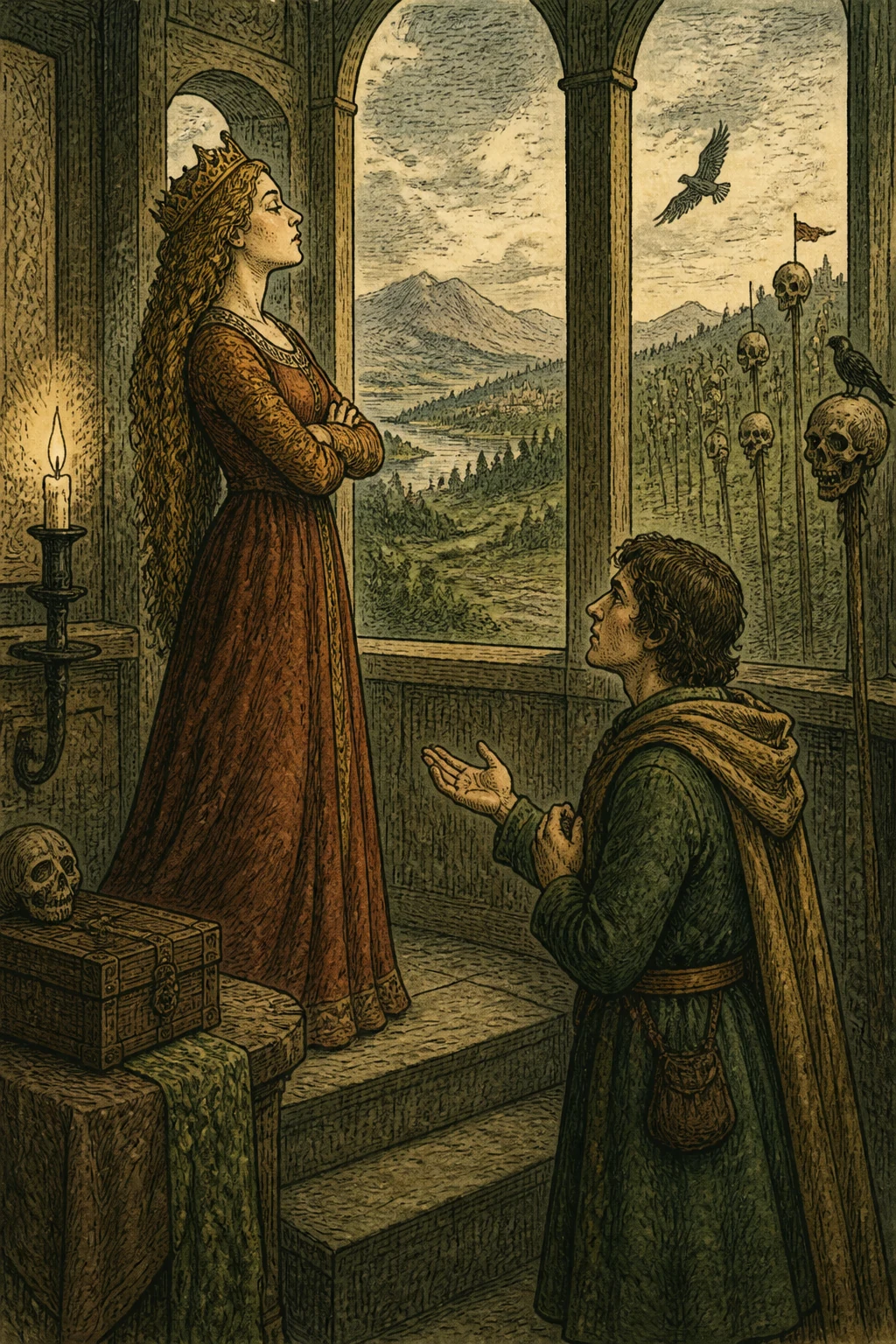
A king had a daughter who was beautiful beyond measure, but so proud and haughty that no suitor was good enough for her. She rejected them one after another, and mocked them into the bargain. One day the king had a great feast prepared and invited all the men from near and far who wished to marry. They were arranged in a row according to rank and station: first came the kings, then the dukes, princes, counts, and barons, and last of all the noblemen. The princess was led along the row, but she found fault with every one of them. One was too fat for her. "What a wine barrel!" she said. Another was too tall. "Long and lank, with a wavering walk." The third was too short. "Short and stout, with no grace about." The fourth was too pale. "Death warmed over!" The fifth was too red. "A barnyard cock!" The sixth was not straight enough. "Green wood dried behind the stove!" And so she found something to criticize in every one of them, but she made particular fun of a good king who stood at the head of the row and whose chin had grown a little crooked. "Why," she cried with a laugh, "his chin is like a thrush's beak!" And from that time on he was called King Thrushbeard. But when the old king saw that his daughter did nothing but mock these men and scorned every suitor gathered there, he grew angry and swore that she should marry the very first beggar who came to his door.
A few days later a minstrel began singing beneath the window, hoping to earn a small alms. When the king heard him, he said, "Have him come up." So the minstrel entered in his dirty, ragged clothes, sang before the king and his daughter, and, when he had finished, asked for a charitable gift. The king said, "Your singing has pleased me so well that I shall give you my daughter here for your wife." The princess was horrified, but the king said, "I swore an oath to give you to the first beggar who came along, and I mean to keep it." No objections were of any use. The priest was sent for, and she had to marry the minstrel then and there. When it was done, the king said, "Now that you are a beggar's wife, it would not be fitting for you to stay any longer in my palace. You must go away with your husband."
The beggar led her out by the hand, and she had to go with him on foot. When they came to a great forest, she asked, "Ah, whose beautiful forest is this?"
"It belongs to King Thrushbeard; had you taken him, it would be yours." "Alas, poor maiden that I am, if only I had taken King Thrushbeard!"
Then they crossed a meadow, and again she asked, "Whose beautiful green meadow is this?" "It belongs to King Thrushbeard; had you taken him, it would be yours."
"Alas, poor maiden that I am, if only I had taken King Thrushbeard!" Then they passed through a great city, and again she asked, "Whose fine great city is this?"
"It belongs to King Thrushbeard; had you taken him, it would be yours." "Alas, poor maiden that I am, if only I had taken King Thrushbeard!"
"I do not like it at all," said the minstrel, "that you keep wishing for another husband. Am I not good enough for you?" At last they came to a very small cottage, and she said:
"Oh, heavens, how small this house can be! Whose wretched little cottage do I see?" The minstrel answered, "It is your house and mine, where we shall live together." She had to stoop to get through the low doorway. "Where are the servants?" asked the princess. "Servants, indeed!" answered the beggar. "Whatever you want done, you must do yourself. Make a fire at once and put some water on, so you can cook my supper. I am quite worn out." But the princess knew nothing about lighting fires or cooking, and the beggar had to lend a hand himself to get things done even tolerably well. When they had eaten their meagre meal, they went to bed, but early the next morning he made her get up to see to the house. For a few days they lived as best they could in this fashion, until they had eaten all their provisions. Then the husband said, "Wife, we cannot go on eating here and earning nothing. You shall weave baskets." He went out, cut willow rods, and brought them home. She began to weave, but the hard rods pricked her delicate hands until they were sore. "I see this will not do," said her husband. "Try spinning instead. Perhaps you will be better at that." She sat down and tried to spin, but the coarse thread soon cut into her soft fingers until the blood ran down them. "You see," said her husband, "you are no good at any sort of work. I have made a bad bargain with you. Now I shall try trading in pots and earthenware. You must sit in the market and offer the goods for sale." "Oh," she thought, "if people from my father's kingdom come to the market and see me sitting there selling things, how they will mock me!" But there was no help for it: she had to submit if they were not to starve. The first time all went well, for people were glad to buy from so beautiful a woman and paid whatever she asked. Indeed, many gave her the money and left her the pots as well. They lived on her earnings for as long as they lasted, and then her husband bought another stock of earthenware. She sat down with it at a corner of the marketplace, spread it out around her, and offered it for sale. Suddenly a drunken hussar came galloping along and rode straight into the pots, smashing everything into a thousand pieces. She began to cry and was so frightened that she did not know what to do. "Oh, what will become of me!" she cried. "What will my husband say?" She ran home and told him of her misfortune. "Who would sit at the corner of the marketplace with earthenware?" said her husband. "Stop crying. I can see well enough that you are no use at any proper work. I have been to our king's palace and asked whether they needed a kitchen maid, and they have promised to take you on. You will get your meals for your work."
So the princess became a kitchen maid and had to help the cook and do the hardest work. She fastened a little pot inside each of her pockets, and in these she brought home whatever share of the leftovers fell to her, and on this they lived. Now it happened that the wedding of the king's eldest son was to be celebrated, and the poor woman went upstairs and stood at the door of the hall to watch. When the candles were lit and the guests came in, each more splendid than the last, and everything shone with pomp and magnificence, she thought sadly of her fate and cursed the pride and arrogance that had brought her so low and plunged her into such poverty. From time to time the servants tossed her a few scraps of the delicious dishes being carried in and out, whose fragrance wafted towards her. She put them in her little pots, intending to carry them home. Suddenly the king's son entered, dressed in velvet and silk, with gold chains about his neck. When he saw the beautiful woman standing in the doorway, he took her by the hand and wanted to dance with her. But she refused in alarm, for she saw that he was King Thrushbeard, who had courted her and whom she had rejected with mockery. Her resistance was in vain: he drew her into the hall. Then the cord from which her pockets hung snapped, and the pots fell out, spilling soup and scattering scraps in every direction. When the guests saw this, laughter and mockery broke out all around, and she was so ashamed that she wished herself a thousand fathoms beneath the earth. She darted out through the door and tried to escape, but a man caught up with her on the stairs and brought her back. When she looked at him, it was King Thrushbeard again. He spoke kindly to her. "Do not be afraid. I and the minstrel who lived with you in that wretched little cottage are one and the same. It was for your sake that I disguised myself, and I was also the hussar who rode over your pots and broke them. All this was done to humble your proud spirit and punish you for the arrogance with which you mocked me." Then she wept bitterly and said, "I have done you a great wrong and am not worthy to be your wife." But he said, "Take heart. The bad days are over, and now we shall celebrate our wedding." Then the ladies-in-waiting came and dressed her in the most magnificent clothes, and her father came with the whole court and wished her happiness in her marriage to King Thrushbeard. Only then did the true rejoicing begin. I wish you and I had been there too.