Prevod
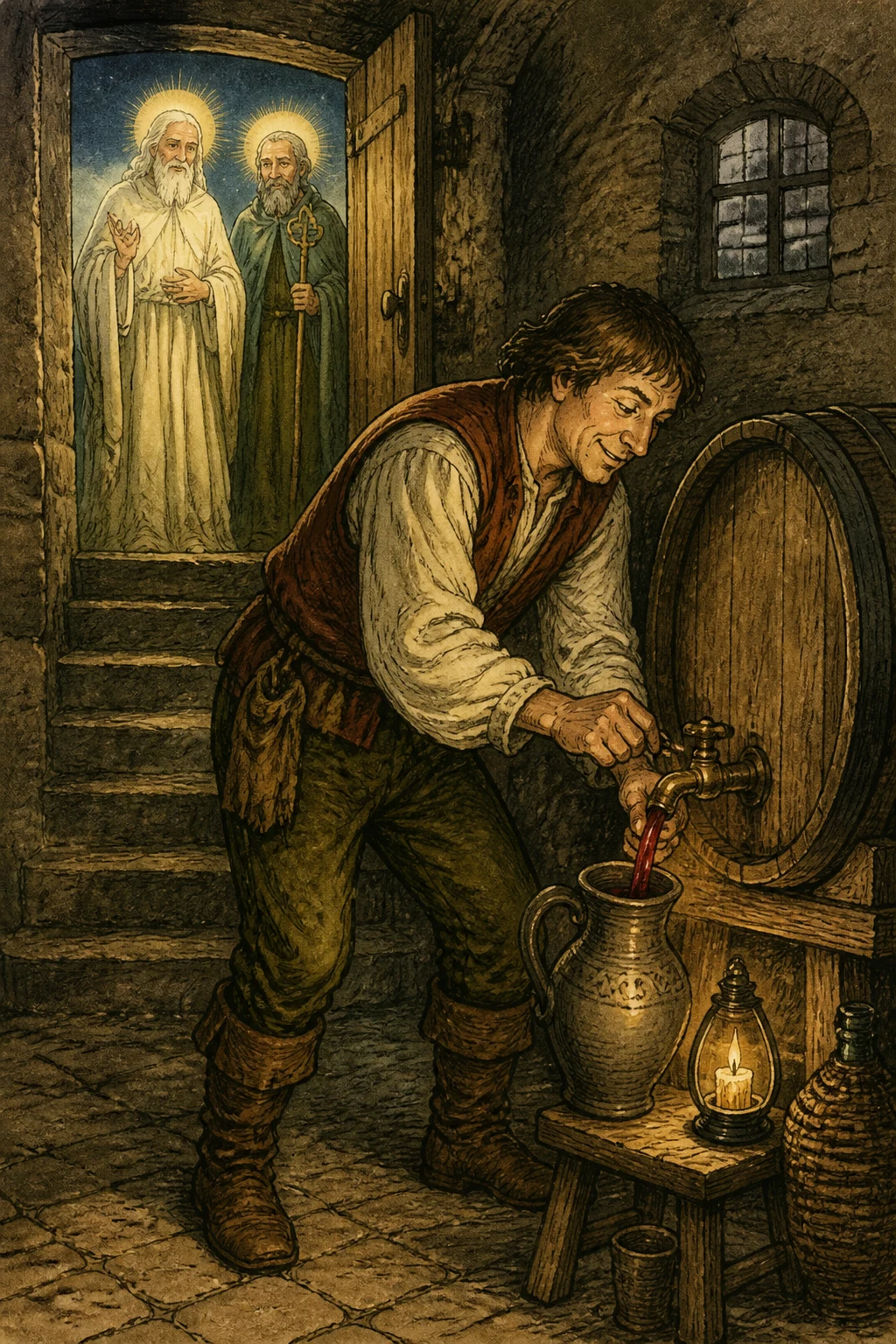
Once, in the days when our Lord and St. Peter went wandering on earth, they came to a blacksmith. He had made a bargain with the Devil that in seven years he would belong to him, on condition that, for those seven years, he should be master of all masters in the smith’s craft; and both he and the Devil had signed their names to the contract. So he had put up a sign in great letters over the smithy door: “Here lives the Master of All Masters!” When our Lord came walking by and saw it, he went inside.
“Who are you?” he asked the smith. “Read what it says above the door!” the smith replied. “But perhaps you cannot read writing, in which case you must wait until someone comes along who can help you.” Before our Lord could answer, a man came with a horse and asked the smith to shoe it for him. “Might I be allowed to shoe it?” said our Lord. “You may try,” said the smith. “You cannot make such a mess of it that I cannot put it right again.” So our Lord went out and took one of the horse’s legs off, laid it in the forge, and heated the shoe red-hot; then he sharpened the heel and toe calkins and clinched the nails, and put the leg back on the horse, whole and sound. When he had finished, he took off the other foreleg and did the same with that; and once he had put it back on, he took the hind legs, first the right and then the left, laid them in the forge, heated the shoes red-hot, sharpened the heel and toe calkins and clinched the nails, and put the legs back on the horse. All the while the smith stood watching him. “You are not such a bad smith after all,” he said. “Do you think so?” said our Lord.
A little later the smith’s mother came over to the smithy and asked him to come home for dinner. She was very old, terribly bent in the back and wrinkled in the face, and could scarcely walk. “Now watch closely!” said our Lord. He took the woman, laid her in the forge, and hammered her into a beautiful young maiden. “I stand by what I said,” said the smith. “You are not a bad smith at all. It says above my door, ‘Here lives the Master of All Masters,’ but even so, I will say it plainly: a man learns as long as he lives!” And with that he went up to the house and ate his dinner.
No sooner had he returned to the smithy than a man came riding up who wanted his horse shod. “That will soon be done!” said the smith. “I have just learned a new way of shoeing; it comes in handy when the days are short.” And he began cutting and wrenching until he had got all the horse’s legs off. “For I cannot see the point of fiddling about with one at a time,” he said. Then he laid the legs in the forge, just as he had seen our Lord do, piled on plenty of coal, and set the smithy lads pumping the bellows briskly. But it went as might have been expected: the legs burned up, and the smith had to pay for the horse. He was none too pleased about that; but just then a poor old woman came walking past, and he thought, “If one thing will not work, perhaps another will.” He took the old woman and laid her in the forge, and though she wept and begged for her life, it did her no good. “Old as you are, you do not know what is best for you,” said the smith;
“in a moment you will be a young maiden again, and I will not charge you so much as a shilling for the forging.” The poor old woman fared no better than the horse’s legs. “That was wickedly done!” said our Lord. “Oh, there will not be many asking after her,” answered the smith;
“but it is a shameful trick of the Devil’s: he is barely keeping his word about what is written above the door.” “Now, if you could have three wishes from me,” said our Lord, “what would you wish for?” “Try me,” answered the smith, “and you may find out.” So our Lord granted him the three wishes. “First and foremost, I wish that anyone I ask to climb the pear tree standing here beside the smithy wall must stay there until I myself tell him to come down again,” said the smith;
“secondly, I wish that anyone I ask to sit in the armchair in the workshop must remain sitting there until I myself tell him to get up again; and lastly, I wish that anyone I ask to crawl into the wire-mesh purse I carry in my pocket must stay inside until I myself give him leave to crawl out again.” “You have wished like a fool!” said St. Peter. “First and foremost, you ought to have wished for God’s grace and friendship.” “I did not dare aim so high,” said the smith. Then our Lord and St. Peter said farewell and went on their way.
Time passed, and when the term was up, the Devil came, as the contract said he should, to fetch the smith. “Are you ready now?” he asked, poking his nose through the smithy door. “Oh, I really must put a head on this spike first,” answered the smith. “Meanwhile, climb up the pear tree and pick yourself a pear to munch on. You may be both thirsty and hungry after your journey.” The Devil thanked him for his kind offer and climbed the tree. “Well, now that I think it over,” said the smith, “I shall not get a head on this nail for another four years, for this iron is devilishly hard. You cannot come down before then, so you will have to sit and rest meanwhile.” The Devil begged and pleaded in the most piteous voice to be allowed down again, but it did him no good. At last he had to promise not to come back until the four years were over, as the smith had said. “Very well, then you may come down,” said the smith.
When that time had passed, the Devil came again to fetch the smith. “You must be ready now,” he said. “I should think you have had time to put a head on that nail.” “Yes, I have certainly got a head on it,” answered the smith, “but all the same, you have come just a little too early, for I have not sharpened the point yet;
and never in my life have I forged such hard iron. While I hammer a point on the nail, you might sit in my armchair and rest, for I dare say you are tired.” “Thank you kindly!” said the Devil, and sat down in the armchair. But no sooner had he settled himself than the smith said again that, now he came to think it over, he could not possibly have the point sharpened for another four years. At first the Devil asked politely to be let out of the chair; then he grew angry and began to threaten. But the smith excused himself as best he could, saying it was the iron’s fault, for it was so devilishly hard, and consoled the Devil by reminding him how comfortably he was sitting in the armchair, and promising to release him in four years, to the very minute. There was nothing else for it: the Devil had to promise not to fetch the smith until the four years were over. Then the smith said:
“Very well, you may get up now,” and the Devil was off as fast as he could go. Four years later the Devil came again to fetch the smith. “Now I know you must be ready,” said the Devil, poking his nose through the smithy door. “Ready and waiting!” answered the smith. “We can leave whenever you please. But listen,” he went on, “there is one thing I have stood here thinking I should like to ask you for a long time: is it true, what people say, that the Devil can make himself as small as he likes?” “Indeed it is!” answered the Devil. “Then perhaps you would do me the favour of crawling into this wire-mesh purse and seeing whether the bottom is sound,” said the smith. “I am so afraid of losing my travelling money.” “Gladly!” said the Devil. He made himself small and crawled into the purse. But no sooner was the Devil inside than the smith shut it. “Yes, it is sound and tight all over,” said the Devil from inside the purse. “Well, it is good of you to say so,” answered the smith, “but better safe than sorry. I may as well weld the links a little, just to make sure.” With that he laid the purse in the forge and heated it red-hot. “Ow! Ow! Are you mad? Do you not know I am inside the purse?” cried the Devil. “Yes, but I cannot help that,” said the smith. “As the old saying goes, ‘You must strike while the iron is hot.’” Then he took his sledgehammer, laid the purse on the anvil, and hammered away at it with all his might. “Ow, ow, ow!” screamed the Devil inside the purse.
“For mercy’s sake! Only let me out, and I will never come back again.” “Well, I think the links are fairly well welded now,” said the smith, “so you may come out!” With that he opened the purse, and the Devil was off so fast that he did not even dare look behind him.
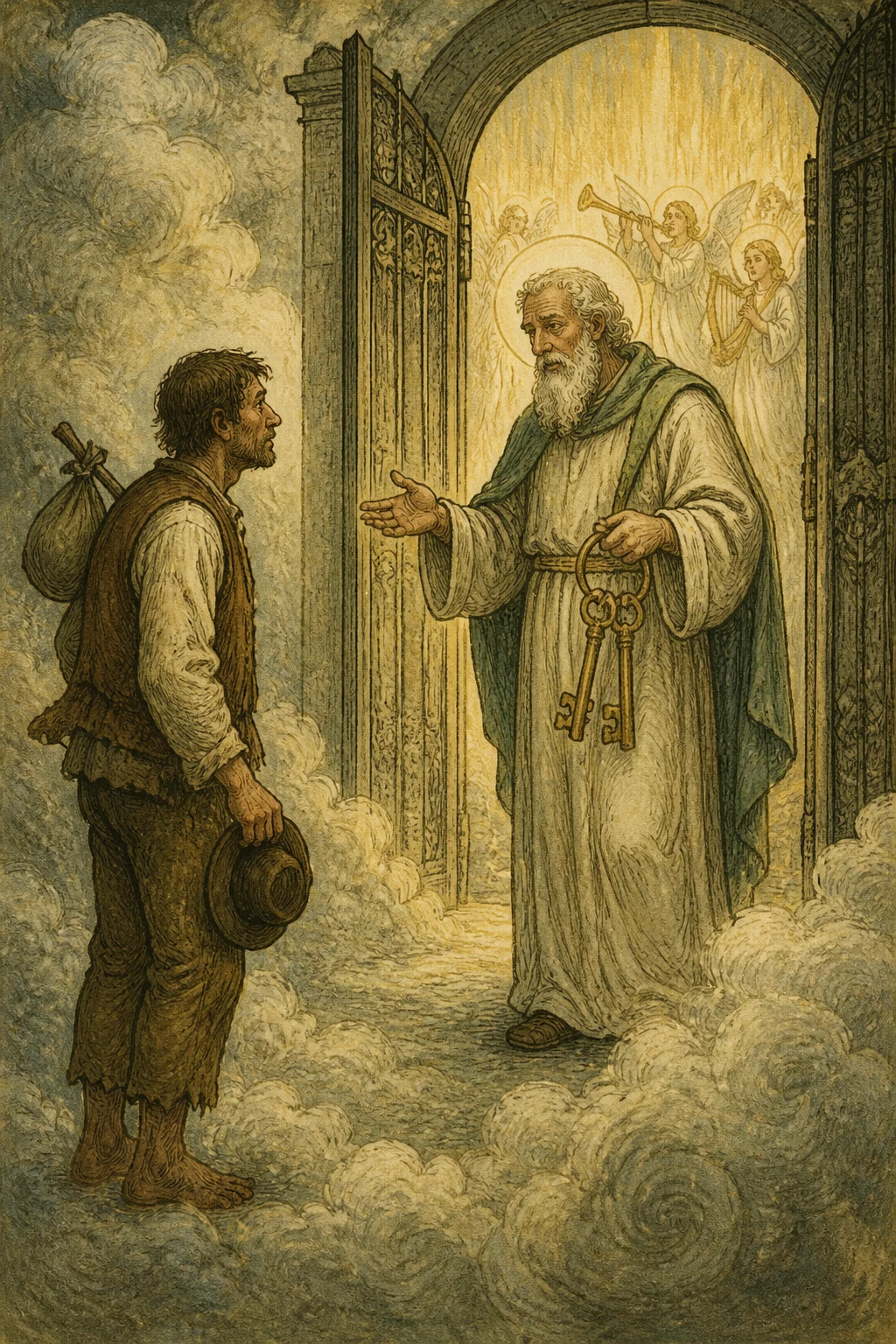
But after a while it occurred to the smith that perhaps he had done wrong to make an enemy of the Devil. “For if I should fail to get into the kingdom of God,” he thought, “there may be a danger of my being left homeless, now that I have quarrelled with the ruler of Hell.” He decided it would be best to try to get into either Hell or Heaven sooner rather than later, so that he would know where he stood. So he shouldered his sledgehammer and set off. When he had walked a good way, he came to the crossroads where the road to Heaven parts from the road to Hell. There he caught up with a journeyman tailor, who was hurrying along with his pressing iron in his hand.
“Good day!” said the smith. “Where are you bound?” “For Heaven, if I can get in,” answered the tailor. “And you?” “Oh, then I doubt we shall be travelling together,” answered the smith. “I mean to try Hell first, for I have some acquaintance with the Devil already.” Then they said farewell and went their separate ways. But the smith was a strong, sturdy fellow and walked much faster than the tailor, so it was not long before he stood at the gate of Hell. He asked the gatekeeper to announce him and say that someone was outside who would like a word with the Devil. “Go out and ask who it is,” said the Devil to the gatekeeper, and so he did. “Give the Devil my greetings and tell him it is the smith who had the purse he knows about,” he answered, “and ask him kindly to let me in at once, for I worked at my forge until noon today, and since then I have walked a long way.” When the Devil received this message, he ordered the gatekeeper to fasten all nine locks on the gate of Hell. “And put a padlock on as well,” said the Devil, “for if he gets in, he will turn all Hell upside down!” “There is no shelter to be had here, then,” the smith said to himself when he heard them securing the gate still more firmly. “I shall have to try Heaven.” With that he turned round and went back until he reached the crossroads again; there he took the road the tailor had gone. Now, being angry at having walked all that way there and back for nothing, he strode along as fast as he could, and reached the gate of Heaven just as St. Peter opened it a crack, enough to let the thin journeyman tailor slip inside. The smith was still six or seven paces from the gate. “I had better hurry here,” he thought, and seized his sledgehammer and hurled it into the gap just as the tailor slipped through; but if he did not get in through that opening, I do not know what became of him.