Prevod
Whatever wisdom I possess, yours is twice as great.
You have neither lover nor husband now—what are you staring at, naked woman?
The monkey asked, “How did that happen?” The crocodile replied: Tale 12. The Farmer and His Wife. In a certain town there lived a farmer and his wife. Because her husband was old, the farmer’s wife was forever thinking of other men and could never settle down at home. She wandered about, seeking other lovers. One day a rogue who made his living by stealing other people’s wealth noticed her and, finding her alone, said, “Lovely lady! My wife is dead, and the sight of you has tormented me with desire. Grant me the favor of your love.” She replied, “Handsome sir! If that is so, my husband has a great deal of money. He is so old that he can scarcely move. I shall take his wealth and come to you. Then we can go elsewhere together and enjoy the pleasures of love to our hearts’ content.”
He said, “That suits me very well. Come quickly to this spot at dawn, so that we may go to some more agreeable city, where I can make life worth living in your company.”
She agreed and went home with a smiling face. That night, when her husband was asleep, she took all his wealth and hurried at dawn to the appointed place. The rogue set off briskly toward the south, making her walk ahead of him. After they had traveled about two yojanas, they came to a river. Seeing it, the rogue thought, “What am I to do with this woman, whose youth is almost over? Besides, someone may come after her at any moment, and that would land me in serious trouble. I had better take her money and leave.”
Having made up his mind, he said to her, “My love, this great river is very difficult to cross. I shall first carry the money to the far bank and come back. Then I shall take you alone on my back and carry you across with ease.”
She said, “My handsome man, let us do that.” And with these words she handed over all the money to him.
Then he said, “My dear, give me your lower garment and your wrap as well, so that you can pass through the water without worrying about them.” She did as he asked, and the rogue took the money and both garments and went off as he had planned. She sat anxiously on the sandy riverbank, her arms clasped about her neck. While she was sitting there, a she-jackal came along with a lump of meat in her mouth. Looking about, the jackal saw a large fish that had come out of the river and was lying beside the water. She dropped her meat and rushed at the fish. Just then, something swooped down from the sky and darted forward. At that moment a vulture descended from the sky, snatched up the lump of meat, and flew away again. The fish, seeing the jackal, slipped back into the river. Seeing the jackal, it slipped back into the river. As the jackal stood gazing up at the vulture, all her efforts wasted, the naked woman said to her with a smile:
“The vulture has carried off your meat, and the fish has gone back into the water.
Now that you have lost both fish and meat, what are you staring at, jackal?”
“My friend has turned into an enemy, and my beloved wife is dead.
Another has taken over my home—what else is still to happen?”
Or, as the saying rightly goes:
“Blows fall again and again upon a wound; the fire of hunger grows when food runs out.
Enemies arise in times of trouble—such is a man’s lot when fate turns against him.”
“What should I do? Should I fight him? Or should I reason with him gently and persuade him to leave my home? Should I try sowing discord, or offer him a gift? Or should I ask my friend the monkey? For it is said:
“He who acts after consulting wise elders who wish him well
Meets with no obstacle in anything he undertakes.”
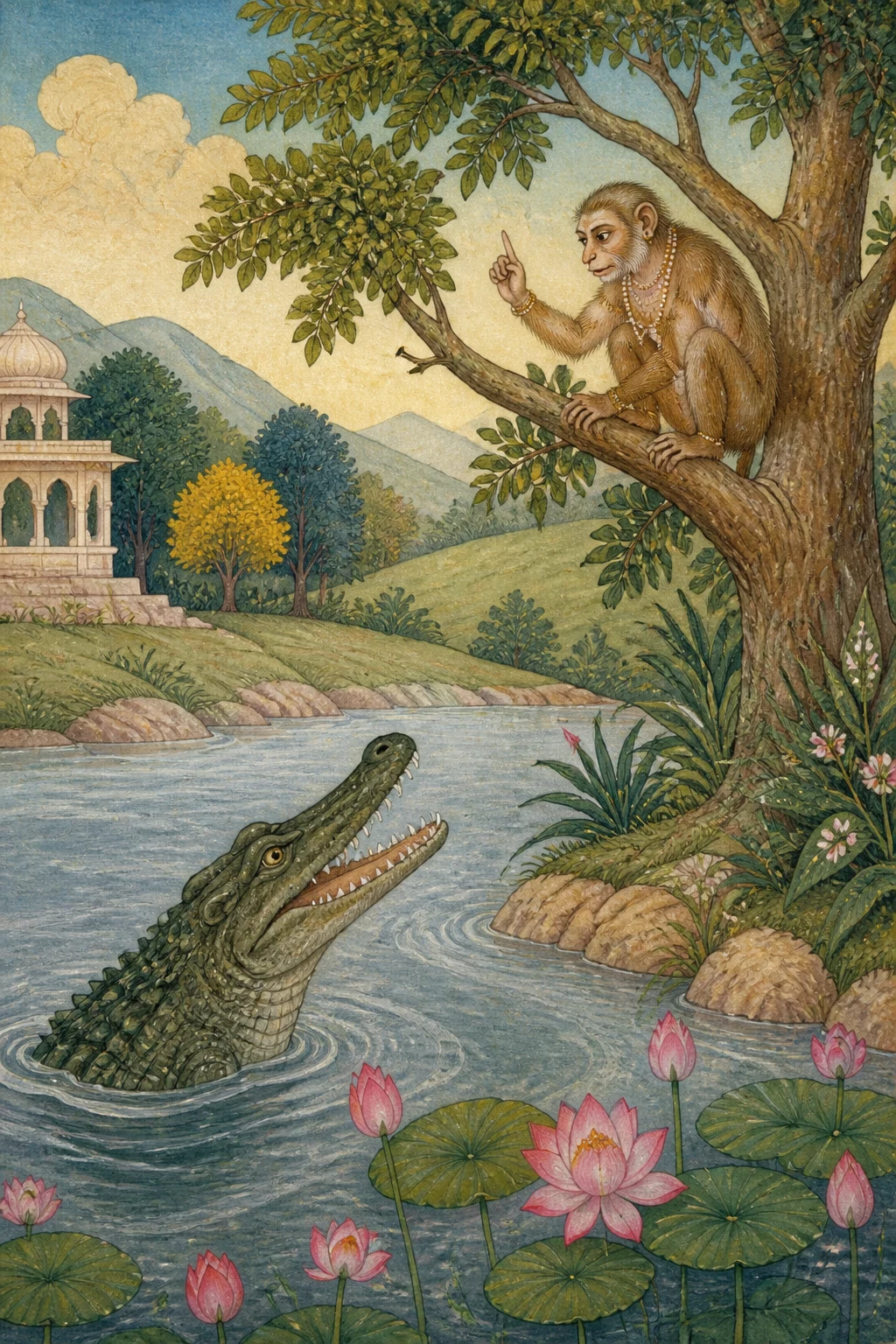
Having considered the matter in this way, he once again approached the monkey in the rose-apple tree and asked, “My friend! Look how unfortunate I am. Now a crocodile stronger than I has taken possession of my home as well. I have come to ask your advice. Tell me what I should do. Which of the expedients, beginning with conciliation, is appropriate here?”
The monkey said, “You ungrateful evildoer! Why do you keep coming after me, even though I have forbidden it? I will not give advice to a fool like you.”
Hearing this, the crocodile said, “My friend! Though I have wronged you, remember our former affection and give me good advice.”
The monkey said, “I will tell you nothing. At your wife’s bidding, you took me out to cast me into the sea. That was no way to behave. Though a wife may be dearer than anyone else in the world, one does not throw friends and kinsmen into the sea at her command. Fool! I warned you long ago that your stupidity would bring about your ruin, for:
“He who, in his arrogance, fails to heed the advice of good people
Soon meets his destruction, like the camel with the bell.”
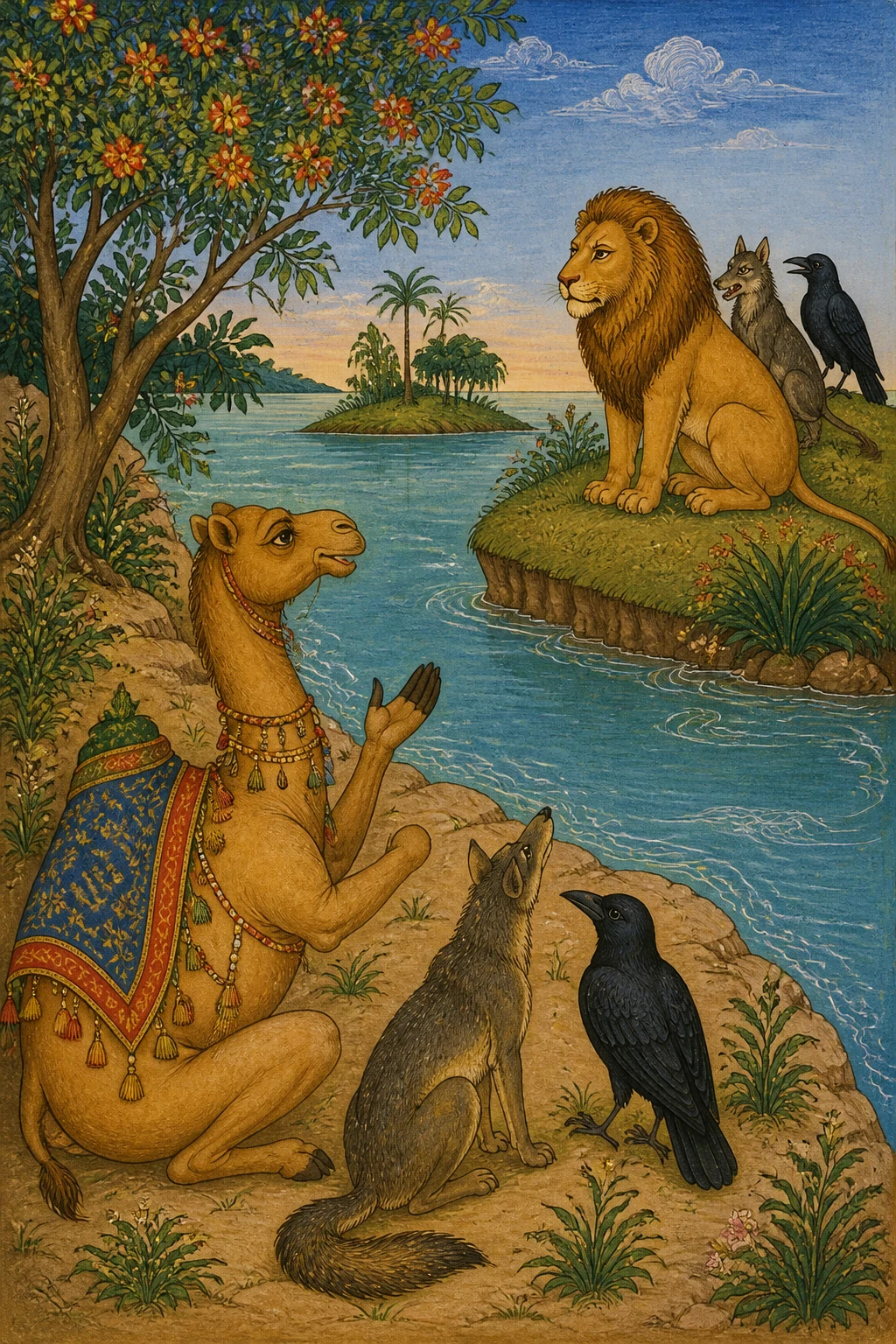
The crocodile asked, “How did that happen?” The monkey replied: Tale 13. Ujjvalaka the Wheelwright. In a certain town there lived a wheelwright named Ujjvalaka. Afflicted by extreme poverty, he thought, “Ah, a curse on the poverty in our house! Everyone else is busy with his own trade, but mine finds no employment in this town. Everyone has an old four-story house, while I have nothing here. What use is my skill as a wheelwright?” With these thoughts he left the country. As he made his way through a forest, he saw, at sunset, a she-camel deep in a cavernous thicket. She had strayed from her herd and was suffering the pains of labor. He took the camel and her newborn calf and set off for home. When he arrived, he fetched a rope and tethered her. Then he took a sharp axe and went to a hillside to gather leafy branches for her. He cut a great many fresh, tender shoots, carried them back on his head, and laid them before her. She ate them little by little, and with this leafy diet she grew plumper day by day. The calf too grew into a large camel. The wheelwright now supported his family on the milk he obtained each day. He was so fond of the young camel that he fastened a large bell around its neck. Later he thought, “Ah, what need have I of other wretched work? Simply by caring for this camel, I have brought prosperity to my family. Why should I pursue any other trade?”
With this in mind, he went home and said to his wife, “My dear, this is a good business. If you agree, I shall borrow some money from a wealthy man and go to the land of Gurjara to buy camels. Meanwhile, you must take good care of these two until I return with another she-camel.” He went to Gurjara, bought a she-camel, and returned home. To make a long story short, he managed his affairs so well that he acquired a great many camels and calves. Once he had assembled a large herd, he hired a man to look after it. As his yearly wages he gave the man one camel calf, and also allowed him all the milk he could drink throughout the year. Thus the wheelwright lived comfortably, steadily carrying on his trade in she-camels and their young. The camels would go out to feed in the woods near the town. After eating their fill of tender creepers and drinking from a large lake, they would make their leisurely way home in the evening. But the first camel, full of conceit, always lagged behind and joined them later. The other young camels said, “What a fool this camel is! He strays behind the herd and comes along ringing his bell. If he falls into the jaws of some dangerous beast, he will certainly die.” One day, as the camel wandered through the forest, a lion heard the bell and came toward it. Looking about, the lion saw a herd of she-camels and young camels passing by. One of them, however, remained behind, playing and nibbling creepers, while the others drank and went home. When at last he came out of the forest and looked around, he could neither see nor recognize the way. Separated from the herd, he walked slowly on, making a great noise. Following the sound, the lion moved ahead and lay quietly in wait. As soon as the camel came near, the lion sprang upon him, seized him by the neck, and killed him. ***********************************************************************
“That is why I say, ‘He who fails to heed the advice of good people’ (74).”
After hearing this, the crocodile said:
“Those who offer counsel, wishing others well,
Meet with no misfortune, either in this world or the next.
“Therefore, though I have been ungrateful, please show me kindness by giving me advice. For it is said:
“What merit is there in being kind to those who have done one good?
He who is kind to those who have harmed him is called truly good by the good.”
Hearing this, the monkey said, “My good fellow! If that is so, go there and fight him. For it is said:
“If slain, you will gain heaven; if you live, your home and fame.
By fighting, you stand to gain one of two incomparable rewards.
“Subdue a superior by submission, a valiant foe by sowing discord,
A lesser man by a small gift, and an equal by valor.”
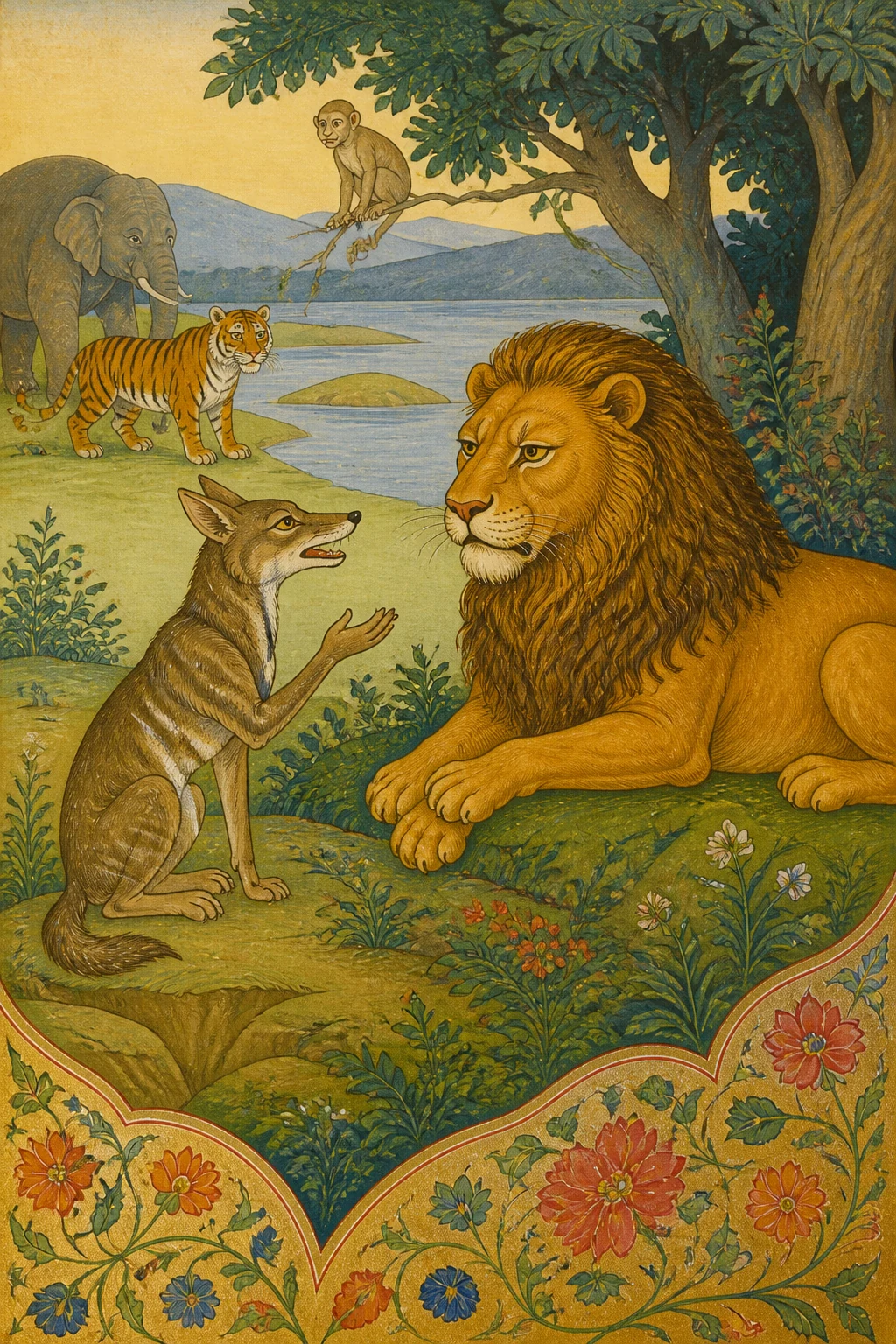
The crocodile asked, “How is that?” The monkey replied: Tale 14. The Jackal Named Mahācaturaka. In a certain country there lived a jackal named Mahācaturaka. One day he came upon an elephant that had died a natural death in the forest. He prowled all around it, but could not pierce its tough hide. Just then a lion, wandering here and there, arrived at the spot. Seeing him approach, the jackal bowed his head to the ground, joined his forepaws, and said humbly, “My lord! I am your servant, standing guard over this elephant for you. Please eat it, my lord.”
Seeing him bow so submissively, the lion said, “My good fellow! I never eat an animal killed by another. I bestow this elephant upon you.”
Delighted, the jackal said, “Such generosity toward his servants is worthy of my lord. For it is said:
“Even in the direst straits, a great soul’s purity keeps him true to his noble qualities;
A conch does not lose its whiteness even after passing through the fire.”
After the lion had gone, a tiger appeared. Seeing him, the jackal thought, “Well, I have got rid of one dangerous fellow by submitting to him. How shall I get rid of this one? He is certainly brave; nothing but sowing distrust will work on him. For it is said:
“Where neither conciliation nor gifts can be employed,
One must sow discord, for that brings others under one’s power.
“Moreover, even one endowed with every virtue can be brought into bondage through an inner breach. For it is said:
“Even a pearl, flawless within, perfectly rounded, and most beautiful,
Is strung and bound once it has been pierced within.”
Having considered this, he went toward the tiger, his neck held proudly erect, and exclaimed in agitation, “Uncle! How have you wandered into the jaws of death? This elephant was killed by a lion. He left me to guard it and has gone to bathe in the river. As he went, he gave me these orders: ‘If a tiger comes here, you must tell me in the strictest secrecy, for I intend to rid this forest of tigers. Once, while I was away, a tiger ate from an elephant I had killed and left it befouled with his leavings. Ever since that day I have been furious with all tigers.’”
Terrified by these words, the tiger said, “Nephew! Grant me my life. Even if he takes a long time to return, you must not say a word to him about me.” And with that he fled in haste.
After the tiger had gone, a leopard came along. Seeing him, the jackal thought, “This spotted fellow has strong fangs. I must contrive to have him tear open the elephant’s hide.” Having decided this, he said, “My sister’s son! Why have I not seen you for so long? And why do you look so hungry? You are my guest. Here lies an elephant killed by a lion, who has appointed me to guard it. Still, before the lion returns, eat your fill of its flesh and then hurry away.” The leopard said, “Uncle, if that is how things stand, I want none of this meat. A man who stays alive may yet see a hundred blessings. As the saying goes, ‘One should swallow only what one can swallow, and what, once swallowed, one can digest’ (23), and so on. One should eat only what one can digest. I shall leave this place.” The jackal said, “Oh, you timid fellow! Eat without fear. I shall warn you of his approach while he is still far away.” The leopard did so. As soon as the jackal saw that he had torn open the hide, he cried, “My sister’s son! Be off! Here comes the lion!” At these words, the leopard fled far away. The jackal had just begun eating through the opening the leopard had made when another jackal arrived in a great fury. Seeing that this newcomer was his equal in strength, he recited the verse, “Subdue a superior by submission, a valiant foe by sowing discord” (78), and advanced upon him. He tore him with his fangs and drove him away, then feasted contentedly on the elephant’s flesh for a long time. “You too should defeat this enemy of your own kind in battle and drive him away. Otherwise, once he has firmly established himself, he will bring about your destruction. For it is said:
“One may expect abundance from cows, austerity from a brahmin,
Fickleness from women, and danger from one’s own kind.
“And again:
“Food is plentiful and varied, and the townswomen are careless;
A foreign land has only one fault: one’s own kind turn against one.”
The crocodile asked, “How did that happen?” The monkey replied: Tale 15. The Dog Named Citrāṅga. In a certain town there lived a dog named Citrāṅga. A prolonged famine struck the town, and for lack of food the dogs and other creatures began to die out, family after family. His throat wasted with hunger, Citrāṅga fled to another country for fear of starving. There, in a certain town, the kindness of a householder’s wife allowed him to enter her house each day and eat a variety of foods until he was thoroughly satisfied. But whenever he left the house, the other dogs, fierce and swaggering, surrounded him on every side and tore his whole body with their teeth. Then he thought, “Ah, better one’s own country, where one can live in peace even during a famine, and no one picks a fight. I shall go back to my own town.” Having made up his mind, he returned home. When he came back from abroad, all his kinsfolk asked him, “Citrāṅga! Tell us about the foreign country. What sort of place is it? How do the people behave? What is there to eat? What are the customs there?”
He replied, “What can I say about life abroad?” And he recited, “Food is plentiful and varied, and the townswomen are careless” (83).
Having heard the monkey’s advice, the crocodile steeled himself to face death, took leave of the monkey, and returned to his home. There he fought the intruder who had taken possession of it. Sustained by his steadfast courage, he killed him, recovered his home, and lived happily for a long time. Well is it said:
“What use is prosperity gained without exertion, the mere luck of an idle man?
Even a deer eats grass that chance puts in its path.”
Thus ends the fourth book, entitled “The Loss of Gains,” in the Pañcatantra composed by the illustrious Viṣṇuśarman.
********************************************************************* The Fifth Book: Ill-Considered Action. The Tale of the Jain Ascetic.