Prevod
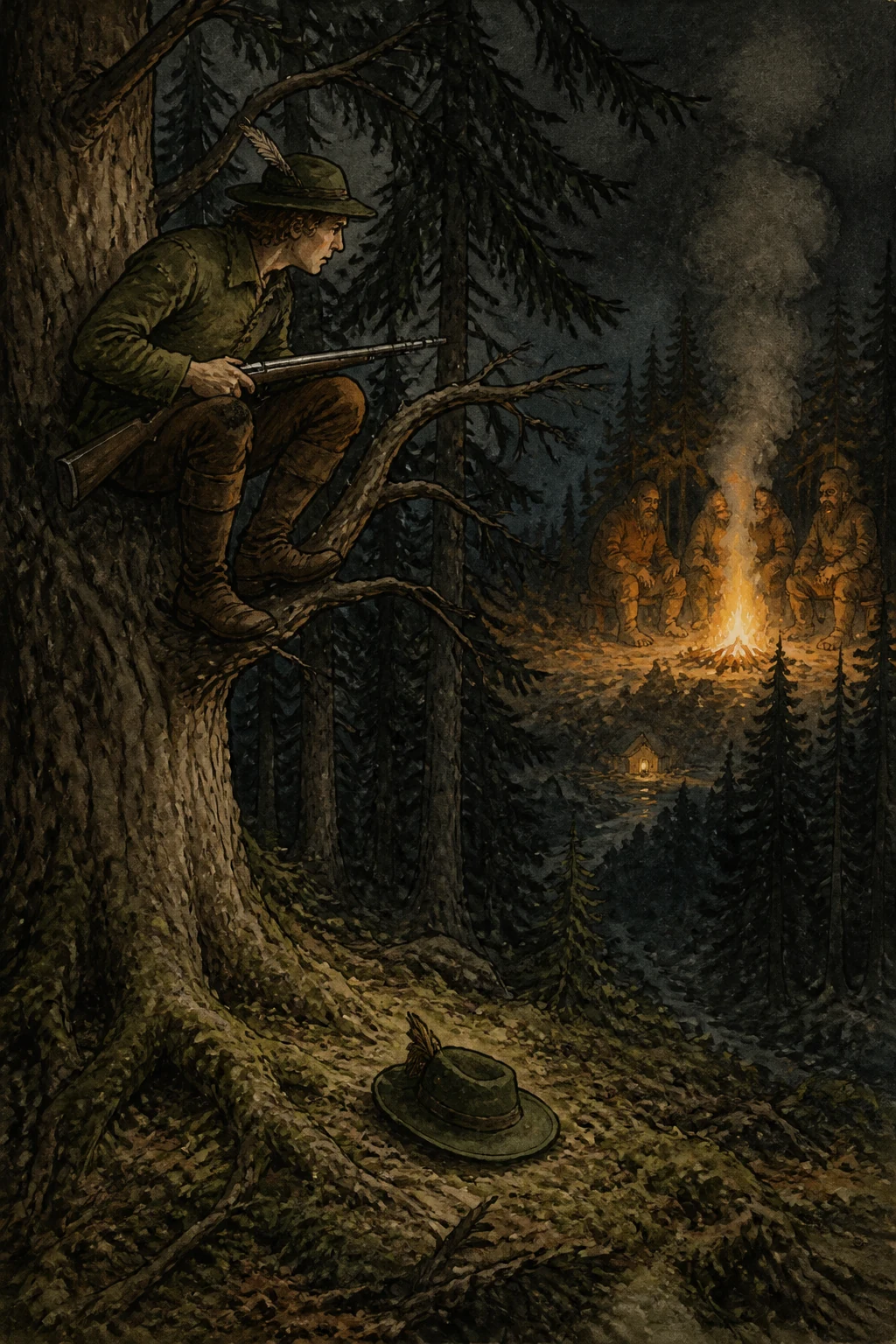
Once upon a time, as never before, there lived an emperor who had three sons. When his dying hour came, he called his sons to him and said, “My sons, as you can see, I am at death’s door, and I ask only one thing of you: for three nights after my burial, keep watch over my grave, one of you each night.” As soon as he heard his sons promise, he opened his mouth and breathed his last. Preparations were made for his burial, as befitted an emperor’s passing, and with great pomp and mourning he was laid to his eternal rest. Mindful of their father’s last words, the eldest son took the first night’s watch. He kept watch for a while, and in the dead of night, when even the waters slept, he suddenly found someone approaching who meant to dig up the dead man. It was unthinkable that the emperor’s son should allow such a wicked deed, so he grappled with the stranger. They wrestled and wrestled until the cocks began to crow, when the stranger vanished like a phantom. On the second night, the emperor’s middle son fared just as the eldest had. When the two brothers met, they agreed to tell their youngest brother what had happened and urge him to choose one of them to accompany him on his watch, lest he be overcome, being younger than they were. But the youngest prince would not hear of it. “I shall go alone,” he said, “for Father must have known what he was saying when he commanded each of us to keep watch by himself.” And so, when evening came, he went to the appointed place. Knowing what awaited him, he took his weapons and made ready for a fight. Around midnight, he too saw someone approaching. He tried to use his weapons, but the stranger gave him no chance; he appeared like a vision rising out of the earth, and they fell to wrestling. The struggle was fierce, for it was an unclean spirit that had come to dig up the emperor, and it strained every sinew to overcome the youngest son. You see, the spirit knew that if it failed on the third night as well, it would have to abandon its purpose: it could never dig him up afterward. But the lad was not to be outdone. As I have said, they fought for their lives; this was no play fighting. Sweat streamed from the prince, yet he would not yield an inch to the foul creature. They struggled to the death until cockcrow. The moment the cock was heard, the spirit vanished like a phantom, and the lad fell to the ground, exhausted. Had the struggle lasted even as long as it takes a leaf to flutter down, his strength would have failed, and who knows what might have happened? Where the prince fell, on his father’s grave, there he fell asleep, so utterly worn out was he. And when he woke, what do you suppose he saw? The sun had long since risen and stood three spear-lengths above the horizon. What was he to do? He was ashamed to go home in broad daylight, passing through the town armed from head to foot; yet he could not stay there. Then it occurred to him to make his way slowly toward a nearby forest, spend the day hunting, and return home toward evening. As he walked through the forest, his thoughts would give him no peace. He wondered why his father had ordered them to guard his grave for three nights in a row. Walking on without knowing where he was going, turning one thought over after another, he found that he had strayed from the path and no longer knew his way. He went this way and that, but could not find the road. He turned to the right, then to the left, yet instead of coming out into the open, he wandered ever farther astray. Groping through the woods and searching for a path, he came to a clearing. In its midst he saw a great fire, and on the fire a pot from which some sort of sound was coming, though he could not tell what it was. He stood still and listened. It sounded like barking. He looked again, but saw no one. What was he to do? He did not dare go closer, for he had no notion what devilry this might be. So he drew his bow and let fly an arrow, and crack! It struck the lid of the pot and knocked it off. At that very instant the whole forest began to roar until the noise was deafening, and suddenly seven zmei appeared before him, surrounded him, seized him, and began debating how to punish him for releasing the Swift One of the Earth, whom they had shut up in that pot. One said they should cut him to pieces. Another said they should hang him. Another would have him flayed alive. Others proposed all manner of tortures to kill him. But the oldest among them said they should let him live, for who knew what use he might be to them? Perhaps he could steal an emperor’s daughter whom they had been trying in vain to carry off. This maiden was kept by her father in a house with locked doors. Only once a year did her father leave it unlocked, and then a cock guarded one door and a little bell the other. No one could approach, for the moment anyone set foot on the threshold, either the bell would ring or the cock would crow. The prince promised to try his luck, and so the zmei spared his life. He crept quietly up to the house and, before setting foot on the threshold, reached out so stealthily that neither guardian detected him, seized the cock by the neck, and twisted it before it could utter so much as a peep. Then he gently opened the door, went to the other entrance, and silenced the bell. Returning to the zmei, he told them to come in one at a time, for he would be waiting just inside the door. Blinded by their greed to lay hands on the maiden, the zmei obeyed. Zmei they certainly were, and mighty fellows too, but they must have been rather dim-witted to take the lad at his word and follow him in one by one. For the emperor’s youngest son stood inside with his sword in his hand, unbeknownst to them, and as each came through—swish!—he struck off its head and dragged the whole body into the chamber. He dealt thus with the first, then the second, and so on to the sixth. But that devil of a seventh zmeu seems not to have been quite such a fool. It was as though the devil had whispered in his ear what destruction awaited him inside, for he would not enter, but fled. The lad had worked so quietly and deftly that the maiden noticed nothing. She lay fast asleep in her bed, quite unaware of what had happened. Then he too approached her, and, by the truth of God, never in his life had he seen such beauty! He took the ring from her little finger and the kerchief from her face. With these two things he returned home to his brothers, without telling them anything of his adventures. The maiden’s father, the emperor, who knew that certain zmei were trying to abduct his child, was overjoyed to see them slaughtered. Believing his daughter safe from that day forward, he had it proclaimed at every crossroads in every city in the world that the brave man who had slain the zmei should come forward, for he would give him his daughter in marriage and his empire as well. Before long, an ugly, thick-lipped Gypsy, black as soot, came to the emperor and declared that he had killed the zmei. To convince the emperor, he proudly displayed his bloodied cleaver and spattered clothes. He had smeared both cleaver and clothes with the blood of an old horse of his, worn out with age and short of breath, which was of no further use to him and which he had killed for its hide. The emperor did not much relish the thought of having a Gypsy for a son-in-law, but since he had given his word, he meant to keep it. Before the betrothal took place, he invited the Gypsy to a feast held to celebrate his daughter’s deliverance from the zmei. The Gypsy sat upon seven cushions at the emperor’s right hand. While they were eating and making merry, the victorious prince arrived and, only after much difficulty, managed to gain admittance to speak with the emperor. Entering the imperial banquet hall, he began by praising the man who had performed the great deed and congratulating the emperor on his daughter’s deliverance from danger. “I killed the zmei,” said the Gypsy, puffed up with pride. “What do you know, lad? What a fight I had!” “That may be so, brave fellow, but somehow I still find it hard to believe you could have performed such a feat.” “Why do you stand there listening to this lout’s slanders? Servants!” “Ho, ho, brave fellow! Gently, gently! You are in too much of a hurry. Such a prize is not for the likes of you! If we are to believe you performed this mighty deed, show us some token that will set our doubts to rest.” “What more of a token do you want than my cleaver and these blood-spattered clothes?” “I cannot believe that the man who accomplished such a feat could have been so empty-headed as not to take some token by which to prove his deed.” “What are you waiting for, servants? Throw out this madman who has come to spoil our feast!” “Wait a little, brave fellow,” the emperor said to him, having listened to their quarrel. “What this young man is suggesting seems to have some bearing on the matter.” “I think, mighty emperor, that the man who performed such a feat would surely not have rested content and stood there with his finger in his mouth after killing the zmei and finding himself master of the chamber where the princess slept. He must have taken some token by which to make his bravery known.” As the prince spoke, the cushions began slipping, one
by one, from beneath the Gypsy. Most likely he kept squirming in his seat, restless and afraid because of the villainy he had committed. Still speaking, the prince brought out the kerchief and the ring he had taken from the maiden’s finger. “Oh! Those are mine!” the maiden cried. “They disappeared in the confusion when the zmei were killed.” “They did not disappear, princess,” the prince replied. “I took them after killing six of the zmei, and I am sorry the seventh escaped me.” Then the emperor breathed freely again, overjoyed to have saved his daughter’s honor and delivered her from a marriage that had never pleased him in the least. After reproaching the Gypsy as he deserved, he ordered two unbroken stallions to be brought. He had the Gypsy tied to their tails, together with a sack of walnuts. Then he let the stallions loose to race away into the world, and wherever a walnut fell, a piece of the Gypsy fell too, until nothing, not even dust, remained of him. Preparations were then made for the wedding of the valiant prince and the maiden, who was as beautiful as a fairy. When all was ready and the long-awaited day arrived, they set out together for the church. Crowds upon crowds followed to escort them there. The emperor and empress, the bride and groom, and their relatives rode in carriages mounted entirely in gold. They were close now, with only a few steps left to the church, when suddenly a terrible rushing sound was heard, and there was the seventh zmeu, swooping down upon them. He cracked a whip, and all the carriages turned to stone; only the emperor and the bridal couple escaped. The zmeu seized the bride about the waist, tore her from her people, rose into the air, and vanished with her. Everyone was left stunned with terror. But the bridegroom was more distraught than all the rest. He bit his hands in anguish that he had not managed to lay hold of that accursed zmeu and kill him too, for now see what misery the creature had brought upon him! What was he to do? He could not live without his betrothed. What was he to do now?
He would go and look for her—but where? The poor fellow fretted and racked his brains, not knowing how best to set about it. At last he resolved that, come what might, he would go in search of his destined bride. The girl’s poor father tried to hold him back, lest he too should throw his life away for nothing; but it was no use. Once he had set his mind on going, go he must. So he took a little food for the journey and set out. Reaching the open country, he followed the road, and on and on he went, through forests and valleys, over wastelands, through groves, across mountains and little dales, until he came to a great, great forest that seemed to have no end. Groping his way through the thickets, he stumbled upon a clearing. Someone was sitting there beside a fire. By now he had eaten the last of his provisions, so he went straight up to the man by the fire. As soon as the stranger saw him, he recognized him and began thanking him for rescuing him from the ogre’s clutches. For this was none other than Agerul Pământului, the Swift One of the Earth. Here was where he lived. They talked for a while, asking after one another and telling their troubles, and then the emperor’s son said, “I am on my way to find my betrothed, whom the ogre carried off. Do you happen to know, cousin, where that foul creature lives?” “What you are attempting is no easy thing. My advice would be to mind your own affairs and leave the ogre and everything else to the devil, for it may cost you your life.” “You plainly do not understand,” the young hero answered, “that I cannot live without my betrothed. I am determined to follow her even beyond this world. Either I shall succeed in winning back my beloved, or I shall break my neck in the attempt.” Seeing him so resolved, Agerul Pământului told him that the ogre himself was not so very fearsome, but his mother was a witch whose powers knew no bounds, and that he must kill her first. Then he told him which way to go to reach the witch’s house, and what he must do to lay hands on the treasure he sought. That was all the emperor’s son wished to know. After receiving these counsels and taking a little food from Agerul Pământului, he set out. On he went, and on, until he reached the borders of the ogres’ land. And rather than waste our time recounting everything the poor emperor’s son met along the way, let me tell you how he arrived and how he succeeded. Once there, he did exactly as Agerul Pământului had taught him. Now the ogre’s wicked mother slept only at noon, when the sun stood at its highest. When the emperor’s son arrived and stopped at the gate, she had just fallen asleep while her serving girl searched her hair for lice. This serving girl, too, had been carried off, and came of a noble family. As he stood there watching the girl tend the old hag’s head, she caught sight of him. He beckoned to her. Gently she laid the old woman’s head upon a pillow and came at once to the emperor’s son to see what he wanted. When they had spoken and understood one another, she took him into a room and taught him what to do, after he had promised to free her too from the witch’s bondage. “The toothless old hag, the ogre’s mother,” she said, “has the gift of remaining alive as long as that great vat behind the door exists. There are a great many souls inside it, and if anyone should be about to kill her, she runs to it and drinks in some of the souls shut up there, gaining fresh strength and life.” Before the old woman woke, the emperor’s son set to work and buried the vat in the cellar. When she awoke and heard that someone had come and wished to see her, she went straight to the room where the emperor’s son was waiting, for that was where she liked to speak with those who came to visit her. Goodness me! I nearly forgot to tell you that all around the witch’s courtyard stakes had been driven into the ground, and on each stake was the head of some man whom fate had drawn toward death and whose sins had driven him to trespass on her land. Only one stake still had no head, and it kept crying out to the old woman, “A head! A head!” To tell the truth, the emperor’s son was somewhat frightened by this, but the girl who served the witch encouraged him, and he summoned up his courage, saying, “You’ll get a head when green mares foal, or when horses celebrate Easter!” The old woman came to him and began speaking in such sweet and coaxing tones that she might have won over the stoutest hero alive. But the emperor’s son knew what to expect and stood ready to fight. Still talking, the old woman pretended to be looking for something about the house, then took some threads hanging from a nail and put them on. In an instant she turned into a soldier, sword ready in hand. Without delaying a moment, and quicker than thought, the emperor’s son drew his broadsword and struck off her head, slashing it nine times. For that was what the girl had taught him to do. The accursed old hag, even with her head cut off, went leaping about the house, searching everywhere for the vat of souls so that she could drink them in; but when she could not find it, she fell to the floor and died. Afterward the girl in the old woman’s house showed the emperor’s son the way to the ogre’s dwelling and taught him what to do there as well. When he reached the ogre’s home, he went fearlessly into the room where his betrothed sat, for the ogre hunted by day and did not return until evening. The emperor’s daughter was beside herself with joy when she saw him. Before anything else, he asked her to find out from the ogre where his strength lay; then the emperor’s son returned to the old woman’s courtyard and spent the night there. When the ogre came home, the girl asked him where his strength lay. He gave her a slap that made her howl. She pretended to weep and to be ill, and the ogre, sorry he had lost his temper, told her a lie. “My strength,” he said, “lies in the gatepost.” The next day she told Făt-Frumos, but he did not believe it. Again the girl pretended to be distressed because she did not know where the ogre’s strength lay, and she suffered just as she had the time before; then the ogre told her another lie. When she saw that the emperor’s son did not believe this either—for he knew a thing or two—she took to her bed, pretending to be ill. On the third day, when the ogre returned from hunting, he found her lying there. He went to ask what ailed her, and she answered, “I have taken to my bed with grief because you hide from me where your strength lies.” This time too the ogre gave the girl such a cuff that the dogs in Giurgiu heard it. Then she pretended to be so desperately ill that the ogre thought she was about to shake hands with death. Repenting of what he had done, and wishing to comfort her, he told her the truth. “My strength,” he said, “lies in a sow that wallows all day long in a pool of fresh milk. That pool is not very far from here. Inside the sow is a hare, inside the hare a quail, and inside the quail are three worms. Those are my strength.” That was all the girl wished to know. As soon as dawn broke and the ogre went hunting, the emperor’s son came to learn what she had found out, for his longing to see his betrothed safely home would not let him delay another moment. The girl told him everything, from beginning to end, and he set off at once. More out of habit than anything else, he took a little food she gave him, but eating was the last thing on his mind. He walked and walked, and walked some more. His provisions ran out. Still he pressed bravely onward, until toward evening, ravenous with hunger and thirsty beyond telling, he came to a forest where he found a hut. He went inside and found a blind man eating his little dish of maize porridge with fresh milk. He drew quietly nearer and, without the blind man noticing him, ate until he had somewhat appeased his hunger. The blind man noticed that the food on the table was disappearing much too quickly. He wondered at it. Usually, he knew, his meal was enough for him; this time, however, he had not eaten his fill. He realized that some mischief must be afoot. So he asked, “Who is helping me eat my dinner? If you are an honest man, you are welcome; but if you are a wicked man, be gone, for it will not go well with you.” “An honest man, grandfather. I am a traveler, and for the time being I should like to find some work.” The blind old man gladly took him into his service and set him to taking his little flock of sheep out to pasture. But he took care to warn him never to cross the boundaries of his estate onto the land belonging to the sow in the pool of fresh milk, or it would be the worse for him, and he would lose the sheep as well. The emperor’s son promised to obey the blind man’s words; yet on the very first day he crossed the boundary, and the sheep greedily grazed on the tall grass, soft as silk, that grew on the sow’s land. When he came home that evening, the sheep gave enough milk for them both, with some left over. The blind man marveled and told his daughter to follow the servant the next day and see just what he was doing. As soon as the servant set out with the sheep the following morning, the girl did as her father had told her. He went straight ahead, as unconcerned as if he were crossing an open field, and took the sheep to graze on the sow’s estate. The girl was frightened, but she hid herself and kept quiet to see what would happen. And what do you suppose she saw? Along came the sow, with one jaw reaching to heaven and the other to the earth, and rushed at the blind man’s servant to tear him to pieces, and worse besides. The emperor’s son stood boldly with his broadsword in his hand, and they fell to fighting. They fought and fought until both were so weary they could scarcely move. Then the sow said, “If only someone would give me a little reed shoot and a potsherd of milk from my pool of fresh milk, I would show you what it means to dare trespass on my land!” “And if someone would give me a ring-shaped loaf to eat and a jug of spring water to drink, I would show you who I am!” said the emperor’s son. And there was the blind old man’s daughter, who had been watching their fight, coming forward to give him the loaf she had brought to eat while keeping watch. Then she ran off and fetched him a jug of water from the spring. The young man ate and drank, and with his strength restored, he threw the sow to the ground, straddled her, and cut off her head. Then he slit her open, taking care not to let the hare escape. He caught the hare, cut it open too, and seized the quail. Taking the three worms from the quail’s kidneys, he gave their necks a little twist and tucked them into his bosom. Returning to the old man’s house, he bade farewell to the blind man and his daughter, telling them that they would soon hear news of him, and hurried back to the ogre’s dwelling as fast as he could. Once there, he changed his clothes, disguised himself as a physician, and began calling out, “Remedies for sale! Remedies!” As soon as the ogre heard him, he sent for him, for he was feeling none too well. For several days he had been languishing. He was not himself at all, you understand, for his strength now lay in the bosom of the emperor’s son. He had fallen ill. When the emperor’s son entered and the ogre asked whether he could cure him, the pretended physician said that he would recover if he bathed in mares’ milk. The ogre gave orders at once, and a bath was prepared with milk from his mares, which he had ordered to be milked. When the ogre stepped into the bath, the emperor’s son gave the worms’ necks another little twist, and the ogre suddenly sprang up, saying, “Now I feel as well as when I lay at my mother’s breast!” He gave the physician costly gifts and invited him to dine. For the ogre, you see, did not recognize who the physician was. As they feasted and chatted together, the emperor’s son asked the ogre, “What are those whips for, each hanging from its own nail on the far wall?” “If I crack the first one once,” the ogre answered, “all my flocks turn into a walnut. If I crack the second, all my possessions turn into an apple. And when I crack the third whip behind anything, I turn it into solid stone; when I crack it in front, the enchantment is undone, and whatever has been turned to stone returns to its true form.” As soon as the emperor’s son learned this, he went outside and wrung the worms’ necks completely, and the ogre died on the spot. Then he took the whips and cracked one, turning all the ogre’s flocks and herds into a walnut, which he tucked into his bosom. He cracked another, and all the ogre’s possessions turned into an apple, which he likewise tucked away. Taking his betrothed with him, he went to the blind man’s house, but did not find him there, for the old man had died. So he took the girl with him, and going on to the old witch’s house, he fetched the girl who had served her as well. With all three, he returned home to the emperor, his father-in-law. Going before the carriages and horses that had stood as solid stone ever since the ogre carried off the emperor’s daughter, he cracked the whip three times in front of them, and they were restored just as they had been on the day he and all the court had set out for the wedding. The two girls whom the emperor’s son had brought with him he gave in marriage to his brothers. And there was a tremendous wedding, such as emperors hold, the like of which had never been seen upon the face of the earth; and there was such rejoicing that the people of that empire remembered it for as long as they lived. I was there myself and saw all the merrymaking, for if I had not been, how could I have known what to tell you? A short spoon under the nose of whoever will not listen.