Prevod
But the almighty father circles the vast walls of heaven, examining them, lest anything weakened by the fire’s force should fall. Once he sees that they stand firm, their strength unimpaired, he surveys the earth and the works of humankind. Yet his own Arcadia claims his more devoted care: he restores the springs and rivers still afraid to flow, gives grass to the earth and leaves to the trees, and bids the ravaged forests grow green again.
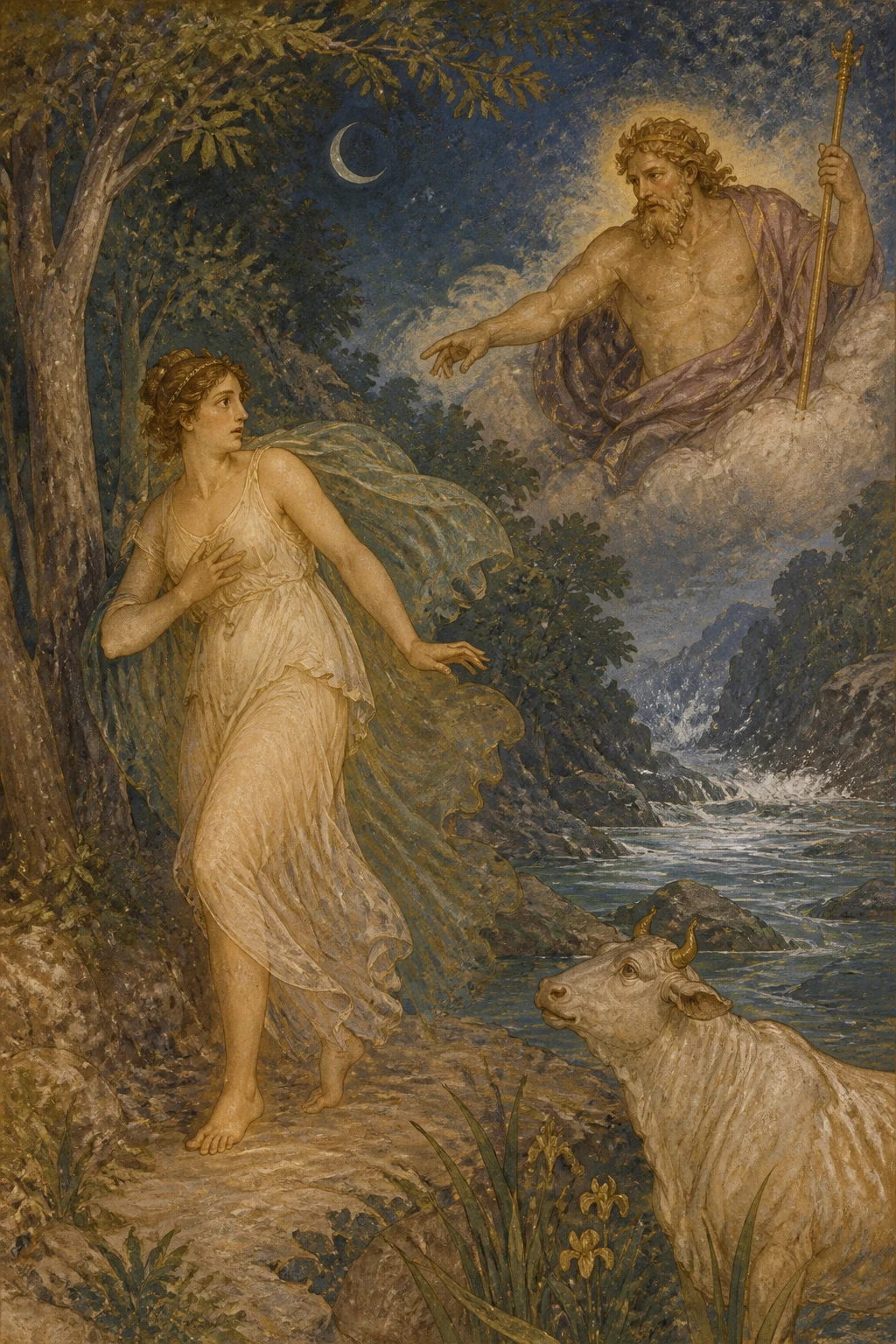
As he comes and goes about his work, his gaze rests on a maiden of Nonacris, and the fire he catches burns deep in his bones. It was not her task to soften wool by drawing it out, nor to arrange her hair in changing styles; once a clasp held her dress and a white ribbon bound her unkempt hair, with now a light javelin in her hand, now a bow, she was a soldier of Phoebe: no maiden ever trod Maenalus dearer to Trivia than she. But no favor lasts forever.
The sun stood high, beyond the middle of its course, when she entered a grove no age had ever felled. Here she slipped the quiver from her shoulder and unstrung her supple bow, then lay down on the grass-covered ground, resting her neck upon her painted quiver. When Jupiter saw her weary and unguarded, “Surely my wife will never learn of this stolen pleasure,” he said, “or, if she does, her quarrels are—oh, they are—worth the price.”
At once he assumes Diana’s face and dress and says, “Maiden, one of my companions, on what mountain ridges have you hunted?” From the turf the maiden rises. “Hail, goddess,” she says, “greater, in my judgment, than Jupiter, though he himself should hear.” He hears and laughs, delighted to be preferred to himself, and gives her kisses neither restrained enough nor such as a maiden ought to give.
As she prepares to tell him in what forest she has hunted, he stops her with an embrace, revealing himself through his crime. She fights against him with all the strength a woman can muster (if only you had seen her, daughter of Saturn: you would have been kinder!), she fights indeed: but whom could a girl overcome, and who could overcome Jupiter? Victorious, he seeks the heaven of the gods; she hates the grove, the forest that knows her secret.
As she leaves it, she almost forgets to take up her quiver and arrows, and the bow she had hung up. Now Dictynna, attended by her band, comes striding over lofty Maenalus, proud of the beasts she has slain. She sees the girl and calls her; at the call, the girl flees, fearing at first that Jupiter is hiding in her form. But when she sees the nymphs advancing beside her, she knows there is no trick and joins their company.
Alas, how hard it is not to betray a secret in one’s face! She can scarcely lift her eyes from the ground; no longer, as before, does she walk close beside the goddess, or lead the whole band, but keeps silent, her blush revealing her violated chastity; and, had Diana not been a virgin, she could have recognized the wrong by a thousand signs; the nymphs, they say, perceived it.
The moon’s horns were rising for the ninth time, when the goddess, weary from hunting in her brother’s heat, found a cool grove from which a murmuring stream flowed, rolling along its water-worn sands. She praised the spot, then touched the water’s surface with her foot; praising that too, she said, “There is no one here to watch us; let us bathe our naked bodies in the flowing water.”
The Parrhasian maiden blushed. All laid aside their clothes; she alone sought reasons to delay. As she hesitated, her dress was stripped away, and with her body bared, her secret lay revealed. As she stood stunned, trying to hide her belly with her hands, “Go far from here,” said Cynthia, “and do not defile these sacred springs,” and ordered her to leave their company.
The wife of the mighty Thunderer had long known of this and had postponed her harsh punishment until the proper time. Now there was no reason for delay: the boy Arcas had already been born to her rival, and this itself grieved Juno. As soon as she turned her savage thoughts and gaze upon her, “Of course, adulteress,” she said, “this alone remained: that you should bear a child, and through that birth make known the insult to me, and give proof of my Jupiter’s disgrace.
You shall not go unpunished: I shall strip you of that beauty that pleases you and pleases my husband, you shameless creature.” So saying, she seized the hair above her brow and flung her face down on the ground. She stretched out her arms in supplication: her arms began to bristle with black shaggy hair, her hands to curve and lengthen into hooked claws, serving as feet, while the face Jupiter had once praised grew hideous with a broad, gaping muzzle.
And lest her prayers and pleading words should soften any heart, her power of speech was taken away; an angry, threatening voice, full of terror, issued from her rasping throat. Yet even as a bear she kept her former mind, and, bearing witness to her anguish with incessant groans, she raised such hands as she now had toward heaven and the stars, feeling Jupiter’s ingratitude, though she could not speak of it.
Ah, how often, afraid to rest alone in the forest, she wandered before her house and through the fields once hers! Ah, how often the barking of hounds drove her over the rocks, and she who had hunted fled in terror from the hunters! Often, forgetting what she was, she hid at the sight of wild beasts; a bear herself, she shuddered to see bears upon the mountains and dreaded wolves, though her own father was among them.
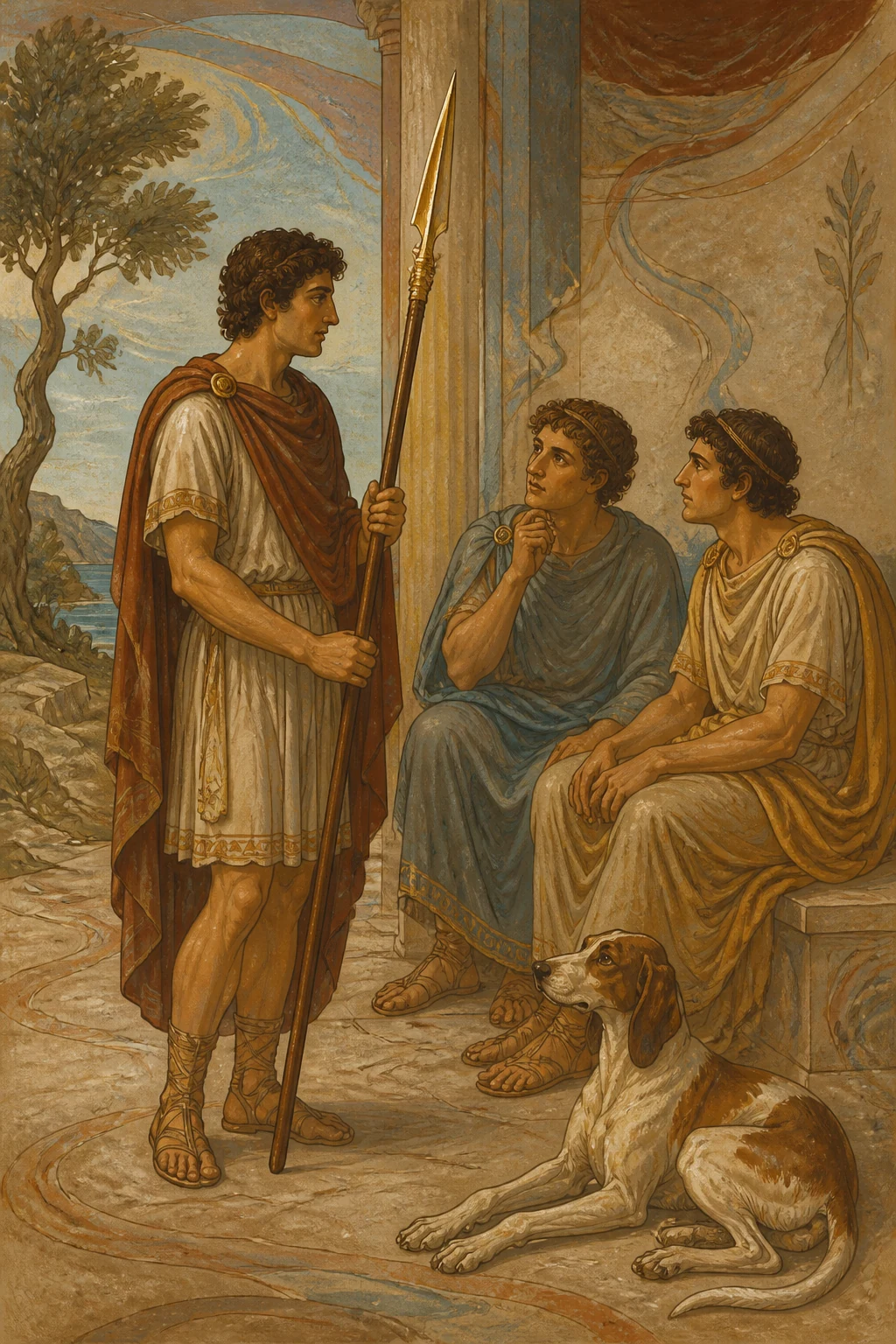
Now came Arcas, the son of Lycaon’s daughter, ignorant of his mother, nearly fifteen years old. As he pursued wild beasts, seeking suitable woodland glades and enclosing the Erymanthian forests with woven nets, he came upon his mother. At the sight of Arcas she stood still, looking as though she recognized him. He drew back, unknowing, frightened by her unwavering gaze that never left him; and as she longed to draw nearer, he was about to pierce her breast with his deadly spear.
The Almighty stopped him, removing both of them and averting the crime; then, snatching them through the void on a swift wind, he set them in heaven and made them neighboring constellations. Juno swelled with anger when her rival shone among the stars, and descended to the sea, to white-haired Tethys and aged Ocean, whose revered presence had often moved the gods. When they asked the reason for her coming, she began: “You ask why I, the queen of the gods, have left my heavenly dwelling and come here? Another holds heaven in my place.
Call me a liar if, when night has darkened the world, you do not see those stars, lately honored with a place in highest heaven—wounds to my heart—there where the circle farthest north and shortest in its course surrounds the pole. What reason, indeed, has anyone to avoid offending Juno or fear her anger, when by harming others I only help them? Oh, what I have accomplished! How vast my power is!
I forbade her to be human: she has become a goddess. Such are the punishments I inflict on the guilty; such is my mighty sovereignty. Let him restore her former shape, strip away her beastly features, as he did before for the Argive daughter of Phoroneus. Why not drive Juno out, marry her, install her in my bed, and take Lycaon for his father-in-law? But you, if this contempt for the foster-daughter you reared moves you, keep the seven stars of the Bear from your blue depths; drive away these stars, admitted to heaven as the reward for adultery, and never let that rival bathe in your pure waters.”